REVIEW 6 major objections 4 minor 21 references
UAT20: Unifying Liquidity Across Rollups
T0 review · 6 major / 4 minor · reviewed 2026-08-07 · deepseek-v4-flash
Pith's one-line read UAT20 is a proposed universal abstract token standard that makes a user's ERC20 balances across rollups behave as a single consistent global balance.
desk verdict An internally inconsistent protocol proposal: the empirical fragmentation data is useful, but the central state-update rules don't conserve balance, so the paper isn't ready for peer review. read the letter →
The pith
A machine-rendered reading of the paper's core claim, the machinery that carries it, and where it could break.
The reading
What carries the argument
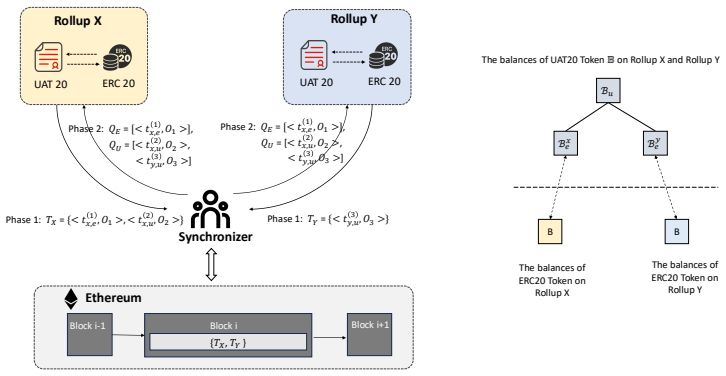
The load-bearing mechanism is a two-phase Execute-Commit protocol layered over CRDTs, with Ethereum acting as the global transaction orderer. In phase one, a UAT20 transfer only generates pending operations; in phase two, the ordered operations are committed through the functions commitE and commitU, with ERC20 transactions processed before UAT20 transactions and each queue processed in order. Rollup-specific balance deductions are resolved by a user-defined priority policy that all replicas agree on, which is what lets concurrent updates converge.
What would settle it
Deploy UAT20 on two test rollups, let two users send concurrent UAT20 transfers that together exceed the sender's balance, finalize them through Ethereum in a known order, and inspect both rollups: if the two replicas end with different balances, or if the transaction appearing earlier in the queue is the one that fails, the protocol's claimed deterministic convergence is false.
Extended reading notes
Core claim
UAT20's central claim is that combining CRDT replicas with an Ethereum-ordered two-phase commit protocol yields a token whose state is eventually consistent across all rollups while still allowing each rollup to process transfers independently. Concretely, the UAT20 balance of a user is the sum of their per-rollup ERC20 balances; transactions generate operation sets that are broadcast to Ethereum, and the commit phase applies those operations in a deterministic order, giving ERC20 transactions priority over UAT20 transactions and resolving conflicting UAT20 transfers by queue order. The paper argues this removes the need for manual bridging and lets a transfer initiated on any rollup update the user's unified balance everywhere.
Load-bearing premise
The protocol only works if every participating rollup runs a special version of the token contract that UAT20 can write to, and users move their existing tokens into it; standard ERC20 liquidity already sitting on rollups is untouched by UAT20 as described.
Editorial extensions
If this is right
- A user holding UAT20 on several rollups can transfer from any one rollup and see the balance change consistently on all others.
- Conflicting simultaneous transfers of the same UAT20 balance settle deterministically by Ethereum's ordering, so later-ordered transfers fail rather than double-spend.
- Users no longer need to bridge assets manually or rely on aggregator pre-authorizations for UAT20-compatible tokens, reducing gas and security exposure.
- The empirical finding that roughly 12 percent of analyzed rollup token transactions are liquidity-aggregation moves implies a large class of activity that UAT20 could render unnecessary.
Reading between the lines
- Editorial inference: the protocol only unifies liquidity that has been moved into UAT20-compatible contracts; the paper's empirical numbers describe existing standard ERC20 fragmentation, so the realized benefit depends on migration and adoption, not just the protocol.
- Editorial inference: by making rollup-specific balances a priority-ordered deduction policy, UAT20 effectively turns cross-rollup transfer into a deterministic multi-account balance update; the same CRDT-plus-ordering pattern could generalize to other state, such as lending positions or non-fungible ownership.
- Editorial inference: a direct testable extension is to measure convergence latency and gas overhead of the commit phase on a public testnet with adversarial concurrent transfers, since the paper does not benchmark protocol cost.
Editorial analysis
A structured set of objections, weighed in public.
Referee Report
Summary. The paper proposes UAT20, a universal abstract token standard intended to unify ERC20 balances across Ethereum rollups. The protocol combines CRDTs with a two-phase Execute-Commit protocol in which Ethereum orders transactions from all rollups and a synchronizer distributes the order; per-rollup Σ20 and Υ20 contracts update aggregated and rollup-specific balances. The paper also reports an empirical study of token transfers on Arbitrum, Optimism, and ZKsync to motivate the problem. The central claims are eventual consistency across rollups and seamless, secure unification of liquidity.
Significance. If the protocol were fully specified and correct, it would address a real pain point in the multi-rollup ecosystem. The empirical dataset is a useful descriptive contribution, and the use of Ethereum as an ordering service is a plausible way to turn concurrent CRDT updates into a total order. However, the manuscript does not provide the formal machinery needed to substantiate its consistency claims, and the central state-update rule as written contains accounting errors that break balance conservation and the stated invariant. The compatibility requirement is also contradicted by the design. These are load-bearing defects, not presentational issues.
major comments (6)
- [§II-C (Definition 1, Definition 2)] Definition 1 defines B_i^e as the balance of ERC20 token held by each user on R_i, i.e., the same mapping as the Σ20 balance B of Definition 2. In the Σ20 transfer example, the execution phase already updates B[C] and B[A] on RX, and the operation set O1 contains SUB(B_i^e[C],10) and ADD(B_i^e[A],10). The commit phase then says that 'Υ20 on each rollup updates both B_u and B_i^e balances' and afterwards 'these updates ... will be synchronized to the balance of Σ20 (B) on RX and RY by calling Σ20.transfer'. If B_i^e and Σ20.B denote the same ledger, the 10-unit debit is applied twice; if they are different ledgers, the semantics of the second call (overwrite vs. transfer) is never specified. Under either reading the invariant B_u[C] = sum_i B_i^e[C] is not maintained. The example then continues as if Bx_e[C] were still 40 after t1, although a committed O1 would make it 30 (or 20 if applied twice).
- [§II-C (UAT20 transfer example)] The description of t^{(2)}_{x,u} violates conservation. The operation set O2 is SUB(B_u[C],50), ADD(B_u[A],50), and the commit step deducts 40 from Bx_e[C] and 10 from By_e[C]. But it then increases Bx_e[A] by 40 and By_e[A] by 40. This gives A a net credit of 80 UAT20 while C is debited only 50, and B_u[A] was only increased by 50. The error is internal to the example and cannot be attributed to deployment assumptions.
- [§II-A vs. §II-C] The compatibility requirement in §II-A says UAT20 should 'minimally impact both the original rollup design and the underlying ERC20 token (Σ20) design'. However, Definition 2 changes Σ20 so that transfer and approve functions invoke Fe to emit UAT20 operations and F can be called by Fc to modify B during the commit phase. This is a modified token contract, not standard ERC20. Users with existing balances in standard ERC20 contracts would have to migrate to this new contract on every rollup before UAT20 can 'unify' them. The paper never acknowledges this migration constraint, and it contradicts the stated compatibility goal and the empirical section's framing that UAT20 addresses the currently fragmented standard-token liquidity.
- [§II-A, §II-B] Although the paper invokes CRDTs as the foundation of consistency, no concrete CRDT is defined. The text mentions 'merge functions that reconcile concurrent updates' but neither specifies the merge operation nor proves that the two-phase Execute-Commit protocol yields convergence. There is also no failure or liveness model: the synchronizer's behavior under crash, Byzantine, or reorg conditions is not analyzed, and no argument is given that valid transactions eventually commit. The eventual consistency claim in the abstract and requirements list is therefore asserted, not established.
- [Abstract and Introduction vs. rest of paper] The abstract and introduction promise 'secure' liquidity unification 'without introducing security risks', but the manuscript contains no security analysis: no adversarial model, no trust assumptions about the synchronizer, no treatment of replay attacks, ordering manipulation by Ethereum block proposers, or cross-rollup double-spend. The security claim is load-bearing and is left completely unsupported.
- [§III] The empirical study cannot support the 'effectiveness' claim. The identification of a 'liquidity unification behavior' requires a transfer-out within two hours after a transfer-in on another rollup, but the two-hour threshold is arbitrary and no sensitivity analysis is reported. The observed 12.37% share of bridge-like transactions is descriptive; it does not measure what share of that activity UAT20 would actually eliminate, nor does it quantify gas or latency savings. At most the study motivates the problem, not the solution.
minor comments (4)
- [§II-C] There are typographical errors: 'tranfer' should be 'transfer', and '∓20' should be 'Υ20' in the UAT20 transfer example.
- [§II-C, Definition 2] The term 'E-Token' is used in Definition 2 without being introduced; the surrounding text refers to the token as Σ20, so the definition should be aligned with the notation used elsewhere.
- [§II-B example] The example says user C has 100 UAT20 composed of 40 ERC20 tokens on RX and '60 ERC20 tokens on RX', which should presumably be 'on RY'.
- [Figure 1] The figure labels are hard to parse: the same symbol B is used for both the UAT20 aggregated balance and the ERC20 balance, and the labels 'Bex' and 'Bey' are not defined in the text.
Circularity Check
No significant circularity: the paper's consistency/unification claim rests on an asserted commit protocol and CRDT citation, not on fitted parameters or self-citation; the global-balance identity is definitional, not a derived prediction.
full rationale
UAT20's central derivation chain is not circular. The protocol introduces a two-phase Execute-Commit design with Ethereum ordering; eventual consistency is asserted by invoking CRDT properties from external references [18], [19], and no load-bearing premise is justified by a self-citation or by an author-imported uniqueness theorem. Definition 1 sets Bu[C] = sum_i B_i_e[C], but this is a definition of the aggregated balance, not a claimed result derived from it; the paper's actual contribution is the claim that the commit protocol can maintain that aggregate while resolving conflicts, and that claim is asserted rather than formally proved. That omitted proof is a soundness/completeness gap, not a circular reduction. The empirical section uses external BigQuery and ZKsync Explorer data with a stated heuristic to measure fragmentation; it fits no parameter that is later renamed as a prediction. The accounting inconsistency noted in the skeptic brief (applying a Sigma20 transfer during execution and again during synchronization, and crediting A with 80 tokens for a 50-token transfer) is an internal correctness problem in the state-update rule, but it does not make any claimed derivation equivalent to its inputs. With no fitted-input prediction, no self-citation chain, and no definitional equivalence carrying the central claim, the circularity score is 0.
Assumptions & free parameters
free parameters (1)
- two-hour lookback window =
120 minutes
assumptions (5)
- domain assumption CRDT convergence: a state-based CRDT converges to the same state when all replicas merge the same set of updates.
- domain assumption Ethereum L1 provides a trusted, available total order for token transactions and rollups can always synchronize that order.
- ad hoc to paper Per-rollup ERC20 contracts can be upgraded or replaced with UAT20-compatible Σ20 contracts that allow the UAT20 commit phase to modify local balances.
- domain assumption The synchronizer is honest and available.
- domain assumption The operation sets generated by Σ20 and Υ20 transfers can be applied as commutative or order-resolved CRDT operations on every rollup.
invented entities (2)
-
UAT20 Token (Υ20)
-
Synchronizer
Cite this review
Pith. "Pith review of UAT20: Unifying Liquidity Across Rollups." pith.science (2026). https://pith.science/paper/6SZJFKPW
@misc{pith2026250208919,
  author       = {Pith},
  title        = {Pith review of: UAT20: Unifying Liquidity Across Rollups},
  year         = {2026},
  howpublished = {\url{https://pith.science/paper/6SZJFKPW}},
  note         = {Machine review of arXiv:2502.08919}
}
read the original abstract
Ethereum has been a cornerstone of the decentralized ecosystem, with rollup-based scaling solutions like Arbitrum and Optimism significantly expanding its capabilities. These rollups enhance scalability and foster innovation, but their rapid proliferation has introduced \emph{liquidity fragmentation}. Specifically, tokens distributed on multiple rollups fragment the liquidity of users, complicating participation in trading and lending activities bound by minimum liquidity thresholds. This paper proposes UAT20, a universal abstract token standard, to address liquidity fragmentation across rollups. Leveraging Conflict-free Replicated Data Types (CRDTs), UAT20 ensures consistent states across multiple rollups. We introduce a two-phase commit protocol to resolve transaction conflicts, enabling seamless and secure liquidity unification. Finally, our empirical analysis demonstrated the necessity and effectiveness of UAT20 in mitigating liquidity fragmentation within Rollups.
Figures

Reference graph
Works this paper leans on
-
[1]
Ethereum: A secure decentralised generalised transaction ledger,
G. Wood, “Ethereum: A secure decentralised generalised transaction ledger,” Ethereum Project Yellow Paper, vol. 151, 2014
work page 2014
-
[2]
Arbitrum: Scalable, private smart contracts,
H. Kalodner, S. Goldfeder, X. Chen, S. M. Weinberg, and E. W. Felten, “Arbitrum: Scalable, private smart contracts,” in 27th USENIX Security Symposium (USENIX Security 18) , 2018, pp. 1353–1370
work page 2018
-
[3]
Optimistic and validity rollups: Analysis and comparison between optimism and starknet,
L. Donno, “Optimistic and validity rollups: Analysis and comparison between optimism and starknet,” arXiv preprint arXiv:2210.16610 , 2022
arXiv 2022
-
[4]
Scroll is the leading zero-knowledge rollup. scaling ethereum for good
“Scroll is the leading zero-knowledge rollup. scaling ethereum for good.” https://scroll.io/, 2022
work page 2022
-
[5]
Zksync is an ever expanding verifiable blockchain network, secured by math,
“Zksync is an ever expanding verifiable blockchain network, secured by math,” https://zksync.io/, 2022
work page 2022
-
[6]
The superchain ecosystem platform accelerates the adoption and de- velopment of the op stack
“The superchain ecosystem platform accelerates the adoption and de- velopment of the op stack.” https://www.superchain.eco/, 2023
work page 2023
-
[7]
Liquidity fragmentation on decentralized exchanges,
A. Lehar, C. Parlour, and M. Zoican, “Liquidity fragmentation on decentralized exchanges,” arXiv preprint arXiv:2307.13772 , 2023
arXiv 2023
-
[8]
Hop: Send tokens across rollups,
C. Whinfrey, “Hop: Send tokens across rollups,” 2021
work page 2021
Show all 21 references
-
[9]
zkbridge: Trustless cross-chain bridges made practical,
T. Xie, J. Zhang, Z. Cheng, F. Zhang, Y . Zhang, Y . Jia, D. Boneh, and D. Song, “zkbridge: Trustless cross-chain bridges made practical,” in Proceedings of the 2022 ACM SIGSAC Conference on Computer and Communications Security, 2022, pp. 3003–3017
2022
-
[10]
Horizon: A gas- efficient, trustless bridge for cross-chain transactions,
R. Lan, G. Upadhyaya, S. Tse, and M. Zamani, “Horizon: A gas- efficient, trustless bridge for cross-chain transactions,” arXiv preprint arXiv:2101.06000, 2021
2021 arXiv
-
[11]
Zetachain: the future of multichain
“Zetachain: the future of multichain.” 2022. [Online]. Available: https://www.zetachain.com/
2022
-
[12]
Native cross chain swaps
“Native cross chain swaps.” 2021. [Online]. Available: https://chainflip. io/
2021
-
[13]
Interlay:use your bitcoin. anywhere
“Interlay:use your bitcoin. anywhere.” 2021. [Online]. Available: https://interlay.io/
2021
-
[14]
Sok: Security and privacy of blockchain interoperability,
A. Augusto, R. Belchior, M. Correia, A. Vasconcelos, L. Zhang, and T. Hardjono, “Sok: Security and privacy of blockchain interoperability,” in 2024 IEEE Symposium on Security and Privacy (SP) . IEEE, 2024, pp. 3840–3865
2024
-
[15]
1inch network offers a defi ecosystem with products like 1inch dapp, wallet, developer portal, portfolio, and fusion for secure web3 opera- tions
“1inch network offers a defi ecosystem with products like 1inch dapp, wallet, developer portal, portfolio, and fusion for secure web3 opera- tions.” https://1inch.io/, 2023
2023
-
[16]
Swoop exchange: A decentralized exchange aggregator,
“Swoop exchange: A decentralized exchange aggregator,” https:// swoopexchange.com, 2024
2024
-
[17]
Matcha: A decentralized exchange aggregator,
“Matcha: A decentralized exchange aggregator,” https://matcha.xyz, 2024
2024
-
[18]
Conflict-free replicated data types (crdts),
N. Preguiça, C. Baquero, and M. Shapiro, “Conflict-free replicated data types (crdts),” arXiv preprint arXiv:1805.06358 , 2018
2018 arXiv
-
[19]
Efficient syn- chronization of state-based crdts,
V . Enes, P. S. Almeida, C. Baquero, and J. Leitão, “Efficient syn- chronization of state-based crdts,” in 2019 IEEE 35th International Conference on Data Engineering (ICDE) . IEEE, 2019, pp. 148–159
2019
-
[20]
Google bigquery: Serverless, highly scalable, and cost-effective multi- cloud data warehouse,
“Google bigquery: Serverless, highly scalable, and cost-effective multi- cloud data warehouse,” https://cloud.google.com/bigquery, 2024
2024
-
[21]
Zksync block explorer api
“Zksync block explorer api.” 2021. [Online]. Available: https: //docs.zksync.io/zksync-era/tooling/block-explorers
2021
Reviewed August 7, 2026 · model on record in the stance chip above.
Discussion (0). Continue with ORCID to comment.