REVIEW 4 major objections 7 minor 72 references
The Effect of Rotation on Triggering S Doradus Instabilities in Luminous Blue Variables
T0 review · 4 major / 7 minor · reviewed 2026-08-07 · deepseek-v4-flash
Pith's one-line read Rotation makes luminous blue variables hit their modified Eddington limit at the equator first, triggering S Dor eruptions at higher effective temperatures and shaping disk-like outflows.
desk verdict First explicit rotating-star MEL trigger criterion with testable equator/pole predictions, but the numerical thresholds have a factor-of-two inconsistency that needs fixing. read the letter →
The pith
A machine-rendered reading of the paper's core claim, the machinery that carries it, and where it could break.
The reading
What carries the argument
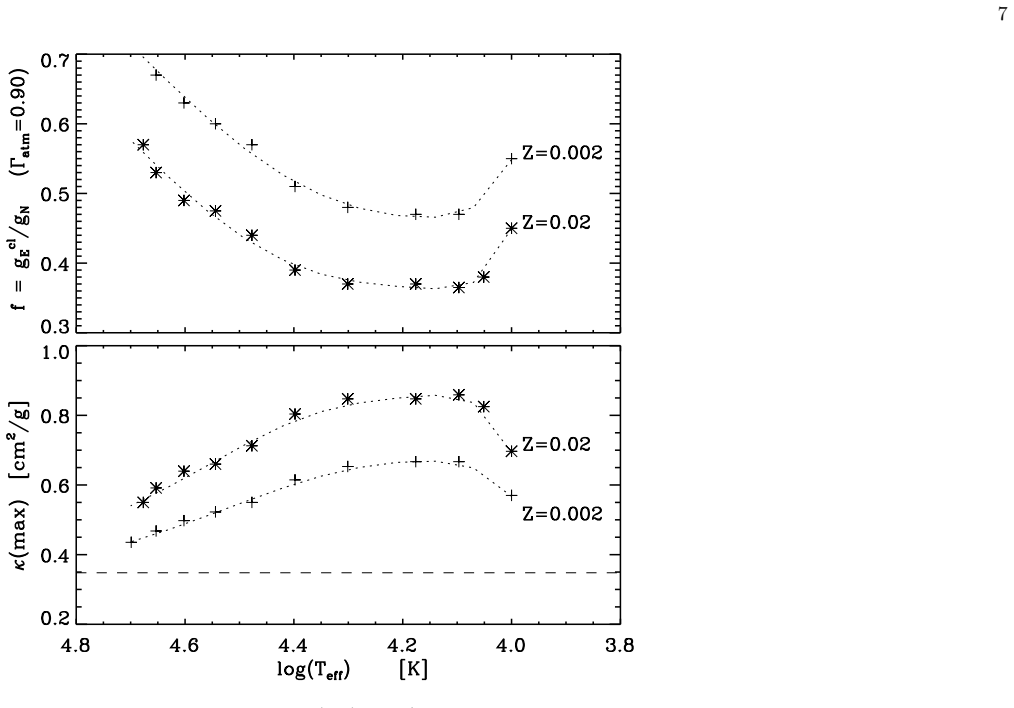
The load-bearing object is the rotationally modified Eddington criterion, Equation (24): $(L/M)_{\mathrm{crit,eq}} = 1.17\times10^4\,\Psi(\omega)/\kappa_{\max}(T_{\mathrm{eq}})$. It combines three pieces: the adopted instability threshold $\Gamma_{\mathrm{mod}}=0.9$ (effective gravity reduced to ten percent of Newtonian gravity), the von Zeipel gravity-darkening law that makes the equator cooler than the poles, and the opacity peak $\kappa_{\max}(T_{\mathrm{eff}})$, which rises toward roughly 12000 K so a cooler equator experiences stronger radiation pressure. The ratio $\Psi(\omega)$ encodes how much of the total luminosity is emitted from the polar caps of a distorted rotating star. Together these imply that the equator hits the instability first and that faster rotation shifts the trigger to higher effective temperatures.
What would settle it
A direct test is to gather a sample of post-main-sequence LBVs with measured $v\sin i$ and high-cadence S Dor light curves: the claim predicts that for matched $L/M$, faster rotators enter eruption at higher effective temperatures, and that equatorial disk-like nebulae appear preferentially around fast rotators. A cleaner single observation would be spectropolarimetry of an LBV beginning an S Dor eruption, since the mechanism predicts the equatorial wind turns on before the polar wind.
Extended reading notes
Core claim
On the paper's own terms, the central claim is that the modified Eddington limit of a rotating post-main-sequence luminous blue variable is set by the equator rather than by the mean stellar surface. The instability criterion becomes $(L/M)_{\mathrm{crit,eq}} = 1.17\times10^4\,\Psi(\omega)/\kappa_{\max}(T_{\mathrm{eq}})$, where $\Psi(\omega)=L_{\mathrm{tot}}/L_{\mathrm{p}}$ measures how rotation redistributes luminosity toward the poles and $\kappa_{\max}(T_{\mathrm{eq}})$ is the maximum photospheric opacity at the cooler equatorial temperature. Since $\kappa_{\max}$ grows as the effective temperature falls, rotation makes the equatorial atmosphere reach $\Gamma_{\mathrm{mod}}=0.9$ at a higher effective temperature and at a lower $L/M$ than a non-rotator would need. In the numerical grid built from Geneva evolutionary tracks, most LBVs are unstable at both poles and equator, while lower-mass and slower-rotating cases are stable or equator-only; the models reproduce observed equatorial rings and bipolar nebulae.
Load-bearing premise
The quantitative trigger rests on the adopted threshold from Ulmer and Fitzpatrick: an atmosphere is unstable when radiation pressure reduces effective gravity to ten percent of Newtonian gravity; if the true threshold differs, the temperatures and $L/M$ values at which S Dor eruptions start shift, even though the equator-first ordering from rotation may survive.
Editorial extensions
If this is right
- At fixed $L/M$, a faster rotating LBV reaches the modified Eddington limit at a higher effective temperature than a non-rotator, so rotation broadens the S Dor strip in the Hertzsprung-Russell diagram.
- The equatorial instability is triggered before the polar one; at low $\omega$ the equator's instability spreads over the full surface, while at high $\omega$ it can remain equator-only and launch a disk or ring.
- Most Galactic models with $M_i > 40\,M_\odot$ are unstable at both poles and equator even without rotation, whereas $32$ to $40\,M_\odot$ stars need rotation ($\omega \gtrsim 0.6$) to become unstable.
- The predicted mass-loss geometry, with a dense slow equatorial wind and a faster polar wind, matches the bipolar nebulae of AG Car and HR Car and the equatorial disks inferred for R127 and SN 2009ip.
- Lower-metallicity SMC models are more stable than Galactic ones because their post-main-sequence masses are higher and their opacities lower, implying that the incidence of LBV instability should depend on metallicity.
Reading between the lines
- If the equator-first trigger holds, high-resolution spectropolarimetry of an LBV at the start of an S Dor eruption should catch the equatorial wind turning on before the polar wind, a signature this paper does not test directly.
- The same rotation-modified Eddington logic should apply to other opacity-driven instabilities in massive stars, such as the Humphreys-Davidson limit, potentially shifting the predicted red supergiant upper luminosity boundary for rotating stars.
- A testable extension is to compare $v\sin i$ measurements across a large LBV sample with nebular morphology: this mechanism predicts a positive correlation between rotation rate and the presence of equatorial disk or ring features.
- The analysis assumes latitude-independent rotation, so differential rotation or magnetic coupling could change the quantitative thresholds; the equator-first ordering itself likely survives because it only requires $T_{\mathrm{eq}} < T_{\mathrm{p}}$.
Signed reviews
Editorial analysis
A structured set of objections, weighed in public.
Referee Report
Summary. The paper studies how stellar rotation modifies the Modified Eddington Limit (MEL) criterion that is believed to trigger S Doradus-type instabilities in Luminous Blue Variables (LBVs). Adopting the Ulmer & Fitzpatrick (1998) threshold that a non-rotating atmosphere becomes unstable when radiation pressure reduces the effective gravity to 10% of Newtonian gravity (Γ_mod = 0.9), the authors extend the criterion to rotating stars. They derive closed-form expressions for the critical L/M ratio at the equator (Eq. 24) and at the pole (Eq. 25), incorporating the von Zeipel gravity-darkening law, the centrifugal term, and the rotation-dependent surface and luminosity factors Ψ(ω). They apply these criteria to model LBVs built from Geneva evolutionary tracks at Z = 0.014 and Z = 0.002, computing instability flags at ω = 0, 0.3, 0.6, and 0.9 (Table 3), polar and equatorial temperatures and escape speeds, and wind speed ratios. The central claims are that rotation lowers the critical L/M and raises the triggering T_mean at fixed L/M, that the equator becomes unstable before the poles, that rotation broadens the S Dor strip, that most model LBVs are unstable even without rotation, and that the equator/pole asymmetry predicts equatorial disk or ring morphologies and faster polar outflows, which the authors compare with observations of AG Car, HR Car, R127, SN 2009ip, and HD 160529. The paper is explicit about its simplifying assumptions, which are listed in Section 7.
Significance. If the derived criterion is correct, the paper supplies a compact, falsifiable framework for the role of rotation in LBV variability: the equator-first instability ordering, the Ψ(ω)-dependent threshold, and the prediction that rotation broadens the S Dor strip all translate directly into observational programs (rotation-rate surveys, nebular imaging, metallicity-dependent LBV demographics). The analytic derivation is transparent, and the explicit power-law fits in Appendix A make the thresholds in Figures 9–10 and the flags in Table 3 directly reproducible from the text. I also credit the authors for candidly listing their assumptions and for acknowledging, in Section 5.3, that the Table 3 models are selected on the S Dor strip so that most unstable flags are unsurprising. The strongest quantitative content is in Eqs. 24–26 and Figures 9–10; these are also where the manuscript needs the most work, because the rotating-star trigger convention is stated ambiguously (Major Comment 1). The observational comparison is suggestive rather than decisive, but the paper does not oversell the individual nebular matches.
major comments (4)
- [§4.2, Eq. 22; §7, assumption (a)] The paper's rotating-star trigger criterion is internally ambiguous, and the two self-consistent readings differ by up to a factor of about 2 at the rotation rates used in Table 3. For ω = 0 the criterion is g_rad = 0.9 g_N (Eq. 4), i.e., g_N − g_rad = 0.1 g_N. Assumption (a) in Section 7 states that for rotating stars the trigger occurs when "the effective surface gravity is reduced by rotation and radiation pressure to only 10% of the Newtonian gravity," which reads as g_N − Ω²R_eq − g_rad = 0.1 g_N, i.e., g_rad = (0.9 − ω²) g_N. Equation 22 instead sets g_rad = 0.9 g_N (1 − ω²) = 0.9 g_rot, which is the criterion that results if Γ_mod is defined with the rotation-reduced gravity in the denominator, as in the usual ΩΓ-limit treatment. The two conventions agree only at ω = 0; at ω = 0.9 the required g_rad differs by the factor (0.9 − ω²)/[0.9(1 − ω²)] ≈ 0.53, and Eq. 24 changes by the same factor. The paper must adopt one convention explicitly. If the intended convention is the margin relative to Newtonian gravity, Eqs. 22–24 and Figures 9–10 must be recomputed; several borderline cases in Table 3 change (e.g., the Z = 0.014, M_i = 32 M_sun non-rotating model at ω = 0.6, with log(L/M) = 4.021 versus a threshold of log ≈ 4.04, flips from N to Y_eq, and the lone pole-only model at ω = 0.9 becomes unstable at both poles and equator). If, instead, the intended convention is Γ_mod = g_rad/g_rot = 0.9, then Eq. 22 can stand but the wording of Section 4 ("10% of the gravity") and of assumption (a) must be corrected, and the paper should justify why the UF98 non-rotating calibration carries over to that ratio. The qualitative conclusions (equator-first, strip broadening) survive under either reading, but the quantitative thresholds are not uniquely determined as written.
- [§5.1–5.3, Table 3; Abstract] The abstract's claim that the numerical models "confirm that most LBVs should be unstable at both the equator and the poles" is stronger than the model construction can support. The parameters in Table 3 are chosen at the first post-MS crossing of the observed S Dor strip (Section 5.1), and the UF98 instability criterion is calibrated to that same observed strip, so the ω = 0 flags are close to tautological. The authors acknowledge this in Section 5.3, noting that it is "not surprising" that most models are unstable; I weigh that admission in their favor. The genuine content of Table 3 is the differential, rotation-dependent behavior: which models change stability flags between ω = 0 and ω = 0.9, the equator-versus-pole ordering, and the inferred disk/bipolar classification. I recommend that the abstract, Section 6, and Section 7 be repositioned around these differential predictions rather than around the fraction of unstable models, which is built in by construction.
- [§3.2, Eqs. 6–8 and 24–26] The opacity function κ_max(T_eff) is taken from UF98 models that individually reach Γ_mod = 0.9 at their respective log g. When Eqs. 24–26 are applied to the equator of a rotating star, the local atmosphere at the trigger satisfies a different radiation-pressure condition (g_rad/g_N = 0.9(1 − ω²) or (0.9 − ω²), depending on the convention chosen in Major Comment 1) and has a local effective gravity lower than the polar value, so the same κ_max(T) curve is being used outside the conditions under which it was computed. In addition, several equatorial temperatures in Table 3 fall below the 10,000 K lower bound of the fitted f(T_eff) in Eq. A1 (notably T_eq = 8,870 K for the Z = 0.014, M_i = 32 M_sun model at ω = 0.9), so those stability flags rest on extrapolated opacity. Since the threshold values in Figures 9–10 and the flags in Table 3 are the paper's main quantitative output, I ask for a quantitative sensitivity estimate, or an explicit bounding statement, for the effect of the log g dependence and of the extrapolation.
- [§2.2, Table 2, §5.2] The adopted present-day rotation rates ω = 0.6 and 0.9 are not reached by the evolutionary tracks used to select the models: Table 2 gives ω ≤ 0.065 at the TAMS for the Z = 0.014 models and ω ≤ 0.465 for Z = 0.002, and Section 4.2 shows that ω decreases as the star expands (ω ∝ T_eff). The high-ω columns of Table 3 are therefore a parameter study, not an evolutionary prediction; they are observationally motivated by fast rotators such as AG Car and HR Car, but those cases require a spin-up channel (merger or anisotropic mass loss, Section 2.2) that is not modeled. The paper should state this distinction explicitly, and the quantitative predictions at ω = 0.6–0.9 (including the disk/bipolar morphology claims) should be flagged as contingent on the assumed spin-up mechanism.
minor comments (7)
- [Table 3, Z=0.014 no-rot, M_i=60] The entry v_esc(eq) = 1689 km s⁻¹ for the ω = 0.9 row is inconsistent with v_esc(p) = 223 km s⁻¹ and with the listed v∞(p)/v∞(eq) = 2.64; the stated bistability factors (2.6 and 1.3) imply v_esc(eq) ≈ 169 km s⁻¹, so this appears to be a typographical error.
- [Table 3, v∞(p)/v∞(eq) column] The v∞(p)/v∞(eq) column should be checked against the stated 2.6/1.3/0.7 bistability factors; for example, the Z = 0.014 no-rot, M_i = 32 M_sun, ω = 0.9 row (T_p ≈ 15,900 K, T_eq ≈ 8,870 K) should yield a ratio of about 4.0 (factors 1.3 and 0.7), not the listed 1.97.
- [§4.2, Eqs. 22–26] The equations mix masses: ω is defined via Ω_crit with the effective mass M_eff (Eq. 11), while the trigger criteria use the full mass M (with electron scattering folded into κ_max, per the footnote to Eq. 3); a sentence explaining the intended use of M versus M_eff would remove ambiguity.
- [§5.2, Table 3] State explicitly which model rows rely on the f(T_eff) polynomial outside its fitted range of 10,000–60,000 K (Eq. A1), and give the associated uncertainty for those stability flags.
- [Abstract and §6] The abstract's phrase "dense equatorial disks or rings and high-velocity bipolar outflows" states as a model output what the paper actually infers from instability flags and v∞ ratios without a mass-loss or hydrodynamical calculation; suggest softening the wording.
- [Throughout] Typos and minor defects: "corresond" (Section 6), "occurence" (Section 7), "instabiltiy" (Section 5.2), "criterium" (throughout), a stray "1" after Eq. 3, and broken spacing in Table 3 entries such as "30 7" and "319 31 9".
- [§3.1, Eq. 4] The sensitivity of the results to the adopted threshold Y_max = 0.9 is not discussed; since (L/M)_crit scales linearly with Y_max, a one-line statement (e.g., Y_max = 0.8 shifts the curves in Fig. 9 by about 0.05 dex) would help the reader judge the robustness of Table 3.
Circularity Check
Rotation-dependent threshold is genuinely derived; the 'most LBVs unstable' result is partly built into the strip-based model selection.
-
fitted input called prediction
[Section 5.1 (model selection) and Section 5.3, final paragraph]
"We realize that the stellar parameters of the models in Table 3 were chosen in such a way that they are, by definition, at or very close to the S Dor strip. Therefore it is not surprising to find that most models are unstable at their equator even at small values of omega."
The model LBVs' L, M, and Tmean are not drawn from an independent grid; they are adopted at the point where Geneva tracks 'first cross the S Dor instability strip' (Section 5.1). The S Dor strip is independently identified as the locus where Gamma_mod is approximately 0.8-0.9 (Section 3.1, UF98 calibration), and the instability criterion in Eqs. 4 and 24 is the same Gamma_mod = 0.9 condition. Placing models on the Gamma_mod ~ 0.9 strip therefore almost guarantees they satisfy the Gamma_mod = 0.9 instability criterion. The authors concede this explicitly.
full rationale
The rotation-dependent core of the paper is not circular. Equations 22-26 combine the adopted UF98 threshold with the von Zeipel gravity-darkening relation (Eq. 17) and the total-to-polar luminosity ratio Psi(omega) (Eq. 15) to derive a critical L/M that scales as Psi(omega)/kappa_max(T). The equator-first ordering and the broadening of the instability strip with omega follow from Teq < Tp and kappa_max(Teq) > kappa_max(Tp), not from the threshold itself. The UF98 Gamma_mod = 0.9 trigger is an external calibration, and the paper is explicit that it is adopted rather than derived. The one partially circular element is the numerical 'confirmation' that most LBV models are unstable: the models' parameters are chosen where Geneva tracks first cross the S Dor strip (Section 5.1), which is the same Gamma_mod ~ 0.9 locus used to calibrate the criterion; the authors acknowledge this in Section 5.3. That makes the abstract's 'confirm that most LBVs should be unstable' partly a selection effect, but it does not infect the rotation-dependent predictions, which have independent content. The skeptic's Eq. 22 concern is a consistency issue rather than a circularity: applying the 0.9 factor to the rotation-reduced gravity instead of to Newtonian gravity as stated in Section 7(a) shifts the quantitative thresholds (by up to a factor ~0.53 at omega = 0.9) and can change individual Table 3 flags, but this is an internal inconsistency, not a reduction of the output to the input. No load-bearing self-citations or imported uniqueness theorems are present.
Assumptions & free parameters
free parameters (2)
- Ymax = 0.9 instability threshold =
0.9
- Power-law fit coefficients in Eqs. A1-A4 =
Coefficients listed in Appendix A
assumptions (7)
- domain assumption The S Dor instability is triggered when the effective surface gravity is reduced to 10 percent of Newtonian gravity, Gamma_mod = 0.9 (UF98).
- domain assumption The atmosphere's radiation pressure is set by the maximum Rosseland mean opacity kappa_max in 10^-2 < tau < 10^3, computed from LTE ATLAS9 model atmospheres by UF98.
- standard math Von Zeipel's theorem: the local radiative flux is proportional to the local effective gravity (F proportional to g_eff).
- domain assumption Rotation is rigid: Omega is independent of latitude, and the stellar shape is described by the Roche model with sub-photospheric opacity equal to electron scattering.
- domain assumption During post-main-sequence expansion at nearly constant mass, the envelope conserves angular momentum, so Omega scales as R^-2 and omega scales as R^-1/2.
- domain assumption Wind terminal velocity scales with local escape velocity, with empirical bistability ratios v_infinity/v_esc = 2.6, 1.3, and 0.7 depending on Teff.
- domain assumption The total luminosity and surface-averaged mean temperature Tmean from Geneva evolutionary tracks characterize the star independent of rotational distortion; the polar radius is derived from L, Tmean, and surface area.
Cite this review
Pith. "Pith review of The Effect of Rotation on Triggering S Doradus Instabilities in Luminous Blue Variables." pith.science (2026). https://pith.science/paper/V5ZYUFCZ
@misc{pith2026250209504,
  author       = {Pith},
  title        = {Pith review of: The Effect of Rotation on Triggering S Doradus Instabilities in Luminous Blue Variables},
  year         = {2026},
  howpublished = {\url{https://pith.science/paper/V5ZYUFCZ}},
  note         = {Machine review of arXiv:2502.09504}
}
read the original abstract
Luminous blue variables are an intermediate stage in the evolution of high-mass stars characterized by extreme mass loss and substantial variability. The stars show large irregular episodic variations on timescales of years to decades in these stars' effective temperatures (called "S Dor variations"). Observations show that these variations are triggered when the stars are in a well-defined strip in the HRD that corresponds to the Modified Eddington Limit, where the atmospheric radiation pressure almost balances gravity. In this work we consider the role that rotation plays in the instability that leads to the triggering of S Dor variations in luminous post-main sequence LBVs. We adopt the existing instability criterion that the effective surface gravity is reduced to 10% of the Newtonian gravity due to radiation pressure in the atmosphere of non-rotating stars. We then specifically describe how rotation impacts this instability. By carrying out numerical simulations of model LBVs at both solar and sub-solar metallicities, we confirm that most LBVs should be unstable at both the equator and the poles, and that rotation exacerbates this effect; some models also produce enhanced mass loss at the pole or equator. Our numerical models also predict dense equatorial disks or rings and high-velocity bipolar outflows, in agreement with existing observations of LBV circumstellar nebulae.
Figures


Figures from the paper (10 more)


Reference graph
Works this paper leans on
-
[1]
Aadland, E., Massey, P., Neugent, K. F., & Drout, M. R. 2018, AJ, 156, 294, doi: 10.3847/1538-3881/aaeb96
-
[2]
1986, in Luminous Stars and Associations in Galaxies, ed
Appenzeller, I. 1986, in Luminous Stars and Associations in Galaxies, ed. C. W. H. De Loore, A. J. Willis, & P. Laskarides, Vol. 116, 139–148
work page 1986
-
[3]
1989, in Astrophysics and Space Science
Appenzeller, I. 1989, in Astrophysics and Space Science
work page 1989
-
[4]
The stability of late-type stars close to the Eddington limit
Asplund, M. 1998, A&A, 330, 641, doi: 10.48550/arXiv.astro-ph/9710158
work page Pith review arXiv doi:10.48550/arxiv.astro-ph/9710158 1998
-
[5]
Bodensteiner, J., Sana, H., Dufton, P. L., et al. 2023, A&A, 680, A32, doi: 10.1051/0004-6361/202345950
-
[6]
Burggraf, B., Weis, K., Bomans, D. J., et al. 2015, A&A, 581, A12, doi: 10.1051/0004-6361/201323308
-
[7]
Clark, J. S., & Negueruela, I. 2004, A&A, 413, L15, doi: 10.1051/0004-6361:20031700
-
[8]
Crowther, P. A. 1997, in Astronomical Society of the Pacific Conference Series, Vol. 120, Luminous Blue Variables: Massive Stars in Transition, ed. A. Nota & H. Lamers, 51
work page 1997
Show all 72 references
-
[9]
1987, ApJ, 317, 760, doi: 10.1086/165324 —
Davidson, K. 1987, ApJ, 317, 760, doi: 10.1086/165324 —. 2020, Galaxies, 8, 10, doi: 10.3390/galaxies8010010
1987 doi
- [10]
-
[11]
D., & Vink, J
Davies, B., Oudmaijer, R. D., & Vink, J. S. 2005, A&A, 439, 1107, doi: 10.1051/0004-6361:20052781 de Koter, A., Lamers, H. J. G. L. M., & Schmutz, W. 1996, A&A, 306, 501
2005 doi
-
[12]
Z., Levesque, E
Dorn-Wallenstein, T. Z., Levesque, E. M., Neugent, K. F., et al. 2020, ApJ, 902, 24, doi: 10.3847/1538-4357/abb318
2020 doi
-
[13]
Z., Neugent, K
Dorn-Wallenstein, T. Z., Neugent, K. F., & Levesque, E. M. 2023, ApJ, 959, 102, doi: 10.3847/1538-4357/ad0725
2023 doi
-
[14]
Eddington, A. S. 1926, The Internal Constitution of the Stars Ekstr¨ om, S., Georgy, C., Eggenberger, P., et al. 2012, A&A, 537, A146, doi: 10.1051/0004-6361/201117751
1926 doi
-
[15]
2013, A&A, 558, A103, doi: 10.1051/0004-6361/201322178
Georgy, C., Ekstr¨ om, S., Eggenberger, P., et al. 2013, A&A, 558, A103, doi: 10.1051/0004-6361/201322178
2013 doi
-
[16]
R., et al
Gootkin, K., Dorn-Wallenstein, T., Lomax, J. R., et al. 2020, ApJ, 900, 162, doi: 10.3847/1538-4357/abad32 Gr¨ afener, G., & Hamann, W. R. 2008, in Revista Mexicana de Astronomia y Astrofisica Conference Series, Vol. 33, Revista Mexicana de Astronomia y Astrofisica Conference Se...
2020 doi
-
[17]
L., Bigley, A., Mauerhan, J
Graham, M. L., Bigley, A., Mauerhan, J. C., et al. 2017, MNRAS, 469, 1559, doi: 10.1093/mnras/stx948
2017 doi
-
[18]
2021, A&A, 647, A99, doi: 10.1051/0004-6361/202038298
Grassitelli, L., Langer, N., Mackey, J., et al. 2021, A&A, 647, A99, doi: 10.1051/0004-6361/202038298
2021 doi
-
[19]
H., Hillier, D
Groh, J. H., Hillier, D. J., & Damineli, A. 2006, ApJL, 638, L33, doi: 10.1086/500928
2006 doi
-
[20]
H., Damineli, A., Hillier, D
Groh, J. H., Damineli, A., Hillier, D. J., et al. 2009, ApJL, 705, L25, doi: 10.1088/0004-637X/705/1/L25
2009 doi
-
[21]
H., Ekstr¨ om, S., Georgy, C., et al
Groh, J. H., Ekstr¨ om, S., Georgy, C., et al. 2019, A&A, 627, A24, doi: 10.1051/0004-6361/201833720
2019 doi
-
[22]
Holgado, G., Sim´ on-D ´ ıaz, S., Herrero, A., & Barb´ a, R. H. 2022, A&A, 665, A150, doi: 10.1051/0004-6361/202243851
2022 doi
-
[23]
R., & McSwain, M
Huang, W., Gies, D. R., & McSwain, M. V. 2010, ApJ, 722, 605, doi: 10.1088/0004-637X/722/1/605
2010 doi
-
[24]
W., Wang, C., et al
Huang, Y., Zhang, H. W., Wang, C., et al. 2019, ApJL, 884, L7, doi: 10.3847/2041-8213/ab430b
2019 doi
-
[25]
M., & Davidson, K
Humphreys, R. M., & Davidson, K. 1979, ApJ, 232, 409, doi: 10.1086/157301 —. 1994, PASP, 106, 1025, doi: 10.1086/133478
1979 doi
-
[26]
M., Weis, K., Davidson, K., & Gordon, M
Humphreys, R. M., Weis, K., Davidson, K., & Gordon, M. S. 2016, ApJ, 825, 64, doi: 10.3847/0004-637X/825/1/64
2016 doi
-
[27]
2018, Nature, 561, 498, doi: 10.1038/s41586-018-0525-0
Jiang, Y.-F., Cantiello, M., Bildsten, L., et al. 2018, Nature, 561, 498, doi: 10.1038/s41586-018-0525-0
2018 doi
-
[28]
2022, MNRAS, 517, 2028, doi: 10.1093/mnras/stac2598
Keszthelyi, Z., de Koter, A., G¨ otberg, Y., et al. 2022, MNRAS, 517, 2028, doi: 10.1093/mnras/stac2598
2022 doi
-
[29]
P., Pauldrach, A., Puls, J., & Abbott, D
Kudritzki, R. P., Pauldrach, A., Puls, J., & Abbott, D. C. 1989, A&A, 219, 205
1989
-
[30]
Kurucz, R. L. 1995, Highlights of Astronomy, 10, 407
1995
-
[31]
Lamers, H. J. G. L. M. 1986, in IAU Symposium, Vol. 116, Luminous Stars and Associations in Galaxies, ed. C. W. H. De Loore, A. J. Willis, & P. Laskarides, 157–178
1986
-
[32]
Lamers, H. J. G. L. M. 1989, in Astrophysics and Space Science Library, Vol. 157, IAU Colloq. 113: Physics of Luminous Blue Variables, ed. K. Davidson, A. F. J. Moffat, & H. J. G. L. M. Lamers, 135
1989
-
[33]
Lamers, H. J. G. L. M. 1995, in Astronomical Society of the Pacific Conference Series, Vol. 83, IAU Colloq. 155: Astrophysical Applications of Stellar Pulsation, ed. R. S. Stobie & P. A. Whitelock, 176
1995
-
[34]
Lamers, H. J. G. L. M., & Cassinelli, J. P. 1999, Introduction to Stellar Winds, 452
1999
-
[35]
Lamers, H. J. G. L. M., & Cassinelli, J. P. 1999, Introduction to Stellar Winds (Cambridge University Press). https://ui.adsabs.harvard.edu/abs/1999isw..book.....L
1999
-
[36]
Lamers, H. J. G. L. M., & Fitzpatrick, E. L. 1988, ApJ, 324, 279, doi: 10.1086/165894
1988 doi
-
[37]
Lamers, H. J. G. L. M., & Noordhoek, R. 1993, in Astronomical Society of the Pacific Conference Series, Vol. 35, Massive Stars: Their Lives in the Interstellar Medium, ed. J. P. Cassinelli & E. B. Churchwell, 517
1993
-
[38]
Lamers, H. J. G. L. M., Snow, T. P., & Lindholm, D. M. 1995, ApJ, 455, 269, doi: 10.1086/176575
1995 doi
-
[39]
1997, in Astronomical Society of the Pacific Conference Series, Vol
Langer, N. 1997, in Astronomical Society of the Pacific Conference Series, Vol. 120, Luminous Blue Variables: Massive Stars in Transition, ed. A. Nota & H. Lamers, 83
1997
-
[40]
1997, in Astronomical Society of the Pacific Conference Series, Vol
Leitherer, C. 1997, in Astronomical Society of the Pacific Conference Series, Vol. 120, Luminous Blue Variables: Massive Stars in Transition, ed. A. Nota & H. Lamers, 58
1997
-
[41]
Bally, J., & Keeney, B. A. 2014, AJ, 147, 23, doi: 10.1088/0004-6256/147/1/23
2014 doi
-
[42]
2002, A&A, 392, 575, doi: 10.1051/0004-6361:20020938 —
Maeder, A. 2002, A&A, 392, 575, doi: 10.1051/0004-6361:20020938 —. 2009, Physics, Formation and Evolution of Rotating Stars, doi: 10.1007/978-3-540-76949-1
2002 doi
-
[43]
M., et al
Margutti, R., Milisavljevic, D., Soderberg, A. M., et al. 2014, ApJ, 780, 21, doi: 10.1088/0004-637X/780/1/21
2014 doi
-
[44]
C., & Humphreys, R
Martin, J. C., & Humphreys, R. M. 2023, AJ, 166, 214, doi: 10.3847/1538-3881/ad011e
2023 doi
-
[45]
2023, ApJ, 942, 69, doi: 10.3847/1538-4357/aca665
Meynet, G. 2023, ApJ, 942, 69, doi: 10.3847/1538-4357/aca665
2023 doi
-
[46]
H., et al
Mehner, A., Baade, D., Groh, J. H., et al. 2017, A&A, 608, A124, doi: 10.1051/0004-6361/201731829
2017 doi
-
[47]
2021, A&A, 655, A33, doi: 10.1051/0004-6361/202141473
Mehner, A., Janssens, S., Agliozzo, C., et al. 2021, A&A, 655, A33, doi: 10.1051/0004-6361/202141473
2021 doi
-
[48]
1997, A&A, 321, 465 25
Meynet, G., & Maeder, A. 1997, A&A, 321, 465 25
1997
-
[49]
P., Hirai, R., Podsiadlowski, P., & Schneider, F
Owocki, S. P., Hirai, R., Podsiadlowski, P., & Schneider, F. R. N. 2019, MNRAS, 485, 988, doi: 10.1093/mnras/stz461
2019 doi
-
[50]
P., & Shaviv, N
Owocki, S. P., & Shaviv, N. J. 2016, MNRAS, 462, 345, doi: 10.1093/mnras/stw1642
2016 doi
-
[51]
P., Townsend, R
Owocki, S. P., Townsend, R. H. D., & Quataert, E. 2017, MNRAS, 472, 3749, doi: 10.1093/mnras/stx2251
2017 doi
-
[52]
R., Baade, D., et al
Reilly, E., Maund, J. R., Baade, D., et al. 2017, MNRAS, 470, 1491, doi: 10.1093/mnras/stx1228
2017 doi
-
[53]
D., & Mehner, A
Richardson, N. D., & Mehner, A. 2018, Research Notes of the American Astronomical Society, 2, 121, doi: 10.3847/2515-5172/aad1f3
2018 doi
-
[54]
W., Clark, J
Ritchie, B. W., Clark, J. S., Negueruela, I., & Najarro, F. 2009, A&A, 507, 1597, doi: 10.1051/0004-6361/200912986
2009 doi
-
[55]
Schneider, F. R. N., Langer, N., de Koter, A., et al. 2014, A&A, 570, A66, doi: 10.1051/0004-6361/201424286
2014 doi
- [56]
-
[57]
E., Leitherer, C., Clayton, G
Schulte-Ladbeck, R. E., Leitherer, C., Clayton, G. C., et al . 1993, ApJ, 407, 723, doi: 10.1086/172553
1993 doi
-
[58]
2002, MNRAS, 336, L22, doi: 10.1046/j.1365-8711.2002.05964.x
Smith, N. 2002, MNRAS, 336, L22, doi: 10.1046/j.1365-8711.2002.05964.x
2002
-
[59]
2015, MNRAS, 447, 598, doi: 10.1093/mnras/stu2430
Smith, N., & Tombleson, R. 2015, MNRAS, 447, 598, doi: 10.1093/mnras/stu2430
2015 doi
-
[60]
S., & de Koter, A
Smith, N., Vink, J. S., & de Koter, A. 2004, ApJ, 615, 475, doi: 10.1086/424030
2004 doi
-
[61]
Spoon, H. W. W., de Koter, A., Sterken, C., Lamers, H. J. G. L. M., & Stahl, O. 1994, A&AS, 106, 141
1994
-
[62]
2003, A&A, 400, 279, doi: 10.1051/0004-6361:20021908
Stahl, O., G¨ ang, T., Sterken, C., et al. 2003, A&A, 400, 279, doi: 10.1051/0004-6361:20021908
2003 doi
-
[63]
2001, A&A, 375, 54, doi: 10.1051/0004-6361:20010824
Stahl, O., Jankovics, I., Kov´ acs, J., et al. 2001, A&A, 375, 54, doi: 10.1051/0004-6361:20010824
2001 doi
-
[64]
M., Davidson, K., et al
Szeifert, T., Humphreys, R. M., Davidson, K., et al. 1996, A&A, 314, 131
1996
-
[65]
Ulmer, A., & Fitzpatrick, E. L. 1998, ApJ, 504, 200, doi: 10.1086/306048 van Genderen, A. M. 2001, A&A, 366, 508, doi: 10.1051/0004-6361:20000022
1998 doi
-
[66]
Vink, J. S. 2012, in Astrophysics and Space Science
2012
-
[67]
S., & de Koter, A
Vink, J. S., & de Koter, A. 2002, A&A, 393, 543, doi: 10.1051/0004-6361:20021009
2002 doi
-
[68]
S., de Koter, A., & Lamers, H
Vink, J. S., de Koter, A., & Lamers, H. J. G. L. M. 1999, A&A, 350, 181 —. 2001, A&A, 369, 574, doi: 10.1051/0004-6361:20010127
1999 doi
-
[69]
S., & Gr¨ afener, G
Vink, J. S., & Gr¨ afener, G. 2012, ApJL, 751, L34, doi: 10.1088/2041-8205/751/2/L34
2012 doi
-
[70]
S., Muijres, L
Vink, J. S., Muijres, L. E., Anthonisse, B., et al. 2011, A&A, 531, A132, doi: 10.1051/0004-6361/201116614 von Zeipel, H. 1924, MNRAS, 84, 665, doi: 10.1093/mnras/84.9.665
2011 doi
-
[71]
Weis, K., & Bomans, D. J. 2020, Galaxies, 8, 20, doi: 10.3390/galaxies8010020
2020 doi
-
[72]
1989, A&A, 217, 87 26 Table 3
Wolf, B. 1989, A&A, 217, 87 26 Table 3. Parameters of rotating stars in the S Dor instability strip Mi M log(L) log(L/M) log( Tmean) XH ω R p Req log(Tp) log( Teq) vrot(eq) vesc(p) vesc(eq) Instab? v∞(p)/v ∞(eq) (M⊙) ( M⊙) ( L⊙) ( L⊙/M⊙) K ( R⊙) ( R⊙) (K) (K) (km/s) (km/s) (km...
1989
Reviewed August 7, 2026 · model on record in the stance chip above.
Discussion (0). Continue with ORCID to comment.