REVIEW 3 major objections 4 minor 24 references
On dynamics of the Mapping class group action on relative $\text{PSL}(2,\mathbb{R})$-Character Varieties
T0 review · 3 major / 4 minor · reviewed 2026-08-07 · deepseek-v4-flash
Pith's one-line read Simple-stable representations give the mapping class group a new domain of discontinuity in relative PSL(2,R)-character varieties, and hyperbolic cone-surface holonomies are simple-stable, including indiscrete examples.
desk verdict A genuinely new notion (simple-stability) and strong results, but the proof of Theorem 1.2 has an unsupported geodesic-existence step in an incomplete universal cover that needs a real fix. read the letter →
The pith
A machine-rendered reading of the paper's core claim, the machinery that carries it, and where it could break.
The reading
What carries the argument
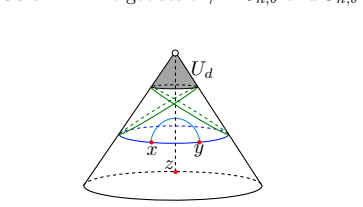
The proof uses the developing map from the universal cover of the punctured cone surface into the hyperbolic plane, together with a compact core K obtained by removing cone neighbourhoods. The lifted core eK, equipped with the induced path metric, is shown to be a proper geodesic space quasi-isometric to the Cayley graph of the fundamental group, so orbit maps over subwords of simple closed curves become uniform quasi-geodesics in $H^{2}$. A key cone lemma ensures that geodesic arcs in a cone with angle less than pi cannot cross the cone-point unless they wrap around it more than once, which is excluded for simple curves by a self-intersection argument.
What would settle it
Take an admissible cone surface and a simple closed curve; compute its geodesic representative in the punctured surface and check whether it truly avoids all cone neighbourhoods. A more direct test: pick a point in the universal cover and a word corresponding to a subword of a simple closed curve, and examine whether the distance between the point and its translate is actually realized by a path in the incomplete universal cover, rather than by a minimizing sequence escaping to a cone-point lift.
Extended reading notes
Core claim
Simple-stability is the correct analogue of primitive stability for the mapping class group action on relative PSL(2,R)-character varieties: a representation is simple-stable when orbit maps of lifts of non-separating simple closed curves are uniform quasi-geodesics in the hyperbolic plane. Theorem 1.1 establishes that the set of such representations is open and that the mapping class group acts properly discontinuously on it. Theorem 1.2 shows that the holonomy of every admissible hyperbolic cone surface is simple-stable, and that the holonomy of an admissible cone surface with exactly one cone-point is primitive-stable. These holonomies form an infinite family of indiscrete representations sitting in the newly constructed domain of discontinuity.
Load-bearing premise
In proving that holonomies of admissible cone surfaces are simple-stable, the paper assumes that for every subword of a lift of a simple closed curve, a geodesic segment joining the two endpoints exists in the incomplete universal cover of the punctured cone surface, and that if it did not exist, a length-minimizing curve would have to run through a lifted cone-point.
Editorial extensions
If this is right
- The mapping class group has an open domain of discontinuity inside relative PSL(2,R)-character varieties, strictly larger than the Schottky representations for surfaces with at least two punctures.
- Holonomies of admissible cone surfaces with an irrational cone-angle give explicit indiscrete representations in this domain of discontinuity.
- With exactly one cone-point, the holonomy is primitive-stable, providing an infinite family of indiscrete primitive-stable representations and answering Minsky's question.
- These holonomies also satisfy the simple Bowditch Q-conditions, showing that the type-preserving hypothesis in Bowditch's conjecture cannot be dropped.
- For punctured spheres, the holonomy of an admissible hyperbolic cone sphere is strongly simple-stable, extending the domain-of-discontinuity statement to separating curves.
Reading between the lines
- If the geodesic-existence assumption in the proof of Theorem 1.2 fails in some corner case, the class of simple-stable cone holonomies could be smaller than claimed; this is a delicate point at cone-point lifts where the metric completion is not locally compact.
- Simple-stability may serve as the natural bounded-geometry condition for mapping class group actions on relative character varieties, paralleling primitive stability for Out(F_n); investigating its relation to other conditions such as Anosov or relatively hyperbolic representations would be a natural next step.
- The construction may extend to cone-angles approaching 2*pi or to higher-dimensional target groups, though the admissibility condition (angle less than pi) is used crucially to rule out wrapping around cone-points.
- The proof techniques suggest that the mapping class group's domain of discontinuity may be strictly larger than the one inherited from Out(F_n) via the Dehn-Nielsen-Baer embedding.
Editorial analysis
A structured set of objections, weighed in public.
Referee Report
Summary. The paper defines simple-stability for representations of fundamental groups of punctured surfaces into PSL(2,R), proves that simple-stable representations form a domain of discontinuity for the mapping class group action on relative character varieties (Theorem 1.1), and claims that holonomies of admissible hyperbolic cone surfaces are simple-stable, with primitive-stability in the one-cone-point case (Theorem 1.2). It also proves SBQ-conditions for these holonomies (Theorem 1.3) and a strong form of simple-stability for admissible cone spheres (Theorem 1.4). The central geometric argument compares distances in a pi_1-invariant subspace of the incomplete universal cover of the surface minus cone-points with distances in H2 under the developing map.
Significance. If correct, Theorem 1.2 supplies an infinite family of indiscrete primitive-stable representations, answering a question of Minsky, and gives simple-stable representations that are not primitive-stable in the multi-cone-point case. The paper is clearly structured and builds on independent tools (Minsky's primitive stability, Bowditch conditions, Dehn-Nielsen-Baer, Alexander method) without fitted parameters. The definition of simple-stability and the proposed domain of discontinuity in Theorem 1.1 are valuable contributions. However, the proof of the main geometric theorem relies on a geodesic-existence statement in an incomplete space that is not established, and this gap currently prevents the main results from being considered proven.
major comments (3)
- [Section 5.1, proof of Theorem 1.2] The proof begins with the assertion that for every subword w of a lift of a simple closed curve there exists a geodesic joining ex and w·ex in ^S\P. This is not justified. The space ^S\P is incomplete (Remark 2.17), and its metric completion is not locally compact at the lift of a cone-point (Section 2, discussion after Proposition 2.4), so the usual compactness argument for minimizing curves does not apply. Proposition 2.6 produces minimizers only in the completion of the cone, not in C*_{h,θ} or its universal cover; in an incomplete length space the infimum need not be attained. The contradiction argument therefore does not rule out the possibility that no geodesic exists, and the subsequent argument is unsupported.
- [Section 5.1, proof of Theorem 1.2, equality d_K(ex,w·ex)=d_H2(...)] The displayed equality d_K(ex,w·ex) = d_H2(dev(ex), dev(w·ex)) is used to transfer the lower quasi-isometry bound from (K,d_K) to H2. The developing map is only 1-Lipschitz, so in general only d_H2(dev(ex),dev(w·ex)) ≤ d_K(ex,w·ex) follows. Equality requires a geodesic in K whose developing image is a geodesic in H2 with the specified endpoints. The proof constructs K using Lemma 2.8, but Lemma 2.8 itself assumes the existence of a geodesic between the two points in the cone. Thus the argument presupposes the very objects whose existence is at issue. Without equality, the lower bound required for simple-stability, and for primitive-stability in the one-cone-point case, does not follow.
- [Section 5.2, proof of Theorem 1.4 and Proposition 5.7] Theorem 1.4 is proved by saying that the proof follows exactly as Theorem 1.2, with only the polygon used in constructing the universal cover changed. Since the gap in Theorem 1.2 is located in the geodesic-existence step and in the equality d_K = d_H2, the same gap carries over to Theorem 1.4. The claim in Proposition 5.7 that 'the argument there depended only on the simplicity of the closed curves' does not address the incomplete-space issue. A repair of the geodesic-existence argument in Section 5.1 is therefore needed before Theorems 1.2 and 1.4 can be considered established.
minor comments (4)
- [Theorem 1.2 and Section 4] Theorem 1.2 states 'admissible cone surfaces' without qualification, while Definition 4.2 and the surrounding discussion restrict simple-stability to S_{g,n} with genus at least one. The sphere case is treated separately in Theorem 1.4; please make this qualification explicit in the theorem statement and in the introduction.
- [Remark 5.9] Remark 5.9 is empty; it should either be filled in or removed.
- [Proposition 5.2, proof] The construction of the sequences δ_k and ε_k with B_{δ_k}(ex) ⊂ B_{ε_k}(ex) is not fully justified; a brief explanation of how these sequences are chosen would improve clarity.
- [Lemma 6.5, proof] The sentence 'S \ F is disjoint union of geodesic polygons or a geodesic polygons with an open disk removed' contains a grammatical error and should be rewritten.
Circularity Check
No circularity: the main results are derived from external geometric and dynamical theorems, not from their own assumptions.
full rationale
The paper's central derivation chain is independent of its conclusions. Simple-stability is a new definition adapted from Minsky's primitive stability, but the proof that holonomies of admissible cone surfaces are simple-stable (Theorem 1.2) uses geometric facts about cone surfaces (existence of geodesic representatives, collar/partition arguments, developing maps) and prior theorems (Dehn-Nielsen-Baer, Alexander method, Minsky's primitive-stability machinery) rather than assuming the target inequalities. The constants C and epsilon are not fitted to data; they come from a quasi-isometry between the Cayley graph and a proper geodesic subspace of the universal cover. The one-cone-point primitive-stability case likewise invokes Minsky's Lemma 4.4 about c^2 blocking, an external result, and the same geometric argument. There are no fitted parameters renamed as predictions, no self-citation chain that forces the conclusion, and no definition constructed to equal its input. The proof does contain a potential mathematical gap: it assumes geodesics exist in the incomplete cover ^S\P and that failure would force a minimizing curve through a cone-point lift, whereas the metric completion fails local compactness at cone-point lifts. That is a correctness risk, not circularity, because the missing argument is a completeness/compactness comparison, not an appeal to the theorem being proved.
Assumptions & free parameters
assumptions (6)
- standard math Dehn-Nielsen-Baer theorem: MCG(Sg,n) is isomorphic to Out*_C(pi1(Sg,n)) (FM12, Theorem 8.8).
- standard math Alexander method: a mapping class is determined by its action on a filling (FM12, Proposition 2.8).
- domain assumption Minsky's openness lemma [Min13, Lemma 3.2] transfers to simple-stability to prove SS is open (Theorem 4.6).
- domain assumption Minsky's blocking lemma [Min13, Lemma 4.4]: c^2 cannot be a subword of a primitive word.
- domain assumption Collar Lemma for hyperbolic cone surfaces [DP07], giving collar neighborhoods around simple closed geodesics.
- domain assumption A curve on a punctured surface that goes around a puncture more than once has a self-intersection (Proposition 2.10).
Cite this review
Pith. "Pith review of On dynamics of the Mapping class group action on relative $\text{PSL}(2,\mathbb{R})$-Character Varieties." pith.science (2026). https://pith.science/paper/GXMWLUKZ
@misc{pith2026250209513,
  author       = {Pith},
  title        = {Pith review of: On dynamics of the Mapping class group action on relative $\textPSL(2,\mathbbR)$-Character Varieties},
  year         = {2026},
  howpublished = {\url{https://pith.science/paper/GXMWLUKZ}},
  note         = {Machine review of arXiv:2502.09513}
}
abstract
In this paper, we study the mapping class group action on the relative $\text{PSL}(2,\mathbb{R})$-character varieties of punctured surfaces. It is well known that Minsky's primitive-stable representations form a domain of discontinuity for the $\text{Out}(F_n)$-action on the $\text{PSL}(2,\mathbb{C})$-character variety. We define simple-stability of representations of fundamental group of a surface into $\text{PSL}(2,\mathbb{R})$ which is an analogue of the definition of primitive stability and prove that these representations form a domain of discontinuity for the $\text{MCG}$-action. Our first main result shows that holonomies of hyperbolic cone surfaces are simple-stable. We also prove that holonomies of hyperbolic cone surfaces with exactly one cone-point of cone-angle less than $\pi$ are primitive-stable, thus giving examples of an infinite family of indiscrete primitive-stable representations.
Figures


Figures from the paper (7 more)



Reference graph
Works this paper leans on
-
[1]
Bridson and Andr\' e Haefliger, Metric spaces of non-positive curvature, Grundlehren der mathematischen Wissenschaften [Fundamental Principles of Mathematical Sciences], vol
Martin R. Bridson and Andr\' e Haefliger, Metric spaces of non-positive curvature, Grundlehren der mathematischen Wissenschaften [Fundamental Principles of Mathematical Sciences], vol. 319, Springer-Verlag, Berlin, 1999. 1744486
1999
-
[2]
B. H. Bowditch, Markoff triples and quasi- F uchsian groups , Proc. London Math. Soc. (3) 77 (1998), no. 3, 697--736. 1643429
work page 1998
-
[3]
Joan S. Birman and Caroline Series, Geodesics with bounded intersection number on surfaces are sparsely distributed, Topology 24 (1985), no. 2, 217--225. 793185
work page 1985
-
[4]
Shalen, Varieties of group representations and splittings of 3 -manifolds , Ann
Marc Culler and Peter B. Shalen, Varieties of group representations and splittings of 3 -manifolds , Ann. of Math. (2) 117 (1983), no. 1, 109--146. 683804
work page 1983
-
[5]
Vincent Despré, Benedikt Kolbe, Hugo Parlier, and Monique Teillaud, Computing a D irichlet domain for a hyperbolic surface , https://arxiv.org/abs/2212.01934, 2022
work page Pith review arXiv 2022
-
[6]
Dryden and Hugo Parlier, Collars and partitions of hyperbolic cone-surfaces, Geom
Emily B. Dryden and Hugo Parlier, Collars and partitions of hyperbolic cone-surfaces, Geom. Dedicata 127 (2007), 139--149. 2338522
work page 2007
-
[7]
Bertrand Deroin and Nicolas Tholozan, Supra-maximal representations from fundamental groups of punctured spheres to PSL(2, R) , Ann. Sci. \' E c. Norm. Sup\' e r. (4) 52 (2019), no. 5, 1305--1329. 4057784
work page 2019
-
[8]
49, Princeton University Press, Princeton, NJ, 2012
Benson Farb and Dan Margalit, A P rimer on M apping C lass G roups , Princeton Mathematical Series, vol. 49, Princeton University Press, Princeton, NJ, 2012. 2850125
work page 2012
Show all 24 references
-
[9]
Goldman, Topological components of spaces of representations, Invent
William M. Goldman, Topological components of spaces of representations, Invent. Math. 93 (1988), no. 3, 557--607. 952283
1988
-
[10]
, The modular group action on real SL (2) -characters of a one-holed torus , Geom. Topol. 7 (2003), 443--486. 2026539
2003
-
[11]
, Mapping class group dynamics on surface group representations, Problems on mapping class groups and related topics, Proc. Sympos. Pure Math., vol. 74, Amer. Math. Soc., Providence, RI, 2006, pp. 189--214. 2264541
2006
-
[12]
Thomas Le Fils, Holonomy of complex projective structures on surfaces with prescribed branch data, J. Topol. 16 (2023), no. 1, 430--487. 4575871
2023
-
[13]
thesis, University of Warwick, September 2015, https://wrap.warwick.ac.uk/78992/
Damiano Lupi, Primitive stability and B owditch conditions for rank 2 free group representations , Ph.D. thesis, University of Warwick, September 2015, https://wrap.warwick.ac.uk/78992/
2015
-
[14]
Jaejeong Lee and Binbin Xu, Bowditch's Q -conditions and M insky's primitive stability , Trans. Amer. Math. Soc. 373 (2020), no. 2, 1265--1305. 4068264
2020
-
[15]
Arnaud Maret, A note on C haracter V arieties , https://arnaudmaret.com/files/character-varieties.pdf
-
[16]
Bruno Martelli, An I ntroduction to G eometric T opology , 2022, https://arxiv.org/abs/1610.02592
2022 arXiv
-
[17]
Mathews, Hyperbolic cone-manifold structures with prescribed holonomy II : higher genus , Geom
Daniel V. Mathews, Hyperbolic cone-manifold structures with prescribed holonomy II : higher genus , Geom. Dedicata 160 (2012), 15--45. 2970041
2012
-
[18]
Minsky, On dynamics of Out(F_n) on PSL _2( C ) characters , Israel J
Yair N. Minsky, On dynamics of Out(F_n) on PSL _2( C ) characters , Israel J. Math. 193 (2013), no. 1, 47--70. 3038545
2013
-
[19]
Sara Maloni, Fr\'ed\'eric Palesi, and Ser Peow Tan, On the character variety of the four-holed sphere, Groups Geom. Dyn. 9 (2015), no. 3, 737--782. 3420542
2015
-
[20]
Julien March\'e and Maxime Wolff, The modular action on PSL _2( R ) -characters in genus 2 , Duke Math. J. 165 (2016), no. 2, 371--412. 3457677
2016
-
[21]
Dedicata 191 (2017), 53--83
Huiping Pan, On finite marked length spectral rigidity of hyperbolic cone surfaces and the T hurston metric , Geom. Dedicata 191 (2017), 53--83. 3719075
2017
-
[22]
Caroline Series, Primitive stability and B owditch's BQ -conditions are equivalent , 2019, https://arxiv.org/abs/1901.01396
2019 arXiv
-
[23]
Differential Geom
Ser Peow Tan, Yan Loi Wong, and Ying Zhang, Generalizations of M c S hane's identity to hyperbolic cone-surfaces , J. Differential Geom. 72 (2006), no. 1, 73--112. 2215456
2006
-
[24]
, Generalized M arkoff maps and M c S hane's identity , Adv. Math. 217 (2008), no. 2, 761--813. 2370281
2008
Reviewed August 7, 2026 · model on record in the stance chip above.
Discussion (0). Continue with ORCID to comment.