REVIEW 1 major objections 6 minor 1 cited by
Swift-XRT and NuSTAR Monitoring of Obscuration Variability in Mrk 477
T0 review · 1 major / 6 minor · reviewed 2026-08-07 · deepseek-v4-flash
Pith's one-line read Fifteen X-ray observations of Mrk 477 show its obscuring gas column changes in as little as two weeks, and pooled with 26 other sources the chance of catching obscuration variability rises from about 20% below 10 days to 60-70% beyond 5…
desk verdict New monitoring data and a plausible compiled trend, but the timescale claim needs a source-level robustness test before it carries the paper. read the letter →
The pith
A machine-rendered reading of the paper's core claim, the machinery that carries it, and where it could break.
The reading
What carries the argument
The argument runs on simultaneous X-ray spectral fitting with two self-consistent torus models: borus02, a homogeneous-reflector model, and UXCLUMPY, a clumpy-cloud model. All 15 spectra are fit together with the torus reflection parameters (covering factor, average torus column density, cloud-distribution width, inclination) and the photon index tied across epochs, while the line-of-sight column density $N_{\rm H,los}$ and a cross-normalization constant are free in each epoch; this design is what separates obscuration changes from intrinsic luminosity changes. The variability claim is then carried by a pair-counting statistic: across the 105 epoch pairs of Mrk 477 and about 350 pairs in the full 27-source sample, a pair counts as variable when its two $N_{\rm H,los}$ values are inconsistent at 90% confidence, and the fraction of such pairs is computed as a function of the time separation $\Delta t$.
What would settle it
Observe a moderately obscured (Compton-thin) active galaxy at five or more epochs spread over a decade with simultaneous soft and hard X-ray coverage, fitting each epoch with the torus reflection parameters free; if the covering factor, average column density, or photon index must vary to produce acceptable fits, the tied-parameter assumption fails and the reported variability fractions would need revision. For the BLR hypothesis, search for a fully sampled cloud eclipse lasting longer than about 300-500 days; if such an eclipse has an inferred cloud size below $10^{15}\,{\rm cm}$, it would contradict the paper's claim that only torus-scale material can explain long-timescale variability.
Extended reading notes
Core claim
The paper's central claim is that Mrk 477, a Seyfert 2 active nucleus viewed through obscuring gas, shows frequent line-of-sight column density variability, with $N_{\rm H,los}$ moving between roughly $1.5\times10^{23}$ and $7\times10^{23}\,{\rm cm}^{-2}$ and changes appearing on timescales down to about two weeks. Of the 105 pairs of observations, 42 are inconsistent at 90% confidence with a single column density, so the probability that two randomly drawn epochs disagree is about 40%; the chance of catching at least one variable pair rises to 78% with three observations and 95% with four. Combined with 26 other sources analyzed with the same method, the variable-pair fraction increases from about 20% at $\Delta t<10$ days to roughly 60-70% at $\Delta t>5$ years, while the average column change in variable pairs stays near $30{-}40\times10^{22}\,{\rm cm}^{-2}$ except for the shortest separations, where it drops to about $5\times10^{22}\,{\rm cm}^{-2}$. The paper further claims that this timescale dependence is difficult to explain if all obscuration variability comes from broad-line-region clouds, because above a cloud's crossing time the variability probability should become flat; matching the observed rise would require such clouds two to three orders of magnitude larger than previous measurements, so the data favor variability arising from torus-scale structure, with broad-line-region clouds possibly dominating only the $\Delta t<10$ day regime.
Load-bearing premise
The load-bearing premise is that the reflecting structure around the black hole and the intrinsic spectral shape stay completely unchanged across the 13 years, so every spectral difference between epochs must be assigned to the gas directly in front of the source; if the reflector itself evolves, some of that evolution would be misread as line-of-sight obscuration variability.
Editorial extensions
If this is right
- With only two observations of a genuinely variable obscured active galaxy, the chance of seeing the variability is about 40%, so archival two-epoch comparisons systematically underreport obscuration variability.
- Monitoring campaigns that obtain three or four epochs have a 78-95% chance of catching at least one variable pair, making modest campaigns a cost-effective way to identify variable sources.
- Across the 27-source sample, the variable-pair fraction grows from about 20% at separations under 10 days to 60-70% beyond 5 years, implying that long-term obscuration variability is common among Compton-thin Seyfert 2 nuclei.
- The average column change in variable pairs is roughly constant at $30{-}40\times10^{22}\,{\rm cm}^{-2}$ across timescales, except below 10 days where it drops to about $5\times10^{22}\,{\rm cm}^{-2}$, suggesting a distinct short-timescale population of low-column clouds.
- The timescale dependence favors torus-scale material as the dominant source of obscuration variability, with broad-line-region clouds contributing mainly at the shortest separations.
Reading between the lines
- Beyond the paper: the rising variable-pair fraction with time implies that two-epoch 'changing-look' classifications separated by years will overstate how quickly or dramatically a source is transitioning, because the same source would likely show a different column if sampled again.
- Beyond the paper: if the $\Delta t<10$ day regime is indeed dominated by broad-line-region clouds, rapid-cadence monitoring of Compton-thin Seyfert 2 galaxies should find frequent small-amplitude eclipses with $\Delta N_{\rm H,los}\sim5\times10^{22}\,{\rm cm}^{-2}$, a testable prediction the paper does not itself make.
- Beyond the paper: applying the same pair-count statistic to the growing X-ray archive of other obscured active galaxies would test whether the >5-year variable-pair fraction continues to rise, and would show how much Mrk 477's dense monitoring skews the current sample.
- Beyond the paper: the tied-reflection assumption could be stress-tested on sources with stronger reflection than Mrk 477, where torus geometry changes would leave clearer spectral signatures; if reflection variability turns out to be common, the derived $N_{\rm H,los}$ histories of all 27 sources would need to be re-fit.
Signed reviews
Editorial analysis
A structured set of objections, weighed in public.
Referee Report
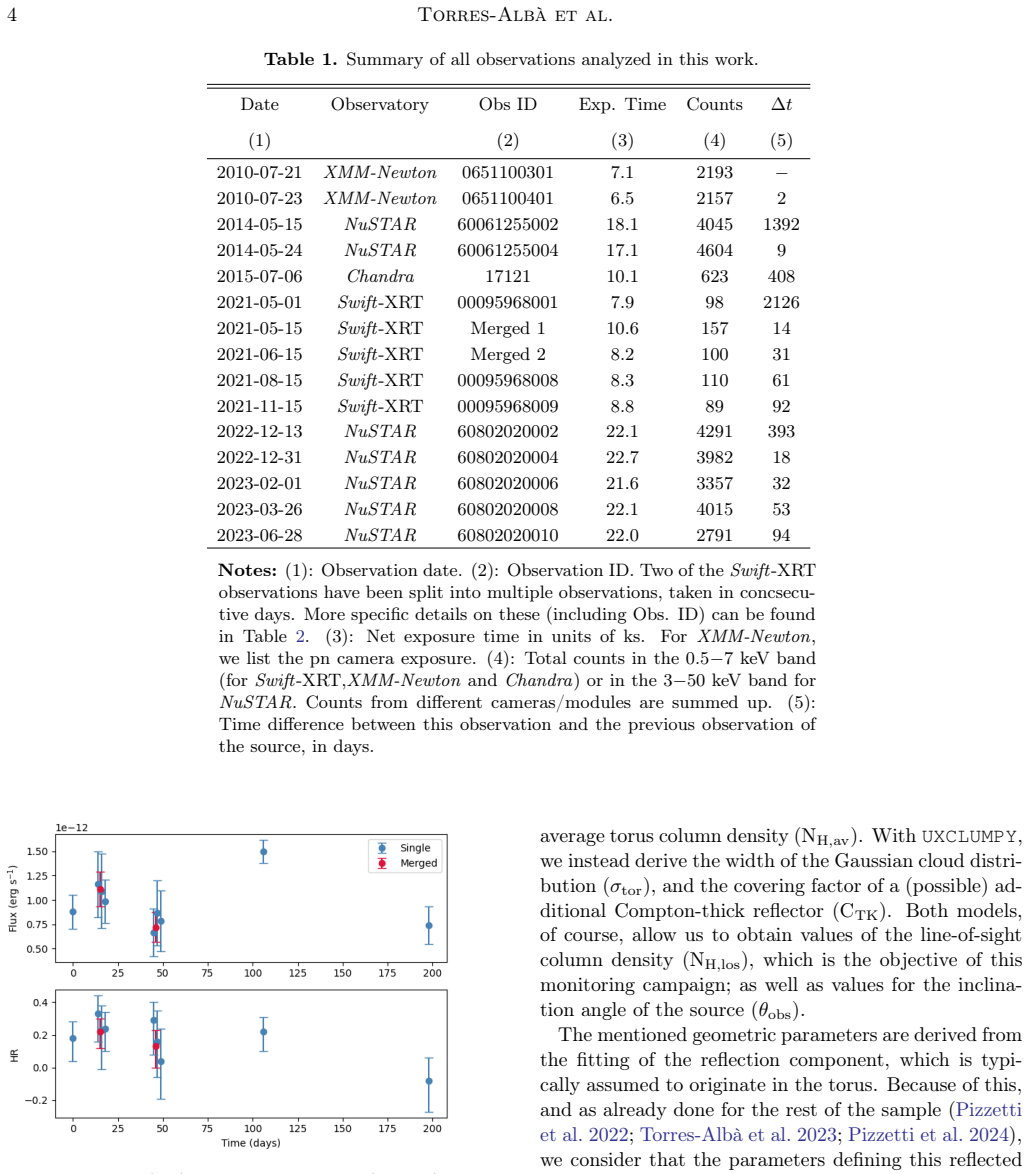
Summary. The paper presents a multi-epoch X-ray analysis of the Seyfert 2 galaxy Mrk 477, combining five archival observations (XMM-Newton, NuSTAR, Chandra) with two dedicated monitoring campaigns (five Swift-XRT and five NuSTAR epochs). All 15 epochs are fit simultaneously with two self-consistent torus models (borus02 and UXCLUMPY), with reflection parameters and the photon index tied across epochs while the line-of-sight column density NH,los and a cross-normalization are free per epoch. The authors report NH,los variability between multiple epoch pairs, including a claimed ~14-day change between two Swift-XRT observations, and estimate that 42 of the 105 Mrk 477 observation pairs (40%) are variable at 90% confidence. Combining these 105 pairs with ~245 pairs from 26 other sources analyzed in the authors' earlier papers, they find that the fraction of variable pairs increases from ~20% at Δt < 10 days to ~60–70% at Δt > 5 years. They interpret this timescale trend as evidence against BLR clouds being the sole origin of obscuration variability, unless the clouds are implausibly large.
Significance. If the sample-level timescale trend is robust, it provides a valuable empirical constraint on the origin and location of obscuring material in AGN, complementing small-number eclipsing-event studies such as Markowitz et al. (2014). The Mrk 477 monitoring campaign itself is a useful addition, and the paper has genuine strengths: it uses two independent torus models that cross-check the NH,los measurements, it explicitly tests the tied-reflection-parameter assumption by fitting archival+Swift and NuSTAR-only subsets separately (Appendix B), and it presents the fitted spectral components in detail. The main significance claim, however, is the trend in Fig. 6, and that claim currently rests on a statistical treatment of non-independent observation pairs that needs to be demonstrated to be robust.
major comments (1)
- [§5.2, Eq. (4) and derived probabilities] The quantity 42/105 = 40% is used both as the observed pair fraction and, after assuming all pairs are independent Bernoulli draws, to compute the probabilities 78% (3 observations) and 95% (4 observations). Pairs sharing an epoch are strongly correlated (a single observation appears in up to 14 pairs), so the effective sample size is far below 105 and the naive binomial variance underestimates the uncertainty. Please provide a clustering-aware estimate (e.g., bootstrap by epoch or by source) or explicitly label these numbers as descriptive fractions without formal probability claims.
minor comments (6)
- [Throughout] Typographical errors: §2.1 heading 'Data Analisys', §2.3 'arund', §1 'as longs as years', §4 'desnsity', §5.4 'perfomed', and the text near Eq. (1) 'Bremmstrahlung' should be corrected.
- [Fig. 6] The binned fractions would be much easier to interpret with binomial error bars (e.g., Wilson intervals), and the Mrk 477-only curve should either be overlaid in a separate panel or have its contribution to each bin indicated so that the reader can see the weighting directly.
- [Table 4] The notation in the table footnote ('NH,inst.,num.') does not match the table's column headers (e.g., NH,swift1, Cnus3); please align the notation used in the text, the table, and the footnote.
- [§5.2] The statement that 'this statistical approach is not valid when looking at a single source' for Mrk 477 is puzzling because the same pair-counting approach is applied to the full sample in the same section; please clarify why pair non-independence is deemed acceptable for the sample-level estimate but not for the single-source estimate.
- [Fig. 7 caption] The in-text citation 'Gravity Collaboration et al. 2023' does not match the reference list entry 'Gravity Collaboration, Amorim, A., Bourdarot, G., et al. 2023'; please standardize the citation format.
- [Abstract and §5.2] The abstract's '40%, 78% and 95%' probabilities should carry an explicit caveat that they assume independent pairs; as written, they appear as exact probabilities rather than as descriptive fractions derived from a correlated dataset.
Circularity Check
No significant circularity: the variability statistics are descriptive summaries of the spectral fits, and the BLR test is an external consistency check.
full rationale
The paper's derivation chain is descriptive and data-driven rather than predictive: NH,los values are fitted per epoch (Table 4), and the claimed 'probabilities' are fractions of observation pairs whose 90% confidence contours do not overlap (Sect. 5.2), so the central variability statistics are summaries of the fit, not predictions forced by construction. The tied reflection parameters (Cf, NH,av, sigma_tor, theta_obs, Gamma) are an explicit assumption that is tested in Appendix B by splitting the data into archival+Swift and NuSTAR-only subsets; the test is a consistency check, not a circular validation. The BLR-cloud discussion (Sect. 5.3) infers a crossing time from the observed trend and computes implied cloud sizes, then compares them to external measurements (Maiolino et al. 2010; GRAVITY), which is a physical consistency argument rather than a reduction to the paper's inputs. Self-citations to earlier group papers supply additional data points and methodological continuity, but no load-bearing step invokes an unverified uniqueness theorem or defines a result in terms of itself. The acknowledged clustering of Mrk 477 pairs in Fig. 6 is a statistical limitation (pseudo-replication), not a circularity, and the paper flags it explicitly.
Assumptions & free parameters
free parameters (8)
- N_H,los per epoch (15 values) =
0.17-0.75 x 10^24 cm^-2 (borus02 full fit)
- C_norm per epoch (14 values) =
0.85-1.42 (borus02 and UXCLUMPY)
- Photon index Gamma =
1.54+0.05-0.06 (borus02), 1.78+0.03-0.03 (UXCLUMPY)
- Torus covering factor Cf =
1.00 (+0 -0.08)
- Average torus column density N_H,av =
0.08+0.02-0.02 x 10^24 cm^-2
- Cloud distribution width sigma_tor =
84.0 deg (UXCLUMPY)
- Soft emission temperature kT and Gaussian line energy =
kT~0.29 keV, Eline~0.91 keV
- Scattering fraction Fs =
2.8e-2 (borus02), 20.6e-2 (UXCLUMPY)
assumptions (6)
- domain assumption borus02 and UXCLUMPY torus models accurately represent the reflection and transmission spectra of Mrk 477
- domain assumption Torus reflection parameters (Cf, N_H,av, sigma_tor, theta_obs) do not vary across the ~13-year observing span
- domain assumption Intrinsic photon index Gamma is constant over all epochs
- domain assumption Galactic absorption, solar abundances, and Ecut=300 keV are fixed to literature values
- ad hoc to paper Non-overlap of 90% confidence intervals is a valid criterion for pair variability
- ad hoc to paper Observation pairs within a source are treated as independent draws for the probability calculations
Cite this review
Pith. "Pith review of Swift-XRT and NuSTAR Monitoring of Obscuration Variability in Mrk 477." pith.science (2026). https://pith.science/paper/C7J7DWR3
@misc{pith2026250209759,
  author       = {Pith},
  title        = {Pith review of: Swift-XRT and NuSTAR Monitoring of Obscuration Variability in Mrk 477},
  year         = {2026},
  howpublished = {\url{https://pith.science/paper/C7J7DWR3}},
  note         = {Machine review of arXiv:2502.09759}
}
abstract
We present the analysis of 15 X-ray observations of Mrk 477, a nearby Seyfert 2 active galactic nucleus, with the objective to monitor its obscuring column density variability. The full dataset consists of five archival observations, split into two XMM-Newton, two NuSTAR and one Chandra observation, plus two dedicated monitoring campaigns. The monitoring campaigns were performed with Swift-XRT and NuSTAR, containing five observations each. We performed a simultaneous analysis using self-consistent torus models, deriving geometric properties of the torus as well as the obscuration along the line of sight. Mrk 477 is best modeled with a torus with large covering factor yet low column density (on average). Its line of sight column density oscillates between $1.5-7\times10^{23}$~cm$^{-2}$. Mrk~477 presents frequent obscuring column density variability, on timescales as short as $\sim2$~weeks. The probability of drawing a pair of obscuration-variable observations for Mrk~477 when having 2, 3, and 4 observations is 40\%, 78\% and 95\%, respectively. Adding the results of this work to those of another 26 sources, we find a trend of increasing obscuration variability with time (from $\sim20$\% at $\Delta t<10$~days, to $\sim60-70$\% at timescales larger than 5 years). We discuss whether this is compatible with the majority of obscuration variability coming from broad line region clouds.
Figures


Figures from the paper (8 more)


Forward citations
Cited by 1 Pith paper
-
X-ray Absorption Variability in NGC 1142: Another Constraint on the Nature of the Torus/Broad-Line Region in Active Galactic Nuclei
NGC 1142’s NH varies across nine epochs; detection probability scales with observation count, and simple cloud simulations favor many simultaneous eclipsing clouds.
Reference graph
Works this paper leans on
-
[1]
, " * write output.state after.block = add.period write newline
ENTRY address archiveprefix author booktitle chapter edition editor howpublished institution eprint journal key month note number organization pages publisher school series title type volume year label extra.label sort.label short.list INTEGERS output.state before.all mid.sentence after.sentence after.block FUNCTION init.state.consts #0 'before.all := #1 ...
-
[2]
write newline
" write newline "" before.all 'output.state := FUNCTION n.dashify 't := "" t empty not t #1 #1 substring "-" = t #1 #2 substring "--" = not "--" * t #2 global.max substring 't := t #1 #1 substring "-" = "-" * t #2 global.max substring 't := while if t #1 #1 substring * t #2 global.max substring 't := if while FUNCTION word.in bbl.in " " * FUNCTION format....
-
[3]
, " * write output.state after.block = add.period write newline
ENTRY address archivePrefix author booktitle chapter doi edition editor eprint howpublished institution journal key month number organization pages publisher school series title misctitle type volume year version url label extra.label sort.label short.list INTEGERS output.state before.all mid.sentence after.sentence after.block FUNCTION init.state.consts ...
-
[4]
write newline
" write newline "" before.all 'output.state := FUNCTION format.url url empty "" new.block "" url * "" * if FUNCTION format.eprint eprint empty "" archivePrefix empty "" archivePrefix "arXiv" = new.block " " eprint * " " * new.block " " eprint * " " * if if if FUNCTION format.doi doi empty "" " " doi * " " * if FUNCTION format.pid doi empty eprint empty ""...
-
[5]
- [1] #1 = = ^ ^ ^ .\!\!^ d .\!\!^ h .\!\!^ m .\!\!^ s .\!\!^ @mss
thebibliography [1] 20pt to REFERENCES 6pt =0pt 10pt plus 3pt =0pt =0pt =1pt plus 1pt =0pt =0pt -12pt =13pt plus 1pt =20pt =13pt plus 1pt \@M =10000 =-1.0em =0pt =0pt 0pt =0pt =1.0em @enumiv\@empty 10000 10000 `\.\@m \@noitemerr \@latex@warning Empty `thebibliography' environment \@ifnextchar \@reference \@latexerr Missing key on reference command Each re...
2019
-
[6]
Aird , J., Coil , A. L., Georgakakis , A., et al. 2015, , 451, 1892, 10.1093/mnras/stv1062
-
[7]
1989, , 53, 197, 10.1016/0016-7037(89)90286-X
Anders , E., & Grevesse , N. 1989, , 53, 197, 10.1016/0016-7037(89)90286-X
-
[8]
Arnaud , K. A. 1996, in Astronomical Society of the Pacific Conference Series, Vol. 101, Astronomical Data Analysis Software and Systems V, ed. G. H. Jacoby & J. Barnes , 17
1996
Show all 62 references
-
[9]
A., et al
Balokovi \' c , M., Brightman, M., Harrison, F. A., et al. 2018, The Astrophysical Journal, 854, 42, 10.3847/1538-4357/aaa7eb
2018 doi
-
[10]
A., Madejski , G., et al
Balokovi \'c , M., Harrison , F. A., Madejski , G., et al. 2020, , 905, 41, 10.3847/1538-4357/abc342
2020 doi
-
[11]
2009, , 695, 781, 10.1088/0004-637X/695/1/781
Bianchi , S., Piconcelli , E., Chiaberge , M., et al. 2009, , 695, 781, 10.1088/0004-637X/695/1/781
2009 doi
-
[12]
G., Torres-Alb \`a , N., Annuar , A., et al
Boorman , P. G., Torres-Alb \`a , N., Annuar , A., et al. 2024, Frontiers in Astronomy and Space Sciences, 11, 1335459, 10.3389/fspas.2024.1335459
2024
-
[13]
Buchner , J., Brightman , M., Nandra , K., Nikutta , R., & Bauer , F. E. 2019, , 629, A16, 10.1051/0004-6361/201834771
2019 doi
-
[14]
2015, , 802, 89, 10.1088/0004-637X/802/2/89
Buchner , J., Georgakakis , A., Nandra , K., et al. 2015, , 802, 89, 10.1088/0004-637X/802/2/89
2015 doi
-
[15]
N., Hill , J
Burrows , D. N., Hill , J. E., Nousek , J. A., et al. 2005, , 120, 165, 10.1007/s11214-005-5097-2
2005 doi
-
[16]
S., Torres-Alb \`a , N., Marchesi , S., et al
Cox , I. S., Torres-Alb \`a , N., Marchesi , S., et al. 2023, , 958, 155, 10.3847/1538-4357/ad014e
2023 doi
-
[17]
2004, , 615, L25, 10.1086/424380
Elvis , M., Risaliti , G., Nicastro , F., et al. 2004, , 615, L25, 10.1086/424380
2004 doi
-
[18]
C., Allen, G
Fruscione, A., McDowell, J. C., Allen, G. E., et al. 2006, in Observatory Operations: Strategies, Processes, and Systems, ed. D. R. Silva & R. E. Doxsey, Vol. 6270, International Society for Optics and Photonics (SPIE), 586 -- 597, 10.1117/12.671760
2006 doi
-
[19]
2023, , 669, A14, 10.1051/0004-6361/202244655
Gravity Collaboration , Amorim , A., Bourdarot , G., et al. 2023, , 669, A14, 10.1051/0004-6361/202244655
2023 doi
-
[20]
Guainazzi , M., La Parola , V., Miniutti , G., Segreto , A., & Longinotti , A. L. 2012, , 547, A31, 10.1051/0004-6361/201219946
2012 doi
-
[21]
A., Craig , W
Harrison , F. A., Craig , W. W., Christensen , F. E., et al. 2013, , 770, 103, 10.1088/0004-637X/770/2/103
2013 doi
-
[22]
M., Gonz \'a lez-Delgado , R., Leitherer , C., et al
Heckman , T. M., Gonz \'a lez-Delgado , R., Leitherer , C., et al. 1997, , 482, 114, 10.1086/304139
1997 doi
-
[23]
2015, , 579, A90, 10.1051/0004-6361/201526127
Hern \'a ndez-Garc \' a , L., Masegosa , J., Gonz \'a lez-Mart \' n , O., & M \'a rquez , I. 2015, , 579, A90, 10.1051/0004-6361/201526127
2015 doi
-
[24]
2017, , 844, 21, 10.3847/1538-4357/aa7891
Ichikawa , K., & Tazaki , R. 2017, , 844, 21, 10.3847/1538-4357/aa7891
2017 doi
-
[25]
C., Ciroi , S., & Rafanelli , P
Ilic , D., Popovic , L. C., Ciroi , S., & Rafanelli , P. 2008, in Revista Mexicana de Astronomia y Astrofisica Conference Series, Vol. 32, Revista Mexicana de Astronomia y Astrofisica Conference Series, 102--102
2008
-
[26]
B., Radeva , Y., et al
Jahoda , K., Markwardt , C. B., Radeva , Y., et al. 2006, , 163, 401, 10.1086/500659
2006 doi
-
[27]
2001, , 365, L1, 10.1051/0004-6361:20000036
Jansen , F., Lumb , D., Altieri , B., et al. 2001, , 365, L1, 10.1051/0004-6361:20000036
2001 doi
-
[28]
Kalberla , P. M. W., Burton , W. B., Hartmann , D., et al. 2005, , 440, 775, 10.1051/0004-6361:20041864
2005 doi
-
[29]
2023, , 522, 4098, 10.1093/mnras/stad1216
Kayal , A., Singh , V., Ricci , C., et al. 2023, , 522, 4098, 10.1093/mnras/stad1216
2023 doi
-
[30]
G., Krumpe , M., et al
Laha , S., Markowitz , A. G., Krumpe , M., et al. 2020, , 897, 66, 10.3847/1538-4357/ab92ab
2020 doi
-
[31]
2010, , 517, A47, 10.1051/0004-6361/200913985
Maiolino , R., Risaliti , G., Salvati , M., et al. 2010, , 517, A47, 10.1051/0004-6361/200913985
2010 doi
-
[32]
2012, , 421, 1803, 10.1111/j.1365-2966.2012.20445.x
Marchese , E., Braito , V., Della Ceca , R., Caccianiga , A., & Severgnini , P. 2012, , 421, 1803, 10.1111/j.1365-2966.2012.20445.x
2012
-
[33]
2019, , 872, 8, 10.3847/1538-4357/aafbeb
Marchesi , S., Ajello , M., Zhao , X., et al. 2019, , 872, 8, 10.3847/1538-4357/aafbeb
2019 doi
-
[34]
2022, , 935, 114, 10.3847/1538-4357/ac80be
Marchesi , S., Zhao , X., Torres-Alb \`a , N., et al. 2022, , 935, 114, 10.3847/1538-4357/ac80be
2022 doi
-
[35]
G., Krumpe , M., & Nikutta , R
Markowitz , A. G., Krumpe , M., & Nikutta , R. 2014, , 439, 1403, 10.1093/mnras/stt2492
2014 doi
-
[36]
2014, , 437, 1776, 10.1093/mnras/stt2005
Miniutti , G., Sanfrutos , M., Beuchert , T., et al. 2014, , 437, 1776, 10.1093/mnras/stt2005
2014 doi
-
[37]
L., Naddaf , M.-H., Zaja c ek , M., et al
M \"u ller , A. L., Naddaf , M.-H., Zaja c ek , M., et al. 2022, , 931, 39, 10.3847/1538-4357/ac660a
2022 doi
-
[38]
2002, , 570, L9, 10.1086/340857
Nenkova , M., Ivezi \'c , Z ., & Elitzur , M. 2002, , 570, L9, 10.1086/340857
2002 doi
-
[39]
M., Nikutta , R., Ivezi \'c , Z ., & Elitzur , M
Nenkova , M., Sirocky , M. M., Nikutta , R., Ivezi \'c , Z ., & Elitzur , M. 2008, , 685, 160, 10.1086/590483
2008 doi
-
[40]
2015, , 53, 365, 10.1146/annurev-astro-082214-122302
Netzer , H. 2015, , 53, 365, 10.1146/annurev-astro-082214-122302
2015 doi
-
[41]
2022, , 936, 149, 10.3847/1538-4357/ac86c6
Pizzetti , A., Torres-Alb \`a , N., Marchesi , S., et al. 2022, , 936, 149, 10.3847/1538-4357/ac86c6
2022 doi
- [42]
-
[43]
2007, , 377, 607, 10.1111/j.1365-2966.2007.11634.x
Puccetti , S., Fiore , F., Risaliti , G., et al. 2007, , 377, 607, 10.1111/j.1365-2966.2007.11634.x
2007
-
[44]
A., et al
Ramos Almeida , C., Alonso-Herrero , A., Levenson , N. A., et al. 2014, , 439, 3847, 10.1093/mnras/stu235
2014 doi
-
[45]
2023, , 669, L5, 10.1051/0004-6361/202245409
Ramos Almeida , C., Esparza-Arredondo , D., Gonz \'a lez-Mart \' n , O., et al. 2023, , 669, L5, 10.1051/0004-6361/202245409
2023 doi
-
[46]
2023, , 945, 55, 10.3847/1538-4357/acb5a6
Ricci , C., & Paltani , S. 2023, , 945, 55, 10.3847/1538-4357/acb5a6
2023 doi
-
[47]
J., et al
Ricci , C., Ueda , Y., Koss , M. J., et al. 2015, , 815, L13, 10.1088/2041-8205/815/1/L13
2015 doi
-
[48]
E., Arevalo , P., et al
Ricci , C., Bauer , F. E., Arevalo , P., et al. 2016, , 820, 5, 10.3847/0004-637X/820/1/5
2016 doi
-
[49]
2005, , 623, L93, 10.1086/430252
Risaliti , G., Elvis , M., Fabbiano , G., Baldi , A., & Zezas , A. 2005, , 623, L93, 10.1086/430252
2005 doi
-
[50]
2002, , 571, 234, 10.1086/324146
Risaliti , G., Elvis , M., & Nicastro , F. 2002, , 571, 234, 10.1086/324146
2002 doi
-
[51]
2009, , 393, L1, 10.1111/j.1745-3933.2008.00580.x
Risaliti , G., Salvati , M., Elvis , M., et al. 2009, , 393, L1, 10.1111/j.1745-3933.2008.00580.x
2009
-
[52]
2015, , 815, 55, 10.1088/0004-637X/815/1/55
Rivers , E., Balokovi \'c , M., Ar \'e valo , P., et al. 2015, , 815, 55, 10.1088/0004-637X/815/1/55
2015 doi
- [53]
-
[54]
N., et al
Serafinelli , R., Braito , V., Reeves , J. N., et al. 2023, , 672, A10, 10.1051/0004-6361/202245224
2023 doi
-
[55]
2019, , 877, 95, 10.3847/1538-4357/ab1b20
Tanimoto , A., Ueda , Y., Odaka , H., et al. 2019, , 877, 95, 10.3847/1538-4357/ab1b20
2019 doi
- [56]
-
[57]
2023, , 678, A154, 10.1051/0004-6361/202345947
Torres-Alb \`a , N., Marchesi , S., Zhao , X., et al. 2023, , 678, A154, 10.1051/0004-6361/202345947
2023 doi
- [58]
- [59]
-
[60]
2023, , 674, A123, 10.1051/0004-6361/202245783
Vander Meulen , B., Camps , P., Stalevski , M., & Baes , M. 2023, , 674, A123, 10.1051/0004-6361/202245783
2023 doi
-
[61]
A., Ferland , G
Verner , D. A., Ferland , G. J., Korista , K. T., & Yakovlev , D. G. 1996, , 465, 487, 10.1086/177435
1996 doi
-
[62]
2021, , 650, A57, 10.1051/0004-6361/202140297
Zhao , X., Marchesi , S., Ajello , M., et al. 2021, , 650, A57, 10.1051/0004-6361/202140297
2021 doi
Reviewed August 7, 2026 · model on record in the stance chip above.
Discussion (0). Continue with ORCID to comment.