REVIEW 3 major objections 5 minor 1 cited by
Sum-of-Squares Bounds on Surface-Enhanced Raman Scattering
T0 review · 3 major / 5 minor · reviewed 2026-08-07 · deepseek-v4-flash
Pith's one-line read SERS bounds come within 3x of best designs
desk verdict A genuinely novel SOS-based method for quartic SERS bounds, but the reported 'bounds' are not yet proven because the Green's-function tail is dropped without a rigorous error estimate. read the letter →
The pith
A machine-rendered reading of the paper's core claim, the machinery that carries it, and where it could break.
The reading
What carries the argument
The key object is the generalized Lagrangian dual of the polarization-field optimization problem, with the multiplier promoted from a scalar to a quadratic polynomial so that the product with the quadratic power-conservation constraint has the same quartic degree as the objective. Nonnegativity of the resulting polynomial is imposed by the stronger sum-of-squares condition, which converts the dual into a semidefinite program. To keep the program small, the vacuum Green's function $\mathbf{G}_{RD}$ is compressed by a singular-value expansion and the polarization is represented in the $q$ dominant right singular vectors; with a molecule-metasurface separation $d>0$ the singular values decay exponentially, and the paper reports that $q<20$ gives converged bounds.
What would settle it
For a reported geometry, run a much denser inverse-design search (many random initializations and a finer discretization) and evaluate the true $\int \lVert \mathbf{E} \rVert^4 \, d\mathbf{r}$ figure of merit; a single structure whose value exceeds the corresponding SOS bound by more than numerical tolerance would show the bound is not an upper bound. Alternatively, recompute the bound with a rigorous bound on the discarded tail and check whether the stated factor-of-ten tightness survives.
Extended reading notes
Core claim
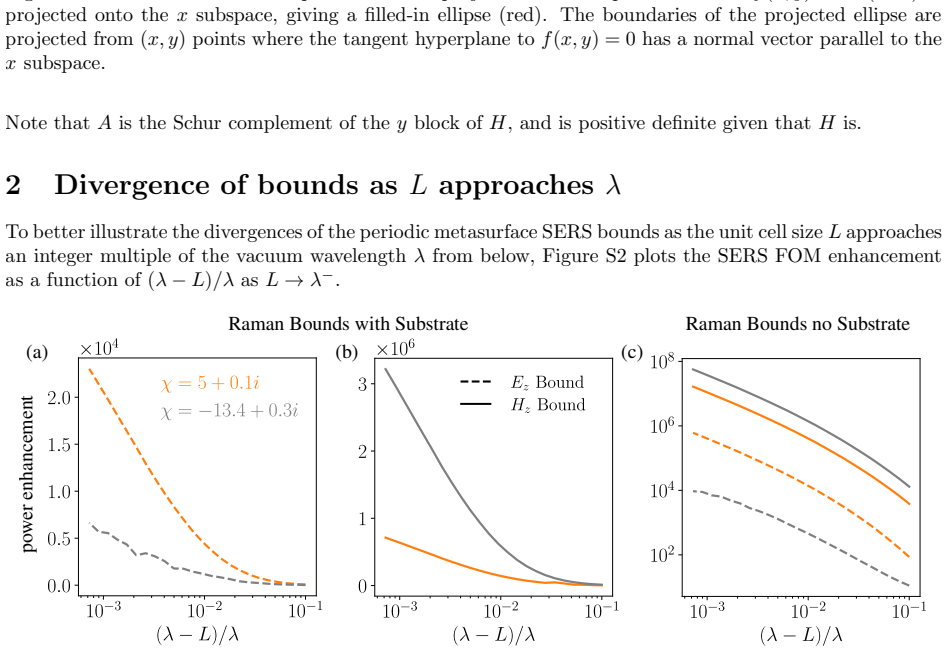
The central discovery is that a quartic, spatially averaged SERS figure of merit can be bounded from above over all allowed material distributions by solving a semidefinite program, rather than by factoring the figure of merit into quadratic pieces as earlier nonlinear bounds did. Working in the induced-polarization representation, the paper keeps only the dominant singular-value modes of the vacuum Green's function connecting the design region to the Raman-molecule region, which makes the SOS program tractable; numerical convergence is reached for a cutoff below about twenty modes. The computed bounds agree closely with inverse-designed dielectric and metallic structures, and they reveal two concrete physical conclusions. First, a suspended lossy metasurface can achieve theoretically diverging SERS enhancement as its period approaches the vacuum wavelength from below, because arbitrarily thin waveguides support progressively more delocalized high-$Q$ guided modes whose quality factor grows fast enough to overcome the reduced field overlap. Second, for metallic structures the $E_z$ polarization is fundamentally limited because it cannot excite surface plasmon polaritons, while $H_z$-polarized fields retain the large enhancements.
Load-bearing premise
The bounds rely on the assumption that the parts of the field left out of the truncated calculation are too small to matter; the paper checks this numerically but does not prove it, so the results are converged estimates rather than guaranteed upper limits.
Editorial extensions
If this is right
- Inverse designs that come within the reported bounds are near global optima, so the bounds give topology optimization a practical stopping criterion for SERS metasurfaces.
- Suspended thin-waveguide grating designs with period approaching the vacuum wavelength from below are identified as the optimal route to large-area SERS, with enhancement that theoretically diverges even for lossy materials.
- For metallic metasurfaces, $E_z$-polarized pumping is a low-ceiling strategy; experimenters should use $H_z$ polarization or accept the reflection-limited performance.
- Adding a uniform loss factor of $1+i/600$ caps the modal quality factor, removes the divergence, and produces a sharp finite transition at $L=\lambda$, matching realistic fabrication and bandwidth limits.
- The SOS approach extends to any nonlinear photonics figure of merit that is a polynomial or rational function of the fields, so the same machinery can bound second-harmonic generation, bistability thresholds, or lasing thresholds.
Reading between the lines
- Testable extension: apply the same generalized-Lagrangian SOS relaxation to a Kerr-nonlinearity figure of merit, such as a bistability threshold, and compare the bound against inverse-designed cavities; agreement would transfer the technique's apparent tightness to a new nonlinear regime.
- The near-$\chi$-independence of the $E_z$ bound away from the divergence suggests that a simple multilayer reflector may already saturate the bound at small periods, leaving little headroom for complex topology optimization of that polarization.
- Because the tail of the Green's function expansion is dropped without a rigorous error bound, the printed numbers are converged estimates; constructing a certified upper bound by bounding the tail in $L^4$ would settle whether the factor-of-ten tightness holds rigorously.
- The substrated logarithmic divergence, whose physical origin the paper leaves open, could be probed by varying substrate loss and watching the prefactor of $\log(\lambda-L)$; tracking that prefactor against substrate absorption would test whether the divergence is a loss-softened remnant of the suspended-structure power-law divergence.
Signed reviews
Editorial analysis
A structured set of objections, weighed in public.
Referee Report
Summary. This paper proposes a sum-of-squares (SOS) programming framework for computing upper bounds on the spatially averaged SERS figure of merit ∫_{Ω_R} ||E||^4 dr for periodic 2D metasurfaces. The authors relax the structural Maxwell design problem to an optimization over induced polarizations subject to global power-conservation constraints, promote the Lagrange multiplier to a quadratic polynomial to handle the quartic objective, and map the resulting nonnegativity condition to a semidefinite program. To make the SDP tractable, they expand the vacuum Green's function in singular vectors and retain only a dominant subspace. The computed bounds are compared with topology-optimized designs for suspended and substrate-supported structures, leading to claims of tightness, a divergence of enhancement as the period approaches the pump wavelength, a suppression of Ez-polarized SERS for metals, and singularity-strength scaling with molecule–surface separation.
Significance. If the bounds are rigorous, the paper contributes the first application of SOS programming to optics and a general method for bounding non-quadratic, nonlinear photonic FOMs. The physical conclusions—particularly the delocalized high-Q guided-mode route to divergence and the Ez-polarization ceiling for metals—are valuable and consistent with existing intuition. The derivation of the generalized Lagrangian dual and the SOS-to-SDP mapping is mathematically sound, and the comparison against independent inverse-design benchmarks is a strong feature. The main obstacle is that the practical computations do not currently establish the claimed upper-bound status, because the truncation of the Green's function expansion is not certified.
major comments (3)
- [Sec. 3.2, Eq. (6); SI Eq. (10)] The triangle inequality gives f(P) ≤ (||E_i + A_q||_4 + ||B_q||_4)^4, but the SOS program (7) bounds only ||E_i + A_q||_4^4. The statement that the tail 'can in practice be neglected once bounds on the first term have converged' is not a proof: convergence of the SOS value for the first term does not control ||B_q||_4, and the fourth power of the sum is not the sum of fourth powers. Feasible polarizations may have components in the discarded singular vectors, and the projected constraints do not force those components to vanish. Without an explicit bound on ||B_q||_4 (e.g., from the power-conservation bound on ||P|| and the exponential decay of s_j), the values reported in Figs. 3 and 4 and the tightness factors in Sec. 4.1 are not certified upper bounds.
- [Secs. 4.1–4.3] The physical claims of a diverging enhancement as L→λ and of a fundamental Ez-polarization limitation for metals are invoked as consequences of the computed upper bounds. Because the bound status is not yet established, these claims are currently supported only as numerically converged estimates. The authors should either supply a certified tail bound (or solve the SOS program over the full tail) or clearly re-label the results as approximate bounds in the abstract and throughout the paper.
- [SI Table 1] The convergence study in the SI shows that the SOS bound on the first term in Eq. (10) saturates for q≥5, but it provides no information on the discarded tail ||B_q||_4. This does not address the objection raised above; a separate tail estimate or a rigorous bound on the tail operator restricted to the feasible set is needed.
minor comments (5)
- [Eq. (4)] The displayed generalized Lagrangian in Eq. (4) is garbled in the arXiv rendering; the expression should be typeset cleanly.
- [References] Reference [59] for SumOfSquares.py is incomplete; it should list the authors, version, and a stable URL or DOI.
- [Data Availability] The data availability statement says data are not publicly available; given the strongly numerical character of the paper, releasing the code and datasets would substantially improve reproducibility.
- [Fig. 3(d) inset] The log-log slopes in the inset of Fig. 3(d) are reported without describing the fitting range or any uncertainty; please specify how the exponents were extracted.
- [Sec. 3.2] The sentence 'the bounds generally saturate with q < 20' should be quantified per panel: please state the q used for each curve and the saturation criterion applied.
Circularity Check
No significant circularity: the SOS bound values come from a Maxwell-based SDP relaxation, not from the inverse-design benchmarks; the low-rank tail truncation is an unproven-certificate issue, not a circular reduction.
full rationale
The derivation chain is self-contained against the external topology-optimization benchmark. Starting from Maxwell's equations, the paper relaxes the structural optimization problem to an optimization over polarization P with the single quadratic power-conservation constraint C(P)=0 (Eq. 3), then forms a generalized Lagrangian dual (Eq. 4), replaces non-negativity by the sufficient SOS condition (Eq. 5), and projects onto the dominant singular-vector subspace of G_RD (Eqs. 6-7). Each step is a relaxation or dual bound, so no feasible structure is excluded; the bound value is the optimum of an SDP solved with MOSEK/YALMIP, not a number fitted to the inverse-designed structures. The inverse designs in Figs. 3-4 are independent topology-optimization results and are not used as inputs to the SOS program. The only step that could be mistaken for circularity is the treatment of the Green's-function tail in Eq. (6): the paper drops the second triangle-inequality term after observing numerical convergence of the first term, and the SI states that the SOS bound "converges to a fixed value which is the SERS bound." That is a gap in certifiedness (the reported values are numerically converged estimates, not proven upper bounds), but it is not a definitional or fitted-input circularity: the discarded tail is not used to define the bound as equal to a target, and no parameter is calibrated against the FOM being predicted. The paper cites prior work by the same authors for the general bounding framework (refs. 6, 35) and for related physical motifs (refs. 9, 44), but those citations provide independent, parameter-free formulations and do not by themselves force the numerical results; the SOS derivation and computations stand on the equations presented here. Accordingly, no load-bearing circular step is exhibited, and the score reflects only the presence of minor, non-load-bearing self-citation.
Assumptions & free parameters
free parameters (3)
- mode cutoff q =
5 to 26 (converged by q=5 in SI Table 1; typical q<20)
- constraint interpolation parameter gamma =
optimized via Brent's method, no single value reported
- uniform loss factor 1 + i/600 =
1 + i/600
assumptions (7)
- domain assumption The global power-conservation constraint C(P)=0 (Eq. 3b) is necessary for every physical polarization field P in the design region.
- domain assumption The FOM ∫_{Ω_R}||E||^4 dr correctly represents spatially averaged SERS for isotropic molecules, reciprocal materials, and negligible pump/Raman frequency shift.
- ad hoc to paper For q large enough, the tail of G_RD's SVD contributes negligibly to the FOM.
- standard math Equality constraints C_I=0 and C_γ=0 project to inequality constraints C_I(x)≥0 and C_γ(x)≥0 in the dominant subspace.
- domain assumption A positive separation d>0 between Ω_R and Ω_D makes G_RD approximately low rank and prevents field-singularity divergences.
- standard math Replacing polynomial nonnegativity with a sum-of-squares condition preserves a valid upper bound via weak duality.
- domain assumption Materials are described by local, frequency-independent permittivities; nonlocal response is not modeled.
Cite this review
Pith. "Pith review of Sum-of-Squares Bounds on Surface-Enhanced Raman Scattering." pith.science (2026). https://pith.science/paper/SHXMPR43
@misc{pith2026250209821,
  author       = {Pith},
  title        = {Pith review of: Sum-of-Squares Bounds on Surface-Enhanced Raman Scattering},
  year         = {2026},
  howpublished = {\url{https://pith.science/paper/SHXMPR43}},
  note         = {Machine review of arXiv:2502.09821}
}
abstract
Surface-enhanced Raman scattering (SERS) is a critical tool for chemical sensing and spectroscopy, and a key question is how to optimally design nanostructures for maximizing SERS. We present fundamental limits on spatially-averaged SERS via periodic metasurfaces, derived using sum-of-squares (SOS) programming. This work represents the first use of SOS techniques to optics, overcoming difficulties that prior bounding techniques have with regards to non-linear photonic processes with higher order figures of merit. Our bounds on the $\int \lVert \mathbf{E} \rVert^4 \text{d} \mathbf{r}$ SERS enhancement factor for 2D examples demonstrate remarkable tightness when compared with inverse-designed dielectric and metallic structures for both electrical field out-of-plane ($E_z$) and in-plane ($H_z$) polarizations. We show that delocalized high-Q guided modes can achieve significant, theoretically diverging SERS enhancement even in the presence of material loss. For metallic structures, we demonstrate a fundamental performance limitation for $E_z$ polarized drive fields due to surface plasmon excitation restrictions. By varying the separation between Raman-active molecules and the metasurface design region, we also find material-dependent bounds on the maximum strength of field singularities. Our results offer insights into optimal metasurface design strategies for enhancing light-matter interactions, and our methodology may be adapted to the study of other nonlinear photonics design problems.
Figures


Figures from the paper (3 more)


Forward citations
Cited by 1 Pith paper
-
Inferring Structure via Duality for Photonic Inverse Design
The paper derives four minimax-based lemmas about scattering QCQPs and introduces a scrape, contract, and expand protocol that transforms a design problem into a strongly dual form whose solution seeds a near-optimal ...
Reference graph
Works this paper leans on
-
[1]
Rigorous justification of the |E|4 enhancement factor in Surface Enhanced Raman Spectroscopy,
E. C. Le Ru and P. G. Etchegoin, “Rigorous justification of the |E|4 enhancement factor in Surface Enhanced Raman Spectroscopy,” Chem. Phys. Lett.423, 63–66 (2006)
work page 2006
-
[2]
Designing structures that maximize spatially averaged surface-enhanced Raman spectra,
W. Yao, F. Verdugo, H. O. Everitt,et al., “Designing structures that maximize spatially averaged surface-enhanced Raman spectra,” Opt. Express31, 4964–4977 (2023)
work page 2023
-
[3]
Structuredsemidefiniteprogramsandsemialgebraicgeometrymethodsinrobustnessandoptimization,
P.A.Parrilo,“Structuredsemidefiniteprogramsandsemialgebraicgeometrymethodsinrobustnessandoptimization,” Ph.D. thesis, California Institute of Technology (2000)
work page 2000
-
[4]
Global Optimization with Polynomials and the Problem of Moments,
J. B. Lasserre, “Global Optimization with Polynomials and the Problem of Moments,” SIAM J. on Optim.11, 796–817 (2001)
work page 2001
-
[5]
G. Blekherman, P. A. Parrilo, and R. R. Thomas, eds.,Semidefinite Optimization and Convex Algebraic Geometry, MOS-SIAM Series on Optimization (Society for Industrial and Applied Mathematics : Mathematical Programming Society, Philadelphia, 2013)
work page 2013
-
[6]
Physical limits in electromagnetism,
P. Chao, B. Strekha, R. Kuate Defo,et al., “Physical limits in electromagnetism,” Nat. Rev. Phys.4, 543–559 (2022)
work page 2022
-
[7]
Heuristic methods and performance bounds for photonic design,
G. Angeris, J. Vučković, and S. Boyd, “Heuristic methods and performance bounds for photonic design,” Opt. Express 29, 2827–2854 (2021)
work page 2021
-
[8]
Many photonic design problems are sparse QCQPs,
S. Gertler, Z. Kuang, C. Christie,et al., “Many photonic design problems are sparse QCQPs,” Sci. Adv. (2025)
work page 2025
Show all 79 references
-
[9]
Suppressing electromagnetic local density of states via slow light in lossy quasi-one-dimensional gratings,
B. Strekha, P. Chao, R. K. Defo,et al., “Suppressing electromagnetic local density of states via slow light in lossy quasi-one-dimensional gratings,” Phys. Rev. A109, L041501 (2024)
2024
-
[10]
S. A. Maier,Plasmonics: Fundamentals and Applications(Springer US, New York, NY, 2007)
2007
-
[11]
L. B. Felsen and N. Marcuvitz,Radiation and Scattering of Waves, IEEE Press Series on Electromagnetic Waves (Inst. of Electrical and Electronics Engineers, New York, 2003)
2003
-
[12]
Confluent tip singularity of the electromagnetic field at the apex of a material cone,
M. Idemen, “Confluent tip singularity of the electromagnetic field at the apex of a material cone,” Wave Motion38, 251–277 (2003)
2003
-
[13]
On the electromagnetic field singularities near the vertex of a dielectric wedge,
B. V. Budaev and D. B. Bogy, “On the electromagnetic field singularities near the vertex of a dielectric wedge,” Rádió Sci.42 (2007)
2007
-
[14]
Spectral response of plasmon resonant nanoparticles with a non-regular shape,
J. P. Kottmann, O. J. F. Martin, D. R. Smith, and S. Schultz, “Spectral response of plasmon resonant nanoparticles with a non-regular shape,” Opt. Express6, 213–219 (2000)
2000
-
[15]
Surface-enhanced Raman spectroscopy,
R. L. Garrell, “Surface-enhanced Raman spectroscopy,” Anal. Chem.61, 401A–411A (1989)
1989
-
[16]
Kneipp, M
K. Kneipp, M. Moskovits, and H. Kneipp, eds.,Surface-Enhanced Raman Scattering, vol. 103 ofTopics in Applied Physics(Springer Berlin Heidelberg, 2006)
2006
-
[17]
Raman Techniques: Fundamentals and Frontiers,
R. R. Jones, D. C. Hooper, L. Zhang,et al., “Raman Techniques: Fundamentals and Frontiers,” Nanoscale Res. Lett. 14, 231 (2019)
2019
-
[18]
Surface-enhanced spectroscopy,
M. Moskovits, “Surface-enhanced spectroscopy,” Rev. Mod. Phys.57, 783–826 (1985)
1985
-
[19]
Present and Future of Surface-Enhanced Raman Scattering,
J. Langer, D. Jimenez de Aberasturi, J. Aizpurua,et al., “Present and Future of Surface-Enhanced Raman Scattering,” ACS Nano14, 28–117 (2020)
2020
-
[20]
Inverse design in nanophotonics,
S. Molesky, Z. Lin, A. Y. Piggott,et al., “Inverse design in nanophotonics,” Nat. Photonics12, 659–670 (2018)
2018
-
[21]
Inverse design of nanoparticles for enhanced Raman scattering,
R. E. Christiansen, J. Michon, M. Benzaouia,et al., “Inverse design of nanoparticles for enhanced Raman scattering,” Opt. Express28, 4444–4462 (2020)
2020
-
[22]
Topologyoptimizationofsurface-enhancedRamanscatteringsubstrates,
Y.Pan,R.E.Christiansen,J.Michon, etal.,“Topologyoptimizationofsurface-enhancedRamanscatteringsubstrates,” Appl. Phys. Lett.119, 061601 (2021)
2021
-
[23]
Field behavior near a dielectric wedge,
J. Andersen and V. Solodukhov, “Field behavior near a dielectric wedge,” IEEE Trans. on Antennas Propag.26, 598–602 (1978)
1978
-
[24]
Nonlocal Optical Response of Metal Nanostructures with Arbitrary Shape,
J. M. McMahon, S. K. Gray, and G. C. Schatz, “Nonlocal Optical Response of Metal Nanostructures with Arbitrary Shape,” Phys. Rev. Lett.103, 097403 (2009)
2009
-
[25]
Probing the Ultimate Limits of Plasmonic Enhancement,
C. Ciracì, R. T. Hill, J. J. Mock,et al., “Probing the Ultimate Limits of Plasmonic Enhancement,” Science337, 1072–1074 (2012)
2012
-
[26]
Optical Nonlocality in Polar Dielectrics,
C. R. Gubbin and S. De Liberato, “Optical Nonlocality in Polar Dielectrics,” Phys. Rev. X10, 021027 (2020)
2020
-
[27]
Minimum length scale in topology optimization by geometric constraints,
M. Zhou, B. S. Lazarov, F. Wang, and O. Sigmund, “Minimum length scale in topology optimization by geometric constraints,” Comput. Methods Appl. Mech. Eng.293, 266–282 (2015)
2015
-
[28]
Analytical level set fabrication constraints for inverse design,
D. Vercruysse, N. V. Sapra, L. Su,et al., “Analytical level set fabrication constraints for inverse design,” Sci. Reports 9, 8999 (2019)
2019
-
[29]
Photonic topology optimization with semiconductor- foundry design-rule constraints,
A. M. Hammond, A. Oskooi, S. G. Johnson, and S. E. Ralph, “Photonic topology optimization with semiconductor- foundry design-rule constraints,” Opt. Express29, 23916 (2021)
2021
-
[30]
Inverse Design of Photonic Devices with Strict Foundry Fabrication Constraints,
M. F. Schubert, A. K. C. Cheung, I. A. D. Williamson,et al., “Inverse Design of Photonic Devices with Strict Foundry Fabrication Constraints,” ACS Photonics9, 2327–2336 (2022)
2022
-
[31]
Hackbusch,Hierarchical Matrices: Algorithms and Analysis, vol
W. Hackbusch,Hierarchical Matrices: Algorithms and Analysis, vol. 49 ofSpringer Series in Computational Mathematics(Springer, Berlin, Heidelberg, 2015)
2015
-
[32]
Fluctuating volume-current formulation of electromagnetic fluctuations in inhomogeneous media: Incandescence and luminescence in arbitrary geometries,
A. G. Polimeridis, M. T. H. Reid, W. Jin,et al., “Fluctuating volume-current formulation of electromagnetic fluctuations in inhomogeneous media: Incandescence and luminescence in arbitrary geometries,” Phys. Rev. B92, 134202 (2015)
2015
-
[33]
Maximum electromagnetic local density of states via material structuring,
P. Chao, R. K. Defo, S. Molesky, and A. Rodriguez, “Maximum electromagnetic local density of states via material structuring,” Nanophotonics (2022)
2022
-
[34]
Upper bounds on absorption and scattering,
M. Gustafsson, K. Schab, L. Jelinek, and M. Capek, “Upper bounds on absorption and scattering,” New J. Phys.22, 073013 (2020)
2020
-
[35]
GlobalT-operator bounds on electromagnetic scattering: Upper bounds on far-field cross sections,
S. Molesky, P. Chao, W. Jin, and A. W. Rodriguez, “GlobalT-operator bounds on electromagnetic scattering: Upper bounds on far-field cross sections,” Phys. Rev. Res.2, 033172 (2020)
2020
-
[36]
Computational bounds to light–matter interactions via local conservation laws,
Z. Kuang and O. D. Miller, “Computational bounds to light–matter interactions via local conservation laws,” Phys. Rev. Lett.125, 263607 (2020)
2020
-
[37]
Fundamental Limits to Near-Field Optical Response over Any Bandwidth,
H. Shim, L. Fan, S. G. Johnson, and O. D. Miller, “Fundamental Limits to Near-Field Optical Response over Any Bandwidth,” Phys. Rev. X9, 011043 (2019)
2019
-
[38]
T-operator limits on optical communication: Metaoptics, computation, and input-output transformations,
S. Molesky, P. Chao, J. Mohajan,et al., “T-operator limits on optical communication: Metaoptics, computation, and input-output transformations,” Phys. Rev. Res.4, 013020 (2022)
2022
-
[39]
Fundamental limits to multi-functional and tunable nanophotonic response,
H. Shim, Z. Kuang, Z. Lin, and O. D. Miller, “Fundamental limits to multi-functional and tunable nanophotonic response,” (2021)
2021
-
[40]
Fundamental limits to attractive and repulsive Casimir-Polder forces,
P. S. Venkataram, S. Molesky, P. Chao, and A. W. Rodriguez, “Fundamental limits to attractive and repulsive Casimir-Polder forces,” Phys. Rev. A101, 052115 (2020)
2020
-
[41]
Trace expressions and associated limits for equilibrium Casimir torque,
B. Strekha, M. Krüger, and A. W. Rodriguez, “Trace expressions and associated limits for equilibrium Casimir torque,” Phys. Rev. A109, 012813 (2024)
2024
-
[42]
Fundamental limits on radiative𝜒(2) second harmonic generation,
J. Mohajan, P. Chao, W. Jin,et al., “Fundamental limits on radiative𝜒(2) second harmonic generation,” Opt. Express 31, 44212–44223 (2023)
2023
-
[43]
Limits to surface-enhanced Raman scattering near arbitrary-shape scatterers,
J. Michon, M. Benzaouia, W. Yao,et al., “Limits to surface-enhanced Raman scattering near arbitrary-shape scatterers,” Opt. Express27, 35189–35202 (2019)
2019
-
[44]
Physical limits on Raman scattering: The critical role of pump and signal co-design,
A. Amaolo, P. Chao, T. J. Maldonado,et al., “Physical limits on Raman scattering: The critical role of pump and signal co-design,” Phys. Rev. A110, L061501 (2024)
2024
-
[45]
Cavity-enhancedsecond-harmonicgenerationvianonlinear-overlapoptimization,
Z.Lin,X.Liang,M.Lončar, etal.,“Cavity-enhancedsecond-harmonicgenerationvianonlinear-overlapoptimization,” Optica 3, 233–238 (2016)
2016
-
[46]
Inverse-designed photonic fibers and metasurfaces for nonlinear frequency conversion [Invited],
C. Sitawarin, W. Jin, Z. Lin, and A. W. Rodriguez, “Inverse-designed photonic fibers and metasurfaces for nonlinear frequency conversion [Invited],” Photonics Res.6, B82–B89 (2018)
2018
-
[47]
Adjoint Method and Inverse Design for Nonlinear Nanophotonic Devices,
T. W. Hughes, M. Minkov, I. A. D. Williamson, and S. Fan, “Adjoint Method and Inverse Design for Nonlinear Nanophotonic Devices,” ACS Photonics5, 4781–4787 (2018)
2018
-
[48]
Inverse-designed silicon carbide quantum and nonlinear photonics,
J. Yang, M. A. Guidry, D. M. Lukin,et al., “Inverse-designed silicon carbide quantum and nonlinear photonics,” Light. Sci. & Appl.12, 201 (2023)
2023
-
[49]
Inverse Design of Nonlinear Polaritonic Metasurfaces for Second Harmonic Generation,
S. A. Mann, H. Goh, and A. Alù, “Inverse Design of Nonlinear Polaritonic Metasurfaces for Second Harmonic Generation,” ACS Photonics10, 993–1000 (2023)
2023
-
[50]
Inverse Design of an All-Dielectric Nonlinear Polaritonic Metasurface,
S. Stich, J. Mohajan, D. de Ceglia,et al., “Inverse Design of an All-Dielectric Nonlinear Polaritonic Metasurface,” (2024)
2024
-
[51]
Designing structures that maximize spatially averaged surface-enhanced Raman spectra: Erratum,
I. M. Hammond, P. Chao, W. Yao,et al., “Designing structures that maximize spatially averaged surface-enhanced Raman spectra: Erratum,” Opt. Express32, 44754–44755 (2024)
2024
-
[52]
General Heuristics for Nonconvex Quadratically Constrained Quadratic Programming,
J. Park and S. Boyd, “General Heuristics for Nonconvex Quadratically Constrained Quadratic Programming,” (2017)
2017
-
[53]
S. P. Boyd and L. Vandenberghe,Convex Optimization(Cambridge University Press, Cambridge, UK ; New York, 2004)
2004
-
[54]
NP-hardness of deciding convexity of quartic polynomials and related problems,
A. A. Ahmadi, A. Olshevsky, P. A. Parrilo, and J. N. Tsitsiklis, “NP-hardness of deciding convexity of quartic polynomials and related problems,” Math. Program.137, 453–476 (2013)
2013
-
[55]
Minimizing Polynomial Functions,
P. A. Parrilo and B. Sturmfels, “Minimizing Polynomial Functions,” (2001)
2001
-
[56]
DSOS and SDSOS Optimization: More Tractable Alternatives to Sum of Squares and Semidefinite Optimization,
A. A. Ahmadi and A. Majumdar, “DSOS and SDSOS Optimization: More Tractable Alternatives to Sum of Squares and Semidefinite Optimization,” SIAM J. on Appl. Algebr. Geom.3, 193–230 (2019)
2019
-
[57]
ApS,MOSEK optimizer API for python manual
M. ApS,MOSEK optimizer API for python manual. Release 10.2.13(2025)
2025
-
[58]
Pre- and post-processing sum-of-squares programs in practice,
J. Löfberg, “Pre- and post-processing sum-of-squares programs in practice,” IEEE Trans. on Autom. Control.54, 1007–1011 (2009)
2009
-
[59]
SumOfSquares.py,
C. Yuan, “SumOfSquares.py,”
-
[60]
SciPy 1.0: Fundamental Algorithms for Scientific Computing in Python,
P. Virtanen, R. Gommers, T. E. Oliphant,et al., “SciPy 1.0: Fundamental Algorithms for Scientific Computing in Python,” Nat. Methods17, 261–272 (2020)
2020
-
[61]
R. P. Brent,Algorithms for Minimization without Derivatives(Dover Publications, Mineola, N.Y, 2002)
2002
-
[62]
J. D. Joannopoulos, J. G. Steven, J. N. Winn, and R. D. Meade,Photonic Crystals: Molding the Flow of Light (Princeton University Press, Princeton, 2008), 2nd ed
2008
-
[63]
A non-linear material interpolation for design of metallic nano-particles using topology optimization,
R. E. Christiansen, J. Vester-Petersen, S. P. Madsen, and O. Sigmund, “A non-linear material interpolation for design of metallic nano-particles using topology optimization,” Comput. Methods Appl. Mech. Eng.343, 23–39 (2019)
2019
-
[64]
The structural basis for giant enhancement enabling single-molecule Raman scattering,
Z. Wang, S. Pan, T. D. Krauss,et al., “The structural basis for giant enhancement enabling single-molecule Raman scattering,” Proc. National Acad. Sci.100, 8638–8643 (2003)
2003
-
[65]
Self-Similar Chain of Metal Nanospheres as an Efficient Nanolens,
K. Li, M. I. Stockman, and D. J. Bergman, “Self-Similar Chain of Metal Nanospheres as an Efficient Nanolens,” Phys. Rev. Lett.91, 227402 (2003)
2003
-
[66]
Formulation for scalable optimization of microcavities via the frequency-averaged local density of states,
X. Liang and S. G. Johnson, “Formulation for scalable optimization of microcavities via the frequency-averaged local density of states,” Opt. Express21, 30812–30841 (2013)
2013
-
[67]
Hierarchicalmean-fieldT-operatorboundsonelectromagneticscattering: Upper bounds on near-field radiative Purcell enhancement,
S.Molesky,P.Chao,andA.W.Rodriguez,“Hierarchicalmean-fieldT-operatorboundsonelectromagneticscattering: Upper bounds on near-field radiative Purcell enhancement,” Phys. Rev. Res.2, 043398 (2020)
2020
-
[68]
Bounds on Efficiency Metrics in Photonics,
G. Angeris, T. Diamandis, J. Vučković, and S. P. Boyd, “Bounds on Efficiency Metrics in Photonics,” ACS Photonics 10, 2521–2529 (2023)
2023
-
[69]
Optical bistability on a silicon chip,
V. R. Almeida and M. Lipson, “Optical bistability on a silicon chip,” Opt. Lett.29, 2387–2389 (2004)
2004
-
[70]
Optical bistability and multistability in one-dimensional periodic metal-dielectric photonic crystal,
F. Y. Wang, G. X. Li, H. L. Tam,et al., “Optical bistability and multistability in one-dimensional periodic metal-dielectric photonic crystal,” Appl. Phys. Lett.92, 211109 (2008)
2008
-
[71]
Low threshold optical bistability at terahertz frequencies with graphene surface plasmons,
X. Dai, L. Jiang, and Y. Xiang, “Low threshold optical bistability at terahertz frequencies with graphene surface plasmons,” Sci. Reports5, 12271 (2015)
2015
-
[72]
Plasmonic Metasurfaces for Nonlinear Optics and Quantitative SERS,
S. Gwo, C.-Y. Wang, H.-Y. Chen,et al., “Plasmonic Metasurfaces for Nonlinear Optics and Quantitative SERS,” ACS Photonics 3, 1371–1384 (2016)
2016
-
[73]
Nonlinear metasurfaces: A paradigm shift in nonlinear optics,
A. Krasnok, M. Tymchenko, and A. Alù, “Nonlinear metasurfaces: A paradigm shift in nonlinear optics,” Mater. Today 21, 8–21 (2018)
2018
-
[74]
Planar nonlinear metasurface optics and their applications,
T. Huang, X. Zhao, S. Zeng,et al., “Planar nonlinear metasurface optics and their applications,” Reports on Prog. Phys. 83, 126101 (2020)
2020
-
[75]
Exceptional Precision of a Nonlinear Optical Sensor at a Square-Root Singularity,
K. J. H. Peters and S. R. K. Rodriguez, “Exceptional Precision of a Nonlinear Optical Sensor at a Square-Root Singularity,” Phys. Rev. Lett.129, 013901 (2022)
2022
-
[76]
Bayesian optimization of Fisher Information in nonlinear multiresonant quantum photonics gyroscopes,
M. Sun, V. Kovanis, M. Lončar, and Z. Lin, “Bayesian optimization of Fisher Information in nonlinear multiresonant quantum photonics gyroscopes,” Nanophotonics13, 2401–2416 (2024)
2024
-
[77]
Ultralow-threshold electrically pumped quantum-dot photonic-crystal nanocavity laser,
B. Ellis, M. A. Mayer, G. Shambat,et al., “Ultralow-threshold electrically pumped quantum-dot photonic-crystal nanocavity laser,” Nat. Photonics5, 297–300 (2011)
2011
-
[78]
Monolayer semiconductor nanocavity lasers with ultralow thresholds,
S. Wu, S. Buckley, J. R. Schaibley,et al., “Monolayer semiconductor nanocavity lasers with ultralow thresholds,” Nature 520, 69–72 (2015)
2015
-
[79]
Inverse Design of Whispering-Gallery Nanolasers with Tailored Beam Shape and Polarization,
I. Diez, A. Krysa, and I. J. Luxmoore, “Inverse Design of Whispering-Gallery Nanolasers with Tailored Beam Shape and Polarization,” ACS Photonics10, 968–976 (2023). Sum-of-Squares Bounds on Surface-Enhanced Raman Scattering: Supplementary Info Pengning Chao, Ian M. Hammond, an...
2023 arXiv
Reviewed August 7, 2026 · model on record in the stance chip above.
Discussion (0). Continue with ORCID to comment.