REVIEW 5 major objections 5 minor 4 cited by
Port-LLM: A Port Prediction Method for Fluid Antenna based on Large Language Models
T0 review · 5 major / 5 minor · reviewed 2026-08-07 · deepseek-v4-flash
Pith's one-line read This paper claims a language model can predict fluid-antenna ports with about 99 percent accuracy.
desk verdict A clear, well-written first LLM-based FA port predictor with plausible synthetic gains, but the input assumes full channel tables that a single-port FA cannot sound at the simulated speeds—an unaddressed practical gap. read the letter →
The pith
A machine-rendered reading of the paper's core claim, the machinery that carries it, and where it could break.
The reading
What carries the argument
The central object is the 'channel table,' the $N_t \times N \times M$ array holding the channel coefficient between every base-station antenna and every one of the FA's $N \times M$ ports at a given time. The mechanism is a two-step prediction pipeline: normalize the past $T$ channel tables into real and imaginary parts, compress them through convolutional downsampling and multi-head attention into token-like embeddings, pass them through a six-layer GPT-2 backbone fine-tuned with LoRA (query/value matrices only) or with a trainable prompt encoder, project the output back to $F$ predicted tables, and finally select the port with the smallest distance to the reference channel table. The LoRA and prompt adaptations are what allow a text-pretrained language model to absorb wireless channel data while freezing most of its parameters.
What would settle it
Run the trained model on channel tables obtained from a real or simulated FA that measures only the occupied port (and perhaps a few pilot ports) instead of all 100×50 ports; if Port-LLM's port accuracy collapses toward random selection or its NMSEv rises above the MPMP baseline, the central claim is refuted. A simpler check: if at some mobility speed the reported ~98-99% channel-table accuracy does not translate to NMSEv near -24 dB in an independent realization of the same channel model, the generalization claim fails.
Extended reading notes
Core claim
The paper's central claim is that the port-selection problem can be reframed as a sequence-to-sequence channel-table forecasting problem and solved by a pre-trained transformer designed for text. Given the complex channel tables $S$ for the past $T$ moments, the model outputs predicted tables $\hat{S}$ for the next $F$ moments; the predicted moving port is then the port minimizing $\sum_i \|\hat{S}_i - H_{\mathrm{ref},i}\|$, the distance between the predicted table and the known reference channel. The authors report that this two-step scheme achieves approximately -24 dB NMSE between the channel at the predicted port and the reference channel, about 98-99% channel-table accuracy, and superior spectral efficiency compared with MPMP and Vec Prony, and they interpret the SISO-trained model's direct success in MISO tests as evidence of generalization.
Load-bearing premise
For the method to work, the user device must already know the complete channel table—the channel between every base-station antenna and every fluid-antenna port—at each of the past T time steps, even though a physical fluid antenna occupies one port at a time.
Editorial extensions
If this is right
- If the central claim holds, a model trained only in SISO settings will port directly to MISO base stations with up to 32×8 antennas and keep NMSEv around -24 dB, because the paper reports testing without retraining at 2×8, 8×8, and 32×8.
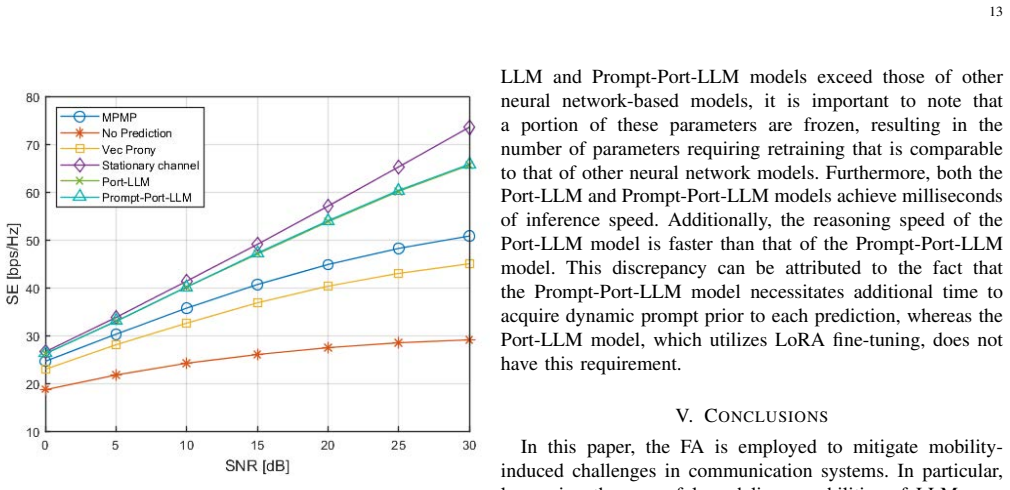
- At 90, 120, and 150 km/h, both LLM variants outperform RNN, LSTM, GRU, and Transformer baselines on port-channel NMSE, and they outperform MPMP and Vec Prony on spectral efficiency, implying the LLM approach is the strongest reported predictor in these settings.
- The two-step decomposition means port selection is only as good as the predicted channel table; the paper's reported table accuracy of 98.18% and 99.45% is the ceiling for the subsequent port decision.
- Prompt-Port-LLM's 1.27-percentage-point accuracy gain over Port-LLM does not change NMSEv materially (-23.89 vs -23.91 dB), so the LoRA-only variant already saturates the port-selection tolerance range.
Reading between the lines
- A testable extension the paper does not report: feed only the reference channel plus a sparse sample of measured ports, and measure how port accuracy degrades.
- The 'tolerance range' explanation implies port selection is robust to moderate channel-table error, so a lighter predictor might suffice; this is an inference, not a paper claim.
- The same two-step recipe—table forecasting followed by argmin alignment—could apply to other physical-layer selection tasks such as beam or RIS configuration, but the paper does not claim this.
Editorial analysis
A structured set of objections, weighed in public.
Referee Report
Summary. The paper proposes Port-LLM and Prompt-Port-LLM, two LLM-based methods for predicting future fluid antenna ports to maintain a stable channel under UE mobility. The pipeline predicts channel tables for all FA ports from past channel tables using a fine-tuned GPT-2 backbone (with LoRA or prompt fine-tuning), then selects the port whose predicted channel best matches a reference channel. Simulations on a 3GPP CDL-D channel at 39 GHz with UE speeds of 90–150 km/h report channel-table accuracy around 98–99%, reference-channel NMSE near -24 dB, and millisecond inference, with comparisons against RNN, LSTM, GRU, Transformer, MPMP, and Vec Prony baselines.
Significance. If the results hold, this is a novel application of LLMs to FA port prediction and a plausible approach to mobility mitigation. The paper provides a clearly described two-step architecture, reports comparisons against several baselines, and gives computational efficiency figures. The main strengths are the explicit pipeline design, the use of pre-trained GPT-2 with lightweight fine-tuning, and the demonstration of transfer from SISO training to MISO testing in simulation. However, the significance is tempered by the entirely synthetic single-channel-model evaluation, the lack of statistical rigor, and several unresolved practical and methodological gaps.
major comments (5)
- [III.A.1, Eqs. (15)–(16), Algorithm 1, Sec. IV.A.1]
- [IV.A.1 and Figs. 8–10; Sec. III.A architecture]
- [IV.B, Figs. 6–10, Table III]
- [IV.A.3 baselines and IV.B SE comparisons (Figs. 11–13)]
- [Eq. (34) and Fig. 6]
minor comments (5)
- [Table III]
- [IV.A.1]
- [Abstract]
- [Sec. II, Eqs. (17)–(19) and Sec. III.A.5, Eq. (30)]
- [General]
Circularity Check
No load-bearing circularity; the reported channel-table and port metrics are empirical outputs of a trained model, and the self-citations appear as baselines rather than as premises that force the result.
full rationale
The paper's derivation chain is self-contained: Eq. (19) defines the desired port as the minimizer of the distance between the true future channel table and the reference channel; Eqs. (15)-(16) define the input as past channel tables over all FA ports; Eq. (31) trains the network on normalized channel-table prediction error; Eq. (30) decodes future ports by applying the same nearest-reference rule to the predicted tables. The reported Accuracy (Eq. 34) and NMSEv (Eq. 35) are downstream measurements on unseen test data and on MISO configurations not used in training. No equation reduces to a fitted constant, no parameter is fit to the port-selection metric, and no uniqueness theorem is imported from prior work. The self-citations in [13], [14], and [16] share authors with this paper, but they are used as comparison targets or general background; the decision to use full channel tables as input is justified inside the paper by Eq. (19), not by an external self-cited result. The main caveat is practical rather than circular: the UE is assumed to have access to the full channel table S(t) for all M x N ports at past moments (Eqs. 15-16; Sec. IV.A.1 states only that 'the reference channel is accessible to the UE'), and no measurement or switching protocol is provided. That is an input-feasibility risk that would affect deployability, but it does not make the prediction equal to its input by construction. Accordingly, no specific circular step is exhibited.
Assumptions & free parameters
free parameters (6)
- LoRA rank r =
4
- Context and horizon lengths T, F =
T=8, F=8
- GPT-2 layer count =
N_L=6
- Dimensionality hyperparameters =
d_model=768, K=8, d_l=2048, prompt encoder dim=768
- Learning rate schedule =
alpha_max=1e-3, alpha_min=4e-6, warmup 100 epochs
- Sampling time T0 =
randomly selected per UE
assumptions (5)
- domain assumption The 3GPP TR 38.901 CDL-D channel model is representative of real mobile channels.
- domain assumption Full channel tables for all FA ports at past T moments are available to the model.
- domain assumption The reference channel is known to the UE at each prediction group.
- domain assumption A SISO-trained model transfers to MISO without retraining.
- domain assumption GPT-2 pretrained knowledge helps model wireless channel tables.
Cite this review
Pith. "Pith review of Port-LLM: A Port Prediction Method for Fluid Antenna based on Large Language Models." pith.science (2026). https://pith.science/paper/CTV64PV2
@misc{pith2026250209857,
  author       = {Pith},
  title        = {Pith review of: Port-LLM: A Port Prediction Method for Fluid Antenna based on Large Language Models},
  year         = {2026},
  howpublished = {\url{https://pith.science/paper/CTV64PV2}},
  note         = {Machine review of arXiv:2502.09857}
}
read the original abstract
The objective of this study is to address the mobility challenges faced by user equipment (UE) through the implementation of fluid antenna (FA) on the UE side. This approach aims to maintain the time-varying channel in a relatively stable state by strategically relocating the FA to an appropriate port. To the best of our knowledge, this paper introduces, for the first time, the application of large language models (LLMs) in the prediction of FA ports, presenting a novel model termed Port-LLM. Our proposed method for predicting the moving port of the FA is a two-step prediction method. To enhance the learning efficacy of our proposed Port-LLM model, we integrate low-rank adaptation (LoRA) fine-tuning technology. Additionally, to further exploit the natural language processing capabilities of pre-trained LLMs, we propose a framework named Prompt-Port-LLM, which is constructed upon the Port-LLM architecture and incorporates prompt fine-tuning techniques along with a specialized prompt encoder module. The simulation results show that our proposed models all exhibit strong generalization ability and robustness under different numbers of base station antennas and medium-to-high mobility speeds of UE. In comparison to existing methods, the performance of the port predicted by our models demonstrates superior efficacy. Moreover, both of our proposed models achieve millimeter-level inference speed.
Figures


Figures from the paper (8 more)


Forward citations
Cited by 4 Pith papers
-
LVM4CSI: Enabling Direct Application of Pre-Trained Large Vision Models for Wireless Channel Tasks
A frozen pre-trained vision model can extract wireless channel paths and features, beating conventional estimators in channel estimation and matching specialized networks in sensing with far fewer trainable parameters.
-
Resilient LLM-Empowered Semantic MAC Protocols via Zero-Shot Adaptation and Knowledge Distillation
A hybrid MAC protocol that starts with LLM-generated control messages and switches to a distilled neural model after retraining improves resilience to user-count changes at lower compute than pure LLM inference.
-
Vehicle-to-Infrastructure Collaborative Spatial Perception via Multimodal Large Language Models
Multi-car bird's-eye view tokens injected into a frozen vision-language model improve simulated V2I link prediction accuracy by up to 13.9 points on average.
-
Large Language Model Empowered Design of Fluid Antenna Systems: Challenges, Frameworks, and Case Studies for 6G
The paper proposes an LLM-driven framework for fluid antenna system design and reports that an LLM-assisted genetic algorithm beats a standard genetic algorithm in a multiuser port selection simulation.
Reference graph
Works this paper leans on
-
[1]
K.-K. Wong, A. Shojaeifard, K.-F. Tong, and Y . Zhang, “Fluid Antenna Systems,” IEEE Trans. Wireless Commun., vol. 20, no. 3, pp. 1950–1962, 2021
work page 1950
-
[2]
Port Selection for Fluid Antenna Systems,
Z. Chai, K.-K. Wong, K.-F. Tong, Y . Chen, and Y . Zhang, “Port Selection for Fluid Antenna Systems,” IEEE Commun. Lett. , vol. 26, no. 5, pp. 1180–1184, 2022
work page 2022
-
[3]
Performance Limits of Fluid Antenna Systems,
K. K. Wong, A. Shojaeifard, K.-F. Tong, and Y . Zhang, “Performance Limits of Fluid Antenna Systems,” IEEE Commun. Lett., vol. 24, no. 11, pp. 2469–2472, 2020
work page 2020
-
[4]
Liquid Antennas: Past, Present and Future,
Y . Huang, L. Xing, C. Song, S. Wang, and F. Elhouni, “Liquid Antennas: Past, Present and Future,” IEEE Open J. Antennas Propag. , vol. 2, pp. 473–487, 2021
2021
-
[5]
Historical review of fluid antenna and movable antenna,
L. Zhu and K.-K. Wong, “Historical review of fluid antenna and movable antenna,” arXiv preprint arXiv:2401.02362 , 2024
arXiv 2024
-
[6]
6D Movable Antenna Based on User Dis- tribution: Modeling and Optimization,
Q. J. X. Shao and R. Zhang, “6D Movable Antenna Based on User Dis- tribution: Modeling and Optimization,” IEEE Trans. Wireless Commun., vol. 24, no. 1, pp. 355–370, 2025
work page 2025
-
[7]
6D Movable Antenna Enhanced Wireless Network via Discrete Position and Rotation Opti- mization,
Q. J. X. Shao, R. Zhang and R. Schober, “6D Movable Antenna Enhanced Wireless Network via Discrete Position and Rotation Opti- mization,” IEEE J. Sel. Areas Commun. , vol. 43, no. 3, pp. 674–687, 2025. 14
work page 2025
-
[8]
Movable antennas for wireless commu- nication: Opportunities and challenges,
L. Zhu, W. Ma, and R. Zhang, “Movable antennas for wireless commu- nication: Opportunities and challenges,” IEEE Commun. Mag. , vol. 62, no. 10, pp. 114–120, 2023
2023
Show all 29 references
-
[9]
Fluid Antenna System—Part I: Preliminaries,
K.-K. Wong, W. K. New, X. Hao, K.-F. Tong, and C.-B. Chae, “Fluid Antenna System—Part I: Preliminaries,” IEEE Commun. Lett. , vol. 27, no. 8, pp. 1919–1923, 2023
1919
-
[10]
Fluid Antenna System—Part II: Research Opportunities,
K.-K. Wong, K.-F. Tong, and C.-B. Chae, “Fluid Antenna System—Part II: Research Opportunities,” IEEE Commun. Lett. , vol. 27, no. 8, pp. 1924–1928, 2023
1924
-
[11]
Movable-Antenna Enhanced Multiuser Communication via Antenna Position Optimization,
L. Zhu, W. Ma, B. Ning, and R. Zhang, “Movable-Antenna Enhanced Multiuser Communication via Antenna Position Optimization,” IEEE Trans. Wireless Commun., vol. 23, no. 7, pp. 7214–7229, 2024
2024
-
[12]
MIMO Capacity Characterization for Movable Antenna Systems,
W. Ma, L. Zhu, and R. Zhang, “MIMO Capacity Characterization for Movable Antenna Systems,” IEEE Trans. Wireless Commun. , vol. 23, no. 4, pp. 3392–3407, 2024
2024
-
[13]
Addressing the curse of mobility in massive MIMO with prony-based angular-delay domain channel predictions,
H. Yin, H. Wang, Y . Liu, and D. Gesbert, “Addressing the curse of mobility in massive MIMO with prony-based angular-delay domain channel predictions,” IEEE J. Sel. Areas Commun. , vol. 38, no. 12, pp. 2903–2917, 2020
2020
-
[14]
Transforming Time- Varying to Static Channels: The Power of Fluid Antenna Mobility,
W. Li, H. Yin, F. Fu, Y . Cao, and M. Debbah, “Transforming Time- Varying to Static Channels: The Power of Fluid Antenna Mobility,” arXiv preprint arXiv:2408.04320 , 2024
2024 arXiv
-
[15]
Large Language Models for Telecom: Forthcoming Impact on the Industry,
A. Maatouk, N. Piovesan, F. Ayed, A. D. Domenico, and M. Debbah, “Large Language Models for Telecom: Forthcoming Impact on the Industry,” IEEE Commun. Mag. , pp. 1–7, 2024
2024
-
[16]
A Superdirective Beamforming Ap- proach based on MultiTransUNet-GAN,
Y . Zhang, H. Yin, and L. Han, “A Superdirective Beamforming Ap- proach based on MultiTransUNet-GAN,” IEEE Trans. Commun. , pp. 1–1, 2024
2024
-
[17]
Machine Learning-Based Antenna Selection in Wireless Communications,
J. Joung, “Machine Learning-Based Antenna Selection in Wireless Communications,” IEEE Commun. Lett., vol. 20, no. 11, pp. 2241–2244, 2016
2016
-
[18]
A Critical Review of Recurrent Neural Networks for Sequence Learning,
Z. C. Lipton, “A Critical Review of Recurrent Neural Networks for Sequence Learning,” arXiv Preprint, CoRR, abs/1506.00019 , 2015
2015 arXiv
-
[19]
Long Short-Term Memory,
S. Hochreiter and J. Schmidhuber, “Long Short-Term Memory,” Neural Computation, vol. 9, no. 8, pp. 1735–1780, 1997
1997
-
[20]
Empirical evaluation of gated recurrent neural networks on sequence modeling,
J. Chung, C. Gulcehre, K. Cho, and Y . Bengio, “Empirical evaluation of gated recurrent neural networks on sequence modeling,” arXiv preprint arXiv:1412.3555, 2014
2014 arXiv
-
[21]
Language models are unsupervised multitask learners,
A. Radford, J. Wu, R. Child, D. Luan, D. Amodei, I. Sutskever et al., “Language models are unsupervised multitask learners,” OpenAI blog , vol. 1, no. 8, p. 9, 2019
2019
-
[22]
Csi-LLM: A Novel Downlink Channel Prediction Method Aligned with LLM Pre-Training,
S. Fan, Z. Liu, X. Gu, and H. Li, “Csi-LLM: A Novel Downlink Channel Prediction Method Aligned with LLM Pre-Training,” arXiv preprint arXiv:2409.00005, 2024
2024 arXiv
-
[23]
LLM4CP: Adapting Large Language Models for Channel Prediction,
B. Liu, X. Liu, S. Gao, X. Cheng, and L. Yang, “LLM4CP: Adapting Large Language Models for Channel Prediction,” J. Commun. Inf. Networks, vol. 9, no. 2, pp. 113–125, 2024
2024
-
[24]
Beam predic- tion based on large language models,
Y . Sheng, K. Huang, L. Liang, P. Liu, S. Jin, and G. Y . Li, “Beam predic- tion based on large language models,” arXiv preprint arXiv:2408.08707, 2024
2024 arXiv
-
[25]
Lora: Low-rank adaptation of large language models,
E. J. Hu, Y . Shen, P. Wallis, Z. Allen-Zhu, Y . Li, S. Wang, L. Wang, and W. Chen, “Lora: Low-rank adaptation of large language models,” arXiv preprint arXiv:2106.09685 , 2021
2021 arXiv
-
[26]
Technical Report TR 38.901, available: http://www.3gpp.org, 2019
3GPP, Study on channel model for frequencies from 0.5 to 100 GHz (Re- lease 16). Technical Report TR 38.901, available: http://www.3gpp.org, 2019
2019
-
[27]
Attention is All you Need,
A. Vaswani, N. Shazeer, N. Parmar, J. Uszkoreit, L. Jones, A. N. Gomez, L. Kaiser, and I. Polosukhin, “Attention is All you Need,” in Advances in Neural Information Processing Systems 30: Annual Conference on Neural Information Processing Systems (NIPS), Long Beach, CA, USA, D...
2017
-
[28]
An Image is Worth 16x16 Words: Transformers for Image Recognition at Scale,
A. Dosovitskiy, L. Beyer, A. Kolesnikov, D. Weissenborn, X. Zhai, T. Unterthiner, M. Dehghani, M. Minderer, G. Heigold, S. Gelly, J. Uszkoreit, and N. Houlsby, “An Image is Worth 16x16 Words: Transformers for Image Recognition at Scale,” in the 9th International Conference on ...
2021
-
[29]
Eigen-Based Transceivers for the MIMO Broadcast Channel With Semi-Orthogonal User Selection,
L. Sun and M. R. McKay, “Eigen-Based Transceivers for the MIMO Broadcast Channel With Semi-Orthogonal User Selection,” IEEE Trans. Signal Process., vol. 58, no. 10, pp. 5246–5261, 2010
2010
Reviewed August 7, 2026 · model on record in the stance chip above.
Discussion (0). Continue with ORCID to comment.