REVIEW 3 major objections 5 minor 32 references
Behaviour of the Schwarzian derivative on long complex projective tubes
T0 review · 3 major / 5 minor · reviewed 2026-08-07 · deepseek-v4-flash
Pith's one-line read On long complex projective tubes, the Schwarzian derivative is asymptotically universal and controls renormalized volume.
desk verdict A careful, mostly self-contained proof of sharp exponential asymptotics for the Schwarzian on long projective tubes, with the explicit constants resting on one external input that deserves scrutiny. read the letter →
The pith
A machine-rendered reading of the paper's core claim, the machinery that carries it, and where it could break.
The reading
What carries the argument
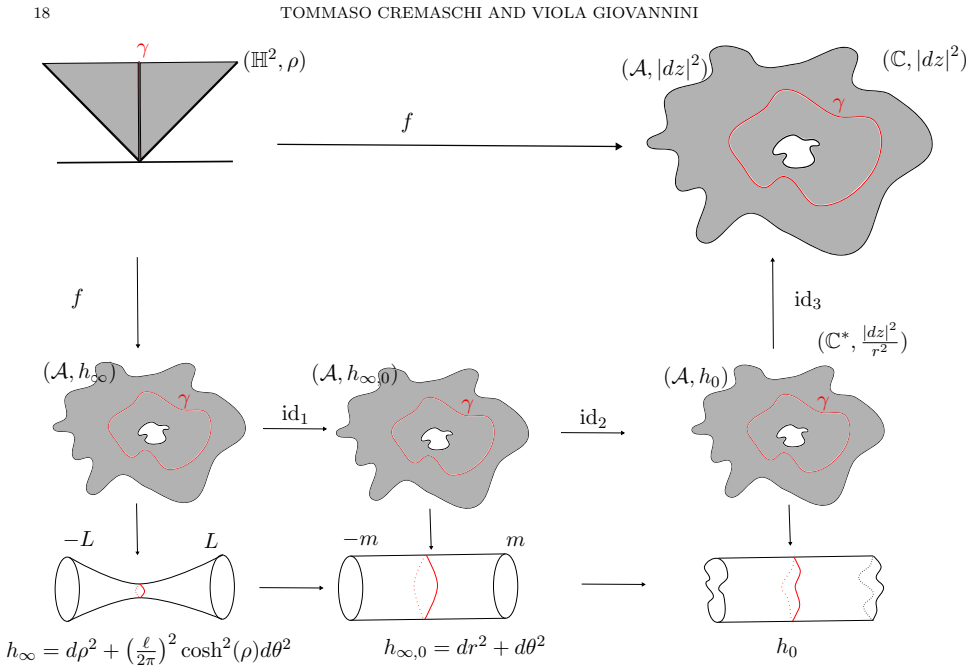
The central tool is the Osgood-Stowe tensor $B(g,e^{2u}g)$, a real symmetric $(0,2)$-tensor computed from the conformal factor $u$ between two metrics; for a developing map it equals the real part of the Schwarzian derivative. The paper factors the developing map on the tube through three intermediate metrics, so the Osgood-Stowe tensor splits into three terms, two of which are computable flat-cylinder terms. The essential unknown is a harmonic function $u_1$ on the cylinder $[-m,m]\times S^1$ that relates two flat metrics; Fourier analysis shows its coefficients and derivatives decay like $k^n e^{-km}$, and since $m\ge \pi^2/(2\ell)$ this produces the exponential error in the theorem. A Stokes-type lemma converts pairings with infinitesimal earthquakes and graftings into integrals of the Osgood-Stowe tensor over the core curve, which is why the pairing bounds reduce to estimates on $u_1$ and its derivatives.
What would settle it
Construct a non-symmetric long tube (for example, a convex co-compact hyperbolic example with a short compressible curve), compute the developing map and its Schwarzian numerically at several points of the core, and test whether the normalized error $|S(f)-\frac{1}{2z^2}(1+\frac{4\pi^2}{\ell^2})dz^2|/(e^{-\pi^2/(2\ell)}/\ell^2)$ remains bounded as $\ell\to 0$. Alternatively, compute renormalized volume along a grafting ray and check whether $V_R(M_s)-V_R(M_0)+\pi^3/\ell_s-\pi^3/\ell_0-(\ell_s-\ell_0)\pi/4$ is $O(e^{-\pi s/(2\ell_0)}s^3)$; a failure of this decay would contradict the claimed Schwarzian asymptotics.
Extended reading notes
Core claim
The central claim, Theorem 1.1, is that for a long tube $A$ of a complex projective surface $Z$ with core geodesic $\gamma$ of length $\ell\le \varepsilon_0=2\operatorname{arsinh}(1)$, the developing map $f:\mathbb{H}^2\to\mathbb{CP}^1$ satisfies $S(f)=\frac{1}{2z^2}\left(1+\frac{4\pi^2}{\ell^2}\right)dz^2+O\!\left(\frac{e^{-\pi^2/(2\ell)}}{\ell^2}\right)dz^2$ uniformly in a tubular neighbourhood of $f^{-1}(\gamma)$. The leading term is exactly the Schwarzian computed in Section 3 for the symmetric tube, so the theorem says that the Schwarzian of every long tube is asymptotic to a universal symmetric form. Theorem 1.2 then bounds the pairings with infinitesimal earthquakes and graftings, and Theorems 1.3 and 1.4 translate those bounds into renormalized-volume statements: along an earthquake path the renormalized volume changes at most by a constant times $e^{-\pi^2/\ell}t/\ell$, and along a grafting (pinching) path it follows $V_R(M_s)-V_R(M_0)=\pi^3/\ell_0-\pi^3/\ell_s+(\ell_s-\ell_0)\pi/4+O(e^{-\pi s/(2\ell_0)}s^3)$, diverging as $-\pi^3/\ell_s$ when the curve is pinched.
Load-bearing premise
The explicit constants rest on an external estimate that the conformal factor $u_1$ is bounded by $W\le 3.7$ on the boundary of the tube, obtained by comparing the ambient conformal metric with the induced metric on the convex core boundary; if this boundary bound were false or substantially larger, the stated rates in Theorems 1.2, 1.3, and 1.4 would need to be changed.
Editorial extensions
If this is right
- Any long tube with core length $\ell$ has Schwarzian $\frac{1}{2z^2}\left(1+\frac{4\pi^2}{\ell^2}\right)dz^2$ up to an error $O(e^{-\pi^2/(2\ell)}/\ell^2)$, uniformly near the core.
- The real Schwarzian is asymptotically orthogonal to infinitesimal earthquakes: $|\langle\operatorname{Re}S(f),\mu\rangle|\le C e^{-\pi^2/\ell}/\ell$.
- Infinitesimal graftings pair at size $\pi^2/\ell$, with error at most $\ell/4+C e^{-\pi^2/\ell}/\ell$.
- Along an earthquake path on a short compressible curve, renormalized volume changes by at most $C e^{-\pi^2/\ell}t/\ell$.
- Along a grafting or pinching path, $V_R(M_s)-V_R(M_0)=\pi^3/\ell_0-\pi^3/\ell_s+(\ell_s-\ell_0)\pi/4+O(e^{-\pi s/(2\ell_0)}s^3)$, so renormalized volume diverges as $-\pi^3/\ell_s$.
Reading between the lines
- One testable extension is that the same Fourier decay should control all derivatives of the conformal factor near the core, not just its first and second derivatives, giving uniform $C^k$ versions of Theorem 1.1.
- The mechanism suggests the universal leading term is stable under deformations of the surface outside the tube: two long tubes with the same core length should have Schwarzians differing only by the exponentially small remainder, which a numerical experiment could check directly.
- The error term in the pinching formula might be improvable: Lemma 4.1 gives only a two-sided bound on $\ell_s$, so sharper grafting-ray length estimates would likely make the $O(e^{-\pi s/(2\ell_0)}s^3)$ remainder more explicit.
- Since the earthquake pairing is exponentially small, the standard variational formula for the hyperbolic length of a curve suggests the length function of a short curve is nearly constant along earthquake directions, a quantitative rigidity statement not stated in the paper.
Editorial analysis
A structured set of objections, weighed in public.
Referee Report
Summary. The paper studies the Schwarzian derivative of the developing map of a complex projective structure restricted to a long tube around a short geodesic. Theorem 1.1 gives an asymptotic formula S(f) = (1/(2z^2))(1+4π^2/ℓ^2)dz^2 + O(e^{-π^2/(2ℓ)}/ℓ^2)dz^2 on a tubular neighborhood of the core. Theorem 1.2 gives quantitative bounds for the pairing of Re S(f) with infinitesimal earthquakes and graftings, with explicit constants and exponential decay. Theorems 1.3 and 1.4 translate these into bounds and asymptotics for the renormalized volume under complex earthquake paths and under pinching a compressible curve. The proof strategy is to decompose the Osgood-Stowe tensor into three terms, estimate the non-symmetric term via Fourier analysis on a Euclidean cylinder, and compare with an explicit symmetric toy model computed in Section 3.
Significance. If the quantitative estimates hold, the paper provides one of the first precise asymptotic descriptions of the Schwarzian derivative on long complex projective tubes and gives explicit control on renormalized volume variations in the compressible-boundary setting, recovering in particular the Schlenker-Witten pinching asymptotics. The method is natural and has useful cross-checks: the symmetric tube computation in Proposition 3.5 matches the main theorem to leading order, and the comparison with Gardiner's formula and McMullen's complex earthquake theory gives independent consistency. The explicit constants are a strength if fully justified, and the Osgood-Stowe/Fourier decomposition is a clean framework. However, two load-bearing quantitative steps need repair before the stated results are established: the use of Canary's theorem outside its stated length hypothesis, and the treatment of the zero Fourier mode in the core bound for the conformal factor.
major comments (3)
- [§5.4 and Remark 5.21] The Fourier estimate for the zero mode is not justified. The text solves Δu=0 on the Euclidean cylinder [−m,m]×S^1 with boundary bound |u(±m,·)|≤W≤3.7 and writes the zero mode as u_0(r)=C0+C1r. It then asserts |v1(0)|=|C0|≤W0, with W0 the smaller bound on the interior curve α. From the stated boundary data alone, one can only conclude |C0|≤W and |C1|≤2W/m, since C0 is the value at the core of a linear harmonic function whose endpoint values may be as large as W. The interior bound |u|α≤W0 does not control C0 without an additional estimate for C1 and the radial position of α. This is load-bearing: Remark 5.21 uses the W0-bound to obtain the core estimate |u(γ)|≤2.8, and Lemma 5.22 and the definition of G(ℓ) depend on it, so the constants in Theorems 5.7, 5.14 and Theorem 1.2 inherit the gap. Please either justify an r-symmetry statement for u1 for general long tubes, or provide a separate bound for the zero mode.
- [Lemmas 5.18 and 5.20] The boundary bound |u1|∂A≤W≤3.7 is the quantitative anchor of the Fourier estimates, and it is obtained from Lemma 5.18 via [Can01, Theorem 5.1]. The curves to which it is applied have h∞-lengths ℓ∞(α0)∈[2,2.5] and ℓ∞(α)=ε0≈1.76, while the quoted theorem is stated under a length <1 hypothesis. The footnote in Lemma 5.18 asserts that the length hypothesis is only needed for a linear bound, but this assertion is not substantiated and the numerical values W≤3.7, W0≤2.3 depend on the extrapolated values of b at x=2.5 and x=ε0. Since W appears in every Fourier bound in §5.4 and hence in the explicit constants 113π^2, 142π^4, and 18π^2 in Theorems 5.7, 5.14, 1.2, and 1.3, the quantitative form of the main results is not established as stated. Please either prove the required extension of Canary's bound or state the results with constants depending on an unspecified boundary bound.
- [Abstract and Theorem 1.2] The abstract and the introductory statement of Theorem 1.2 claim |Fe(ℓ)|, |Fgr(ℓ)| ≤ C e^{-π^2/ℓ}/ℓ. The bounds actually proved in §5.2 and §5.3 contain terms 113π^2 e^{-π^2/(2ℓ)}/ℓ and 18π^2 e^{-π^2/(2ℓ)}/ℓ. Since e^{-π^2/(2ℓ)}/e^{-π^2/ℓ}=e^{π^2/(2ℓ)}→∞ as ℓ→0, no constant C independent of ℓ can absorb those terms. Thus the stated exponential rate is strictly stronger than the proof supports. Please correct the statements (probably to e^{-π^2/(2ℓ)}) or improve the estimates.
minor comments (5)
- [Lemma 5.18] The line defining ℓ∞(αd) reads 'ℓ∞(αd) = ℓ cosh(L) = ℓ cosh(L−d)'; the first equality is inconsistent with the definition of αd and should be ℓ cosh(L−d).
- [Lemma 5.18] The displayed formula for b(x) is typeset in a garbled way, with missing parentheses and unclear placement of ℓ∞(αd); as printed it is not readable enough to verify the numerical values used in Lemma 5.20.
- [Lemma 2.2] The first equality of Lemma 2.2 is quoted from [GCS24, Lemma 5.1] without reproducing the argument; since the lemma is called 'key' and used repeatedly, a self-contained proof or a precise statement of the cited lemma would improve the paper.
- [References] There are small typographical issues in the references, e.g. 'srojective structures' in [KM] and 'Menifolds' in [MT98]; these should be corrected.
- [Figure 1] The caption of Figure 1 mentions id3, but the diagram and the surrounding decomposition only use id0, id1, id2; this is confusing and should be fixed.
Circularity Check
No significant circularity: the central estimates derive from external geometric bounds; only a minor, non-load-bearing self-citation appears.
full rationale
The paper's central claims (Theorems 1.1-1.4) are not circular. Theorem 1.1 is proved by comparing a general long tube to the explicitly computed symmetric tube via the conformal map F_l, with the discrepancy controlled by the Osgood-Stowe tensor and Fourier estimates on the flat conformal factor u_1; neither the model computation nor the error mechanism is defined in terms of the target Schwarzian asymptotics. Theorem 1.2 follows from Lemma 2.2 plus the independent estimates in Theorems 5.7 and 5.14, and Lemma 2.2 is a Stokes-type identity whose second half is proved in the text and whose first half is a standard computation (cited from [GCS24] but not load-bearing: it only converts pairings to boundary integrals and does not inject the desired conclusion). The explicit constants depend on the boundary bound W from Lemma 5.20, which rests on Canary's external theorem [Can01]; this is an external input and a possible correctness risk (e.g. the footnote extends Canary's bound beyond its stated length < 1 hypothesis), not a circularity. The paper also checks against independent benchmarks: the symmetric tube toy model, Gardiner's formula, McMullen's complex earthquakes, and the known Schlenker-Witten pinching asymptotics, which it recovers rather than assumes. No fitted parameters are renamed as predictions and no uniqueness theorem from the authors' prior work is invoked to force a choice.
Assumptions & free parameters
assumptions (8)
- standard math Riemann uniformization and Bers embedding identify Teichmüller space with Beltrami and quadratic differentials.
- standard math Collar lemma and Margulis tube estimates (Buser, Theorem 4.1.6).
- standard math McMullen's theorem that the complex earthquake map is holomorphic and ν = iμ.
- standard math Gardiner's formula for the differential of hyperbolic length.
- standard math Canary's bound on lengths of curves on the convex core boundary (Can01, Theorem 5.1).
- standard math Krasnov-Schlenker theorem: dVR = Re⟨S(f), μ⟩.
- standard math Diaz-Kim grafting length bounds (DK07, Proposition 3.4).
- domain assumption Tameness and deformation space parametrization CC(M) ≅ T(∂M)/T0(D).
Cite this review
Pith. "Pith review of Behaviour of the Schwarzian derivative on long complex projective tubes." pith.science (2026). https://pith.science/paper/2TZWE5GS
@misc{pith2026250210071,
  author       = {Pith},
  title        = {Pith review of: Behaviour of the Schwarzian derivative on long complex projective tubes},
  year         = {2026},
  howpublished = {\url{https://pith.science/paper/2TZWE5GS}},
  note         = {Machine review of arXiv:2502.10071}
}
read the original abstract
The Schwarzian derivative parametrizes the fibres of the space of complex projective structures on a surface as vector bundle over its Teichm\"uller space. We study its behaviour on long complex projective tubes, and get estimates for the pairing of its real part with infinitesimal earthquakes and graftings. As the real part of their Schwarzian coincides with the differential of the renormalized volume we obtain bounds for the variation of renormalized volume under complex earthquake paths, and its asymptotic behaviour under pinching a compressible curve.
Figures
Reference graph
Works this paper leans on
-
[1]
Tameness of hyperbolic 3-manifolds
Ian Agol. Tameness of hyperbolic 3-manifolds . http://arxiv.org/abs/math/0405568 , 2004
arXiv 2004
-
[2]
Epstein surfaces, w -volume, and the osgood-stowe differential
Martin Bridgeman and Kenneth Bromberg. Epstein surfaces, w -volume, and the osgood-stowe differential. 2024
work page 2024
-
[3]
Martin Bridgeman, Jeffrey Brock, and Kenneth Bromberg. Schwarzian derivatives, projective structures, and the weil--petersson gradient flow for renormalized volume. Duke Mathematical Journal , 168(5):867 -- 896, 2019
work page 2019
-
[4]
Martin Bridgeman, Jeffrey Brock, and Kenneth Bromberg. Schwarzian derivatives, projective structures, and the W eil- P etersson gradient flow for renormalized volume. Duke Math. J. , 168(5):867--896, 2019
work page 2019
-
[5]
The W eil- P etersson gradient flow of renormalized volume and 3-dimensional convex cores
Martin Bridgeman, Jeffrey Brock, and Kenneth Bromberg. The W eil- P etersson gradient flow of renormalized volume and 3-dimensional convex cores. Geom. Topol. , 27(8):3183--3228, 2023
work page 2023
-
[6]
Martin Bridgeman, Kenneth Bromberg, and Franco Vargas Pallete. Convergence of the gradient flow of renormalized volume to convex cores with totally geodesic boundary. Compos. Math. , 159(4):830--859, 2023
work page 2023
-
[7]
Martin Bridgeman and Richard D. Canary. Renormalized volume and the volume of the convex core. Annales de l'Institut Fourier , 67(5):2083--2098, 2017
work page 2017
- [8]
Show all 32 references
-
[9]
a user Classics. Birkh\
Peter Buser. Geometry and spectra of compact R iemann surfaces . Modern Birkh\" a user Classics. Birkh\" a user Boston, Ltd., Boston, MA, 2010. Reprint of the 1992 edition
2010
-
[10]
R. D. Canary. The conformal boundary and the boundary of the convex core . Duke Mathematical Journal , 106(1):193 -- 207, 2001
2001
-
[11]
Shrinkwrapping and the taming of hyperbolic 3-manifolds
Danny Calegary and David Gabai. Shrinkwrapping and the taming of hyperbolic 3-manifolds . Journal of American Mathematical Society , 19(2):385--446, 2006
2006
-
[12]
Asymptotic behavior of grafting rays
Raquel Diaz and Inkang Kim. Asymptotic behavior of grafting rays. 2007
2007
-
[13]
Complex projective structures
David Dumas. Complex projective structures. 13:455--508, 2008
2008
-
[14]
Projective structures, grafting and measured laminations
David Dumas and Michael Wolf. Projective structures, grafting and measured laminations . Geometry & Topology , 12(1):351 -- 386, 2008
2008
-
[15]
Primer on Mapping Class Groups
Benson Farb and Dan Margalit. Primer on Mapping Class Groups . Princeton Mathematical Series , 2011
2011
-
[16]
Gardiner
Frederick P. Gardiner. Schiffer's interior variation and quasiconformal mapping. Duke Math. J. , 42(1):371--380, 1975
1975
-
[17]
Quasiconformal Teichm\"uller Theory , volume 76 of Mathematical Surveys and Monographs
Nikola Gardiner, Frederick P.; Lakic. Quasiconformal Teichm\"uller Theory , volume 76 of Mathematical Surveys and Monographs . American Mathematical Society, first edition, 2000
2000
-
[19]
Sebastian W. Hensel. Iterated grafting and holonomy lifts of teichmueller space, 2008
2008
-
[20]
Teichm \"u ller theory and applications to geometry, topology, and dynamics , volume 1-2
John H Hubbard. Teichm \"u ller theory and applications to geometry, topology, and dynamics , volume 1-2. Matrix Editions, 2016
2016
-
[21]
Kra and B
I. Kra and B. Maskit. Remarks on srojective structures: Riemann Surfaces and Related Topics
-
[22]
On the renormalized volume of hyperbolic 3-manifolds
Kirill Krasnov and Jean-Marc Schlenker. On the renormalized volume of hyperbolic 3-manifolds. Communications in Mathematical Physics , (279):637--668, 2008
2008
-
[23]
Hyperbolic Manifolds: An introduction in 2 and 3 dimensions
Albert Marden. Hyperbolic Manifolds: An introduction in 2 and 3 dimensions . Cambridge University Press , 2016
2016
-
[24]
An introduction to geometric topology
Bruno Martelli. An introduction to geometric topology . arXiv:1610.02592v1 , 2016
2016 arXiv
-
[25]
Complex earthquakes and teichm\"uller theory
Curt McMullen. Complex earthquakes and teichm\"uller theory. Journal of the American Mathematical Society , 11:283--320, 1998
1998
-
[26]
Hyperbolic Menifolds and Kleinian Groups
Katsuhiko Matsuzaki and Masahiko Taniguchi. Hyperbolic Menifolds and Kleinian Groups . Oxford University Press , 1998
1998
-
[27]
The schwarzian derivative and schlicht functions
Zeev Nehari. The schwarzian derivative and schlicht functions. Bull. Amer. Math. Soc. , 55:545--551, 1949
1949
-
[28]
The schwarzian derivative and conformal mapping of riemannian manifolds
Brad Osgood and Dennis Stowe. The schwarzian derivative and conformal mapping of riemannian manifolds. Duke Mathematical Journal , 67(1):57 -- 99, 1992
1992
-
[29]
Continuity of the renormalized volume under geometric limits
Franco Vargas Pallete. Continuity of the renormalized volume under geometric limits. arXiv:1605.07986, 2016
2016 arXiv
-
[30]
Hypersurfaces in H n and the space of its horospheres
Jean-Marc Schlenker. Hypersurfaces in H n and the space of its horospheres. Geom. Funct. Anal. , 12(2):395--435, 2002
2002
-
[31]
The renormalized volume and the volume of the convex core of quasifuchsian manifolds
Jean-Marc Schlenker. The renormalized volume and the volume of the convex core of quasifuchsian manifolds. Math. Res. Lett. , 20(4):773--786, 2013. Corrected version available as arXiv:1109.6663v4
2013 arXiv
-
[32]
Notes on the Schwarzian tensor and measured foliations at infinity of quasifuchsian manifolds
Jean-Marc Schlenker . Notes on the Schwarzian tensor and measured foliations at infinity of quasifuchsian manifolds . ArXiv e-prints , August 2017
2017
-
[33]
No ensemble averaging below the black hole threshold
Jean-Marc Schlenker and Edward Witten. No ensemble averaging below the black hole threshold. J. High Energy Phys. , (7):Paper No. 143, 50, 2022
2022
Reviewed August 7, 2026 · model on record in the stance chip above.
Discussion (0). Continue with ORCID to comment.