REVIEW 2 major objections 4 minor 31 references
The hadronic contribution to the running of $\alpha$ and the electroweak mixing angle
T0 review · 2 major / 4 minor · reviewed 2026-08-07 · deepseek-v4-flash
Pith's one-line read Lattice QCD can now compute the high-energy hadronic contribution to the running of alpha and sin²θ_W up to Q² = 9 GeV² with controlled errors, making a high-precision Δα_had^(5)(M_Z²) feasible.
desk verdict Careful lattice window results, but the title overclaims and the perturbative subtraction uncertainty is left unquantified. read the letter →
The pith
A machine-rendered reading of the paper's core claim, the machinery that carries it, and where it could break.
The reading
What carries the argument
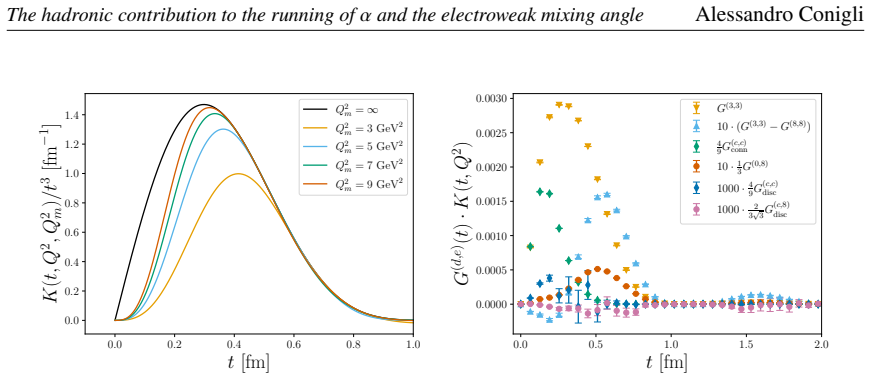
The central object is the subtracted window $b\Pi(Q^2)=\Pi(Q^2)-\Pi(Q^2/4)$, evaluated through the time-momentum representation with a modified kernel $$K_{\rm sub}(x_0,$Q^{2}$,$Q_m^{2}$)=\frac{16}{$Q^{2}$}\$sin^{4}$\!\left(\frac{Qx_0}{4}\right)-\frac{$Q^{2}$}{$Q_m^{4}$}\$sin^{4}$\!\left(\frac{Q_m x_0}{2}\right),$$ which removes the leading $x_0^4$ growth of the integrand and suppresses $O(a^2\log a)$ discretization errors. The subtracted contribution is restored from the massless perturbative Adler function through $b^{(3,3)}(Q^2,Q_m^2)=\frac{Q^2}{4Q_m^2}[\Pi^{(3,3)}(4Q_m^2)-\Pi^{(3,3)}(Q_m^2)]$ at the default $Q_m=3\,\mathrm{GeV}$, with the charm analogue written as $2b^{(3,3)}+\Delta_{lcb}$. Tree-level correction factors $O_{\rm tl}(0)/O_{\rm tl}(a)$ further reduce cutoff effects, and Padé approximants $R^N_M(Q^2)$ provide an analytic representation of the $Q^2$ dependence used for the running with energy.
What would settle it
Repeat the same analysis at fixed $Q^2$ with the subtraction scale changed from $Q_m=3\,\mathrm{GeV}$ to $5\,\mathrm{GeV}$; if the continuum-extrapolated window $\Pi(Q^2)-\Pi(Q^2/4)$ shifts by more than the quoted combined error, the perturbative subtraction is not controlled. A second check is that the local and point-split current discretizations must agree in the continuum limit after the tree-level correction $O_{\rm tl}(0)/O_{\rm tl}(a)$ is applied.
Extended reading notes
Core claim
The central claim is that the leading hadronic contribution to the running of $\alpha$ and $\sin^2\theta_W$ in the high-energy regime can be determined on the lattice with controlled systematic errors by computing the subtracted HVP function $b\Pi(Q^2)=\Pi(Q^2)-\Pi(Q^2/4)$ up to $Q^2=9\,\mathrm{GeV}^2$. The subtraction cancels the leading $x_0^4$ short-time behaviour of the time-momentum kernel, and the removed piece is added back analytically using the massless perturbative Adler function at the default scale $Q_m=3\,\mathrm{GeV}$. With five lattice spacings, physical-pion ensembles, two independent $O(a)$-improvement schemes and two vector-current discretizations, the paper reports a controlled chiral-continuum extrapolation for the isovector, isoscalar, charm-connected, and $Z\gamma$ mixed contributions, with fit-model systematics estimated by a weighted information-criterion average. The paper presents these as preliminary results and concludes that high-precision estimates of $\Delta\alpha_{\mathrm{had}}^{(5)}(M_Z^2)$ at the $Z$ pole are now in prospect, provided the complementary low-energy window $\Pi(Q^2/4)-\Pi(0)$ is computed with comparable accuracy.
Load-bearing premise
The load-bearing premise is that the subtraction term added back from massless perturbative QCD at $Q_m=3\,\mathrm{GeV}$ (and its charm analogue) is accurate enough that non-perturbative corrections are negligible at the quoted precision; if the perturbative Adler function is not reliable at this scale, the added-back term carries an uncertainty that the lattice data cannot constrain.
Editorial extensions
If this is right
- The high-energy window $\Pi(Q^2)-\Pi(Q^2/4)$ has been obtained from first principles up to $Q^2=9\,\mathrm{GeV}^2$, so the remaining hadronic uncertainty in $\Delta\alpha_{\mathrm{had}}^{(5)}(M_Z^2)$ is concentrated in the low-energy piece $\Pi(Q^2/4)-\Pi(0)$, which the paper plans to compute with the same ensembles.
- A lattice determination of $\Delta\alpha_{\mathrm{had}}^{(5)}(M_Z^2)$ at high precision would provide a first-principles cross-check of data-driven evaluations and sharpen the comparison with global electroweak fits.
- The same subtracted-window results feed directly into the running of $\sin^2\theta_W$, including the mixed $Z\gamma$ contribution relevant for low-energy electroweak precision experiments.
- The short-distance subtraction reduces lattice artefacts enough that finer ensembles or higher $Q^2$ can be added without cutoff effects dominating the error.
Reading between the lines
- Inference: the same $\Pi(Q^2)-\Pi(Q^2/4)$ window construction could isolate the short-distance part of other hadronic quantities, such as windowed contributions to the muon $g-2$, wherever the time-momentum kernel grows like $x_0^4$ at short times.
- Inference: scanning the subtraction scale $Q_m$ would convert the perturbative matching into a diagnostic, since the final window should be independent of $Q_m$; the first scale at which results shift would mark where massless perturbative QCD ceases to be controlled.
- Implicit consequence: once $\Pi(Q^2/4)-\Pi(0)$ is computed at comparable precision, the total $\Delta\alpha_{\mathrm{had}}^{(5)}(M_Z^2)$ becomes a first-principles number that can be confronted directly with data-driven evaluations, sharpening the existing tension rather than leaving it as a side remark.
Editorial analysis
A structured set of objections, weighed in public.
Referee Report
Summary. The paper reports a lattice QCD calculation of the subtracted hadronic vacuum polarization (HVP) function bΠ(Q²)=Π(Q²)−Π(Q²/4) for Q² up to 9 GeV², using N_f=2+1 O(a)-improved Wilson fermions on 26 CLS ensembles spanning five lattice spacings and pion masses down to the physical point. The authors decompose the isovector, isoscalar, charm-connected, and Zγ contributions, applying a kernel subtraction to reduce short-distance cutoff effects. The subtracted term is computed from the massless perturbative Adler function at a default scale Q_m=3 GeV and added back analytically. Chiral-continuum extrapolations are performed with two current discretizations, two improvement-coefficient sets, several fit ansätze, and Takeuchi Information Criterion model averaging. Results for the window bΠ are shown as functions of Q² for Δα_had and Δsin²θ_W. The conclusion states that the work provides excellent prospects for a high-precision estimate of Δα_had^(5)(M_Z²), with the low-energy component Π(Q²/4)−Π(0) left for future work.
Significance. If the method is validated, this is a promising first-principles route to the hadronic running of α and sin²θ_W at high momentum transfers, potentially complementing or challenging data-driven estimates. The paper’s strengths are its extensive cross-checks of the lattice systematics: two vector-current discretizations, two non-perturbative improvement schemes, five lattice spacings, chiral fits with multiple ansätze, and model averaging. These elements give reasonable confidence in the chiral-continuum extrapolation. However, the central claim of controlled systematic uncertainties currently rests on an unquantified perturbative input—the subtracted term added back in Eqs. (8)–(9) and (13)–(14)—which is not directly tested by the lattice data. The paper is a proceedings contribution and explicitly presents preliminary results, so the missing analysis is a gap in the present manuscript rather than a fundamental obstruction.
major comments (2)
- [§2.3, Eqs. (8), (9), (13), (14)] The perturbative subtraction term b^(3,3)(Q²,Q_m²), and the charm-counterpart 2b^(3,3)+Δ_lcb, are computed from the massless perturbative Adler function at the default scale Q_m=3 GeV and added back to the lattice-determined bΠ_sub. The text states that this term 'can be computed reliably' (p. 4), but it does not specify the perturbative order used, the renormalization-scale uncertainty, or the magnitude of non-perturbative (OPE/condensate) corrections. Since any error in this added-back term enters bΠ linearly and is not constrained by the lattice data, the claim that the high-energy window is computed with controlled systematic uncertainties is not yet substantiated. I recommend adding a quantitative estimate, for example a scan of the final window as a function of Q_m (or a change of the renormalization scale) and an estimate of OPE corrections, to demonstrate that the added-back term is reliable at the quoted precision.
- [§4, Eq. (19)] The Padé representation with M=2, N=3 is used to provide a smooth analytic representation of bΠ(Q²), and the results in Fig. 4 are based on this parametrization. The paper states that higher-order coefficients are 'poorly determined,' but no systematic error from the choice of Padé order is quantified. Since the final curves and any subsequent integration to M_Z² would inherit this uncertainty, an estimate of the Padé truncation error (e.g., by comparing M=2/3 and N=2/3 variants or using a different parametrization) is needed to support the 'controlled systematics' claim.
minor comments (4)
- [Abstract and §2.1] The lattice-spacing range is quoted as '0.0039 fm< a <0.087 fm'; the lower value appears to be a typo for 0.039 fm, since CLS ensembles with β=3.85 have a≈0.039 fm. Please correct.
- [§4, Fig. 4] The figure would be more informative if the error bands were described in the caption or text—specifically, whether they include statistical and systematic uncertainties, and how they were propagated from the model average.
- [§5] The sentence referring to 'the observed tension with data-driven approaches for Δα_had(Q²)' is vague; please specify which comparison is meant and provide a reference or quantitative statement.
- [General] Since the paper presents results only through figures, a small table with the central values and total uncertainties of the contributions at a representative Q² (e.g., 5 GeV²) would greatly improve the transparency of the results for a proceedings contribution.
Circularity Check
No significant circularity: the perturbative subtraction is an external input, and the lattice window results are independently computed.
full rationale
The derivation chain is self-contained on the lattice side. Equation (6) is an identity; Equation (8) defines the lattice-computed subtracted window bPi_sub; Equation (9) defines the added-back term b^(3,3) explicitly as a combination of vacuum-polarization values evaluated with the massless perturbative Adler function. This perturbative term is an external theoretical input, not a parameter fitted to the lattice data, and it is not renamed as a lattice prediction. The chiral-continuum extrapolations are performed on lattice-determined quantities across five lattice spacings and several pion masses, with model averaging for systematics. The Padé representation in Eq. (19) is a fitting description of the computed points, not a circular input. The paper's central claim is that the method shows 'excellent prospects' for future high-precision estimates, not a final fitted number masquerading as a prediction. The paper does lean on the authors' earlier work [1,21] for the decomposition and improvement techniques, and some of those citations are by the same group; however, these are methodological references, not load-bearing self-validating theorems. The identified weakness—that the perturbative subtraction term at Q_m = 3 GeV is added back without a quantified perturbative uncertainty—is a legitimate systematic-error concern, but it is a robustness issue rather than circularity, since the perturbative input does not derive from the lattice observable being predicted.
Assumptions & free parameters
free parameters (3)
- Q_m (subtraction scale) =
3 GeV (default)
- chiral-continuum fit coefficients β2, β3, β4, δ2, δ3, ε2, γ1, γ2, γ0 =
not quoted in the paper
- Padé coefficients a_j, b_k (M=2, N=3) =
not quoted
assumptions (4)
- domain assumption The massless perturbative Adler function reliably describes the subtracted term b^(3,3)(Q²,Q_m²) at Q_m = 3 GeV.
- domain assumption Symanzik effective theory form of the lattice-spacing dependence with terms up to a^4 and linear chiral dependence.
- domain assumption Tree-level lattice perturbation theory captures the dominant cutoff effects, allowing the correction O(a) -> O(a)·O_tl(0)/O_tl(a).
- standard math The time-momentum representation of the HVP, Eq. (3), is valid with the given kernel.
Cite this review
Pith. "Pith review of The hadronic contribution to the running of $\alpha$ and the electroweak mixing angle." pith.science (2026). https://pith.science/paper/YAT6QCOL
@misc{pith2026250210159,
  author       = {Pith},
  title        = {Pith review of: The hadronic contribution to the running of $\alpha$ and the electroweak mixing angle},
  year         = {2026},
  howpublished = {\url{https://pith.science/paper/YAT6QCOL}},
  note         = {Machine review of arXiv:2502.10159}
}
abstract
We report on our update to [1] on the hadronic running of electroweak couplings from $O(a)$-improved Wilson fermions with $N_f=2+1$ flavours. The inclusion of additional ensembles at very fine lattice spacings together with a number of techniques to split the different contributions for a better control of cutoff effects allows us to substantially improve the precision. We employ two different discretizations of the vector current to compute the subtracted Hadronic Vacuum Polarization (HVP) functions $\bar{\mathit{\Pi}}^{\gamma\gamma}$ and $\bar{\mathit{\Pi}}^{Z\gamma}$ for Euclidean time momenta up to $Q^2\leq 9 \ \mathrm{GeV}^2$ . To reduce cutoff effects in the short distance region we apply a suitable subtraction to the TMR kernel function, which cancels the leading $x_0^4$ behaviour. The subtracted term is then computed in perturbative QCD using the Adler function and added back to compensate for the subtraction. Chiral-continuum extrapolations are performed with five values of the lattice spacing and several pion masses, including its physical value, and several fit ans\"atze are explored to estimate the systematics arising from model selection. Our results show excellent prospects for high-precision estimates of $\Delta\alpha_{\mathrm{had}}^{(5)}(M_Z^2)$ at the Z-pole.
Figures


Figures from the paper (1 more)

Reference graph
Works this paper leans on
-
[21]
S. Kuberski, M. Cè, G. von Hippel, H. B. Meyer, K. Ottnad, A. Risch et al.,Hadronic vacuum polarization in the muon g− 2: the short-distance contribution from lattice QCD, JHEP 03 (2024) 172, [2401.11895]
arXiv 2024
-
[1]
M. Cè, A. Gérardin, G. von Hippel, H. B. Meyer, K. Miura, K. Ottnad et al.,The hadronic running of the electromagnetic coupling and the electroweak mixing angle from lattice QCD, JHEP 08 (2022) 220, [2203.08676]
arXiv 2022
-
[2]
Abi et al.,Measurement of the Positive Muon Anomalous Magnetic Moment to 0.46 ppm, Phys
(Muon g-2), B. Abi et al.,Measurement of the Positive Muon Anomalous Magnetic Moment to 0.46 ppm, Phys. Rev. Lett.126 (2021) 141801, [2104.03281]
arXiv 2021
-
[3]
(Muon g-2), D. P. Aguillard et al.,Measurement of the Positive Muon Anomalous Magnetic Moment to 0.20 ppm,Phys. Rev. Lett.131 (2023) 161802, [2308.06230]
arXiv 2023
-
[4]
S. Borsanyi et al.,Leading hadronic contribution to the muon magnetic moment from lattice QCD, Nature 593 (2021) 51, [2002.12347]
arXiv 2021
-
[5]
D. Djukanovic, G. von Hippel, S. Kuberski, H. B. Meyer, N. Miller, K. Ottnad et al.,The hadronicvacuumpolarizationcontributiontothemuon 𝑔− 2atlongdistances , 2411.07969
-
[6]
A. Boccaletti et al.,High precision calculation of the hadronic vacuum polarisation contribution to the muon anomaly, 2407.10913
-
[7]
(RBC, UKQCD), T. Blum et al.,The long-distance window of the hadronic vacuum polarization for the muon g-2, 2410.20590
Show all 31 references
-
[8]
Bazavov et al.,Hadronic vacuum polarization for the muon𝑔− 2 from lattice QCD: Long-distance and full light-quark connected contribution, 2412.18491
A. Bazavov et al.,Hadronic vacuum polarization for the muon𝑔− 2 from lattice QCD: Long-distance and full light-quark connected contribution, 2412.18491
-
[9]
Becker et al.,The P2 experiment, Eur
D. Becker et al.,The P2 experiment, Eur. Phys. J. A54(2018) 208, [1802.04759]
2018 arXiv
-
[10]
Bruno, T
M. Bruno, T. Korzec and S. Schaefer,Setting the scale for the CLS2+ 1 flavor ensembles, Phys. Rev. D95 (2017) 074504, [1608.08900]
2017 arXiv
-
[11]
Mohler, S
D. Mohler, S. Schaefer and J. Simeth,CLS 2+1 flavor simulations at physical light- and strange-quark masses, EPJ Web Conf.175 (2018) 02010, [1712.04884]
2018 arXiv
-
[12]
Mohler and S
D. Mohler and S. Schaefer,Remarks on strange-quark simulations with Wilson fermions, Phys. Rev. D102 (2020) 074506, [2003.13359]
2020 arXiv
-
[13]
Kuberski,Low-mode deflation for twisted-mass and RHMC reweighting in lattice QCD, Comput
S. Kuberski,Low-mode deflation for twisted-mass and RHMC reweighting in lattice QCD, Comput. Phys. Commun.300 (2024) 109173, [2306.02385]
2024 arXiv
-
[14]
(RQCD), G. S. Bali, E. E. Scholz, J. Simeth and W. Söldner,Lattice simulations with 𝑁𝑓 = 2+ 1 improved Wilson fermions at a fixed strange quark mass,Phys. Rev. D94(2016) 074501, [1606.09039]
2016 arXiv
-
[15]
Gerardin, T
A. Gerardin, T. Harris and H. B. Meyer,Nonperturbative renormalization and 𝑂(𝑎)-improvement of the nonsinglet vector current with𝑁𝑓 = 2+ 1 Wilson fermions and tree-level Symanzik improved gauge action, Phys. Rev. D99 (2019) 014519, [1811.08209]. 9 The hadronic contribution to ...
2019 arXiv
-
[16]
Heitger and F
(ALPHA), J. Heitger and F. Joswig,The renormalisedO(𝑎) improved vector current in three-flavour lattice QCD with Wilson quarks,Eur. Phys. J. C81(2021) 254, [2010.09539]
2021 arXiv
-
[17]
Fritzsch,Mass-improvement of the vector current in three-flavor QCD, JHEP 06(2018) 015, [1805.07401]
P. Fritzsch,Mass-improvement of the vector current in three-flavor QCD, JHEP 06(2018) 015, [1805.07401]
2018 arXiv
-
[18]
Cè et al.,Window observable for the hadronic vacuum polarization contribution to the muon g-2 from lattice QCD, Phys
M. Cè et al.,Window observable for the hadronic vacuum polarization contribution to the muon g-2 from lattice QCD, Phys. Rev. D106 (2022) 114502, [2206.06582]
2022 arXiv
-
[19]
Bernecker and H
D. Bernecker and H. B. Meyer,Vector Correlators in Lattice QCD: Methods and applications,Eur. Phys. J. A47(2011) 148, [1107.4388]
2011 arXiv
-
[20]
Francis, B
A. Francis, B. Jaeger, H. B. Meyer and H. Wittig,A new representation of the Adler function for lattice QCD, Phys. Rev. D88(2013) 054502, [1306.2532]
2013 arXiv
-
[22]
M. Cè, T. Harris, H. B. Meyer, A. Toniato and C. Török,Vacuum correlators at short distances from lattice QCD,JHEP 12 (2021) 215, [2106.15293]
2021 arXiv
-
[23]
Sommer, L
R. Sommer, L. Chimirri and N. Husung,Log-enhanced discretization errors in integrated correlation functions, PoS LATTICE2022(2023) 358, [2211.15750]
2023 arXiv
-
[24]
Urech,Virtual photons in chiral perturbation theory, Nucl
R. Urech,Virtual photons in chiral perturbation theory, Nucl. Phys. B433 (1995) 234, [hep-ph/9405341]
1995 arXiv
-
[25]
Neufeld and H
H. Neufeld and H. Rupertsberger,The Electromagnetic interaction in chiral perturbation theory,Z. Phys. C71(1996) 131, [hep-ph/9506448]
1996 arXiv
-
[26]
Lüscher,Properties and uses of the Wilson flow in lattice QCD, JHEP 08(2010) 071, [1006.4518]
M. Lüscher,Properties and uses of the Wilson flow in lattice QCD, JHEP 08(2010) 071, [1006.4518]. [Erratum: JHEP03(2014) 092]
2010 arXiv
-
[27]
(RQCD), G. S. Bali, S. Collins, P. Georg, D. Jenkins, P. Korcyl, A. Schäfer et al.,Scale setting and the light baryon spectrum in N𝑓 = 2 + 1 QCD with Wilson fermions, JHEP 05 (2023) 035, [2211.03744]
2023 arXiv
-
[28]
W. I. Jay and E. T. Neil,Bayesian model averaging for analysis of lattice field theory results, Phys. Rev. D103 (2021) 114502, [2008.01069]
2021 arXiv
-
[29]
Frison,Towards fully bayesian analyses in Lattice QCD, 2302.06550
J. Frison,Towards fully bayesian analyses in Lattice QCD, 2302.06550
-
[30]
Gérardin, M
A. Gérardin, M. Cè, G. von Hippel, B. Hörz, H. B. Meyer, D. Mohler et al.,The leading hadronic contribution to(𝑔− 2)𝜇 from lattice QCD with𝑁f = 2+ 1 flavours of O(𝑎) improved Wilson quarks,Phys. Rev. D100 (2019) 014510, [1904.03120]
2019 arXiv
-
[31]
Aubin, T
C. Aubin, T. Blum, M. Golterman and S. Peris,Model-independent parametrization of the hadronic vacuum polarization and𝑔-2 for the muon on the lattice,Phys. Rev. D86(2012) 054509, [1205.3695]. 10
2012 arXiv
Reviewed August 7, 2026 · model on record in the stance chip above.
Discussion (0). Continue with ORCID to comment.