REVIEW 4 major objections 5 minor 33 references
RIPOST: Two-Phase Private Decomposition for Multidimensional Data
T0 review · 4 major / 5 minor · reviewed 2026-08-07 · deepseek-v4-flash
Pith's one-line read RIPOST constructs an ε-differentially private view of multidimensional count data without needing a predefined decomposition depth, using a two-phase split that first isolates empty cells and then refines non-empty blocks to minimize…
desk verdict Useful two-phase decomposition for DP data release, but the privacy proof leaves the leaf perturbation unspecified—fix that before trusting the ε claim. read the letter →
The pith
A machine-rendered reading of the paper's core claim, the machinery that carries it, and where it could break.
The reading
What carries the argument
The load-bearing piece is the budget-weight series ω_i = k/(i(i+1)) with an offset os such that os ≥ k, which makes the weights sum to at most 1 over any decomposition depth and lets Secure_cc and Secure_ss draw a per-operation budget ε_i = ω_i × ε_phase without knowing h in advance. Around that sits the two-phase decision loop: phase 1 uses the Laplace-perturbed sum with threshold 0 to certify empty blocks and an exponential-mechanism split scoring by min{min-left, min-right} of empty/non-empty counts; phase 2 uses perturbed aggregation error for convergence and exponential-mechanism splits scoring by -(AE_left + AE_right). The leaf values published are the block means after Laplace perturbation. Sensitivity values used are ΔSum = 1, ΔMin = 1, and ΔAE = 2.
What would settle it
Compute the actual privacy loss along the deepest leaf path for a specific tensor by summing the per-operation weights ω_i multiplied by the phase budgets ε_{1cc}, ε_{1ss}, ε_{2cc}, and ε_{2ss}, plus the leaf-mean noise, and verify the total is below ε; then check what sensitivity and scale the implementation uses for the leaf mean. If a block of n cells is published with Laplace scale based on sensitivity 1 instead of 1/n, the view is private but overly noisy; if the scale is based on a sensitivity smaller than the true one, the ε-DP claim fails. A runnable test is to use a DP auditor on pairs of neighboring tensors and compare the released view distributions against the e^ε bound.
Extended reading notes
Core claim
The paper's central claim is that you can build an ε-DP materialized view of a multidimensional count tensor by recursion whose depth is not fixed in advance and whose split decisions are data-dependent, and do so without exceeding the privacy budget on any root-to-leaf path. The mechanism is two-phase: phase 1 repeatedly tests whether a block's noisy sum is at most 0 to certify the block as empty (or near-empty) and splits otherwise using an exponential-mechanism score based on separating empty from non-empty cells; phase 2 takes the surviving blocks and splits them by noisy aggregation error (AE) until a block's perturbed AE falls below the threshold, then publishes each leaf's Laplace-perturbed mean. Budgets are assigned per operation from the series ω_i = k/(i(i+1)) with offset os ≥ k, whose total over any depth is at most 1, so the sum of per-operation budgets per phase is bounded without knowing h. The paper also reports experiments where RIPOST's average relative RMSE is 1.47× lower than the closest competitor HDPView on the Fire dataset and more than 10× lower than other decomposition and generative baselines.
Load-bearing premise
The privacy argument assumes that the per-depth budget weights from the convergent series, combined with sequential and parallel composition, bound the total privacy loss along every data-dependent root-to-leaf path, and that the Laplace noise for the published leaf means is correctly calibrated — but Algorithm 1 never states the sensitivity or the scale λ of that mean perturbation.
Editorial extensions
If this is right
- Users can issue arbitrary range queries over the released view with no additional privacy cost; the tree index speeds up query processing.
- Practitioners no longer need to guess a decomposition depth h; the same budget recipe works for any depth the data dictates.
- The two-phase split reduces early convergence: the paper reports only 29% of RIPOST blocks retain AE > 0 at convergence versus 63% for HDPView and 92% for PrivTree on its Adult-based experiment.
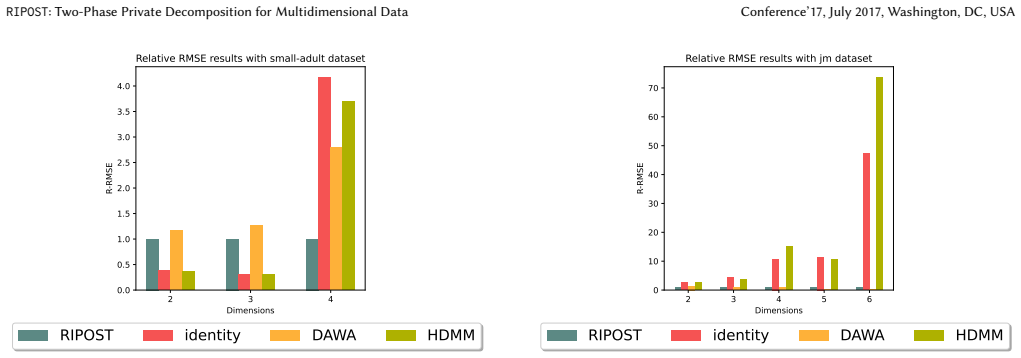
- On the tested workloads RIPOST reports lower R-RMSE than HDPView (1.47× on Fire), PrivTree (13×), and the generative baselines (22–62×), with the workload-aware competitors DAWA and HDMM also bested on small-domain tests.
- The approach is stated to generalize beyond count tensors to other aggregation functions, since the decomposition logic uses metric tests rather than counts only.
Reading between the lines
- The fixed, data-independent weights mean that realized budget use depends on actual depth; the paper itself notes unconsumed budget could be recycled into leaf noise, a direct extension that would likely improve utility at the same ε.
- The empty/non-empty first phase exploits sparsity; on dense tensors with few empty regions the phase loses its advantage, so the reported gains may shrink on such data.
- The released view could serve as a warm start for workload-aware optimizers such as matrix-mechanism methods, a combination the paper does not test.
- A direct way to stress-test the privacy claim is to run a DP auditor on the released view; the paper does not include such an audit, only the analytical composition argument.
Editorial analysis
A structured set of objections, weighed in public.
Referee Report
Summary. The paper introduces RIPOST, a differentially private algorithm for publishing a multidimensional count tensor as a hierarchical decomposition. RIPOST avoids a predefined decomposition depth h by allocating per-level privacy weights from a convergent series, and it uses a two-phase, data-dependent splitting strategy: the first phase separates empty from non-empty cells using a noisy Sum test, and the second phase further splits blocks to minimize a noisy Aggregation Error (AE) test. Leaf blocks are represented by perturbed means, which constitute the published view. The authors evaluate RIPOST against HDPView, PrivTree, HDMM, DAWA, PrivBayes, and P3GM on several datasets, reporting lower relative RMSE for range queries in most settings.
Significance. If the privacy proof is completed, the depth-independent budget-management idea via a convergent series and the two-phase splitting heuristic are reasonable contributions to the private multidimensional data publishing literature. The empirical evaluation is broad and the source code is released, which are strengths. The central claim, however, is that RIPOST satisfies epsilon-DP, and as submitted this claim is not verifiable because the final leaf-mean perturbation mechanism is never specified. The remaining privacy analysis also contains an incorrect sensitivity statement for the splitting score and an undefined metric in the pseudocode. These issues are local and likely fixable, but they block acceptance in the current form.
major comments (4)
- [§5.4, Algorithm 1 (line 29)] The final step `secure_view <- perturb(converged_blocks)` is never specified. The privacy proof ends with the ratio Pr[mean(B_l)+Lap(lambda)=S] / Pr[mean(B'_l)+Lap(lambda)=S] and multiplies by e^{epsilon_p}, but the sensitivity of the block mean and the Laplace scale lambda are not given anywhere in the paper. Because the leaf partition is itself data-dependent, the calibration must be shown to hold for every possible block produced by the decomposition. Please specify the mechanism explicitly, for example by publishing mean(B_l)+Lap(1/(epsilon_p |B_l|)) for a block of size |B_l|, and include this step in the sequential composition argument. Without this, the claimed epsilon-DP guarantee cannot be verified.
- [§5.3.2, Algorithm 1 (line 12)] Algorithm 1 calls Secure_ss(Sum, block, epsilon_1ss) in the first phase, but Algorithm 3 defines score cases only for the metrics 'Min' and 'AE'; there is no 'Sum' case. The surrounding text says the first-phase splitter should minimize the mix of empty and non-empty cells, which corresponds to the 'Min' score. Therefore line 12 should call Secure_ss(Min, block, epsilon_1ss). As printed, the pseudocode is not executable as written, and the metric passed to Secure_ss is inconsistent with the score function definition.
- [§5.2, get_weight and Equations (3)-(4)] The budget distribution depends on the series multiplier k and the offset os, but the paper never assigns concrete values or a default to either. Equation (4) and the condition os >= k define a family of schedules rather than a single algorithm. The experiments in Section 6 report only alpha, gamma, and beta as RIPOST hyperparameters, and the function get_weight is never instantiated. The values of k and os must be stated because they determine the per-level budget weights and directly affect the number of blocks and the utility results; without them the algorithm cannot be reproduced from the paper.
- [§5.3.2, §5.3.3] The statement 'we set the sensitivity of the score as Delta_score = 2 * Delta_metric' is not correct under the neighboring-tensor definition in Definition 3.1. A single changed cell belongs to exactly one of the two candidate sub-blocks B_L and B_R, so the maximum change in score_i is bounded by the sensitivity of the metric on one sub-block: at most 2 for AE and at most 1 for Min, not 2 * Delta_metric. The algorithm's use of 4 * Delta_metric in the exponential mechanism is conservative, so this error does not break privacy, but the sensitivity analysis should be corrected and the resulting additional utility loss should be acknowledged.
minor comments (5)
- [§5.3.1] The claim that the threshold theta has little effect, with default theta = 0, is justified only by a reference to PrivTree. Since RIPOST uses different metrics (Sum in phase 1, AE in phase 2) and a different budget allocation, an ablation over theta_1 and theta_2 should be provided to support this assertion.
- [§5.2] The derivation of the offset condition is confusing: the inequalities involving the 'ignored' and 'used' terms do not transparently lead to os >= k, and a direct telescoping argument gives k/(os+1) <= 1, i.e., os >= k-1. Please rewrite this derivation for clarity and correctness.
- [§5.1 (paragraph after Algorithm 1 description)] The sentence 'This condition will be satisfied for blocks with nonempty cells due to perturbation' appears to be a typo; the intended meaning is that the noisy condition can be satisfied for empty blocks, or that non-empty blocks may satisfy it because of perturbation. Please rephrase.
- [Table 1 and Section 6.2] Table 1 is hard to read: the row 'Avg R-RMSE 1 x1.47 x13 x22 x62' should explain explicitly that values greater than 1 favor RIPOST and that x1.47 means RIPOST's RMSE is 1.47 times smaller than HDPView's. Also, the P3GM baseline is allocated a larger privacy budget in [0.1, 1]; this is disclosed but should be revisited in the conclusion as a caveat on the reported improvement.
- [References] References [6] and [7] both point to the same Dwork-Roth monograph, and the reference list contains minor formatting inconsistencies; these should be cleaned up.
Circularity Check
No significant circularity: RIPOST's budget distribution and two-phase decomposition are self-contained, and comparisons are against external baselines; the missing Laplace-scale specification is a correctness gap, not a circular step.
full rationale
The central derivation chain of RIPOST is not circular. The privacy budget distribution in Section 5.2 defines weights omega_i = k/(i(i+1)) with an offset satisfying sum(omega_i) <= 1 (Equations 1-4), and the privacy accounting in Section 5.4 accumulates these per-iteration budgets along a single root-to-leaf path using sequential composition, then generalizes with parallel composition. This is a self-contained argument that does not rely on the experimental results or on any fitted parameter being renamed as a prediction. The secure convergence and splitting steps (Algorithms 2 and 3) apply the Laplace and Exponential mechanisms with stated sensitivities for Sum, Min, and AE (Theorem 5.1). The only self-citation, SLIM-View [16], appears in the related-work discussion and is not used to justify any load-bearing theorem or design choice. The evaluation compares RIPOST to external baselines (HDPView, PrivTree, HDMM, DAWA, PrivBayes, P3GM) on standard datasets, and the claimed utility advantage is an empirical outcome rather than a consequence of the definition of the method. Hyperparameters alpha, gamma, beta are tuned on evaluation datasets, which is a reproducibility concern, not circular reasoning. The most serious issue is that Algorithm 1 Line 29 calls perturb(converged_blocks) without specifying the sensitivity of the released leaf mean or the Laplace scale lambda, and Section 5.4 writes Pr[mean(B_l)+Lap(lambda)=S] without giving lambda. This is a gap in the privacy proof and a correctness risk, but it is not a circular reduction: the missing scale is not itself defined in terms of the claimed epsilon-DP conclusion, nor is it fitted from the data used to evaluate utility. Therefore, no circular step meeting the required evidence threshold can be identified, and the paper should receive a low score reflecting only the minor non-load-bearing self-citation.
Assumptions & free parameters
free parameters (5)
- alpha =
0.3
- gamma =
0.9
- beta =
0.4
- convergence thresholds theta1, theta2 =
0
- series multiplier k and offset os =
not explicitly reported; assumed k=1, os=1 with S=1/(i(i+1))
assumptions (5)
- standard math The sum over i>=1 of k/((i+os)(i+os+1)) is bounded by 1 when os is large enough; the paper's off-by-one derivation (os>=k) is conservative.
- domain assumption Real multidimensional tensors are typically sparse.
- domain assumption The Laplace and Exponential mechanisms can be composed sequentially along a path and in parallel across tree branches, with per-depth weights bounding each path's loss.
- domain assumption The sensitivity values Delta_Sum=1, Delta_Min=1, and Delta_AE=2 in Theorem 5.1 are correct and sufficient for calibration.
- ad hoc to paper The convergence threshold theta=0 does not materially affect output quality, a claim borrowed from PrivTree.
Cite this review
Pith. "Pith review of RIPOST: Two-Phase Private Decomposition for Multidimensional Data." pith.science (2026). https://pith.science/paper/A3PCEQVJ
@misc{pith2026250210207,
  author       = {Pith},
  title        = {Pith review of: RIPOST: Two-Phase Private Decomposition for Multidimensional Data},
  year         = {2026},
  howpublished = {\url{https://pith.science/paper/A3PCEQVJ}},
  note         = {Machine review of arXiv:2502.10207}
}
abstract
Differential privacy (DP) is considered as the gold standard for data privacy. While the problem of answering simple queries and functions under DP guarantees has been thoroughly addressed in recent years, the problem of releasing multidimensional data under DP remains challenging. In this paper, we focus on this problem, in particular on how to construct privacy-preserving views using a domain decomposition approach. The main idea is to recursively split the domain into sub-domains until a convergence condition is met. The resulting sub-domains are perturbed and then published in order to be used to answer arbitrary queries. Existing methods that have addressed this problem using domain decomposition face two main challenges: (i) efficient privacy budget management over a variable and undefined decomposition depth $h$; and (ii) defining an optimal data-dependent splitting strategy that minimizes the error in the sub-domains while ensuring the smallest possible decomposition. To address these challenges, we present RIPOST, a multidimensional data decomposition algorithm that bypasses the constraint of predefined depth $h$ and applies a data-aware splitting strategy to optimize the quality of the decomposition results.The core of RIPOST is a two-phase strategy that separates non-empty sub-domains at an early stage from empty sub-domains by exploiting the properties of multidimensional datasets, and then decomposes the resulting sub-domains with minimal inaccuracies using the mean function. Moreover, RIPOST introduces a privacy budget distribution that allows decomposition without requiring prior computation of the depth $h$. Through extensive experiments, we demonstrated that \texttt{RIPOST} outperforms state-of-the-art methods in terms of data utility and accuracy on a variety of datasets and test cases
Figures


Figures from the paper (7 more)




Reference graph
Works this paper leans on
-
[1]
John M Abowd. 2018. The US Census Bureau adopts differential privacy. In Proceedings of the 24th ACM SIGKDD International Conference on Knowledge Discovery & Data Mining . 2867–2867
2018
-
[2]
Gergely Acs, Luca Melis, Claude Castelluccia, and Emiliano De Cristofaro. 2018. Differentially private mixture of generative neural networks. IEEE Transactions on Knowledge and Data Engineering 31, 6 (2018), 1109–1121
work page 2018
-
[3]
Graham Cormode, Cecilia Procopiuc, Divesh Srivastava, Entong Shen, and Ting Yu. 2012. Differentially private spatial decompositions. In 2012 IEEE 28th Interna- tional Conference on Data Engineering . IEEE, 20–31
work page 2012
-
[4]
Bolin Ding, Marianne Winslett, Jiawei Han, and Zhenhui Li. 2011. Differentially private data cubes: optimizing noise sources and consistency. In Proceedings of the 2011 ACM SIGMOD International Conference on Management of data. 217–228
work page 2011
-
[5]
Cynthia Dwork. 2006. Differential privacy. In Automata, Languages and Program- ming: 33rd International Colloquium, ICALP 2006, Venice, Italy, July 10-14, 2006, Proceedings, Part II 33 . Springer, 1–12
work page 2006
-
[7]
Cynthia Dwork, Aaron Roth, et al. 2014. The algorithmic foundations of differ- ential privacy. Foundations and Trends® in Theoretical Computer Science 9, 3–4 (2014), 211–407
2014
-
[8]
Hamid Ebadi, Thibaud Antignac, and David Sands. 2016. Sampling and partition- ing for differential privacy. In 2016 14th Annual Conference on Privacy, Security and Trust (PST). IEEE, 664–673
work page 2016
-
[9]
Ju Fan, Tongyu Liu, Guoliang Li, Junyou Chen, Yuwei Shen, and Xiaoyong Du
Show all 33 references
-
[10]
Frederik Harder, Kamil Adamczewski, and Mijung Park. 2021. Dp-merf: Differ- entially private mean embeddings with randomfeatures for practical privacy- preserving data generation. In International conference on artificial intelligence and statistics. PMLR, 1819–1827
2021
-
[11]
Ali Inan, Murat Kantarcioglu, Gabriel Ghinita, and Elisa Bertino. 2010. Private record matching using differential privacy. InProceedings of the 13th International Conference on Extending Database Technology . 123–134
2010
-
[12]
James Jordon, Jinsung Yoon, and Mihaela Van Der Schaar. 2019. PATE-GAN: Generating synthetic data with differential privacy guarantees. In International conference on learning representations
2019
-
[13]
Fumiyuki Kato, Tsubasa Takahashi, Shun Takagi, Yang Cao, Seng Pei Liew, and Masatoshi Yoshikawa. 2022. HDPView: differentially private materialized view for exploring high dimensional relational data. arXiv preprint arXiv:2203.06791 (2022)
2022 arXiv
-
[14]
Ios Kotsogiannis, Yuchao Tao, Xi He, Maryam Fanaeepour, Ashwin Machanava- jjhala, Michael Hay, and Gerome Miklau. 2019. Privatesql: a differentially private sql query engine. Proceedings of the VLDB Endowment 12, 11 (2019), 1371–1384
2019
-
[15]
Eleonora Kreačić, Navid Nouri, Vamsi K Potluru, Tucker Balch, and Manuela Veloso. 2023. Differentially private synthetic data using KD-trees. In Uncertainty in Artificial Intelligence. PMLR, 1143–1153
2023
-
[16]
Ala Eddine Laouir and Abdessamad Imine. 2024. SLIM-View: Sampling and Private Publishing of Multidimensional Databases. InProceedings of the Fourteenth ACM Conference on Data and Application Security and Privacy . 391–402
2024
-
[17]
Chao Li, Michael Hay, Gerome Miklau, and Yue Wang. 2014. A data-and workload- aware algorithm for range queries under differential privacy. arXiv preprint arXiv:1410.0265 (2014)
2014 arXiv
-
[18]
Chao Li, Gerome Miklau, Michael Hay, Andrew McGregor, and Vibhor Ras- togi. 2015. The matrix mechanism: optimizing linear counting queries under differential privacy. The VLDB journal 24 (2015), 757–781
2015
-
[19]
Ryan McKenna, Gerome Miklau, Michael Hay, and Ashwin Machanavajjhala
-
[20]
Wahbeh Qardaji, Weining Yang, and Ninghui Li. 2014. Priview: practical differ- entially private release of marginal contingency tables. In Proceedings of the 2014 ACM SIGMOD international conference on Management of data . 1435–1446
2014
-
[21]
Sina Shaham, Gabriel Ghinita, Ritesh Ahuja, John Krumm, and Cyrus Shahabi
-
[22]
Graham Cormode Cecilia Procopiuc Divesh Srivastava, Entong Shen, and Ting Yu. [n.d.]. Differentially Private Spatial Decompositions. ([n. d.])
-
[23]
Shun Takagi, Tsubasa Takahashi, Yang Cao, and Masatoshi Yoshikawa. 2021. P3GM: Private high-dimensional data release via privacy preserving phased generative model. In 2021 IEEE 37th International Conference on Data Engineering (ICDE). IEEE, 169–180
2021
-
[24]
Apple Team. [n.d.]. learning-with-privacy-at-scale. ([n. d.]). https://docs-assets. developer.apple.com/ml-research/papers/learning-with-privacy-at-scale.pdf
-
[25]
Royce J Wilson, Celia Yuxin Zhang, William Lam, Damien Desfontaines, Daniel Simmons-Marengo, and Bryant Gipson. 2020. Differentially private SQL with bounded user contribution. Proceedings on privacy enhancing technologies 2020, 2 (2020), 230–250
2020
-
[26]
Chugui Xu, Ju Ren, Yaoxue Zhang, Zhan Qin, and Kui Ren. 2017. DPPro: Dif- ferentially private high-dimensional data release via random projection. IEEE Transactions on Information Forensics and Security 12, 12 (2017), 3081–3093
2017
-
[27]
Zeidler, W
E. Zeidler, W. Hackbusch, H.R. Schwarz, and B. Hunt. 2004. Oxford Users’ Guide to Mathematics. OUP Oxford
2004
-
[28]
Jun Zhang, Graham Cormode, Cecilia M Procopiuc, Divesh Srivastava, and Xi- aokui Xiao. 2017. Privbayes: Private data release via bayesian networks. ACM Transactions on Database Systems (TODS) 42, 4 (2017), 1–41
2017
-
[29]
Jun Zhang, Xiaokui Xiao, and Xing Xie. 2016. Privtree: A differentially private algorithm for hierarchical decompositions. InProceedings of the 2016 international conference on management of data . 155–170
2016
-
[30]
Xiaojian Zhang, Rui Chen, Jianliang Xu, Xiaofeng Meng, and Yingtao Xie. 2014. Towards accurate histogram publication under differential privacy. InProceedings of the 2014 SIAM international conference on data mining . SIAM, 587–595
2014
-
[31]
Zhikun Zhang, Tianhao Wang, Jean Honorio, Ninghui Li, Michael Backes, Shibo He, Jiming Chen, and Yang Zhang. 2021. Privsyn: Differentially private data synthesis. (2021)
2021
-
[2018]
arXiv preprint arXiv:1808.03537 (2018)
Optimizing error of high-dimensional statistical queries under differential privacy. arXiv preprint arXiv:1808.03537 (2018)
2018 arXiv
-
[2020]
arXiv preprint arXiv:2008.12763 (2020)
Relational data synthesis using generative adversarial networks: A design space exploration. arXiv preprint arXiv:2008.12763 (2020)
2020 arXiv
-
[2023]
ACM transactions on spatial algorithms and systems 9, 4 (2023), 1–30
HTF: Homogeneous Tree Framework for Differentially Private Release of Large Geospatial Datasets with Self-tuning Structure Height. ACM transactions on spatial algorithms and systems 9, 4 (2023), 1–30
2023
Reviewed August 7, 2026 · model on record in the stance chip above.
Discussion (0). Continue with ORCID to comment.