REVIEW 4 major objections 5 minor 44 references
An X-ray view of the Cataclysmic Variable V902 Mon: Discovery of an X-ray eclipse
T0 review · 4 major / 5 minor · reviewed 2026-08-07 · deepseek-v4-flash
Pith's one-line read V902 Mon's X-ray eclipse and hidden accretion column.
desk verdict Plausible new X-ray eclipse in V902 Mon, but the evidence is a single unquantified phase bin and the ADC hidden-primary story is ahead of the data. read the letter →
The pith
A machine-rendered reading of the paper's core claim, the machinery that carries it, and where it could break.
The reading
What carries the argument
The load-bearing diagnostic is the equivalent width of the Fe K-alpha fluorescence line at 6.4 keV (fitted here at 6.38 keV). In ordinary intermediate polars this line has an equivalent width of about 100–200 eV because the visible continuum itself illuminates the fluorescing gas; a value near 0.7 keV means the observed continuum is too weak by itself to produce the line, so a brighter, unseen primary must be irradiating a large solid angle of cool material. The second piece of machinery is the phase-resolved orbital light curve: the NuSTAR dip lands at the same phase as the optical mid-eclipse, and the width of the X-ray eclipse appears narrower than the optical one, consistent with a compact reprocessing region near the white dwarf rather than the extended disk. The paper uses an Accretion Disk Corona-inspired geometry, with the direct view blocked by the disk body and X-rays scattered above the orbital plane into a line of sight that grazes the disk atmosphere, to tie the spectral and timing evidence together.
What would settle it
Refine the orbital period and its derivative with fresh optical eclipse timings and re-fold the NuSTAR events; if the 3–25 keV dip no longer centers on mid-eclipse, the X-ray eclipse identification collapses. A complementary check is a high-signal-to-noise X-ray observation resolving the eclipse profile: in the proposed geometry, the X-ray egress should be sharp, narrow, and delayed relative to the optical egress, whereas a broad or phase-offset dip would refute the hidden-primary reprocessing picture.
Extended reading notes
Core claim
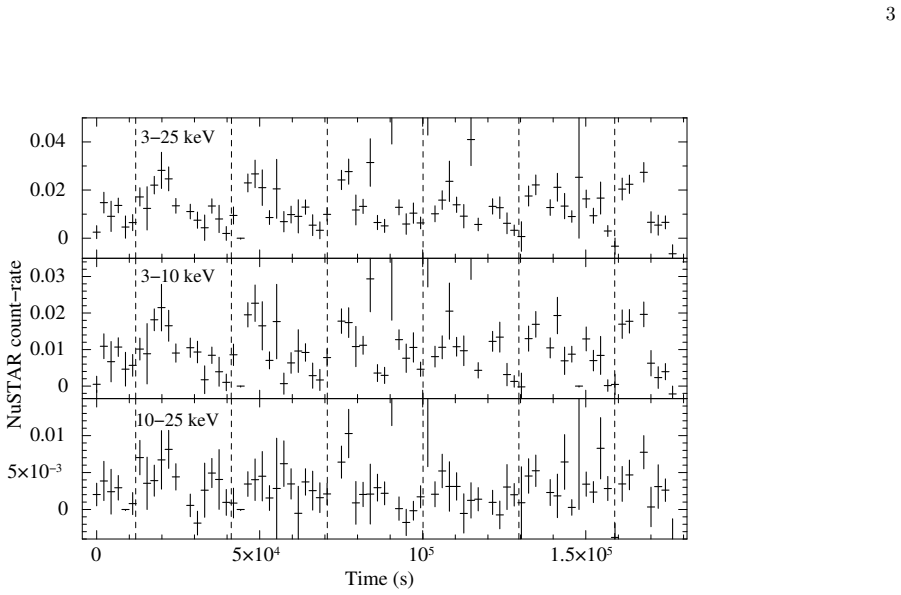
The central discovery is that V902 Mon shows an X-ray eclipse: folding the NuSTAR 3–25 keV, 3–10 keV, and 10–25 keV light curves on the 0.34008279-day orbital period yields a single low-count-rate phase bin that coincides with the optical mid-eclipse epoch from contemporaneous optical photometry. Spectral fitting of the XMM-Newton PN and NuSTAR FPMA/FPMB spectra finds a partial-covering absorber with $N_{\rm H} \sim 1.4\times10^{23}\ \mathrm{cm}^{-2}$ at about 91% covering fraction, a 6.38 keV Fe K-$\alpha$ line with equivalent width $0.67\pm0.05$ keV, and a soft excess modeled as an O VII blend near 0.56 keV. Because the equivalent width of the iron line is far above the 100–200 eV typical of magnetic cataclysmic variables, the paper proposes that the primary X-ray source is always hidden behind Compton-thick disk material and that all observed X-rays are scattered or reprocessed in a region above the orbital plane, most plausibly the pre-shock accretion flow located a few white-dwarf radii up. This is the first X-ray eclipse detected in V902 Mon, and it places the source in the small group of intermediate polars whose X-ray geometry is dominated by near-edge-on viewing.
Load-bearing premise
Everything hinges on the orbital ephemeris used to fold the 2023 NuSTAR data: the updated mid-eclipse epoch and the assumed constant period come from earlier optical work, and the period derivative is not well enough known to guarantee that the single dip in the X-ray phase bin is truly at the optical mid-eclipse rather than at a slightly offset phase.
Editorial extensions
If this is right
- V902 Mon becomes one of only a few intermediate polars with an X-ray eclipse, giving a direct geometric anchor for the system's inclination and component sizes.
- The intrinsic X-ray luminosity of the source is probably about an order of magnitude higher than the observed roughly $10^{32}\ \mathrm{erg\ s}^{-1}$, making it a typical intermediate polar rather than an underluminous anomaly.
- The lack of X-ray spin modulation is expected in this geometry because the observed X-rays are scattered in the pre-shock flow, so it does not count against the intermediate polar classification.
- The pre-shock accretion flow a few white-dwarf radii above the orbital plane is identified as the main site of scattering and Fe K-alpha reprocessing, with the outer disk atmosphere producing the broad out-of-eclipse modulation.
- The X-ray eclipse ingress occurring after the optical ingress implies the reprocessing region does not extend to the outer disk, constraining the vertical extent of the X-ray-emitting and reprocessing zone.
Reading between the lines
- If this hidden-primary picture is common, other X-ray-faint cataclysmic variables with unusually strong Fe K-alpha lines could be edge-on intermediate polars rather than intrinsically faint objects; a systematic survey of equivalent widths and orbital inclinations would test that.
- The model predicts that the Fe K-alpha equivalent width should track orbital inclination across eclipsing intermediate polars, with the most edge-on systems showing the largest values because the visible continuum is most suppressed.
- High signal-to-noise future observations of the X-ray eclipse egress could measure the vertical size of the pre-shock scattering region directly, an extension the present data are too sparse to constrain.
- The paper's choice of a low interstellar column, justified by a dust-rich, gas-poor line of sight, could be checked with an independent measurement of the gas-to-dust ratio toward V902 Mon; if the true interstellar column is high, the soft X-ray component would need another explanation.
Editorial analysis
A structured set of objections, weighed in public.
Referee Report
Summary. The paper analyzes a 93 ks NuSTAR observation of the eclipsing intermediate polar V902 Mon together with an archival XMM-Newton EPIC-PN observation and contemporaneous AAVSO optical photometry. The folded NuSTAR light curves in the 3-10, 10-25, and 3-25 keV bands show a single low phase bin at the phase of the optical mid-eclipse, which the authors interpret as the discovery of an X-ray eclipse. Broadband spectral fitting with a partially covered cooling-flow model plus a Fe K-alpha Gaussian and a soft O VII line yields a local column density of about 1e23 cm^-2, a Fe K-alpha equivalent width of about 0.7 keV, and unabsorbed fluxes corresponding to L_X ~ 1.8e32 erg/s at 3 kpc. The authors propose that the white dwarf's primary X-ray emission is always hidden by a Compton-thick accretion disk and that the observed X-rays are scattered or reprocessed in the pre-shock region a few white-dwarf radii above the orbital plane, in analogy with accretion disk corona sources.
Significance. If the eclipse detection and the hidden-primary interpretation are established, this paper would add an important new data point to the small sample of eclipsing intermediate polars and would provide a plausible geometric explanation for V902 Mon's unusually low X-ray luminosity and strong Fe K-alpha fluorescence. The paper makes good use of NuSTAR's hard X-ray capability and contemporaneous optical coverage, and it is commendably explicit about several limitations, including the uncertain orbital period derivative and the statistical weakness of the X-ray dip. However, the central discovery claim rests on a single folded phase bin with no quoted significance, and the spectral interpretation depends on a fixed, ad hoc interstellar column and on external Fe-line equivalent-width calibrations. The proposed geometry is interesting and testable, but the current evidence does not yet support the 'confirmation' language used in the abstract and title.
major comments (4)
- [§3.1, Fig. 2] The X-ray eclipse claim rests on one folded phase bin at phase 0: 0.0013±0.0009 counts/s in 3-10 keV, 0.0008±0.0006 in 10-25 keV, and 0.002±0.001 in 3-25 keV. No significance, confidence interval, or false-alarm probability is given for the dip, and no eclipse model (for example, a constant plus a Gaussian or top-hat eclipse) is fit to the phase profile. With 20 phase bins, a single low bin can occur by chance, and the paper itself concedes in §4 that 'statistical limitations prevent definitive confirmation.' To support the title and abstract claim of discovering an X-ray eclipse, the authors should quantify the probability that the dip is not a random fluctuation and, ideally, fit the eclipse profile to estimate its width and the level of any uneclipsed component.
- [Footnote 5, §3.1] The adopted linear ephemeris (T0 = JD 2453340.5237, P = 0.34008279 d) is stated in footnote 5 to diverge from the Worpel et al. (2018) mid-eclipse times by about 24 minutes, comparable to one of the 20 phase bins used in Figure 2. Because the phase registration of the NuSTAR data depends on this ephemeris, the coincidence of the X-ray dip with the optical mid-eclipse could be spurious if T0 or P is off by even a fraction of a phase bin. The authors should propagate the uncertainties in T0 and P, including the known period derivative from Rawat et al. (2022), to the NuSTAR epoch, or fold the NuSTAR light curves using contemporaneous AAVSO optical eclipse times to anchor phase zero, and demonstrate that the dip remains aligned with phase 0.
- [§4] The claims that the X-ray eclipse is total, that it is narrower than the optical eclipse, and that 'X-ray ingress begins after the optical ingress' go beyond what a single phase bin can establish. The paper itself states in §3.1 that it is difficult to distinguish a total eclipse from a low-level uneclipsed component, and no ingress or egress phases are measured. The statement about ingress beginning after optical ingress in particular has no visible support in Figure 2. These statements should be removed or replaced by a proper eclipse-profile fit that includes a possible uneclipsed component.
- [§3.2] The interstellar column is fixed at NH1 = 4e20 cm^-2, chosen because the Gaia extinction map implies about 4e21 cm^-2 and the authors argue that a high dust-to-gas ratio in this direction may make the gas column lower than the dust-inferred value. This is an ad hoc assumption that directly affects the soft X-ray normalization, the unabsorbed fluxes, and the inferred luminosities, and it is not tested. The authors should at least present a spectral fit with the dust-map column and discuss its impact on the Fe K-alpha equivalent width and the hidden-primary luminosity inference, or justify the adopted dust-to-gas ratio with an independent measurement.
minor comments (5)
- [§3.2] The full spectral model is written as constant*Tbabs*(Tbpcf*(mkcflow+gauss(6.4 keV)))+gauss(0.55 keV), but the text says the soft Gaussian is modified by only the fully covering Tbabs. As written, the soft line is outside Tbabs and therefore unabsorbed; clarify the intended model or correct the equation.
- [Table 1] Use consistent units and notation: NH1 is listed as 0.04 (10^22 cm^-2) while the text quotes 4e20 cm^-2, and the unit should be stated clearly in the table header. Also replace 'Eqw' with 'EW' or 'Equivalent width'.
- [§3.1] The quoted 32% upper limit on the pulse fraction should be accompanied by a description of how it was derived (for example, simulations of sinusoidal signals added to the light curve), otherwise it is not a formal upper limit.
- [Figure 1 and Figure 2] Figure 1 marks expected eclipses using the Worpel et al. (2018) ephemeris while Figure 2 and the text use an updated T0 with a known offset of about 24 minutes. State explicitly which ephemeris is used for the dashed markers and how the offset would appear in the light curves.
- [Abstract and §4] The abstract says 'we confirm the presence of an X-ray eclipse,' while §4 says 'statistical limitations prevent definitive confirmation.' Harmonize these statements with the significance analysis requested in the major comments.
Circularity Check
No significant circularity: the X-ray eclipse detection and spectral parameters are measured quantities, and the hidden-primary interpretation is an application of external calibrations and analogies, not a derivation from its own inputs.
full rationale
The paper's central claims are the detection of an X-ray eclipse in NuSTAR light curves and the measurement of strong local absorption and a strong Fe K-alpha fluorescence line. These are observational results obtained by folding data on an ephemeris that is independent of the X-ray data: the mid-eclipse epoch is chosen from AAVSO optical light curves, and the orbital period is taken from Worpel et al. (2018). The apparent coincidence of the lowest NuSTAR phase bin with the optical mid-eclipse is an empirical comparison, not a quantity defined in terms of itself. The spectral analysis uses standard XSPEC models, and the inference that a 0.7 keV Fe K-alpha equivalent width implies a hidden luminous component relies on external calibrations (Ezuka & Ishida 1999; Inoue 1985), not on a parameter fitted from the same data being renamed as a prediction. The ADC-like interpretation is explicitly proposed as a scenario, supported by analogies to previously published systems (CH Cyg, ADC LMXBs), rather than derived by construction from the fitted values. Some cited works include the present authors, but these citations are used for background context or as independent published results, and none is the sole justification for the central claim. The paper itself notes that 'statistical limitations prevent definitive confirmation' of a total X-ray eclipse, but this is a stated uncertainty in the observational evidence, not evidence of circular reasoning. No equation in the paper reduces to its own inputs, and no load-bearing argument depends on a self-citation that is itself unverified. The ephemeris and single-bin dip concerns are validity risks, not circularity, and should be addressed as statistical or systematic uncertainties rather than as circular reasoning. Therefore, the paper earns a circularity score of zero.
Assumptions & free parameters
free parameters (9)
- Interstellar NH (NH1) =
0.04 x 10^22 cm^-2 (fixed by hand)
- Partial covering column NH2 =
14 (+7/-5) x 10^22 cm^-2
- Covering fraction CvrFrac =
0.91 (+0.04/-0.06)
- kTmax =
16 (+12/-6) keV
- mkcflow normalization =
4.1 (+4/-2) x 10^-11 Msun/yr
- O VII line energy =
0.56 +/- 0.03 keV
- O VII line normalization =
(2.1 +/- 0.1) x 10^-3 photons/cm2/s
- Fe K-alpha line normalization =
(4 +/- 1) x 10^-6 photons/cm2/s
- Cross-normalization constants =
FPMB 0.8 +/- 0.2, PN 0.7 +/- 0.2
assumptions (4)
- domain assumption V902 Mon is an intermediate polar, based on the optical spin period of 2208 s and beat periods, despite no detection of X-ray pulsations.
- domain assumption A linear orbital ephemeris with P=0.34008279 d and T0=JD 2453340.5237 is valid for the February 2023 NuSTAR observation.
- ad hoc to paper The interstellar NH toward V902 Mon is about 4e20 cm^-2, much lower than the roughly 4e21 cm^-2 implied by the Gaia extinction map, based on an assumed high dust-to-gas ratio.
- domain assumption The broadband X-ray spectrum is adequately described by a cooling-flow model (mkcflow) with full and partial covering absorption, a 6.4 keV Gaussian line, and a soft Gaussian line.
Cite this review
Pith. "Pith review of An X-ray view of the Cataclysmic Variable V902 Mon: Discovery of an X-ray eclipse." pith.science (2026). https://pith.science/paper/BK22RPRW
@misc{pith2026250210501,
  author       = {Pith},
  title        = {Pith review of: An X-ray view of the Cataclysmic Variable V902 Mon: Discovery of an X-ray eclipse},
  year         = {2026},
  howpublished = {\url{https://pith.science/paper/BK22RPRW}},
  note         = {Machine review of arXiv:2502.10501}
}
abstract
V902 Mon is one of a few eclipsing Intermediate Polars (IPs), and show deep eclipses in the optical lightcurves. The presence of a strong Fe K$\alpha$ fluorescence line in its X-ray spectrum and its low X-ray flux compared to other IPs suggests significant absorption, most likely from an accretion disk. In an observation carried out using the Nuclear Spectroscopic Telescope Array (NuSTAR), we confirm the presence of an X-ray eclipse in the energy resolved lightcurves, coincident with the optical AAVSO/CV-band lightcurves. Broadband X-ray spectral analysis using NuSTAR and XMM-Newton observations confirm a strong absorption N$_{H}$ $\sim 10^{23}$ cm$^{-2}$ local to the source, along with a high equivalent width of about 0.7 keV for a Fe K$\alpha$ fluorescence line. We interpret this using a model similar to an Accretion Disk Corona source, which have a very high inclination and the compact object is heavily obscured by the body of the accretion disk. We propose that the primary X-rays from the accretion column in V902 Mon is hidden from our direct view at all times by the accretion disk. In this scenario, the observed scattered X-rays indicate substantial absorption of direct X-rays by the accretion disk. Additionally, a strong Fe fluorescence line suggests reprocessing of the radiation by a more extended region, such as the pre-shock region, which could be located a few white dwarf radii above the orbital plane.
Figures


Figures from the paper (1 more)

Reference graph
Works this paper leans on
-
[1]
Aftab, N., Paul, B., & Kretschmar, P. 2019, X-Ray Reprocessing: Through the Eclipse Spectra of High-mass X-Ray Binaries with XMM-Newton, ApJS, 243, 29, doi: 10.3847/1538-4365/ab2a77
-
[2]
Arnaud, K. A. 1996, in Astronomical Society of the Pacific Conference Series, Vol. 101, Astronomical Data Analysis Software and Systems V, ed. G. H. Jacoby & J. Barnes, 17
1996
-
[3]
Aungwerojwit, A., G¨ ansicke, B. T., Wheatley, P. J., et al. 2012, IPHAS J062746.41+014811.3: A Deeply Eclipsing Intermediate Polar, ApJ, 758, 79, doi: 10.1088/0004-637X/758/2/79
-
[4]
2021, Estimating Distances from Parallaxes
Demleitner, M., & Andrae, R. 2021, Estimating Distances from Parallaxes. V. Geometric and Photogeometric Distances to 1.47 Billion Stars in Gaia Early Data Release 3, AJ, 161, 147, doi: 10.3847/1538-3881/abd806
-
[5]
Bernardini, F., de Martino, D., Mukai, K., et al. 2017, Broad-band characteristics of seven new hard X-ray selected cataclysmic variables, MNRAS, 470, 4815, doi: 10.1093/mnras/stx1494
-
[6]
Beuermann, K., & Osborne, J. 1985, Hard X-Ray Observations of the Eclipsing Binary Ex-Hydrae, SSRv, 40, 117, doi: 10.1007/BF00212873
- [7]
-
[8]
Byckling, K., Mukai, K., Thorstensen, J. R., & Osborne, J. P. 2010, Deriving an X-ray luminosity function of dwarf novae based on parallax measurements, MNRAS, 408, 2298, doi: 10.1111/j.1365-2966.2010.17276.x
Show all 44 references
-
[9]
Q., Liu, X
Chen, B. Q., Liu, X. W., Yuan, H. B., Huang, Y., & Xiang, M. S. 2015, Dust-to-gas ratio, X CO factor and CO-dark gas in the Galactic anticentre: an observational study, MNRAS, 448, 2187, doi: 10.1093/mnras/stv103
2015 doi
- [10]
-
[11]
1999, Iron Line Diagnostics of the Postshock Hot Plasma in MagneticCataclysmic Variables Observed with ASCA, ApJS, 120, 277, doi: 10.1086/313181
Ezuka, H., & Ishida, M. 1999, Iron Line Diagnostics of the Postshock Hot Plasma in MagneticCataclysmic Variables Observed with ASCA, ApJS, 120, 277, doi: 10.1086/313181
1999 doi
-
[12]
Gilliland, R. L. 1982, EX Hya : physical parameters derived from simultaneous spectroscopy and photometry., ApJ, 258, 576, doi: 10.1086/160109
1982 doi
-
[13]
A., Craig, W
Harrison, F. A., Craig, W. W., Christensen, F. E., et al. 2013, The Nuclear Spectroscopic Telescope Array (NuSTAR) High-energy X-Ray Mission, ApJ, 770, 103, doi: 10.1088/0004-637X/770/2/103
2013 doi
-
[14]
1996, in Astrophysics and Space Science Library, Vol
Hellier, C. 1996, in Astrophysics and Space Science Library, Vol. 208, IAU Colloq. 158: Cataclysmic Variables and Related Objects, ed. A. Evans & J. H. Wood, 143, doi: 10.1007/978-94-009-0325-8 44
1996 doi
-
[15]
1997, The size of the accretion region in intermediate polars: eclipses of XY ARIETIS observed with RXTE, MNRAS, 291, 71, doi: 10.1093/mnras/291.1.71
Hellier, C. 1997, The size of the accretion region in intermediate polars: eclipses of XY ARIETIS observed with RXTE, MNRAS, 291, 71, doi: 10.1093/mnras/291.1.71
1997 doi
-
[16]
Hellier, C., & Mason, K. O. 1989, EXOSAT observations of X 1822-371 : modelling of the accretion disc rim., MNRAS, 239, 715, doi: 10.1093/mnras/239.3.715
1989 doi
-
[17]
O., & Cropper, M
Hellier, C., Mason, K. O., & Cropper, M. 1990, Spectroscopy of the intermediate polar FO Aquarii., MNRAS, 242, 250, doi: 10.1093/mnras/242.2.250
1990 doi
-
[18]
O., & Mittaz, J
Hellier, C., Mason, K. O., & Mittaz, J. P. D. 1991, An eclipse in the quadruple-period intermediate polar TV Columbae., MNRAS, 248, 5P, doi: 10.1093/mnras/248.1.5P
1991 doi
-
[19]
1985, TENMA Observations of Bright Binary X-Ray Sources, SSRv, 40, 317, doi: 10.1007/BF00212905
Inoue, H. 1985, TENMA Observations of Bright Binary X-Ray Sources, SSRv, 40, 317, doi: 10.1007/BF00212905
1985 doi
-
[20]
1991, PhD thesis, -
Ishida, M. 1991, PhD thesis, -
1991
-
[21]
2021, The Role of Complex Ionized Absorbers in the Soft X-Ray Spectra of Intermediate
Islam, N., & Mukai, K. 2021, The Role of Complex Ionized Absorbers in the Soft X-Ray Spectra of Intermediate
2021
-
[22]
Polars, ApJ, 919, 90, doi: 10.3847/1538-4357/ac134e
-
[23]
B., Torres, M
Johnson, C. B., Torres, M. A. P., Hynes, R. I., et al. 2017, CXOGBS J174954.5-294335: a new deeply eclipsing intermediate polar, MNRAS, 466, 129, doi: 10.1093/mnras/stw3063
2017 doi
-
[24]
Leahy, D. A. 1987, Searches for pulsed emission - Improved determination of period and amplitude from epoch folding for sinusoidal signals, A&A, 180, 275
1987
-
[25]
1986, in The Physics of Accretion onto Compact Objects, ed
Makishima, K. 1986, in The Physics of Accretion onto Compact Objects, ed. K. O. Mason, M. G. Watson, & N. E. White, Vol. 266, 249, doi: 10.1007/3-540-17195-9 14
1986 doi
-
[26]
2017, X-Ray Emissions from Accreting White Dwarfs: A Review, PASP, 129, 062001, doi: 10.1088/1538-3873/aa6736
Mukai, K. 2017, X-Ray Emissions from Accreting White Dwarfs: A Review, PASP, 129, 062001, doi: 10.1088/1538-3873/aa6736
2017 doi
-
[27]
2007, An Apparent Hard X-Ray Decline of CH Cygni, PASJ, 59, 177, doi: 10.1093/pasj/59.sp1.S177 11
Mukai, K., Ishida, M., Kilbourne, C., et al. 2007, An Apparent Hard X-Ray Decline of CH Cygni, PASJ, 59, 177, doi: 10.1093/pasj/59.sp1.S177 11
2007 doi
-
[28]
R., Kahn, S
Mukai, K., Kinkhabwala, A., Peterson, J. R., Kahn, S. M., & Paerels, F. 2003a, Two Types of X-Ray Spectra in Cataclysmic Variables, ApJL, 586, L77, doi: 10.1086/374583
-
[29]
Mukai, K., & Pretorius, M. L. 2023, The orbital period versus absolute magnitude relationship of intermediate polars: implications for low states and outbursts, MNRAS, 523, 3192, doi: 10.1093/mnras/stad1603
2023 doi
-
[30]
Mukai, K., Rana, V., Bernardini, F., & de Martino, D. 2015, Unambiguous Detection of Reflection in Magnetic Cataclysmic Variables: Joint NuSTAR-XMM-Newton Observations of Three Intermediate Polars, ApJL, 807, L30, doi: 10.1088/2041-8205/807/2/L30
2015 doi
-
[31]
Mukai, K., Still, M., & Ringwald, F. A. 2003b, The Origin of Soft X-Rays in DQ Herculis, ApJ, 594, 428, doi: 10.1086/376752
-
[32]
1994, The DQ Herculis Stars, PASP, 106, 209, doi: 10.1086/133375
Patterson, J. 1994, The DQ Herculis Stars, PASP, 106, 209, doi: 10.1086/133375
1994 doi
-
[33]
Patterson, J., & Halpern, J. P. 1990, On the Nature of the X-Ray Pulsar near Lynds 1457, ApJ, 361, 173, doi: 10.1086/169180
1990 doi
-
[34]
1993, Rapid Oscillations in Cataclysmic Variables
Patterson, J., & Thomas, G. 1993, Rapid Oscillations in Cataclysmic Variables. IX. BG Canis Minoris (=3A 0729+103), PASP, 105, 59, doi: 10.1086/133127
1993 doi
-
[35]
L., & Mukai, K
Pretorius, M. L., & Mukai, K. 2014, Constraints on the space density of intermediate polars from the Swift-BAT survey, MNRAS, 442, 2580, doi: 10.1093/mnras/stu990
2014 doi
-
[36]
C., Joshi, A., & Yadava, U
Rawat, N., Pandey, J. C., Joshi, A., & Yadava, U. 2022, A step towards unveiling the nature of three cataclysmic variables: LS Cam, V902 Mon, and SWIFT J0746.3-1608, MNRAS, 512, 6054, doi: 10.1093/mnras/stac844
2022 doi
-
[37]
M., I lkiewicz, K., Miko lajewska, J., et al
Shara, M. M., I lkiewicz, K., Miko lajewska, J., et al. 2017, Proper-motion age dating of the progeny of Nova Scorpii AD 1437, Nature, 548, 558, doi: 10.1038/nature23644
2017 doi
-
[38]
W., Lemson, G., et al
Taghizadeh-Popp, M., Kim, J. W., Lemson, G., et al. 2020, SciServer: A science platform for astronomy and beyond, Astronomy and Computing, 33, 100412, doi: 10.1016/j.ascom.2020.100412
2020
-
[39]
2017, A systematic X-ray study of the dwarf novae observed with Suzaku, PASJ, 69, 10, doi: 10.1093/pasj/psw114
Wada, Q., Tsujimoto, M., Ebisawa, K., & Hayashi, T. 2017, A systematic X-ray study of the dwarf novae observed with Suzaku, PASJ, 69, 10, doi: 10.1093/pasj/psw114
2017 doi
-
[40]
Walker, M. F. 1954, Nova DQ Herculis (1934): an Eclipsing Binary with Very Short Period, PASP, 66, 230, doi: 10.1086/126703
1934 doi
-
[41]
1986, Multiple optical orbital sidebands in intermediate polars., MNRAS, 219, 347, doi: 10.1093/mnras/219.2.347
Warner, B. 1986, Multiple optical orbital sidebands in intermediate polars., MNRAS, 219, 347, doi: 10.1093/mnras/219.2.347
1986 doi
-
[42]
Warner, B., & Woudt, P. A. 2009, The eclipsing intermediate polar V597 Pup (Nova Puppis 2007), MNRAS, 397, 979, doi: 10.1111/j.1365-2966.2009.15006.x
2009
-
[43]
R., Knigge, C., Aungwerojwit, A., et al
Witham, A. R., Knigge, C., Aungwerojwit, A., et al. 2007, Newly discovered cataclysmic variables from the INT/WFC photometric Hα survey of the northern Galactic plane, MNRAS, 382, 1158, doi: 10.1111/j.1365-2966.2007.12426.x
2007
-
[44]
D., Traulsen, I., Mukai, K., & Ok, S
Worpel, H., Schwope, A. D., Traulsen, I., Mukai, K., & Ok, S. 2018, V902 Monocerotis: A likely disc-accreting intermediate polar, A&A, 617, A52, doi: 10.1051/0004-6361/201833472
2018 doi
Reviewed August 7, 2026 · model on record in the stance chip above.
Discussion (0). Continue with ORCID to comment.