REVIEW 4 major objections 5 minor 61 references
EMK-KEN: A High-Performance Approach for Assessing Knowledge Value in Citation Network
T0 review · 4 major / 5 minor · reviewed 2026-08-10 · deepseek-v4-flash
Pith's one-line read A hybrid of Mamba's selective state-space layers and KAN's learnable activations classifies the knowledge value of papers in citation networks more accurately than six existing models on all ten benchmark datasets tested.
desk verdict Plausible Mamba+KAN architecture, but the SOTA claim is undercut by an internal table conflict and missing artifacts. read the letter →
The pith
A machine-rendered reading of the paper's core claim, the machinery that carries it, and where it could break.
The reading
What carries the argument
The central mechanism is the pairing of a Mamba layer with a KAN layer. Mamba is a selective state-space sequence model: it projects and splits the input, applies a causal convolution, and updates a hidden state through learned matrices $A$, $B$, $C$, and $D$, giving linear-time processing of long sequences and selective propagation or forgetting of information. KAN (Kolmogorov-Arnold network) replaces fixed activation functions with learnable B-spline interpolation, providing fine-grained nonlinear transformations with relatively few parameters. The connective step is the central-node extraction: only the target paper's Mamba outputs are passed to KAN, so the model learns from a paper's direct reference neighborhood instead of the whole citation graph. The same Mamba-KAN pipeline is applied separately to metadata and to text embeddings, and the two KAN outputs are fused for classification.
What would settle it
Compute the same ten benchmark experiments with node features stripped of in-degree, node count, edge count, and any derived structural statistics, and with a temporal train/test split so KQI is only computed from training data; if EMK-KEN's margin over the baselines shrinks to the noise level, the performance claim is an artifact of label leakage rather than knowledge-value learning.
Extended reading notes
Core claim
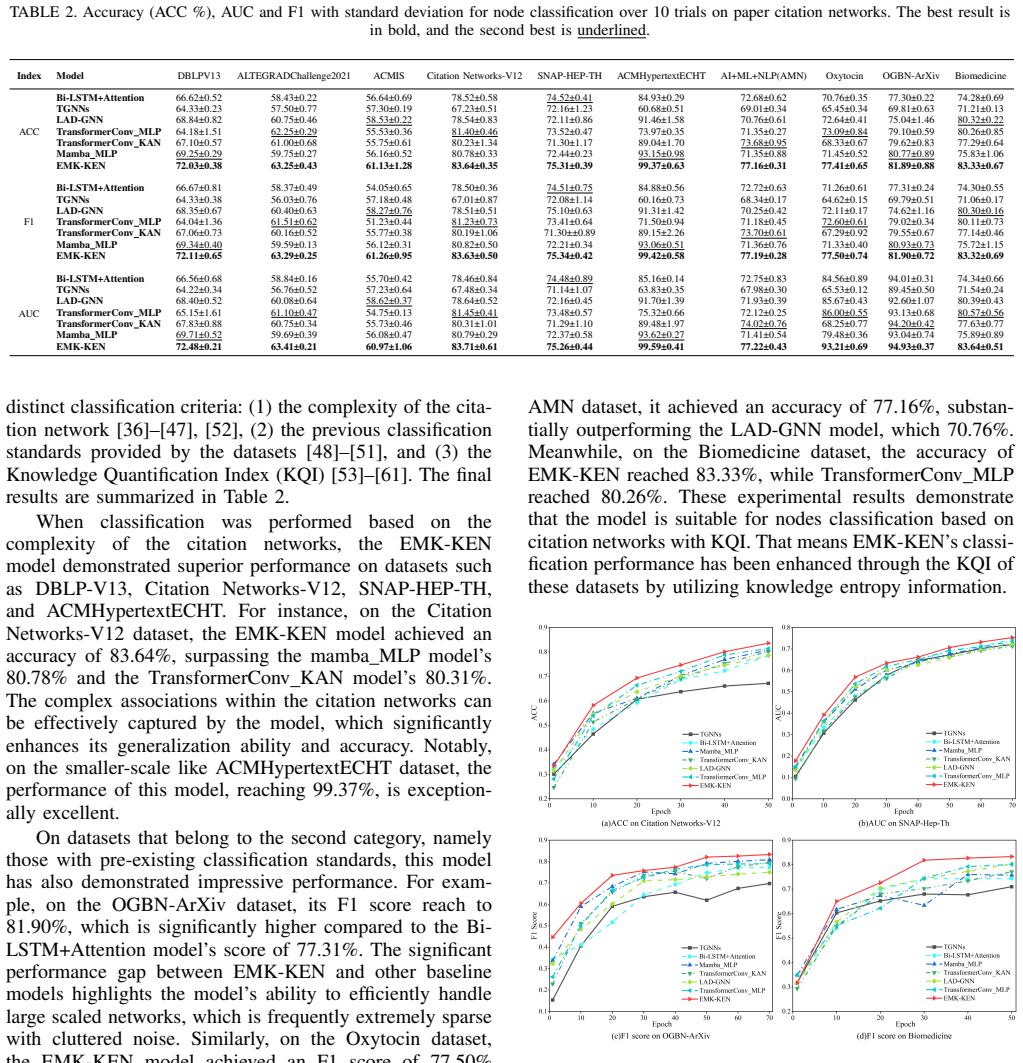
EMK-KEN is a two-module network. The Mamba Long Order Processor (MamST) takes each node's metadata through a feature preprocessor (MetaFP) with relative position encoding, and takes text embeddings from a pretrained language model; both streams go through Mamba's selective state-space layers with causal convolution. The KANflex Neural Unit (KNU) then extracts the central node's output from each stream and applies a KAN layer, whose B-spline basis functions serve as learnable activations, to capture the structural information of the citation neighborhood. The metadata and text outputs are concatenated and passed through a linear layer with softmax to produce the knowledge-level classification. The paper claims this design beats six comparison models on ten datasets, with labels defined by citation-network complexity (in-degree of the central node and counts of nodes and edges in the reference network), by dataset-provided classes, and by the Knowledge Quantization Index (KQI) derived from graph structural entropy; for example, on Citation Networks-V12 it reports 83.64% accuracy versus 80.78% for MambaMLP.
Load-bearing premise
The load-bearing premise is that the structural quantities used to build classification labels are not visible to the classifier; if in-degree or node and edge counts are among the node features, or if the Knowledge Quantization Index is computed on graphs that include test nodes, the model can memorize the labels and the reported gains become an artifact.
Editorial extensions
If this is right
- On the ten datasets tested, the model reports the highest accuracy, F1, and AUC under all three label schemes, including the structural-entropy-based KQI labels.
- Because Mamba processes sequences in linear time and only the central node goes to KAN, the approach scales to very large citation networks without full-graph message passing.
- Ablation experiments attribute the gains to specific components: removing the causal convolution, state-space model, Mamba block, KAN layer, or the post-KAN dropout each lowers accuracy, often sharply.
- The Knowledge Quantization Index, computed from graph structural entropy, is used as a classification target, so the model is effectively predicting a quantified knowledge value rather than raw citation counts.
Reading between the lines
- The fairest control the paper does not report is to strip in-degree, node counts, edge counts, and derived structural statistics from the node features, and to recompute KQI labels using only training-time graphs; if the accuracy margin vanishes, the reported advantage comes from label leakage rather than from learning knowledge value.
- The same architecture could be transferred to other networked artifacts with metadata, text, and local structure, such as patents, clinical guidelines, or software dependency graphs, because it never needs the full graph.
- A natural external validation would test whether KQI classes and EMK-KEN's predictions track future citations or expert judgments of importance; the paper does not connect knowledge value to downstream impact.
Editorial analysis
A structured set of objections, weighed in public.
Referee Report
Summary. The paper proposes EMK-KEN, a model for assessing the knowledge value of academic papers from citation networks. The model combines a Mamba-based sequence processor (MamST) with a KAN-based network unit (KNU) to capture semantic features from node metadata and text embeddings and structural information from the citation graph. The authors introduce a Knowledge Quantization/Quantification Index (KQI) computed from graph structural entropy and use it as classification labels for two of the ten datasets. They report results on ten citation-network datasets, claiming that EMK-KEN outperforms six baseline models in accuracy, F1, and AUC. The central claim is that EMK-KEN is both more effective and more robust than existing GNN- and Mamba-based methods.
Significance. If the reported results were reproducible, the paper would make a useful contribution by demonstrating a practical combination of Mamba and KAN for citation-network classification, with a linear-time sequence model and learnable nonlinear activations. The KQI-based labeling scheme, specified in Section 3, is an interesting attempt to operationalize 'knowledge value' from structural entropy. The paper also provides a fairly detailed description of the two-module architecture and an ablation study over six architectural components. However, the experimental evidence is currently not self-contained: no code, data splits, baseline configurations, or final hyperparameter values are given, and the main results table conflicts with the ablation table. These issues prevent the reader from verifying the central SOTA claim, so the significance of the contribution cannot be assessed on the evidence presented.
major comments (4)
- [Section 4, Tables 2 and 3] The 'Whole model' row of the ablation study (Table 3) is inconsistent with the EMK-KEN row in the main results (Table 2) on every dataset that appears in both tables. For example, ACC values differ as follows: DBLP-V13 70.93±0.85 vs 72.03±0.38; Citation Networks-V12 82.43±0.36 vs 83.64±0.35; OGBN-ArXiv 84.12±0.46 vs 81.89±0.88; Biomedicine 81.51±0.33 vs 83.33±0.67; Oxytocin 73.68±0.27 vs 77.41±0.65; SNAP-HEP-TH 76.20±0.57 vs 75.31±0.39. Some of these gaps exceed the reported standard deviations by a wide margin. This is load-bearing because the paper's central claim of consistent superiority over baselines rests on Table 2. The authors must either explain why the two tables describe different configurations (e.g., different hyperparameters, epochs, or seeds) or provide code and experimental logs that resolve the discrepancy. Without such an explanation, at least one set of results is unreliable.
- [Section 3, label construction and feature leakage] The paper states that for datasets (1) through (6) the reference network was classified 'based on the in-degree of the central node, as well as the number of nodes and edges in the reference network, before being fed into the model for prediction.' It does not specify whether these structural quantities are also included in the metadata feature vector given to the model. If in-degree and edge/node counts are part of the input, the classifier can directly memorize the ground-truth label from the same features, making the reported performance trivial. The paper also does not describe the train/test split, which matters particularly for datasets (7) and (8) where KQI is computed on the full graph; if the same graph structure is used during training and testing, label information may leak between neighborhoods. Please clarify the exact input features and the split procedure for each dataset.
- [Section 4, hyperparameter analysis] The hyperparameter analysis (Figure 6) shows that performance is sensitive to d_state1 and d_state2 and that optimal values are selected per dataset, but the final values used for the results in Table 2 are never reported. The regularization coefficient λ and all training details (learning rate, batch size, epochs, optimizer, dropout rates) are also omitted. Without these values, and without code or data splits, the results in Table 2 cannot be reproduced or independently verified. The authors should provide the exact configuration for every dataset, either in the paper or as supplementary material.
- [Section 3, KQI definition and terminology] The text alternates between 'Knowledge Quantization Index' and 'Knowledge Quantification Index' (the latter appears in the body around Equations 14 and 15). More substantively, the KQI is computed from graph-structural quantities (in-degrees, out-degrees, volume terms in Equations 14 and 15) and is then used as the classification label for the same citation graph that the model consumes. If these same structural quantities appear in the node features, the label is a deterministic function of the input, which would make the classification task ill-posed as a measure of knowledge evaluation. Please clarify which features are used and whether KQI is the only label construction for datasets (9) and (10).
minor comments (5)
- [Section 2.3 and Figure 6] The text contains typos: 'd estate2' should be 'd_state2', and 'seq 1en' should be 'seq_len' where it appears in the metadata processing description.
- [Section 3] The terms 'Knowledge Quantization Index' and 'Knowledge Quantification Index' are used inconsistently; please choose one and use it throughout.
- [Algorithm 1 and Eq. (1)] Algorithm 1 writes 'Hmeta = W fcFmeta + bfc', which omits the ReLU activation present in Eq. (1) and does not match the dimension mapping described in the text. Please align the pseudo-code with the equation.
- [Table 1] Some dataset statistics look suspiciously identical (e.g., avgdegreemean for ACMHypertextECHT and OGBN-ArXiv are both 3.209401105); please verify that the values are correct and that the table columns correspond to the datasets listed in the text.
- [Figure 6 caption] The caption does not define d_state1 and d_state2; please add a sentence explaining that these are the state dimensions for the metadata and text branches of the Mamba module.
Circularity Check
Benchmark labels for six datasets are constructed from the same structural statistics the model is fed, making the claimed superiority partially self-definitional.
-
self definitional
[Section 3 (Dataset and experiment), paragraph after dataset list; cf. Section 2.1 model input definition]
"For datasets (1) to (6), the reference network was classified based on the in-degree of the central node, as well as the number of nodes and edges in the reference network, before being fed into the model for prediction [40], [42]–[46], [52]. ... EMK-KEN is to classify the knowledge level of literature based on the citation network graph structure and metadata."
The labels for six of the ten datasets are defined by a rule over the central node's in-degree and the reference network's node/edge counts. The model is defined to consume the citation-network graph structure and metadata, from which those same structural quantities are directly computable. The paper never states that the label-defining counts are withheld from the input features, so on these datasets the classification target is a deterministic function of the available input. The reported 'prediction' can therefore reduce to recovering the label rule from the graph structure, making the stated accuracy advantage on those datasets partially an artifact of benchmark construction rather than evidence of learned knowledge-value semantics.
full rationale
The main circularity is in the evaluation protocol, not in the Mamba/KAN architecture itself. Section 3 constructs the ground-truth labels for datasets (1)-(6) from in-degree and reference-network node/edge counts, while Section 2.1 defines the model input as the citation-network graph structure and metadata. Since in-degree and network-size statistics are directly computable from the same citation graph the model receives, the paper does not establish that the labels are hidden from the classifier. This makes the SOTA claim on those datasets partially forced by construction. The KQI-based datasets (9)-(10) share a similar concern because KQI is computed from graph structural entropy over the same network, although the paper does not explicitly show the model consuming the full structural entropy value. No load-bearing self-citations or imported uniqueness theorems were found; the Mamba and KAN components are supported by external prior work. The Table 2 vs. Table 3 'Whole model' discrepancy is a serious reproducibility inconsistency, but it is a correctness problem rather than a circularity.
Assumptions & free parameters
free parameters (4)
- d_state2 =
not reported; searched 8 to 120, per-dataset optimal
- d_state1 =
not reported; searched 1 to 16, per-dataset optimal
- regularization coefficient lambda =
not reported
- KQI class thresholds =
not reported
assumptions (3)
- domain assumption KQI as defined in Equations 14-15 is a valid measure of a paper's knowledge value.
- domain assumption Mamba's sequence processing of node metadata and text plus relative position encoding preserves enough citation structure to predict KQI labels.
- domain assumption Per-dataset hyperparameter selection does not overfit the reported test numbers.
invented entities (1)
-
Knowledge Quantization Index (KQI) as ground-truth knowledge value
Cite this review
Pith. "Pith review of EMK-KEN: A High-Performance Approach for Assessing Knowledge Value in Citation Network." pith.science (2026). https://pith.science/paper/KGTOGWBU
@misc{pith2026250215704,
  author       = {Pith},
  title        = {Pith review of: EMK-KEN: A High-Performance Approach for Assessing Knowledge Value in Citation Network},
  year         = {2026},
  howpublished = {\url{https://pith.science/paper/KGTOGWBU}},
  note         = {Machine review of arXiv:2502.15704}
}
read the original abstract
With the explosive growth of academic literature, effectively evaluating the knowledge value of literature has become quite essential. However, most of the existing methods focus on modeling the entire citation network, which is structurally complex and often suffers from long sequence dependencies when dealing with text embeddings. Thus, they might have low efficiency and poor robustness in different fields. To address these issues, a novel knowledge evaluation method is proposed, called EMK-KEN. The model consists of two modules. Specifically, the first module utilizes MetaFP and Mamba to capture semantic features of node metadata and text embeddings to learn contextual representations of each paper. The second module utilizes KAN to further capture the structural information of citation networks in order to learn the differences in different fields of networks. Extensive experiments based on ten benchmark datasets show that our method outperforms the state-of-the-art competitors in effectiveness and robustness.
Figures


Figures from the paper (3 more)


Reference graph
Works this paper leans on
-
[1]
Prediction meth- ods and applications in the science of science: A survey,
J. Hou, H. Pan, T. Guo, I. Lee, X. Kong, and F. Xia, “Prediction meth- ods and applications in the science of science: A survey,” Computer Science Review, vol. 34, p. 100197, Nov. 2019
work page 2019
-
[2]
An index to quantify an individual’s scientific research output,
J. E. Hirsch, “An index to quantify an individual’s scientific research output,” Proceedings of the National Academy of Sciences of the United States of America , vol. 102, pp. 16569–16572, Nov. 2005
work page 2005
-
[3]
E. Garfield, “Citation analysis as a tool in journal evaluation: Journals can be ranked by frequency and impact of citations for science policy studies.,” Science, vol. 178, pp. 471–479, Nov. 1972
work page 1972
-
[4]
Citation count prediction: learning to estimate future citations for literature,
R. Yan, J. Tang, X. Liu, D. Shan, and X. Li, “Citation count prediction: learning to estimate future citations for literature,” in Proceedings of the 20th ACM international conference on Information and knowledge management , pp. 1247–1252, 2011
work page 2011
-
[5]
Document co-citation analysis to enhance transdisciplinary research,
C. M. Trujillo and T. M. Long, “Document co-citation analysis to enhance transdisciplinary research,” Science Advances, vol. 4, no. 1, p. e1701130, 2018
work page 2018
-
[6]
Effect of class imbalance in heterogeneous network embedding: An empirical study,
A. Anil and S. R. Singh, “Effect of class imbalance in heterogeneous network embedding: An empirical study,” Journal of Informetrics , vol. 14, p. 101009, May 2020
work page 2020
-
[7]
A dual-stage attention-based recurrent neural network for time series prediction,
Y . Qin, D. Song, H. Chen, W. Cheng, G. Jiang, and G. W. Cottrell, “A dual-stage attention-based recurrent neural network for time series prediction,” in Proceedings of the Twenty-Sixth International Joint Conference on Artificial Intelligence, IJCAI-17, pp. 2627–2633, Aug. 2017
work page 2017
-
[8]
Predicting future influence of papers, re- searchers, and venues in a dynamic academic network,
F. Zhang and S. Wu, “Predicting future influence of papers, re- searchers, and venues in a dynamic academic network,” Journal of Informetrics, vol. 14, p. 101035, May 2020
work page 2020
Show all 61 references
-
[9]
Predicting the clinical citation count of biomedical papers using multilayer perceptron neural network,
X. Li, X. Tang, and Q. Cheng, “Predicting the clinical citation count of biomedical papers using multilayer perceptron neural network,” Journal of Informetrics , vol. 16, p. 101333, Nov. 2022
2022
-
[10]
Smlp4rec: An efficient all-mlp architecture for sequential recommendations,
J. Gao, X. Zhao, M. Li, M. Zhao, R. Wu, R. Guo, Y . Liu, and D. Yin, “Smlp4rec: An efficient all-mlp architecture for sequential recommendations,” ACM Trans. Inf. Syst. , vol. 42, Jan. 2024
2024
-
[11]
Knowledge error detection via textual and structural joint learning,
X. Wang, X. Ao, F. Zhang, Z. Zhang, and Q. He, “Knowledge error detection via textual and structural joint learning,” Big Data Mining and Analytics, vol. 8, pp. 233–240, Feb. 2025
2025
-
[12]
Medical knowledge graph: Data sources, construction, reasoning, and applications,
X. Wu, J. Duan, Y . Pan, and M. Li, “Medical knowledge graph: Data sources, construction, reasoning, and applications,” Big Data Mining and Analytics, vol. 6, no. 2, pp. 201–217, 2023
2023
-
[13]
H2cgl: Model- ing dynamics of citation network for impact prediction,
G. He, Z. Xue, Z. Jiang, Y . Kang, S. Zhao, and W. Lu, “H2cgl: Model- ing dynamics of citation network for impact prediction,” Information Processing & Management , vol. 60, p. 103512, Nov. 2023
2023
-
[14]
Incorporating bidirection- interactive information and semantic features for relational facts extraction (student abstract),
Y . Yu, G. Wang, H. Ren, and Y . Cai, “Incorporating bidirection- interactive information and semantic features for relational facts extraction (student abstract),” in Proceedings of the AAAI Conference on Artificial Intelligence , vol. 35, pp. 15947–15948, May 2021
2021
-
[15]
Se-gsl: A general and effective graph structure learning framework through structural entropy optimization,
D. Zou, H. Peng, X. Huang, R. Yang, J. Li, J. Wu, C. Liu, and P. S. Yu, “Se-gsl: A general and effective graph structure learning framework through structural entropy optimization,” in Proceedings of the ACM Web Conference 2023 , pp. 499–510, Apr. 2023
2023
-
[16]
Structural entropy based graph structure learning for node classification,
L. Duan, X. Chen, W. Liu, D. Liu, K. Yue, and A. Li, “Structural entropy based graph structure learning for node classification,” in Proceedings of the AAAI Conference on Artificial Intelligence, vol. 38, pp. 8372–8379, Mar. 2024
2024
-
[17]
Label attentive distillation for gnn-based graph classification,
X. Hong, W. Li, C. Wang, M. Lin, and S. Lu, “Label attentive distillation for gnn-based graph classification,” in Proceedings of the AAAI Conference on Artificial Intelligence , vol. 38, pp. 8499–8507, Mar. 2024
2024
-
[18]
Graph neural networks,
G. Corso, H. Stark, S. Jegelka, T. Jaakkola, and R. Barzilay, “Graph neural networks,” Nature Reviews Methods Primers , vol. 4, p. 17, Mar. 2024
2024
-
[19]
Graph neural networks: A review of methods and applications,
J. Zhou, G. Cui, S. Hu, Z. Zhang, C. Yang, Z. Liu, L. Wang, C. Li, and M. Sun, “Graph neural networks: A review of methods and applications,” AI open, vol. 1, pp. 57–81, Jan. 2021
2021
-
[20]
Barriers for the performance of graph neural networks (gnn) in discrete random structures,
D. Gamarnik, “Barriers for the performance of graph neural networks (gnn) in discrete random structures,” Proceedings of the National Academy of Sciences of the United States of America , vol. 120, p. e2314092120, Oct. 2023
2023
-
[21]
Limits of depth: Over-smoothing and over-squashing in gnns,
A. M. ud din and S. Qureshi, “Limits of depth: Over-smoothing and over-squashing in gnns,” Big Data Mining and Analytics , vol. 7, pp. 205–216, Mar. 2024
2024
-
[22]
Caduceus: Bi-directional equivariant long-range dna sequence mod- eling,
Y . Schiff, C.-H. Kao, A. Gokaslan, T. Dao, A. Gu, and V . Kuleshov, “Caduceus: Bi-directional equivariant long-range dna sequence mod- eling,” in ICML, 2024
2024
-
[23]
Mamba: Linear-time sequence modeling with selective state spaces,
A. Gu and T. Dao, “Mamba: Linear-time sequence modeling with selective state spaces,” CoRR, vol. abs/2312.00752, Dec. 2023
2023 arXiv
-
[24]
Graph mamba: Towards learning on graphs with state space models,
A. Behrouz and F. Hashemi, “Graph mamba: Towards learning on graphs with state space models,” in Proceedings of the 30th ACM SIGKDD Conference on Knowledge Discovery and Data Mining , pp. 119–130, Aug. 2024
2024
-
[25]
Transformers are SSMs: Generalized models and efficient algorithms through structured state space duality,
T. Dao and A. Gu, “Transformers are SSMs: Generalized models and efficient algorithms through structured state space duality,” in Proceedings of the 41st International Conference on Machine Learn- ing (R. Salakhutdinov, Z. Kolter, K. Heller, A. Weller, N. Oliver, J. Scarlett, ...
2024
-
[26]
A comprehensive and fair comparison between mlp and kan represen- tations for differential equations and operator networks,
K. Shukla, J. D. Toscano, Z. Wang, Z. Zou, and G. E. Karniadakis, “A comprehensive and fair comparison between mlp and kan represen- tations for differential equations and operator networks,” Computer Methods in Applied Mechanics and Engineering, vol. 431, p. 117290, 2024
2024
-
[27]
Kan: Kolmogorov-arnold networks,
Z. Liu, Y . Wang, S. Vaidya, F. Ruehle, J. Halverson, M. Solja ˇci´c, T. Y . Hou, and M. Tegmark, “Kan: Kolmogorov-arnold networks,” arXiv preprint arXiv:2404.19756 , June 2024
2024 arXiv
-
[28]
Kan 2.0: Kolmogorov-arnold networks meet science,
Z. Liu, P. Ma, Y . Wang, W. Matusik, and M. Tegmark, “Kan 2.0: Kolmogorov-arnold networks meet science,” arXiv preprint arXiv:2408.10205, Aug. 2024
2024 arXiv
-
[29]
Kagnns: Kolmogorov-arnold networks meet graph learning,
R. Bresson, G. Nikolentzos, G. Panagopoulos, M. Chatzianastasis, J. Pang, and M. Vazirgiannis, “Kagnns: Kolmogorov-arnold networks meet graph learning,” arXiv preprint arXiv:2406.18380 , July 2024
2024 arXiv
-
[30]
Gkan: Graph kolmogorov-arnold networks,
M. Kiamari, M. Kiamari, and B. Krishnamachari, “Gkan: Graph kolmogorov-arnold networks,” arXiv preprint arXiv:2406.06470, June 2024
2024 arXiv
-
[31]
Kolmogorov-arnold transformer,
X. Yang and X. Wang, “Kolmogorov-arnold transformer,” arXiv preprint arXiv:2409.10594, Sept. 2024
2024 arXiv
-
[32]
Scibert: A pretrained language model for scientific text,
I. Beltagy, K. Lo, and A. Cohan, “Scibert: A pretrained language model for scientific text,” in Proceedings of the 2019 Conference on Empirical Methods in Natural Language Processing and the 9th International Joint Conference on Natural Language Processing (EMNLP-IJCNLP) (K. I...
2019
-
[33]
Char- bert: Character-aware pre-trained language model,
W. Ma, Y . Cui, C. Si, T. Liu, S. Wang, and G. Hu, “Char- bert: Character-aware pre-trained language model,” in Proceedings of the 28th International Conference on Computational Linguistics (D. Scott, N. Bel, and C. Zong, eds.), (Barcelona, Spain (Online)), pp. 39–50, Internat...
2020
-
[34]
Matscibert: A materials domain language model for text mining and information extraction,
T. Gupta, M. Zaki, N. A. Krishnan, and Mausam, “Matscibert: A materials domain language model for text mining and information extraction,” npj Computational Materials , vol. 8, p. 102, May 2022
2022
-
[35]
Attention-aware heterogeneous graph neural network,
J. Zhang and Q. Xu, “Attention-aware heterogeneous graph neural network,” Big Data Mining and Analytics , vol. 4, pp. 233–241, Dec. 2021
2021
-
[36]
SNAP Datasets: Stanford large network dataset collection
J. Leskovec and A. Krevl, “SNAP Datasets: Stanford large network dataset collection.” http://snap.stanford.edu/data, June 2014
2014
-
[37]
In-conference citation data acm hypertext & echt (version 2)
Anderson, “In-conference citation data acm hypertext & echt (version 2).” http://dx.doi.org/10.5258/SOTON/D1870v2, July 2021
2021 doi
-
[38]
Altegrad challenge 2021
K. Assobo, “Altegrad challenge 2021.” https://www.kaggle.com/ datasets/kevinassobo/altegrad-challenge-2021/data, June 2021
2021
-
[39]
Citation-networks-v12
J. Tang, “Citation-networks-v12.” https://www.kaggle.com/datasets/ mathurinache/citation-network-dataset, Apr. 2020
2020
-
[40]
An overview of microsoft academic service (mas) and applications,
A. Sinha, Z. Shen, Y . Song, H. Ma, D. Eide, B.-j. P. Hsu, and K. Wang, “An overview of microsoft academic service (mas) and applications,” in Proceedings of the 24th international conference on world wide web , pp. 243–246, ACM, May 2015
2015
-
[41]
Dblp-citation-network v13
J. Tang, “Dblp-citation-network v13.” https://www.aminer.cn/citation, May 2021
2021
-
[42]
Arnetminer: Extraction and mining of academic social networks,
J. Tang, J. Zhang, L. Yao, J. Li, L. Zhang, and Z. Su, “Arnetminer: Extraction and mining of academic social networks,” in KDD’08, pp. 990–998, Aug. 2008
2008
-
[43]
A combination approach to web user profiling,
J. Tang, L. Yao, D. Zhang, and J. Zhang, “A combination approach to web user profiling,” ACM TKDD, vol. 5, pp. 1–44, Dec. 2010
2010
-
[44]
Topic level expertise search over heterogeneous networks,
J. Tang, J. Zhang, R. Jin, Z. Yang, K. Cai, L. Zhang, and Z. Su, “Topic level expertise search over heterogeneous networks,” Machine Learning Journal, vol. 82, pp. 211–237, Sept. 2010
2010
-
[45]
A unified probabilistic framework for name disambiguation in digital library,
J. Tang, A. C. Fong, B. Wang, and J. Zhang, “A unified probabilistic framework for name disambiguation in digital library,” IEEE Trans- actions on Knowledge and Data Engineering , vol. 24, pp. 975–987, June 2012
2012
-
[46]
Social network extraction of aca- demic researchers,
J. Tang, D. Zhang, and L. Yao, “Social network extraction of aca- demic researchers,” in ICDM’07, pp. 292–301, Oct. 2007
2007
-
[47]
ACM IS abstract and citation network1,
P. Luo, “ACM IS abstract and citation network1,” 2014
2014
-
[48]
Ogbn-arxiv (processed for pyg)
S. University, “Ogbn-arxiv (processed for pyg).” https://ogb.stanford. edu/docs/nodeprop/#ogbn-arxiv, May 2020
2020
-
[49]
Microsoft academic graph: When experts are not enough,
K. Wang, Z. Shen, C. Huang, C.-H. Wu, Y . Dong, and A. Kanakia, “Microsoft academic graph: When experts are not enough,” Quanti- tative Science Studies , vol. 1, pp. 396–413, Feb. 2020
2020
-
[50]
Distributed representations of words and phrases and their compo- sitionality,
T. Mikolov, I. Sutskever, K. Chen, G. S. Corrado, and J. Dean, “Distributed representations of words and phrases and their compo- sitionality,” in Advances in Neural Information Processing Systems (C. Burges, L. Bottou, M. Welling, Z. Ghahramani, and K. Wein- berger, eds.), vo...
2013
-
[51]
Citation network data sets for ’oxytocin – a social peptide? deconstructing the evidence’,
R. I. Leng, “Citation network data sets for ’oxytocin – a social peptide? deconstructing the evidence’,” June 2022
2022
-
[52]
Identifying node role in social network based on multiple indicators,
S. Huang, T. Lv, X. Zhang, Y . Yang, W. Zheng, and C. Wen, “Identifying node role in social network based on multiple indicators,” PLOS ONE, vol. 9, pp. 1–16, Aug. 2014
2014
-
[53]
Quantifying the value of knowledge within the context of product development,
Y . Xu and A. Bernard, “Quantifying the value of knowledge within the context of product development,” Knowledge-Based Systems , vol. 24, pp. 166–175, Feb. 2011
2011
-
[54]
A theory and methodology to quantify knowledge,
D. Fanelli, “A theory and methodology to quantify knowledge,” R. Soc. Open Sci. , vol. 6, p. 181055, Apr. 2019
2019
-
[55]
Approximate von neumann entropy for directed graphs,
C. Ye, R. C. Wilson, C. H. Comin, L. d. F. Costa, and E. R. Hancock, “Approximate von neumann entropy for directed graphs,” Physical Review E, vol. 89, p. 052804, May 2014
2014
-
[56]
Entropy of city street networks linked to future spatial navigation ability,
A. Coutrot, E. Manley, S. Goodroe, C. Gahnstrom, G. Filomena, D. Yesiltepe, R. C. Dalton, J. M. Wiener, C. H ¨olscher, M. Horn- berger, et al., “Entropy of city street networks linked to future spatial navigation ability,” Nature, vol. 604, pp. 104–110, Mar. 2022
2022
-
[57]
A methodology for identifying breakthrough topics using structural entropy,
H. Xu, R. Luo, J. Winnink, C. Wang, and E. Elahi, “A methodology for identifying breakthrough topics using structural entropy,” Infor- mation Processing & Management , vol. 59, p. 102862, Mar. 2022
2022
-
[58]
Minimum entropy principle guided graph neural networks,
Z. Yang, G. Zhang, J. Wu, J. Yang, Q. Z. Sheng, H. Peng, A. Li, S. Xue, and J. Su, “Minimum entropy principle guided graph neural networks,” in Proceedings of the sixteenth ACM international confer- ence on web search and data mining , pp. 114–122, Feb. 2023
2023
-
[59]
Data-driven dy- namic graph convolution transformer network model for eeg emotion recognition under iomt environment,
X. Jin, F. Zhu, Y . Shen, G. Jeon, and D. Camacho, “Data-driven dy- namic graph convolution transformer network model for eeg emotion recognition under iomt environment,” Big Data Mining and Analytics, 2024
2024
-
[60]
Human-level few-shot con- cept induction through minimax entropy learning,
C. Zhang, B. Jia, Y . Zhu, and S.-C. Zhu, “Human-level few-shot con- cept induction through minimax entropy learning,” Science Advances, vol. 10, p. eadg2488, Apr. 2024
2024
-
[61]
Incremental measurement of structural entropy for dynamic graphs,
R. Yang, H. Peng, C. Liu, and A. Li, “Incremental measurement of structural entropy for dynamic graphs,” Artificial Intelligence , vol. 334, p. 104175, Sept. 2024
2024
Reviewed August 10, 2026 · model on record in the stance chip above.
Discussion (0). Continue with ORCID to comment.