Quadratic invariants and Hamiltonian structure in coupled gyrostat low-order model hierarchies
Pith reviewed 2026-05-22 23:57 UTC · model grok-4.3
The pith
Sparse nested hierarchies of K gyrostats possess exactly (M+1)/2 independent quadratic invariants, recoverable as Casimirs from an explicitly constructible non-canonical Poisson matrix.
A machine-rendered reading of the paper's core claim, the machinery that carries it, and where it could break.
Core claim
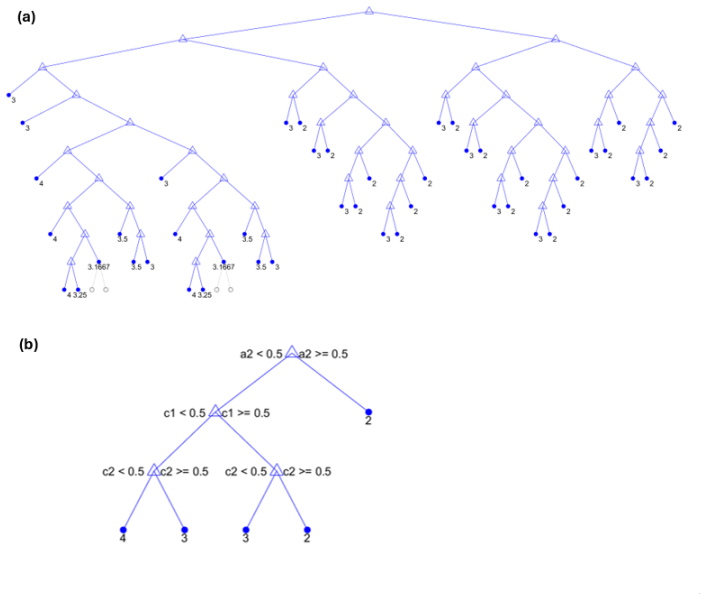
For sparse nested hierarchies of K gyrostats (M = 2K + 1 modes, no linear feedback), the number of independent quadratic invariants is exactly (M + 1)/2. For general GLOMs with all parameters nonzero, energy is the only guaranteed invariant. Many GLOMs admit a non-canonical Hamiltonian structure with quadratic invariants recoverable as Casimir functions of an explicitly constructible Poisson matrix. The Hamiltonian structure imposes precise, computationally verifiable constraints on the nonlinear coefficients, and Casimir gradients project consistently across models of increasing complexity.
What carries the argument
An explicitly constructible Poisson matrix for the non-canonical Hamiltonian structure, from which the quadratic invariants are recovered as Casimir functions.
If this is right
- Energy remains the sole guaranteed invariant when all coupling parameters are nonzero.
- The Hamiltonian structure supplies verifiable algebraic constraints that the nonlinear coefficients must satisfy.
- Casimir gradients project consistently, so invariants remain compatible when a larger model is restricted to a subspace.
- The geometric construction replaces non-scalable algebraic searches for invariants in these hierarchies.
Where Pith is reading between the lines
- The same explicit Poisson-matrix construction may apply to other energy-conserving Galerkin truncations that share similar coupling patterns.
- Consistent projection of invariants across hierarchy levels could simplify nonlinear stability calculations in related geophysical models.
- The result indicates that Hamiltonian structure arises more systematically in certain energy-conserving low-order truncations than the general case suggests.
Load-bearing premise
The models belong to the specific class of energy-conserving Galerkin-truncated systems with sparse nested hierarchies and no linear feedback, allowing the Poisson matrix to be built directly from the nonlinear coefficients.
What would settle it
A concrete sparse nested hierarchy of gyrostats for which the count of independent quadratic invariants is not (M + 1)/2, or for which no explicit Poisson matrix recovers all quadratic invariants as Casimirs without additional fitting.
Figures


read the original abstract
Coupled gyrostat low-order models (GLOMs) are energy-conserving cores of Galerkin-truncated fluid and geophysical systems, including Rayleigh-Benard convection and vorticity dynamics. A single gyrostat always possesses two quadratic invariants; when gyrostats are coupled, the number and geometry of invariants vary sensitively with model configuration, influencing the effective dimension of the dynamics, nonlinear stability, and statistical equilibria. We provide a systematic theory of this dependence. For sparse nested hierarchies of K gyrostats (M=2K+1 modes, no linear feedback), the number of independent quadratic invariants is exactly (M+1)/2; for general GLOMs with all parameters nonzero, energy is the only guaranteed invariant. The standard algebraic approach to finding invariants does not scale with model size. We show instead that many GLOMs admit a non-canonical Hamiltonian structure, with quadratic invariants recoverable as Casimir functions of an explicitly constructible Poisson matrix. The Hamiltonian structure imposes precise, computationally verifiable constraints on the nonlinear coefficients. For Hamiltonian hierarchies, Casimir gradients project consistently across models of increasing complexity, so that invariants are compatible under restriction to subspaces. The clear geometric interpretation of these models enables consistent application of Hamiltonian dynamics across low-order model hierarchies.
Editorial analysis
A structured set of objections, weighed in public.
Referee Report
Summary. The manuscript develops a systematic theory of quadratic invariants for coupled gyrostat low-order models (GLOMs), which are energy-conserving Galerkin truncations of fluid and geophysical systems. For sparse nested hierarchies of K gyrostats (M=2K+1 modes, no linear feedback), it claims the number of independent quadratic invariants is exactly (M+1)/2. It further asserts that many GLOMs admit a non-canonical Hamiltonian structure in which the quadratic invariants appear as Casimir functions of an explicitly constructible Poisson matrix; this structure imposes verifiable constraints on the nonlinear coefficients. For general GLOMs with all parameters nonzero, only the energy is guaranteed to be an invariant. The Hamiltonian formulation is shown to ensure consistent projection of Casimir gradients across increasing model complexity.
Significance. If the central claims hold, the work supplies a scalable geometric framework for identifying invariants and Hamiltonian structures in low-order models used in Rayleigh-Bénard convection and vorticity dynamics. The explicit Poisson-matrix construction and the compatibility of invariants under subspace restriction are concrete strengths that could support consistent application of Hamiltonian methods across model hierarchies and improve analysis of nonlinear stability and statistical equilibria.
minor comments (2)
- The abstract states that the Poisson matrix is 'explicitly constructible' from the nonlinear coefficients but supplies no illustrative example; adding a short worked example for small K (e.g., K=1 or K=2) in §3 or §4 would make the construction immediately verifiable and improve accessibility.
- The claim that 'the standard algebraic approach does not scale' is stated without a concrete complexity comparison or reference to the size at which it fails; a brief remark or small table quantifying the scaling difference would strengthen the motivation for the Hamiltonian route.
Simulated Author's Rebuttal
We thank the referee for their careful reading and positive evaluation of the manuscript. The summary accurately captures the central claims regarding quadratic invariants in sparse GLOM hierarchies and the construction of non-canonical Poisson structures. We note that the report contains no specific major comments requiring point-by-point rebuttal.
Circularity Check
No significant circularity detected
full rationale
The paper derives the count of quadratic invariants ((M+1)/2 for sparse nested hierarchies) and the explicit Poisson matrix construction directly from the governing equations of the specified GLOM class (energy-conserving Galerkin truncations with given coupling). These are presented as algebraic consequences of the nonlinear coefficients and hierarchy structure, with Casimirs recovered as invariants. No steps reduce by definition or fitting to the target result, no self-citation chains are load-bearing for the central claims, and the derivation is scoped to verifiable constraints on coefficients without renaming or smuggling ansatzes. The result is self-contained.
Axiom & Free-Parameter Ledger
axioms (1)
- domain assumption Coupled gyrostat low-order models are energy-conserving cores of Galerkin-truncated fluid and geophysical systems
Lean theorems connected to this paper
-
IndisputableMonolith/Cost/FunctionalEquation.leanwashburn_uniqueness_aczel unclear?
unclearRelation between the paper passage and the cited Recognition theorem.
For sparse nested hierarchies of K gyrostats (M=2K+1 modes, no linear feedback), the number of independent quadratic invariants is exactly (M+1)/2
What do these tags mean?
- matches
- The paper's claim is directly supported by a theorem in the formal canon.
- supports
- The theorem supports part of the paper's argument, but the paper may add assumptions or extra steps.
- extends
- The paper goes beyond the formal theorem; the theorem is a base layer rather than the whole result.
- uses
- The paper appears to rely on the theorem as machinery.
- contradicts
- The paper's claim conflicts with a theorem or certificate in the canon.
- unclear
- Pith found a possible connection, but the passage is too broad, indirect, or ambiguous to say the theorem truly supports the claim.
Reference graph
Works this paper leans on
-
[1]
Arnol’d, V. I. (1969), The hamiltonian nature of the euler equations in the dynamics of a rigid body and of a perfect fluid,Usp. Mat. Nauk, 24(3), 225–226
work page 1969
-
[2]
Charney, J. G., and J. G. DeVore (1979), Multiple flow equilibria in the atmosphere and block- ing, Journal of the Atmospheric Sciences, 36, 1205–1216, doi:10.1175/1520-0469(1979)036<1205: MFEITA>2.0.CO;2
-
[3]
Gibbon, J., and M. McGuinness (1982), The real and complex Lorenz equations in rotating fluids and lasers, Physica D: Nonlinear Phenomena, 5, 108–122, doi:https://doi.org/10.1016/ 0167-2789(82)90053-7
work page 1982
-
[4]
Gluhovsky, A. (2006), Energy-conserving and Hamiltonian low-order models in geophysical fluid dynamics, Nonlinear Processes in Geophysics, 13, 125–133, doi:10.5194/npg-13-125-2006,2006
-
[5]
Gluhovsky, A., and E. Agee (1997), An interpretation of atmospheric low-order models,Journal of the Atmospheric Sciences, 54, 768–773, doi:10.1175/1520-0469(1997)054<0768:AIOALO>2.0. CO;2
-
[6]
Gluhovsky, A., and C. Tong (1999), The structure of energy conserving low-order models,Physics of Fluids, 11(2), 334–343, doi:https://doi.org/10.1063/1.869883
-
[7]
Gluhovsky, A., C. Tong, and E. Agee (2002), Selection of modes in convective low-order mod- els, Journal of the Atmospheric Sciences, 59, 1383–1393, doi:10.1175/1520-0469(2002)059<1383: SOMICL>2.0.CO;2
-
[8]
(2002),Classical Mechanics, Addison-Wesley
Goldstein, H. (2002),Classical Mechanics, Addison-Wesley
work page 2002
-
[9]
Howard, L. N., and R. Krishnamurti (1986), Large-scale flow in turbulent convection: a mathe- matical model,Journal of Fluid Mechanics, 170, 385–410, doi:10.1017/S0022112086000940
- [10]
-
[11]
Lakshmivarahan, S., and Y. Wang (2008a), On the structure of the energy conserving low-order models and their relation to Volterra gyrostat,Nonlinear Analysis: Real World Applications, 9(4), 1573–1589, doi:https://doi.org/10.1016/j.nonrwa.2007.04.002
-
[12]
Lakshmivarahan, S., and Y. Wang (2008b), On the Relation between Energy-Conserving Low- Order Models and a System of Coupled Generalized Volterra Gyrostats with Nonlinear Feedback, Journal of Nonlinear Science, 18, 75–97, doi:https://doi.org/10.1007/s00332-007-9006-6
-
[13]
Lakshmivarahan, S., M. E. Baldwin, and T. Zheng (2006), Further analysis of Lorenz’s maximum simplification equations, Journal of the Atmospheric Sciences, 63, 2673–2699, doi:https://doi. org/10.1175/JAS3796.1. 43
-
[14]
Lorenz, E. N. (1960), Maximum simplification of the dynamic equations,Tellus, 12, 243–254, doi: https://doi.org/10.3402/tellusa.v12i3.9406
-
[15]
Lorenz, E. N. (1963), Deterministic nonperiodic flow,Journal of the Atmospheric Sciences, 20(2), 130–141, doi:https://doi.org/10.1175/1520-0469(1963)020<0130:DNF>2.0.CO;2
- [16]
-
[17]
Matson, L. E. (2007), The Malkus-Lorenz water wheel revisited,American Journal of Physics, 75, 1114–1122, doi:https://doi.org/10.1119/1.2785209
- [18]
-
[19]
Reiterer, P., C. Lainscsek, F. Schurrer, C. Letellier, and J. Maquet (1998), A nine-dimensional
work page 1998
-
[20]
Lorenzsystemtostudyhigh-dimensionalchaos, Journal of Physics A: Mathematical and General, 31, 7121–7139, doi:10.1088/0305-4470/31/34/015
-
[21]
Saltzman, B. (1962), Finite amplitude free convection as an initial value problem - I,Journal of the Atmospheric Sciences, 19, 329–341, doi:10.1175/1520-0469(1962)019<0329:FAFCAA>2.0.CO;2
- [22]
-
[23]
Seshadri, A. K., and S. Lakshmivarahan (2023b), Minimal chaotic models from the volterra gy- rostat, Physica D: Nonlinear Phenomena, 456, 1–15, doi:https://doi.org/10.1016/j.physd.2023. 133948
-
[24]
Shepherd, T. G. (1990), Symmetries, conservation laws, and hamiltonian structure in geo- physical fluid dynamics, Advances in Geophysics, 32, 287–338, doi:https://doi.org/10.1016/ S0065-2687(08)60429-X
work page 1990
-
[25]
Swart, H. E. D. (1988), Low-order spectral models of the atmospheric circulation: A survey,Acta Applicandae Mathematicae, 11, 49–96, doi:10.1007/BF00047114
-
[26]
Thiffeault, J.-L., and W. Horton (1996), Energy-conserving truncations for convection with shear flow, Physics of Fluids, 8, 1715–1719, doi:10.1063/1.868956
-
[27]
Tong, C. (2009), Lord Kelvin’s gyrostat, and its analogs in physics, including the Lorenz model, American Journal of Physics, 77, 526–537, doi:https://doi.org/10.1119/1.3095813
-
[28]
Tong, C., and A. Gluhovsky (2008), Gyrostatic extensions of the Howard-Krishnamurti model of thermal convection with shear,Nonlinear Processes in Geophysics, 15(71-79), doi:10.5194/ npg-15-71-2008. 44
work page 2008
discussion (0)
Sign in with ORCID, Apple, or X to comment. Anyone can read and Pith papers without signing in.