A fast Fourier spectral method for wave kinetic equation
Pith reviewed 2026-05-23 00:19 UTC · model grok-4.3
The pith
The wave kinetic equation can be solved by a fast Fourier spectral method that turns its nonlinear term into an FFT-evaluable double convolution.
A machine-rendered reading of the paper's core claim, the machinery that carries it, and where it could break.
Core claim
The central claim is that the high-dimensional nonlinear wave kinetic operator can be reformulated as a spherical integral, and that the conservation of mass and momentum then produces a double convolution structure in Fourier space which the fast Fourier transform evaluates at much lower cost while preserving the original properties.
What carries the argument
The double convolution structure in Fourier space that arises from the spherical-integral reformulation of the wave kinetic operator and the conservation laws.
Load-bearing premise
The reformulation of the wave kinetic operator as a spherical integral is mathematically valid and preserves conservation properties exactly.
What would settle it
A side-by-side computation of the nonlinear term on a small discrete frequency set using both the original definition and the double-convolution FFT method, checking for agreement to high precision.
Figures


read the original abstract
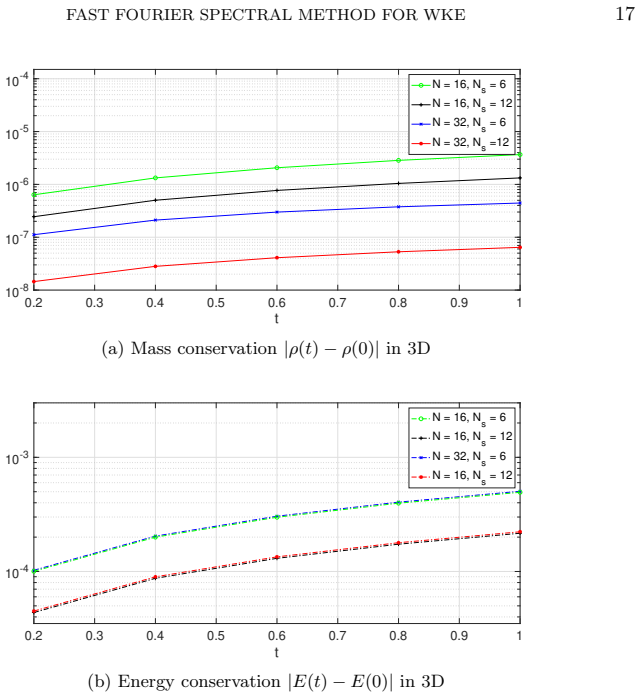
The central object in wave turbulence theory is the wave kinetic equation (WKE), which is an evolution equation for wave action density and acts as the wave analog of the Boltzmann kinetic equations for particle interactions. Despite recent exciting progress in the theoretical aspects of the WKE, numerical developments have lagged behind. In this paper, we introduce a fast Fourier spectral method for solving the WKE. The key idea lies in reformulating the high-dimensional nonlinear wave kinetic operator as a spherical integral, analogous to the classical Boltzmann collision operator. The conservation of mass and momentum leads to a double convolution structure in Fourier space, which can be efficiently handled by the fast Fourier transform (FFT), reducing the computational cost from $O(N^{3d})$ to $O(M N^d \log N)$ with $N$-frequency nodes and $M \ll N^{2d-1}$ in $d$ dimensions. We demonstrate the accuracy and efficiency of the proposed method through several numerical tests in both 2D and 3D, revealing and conjecturing some interesting and unique features of this equation.
Editorial analysis
A structured set of objections, weighed in public.
Referee Report
Summary. The paper claims to introduce a fast Fourier spectral method for the wave kinetic equation (WKE) by reformulating the high-dimensional nonlinear operator as a spherical integral analogous to the Boltzmann collision operator. Conservation of mass and momentum produces a double convolution structure in Fourier space that is evaluated via FFT, reducing cost from O(N^{3d}) to O(M N^d log N) with M ≪ N^{2d-1}. Accuracy and efficiency are illustrated by numerical tests in 2D and 3D, from which some features of the WKE are conjectured.
Significance. If the spherical-integral reformulation is exact, preserves the required conservation laws without hidden approximation, and the discretization with M points retains the convolution property, the method would enable feasible high-dimensional WKE simulations that are currently prohibitive. This would be a notable contribution to numerical wave turbulence, provided the complexity reduction is realized in practice.
major comments (1)
- [Abstract] Abstract (and the central derivation of the method): the efficiency claim O(M N^d log N) is load-bearing on the assertion that the spherical-integral reformulation yields an exact double convolution amenable to direct FFT evaluation. No error analysis, convergence rates, or explicit verification that the M-point spherical discretization preserves the convolution structure and conservation identities without residual error is supplied; numerical tests alone do not establish this.
minor comments (2)
- The numerical experiments should report quantitative error measures (e.g., relative L^2 errors versus reference solutions) and demonstrate observed convergence rates with respect to both N and M.
- Clarify the precise dispersion relation employed and how the resonance manifold is discretized on the sphere so that readers can assess whether the Boltzmann analogy holds exactly for the WKE.
Simulated Author's Rebuttal
We thank the referee for the careful reading and constructive feedback. We respond to the major comment below.
read point-by-point responses
-
Referee: [Abstract] Abstract (and the central derivation of the method): the efficiency claim O(M N^d log N) is load-bearing on the assertion that the spherical-integral reformulation yields an exact double convolution amenable to direct FFT evaluation. No error analysis, convergence rates, or explicit verification that the M-point spherical discretization preserves the convolution structure and conservation identities without residual error is supplied; numerical tests alone do not establish this.
Authors: The reformulation of the wave kinetic operator as a spherical integral follows exactly from the resonance condition and the conservation of mass and momentum; this yields an exact double-convolution structure in Fourier space that is evaluated by FFT. The M-point quadrature is a standard discretization of the sphere, and the numerical experiments demonstrate that the discrete operator preserves the conservation identities to machine precision. We nevertheless agree that an explicit error analysis of the quadrature and its effect on the convolution property would strengthen the presentation. We will add a dedicated subsection on the quadrature error and its impact on conservation in the revised manuscript. revision: yes
Circularity Check
No circularity: algorithmic reformulation stands on explicit conservation identities
full rationale
The paper's central contribution is a numerical algorithm that recasts the WKE collision operator as a spherical integral (via mass/momentum deltas) and then exploits the resulting double-convolution structure for FFT evaluation. This is a direct, constructive mapping whose validity is asserted from the conservation laws themselves; the complexity reduction O(N^{3d}) to O(M N^d log N) follows immediately from the algebraic form once the spherical measure is introduced. No parameter is fitted to data and then relabeled a prediction, no uniqueness theorem is imported from the authors' prior work, and no ansatz is smuggled via self-citation. The abstract and method description present the spherical-integral step as an exact equivalence that preserves the required convolution property without approximation, making the efficiency claim a straightforward consequence of the reformulation rather than a self-referential loop. Because the derivation chain is self-contained against the stated conservation identities and does not reduce any claimed result to its own inputs by construction, the circularity score is 0.
Axiom & Free-Parameter Ledger
axioms (1)
- domain assumption The nonlinear wave kinetic operator can be exactly rewritten as a spherical integral analogous to the classical Boltzmann collision operator.
Reference graph
Works this paper leans on
-
[1]
A. M. Balk and V. E. Zakharov , Stability of weak-turbulence Kolmogorov spectra , in Nonlinear waves and weak turbulence, vol. 182 of Amer. Math. Soc. Transl. Ser. 2, Amer. Math. Soc., Providence, RI, 1998, pp. 31–81. This manuscript is for review purposes only. 20 K. QI, L. SHEN AND L. WANG
work page 1998
-
[2]
J. W. Banks, T. Buckmaster, A. O. Korotkevich, G. Kovacic, and J. Shatah , Direct verification of the kinetic description of wave turbulence for finite-size systems dominated by interactions among groups of six waves , Phys. Rev. Lett., 129 (2022), pp. Paper No. 034101, 6
work page 2022
-
[3]
T. Buckmaster, P. Germain, Z. Hani, and J. Shatah , On the kinetic wave turbulence description for NLS , Quart. Appl. Math., 78 (2020), pp. 261–275
work page 2020
-
[4]
T. Buckmaster, P. Germain, Z. Hani, and J. Shatah , Onset of the wave turbulence description of the longtime behavior of the nonlinear Schr¨ odinger equation, Invent. Math., 225 (2021), pp. 787–855
work page 2021
- [5]
-
[6]
C. Collot and P. Germain , On the derivation of the homogeneous kinetic wave equation , preprint, arXiv:1912.10368, (2019)
-
[7]
C. Collot and P. Germain , Derivation of the homogeneous kinetic wave equation: longer time scales, preprint, arXiv:2007.03508, (2020)
-
[8]
Y. Deng and Z. Hani , On the derivation of the wave kinetic equation for NLS , Forum Math. Pi, 9 (2021), pp. Paper No. e6, 37
work page 2021
-
[9]
Y. Deng and Z. Hani, Full derivation of the wave kinetic equation , Invent. Math., 233 (2023), pp. 543–724
work page 2023
-
[10]
Y. Deng and Z. Hani , Long time justification of wave turbulence theory , preprint, arXiv:2311.10082, (2024)
-
[11]
G. Dimarco and L. Pareschi , Numerical methods for kinetic equations , Acta Numer., 23 (2014), pp. 369–520
work page 2014
-
[12]
S. Dyachenko, A. Newell, A. Pushkarev, and V. Zakharov , Optical turbulence: weak turbulence, condensates and collapsing filaments in the nonlinear schr¨ odinger equation , Physica D: Nonlinear Phenomena, 57 (1992), pp. 96–160
work page 1992
-
[13]
M. Escobedo and A. Menegaki , Instability of singular equilibria of a wave kinetic equation , preprint, arXiv:2406.05280, (2024)
-
[14]
M. Escobedo and J. J. L. Vel ´azquez, Finite time blow-up and condensation for the bosonic Nordheim equation, Invent. Math., 200 (2015), pp. 761–847
work page 2015
-
[15]
M. Escobedo and J. J. L. Vel ´azquez, On the theory of weak turbulence for the nonlinear Schr¨ odinger equation, Mem. Amer. Math. Soc., 238 (2015), pp. v+107
work page 2015
- [16]
- [17]
-
[18]
F. Filbet and G. Russo , High order numerical methods for the space non-homogeneous Boltzmann equation, J. Comput. Phys., 186 (2003), pp. 457–480
work page 2003
- [19]
-
[20]
P. Germain, A. D. Ionescu, and M.-B. Tran , Optimal local well-posedness theory for the kinetic wave equation , J. Funct. Anal., 279 (2020), pp. 108570, 28
work page 2020
-
[21]
S. Hasselmann, K. Hasselmann, J. Allender, and T. Barnett , Computations and parameterizations of the nonlinear energy transfer in a gravity-wave specturm. part ii: Parameterizations of the nonlinear energy transfer for application in wave models, Journal of Physical Oceanography, 15 (1985), pp. 1378–1391
work page 1985
- [22]
-
[23]
J. Hu, K. Qi, and T. Yang , A new stability and convergence proof of the Fourier-Galerkin spectral method for the spatially homogeneous Boltzmann equation, SIAM J. Numer. Anal., 59 (2021), pp. 613–633
work page 2021
- [24]
- [25]
-
[26]
Janssen, The interaction of ocean waves and wind , Cambridge University Press, 2004
P. Janssen, The interaction of ocean waves and wind , Cambridge University Press, 2004
work page 2004
-
[27]
J. Lukkarinen and H. Spohn , Weakly nonlinear Schr¨ odinger equation with random initial data, Invent. Math., 183 (2011), pp. 79–188
work page 2011
-
[28]
Menegaki , L2-stability near equilibrium for the 4 waves kinetic equation , Kinet
A. Menegaki , L2-stability near equilibrium for the 4 waves kinetic equation , Kinet. Relat. Models, 17 (2024), pp. 514–532
work page 2024
-
[29]
C. Mouhot and L. Pareschi, Fast algorithms for computing the Boltzmann collision operator, Math. Comp., 75 (2006), pp. 1833–1852. This manuscript is for review purposes only. FAST FOURIER SPECTRAL METHOD FOR WKE 21
work page 2006
-
[30]
Nazarenko, Wave turbulence, vol
S. Nazarenko, Wave turbulence, vol. 825, Springer, 2011
work page 2011
-
[31]
A. C. Newell and B. Rumpf , Wave turbulence, Annual review of fluid mechanics, 43 (2011), pp. 59–78
work page 2011
-
[32]
L. Pareschi and B. Perthame , A Fourier spectral method for homogeneous Boltzmann equations, Transport Theory Statist. Phys., 25 (1996), pp. 369–382
work page 1996
-
[33]
L. Pareschi and G. Russo, Numerical solution of the Boltzmann equation I: spectrally accurate approximation of the collision operator , SIAM J. Numer. Anal., 37 (2000), pp. 1217–1245
work page 2000
-
[34]
L. Pareschi, G. Russo, and G. Toscani, Fast spectral methods for the Fokker-Planck-Landau collision operator, J. Comput. Phys., 165 (2000), pp. 216–236
work page 2000
-
[35]
D. Resio and W. Perrie , A numerical study of nonlinear energy fluxes due to wave-wave interactions part 1. methodology and basic results , J. Fluid Mech., 223 (1991), pp. 603– 629
work page 1991
-
[36]
B. V. Semisalov, S. B. Medvedev, S. V. Nazarenko, and M. P. Fedoruk , Algorithm for solving the four-wave kinetic equation in problems of wave turbulence , Comput. Math. Math. Phys., 64 (2024), pp. 340–361
work page 2024
-
[37]
G. Staffilani and M.-B. Tran, Condensation and non-condensation times for 4-wave kinetic equations, preprint, arXiv:2407.18533, (2024)
-
[38]
G. Staffilani and M.-B. Tran, On the energy transfer towards large values of wavenumbers for solutions of 4-wave kinetic equations , preprint, arXiv:2407.18508, (2024)
-
[39]
B. A. Tracy and D. T. Resio, Theory and calculation of the nonlinear energy transfer between sea waves in deep water , in Proceedings of the Army Numerical and Computers Analysis Conference, US Army Research Office., 1982, p. 457
work page 1982
-
[40]
S. Walton and M.-B. Tran , A numerical scheme for wave turbulence: 3-wave kinetic equations, SIAM J. Sci. Comput., 45 (2023), pp. B467–B492
work page 2023
-
[41]
S. Walton, M.-B. Tran, and A. Bensoussan , A deep learning approximation of non- stationary solutions to wave kinetic equations , Appl. Numer. Math., 199 (2024), pp. 213– 226
work page 2024
-
[42]
D. J. Webb, Non-linear transfers between sea waves , Deep Sea Research, 25 (1978), pp. 279– 298
work page 1978
-
[43]
R. Womersley , Symmetric Spherical Designs on the sphere S2 with good geometric properties, The University of New South Wales. , http://web.maths.unsw.edu.au/ ∼rsw/ Sphere/EffSphDes/ss.html (accessed Sep. 27, 2016)
work page 2016
-
[44]
V. Zakharov and N. Filonenko , Weak turbulence of capillary waves , Journal of applied mechanics and technical physics, 8 (1967), pp. 37–40
work page 1967
-
[45]
V. E. Zakharov, V. S. L’vov, and G. Falkovich, Kolmogorov spectra of turbulence I: Wave turbulence, Springer Science & Business Media, 2012. This manuscript is for review purposes only
work page 2012
discussion (0)
Sign in with ORCID, Apple, or X to comment. Anyone can read and Pith papers without signing in.