Global Least Common Ancestor (LCA) Networks
Pith reviewed 2026-05-22 23:07 UTC · model grok-4.3
The pith
DAGs with a unique least common ancestor for every vertex subset are exactly the join semi-lattices that avoid certain forbidden topological minors.
A machine-rendered reading of the paper's core claim, the machinery that carries it, and where it could break.
Core claim
Global lca-DAGs are those DAGs for which every non-empty subset of vertices possesses exactly one least common ancestor. The central result equates this property with the condition that the transitive closure of the DAG is a join semi-lattice; the same graphs are also characterized by the absence of a finite set of forbidden topological minors. Recognition is possible in polynomial time, and the class admits an explicit constructive generation procedure whose output also yields associated clustering systems.
What carries the argument
Global lca property: the requirement that every subset of vertices has a unique least common ancestor, which forces the transitive closure to be a join semi-lattice.
If this is right
- Global lca-DAGs admit a polynomial-time recognition algorithm.
- A constructive procedure generates all members of the class.
- The graphs are characterized by a finite list of forbidden topological minors.
- Their reachability relations produce clustering systems and other set systems.
Where Pith is reading between the lines
- The polynomial-time test could be applied directly to verify whether a given hierarchy extracted from data satisfies the global-LCA condition.
- The join-semilattice link supplies an algebraic language for studying reachability that may simplify certain counting or enumeration problems on the same graphs.
- Because the class is defined by a local uniqueness condition on ancestors, it may serve as a canonical form for reducing arbitrary DAGs while preserving hierarchical information.
Load-bearing premise
That requiring a unique least common ancestor for every subset produces a mathematically tractable and non-trivial subclass of DAGs.
What would settle it
A single counterexample DAG that possesses a unique LCA for every subset yet whose transitive closure fails to be a join semi-lattice.
Figures



read the original abstract
Directed acyclic graphs (DAGs) are fundamental structures used across many scientific fields. A key concept in DAGs is the least common ancestor (LCA), which plays a crucial role in understanding hierarchical relationships. Surprisingly little attention has been given to DAGs that admit a unique LCA for every subset of their vertices. Here, we characterize such global lca-DAGs and provide multiple structural and combinatorial characterizations. We show that global lca-DAGs have a close connection to join semi-lattices and establish a connection to forbidden topological minors. In addition, we introduce a constructive approach to generating global lca-DAGs and demonstrate that they can be recognized in polynomial time. We investigate their relationship to clustering systems and other set systems derived from the underlying DAGs.
Editorial analysis
A structured set of objections, weighed in public.
Referee Report
Summary. The paper defines global lca-DAGs as DAGs in which every subset of vertices has a unique least common ancestor. It claims to supply multiple structural and combinatorial characterizations of this class, establish a close connection to join semilattices, provide a forbidden topological minor characterization, introduce a constructive generation method, prove polynomial-time recognition, and relate the class to clustering systems and derived set systems.
Significance. If the stated characterizations and the polynomial-time recognition result hold, the work would define a combinatorially clean subclass of DAGs with potential applications in hierarchical data analysis and phylogenetics; the semilattice and forbidden-minor links would supply useful structural tools, and the recognition algorithm would be a practical contribution.
major comments (2)
- [Abstract] Abstract: the central claims (characterizations, join-semilattice connection, forbidden-minor result, and polynomial-time recognition) are asserted without any definitions, theorems, proofs, or algorithm description visible in the supplied text, so the soundness of the results cannot be evaluated.
- [Abstract] The assumption that the unique-LCA-for-every-subset property yields a non-trivial, well-behaved class is stated but not supported by any explicit verification or counter-example analysis in the visible material.
Simulated Author's Rebuttal
We thank the referee for their report. The comments appear to be based solely on the abstract, as the full manuscript contains all definitions, theorems, proofs, and the algorithm. We address each point below.
read point-by-point responses
-
Referee: [Abstract] Abstract: the central claims (characterizations, join-semilattice connection, forbidden-minor result, and polynomial-time recognition) are asserted without any definitions, theorems, proofs, or algorithm description visible in the supplied text, so the soundness of the results cannot be evaluated.
Authors: The full manuscript supplies these elements. Definitions of global lca-DAGs appear in Section 2. The join-semilattice characterization is Theorem 3.1 (with proof). The forbidden topological minor result is Theorem 4.2. The polynomial-time recognition algorithm, including pseudocode and O(n^3) complexity proof, is in Section 5. The full text allows evaluation of soundness. revision: no
-
Referee: [Abstract] The assumption that the unique-LCA-for-every-subset property yields a non-trivial, well-behaved class is stated but not supported by any explicit verification or counter-example analysis in the visible material.
Authors: Section 2.3 provides explicit examples of global lca-DAGs, a counterexample DAG violating the unique-LCA property for some subsets, and discussion showing the class is non-trivial. The semilattice and minor characterizations further establish that the class is combinatorially well-behaved. revision: no
Circularity Check
No significant circularity in characterizations
full rationale
The paper defines global lca-DAGs directly via the unique-LCA-for-every-subset property and then supplies independent combinatorial characterizations (connection to join semilattices, forbidden topological minors, constructive generation, polynomial recognition). No equations, fitted parameters, self-citations used as load-bearing premises, or renamings of known results appear in the provided abstract or claims. The results are standard mathematical characterizations of a non-trivial class rather than predictions or derivations that reduce to the inputs by construction.
Axiom & Free-Parameter Ledger
axioms (1)
- standard math Standard definitions of directed acyclic graphs and least common ancestors hold.
Lean theorems connected to this paper
-
IndisputableMonolith/Foundation/AlexanderDuality.leanalexander_duality_circle_linking unclear?
unclearRelation between the paper passage and the cited Recognition theorem.
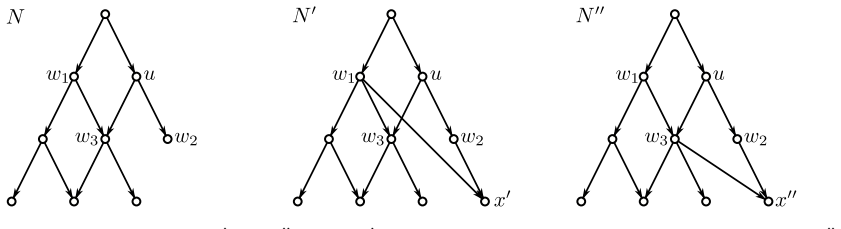
A network N has the global lca-property iff for every strict K_{2,2}-subdivision H there exists an X- or X'-subdivision H' with the same roots/leaves (Thm 4.4).
-
IndisputableMonolith/Cost/FunctionalEquation.leanwashburn_uniqueness_aczel unclear?
unclearRelation between the paper passage and the cited Recognition theorem.
Global lca-DAGs recognized in polynomial time via lxt(G) pairwise-LCA checks (Cor 6.9).
What do these tags mean?
- matches
- The paper's claim is directly supported by a theorem in the formal canon.
- supports
- The theorem supports part of the paper's argument, but the paper may add assumptions or extra steps.
- extends
- The paper goes beyond the formal theorem; the theorem is a base layer rather than the whole result.
- uses
- The paper appears to rely on the theorem as machinery.
- contradicts
- The paper's claim conflicts with a theorem or certificate in the canon.
- unclear
- Pith found a possible connection, but the passage is too broad, indirect, or ambiguous to say the theorem truly supports the claim.
Reference graph
Works this paper leans on
-
[1]
Aho A V , Lam MS, Sethi R, Ullman JD (2006) Compilers: Principles, Techniques, and Tools, 2nd edn. Addison-Wesley
work page 2006
-
[2]
Ahuja RK, Magnanti TL, Orlin JB (1993) Network Flows: Theory, Algorithms, and Applications. Pren- tice Hall
work page 1993
-
[3]
Results in Math 80:45, DOI 10.1007/s00025-025-02354-0
Anil A, Changat M, Chavara JJ, Kamal K Sheela L, Narasimha-Shenoi PG, Schmidt B, Shanavas A V , Stadler PF (2025) Directed transit functions. Results in Math 80:45, DOI 10.1007/s00025-025-02354-0
-
[4]
Barth ´elemy JP, Brucker F (2008) Binary clustering. Discr Appl Math 156:1237–1250, DOI 10.1016/j. dam.2007.05.024
work page doi:10.1016/j 2008
-
[5]
Cardona G, Rossell ´o F, Valiente G (2009) Comparison of tree-child phylogenetic networks. IEEE/ACM Transactions on Computational Biology and Bioinformatics 6(4):552–569, DOI 10.1109/TCBB.2007. 70270
-
[6]
Art Discr Appl Math 2:P1.01, DOI 10.26493/2590-9770.1260.989
Changat M, Narasimha-Shenoi PG, Stadler PF (2019) Axiomatic characterization of transit functions of weak hierarchies. Art Discr Appl Math 2:P1.01, DOI 10.26493/2590-9770.1260.989
- [7]
-
[8]
Davidson EH (2006) The Regulatory Genome: Gene Regulatory Networks in Development and Evolu- tion. Academic Press
work page 2006
-
[9]
Proceedings of the National Academy of Sciences 111(11):4332–4337, DOI 10.1073/pnas.1307712111
Ferraro PJ, Hanauer MM (2014) Quantifying causal mechanisms to determine how protected areas affect poverty through changes in ecosystem services and infrastructure. Proceedings of the National Academy of Sciences 111(11):4332–4337, DOI 10.1073/pnas.1307712111
-
[10]
Springer Berlin Heidelberg, DOI 10.1007/978-3-642-67678-9
Gierz G, Hofmann KH, Keimel K, Lawson JD, Mislove MW, Scott DS (1980) A Compendium of Con- tinuous Lattices. Springer Berlin Heidelberg, DOI 10.1007/978-3-642-67678-9
-
[11]
Birkh¨auser Verlag, Basel, Switzerland
Gr ¨atzer G (2007) General lattice theory, 2nd edn. Birkh¨auser Verlag, Basel, Switzerland
work page 2007
-
[12]
Mathematical Bio- sciences 208(2):521–537, DOI 10.1016/j.mbs.2006.11.005
Gr ¨unewald S, Steel M, Swenson MS (2007) Closure operations in phylogenetics. Mathematical Bio- sciences 208(2):521–537, DOI 10.1016/j.mbs.2006.11.005
-
[13]
In: Markstein P, Xu Y (eds) Computational Systems Bioinformatics
Gusfield D, Eddhu S, Langley C (2003) Efficient reconstruction of phylogenetic networks with con- strained recombination. In: Markstein P, Xu Y (eds) Computational Systems Bioinformatics. Proceedings of the 2003 IEEE Bioinformatics Conference, IEEE Computer Society, Los Alamitos, CA, pp 363–374, DOI 10.1109/CSB.2003.1227337
-
[14]
Undergraduate Texts in Mathematics, Springer, New York, DOI 10.1007/978-1-4757-1645-0
Halmos PR (1974) Naive Set Theory. Undergraduate Texts in Mathematics, Springer, New York, DOI 10.1007/978-1-4757-1645-0
-
[15]
URL https://arxiv.org/abs/2411.14057, 2411.14057
Hellmuth M, Lindeberg A (2024) Characterizing and transforming DAGs within the I-LCA framework. URL https://arxiv.org/abs/2411.14057, 2411.14057
-
[16]
Theory in Biosciences 142(4):301–358, DOI 10.1007/s12064-023-00398-w
Hellmuth M, Schaller D, Stadler PF (2023) Clustering systems of phylogenetic networks. Theory in Biosciences 142(4):301–358, DOI 10.1007/s12064-023-00398-w
-
[17]
Genome Biol Evol 3:23–35, DOI 10.1093/gbe/evq077
Huson DH, Scornavacca C (2011) A survey of combinatorial methods for phylogenetic networks. Genome Biol Evol 3:23–35, DOI 10.1093/gbe/evq077
-
[18]
Commun ACM 5(11):558–562, DOI 10.1145/ 368996.369025
Kahn A (1962) Topological sorting of large networks. Commun ACM 5(11):558–562, DOI 10.1145/ 368996.369025
-
[19]
Koller D, Friedman N (2009) Probabilistic Graphical Models: Principles and Techniques. MIT Press 19
work page 2009
-
[20]
In: Arge L, Hoffmann M, Welzl E (eds) Algorithms – ESA 2007, Springer, Berlin, Heidelberg, Lect
Kowaluk M, Lingas A (2007) Unique lowest common ancestors in dags are almost as easy as matrix mul- tiplication. In: Arge L, Hoffmann M, Welzl E (eds) Algorithms – ESA 2007, Springer, Berlin, Heidelberg, Lect. Notes Comp. Sci., vol 4698, pp 265–274, DOI 10.1007/978-3-540-75520-3 25
-
[21]
Bull Math Biol 87(3):44, DOI 10.1007/s11538-025-01419-z
Lindeberg A, Hellmuth M (2025) Simplifying and characterizing DAGs and phylogenetic networks via least common ancestor constraints. Bull Math Biol 87(3):44, DOI 10.1007/s11538-025-01419-z
-
[22]
Mathialagan S, Vassilevska Williams V , Xu Y (2022) Listing, verifying and counting lowest common ancestors in DAGs: Algorithms and fine-grained lower bounds. In: Boja´nczyk M, Merelli E, Woodruff DP (eds) 49th International Colloquium on Automata, Languages, and Programming (ICALP 2022), Schloss Dagstuhl – Leibniz-Zentrum f ¨ur Informatik, Dagstuhl, Germ...
-
[23]
Muchnick SS (1997) Advanced Compiler Design and Implementation. Morgan Kaufmann
work page 1997
-
[24]
Nakhleh L, Wang LS (2005) Phylogenetic networks: Properties and relationship to trees and clusters. In: Priami C, Zelikovsky A (eds) Transactions on Computational Systems Biology II, Springer, Berlin, Heidelberg, Lect. Notes Comp. Sci., vol 3680, pp 82–99, DOI 10.1007/11567752 6
-
[25]
Pearl J (2009) Causality: Models, Reasoning, and Inference, 2nd edn. Cambridge University Press
work page 2009
- [26]
-
[27]
Mathematical Biosciences 221:54–59, DOI 10.1016/j.mbs.2009.06.007
Rossell ´o F, Valiente G (2009) All that glisters is not galled. Mathematical Biosciences 221:54–59, DOI 10.1016/j.mbs.2009.06.007
-
[28]
In: Kalyanasundaram S, Maheshwari A (eds) Algorithms and Discrete Applied Mathematics
Shanavas A V , Changat M, Hellmuth M, Stadler PF (2024) Unique least common ancestors and clusters in directed acyclic graphs. In: Kalyanasundaram S, Maheshwari A (eds) Algorithms and Discrete Applied Mathematics. CALDAM 2024, Springer, Cham, Lect. Notes Comp. Sci., vol 14508, pp 148–161, DOI 10.1007/978-3-031-52213-0 11
-
[29]
van de Vel MLJ (1993) Theory of convex structures. North Holland, Amsterdam 20
work page 1993
discussion (0)
Sign in with ORCID, Apple, or X to comment. Anyone can read and Pith papers without signing in.