Milliwatt-level UV generation using sidewall poled lithium niobate
Pith reviewed 2026-05-22 23:30 UTC · model grok-4.3
The pith
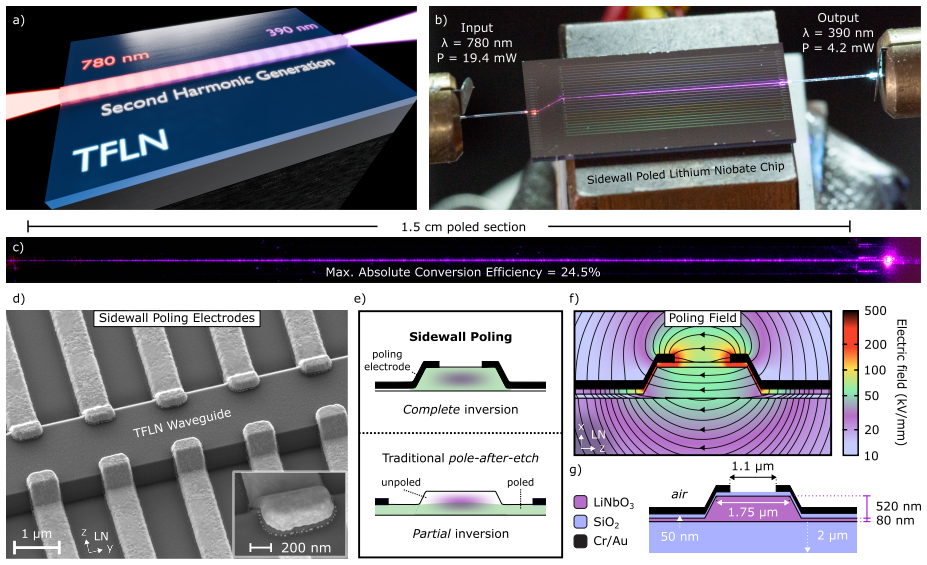
Sidewall-poled lithium niobate waveguides produce 4.2 mW of on-chip 390 nm light with 5050 %W^{-1}cm^{-2} efficiency.
A machine-rendered reading of the paper's core claim, the machinery that carries it, and where it could break.
Core claim
Sidewall-poled lithium niobate waveguides achieve complete domain inversion of the waveguide cross-section, an optimum 50 percent duty cycle, and 2.3 dB/cm propagation loss, which together yield a normalized conversion efficiency of 5050 %W^{-1}cm^{-2} and 4.2 mW of generated on-chip power at 390 nm.
What carries the argument
Sidewall poling process that inverts ferroelectric domains throughout the full waveguide cross-section while preserving low optical loss and the required 50 percent duty cycle.
If this is right
- On-chip ultraviolet sources become practical in the thin-film lithium niobate platform.
- Generated ultraviolet power increases by more than two orders of magnitude compared with earlier thin-film lithium niobate devices.
- The same waveguides support applications that need milliwatt-level coherent ultraviolet light at 390 nm.
- Low-loss, long waveguides with small poling periods are now available for other nonlinear processes.
Where Pith is reading between the lines
- The approach could be extended to other ultraviolet wavelengths by changing the poling period.
- Similar sidewall techniques might improve efficiency in other nonlinear materials that are hard to pole uniformly.
- Integration with on-chip lasers or resonators could produce compact ultraviolet sources without external pumps.
Load-bearing premise
The sidewall poling process produces complete domain inversion and an exact 50 percent duty cycle across centimeter-long waveguides that have small poling periods.
What would settle it
Cross-sectional imaging of the poled waveguides that shows incomplete domain inversion or duty cycle away from 50 percent, or a measured conversion efficiency well below 5050 %W^{-1}cm^{-2} at the stated input powers.
Figures


read the original abstract
Integrated coherent sources of ultra-violet (UV) light are essential for a wide range of applications, from ion-based quantum computing and optical clocks to gas sensing and microscopy. Conventional approaches that rely on UV gain materials face limitations in terms of wavelength versatility; in response frequency upconversion approaches that leverage various optical nonlinearities have received considerable attention. Among these, the integrated thin-film lithium niobate (TFLN) photonic platform shows particular promise owing to lithium niobate's transparency into the UV range, its strong second order nonlinearity, and high optical confinement. However, to date, the high propagation losses and lack of reliable techniques for consistent poling of cm-long waveguides with small poling periods have severely limited the utility of this platform. Here we present a sidewall poled lithium niobate (SPLN) waveguide approach that overcomes these obstacles and results in a more than two orders of magnitude increase in generated UV power compared to the state-of-the-art. Our UV SPLN waveguides feature record-low propagation losses of 2.3 dB/cm, complete domain inversion of the waveguide cross-section, and an optimum 50% duty cycle, resulting in a record-high normalized conversion efficiency of 5050 %W$^{-1}$cm$^{-2}$, and 4.2 mW of generated on-chip power at 390 nm wavelength. This advancement makes the TFLN photonic platform a viable option for high-quality on-chip UV generation, benefiting emerging applications.
Editorial analysis
A structured set of objections, weighed in public.
Referee Report
Summary. The manuscript demonstrates a sidewall poled lithium niobate (SPLN) waveguide platform for on-chip UV generation at 390 nm. It reports record-low propagation losses of 2.3 dB/cm, complete domain inversion throughout the waveguide cross-section with an optimum 50% duty cycle, a normalized conversion efficiency of 5050 %W^{-1}cm^{-2}, and 4.2 mW of generated on-chip UV power, claiming more than two orders of magnitude improvement over the state of the art in TFLN-based UV sources.
Significance. If the poling uniformity and resulting efficiency hold, the result would represent a substantial advance for integrated nonlinear photonics, enabling higher-power on-chip UV sources for applications in ion trapping, optical clocks, and sensing. The combination of low loss and high normalized efficiency addresses longstanding barriers in the TFLN platform.
major comments (2)
- [Abstract] Abstract: The normalized conversion efficiency of 5050 %W^{-1}cm^{-2} and 4.2 mW output power rest on the assumption that the nonlinear overlap integral reaches its theoretical maximum. This requires explicit verification that sidewall poling produces complete 180° domain inversion across the entire waveguide cross-section (not merely near the sidewalls) and maintains a spatially constant 50% duty cycle over cm-scale lengths with the stated poling periods; no such independent characterization (e.g., cross-sectional imaging or direct d_eff extraction) is referenced to support the claim.
- [Abstract] Abstract: The propagation loss figure of 2.3 dB/cm is presented as record-low without specifying the measurement technique (cut-back, ring resonator, etc.), the wavelength at which it was measured, device length, or uncertainty; this value is load-bearing for the overall performance claim and must be substantiated with data in the results section.
Simulated Author's Rebuttal
We thank the referee for the positive evaluation of the significance of our results and for the constructive comments. We address each major comment below. Where the manuscript requires additional detail or data, we will revise accordingly.
read point-by-point responses
-
Referee: [Abstract] Abstract: The normalized conversion efficiency of 5050 %W^{-1}cm^{-2} and 4.2 mW output power rest on the assumption that the nonlinear overlap integral reaches its theoretical maximum. This requires explicit verification that sidewall poling produces complete 180° domain inversion across the entire waveguide cross-section (not merely near the sidewalls) and maintains a spatially constant 50% duty cycle over cm-scale lengths with the stated poling periods; no such independent characterization (e.g., cross-sectional imaging or direct d_eff extraction) is referenced to support the claim.
Authors: We agree that independent verification strengthens the claim. The manuscript states complete domain inversion and 50% duty cycle based on the observed normalized efficiency matching the theoretical maximum for the waveguide geometry, combined with the poling process parameters. However, to directly address the referee's request, we will add cross-sectional SEM imaging of the poled waveguides and a direct extraction of d_eff from the measured efficiency in the revised results section. revision: yes
-
Referee: [Abstract] Abstract: The propagation loss figure of 2.3 dB/cm is presented as record-low without specifying the measurement technique (cut-back, ring resonator, etc.), the wavelength at which it was measured, device length, or uncertainty; this value is load-bearing for the overall performance claim and must be substantiated with data in the results section.
Authors: We agree that the loss value requires full experimental details. The 2.3 dB/cm figure was obtained via the cut-back method on multiple devices at 390 nm with lengths up to 1 cm; the uncertainty is ±0.2 dB/cm. We will expand the results section with the measurement description, raw transmission data, and uncertainty analysis in the revised manuscript. revision: yes
Circularity Check
No circularity: experimental device demonstration
full rationale
The paper is an experimental report on fabricated SPLN waveguides, presenting measured propagation losses (2.3 dB/cm), generated UV power (4.2 mW), and normalized conversion efficiency (5050 %W^{-1}cm^{-2}). These quantities are obtained from direct characterization rather than any derivation, parameter fitting, or self-referential prediction. Claims of complete domain inversion and 50% duty cycle are stated as fabrication outcomes supported by the process and measurements; no equations or self-citations reduce the central results to their own inputs by construction. The derivation chain is therefore self-contained against external benchmarks.
Axiom & Free-Parameter Ledger
axioms (1)
- domain assumption Lithium niobate is transparent into the UV range and possesses strong second-order nonlinearity.
Reference graph
Works this paper leans on
-
[1]
2022 Roadmap on integrated quantum photonics
G. Moody, V. J. Sorger, D. J. Blumenthal, et al. “2022 Roadmap on integrated quantum photonics”. Journal of Physics: Photonics 4.1 (2022). doi: 10.1088/2515-7647/ac1ef4
-
[2]
A. D. Ludlow, M. M. Boyd, J. Ye, et al. “Optical atomic clocks”. Reviews of Modern Physics 87.2 (2015). doi: 10.1103/revmodphys.87.637
-
[3]
UV photonic integrated circuits for far-field structured illumination autofluorescence microscopy
C. Lin, J. S. D. Pe˜ naranda, J. Dendooven, et al. “UV photonic integrated circuits for far-field structured illumination autofluorescence microscopy”. Nature Communications 13.1 (2022). doi: 10.1038/s41467-022-31989-8
-
[4]
R. S. Wiederkehr and S. B. Mendes. “Extension of the broadband single-mode integrated optical waveguide technique to the ultraviolet spectral region and its applications”. The Analyst 139.6 (2014). doi: 10.1039/C3AN02201C
-
[5]
Trapped-ion quantum computing: Progress and challenges
C. D. Bruzewicz, J. Chiaverini, R. McConnell, et al. “Trapped-ion quantum computing: Progress and challenges”. Applied Physics Reviews 6.2 (2019). doi: 10.1063/1.5088164
-
[6]
Recent Progress of Electrically Pumped AlGaN Diode Lasers in the UV-B and -C Bands
S. M. N. Hasan, W. You, M. S. I. Sumon, et al. “Recent Progress of Electrically Pumped AlGaN Diode Lasers in the UV-B and -C Bands”. Photonics 8.7 (2021). doi: 10 . 3390 / photonics8070267
work page 2021
-
[7]
GaN based ultraviolet laser diodes
J. Yang, D. Zhao, Z. Liu, et al. “GaN based ultraviolet laser diodes”. Journal of Semicon- ductors 45.1 (2024). doi: 10.1088/1674-4926/45/1/011501
-
[8]
Hybrid integrated near UV lasers using the deep-UV Al 2O3 platform
C. A. A. Franken, W. A. P. M. Hendriks, L. V. Winkler, et al. “Hybrid integrated near UV lasers using the deep-UV Al 2O3 platform” (2023). doi: 10.48550/ARXIV.2302.11492
-
[9]
Single-frequency violet and blue laser emission from AlGaInN photonic integrated circuit chips
T. Wunderer, A. Siddharth, N. M. Johnson, et al. “Single-frequency violet and blue laser emission from AlGaInN photonic integrated circuit chips”. Optics Letters 48.11 (2023). doi: 10.1364/ol.486758
-
[10]
UV integrated optics devices based on beta-barium borate
G. Poberaj, R. Degl’Innocenti, C. Medrano, et al. “UV integrated optics devices based on beta-barium borate”. Optical Materials 31.7 (2009). doi: 10.1016/j.optmat.2007.12.020
-
[11]
Tunable ultraviolet radiation by second-harmonic generation in periodically poled lithium tantalate
J.-P. Meyn and M. M. Fejer. “Tunable ultraviolet radiation by second-harmonic generation in periodically poled lithium tantalate”. Optics Letters 22.16 (1997). doi: 10.1364/ol.22. 001214
-
[12]
Integrated photonics on thin-film lithium niobate
D. Zhu, L. Shao, M. Yu, et al. “Integrated photonics on thin-film lithium niobate”. Advances in Optics and Photonics 13.2 (2021). doi: 10.1364/aop.411024
-
[13]
Ultraviolet Light Generation in a Periodically Poled MgO:LiNbO 3 Waveguide
T. Sugita, K. Mizuuchi, Y. Kitaoka, et al. “Ultraviolet Light Generation in a Periodically Poled MgO:LiNbO 3 Waveguide”. Japanese Journal of Applied Physics 40.3S (2001). doi: 10.1143/JJAP.40.1751
-
[14]
K. Mizuuchi, T. Sugita, K. Yamamoto, et al. “Efficient 340-nm light generation by a ridge- type waveguide in a first-order periodically poled MgO : LiNbO 3”. Optics Letters 28.15 (2003). doi: 10.1364/OL.28.001344
-
[15]
Ultraviolet second harmonic generation from Mie-resonant lithium niobate nanospheres
J. Wang, Z. Liu, J. Xiang, et al. “Ultraviolet second harmonic generation from Mie-resonant lithium niobate nanospheres”. Nanophotonics 10.17 (2021). doi: 10.1515/nanoph- 2021- 0326
-
[16]
Highly Efficient Ultraviolet Harmonic Generation at a Non- linear Crystal Interface
Y. Guan, Y. Wu, Y. Zheng, et al. “Highly Efficient Ultraviolet Harmonic Generation at a Non- linear Crystal Interface”.Physical Review Applied 19.6 (2023). doi: 10.1103/physrevapplied. 19.064009
-
[17]
Continuous ultraviolet to blue-green astrocomb
Y. S. Cheng, K. Dadi, T. Mitchell, et al. “Continuous ultraviolet to blue-green astrocomb”. Nature Communications 15.1 (2024). doi: 10.1038/s41467-024-45924-6
-
[18]
M. Ludwig, F. Ayhan, T. M. Schmidt, et al. “Ultraviolet astronomical spectrograph cali- bration with laser frequency combs from nanophotonic lithium niobate waveguides”. Nature Communications 15.1 (2024). doi: 10.1038/s41467-024-51560-x . 30
-
[19]
Sub-1 Volt and high-bandwidth visible to near- infrared electro-optic modulators
D. Renaud, D. R. Assumpcao, G. Joe, et al. “Sub-1 Volt and high-bandwidth visible to near- infrared electro-optic modulators”. Nature Communications 14.1 (2023). doi: 10 . 1038 / s41467-023-36870-w
work page 2023
-
[20]
Integrated lithium niobate electro-optic modulators operating at CMOS-compatible voltages
C. Wang, M. Zhang, X. Chen, et al. “Integrated lithium niobate electro-optic modulators operating at CMOS-compatible voltages”. Nature 562.7725 (2018). doi: 10.1038/s41586- 018-0551-y
-
[21]
Visible-to-ultraviolet frequency comb generation in lithium niobate nanophotonic waveguides
T.-H. Wu, L. Ledezma, C. Fredrick, et al. “Visible-to-ultraviolet frequency comb generation in lithium niobate nanophotonic waveguides”. Nature Photonics 18.3 (2024). doi: 10.1038/ s41566-023-01364-0
work page 2024
-
[22]
Tunable and efficient ultraviolet generation with periodically poled lithium niobate
E. Hwang, N. Harper, R. Sekine, et al. “Tunable and efficient ultraviolet generation with periodically poled lithium niobate”. Optics Letters 48.15 (2023). doi: 10.1364/OL.491528
-
[23]
J. Zhao. “Periodic poling of thin-film lithium niobate for second-harmonic generation and entangled photon-pair generation”. PhD thesis. University of California, San Diego, 2020
work page 2020
-
[24]
Submicrometer periodic poling of lithium niobate thin films with bipolar preconditioning pulses
J. T. Nagy and R. M. Reano. “Submicrometer periodic poling of lithium niobate thin films with bipolar preconditioning pulses”. Optical Materials Express 10.8 (2020). doi: 10.1364/ ome.394724
work page 2020
-
[25]
Adapted poling to break the nonlinear efficiency limit in nanophotonic lithium niobate waveguides
P.-K. Chen, I. Briggs, C. Cui, et al. “Adapted poling to break the nonlinear efficiency limit in nanophotonic lithium niobate waveguides”. Nature Nanotechnology 19.1 (2023). doi: 10. 1038/s41565-023-01525-w
work page 2023
-
[26]
C. J. Xin, S. Lu, J. Yang, et al. “Wavelength-accurate and wafer-scale process for nonlinear frequency mixers in thin-film lithium niobate” (2024). doi: 10.48550/ARXIV.2404.12381
-
[27]
Efficient photon-pair generation in layer-poled lithium niobate nanophotonic waveguides
X. Shi, S. S. Mohanraj, V. Dhyani, et al. “Efficient photon-pair generation in layer-poled lithium niobate nanophotonic waveguides”. Light: Science & Applications 13.1 (2024). doi: 10.1038/s41377-024-01645-5
-
[28]
L. Gui, H. Hu, M. Garcia-Granda, et al. “Local periodic poling of ridges and ridge waveguides on X- and Y-Cut LiNbO3 and its application for second harmonic generation”.Optics Express 17.5 (2009). doi: 10.1364/OE.17.003923
-
[29]
Locally periodically poled LNOI ridge waveguide for sec- ond harmonic generation [Invited]
B. Mu, X. Wu, Y. Niu, et al. “Locally periodically poled LNOI ridge waveguide for sec- ond harmonic generation [Invited]”. Chinese Optics Letters 19.6 (2021). doi: 10 . 3788 / COL202119.060007
-
[30]
Y. Su, X. Zhang, H. Chen, et al. “High-efficiency nonlinear frequency conversion enabled by optimizing the ferroelectric domain structure in x-cut LNOI ridge waveguide”.Nanophotonics 13.18 (2024). doi: 10.1515/nanoph-2024-0168
-
[31]
J. T. Nagy and R. M. Reano. “Reducing leakage current during periodic poling of ion-sliced x-cut MgO doped lithium niobate thin films”. Optical Materials Express 9.7 (2019). doi: 10.1364/ome.9.003146
-
[32]
J. Zhao, X. Li, T.-C. Hu, et al. “Unveiling the origins of quasi-phase matching spectral imperfections in thin-film lithium niobate frequency doublers”. APL Photonics 8.12 (2023). doi: 10.1063/5.0171106
-
[33]
Noncritical phasematching behavior in thin-film lithium niobate frequency con- verters
P. S. Kuo. “Noncritical phasematching behavior in thin-film lithium niobate frequency con- verters”. Optics Letters 47.1 (2021). doi: 10.1364/ol.444846
-
[34]
Mitigating Electron Beam Induced Defects for Low-Loss and Stable Active Photonic Circuits
D. Renaud, D. Assumpcao, C. Jin, et al. “Mitigating Electron Beam Induced Defects for Low-Loss and Stable Active Photonic Circuits”. CLEO 2024 . Vol. 7. 2024, SF3G.7. doi: 10.1364/cleo_si.2024.sf3g.7
-
[35]
O. Beyer, D. Maxein, K. Buse, et al. “Investigation of nonlinear absorption processes with femtosecond light pulses in lithium niobate crystals”. Physical Review E 71.5 (2005). doi: 10.1103/physreve.71.056603. 31
-
[36]
Femtosecond time-resolved absorption processes in lithium niobate crystals
O. Beyer, D. Maxein, K. Buse, et al. “Femtosecond time-resolved absorption processes in lithium niobate crystals”. Optics Letters 30.11 (2005). doi: 10.1364/ol.30.001366
-
[37]
Low-loss integrated photonics for the blue and ultraviolet regime
G. N. West, W. Loh, D. Kharas, et al. “Low-loss integrated photonics for the blue and ultraviolet regime”. APL Photonics 4.2 (2019). doi: 10.1063/1.5052502
-
[38]
UV integrated photonics in sputter deposited aluminum oxide
W. Hendriks, B. Dawson, S. Mardani, et al. “UV integrated photonics in sputter deposited aluminum oxide”. Optica Open (pre-print) (2024). doi: 10.1364/opticaopen.25663656.v1
-
[39]
Efficient parametric frequency conversion in lithium niobate nanophotonic chips
J.-Y. Chen, Y. Meng Sua, Z.-h. Ma, et al. “Efficient parametric frequency conversion in lithium niobate nanophotonic chips”. OSA Continuum 2.10 (2019). doi: 10.1364/OSAC.2. 002914
-
[40]
I. I. Chen, J. Solgaard, R. Sekine, et al. “Isotropic atomic layer etching of MgO-doped lithium niobate using sequential exposures of H 2 and SF6/Ar plasmas”. Journal of Vacuum Science & Technology A 42.6 (2024). doi: 10.1116/6.0003962
-
[41]
U. Schlarb and K. Betzler. “Refractive indices of lithium niobate as a function of temperature, wavelength, and composition: A generalized fit”. Physical Review B 48.21 (1993). doi: 10. 1103/physrevb.48.15613
work page 1993
-
[42]
DC-stable electro-optic modulators using thin-film lithium tantalate
K. Powell, X. Li, D. Assumpcao, et al. “DC-stable electro-optic modulators using thin-film lithium tantalate”. Optics Express 32.25 (2024). doi: 10.1364/OE.538870
-
[43]
Lithium tantalate photonic integrated circuits for volume manufacturing
C. Wang, Z. Li, J. Riemensberger, et al. “Lithium tantalate photonic integrated circuits for volume manufacturing”. Nature 629.8013 (2024). doi: 10.1038/s41586-024-07369-1
-
[44]
B. Abasahl, C. Santschi, T. V. Raziman, et al. “Fabrication of plasmonic structures with well-controlled nanometric features: a comparison between lift-off and ion beam etching”. Nanotechnology 32.47 (2021). doi: 10.1088/1361-6528/ac1a93
-
[45]
Visible light photonic integrated Brillouin laser
N. Chauhan, A. Isichenko, K. Liu, et al. “Visible light photonic integrated Brillouin laser”. Nature Communications 12.1 (2021). doi: 10.1038/s41467-021-24926-8
-
[46]
Hybrid-integrated diode laser in the visible spectral range
C. A. A. Franken, A. van Rees, L. V. Winkler, et al. “Hybrid-integrated diode laser in the visible spectral range”. Optics Letters 46.19 (2021). doi: 10.1364/OL.433636
-
[47]
Widely tunable and narrow-linewidth hybrid-integrated diode laser at 637 nm
L. V. Winkler, K. Gerritsma, A. van Rees, et al. “Widely tunable and narrow-linewidth hybrid-integrated diode laser at 637 nm”. Optics Express 32.17 (2024). doi: 10.1364/OE. 523985
work page doi:10.1364/oe 2024
-
[48]
J. E. Castro, E. Nolasco-Martinez, P. Pintus, et al. “Integrated mode-hop-free tunable lasers at 780 nm for chip-scale classical and quantum photonic applications”. APL Photonics 10.3 (2025). doi: 10.1063/5.0232377
-
[49]
Self-Injection Locked Frequency Conversion Laser
J. Ling, J. Staffa, H. Wang, et al. “Self-Injection Locked Frequency Conversion Laser”. Laser & Photonics Reviews 17.5 (2023). doi: 10.1002/lpor.202200663
-
[50]
G. Malovichko, V. Grachev, E. Kokanyan, et al. “Axial and low-symmetry centers of trivalent impurities in lithium niobate: Chromium in congruent and stoichiometric crystals”. Physical Review B 59.14 (1999). doi: 10.1103/physrevb.59.9113
-
[51]
Low-loss fiber-to-chip interface for lithium niobate photonic integrated circuits
L. He, M. Zhang, A. Shams-Ansari, et al. “Low-loss fiber-to-chip interface for lithium niobate photonic integrated circuits”. Optics Letters 44.9 (2019). doi: 10.1364/ol.44.002314
-
[52]
A unified approach for radiative losses and backscattering in optical waveguides
D. Melati, F. Morichetti, and A. Melloni. “A unified approach for radiative losses and backscattering in optical waveguides”. Journal of Optics 16.5 (2014). doi: 10.1088/2040- 8978/16/5/055502. 32
discussion (0)
Sign in with ORCID, Apple, or X to comment. Anyone can read and Pith papers without signing in.