Finite-time scaling with two characteristic time scales: Driven critical dynamics with emergent symmetry
Pith reviewed 2026-05-22 23:26 UTC · model grok-4.3
The pith
In clock models with emergent symmetry, the angular order parameter switches between two distinct finite-time scaling regimes as drive speed changes.
A machine-rendered reading of the paper's core claim, the machinery that carries it, and where it could break.
Core claim
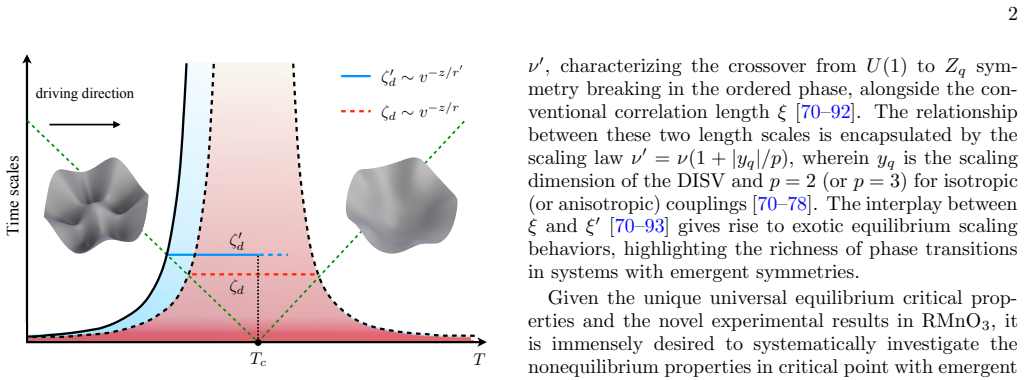
Traversing the critical point by increasing temperature at finite velocity v produces two finite-time scaling regions with characteristic time scales ζ_d ∝ v^{-z/r} and ζ_d' ∝ v^{-z/r'}, where r' is the exponent tied to the dangerously irrelevant scaling variable. While M² obeys the conventional finite-time scaling form, the angular order parameter φ_q is controlled by ζ_d for small v and by ζ_d' for large v. The scaling properties remain the same in models with isotropic and anisotropic couplings.
What carries the argument
The angular order parameter φ_q together with the two driving-induced time scales ζ_d and ζ_d' generated by the usual scaling exponent r and the additional exponent r' of the dangerously irrelevant variable.
If this is right
- M² always follows the standard finite-time scaling form across all drive speeds.
- φ_q is governed by the time scale ζ_d in the slow-drive regime.
- φ_q is governed by the time scale ζ_d' in the fast-drive regime.
- The two-regime scaling holds identically for isotropic and anisotropic couplings.
- The results supply a basis for experiments in hexagonal RMnO₃ materials.
Where Pith is reading between the lines
- Dangerously irrelevant variables can generate measurable dynamic time scales under finite-time driving.
- The same two-scale structure may appear in other models where discrete symmetry breaking gives way to emergent continuous symmetry.
- Dynamic experiments could be used to extract the value of the new exponent r' directly.
Load-bearing premise
The dangerously irrelevant scaling variable generates a new independent exponent r' that produces a separate observable time scale ζ_d' cleanly separable from the usual one in the driven dynamics.
What would settle it
A measurement showing that the effective power-law dependence of φ_q on drive velocity v changes from the exponent set by -z/r to the one set by -z/r' when v crosses from small to large values.
Figures


read the original abstract
Critical points with emergent symmetry exhibit intriguing scaling properties induced by two divergent length scales, attracting extensive investigations recently. We study the driven critical dynamics in a three-dimensional $q$-state clock model, in which the ordered phase breaks the $Z_q$ discrete symmetry, while an emergent $U(1)$ symmetry appears at the critical point. By increasing the temperature at a finite velocity $v$ to traverse the critical point from the ordered phase, we uncover rich dynamic scaling properties beyond the celebrated Kibble-Zurek mechanism. Our findings reveal the existence of two finite-time scaling (FTS) regions, characterized by two driving-induced time scales $\zeta_d\propto v^{-z/r}$ and $\zeta_d'\propto v^{-z/r'}$, respectively. Here $z$ is the dynamic exponent, $r$ is the usual critical exponent of $v$, and $r'$ represents an additional critical exponent of $v$ associated with the dangerously irrelevant scaling variable. While the square of the order parameter $M^2$ obeys the usual FTS form, the angular order parameter $\phi_q$ shows remarkably distinct scaling behaviors controlled by both FTS regions. For small $v$, $\phi_q$ is dominated by the time scale $\zeta_d$, whereas for large $v$, $\phi_q$ is governed by the second time scale $\zeta_d'$. We verify the universality of these scaling properties in models with both isotropic and anisotropic couplings. Our theoretical insights provide a promising foundation for further experimental investigations in the hexagonal RMnO$_3$ (R=rare earth) materials.
Editorial analysis
A structured set of objections, weighed in public.
Referee Report
Summary. The manuscript examines driven critical dynamics in the three-dimensional q-state clock model, where the ordered phase breaks Z_q symmetry but an emergent U(1) symmetry appears at criticality. By ramping temperature across the critical point at finite velocity v, the authors identify two distinct finite-time scaling (FTS) regimes controlled by time scales ζ_d ∝ v^{-z/r} and ζ_d' ∝ v^{-z/r'}, with the second exponent r' arising from a dangerously irrelevant scaling variable. While M² obeys conventional FTS, the angular order parameter φ_q is reported to cross over from ζ_d-dominated scaling at small v to ζ_d'-dominated scaling at large v. The universality of these features is claimed to hold for both isotropic and anisotropic couplings, with suggested relevance to hexagonal RMnO₃ materials.
Significance. If the separation into two cleanly distinguishable FTS regimes for φ_q is robustly established, the work would extend Kibble-Zurek scaling to systems with emergent continuous symmetries and dangerously irrelevant operators, providing a concrete mechanism by which an additional relevant exponent r' controls observable dynamics. This could open new avenues for interpreting nonequilibrium experiments in materials with similar symmetry structures.
major comments (3)
- [Numerical results / scaling collapse figures (around the discussion of φ_q vs. v)] The central claim that φ_q exhibits two separable FTS regimes (small-v controlled by r, large-v controlled by r') is load-bearing for the paper's novelty. The manuscript must demonstrate explicitly that the large-v data for φ_q cannot be collapsed by the standard scaling function of r together with analytic corrections in v; without such a test (e.g., via attempted single-r collapse or residual analysis), the identification of an independent r' remains an assumption rather than a derived result.
- [Theoretical framework / scaling ansatz section] The derivation of how the dangerously irrelevant operator generates a distinct relevant eigenvalue r' that couples differently to the angular operator φ_q than to M² is not shown in detail. The abstract and main text present r' as producing an independent time scale ζ_d', but the RG flow or scaling-function construction that isolates this effect from ordinary corrections should be provided, especially since dangerously irrelevant variables typically enter through sub-leading corrections rather than new leading powers.
- [Methods / data analysis subsection] Error analysis and statistical robustness of the regime separation are not addressed in the provided abstract or summary. The identification of distinct small-v and large-v regimes for φ_q requires quantitative criteria (e.g., goodness-of-fit metrics, crossover location with uncertainty) to rule out artifacts from partitioning the v-range.
minor comments (2)
- [Introduction / abstract] Notation for the two time scales (ζ_d and ζ_d') and the exponents (r and r') should be introduced with explicit definitions and distinguished from standard Kibble-Zurek notation to avoid reader confusion.
- [Results section] The statement that the findings are verified in both isotropic and anisotropic models would benefit from a brief table or figure caption summarizing the extracted exponents r and r' in each case for direct comparison.
Simulated Author's Rebuttal
We thank the referee for the careful reading and constructive major comments, which help clarify the presentation of the two distinct FTS regimes. We address each point below and will revise the manuscript accordingly to strengthen the evidence and derivations.
read point-by-point responses
-
Referee: [Numerical results / scaling collapse figures (around the discussion of φ_q vs. v)] The central claim that φ_q exhibits two separable FTS regimes (small-v controlled by r, large-v controlled by r') is load-bearing for the paper's novelty. The manuscript must demonstrate explicitly that the large-v data for φ_q cannot be collapsed by the standard scaling function of r together with analytic corrections in v; without such a test (e.g., via attempted single-r collapse or residual analysis), the identification of an independent r' remains an assumption rather than a derived result.
Authors: We agree that an explicit test against single-r scaling (with analytic corrections) is necessary to establish the second regime as independent rather than an artifact. In the revised manuscript we will add a dedicated panel (or supplementary figure) showing attempted collapses of the large-v φ_q data using only the conventional r exponent, together with residual plots and goodness-of-fit metrics. This will quantify the systematic deviations that motivate the introduction of r'. revision: yes
-
Referee: [Theoretical framework / scaling ansatz section] The derivation of how the dangerously irrelevant operator generates a distinct relevant eigenvalue r' that couples differently to the angular operator φ_q than to M² is not shown in detail. The abstract and main text present r' as producing an independent time scale ζ_d', but the RG flow or scaling-function construction that isolates this effect from ordinary corrections should be provided, especially since dangerously irrelevant variables typically enter through sub-leading corrections rather than new leading powers.
Authors: The referee is correct that the RG argument linking the dangerously irrelevant variable to a distinct leading exponent r' for φ_q requires more explicit construction. We will expand the scaling-ansatz section with a step-by-step RG-flow sketch showing how the irrelevant operator, when coupled to the angular sector, generates an additional relevant eigenvalue r' that dominates the leading scaling of φ_q at large v, while remaining sub-leading for M². This will distinguish the new time scale from ordinary correction-to-scaling terms. revision: yes
-
Referee: [Methods / data analysis subsection] Error analysis and statistical robustness of the regime separation are not addressed in the provided abstract or summary. The identification of distinct small-v and large-v regimes for φ_q requires quantitative criteria (e.g., goodness-of-fit metrics, crossover location with uncertainty) to rule out artifacts from partitioning the v-range.
Authors: We acknowledge that quantitative criteria for regime identification were not provided. In the revised methods section we will include (i) χ²/dof values for the scaling collapses in each velocity window, (ii) a data-driven estimate of the crossover velocity v* together with bootstrap-derived uncertainty, and (iii) a sensitivity analysis showing that the extracted r' remains stable under modest changes in the partitioning threshold. These additions will demonstrate that the separation is statistically robust. revision: yes
Circularity Check
No significant circularity; scaling forms are independent of fitted inputs
full rationale
The paper extends standard Kibble-Zurek/FTS scaling by positing an additional exponent r' tied to the dangerously irrelevant variable, then reports that M² follows the usual form while φ_q exhibits two regimes controlled by ζ_d and ζ_d'. No equation or claim reduces a reported scaling function or regime separation to a parameter fitted from the same φ_q or M² data; the two time scales are introduced as theoretical consequences rather than outputs of a self-consistent fit. Verification across isotropic and anisotropic models supplies independent content. No self-citation chain is shown to be load-bearing for the central distinction, and no ansatz is smuggled via prior work in a way that collapses the result to its own definition. The derivation therefore remains self-contained against external benchmarks.
Axiom & Free-Parameter Ledger
axioms (2)
- domain assumption Standard dynamic scaling relations hold for the driven system, including the usual relation between dynamic exponent z and the velocity exponent r.
- domain assumption A dangerously irrelevant scaling variable produces a second independent exponent r' that controls a distinct time scale ζ_d'.
Lean theorems connected to this paper
-
Foundation/AlexanderDuality.leanalexander_duality_circle_linking echoes?
echoesECHOES: this paper passage has the same mathematical shape or conceptual pattern as the Recognition theorem, but is not a direct formal dependency.
two driving-induced time scales ζ_d ∝ v^{-z/r} and ζ_d' ∝ v^{-z/r'} ... r' represents an additional critical exponent of v associated with the dangerously irrelevant scaling variable
-
Cost/FunctionalEquation.leanwashburn_uniqueness_aczel unclear?
unclearRelation between the paper passage and the cited Recognition theorem.
M^{2} obeys the usual FTS form ... ϕ_q shows remarkably distinct scaling behaviors controlled by both FTS regions
What do these tags mean?
- matches
- The paper's claim is directly supported by a theorem in the formal canon.
- supports
- The theorem supports part of the paper's argument, but the paper may add assumptions or extra steps.
- extends
- The paper goes beyond the formal theorem; the theorem is a base layer rather than the whole result.
- uses
- The paper appears to rely on the theorem as machinery.
- contradicts
- The paper's claim conflicts with a theorem or certificate in the canon.
- unclear
- Pith found a possible connection, but the passage is too broad, indirect, or ambiguous to say the theorem truly supports the claim.
Forward citations
Cited by 1 Pith paper
-
Optimized adiabatic-impulse protocol preserving Kibble-Zurek scaling with attenuated anti-Kibble-Zurek behavior
An optimized adiabatic-impulse protocol reduces total time for crossing quantum critical points while preserving Kibble-Zurek scaling and attenuating noise-induced anti-Kibble-Zurek defects in the transverse Ising chain.
Reference graph
Works this paper leans on
-
[1]
Theory of dy- namic critical phenomena,
P. C. Hohenberg and B. I. Halperin, “Theory of dy- namic critical phenomena,” Rev. Mod. Phys. 49, 435– 479 (1977)
work page 1977
-
[2]
Critical dynamics: a field- theoretical approach,
R. Folk and G. Moser, “Critical dynamics: a field- theoretical approach,” Journal of Physics A: Mathemat- ical and General 39, R207 (2006)
work page 2006
-
[3]
U. C. T¨ auber,Critical Dynamics: A Field Theory Ap- proach to Equilibrium and Non-Equilibrium Scaling Be- havior (Cambridge University Press, 2014)
work page 2014
-
[4]
Topology of cosmic domains and strings,
T. W. B. Kibble, “Topology of cosmic domains and strings,” Journal of Physics A: Mathematical and Gen- eral 9, 1387 (1976)
work page 1976
-
[5]
Phase-transition dynamics in the lab and the universe,
T. Kibble, “Phase-transition dynamics in the lab and the universe,” Physics Today 60, 47–52 (2007)
work page 2007
-
[6]
Cosmological experiments in superfluid helium?
W. H. Zurek, “Cosmological experiments in superfluid helium?” Nature 317, 505–508 (1985)
work page 1985
-
[7]
Cosmological experiments in condensed matter systems,
W. Zurek, “Cosmological experiments in condensed matter systems,” Physics Reports 276, 177–221 (1996)
work page 1996
-
[8]
Dynamics of a quantum phase transition,
W. H. Zurek, U. Dorner, and P. Zoller, “Dynamics of a quantum phase transition,” Phys. Rev. Lett. 95, 105701 (2005)
work page 2005
-
[9]
Dynamics of a quantum phase transi- tion: Exact solution of the quantum ising model,
J. Dziarmaga, “Dynamics of a quantum phase transi- tion: Exact solution of the quantum ising model,” Phys. Rev. Lett. 95, 245701 (2005)
work page 2005
-
[10]
Universal adiabatic dynamics in the vicinity of a quantum critical point,
A. Polkovnikov, “Universal adiabatic dynamics in the vicinity of a quantum critical point,” Phys. Rev. B 72, 161201 (2005)
work page 2005
-
[11]
Dynamics of a quantum phase transition in a ferromagnetic bose-einstein con- densate,
B. Damski and W. H. Zurek, “Dynamics of a quantum phase transition in a ferromagnetic bose-einstein con- densate,” Phys. Rev. Lett. 99, 130402 (2007)
work page 2007
-
[12]
Universal nonequilibrium quantum dynamics in imag- inary time,
C. De Grandi, A. Polkovnikov, and A. W. Sandvik, “Universal nonequilibrium quantum dynamics in imag- inary time,” Phys. Rev. B 84, 224303 (2011)
work page 2011
-
[13]
Defect production across higher-order phase transitions beyond kibble-zurek scal- ing,
M. Deng, Z. Sun, and F. Li, “Defect production across higher-order phase transitions beyond kibble-zurek scal- ing,” Phys. Rev. Lett. 134, 010409 (2025)
work page 2025
-
[14]
Causality in condensates: Gray solitons as relics of bec formation,
W. H. Zurek, “Causality in condensates: Gray solitons as relics of bec formation,” Phys. Rev. Lett.102, 105702 (2009)
work page 2009
-
[15]
A. del Campo, G. De Chiara, G. Morigi, M. B. Plenio, and A. Retzker, “Structural defects in ion chains by quenching the external potential: The inhomogeneous kibble-zurek mechanism,” Phys. Rev. Lett. 105, 075701 (2010)
work page 2010
-
[16]
Causality and non-equilibrium second-order phase transitions in inhomogeneous systems,
A. del Campo, T. W. B. Kibble, and W. H. Zurek, “Causality and non-equilibrium second-order phase transitions in inhomogeneous systems,” Journal of Physics: Condensed Matter 25, 404210 (2013)
work page 2013
-
[17]
Defect pro- duction in nonlinear quench across a quantum critical point,
D. Sen, K. Sengupta, and S. Mondal, “Defect pro- duction in nonlinear quench across a quantum critical point,” Phys. Rev. Lett. 101, 016806 (2008)
work page 2008
-
[18]
Kibble-zurek problem: Universality and the scaling limit,
A. Chandran, A. Erez, S. S. Gubser, and S. L. Sondhi, “Kibble-zurek problem: Universality and the scaling limit,” Phys. Rev. B 86, 064304 (2012)
work page 2012
-
[19]
Kibble- zurek mechanism and infinitely slow annealing through critical points,
G. Biroli, L. F. Cugliandolo, and A. Sicilia, “Kibble- zurek mechanism and infinitely slow annealing through critical points,” Phys. Rev. E 81, 050101 (2010)
work page 2010
-
[20]
Kibble- zurek mechanism beyond adiabaticity: Finite-time scal- ing with critical initial slip,
Y. Huang, S. Yin, Q. Hu, and F. Zhong, “Kibble- zurek mechanism beyond adiabaticity: Finite-time scal- ing with critical initial slip,” Phys. Rev. B 93, 024103 (2016)
work page 2016
-
[21]
Growth kinetics of the two-dimensional ising model with finite cooling rates,
K. Jeong, B. Kim, and S. J. Lee, “Growth kinetics of the two-dimensional ising model with finite cooling rates,” Phys. Rev. E 99, 022113 (2019)
work page 2019
-
[22]
Chen Tang and Wanzhou Zhang and Chengxiang Ding, “Dynamics of Baxter-Wu model,” (2025)
work page 2025
-
[23]
Finite-time scaling via linear driving,
S. Gong, F. Zhong, X. Huang, and S. Fan, “Finite-time scaling via linear driving,” New Journal of Physics 12, 043036 (2010)
work page 2010
-
[24]
F. Zhong and Z. Xu, “Dynamic monte carlo renor- malization group determination of critical exponents with linearly changing temperature,” Phys. Rev. B 71, 132402 (2005)
work page 2005
-
[25]
F. Zhong, “Probing criticality with linearly varying ex- ternal fields: Renormalization group theory of nonequi- librium critical dynamics under driving,” Phys. Rev. E 11 73, 047102 (2006)
work page 2006
-
[26]
S. Fan and F. Zhong, “Determination of the dynamic and static critical exponents of the two-dimensional three-state potts model using linearly varying tempera- ture,” Phys. Rev. E 76, 041141 (2007)
work page 2007
-
[27]
Finite- time scaling via linear driving: Application to the two- dimensional potts model,
X. Huang, S. Gong, F. Zhong, and S. Fan, “Finite- time scaling via linear driving: Application to the two- dimensional potts model,” Phys. Rev. E 81, 041139 (2010)
work page 2010
-
[28]
S. Yin, P. Mai, and F. Zhong, “Nonequilibrium quan- tum criticality in open systems: The dissipation rate as an additional indispensable scaling variable,” Phys. Rev. B 89, 094108 (2014)
work page 2014
-
[29]
Kibble- zurek mechanism and finite-time scaling,
Y. Huang, S. Yin, B. Feng, and F. Zhong, “Kibble- zurek mechanism and finite-time scaling,” Phys. Rev. B 90, 134108 (2014)
work page 2014
-
[30]
Theory of driven nonequilibrium critical phenomena,
B. Feng, S. Yin, and F. Zhong, “Theory of driven nonequilibrium critical phenomena,” Phys. Rev. B 94, 144103 (2016)
work page 2016
-
[31]
S. Fan and F. Zhong, “Critical dynamics of the two- dimensional random-bond potts model with nonequilib- rium monte carlo simulations,” Phys. Rev. E79, 011122 (2009)
work page 2009
-
[32]
Scaling of the entangle- ment spectrum in driven critical dynamics,
Q. Hu, S. Yin, and F. Zhong, “Scaling of the entangle- ment spectrum in driven critical dynamics,” Phys. Rev. B 91, 184109 (2015)
work page 2015
-
[33]
Scaling theory of entan- glement entropy in confinements near quantum critical points,
X. Cao, Q. Hu, and F. Zhong, “Scaling theory of entan- glement entropy in confinements near quantum critical points,” Phys. Rev. B 98, 245124 (2018)
work page 2018
-
[34]
Driving driven lattice gases to identify their universality classes,
Y. Li, Z. Zeng, and F. Zhong, “Driving driven lattice gases to identify their universality classes,” Phys. Rev. E 100, 020105 (2019)
work page 2019
-
[35]
W. Wang, S. Liu, J. Li, S.-X. Zhang, and S. Yin, arXiv: 2411.06648 (2024), 10.48550/arXiv.2411.06648
-
[36]
Scaling in driven dy- namics starting in the vicinity of a quantum critical point,
S. Yin, C.-Y. Lo, and P. Chen, “Scaling in driven dy- namics starting in the vicinity of a quantum critical point,” Phys. Rev. B 94, 064302 (2016)
work page 2016
-
[37]
Z. Zeng, Y.-K. Yu, Z.-X. Li, Z.-X. Li, and S. Yin, “Finite-time Scaling beyond the Kibble-Zurek Prerequi- site: Driven Critical Dynamics in Strongly Interacting Dirac Systems,” arXiv:2403.19258 (2024)
-
[38]
Nonequilib- rium critical dynamics with emergent supersymmetry,
Z. Zeng, Y.-K. Yu, Z.-X. Li, and S. Yin, “Nonequilib- rium critical dynamics with emergent supersymmetry,” arXiv: 2408.06138 (2024)
-
[39]
Dynamical non-ergodic scaling in continuous finite-order quan- tum phase transitions,
S. Deng, G. Ortiz, and L. Viola, “Dynamical non-ergodic scaling in continuous finite-order quan- tum phase transitions,” Europhysics Letters 84, 67008 (2009)
work page 2009
-
[40]
Nonequilibrium dynamic critical scaling of the quan- tum ising chain,
M. Kolodrubetz, B. K. Clark, and D. A. Huse, “Nonequilibrium dynamic critical scaling of the quan- tum ising chain,” Phys. Rev. Lett. 109, 015701 (2012)
work page 2012
-
[41]
Dy- namic scaling at classical phase transitions approached through nonequilibrium quenching,
C.-W. Liu, A. Polkovnikov, and A. W. Sandvik, “Dy- namic scaling at classical phase transitions approached through nonequilibrium quenching,” Phys. Rev. B 89, 054307 (2014)
work page 2014
-
[42]
Space and time renormalization in phase transition dy- namics,
A. Francuz, J. Dziarmaga, B. Gardas, and W. H. Zurek, “Space and time renormalization in phase transition dy- namics,” Phys. Rev. B 93, 075134 (2016)
work page 2016
-
[43]
Generation of defects in superfluid 4he as an analogue of the formation of cosmic strings,
P. C. Hendry, N. S. Lawson, R. A. M. Lee, P. V. E. McClintock, and C. D. H. Williams, “Generation of defects in superfluid 4he as an analogue of the formation of cosmic strings,” Nature 368, 315–317 (1994)
work page 1994
-
[44]
Nonappearance of vortices in fast mechanical expansions of liquid 4He through the lambda transition,
M. E. Dodd, P. C. Hendry, N. S. Lawson, P. V. E. McClintock, and C. D. H. Williams, “Nonappearance of vortices in fast mechanical expansions of liquid 4He through the lambda transition,” Phys. Rev. Lett. 81, 3703–3706 (1998)
work page 1998
-
[45]
Laboratory simulation of cosmic string formation in the early universe using superfluid 3he,
C. B¨ auerle, Y. M. Bunkov, S. N. Fisher, H. Godfrin, and G. R. Pickett, “Laboratory simulation of cosmic string formation in the early universe using superfluid 3he,” Nature 382, 332–334 (1996)
work page 1996
-
[46]
V. M. H. Ruutu, V. B. Eltsov, A. J. Gill, T. W. B. Kibble, M. Krusius, Y. G. Makhlin, B. Pla¸ cais, G. E. Volovik, and W. Xu, “Vortex formation in neutron- irradiated superfluid 3he as an analogue of cosmological defect formation,” Nature 382, 334–336 (1996)
work page 1996
-
[47]
Observation of spontaneous flux generation in a multi-josephson- junction loop,
R. Carmi, E. Polturak, and G. Koren, “Observation of spontaneous flux generation in a multi-josephson- junction loop,” Phys. Rev. Lett. 84, 4966–4969 (2000)
work page 2000
-
[48]
R. Monaco, J. Mygind, and R. J. Rivers, “Zurek-kibble domain structures: The dynamics of spontaneous vortex formation in annular josephson tunnel junctions,” Phys. Rev. Lett. 89, 080603 (2002)
work page 2002
-
[49]
Spontaneous fluxoid formation in supercon- ducting loops,
R. Monaco, J. Mygind, R. J. Rivers, and V. P. Koshelets, “Spontaneous fluxoid formation in supercon- ducting loops,” Phys. Rev. B 80, 180501 (2009)
work page 2009
-
[50]
S.-W. Su, S.-C. Gou, A. Bradley, O. Fialko, and J. Brand, “Kibble-zurek scaling and its breakdown for spontaneous generation of josephson vortices in bose- einstein condensates,” Phys. Rev. Lett. 110, 215302 (2013)
work page 2013
-
[51]
Kibble-zurek mechanism in the self-organization of a cold atomic cloud,
G. Labeyrie and R. Kaiser, “Kibble-zurek mechanism in the self-organization of a cold atomic cloud,” Phys. Rev. Lett. 117, 275701 (2016)
work page 2016
-
[52]
Critical dynamics of spontaneous symmetry breaking in a homogeneous bose gas,
N. Navon, A. L. Gaunt, R. P. Smith, and Z. Hadz- ibabic, “Critical dynamics of spontaneous symmetry breaking in a homogeneous bose gas,” Science 347, 167– 170 (2015)
work page 2015
-
[53]
Universal scaling of the dynamic bkt transition in quenched 2d bose gases,
S. Sunami, V. P. Singh, D. Garrick, A. Beregi, A. J. Barker, K. Luksch, E. Bentine, L. Mathey, and C. J. Foot, “Universal scaling of the dynamic bkt transition in quenched 2d bose gases,” Science 382, 443–447 (2023)
work page 2023
-
[54]
Cos- mology in the laboratory: Defect dynamics in liquid crystals,
I. Chuang, R. Durrer, N. Turok, and B. Yurke, “Cos- mology in the laboratory: Defect dynamics in liquid crystals,” Science 251, 1336–1342 (1991)
work page 1991
-
[55]
Order parameter fragmentation after a symmetry-breaking transition,
S. Ducci, P. L. Ramazza, W. Gonz´ alez-Vi˜ nas, and F. T. Arecchi, “Order parameter fragmentation after a symmetry-breaking transition,” Phys. Rev. Lett. 83, 5210–5213 (1999)
work page 1999
-
[56]
Quantum kibble–zurek mechanism and critical dynamics on a programmable rydberg sim- ulator,
A. Keesling, A. Omran, H. Levine, H. Bernien, H. Pich- ler, S. Choi, R. Samajdar, S. Schwartz, P. Silvi, S. Sachdev, P. Zoller, M. Endres, M. Greiner, V. Vuleti´ c, and M. D. Lukin, “Quantum kibble–zurek mechanism and critical dynamics on a programmable rydberg sim- ulator,” Nature 568, 207–211 (2019)
work page 2019
-
[57]
Quantum phases of mat- ter on a 256-atom programmable quantum simulator,
S. Ebadi, T. T. Wang, H. Levine, A. Keesling, G. Semeghini, A. Omran, D. Bluvstein, R. Samajdar, H. Pichler, W. W. Ho, S. Choi, S. Sachdev, M. Greiner, V. Vuleti´ c, and M. D. Lukin, “Quantum phases of mat- ter on a 256-atom programmable quantum simulator,” Nature 595, 227–232 (2021)
work page 2021
-
[58]
Coherent quantum annealing in a programmable 2,000 qubit ising 12 chain,
A. D. King, S. Suzuki, J. Raymond, A. Zucca, T. Lant- ing, F. Altomare, A. J. Berkley, S. Ejtemaee, E. Hoskin- son, S. Huang, E. Ladizinsky, A. J. R. MacDonald, G. Marsden, T. Oh, G. Poulin-Lamarre, M. Reis, C. Rich, Y. Sato, J. D. Whittaker, J. Yao, R. Harris, D. A. Lidar, H. Nishimori, and M. H. Amin, “Coherent quantum annealing in a programmable 2,000 ...
work page 2022
-
[59]
Direct Observa- tion of the Proliferation of Ferroelectric Loop Domains and Vortex-Antivortex Pairs,
S. C. Chae, N. Lee, Y. Horibe, M. Tanimura, S. Mori, B. Gao, S. Carr, and S.-W. Cheong, “Direct Observa- tion of the Proliferation of Ferroelectric Loop Domains and Vortex-Antivortex Pairs,” Phys. Rev. Lett. 108, 167603 (2012)
work page 2012
-
[60]
Scaling Behavior and Beyond Equilibrium in the Hexagonal Manganites,
S. M. Griffin, M. Lilienblum, K. T. Delaney, Y. Kuma- gai, M. Fiebig, and N. A. Spaldin, “Scaling Behavior and Beyond Equilibrium in the Hexagonal Manganites,” Phys. Rev. X 2, 041022 (2012)
work page 2012
-
[61]
S.-Z. Lin, X. Wang, Y. Kamiya, G.-W. Chern, F. Fan, D. Fan, B. Casas, Y. Liu, V. Kiryukhin, W. H. Zurek, C. D. Batista, and S.-W. Cheong, “Topological de- fects as relics of emergent continuous symmetry and Higgs condensation of disorder in ferroelectrics,” Nature Physics 10, 970–977 (2014)
work page 2014
-
[62]
Global Formation of Topological Defects in the Multiferroic Hexagonal Manganites,
Q. N. Meier, M. Lilienblum, S. M. Griffin, K. Con- der, E. Pomjakushina, Z. Yan, E. Bourret, D. Meier, F. Lichtenberg, E. K. H. Salje, N. A. Spaldin, M. Fiebig, and A. Cano, “Global Formation of Topological Defects in the Multiferroic Hexagonal Manganites,” Phys. Rev. X 7, 041014 (2017)
work page 2017
-
[63]
S. H. Skjærvø, Q. N. Meier, M. Feygenson, N. A. Spaldin, S. J. L. Billinge, E. S. Bozin, and S. M. Sel- bach, “Unconventional Continuous Structural Disorder at the Order-Disorder Phase Transition in the Hexago- nal Manganites,” Phys. Rev. X 9, 031001 (2019)
work page 2019
-
[64]
Manifestation of structural higgs and goldstone modes in the hexagonal manganites,
Q. N. Meier, A. Stucky, J. Teyssier, S. M. Griffin, D. van der Marel, and N. A. Spaldin, “Manifestation of structural higgs and goldstone modes in the hexagonal manganites,” Phys. Rev. B 102, 014102 (2020)
work page 2020
-
[65]
Structural phase transition and Goldstone-like mode in hexagonal BaMnO3,
X. Zhang, Q.-J. Ye, and X.-Z. Li, “Structural phase transition and Goldstone-like mode in hexagonal BaMnO3,” Phys. Rev. B 103, 024101 (2021)
work page 2021
-
[66]
Pressure Control of Nonferroelastic Ferroelectric Domains in ErMnO 3,
O. W. Sandvik, A. M. M¨ uller, H. W. ˚Anes, M. Zahn, J. He, M. Fiebig, T. Lottermoser, T. Rojac, D. Meier, and J. Schultheiß, “Pressure Control of Nonferroelastic Ferroelectric Domains in ErMnO 3,” Nano Letters 23, 6994–7000 (2023)
work page 2023
-
[67]
J. Kang, Z. Gao, C. Guo, W. Zhu, H. Huang, J. Hong, S.-W. Cheong, and X. Wang, “A snapshot of do- main evolution between topological vortex and stripe in ferroelectric hexagonal ErMnO3,” Journal of Applied Physics 133, 124102 (2023)
work page 2023
-
[68]
A. Baghizadeh, P. Mirzadeh Vaghefi, D. O. Alikin, J. S. Amaral, V. S. Amaral, and J. M. Vieira, “Link of Weak Ferromagnetism to Emergence of Topological Vortices in Bulk Ceramics of h-LuMnxO3 Manganite,” The Jour- nal of Physical Chemistry C 123, 6158–6166 (2019)
work page 2019
-
[69]
Para- metric excitation of an optically silent goldstone-like phonon mode,
D. M. Juraschek, Q. N. Meier, and P. Narang, “Para- metric excitation of an optically silent goldstone-like phonon mode,” Phys. Rev. Lett. 124, 117401 (2020)
work page 2020
-
[70]
M. Oshikawa, “Ordered phase and scaling in Zn models and the three-state antiferromagnetic Potts model in three dimensions,” Phys. Rev. B 61, 3430–3434 (2000)
work page 2000
-
[71]
Emergence of U(1) Symmetry in the 3D XY Model with Zq Anisotropy,
J. Lou, A. W. Sandvik, and L. Balents, “Emergence of U(1) Symmetry in the 3D XY Model with Zq Anisotropy,” Phys. Rev. Lett. 99, 207203 (2007)
work page 2007
-
[72]
Scaling relation for dangerously ir- relevant symmetry-breaking fields,
T. Okubo, K. Oshikawa, H. Watanabe, and N. Kawashima, “Scaling relation for dangerously ir- relevant symmetry-breaking fields,” Phys. Rev. B 91, 174417 (2015)
work page 2015
-
[73]
Critical Exponents Can Be Different on the Two Sides of a Transition: A Generic Mechanism,
F. L´ eonard and B. Delamotte, “Critical Exponents Can Be Different on the Two Sides of a Transition: A Generic Mechanism,” Phys. Rev. Lett. 115, 200601 (2015)
work page 2015
-
[74]
Transitions to valence-bond solid order in a honeycomb lattice anti- ferromagnet,
S. Pujari, F. Alet, and K. Damle, “Transitions to valence-bond solid order in a honeycomb lattice anti- ferromagnet,” Phys. Rev. B 91, 104411 (2015)
work page 2015
-
[75]
Emergent O(n) symmetry in a series of three-dimensional Potts mod- els,
C. Ding, H. W. J. Bl¨ ote, and Y. Deng, “Emergent O(n) symmetry in a series of three-dimensional Potts mod- els,” Phys. Rev. B 94, 104402 (2016)
work page 2016
-
[76]
Anisotropic perturba- tions in three-dimensional O(N)-symmetric vector mod- els,
M. Hasenbusch and E. Vicari, “Anisotropic perturba- tions in three-dimensional O(N)-symmetric vector mod- els,” Phys. Rev. B 84, 125136 (2011)
work page 2011
-
[77]
H. Shao, W. Guo, and A. W. Sandvik, “Monte Carlo Renormalization Flows in the Space of Relevant and Ir- relevant Operators: Application to Three-Dimensional Clock Models,” Phys. Rev. Lett. 124, 080602 (2020)
work page 2020
-
[78]
Unconventional U(1) to Zq crossover in quantum and classical q-state clock models,
P. Patil, H. Shao, and A. W. Sandvik, “Unconventional U(1) to Zq crossover in quantum and classical q-state clock models,” Phys. Rev. B 103, 054418 (2021)
work page 2021
-
[79]
Fermion- induced quantum critical points,
Z.-X. Li, Y.-F. Jiang, S.-K. Jian, and H. Yao, “Fermion- induced quantum critical points,” Nature Communica- tions 8, 314 (2017)
work page 2017
-
[80]
Fermion-induced quantum crit- ical points in three-dimensional weyl semimetals,
S.-K. Jian and H. Yao, “Fermion-induced quantum crit- ical points in three-dimensional weyl semimetals,” Phys. Rev. B 96, 155112 (2017)
work page 2017
discussion (0)
Sign in with ORCID, Apple, or X to comment. Anyone can read and Pith papers without signing in.