REVIEW 1 major objections 16 references
Practical Vectorial Mode Solver for Dielectric Waveguides Based on Finite Differences
T0 review · 1 major / 0 minor · reviewed 2026-05-22 · grok-4.3
Pith's one-line read A finite-difference method solves vector wave equations for dielectric waveguide modes by building a generalized eigenvalue problem from all three electric field components.
desk verdict A straightforward three-component FD eigenvalue solver for vector waveguide modes, but the abstract gives almost no quantitative checks on accuracy. read the letter →
The pith
A machine-rendered reading of the paper's core claim, the machinery that carries it, and where it could break.
The reading
What carries the argument
The generalized eigenvalue problem that assembles the three electric field components (Ex, Ey, Ez) into a single self-consistent finite-difference matrix system.
What would settle it
If computed propagation constants or mode profiles for a standard step-index waveguide deviate measurably from analytical solutions or from results of established vectorial solvers, the accuracy claim fails.
Extended reading notes
Core claim
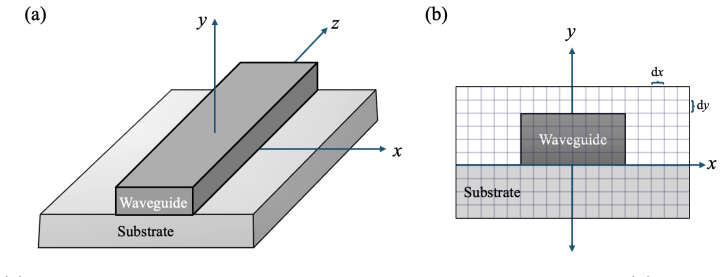
The central claim is that a practical finite-difference vectorial mode solver can be constructed for optically linear, non-magnetic dielectric waveguides by casting the electric field formulation of the vector wave equations into a generalized eigenvalue problem that incorporates all three field components self-consistently; this yields accurate propagation constants and mode profiles while reducing artifacts at permittivity discontinuities.
Load-bearing premise
Finite-difference discretization on the chosen grid captures the continuous vector wave equations accurately enough at permittivity interfaces that no large errors arise.
Editorial extensions
If this is right
- The method supplies both propagation constants and full electric-field mode profiles for linear non-magnetic dielectric waveguides.
- Boundary conditions are enforced more accurately than in formulations that treat components separately.
- Numerical artifacts are reduced at abrupt permittivity changes.
- The solver is validated on representative waveguide structures for practical use.
Reading between the lines
- The formulation may simplify coding compared with methods that require separate interface treatments.
- Grid resolution remains the main practical limit on how sharply discontinuities can be handled.
- The same matrix structure could support frequency-dependent permittivity if the eigenvalue problem is recast accordingly.
Editorial analysis
A structured set of objections, weighed in public.
Referee Report
Summary. The paper presents a finite-difference discretization of the vector wave equation for linear non-magnetic dielectric waveguides, formulated as a generalized eigenvalue problem that incorporates all three components of the electric field. The central claim is that this self-consistent inclusion yields accurate enforcement of boundary conditions and reduced numerical artifacts at permittivity discontinuities. Validation is described on two representative waveguide structures for both propagation constants and mode profiles.
Significance. If the accuracy claims are substantiated, the solver could serve as a practical computational tool for mode analysis in dielectric waveguides. The formulation follows standard vectorial FD approaches to Maxwell's equations without introducing free parameters or circular definitions. However, the absence of quantitative benchmarks limits the assessed impact relative to existing methods in the field.
major comments (1)
- [Validation] Validation description (abstract and corresponding results): states performance on two representative structures but supplies no quantitative error metrics, baseline comparisons to analytic solutions or other solvers, or grid-convergence studies. This directly weakens support for the central accuracy claim regarding interface handling and is load-bearing for the paper's contribution.
Simulated Author's Rebuttal
We thank the referee for the constructive comment on the validation section. We address it point by point below and will revise the manuscript to incorporate additional quantitative details.
read point-by-point responses
-
Referee: [Validation] Validation description (abstract and corresponding results): states performance on two representative structures but supplies no quantitative error metrics, baseline comparisons to analytic solutions or other solvers, or grid-convergence studies. This directly weakens support for the central accuracy claim regarding interface handling and is load-bearing for the paper's contribution.
Authors: We agree that explicit quantitative metrics would strengthen the presentation of the accuracy claims. The full manuscript includes mode profiles and propagation-constant values for the two structures (a slab waveguide with analytic reference and a rectangular dielectric waveguide), but these are shown graphically without tabulated errors or convergence data. In the revised version we will add: (i) a table of relative errors in the effective index for the slab case against the analytic solution, (ii) direct numerical comparisons of both propagation constants and field profiles against a commercial vectorial mode solver for the rectangular waveguide, and (iii) a grid-convergence study (error versus grid spacing) that quantifies the reduction of interface artifacts. These additions will be placed in a new subsection of the results and referenced from the abstract. revision: yes
Circularity Check
No significant circularity; direct discretization of Maxwell equations
full rationale
The paper presents a standard finite-difference discretization of the vectorial electric-field wave equation into a generalized eigenvalue problem for linear non-magnetic dielectrics. The central formulation incorporates all three E components self-consistently on a chosen grid, with boundary conditions enforced via the discretization itself. No parameters are fitted to data and then relabeled as predictions, no self-citations are invoked as load-bearing uniqueness theorems, and no ansatz is smuggled in. The derivation chain reduces directly to the continuous Maxwell equations plus standard FD approximations; the two validation cases are external checks rather than internal fits. This is the most common honest non-finding for a numerical-methods paper.
Assumptions & free parameters
Cite this review
Pith. "Pith review of Practical Vectorial Mode Solver for Dielectric Waveguides Based on Finite Differences." pith.science (2026). https://pith.science/paper/2503.17746
@misc{pith2026250317746,
  author       = {Pith},
  title        = {Pith review of: Practical Vectorial Mode Solver for Dielectric Waveguides Based on Finite Differences},
  year         = {2026},
  howpublished = {\url{https://pith.science/paper/2503.17746}},
  note         = {Machine review of arXiv:2503.17746}
}
read the original abstract
This study presents a finite-difference-based numerical solver designed for the electric field formulation of vector wave equations in optically linear, non-magnetic, dielectric waveguides. We construct a generalized eigenvalue problem by incorporating all three components of the electric field into a self-consistent formulation. This ensures accurate enforcement of boundary conditions and reduces numerical artifacts, particularly at permittivity discontinuities. We validate the solver's performance through two representative waveguide structures, demonstrating its accuracy in computing both propagation constants and mode profiles.
Figures


Figures from the paper (2 more)


Reference graph
Works this paper leans on
-
[1]
Elektromagnetische wellen an dielektrischen dr¨ ahten,
D. Hondros and P. Debye, “Elektromagnetische wellen an dielektrischen dr¨ ahten,”Annalen der Physik , vol. 337, pp. 465–476, 2024/10/13 1910
work page 2024
-
[2]
Finite-element methods for inhomogeneous waveguides,
S. Ahmed and P. Daly, “Finite-element methods for inhomogeneous waveguides,” Proceedings of the Institution of Electrical Engineers , vol. 116, pp. 1661–1664(3), October 1969
work page 1969
-
[3]
Finite-element solution of integrated optical waveguides,
B. Rahman and J. Davies, “Finite-element solution of integrated optical waveguides,” Journal of Light- wave Technology, vol. 2, no. 5, pp. 682–688, 1984
work page 1984
-
[4]
Finite-difference analysis of rectangular dielectric waveguide structures,
K. Bierwirth, N. Schulz, and F. Arndt, “Finite-difference analysis of rectangular dielectric waveguide structures,” IEEE Transactions on Microwave Theory and Techniques , vol. 34, no. 11, pp. 1104–1114, 1986
work page 1986
-
[5]
G. Hadley, “High-accuracy finite-difference equations for dielectric waveguide analysis i: uniform regions and dielectric interfaces,” Journal of Lightwave Technology , vol. 20, no. 7, pp. 1210–1218, 2002
work page 2002
-
[6]
Vector finite difference modesolver for anisotropic dielectric waveguides,
A. Fallahkhair, K. S. Li, and T. E. Murphy, “Vector finite difference modesolver for anisotropic dielectric waveguides,” Journal of Lightwave Technology , vol. 26, no. 11, pp. 1423–1431, 2008
work page 2008
-
[7]
Efficient high order waveguide mode solvers based on boundary integral equa- tions,
W. Lu and Y. Y. Lu, “Efficient high order waveguide mode solvers based on boundary integral equa- tions,” Journal of Computational Physics , vol. 272, pp. 507–525, 2014
work page 2014
-
[8]
K. S. Chiang, “Review of numerical and approximate methods for the modal analysis of general optical dielectric waveguides,” Optical and Quantum Electronics , vol. 26, no. 3, pp. S113–S134, 1994
work page 1994
Show all 16 references
-
[9]
Okamoto, Fundamentals of optical waveguides
K. Okamoto, Fundamentals of optical waveguides . Elsevier, 2010
2010
-
[10]
Improved full-vectorial finite-difference mode solver for optical waveguides with step-index profiles,
Y.-C. Chiang, Y.-P. Chiou, and H.-C. Chang, “Improved full-vectorial finite-difference mode solver for optical waveguides with step-index profiles,” Journal of Lightwave Technology , vol. 20, no. 8, pp. 1609– 1618, 2002
2002
-
[11]
Full-vectorial optical waveguide mode solvers using multidomain pseudospectral frequency-domain (psfd) formulations,
P.-J. Chiang, C.-L. Wu, C.-H. Teng, C.-S. Yang, and H.-c. Chang, “Full-vectorial optical waveguide mode solvers using multidomain pseudospectral frequency-domain (psfd) formulations,” IEEE Journal of Quantum Electronics , vol. 44, no. 1, pp. 56–66, 2008
2008
-
[12]
Arbitrary-order full-vectorial interface conditions and higher order finite- difference analysis of optical waveguides,
Y.-P. Chiou and C.-H. Du, “Arbitrary-order full-vectorial interface conditions and higher order finite- difference analysis of optical waveguides,” Journal of Lightwave Technology , vol. 29, no. 22, pp. 3445– 3452, 2011
2011
-
[13]
Dielectric rectangular waveguide and directional coupler for integrated optics,
E. A. J. Marcatili, “Dielectric rectangular waveguide and directional coupler for integrated optics,” The Bell System Technical Journal , vol. 48, no. 7, pp. 2071–2102, 1969
-
[14]
New waveguide structures for millimeter-wave and optical integrated circuits,
W. McLevige, T. Itoh, and R. Mittra, “New waveguide structures for millimeter-wave and optical integrated circuits,” IEEE Transactions on Microwave Theory and Techniques , vol. 23, no. 10, pp. 788– 794, 1975
1975
-
[15]
Block-iterative frequency-domain methods for maxwell’s equa- tions in a planewave basis,
S. G. Johnson and J. D. Joannopoulos, “Block-iterative frequency-domain methods for maxwell’s equa- tions in a planewave basis,” Optics Express, vol. 8, no. 3, pp. 173–190, 2001
2001
-
[16]
Ultra-low-loss integrated visible photonics using thin-film lithium niobate,
B. Desiatov, A. Shams-Ansari, M. Zhang, C. Wang, and M. Lonˇ car, “Ultra-low-loss integrated visible photonics using thin-film lithium niobate,” Optica, vol. 6, no. 3, pp. 380–384, 2019. 10
2019
Reviewed May 22, 2026 · model on record in the stance chip above.
Discussion (0). Sign in to comment.