REVIEW 2 major objections 23 references
Observations on Recurrent Loss in the Neural Network Model of a Partial Differential Equation: the Advection-Diffusion Equation
T0 review · 2 major / 0 minor · reviewed 2026-05-22 · grok-4.3
Pith's one-line read A recurrent neural network exactly replicates a multistep collocation scheme for the advection-diffusion equation and produces stable solutions where traditional methods fail.
desk verdict The paper sets up a recurrent network that exactly copies a multistep collocation scheme for advection-diffusion, which lets classical stability tools apply directly, but the claim of stable solutions beyond traditional limits does not follow from that setup. read the letter →
The pith
A machine-rendered reading of the paper's core claim, the machinery that carries it, and where it could break.
The reading
What carries the argument
Recurrent network that exactly evaluates a multistep method paired with collocation for spatial derivatives in the advection-diffusion equation.
What would settle it
A direct comparison of the recurrent network outputs against those of the corresponding multistep-collocation scheme on identical inputs would falsify the precise match if discrepancies appear; finding an instance where the network produces a stable solution while the classical multistep method is known to be unstable would test whether stability extends beyond traditional limits.
Extended reading notes
Core claim
By designing the recurrent network to match precisely the evaluation of a multistep method paired with collocation for spatial derivatives, the approach permits the direct transfer of stability analysis techniques from numerical PDE methods to the neural model and the application of efficient ML training to approximate the action of spatial linear operators, with observations indicating stable solutions persist where traditional numerical methods may fail.
Load-bearing premise
The recurrent network matches precisely the evaluation of a multistep method paired with a collocation method for approximating spatial derivatives in the advection-diffusion equation.
Editorial analysis
A structured set of objections, weighed in public.
Referee Report
Summary. The manuscript introduces a recurrent neural network that is constructed to match precisely the evaluation of a linear multistep time-stepping scheme paired with a collocation discretization of the spatial derivatives for the advection-diffusion equation. This equivalence is used to apply classical numerical stability analysis tools to the network while also employing machine-learning techniques to train approximations to the action of spatial linear operators. Observations are presented on the effects of the large number of free parameters even in this linear setting, and the authors claim to demonstrate that stable solutions can be obtained in regimes where traditional numerical methods fail.
Significance. If the exact equivalence to a classical multistep-collocation scheme can be maintained while the learned spatial operator demonstrably enlarges the stability region beyond standard collocation, the work would provide a concrete bridge between neural-network PDE solvers and rigorous numerical analysis, allowing both stability guarantees and data-driven optimization of discretizations. The parameter studies could also illuminate practical training issues for such hybrid architectures. However, the tension between the stated precise matching and the headline stability claim must be resolved before the significance can be assessed.
major comments (2)
- [Abstract] Abstract: The claim that 'stable solutions can be found even where traditional numerical methods may fail' stands in direct tension with the assertion that the recurrent network 'matches precisely the evaluation of a multistep method paired with a collocation method'. Under exact equivalence the discrete operator and amplification factor are identical to those of the classical linear multistep scheme, whose stability region is completely characterized by standard theory; the demonstration therefore requires either (a) that the learned spatial operator deviates from the collocation operator in a way that enlarges the stability region or (b) an explicit redefinition of which 'traditional methods' are being compared. Neither alternative is visible in the abstract or the described architecture.
- [Abstract] Abstract (and the description of the network): The statement that the construction 'allows … the use of traditional tools for analyzing the stability' implies that stability properties reduce exactly to those of the underlying multistep-collocation scheme. This circularity undermines the central claim unless the manuscript shows, with explicit comparison of amplification factors or numerical experiments, how the trained spatial operator produces a larger stability region than the reference collocation method.
Simulated Author's Rebuttal
We thank the referee for the careful reading and for identifying the tension in the abstract claims. The equivalence is to the multistep time-stepping structure, while the spatial operator is a learned approximation rather than a fixed classical collocation operator; this distinction permits both stability analysis via classical tools and the possibility of enlarged stability regions. We address each comment below and will revise the abstract for clarity.
read point-by-point responses
-
Referee: [Abstract] Abstract: The claim that 'stable solutions can be found even where traditional numerical methods may fail' stands in direct tension with the assertion that the recurrent network 'matches precisely the evaluation of a multistep method paired with a collocation method'. Under exact equivalence the discrete operator and amplification factor are identical to those of the classical linear multistep scheme, whose stability region is completely characterized by standard theory; the demonstration therefore requires either (a) that the learned spatial operator deviates from the collocation operator in a way that enlarges the stability region or (b) an explicit redefinition of which 'traditional methods' are being compared. Neither alternative is visible in the abstract or the described architecture.
Authors: The network matches the evaluation structure of a linear multistep method, but the spatial component is not a fixed classical collocation operator; instead, ML training produces an approximation to the action of the spatial linear operator. This learned operator can (and in the reported experiments does) deviate from standard collocation, yielding a different amplification factor and an enlarged stability region. The phrase 'traditional numerical methods' refers to standard multistep schemes that employ fixed, non-learned collocation operators. The abstract will be revised to state explicitly that the spatial operator is learned and may improve stability properties while retaining the multistep form for analysis. revision: yes
-
Referee: [Abstract] Abstract (and the description of the network): The statement that the construction 'allows … the use of traditional tools for analyzing the stability' implies that stability properties reduce exactly to those of the underlying multistep-collocation scheme. This circularity undermines the central claim unless the manuscript shows, with explicit comparison of amplification factors or numerical experiments, how the trained spatial operator produces a larger stability region than the reference collocation method.
Authors: Traditional stability tools apply because the overall scheme remains a linear multistep method whose amplification factor is determined by the (learned) spatial operator; the analysis is not circular. The manuscript's observations and demonstrations of stable solutions beyond traditional limits are obtained precisely because the trained operator differs from the reference collocation operator. If side-by-side comparisons of amplification factors are insufficiently explicit in the current text, we will add them during revision to make the enlargement of the stability region fully transparent. revision: partial
Circularity Check
Recurrent network defined to match multistep+collocation scheme exactly, so stability analysis and claims reduce to classical method properties by construction
-
self definitional
[Abstract]
"a recurrent network is introduced that matches precisely the evaluation of a multistep method paired with a collocation method for approximating spatial derivatives in the advection diffusion equation. This allows for two things: 1) the use of traditional tools for analyzing the stability of a numerical method for solving PDEs ... Further, it is demonstrated that stable solutions can be found even where traditional numerical methods may fail."
The network is defined by construction to reproduce the multistep+collocation evaluation exactly. Consequently the discrete operator, time-stepping rule, and stability region are identical to those of the classical scheme; any stability result or claim of stability outside the classical region is forced to be the same as the input method's properties rather than an independent outcome of the neural architecture.
full rationale
The paper explicitly constructs the recurrent network to be identical in evaluation to a standard linear multistep method with collocation spatial discretization. This equivalence permits direct application of classical stability tools (amplification factors, regions), but the headline claim of 'stable solutions ... even where traditional numerical methods may fail' cannot hold under the stated equivalence without additional deviation from the collocation operator, which is not shown. The central demonstration therefore reduces to re-deriving known properties of the multistep scheme rather than producing independent NN-derived results.
Assumptions & free parameters
Cite this review
Pith. "Pith review of Observations on Recurrent Loss in the Neural Network Model of a Partial Differential Equation: the Advection-Diffusion Equation." pith.science (2026). https://pith.science/paper/RL754VT3
@misc{pith2026250319036,
  author       = {Pith},
  title        = {Pith review of: Observations on Recurrent Loss in the Neural Network Model of a Partial Differential Equation: the Advection-Diffusion Equation},
  year         = {2026},
  howpublished = {\url{https://pith.science/paper/RL754VT3}},
  note         = {Machine review of arXiv:2503.19036}
}
read the original abstract
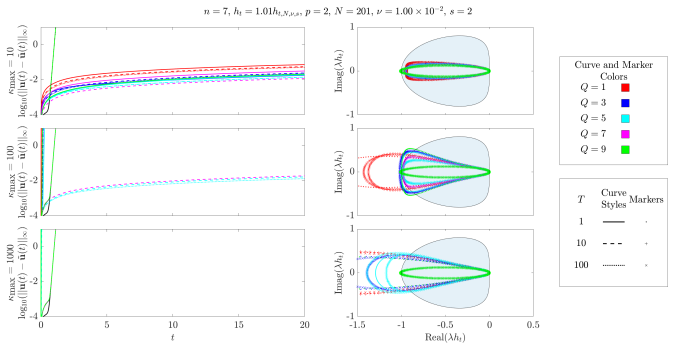
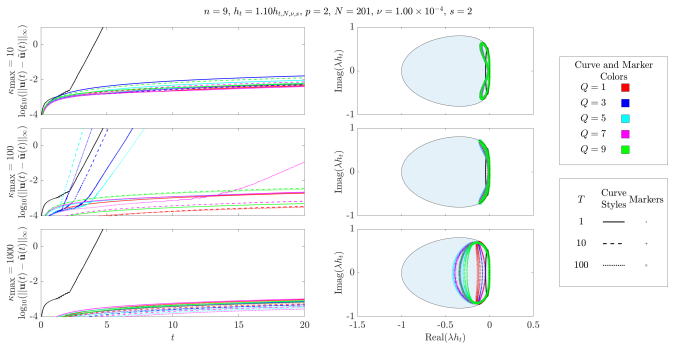
A growing body of literature has been leveraging techniques of machine learning (ML) to build novel approaches to approximating the solutions to partial differential equations. Noticeably absent from the literature is a systematic exploration of the stability of the solutions generated by these ML approaches. Here, a recurrent network is introduced that matches precisely the evaluation of a multistep method paired with a collocation method for approximating spatial derivatives in the advection diffusion equation. This allows for two things: 1) the use of traditional tools for analyzing the stability of a numerical method for solving PDEs and 2) bringing to bear efficient techniques of ML for the training of approximations for the action of (spatial) linear operators. Observations on impacts of varying the large number of parameters in even this simple linear problem are presented. Further, it is demonstrated that stable solutions can be found even where traditional numerical methods may fail.
Figures


Figures from the paper (5 more)



Reference graph
Works this paper leans on
-
[1]
A First Course in the Numerical Analysis of Differential Equations
Arieh Iserles. A First Course in the Numerical Analysis of Differential Equations. Cambridge Texts in Applied Mathematics. Cambridge Univer- sity Press, 2 edition, 2008
work page 2008
-
[2]
Y. Bar-Sinai, S. Hoyer, J. Hickey, and M. P. Brenner. Learning data-driven discretizations for partial differential equations. Proceedings of the National Academy of Sciences, 116(31):15344–15349, 2019
work page 2019
-
[3]
Kristina O. F. Williams and Benjamin F. Akers. Numerical simulation of the korteweg–de vries equation with machine learning. Mathematics, 11(13), 2023
work page 2023
-
[4]
Benjamin F. Akers and Kristina O. F. Williams. Coarse-gridded simulation of the nonlinear schr¨ odinger equation with machine learning.Mathematics, 12(17), 2024
work page 2024
-
[5]
PDE-net: Learning PDEs from data
Zichao Long, Yiping Lu, Xianzhong Ma, and Bin Dong. PDE-net: Learning PDEs from data. In Jennifer Dy and Andreas Krause, editors, Proceedings of the 35th International Conference on Machine Learning , volume 80 of Proceedings of Machine Learning Research, pages 3208–3216. PMLR, 10–15 Jul 2018
work page 2018
-
[6]
Z. Chen, V. Churchill, K. Wu, and D. Xiu. Deep neural network modeling of unknown partial differential equations in nodal space. J. Comput. Phys., 449(C), jan 2022. 27
work page 2022
-
[7]
Deep hidden physics models: deep learning of nonlinear partial differential equations
Maziar Raissi. Deep hidden physics models: deep learning of nonlinear partial differential equations. J. Mach. Learn. Res., 19(1):932–955, January 2018
work page 2018
- [8]
Show all 23 references
-
[9]
Pde-net 2.0: Learning pdes from data with a numeric-symbolic hybrid deep network
Zichao Long, Yiping Lu, and Bin Dong. Pde-net 2.0: Learning pdes from data with a numeric-symbolic hybrid deep network. Journal of Computa- tional Physics, 399:108925, 2019
2019
-
[10]
Neural network enhanced computations on coarse grids
Jan Nordstr¨ om and Oskar˚Alund. Neural network enhanced computations on coarse grids. Journal of Computational Physics , 425:109821, 2021
2021
-
[11]
A logical calculus of ideas immanent in nervous activity
Warren Mcculloch and Walter Pitts. A logical calculus of ideas immanent in nervous activity. Bulletin of Mathematical Biophysics , 5:127–147, 1943
1943
-
[12]
D. E. Rumelhart, P. Smolensky, J. L. McClelland, and G. E. Hinton. Schemata and Sequential Thought Processes in PDP Models. In Paral- lel Distributed Processing, Volume 2: Explorations in the Microstructure of Cognition: Psychological and Biological Models . The MIT Press, 07 1986
1986
-
[13]
Ode-ru: a dynamical system view on recurrent neural networks
Pinchao Meng, Xinyu Wang, and Weishi Yin. Ode-ru: a dynamical system view on recurrent neural networks. Electronic Research Archive, 30(1):257– 271, 2022
2022
-
[14]
W. Ee. A proposal on machine learning via dynamical systems. Commun. Math. Stat., 5:1–11, 2017
2017
-
[15]
IMEXnet a forward stable deep neural network
Eldad Haber, Keegan Lensink, Eran Treister, and Lars Ruthotto. IMEXnet a forward stable deep neural network. In Kamalika Chaudhuri and Ruslan Salakhutdinov, editors, Proceedings of the 36th International Conference on Machine Learning, volume 97 ofProceedings of Machine Learni...
2019
-
[16]
Haber and L
E. Haber and L. Ruthotto. Stable architectures for deep neural networks. Inverse Problems, 34(1), 2017
2017
-
[17]
R. B. Guenther and J. W. Lee. Partial Differential Equations of Mathe- matical Physics and Integral Equations . Dover Publications, Inc., 1996
1996
-
[18]
Hunter and B
J.K. Hunter and B. Nachtergaele. Applied Analysis. World Scientific, 2001
2001
-
[19]
K. E. Atkinson. An Introduction to Numerical Analysis . John Wiley & Sons, 2nd edition, 1989
1989
-
[20]
Randall J. LeVeque. Finite Difference Methods for Ordinary and Partial Differential Equations . Society for Industrial and Applied Mathematics, 2007. 28
2007
-
[21]
Stability ordinates of adams predictor-corrector methods
Michelle Ghrist, Bengt Fornberg, and Jonah Reeger. Stability ordinates of adams predictor-corrector methods. BIT Numerical Mathematics , 55, 12 2014
2014
-
[22]
Nocedal and S
J. Nocedal and S. J. Wright. Numerical Optimzation. Springer, 2nd edition, 2006
2006
-
[23]
Long short-term memory.Neu- ral Computation, 9:1735–1780, 11 1997
Sepp Hochreiter and J¨ urgen Schmidhuber. Long short-term memory.Neu- ral Computation, 9:1735–1780, 11 1997. 29
1997
Reviewed May 22, 2026 · model on record in the stance chip above.
Discussion (0). Sign in to comment.