REVIEW 2 major objections 2 minor 25 references
Beyond Asymptotics: Targeted exploration with finite-sample guarantees
T0 review · 2 major / 2 minor · reviewed 2026-05-22 · grok-4.3
Pith's one-line read A targeted exploration strategy supplies a priori finite-time guarantees that chosen inputs will make uncertain LTI model parameters reach a preset accuracy level.
desk verdict This paper gives a finite-sample targeted exploration method for LTI identification by stitching martingale bounds to spectral-line inputs, but the a priori guarantee rests on how cleanly the transients and uncertainty are controlled. read the letter →
The pith
A machine-rendered reading of the paper's core claim, the machinery that carries it, and where it could break.
The reading
What carries the argument
The targeted exploration strategy that formulates an optimization problem whose solution gives the minimal energy inputs guaranteeing finite-time parameter accuracy.
What would settle it
Apply the computed exploration inputs to a known LTI plant with sub-Gaussian noise for the prescribed finite horizon and verify whether the realized parameter error stays below the target with the claimed probability.
Extended reading notes
Core claim
The central claim is that a targeted exploration strategy, obtained by optimizing inputs via spectral-line predictions of sinusoidal excitation while explicitly subtracting spectral transient error and parametric uncertainty, when combined with non-asymptotic identification bounds based on self-normalized martingales, yields a priori guarantees that the resulting inputs achieve any desired model-parameter accuracy for uncertain LTI systems subject to sub-Gaussian disturbances in finite time.
Load-bearing premise
Existing non-asymptotic identification bounds can be combined with spectral-line predictions without extra looseness that would invalidate the a priori guarantee.
Editorial extensions
If this is right
- Designers obtain explicit upper bounds on the exploration energy required to reach a chosen accuracy in a chosen time.
- The same construction applies directly to any uncertain LTI system whose disturbances satisfy the sub-Gaussian assumption.
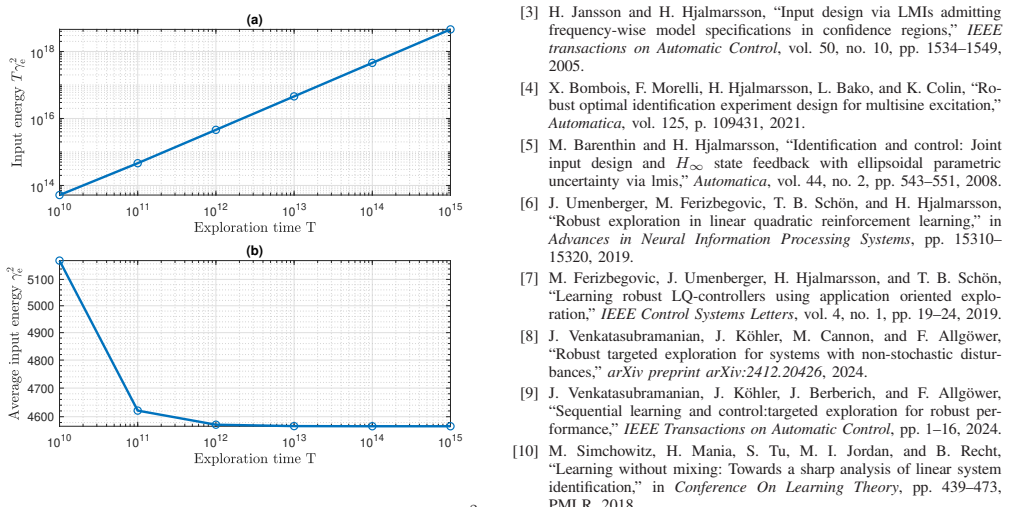
- Shorter allowable exploration horizons translate into strictly higher minimal energy budgets, as shown in the numerical example.
- The approach replaces reliance on asymptotic convergence rates with concrete, finite-horizon certificates.
Reading between the lines
- The same bounding technique could be reused inside receding-horizon adaptive controllers that must keep total excitation energy below a hard limit.
- If analogous finite-sample bounds become available for certain classes of nonlinear systems, the identical spectral-line construction would extend without change.
- The method supplies a concrete benchmark against which future data-driven experiment-design algorithms can be compared on finite-time performance.
Editorial analysis
A structured set of objections, weighed in public.
Referee Report
Summary. The manuscript introduces a targeted exploration strategy for uncertain linear time-invariant (LTI) systems subject to sub-Gaussian disturbances. The main result is a finite-time, a priori guarantee that optimized exploration inputs achieve a desired accuracy in model parameter estimation. The approach combines existing non-asymptotic identification bounds based on self-normalized martingales with spectral line predictions for sinusoidal inputs, while accounting for spectral transient errors and parametric uncertainty. A numerical example illustrates the effect of finite exploration time on required energy.
Significance. If the central claim holds without hidden looseness at the bound-stitching interface, the work would be significant for non-asymptotic system identification and control, enabling practical finite-time exploration with explicit a priori accuracy guarantees rather than relying on asymptotic analysis. Explicit use of existing martingale bounds is a strength that avoids reinventing core concentration inequalities.
major comments (2)
- [Technical derivation (martingale + spectral lines interface)] Technical derivation section on combining bounds: the paper must explicitly show that the spectral transient error bound and the propagation of parametric uncertainty remain independent of the unknown system matrices and do not introduce scaling factors with the identification error itself. If the transient term is controlled only asymptotically or absorbed into constants depending on A and B, the final a priori guarantee on parameter accuracy after input optimization is invalidated.
- [Optimization formulation and guarantee statement] The optimization step that selects exploration inputs to meet the target accuracy: verify that the bound used inside the optimizer is the same (non-loose) finite-sample expression delivered by the martingale+spectral combination; any post-hoc tightening or hidden dependence on the very parameters being estimated would make the guarantee circular.
minor comments (2)
- [Main theorem / notation] Clarify the precise definition of 'spectral lines' and the exact form of the transient error term in the main theorem statement.
- [Numerical example] In the numerical example, report both the theoretical bound value and the empirical estimation error across multiple noise realizations to allow direct assessment of conservatism.
Simulated Author's Rebuttal
We thank the referee for the careful and constructive review. We address the two major comments point by point below, clarifying the technical interface and optimization details while remaining faithful to the manuscript's derivations.
read point-by-point responses
-
Referee: [Technical derivation (martingale + spectral lines interface)] Technical derivation section on combining bounds: the paper must explicitly show that the spectral transient error bound and the propagation of parametric uncertainty remain independent of the unknown system matrices and do not introduce scaling factors with the identification error itself. If the transient term is controlled only asymptotically or absorbed into constants depending on A and B, the final a priori guarantee on parameter accuracy after input optimization is invalidated.
Authors: Section 3 derives the combined bound by first applying the self-normalized martingale concentration to the regression residuals and then adding an explicit additive term for the spectral transient. The transient bound is obtained from the difference between the finite-horizon response and the steady-state sinusoid; it is controlled by an exponential decay factor whose rate is taken as the worst-case stability margin over the known compact uncertainty set for the system matrices. Consequently the transient term depends only on the size of the uncertainty set, the chosen frequencies, and the horizon length, with no multiplicative factor involving the identification error itself. The propagation of parametric uncertainty into the regressor Gram matrix is likewise handled by a uniform bound over the same set. We agree that an additional sentence making this uniformity explicit would strengthen readability and will insert it in the revision. revision: yes
-
Referee: [Optimization formulation and guarantee statement] The optimization step that selects exploration inputs to meet the target accuracy: verify that the bound used inside the optimizer is the same (non-loose) finite-sample expression delivered by the martingale+spectral combination; any post-hoc tightening or hidden dependence on the very parameters being estimated would make the guarantee circular.
Authors: The optimization problem stated in Section 4 directly encodes the finite-sample accuracy guarantee obtained from the martingale-plus-spectral derivation as its constraint; the only quantities appearing in that constraint are the a-priori uncertainty set, the sub-Gaussian parameter, the horizon, and the chosen input spectrum. No post-hoc numerical tightening or replacement by asymptotic expressions occurs, and the decision variables (input amplitudes and frequencies) enter the bound only through the Gram matrix they produce. Because the uncertainty set is fixed before optimization, the resulting guarantee remains non-circular. revision: no
Circularity Check
No circularity: derivation combines external bounds with spectral predictions
full rationale
The paper states its technical derivation (i) leverages existing non-asymptotic identification bounds with self-normalized martingales, (ii) utilizes spectral lines to predict sinusoidal excitation effects, and (iii) accounts for spectral transient error and parametric uncertainty. These steps cite external results rather than re-deriving fitted quantities from the paper's own outputs or defining quantities in terms of themselves. No self-citation load-bearing, uniqueness imported from authors, or ansatz smuggling is indicated in the provided text. The central claim rests on stitching independent prior bounds to new optimization, remaining self-contained against external benchmarks.
Assumptions & free parameters
Cite this review
Pith. "Pith review of Beyond Asymptotics: Targeted exploration with finite-sample guarantees." pith.science (2026). https://pith.science/paper/2504.02380
@misc{pith2026250402380,
  author       = {Pith},
  title        = {Pith review of: Beyond Asymptotics: Targeted exploration with finite-sample guarantees},
  year         = {2026},
  howpublished = {\url{https://pith.science/paper/2504.02380}},
  note         = {Machine review of arXiv:2504.02380}
}
read the original abstract
In this paper, we introduce a targeted exploration strategy for the non-asymptotic, finite-time case. The proposed strategy is applicable to uncertain linear time-invariant systems subject to sub-Gaussian disturbances. As the main result, the proposed approach provides a priori guarantees, ensuring that the optimized exploration inputs achieve a desired accuracy of the model parameters. The technical derivation of the strategy (i) leverages existing non-asymptotic identification bounds with self-normalized martingales, (ii) utilizes spectral lines to predict the effect of sinusoidal excitation, and (iii) effectively accounts for spectral transient error and parametric uncertainty. A numerical example illustrates how the finite exploration time influence the required exploration energy.
Figures
Reference graph
Works this paper leans on
-
[1]
Ljung, System Identification: Theory for the User
L. Ljung, System Identification: Theory for the User . Prentice Hall PTR, 2nd ed., 1999
work page 1999
-
[2]
Opt imal experiment design for open and closed-loop system identific ation,
X. Bombois, M. Gevers, R. Hildebrand, and G. Solari, “Opt imal experiment design for open and closed-loop system identific ation,” Communications in Information and Systems , vol. 11, no. 3, pp. 197– 224, 2011
work page 2011
-
[3]
Input design via LMIs adm itting frequency-wise model specifications in confidence regions,
H. Jansson and H. Hjalmarsson, “Input design via LMIs adm itting frequency-wise model specifications in confidence regions, ” IEEE transactions on Automatic Control , vol. 50, no. 10, pp. 1534–1549, 2005
work page 2005
-
[4]
Ro- bust optimal identification experiment design for multisin e excitation,
X. Bombois, F. Morelli, H. Hjalmarsson, L. Bako, and K. Co lin, “Ro- bust optimal identification experiment design for multisin e excitation,” Automatica, vol. 125, p. 109431, 2021
work page 2021
-
[5]
M. Barenthin and H. Hjalmarsson, “Identification and con trol: Joint input design and H∞ state feedback with ellipsoidal parametric uncertainty via lmis,” Automatica, vol. 44, no. 2, pp. 543–551, 2008
work page 2008
-
[6]
Robust exploration in linear quadratic reinforcement lea rning,
J. Umenberger, M. Ferizbegovic, T. B. Sch¨ on, and H. Hjal marsson, “Robust exploration in linear quadratic reinforcement lea rning,” in Advances in Neural Information Processing Systems , pp. 15310– 15320, 2019
work page 2019
-
[7]
Learning robust LQ-controllers using application orient ed explo- ration,
M. Ferizbegovic, J. Umenberger, H. Hjalmarsson, and T. B . Sch¨ on, “Learning robust LQ-controllers using application orient ed explo- ration,” IEEE Control Systems Letters , vol. 4, no. 1, pp. 19–24, 2019
work page 2019
-
[8]
Robust targeted exploration for systems with non-stochas tic distur- bances,
J. V enkatasubramanian, J. K¨ ohler, M. Cannon, and F. All g¨ ower, “Robust targeted exploration for systems with non-stochas tic distur- bances,” arXiv preprint arXiv:2412.20426 , 2024
Show all 25 references
-
[9]
Sequential learning and control:targeted exploration fo r robust per- formance,
J. V enkatasubramanian, J. K¨ ohler, J. Berberich, and F. Allg¨ ower, “Sequential learning and control:targeted exploration fo r robust per- formance,” IEEE Transactions on Automatic Control , pp. 1–16, 2024
2024
-
[10]
Learning without mixing: Towards a sharp analysis of linea r system identification,
M. Simchowitz, H. Mania, S. Tu, M. I. Jordan, and B. Recht , “Learning without mixing: Towards a sharp analysis of linea r system identification,” in Conference On Learning Theory , pp. 439–473, PMLR, 2018
2018
-
[11]
Near optimal finite time ident ification of arbitrary linear dynamical systems,
T. Sarkar and A. Rakhlin, “Near optimal finite time ident ification of arbitrary linear dynamical systems,” in International Conference on Machine Learning , pp. 5610–5618, PMLR, 2019
2019
-
[12]
Finite sample analysis of s tochastic system identification,
A. Tsiamis and G. J. Pappas, “Finite sample analysis of s tochastic system identification,” in Proc. 58th Conference on Decision and Control (CDC), pp. 3648–3654, IEEE, 2019
2019
-
[13]
Improved algorithms for linear stochastic bandits,
Y . Abbasi-Y adkori, D. P´ al, and C. Szepesv´ ari, “Improved algorithms for linear stochastic bandits,” Advances in neural information process- ing systems , vol. 24, 2011
2011
-
[14]
On the sa mple complexity of the linear quadratic regulator,
S. Dean, H. Mania, N. Matni, B. Recht, and S. Tu, “On the sa mple complexity of the linear quadratic regulator,” F oundations of Compu- tational Mathematics , pp. 1–47, 2019
2019
-
[15]
Certainty equivalence is efficient for linear quadratic control,
H. Mania, S. Tu, and B. Recht, “Certainty equivalence is efficient for linear quadratic control,” Advances in Neural Information Processing Systems, vol. 32, 2019
2019
-
[16]
Stat istical learning theory for control: A finite-sample perspective,
A. Tsiamis, I. Ziemann, N. Matni, and G. J. Pappas, “Stat istical learning theory for control: A finite-sample perspective,” IEEE Control Systems Magazine , vol. 43, no. 6, pp. 67–97, 2023
2023
-
[17]
Active learning for ide ntification of linear dynamical systems,
A. Wagenmaker and K. Jamieson, “Active learning for ide ntification of linear dynamical systems,” in Conference on Learning Theory , pp. 3487–3582, PMLR, 2020
2020
-
[18]
Accu- rate parameter estimation for safety-critical systems wit h unmodeled dynamics,
A. Sarker, P . Fisher, J. E. Gaudio, and A. M. Annaswamy, “ Accu- rate parameter estimation for safety-critical systems wit h unmodeled dynamics,” Artificial Intelligence, vol. 316, p. 103857, 2023
2023
-
[19]
Stochastic model predictive control for sub -gaussian noise,
Y . Ao, J. K¨ ohler, M. Prajapat, Y . As, M. Zeilinger, P . F¨ urnstahl, and A. Krause, “Stochastic model predictive control for sub -gaussian noise,” arXiv preprint arXiv:2503.08795 , 2025
2025
-
[20]
Williams, Probability with martingales
D. Williams, Probability with martingales . Cambridge university press, 1991
1991
-
[21]
From no isy data to feedback controllers: Nonconservative design via a matrix S- lemma,
H. J. van Waarde, M. K. Camlibel, and M. Mesbahi, “From no isy data to feedback controllers: Nonconservative design via a matrix S- lemma,” IEEE Transactions on Automatic Control , vol. 67, no. 1, pp. 162–175, 2022
2022
-
[22]
CVX: MA TLAB software for discipli ned convex programming, version 2.1,
M. Grant and S. Boyd, “CVX: MA TLAB software for discipli ned convex programming, version 2.1,” Mar. 2014
2014
-
[23]
Linear systems can be hard t o learn,
A. Tsiamis and G. J. Pappas, “Linear systems can be hard t o learn,” in Proc. 60th IEEE Conference on Decision and Control (CDC) , pp. 2903–2910, IEEE, 2021
2021
-
[24]
LMI properties and appli cations in sys- tems, stability, and control theory,
R. J. Caverly and J. R. Forbes, “LMI properties and appli cations in sys- tems, stability, and control theory,” arXiv preprint arXiv:1903.08599 , 2019
1903
-
[25]
The scenario a pproach for systems and control design,
M. C. Campi, S. Garatti, and M. Prandini, “The scenario a pproach for systems and control design,” Annual Reviews in Control , vol. 33, no. 2, pp. 149–157, 2009. APPENDIX I PROOF OF THEOREM 2 Proof. By applying the Schur complement twice to the condition in (14), we have (ˆθT ...
2009
Reviewed May 22, 2026 · model on record in the stance chip above.
Discussion (0). Sign in to comment.