REVIEW 1 cited by
Deterministic Parallel High-Quality Hypergraph Partitioning
T0 review · reviewed 2026-08-16 · deepseek-v4-flash
Pith's one-line read DetJet and DetFlows are the first deterministic parallel hypergraph partitioners whose quality matches or beats non-deterministic state-of-the-art solvers, at a modest time cost.
The pith
A machine-rendered reading of the paper's core claim, the machinery that carries it, and where it could break.
The reading
This paper makes two refinement steps deterministic without giving up quality. First, DetJet generalizes the GPU graph refinement algorithm Jet to hypergraphs. Jet allows moves that temporarily violate the balance constraint and later repairs the balance, which lets it escape local minima. The authors add an efficient hypergraph afterburner that simulates move orders without quadratic work, and a new deterministic rebalancing step. Second, DetFlows handles flow-based refinement, normally the strongest and most expensive technique. They show that even though the underlying max-flow solver is non-deterministic, the particular minimum cuts used in refinement are unique, so the bipartition result is fixed. They schedule block pairs in a deterministic matching.
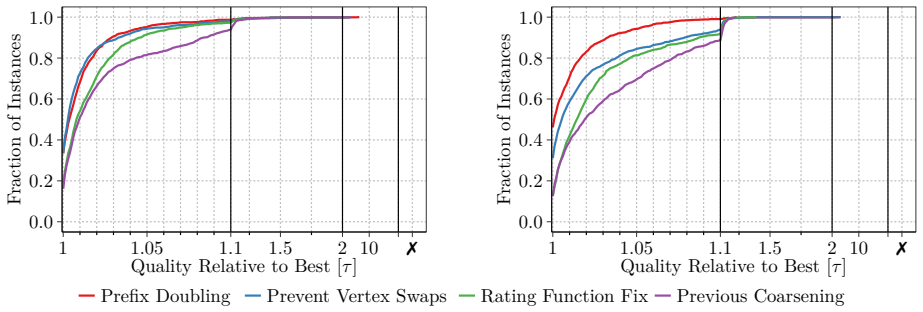
On standard benchmarks with 94 hypergraphs and 71 graphs, DetJet matches the quality of the non-deterministic Mt-KaHyPar default while running about 15% slower. DetFlows is about 1% better than the non-deterministic flow configuration and about 29% slower. The code and benchmark data are public.
Extended reading notes
Core claim
From the conclusion: 'We develop the first deterministic parallel algorithm for hypergraph partitioning that matches the quality of the best non-deterministic and sequential solvers.' If true, this means deterministic partitions no longer cost the quality penalty seen in BiPart and Mt-KaHyPar-SDet; DetJet matches Mt-KaHyPar-Default at a 15% time increase, and DetFlows beats Mt-KaHyPar-Flows by about 1% at a 31% time increase.
Load-bearing premise
The determinism claim depends on every parallel step being order-independent or deterministically tie-broken. The paper gives a clean argument for flow-based refinement via unique min cuts, but Algorithm 2 sorts pins by gain only, with no tie-break rule stated, and Section 5.2 schedules a maximal matching in the quotient graph with no tie-break rule stated. If equal-gain moves or equal-priority matching edges are processed in different orders across runs, recomputed gains and the final partition could differ. This is a load-bearing assumption for the central 'deterministic' claim, and it is distinct from the quality-versus-time claims.
Signed reviews
Editorial analysis
A structured set of objections, weighed in public.
Assumptions & free parameters
free parameters (4)
- Temperature schedule tau =
three rounds decreasing from 0.75 to 0
- Deadzone factor d =
0.1
- Jet iteration limit =
8
- Number of temperature rounds =
3
assumptions (4)
- domain assumption The multilevel paradigm (coarsen, initial partition, refine) improves solutions for hypergraph partitioning.
- standard math In a residual graph of a maximum flow, the vertices reachable from the source and sink induce the unique inclusion-minimal source-side and minimal sink-side minimum cuts (Picard-Queyranne).
- domain assumption Parallel sorting, prefix sums, and integer atomic adds are deterministic in the implementation.
- domain assumption The benchmark instances are representative of practical hypergraph partitioning workloads.
Cite this review
Pith. "Pith review of Deterministic Parallel High-Quality Hypergraph Partitioning." pith.science (2026). https://pith.science/paper/WBHLQTXY
@misc{pith2026250412013,
  author       = {Pith},
  title        = {Pith review of: Deterministic Parallel High-Quality Hypergraph Partitioning},
  year         = {2026},
  howpublished = {\url{https://pith.science/paper/WBHLQTXY}},
  note         = {Machine review of arXiv:2504.12013}
}
abstract
We present a deterministic parallel multilevel algorithm for balanced hypergraph partitioning that matches the state of the art for non-deterministic algorithms. Deterministic parallel algorithms produce the same result in each invocation, which is crucial for reproducibility. Moreover, determinism is highly desirable in application areas such as VLSI design. While there has been tremendous progress in parallel hypergraph partitioning algorithms recently, deterministic counterparts for high-quality local search techniques are missing. Consequently, solution quality is severely lacking in comparison to the non-deterministic algorithms. In this work we close this gap. First, we present a generalization of the recently proposed Jet refinement algorithm. While Jet is naturally amenable to determinism, significant changes are necessary to achieve competitive performance on hypergraphs. We also propose an improved deterministic rebalancing algorithm for Jet. Moreover, we consider the powerful but slower flow-based refinement and introduce a scheme that enables deterministic results while building upon a non-deterministic maximum flow algorithm. As demonstrated in our thorough experimental evaluation, this results in the first deterministic parallel partitioner that is competitive to the highest quality solvers. With Jet refinement, we match or exceed the quality of Mt-KaHyPar's non-deterministic default configuration while being only 15\% slower on average. We observe self-relative speedups of up to 55 on 64 cores with a 22.5$\times$ average speedup. Our deterministic flow-based refinement exceeds the quality of the non-deterministic variant by roughly 1\% on average but requires 31\% more running time.
Figures


Figures from the paper (8 more)


Forward citations
Cited by 1 Pith paper
-
Linear-Time Multilevel Graph Partitioning via Edge Sparsification
A multilevel graph partitioner with edge sparsification achieves proven linear expected work and a 1.49x average speedup in KaMinPar with only about 1% average cut increase.
Reference graph
Works this paper leans on
-
[1]
Engineering a Direct k- way Hypergraph Partitioning Algorithm
Yaroslav Akhremtsev, Tobias Heuer, Peter Sanders, and Sebastian Schlag. Engineering a Direct k- way Hypergraph Partitioning Algorithm. In 19th Workshop on Algorithm Engineering & Experiments (ALENEX), pages 28–42, 2017. doi:10.1137/1. 9781611974768.3
doi:10.1137/1 2017
-
[2]
High-Quality Shared-Memory Graph Parti- tioning
Yaroslav Akhremtsev, Peter Sanders, and Christian Schulz. High-Quality Shared-Memory Graph Parti- tioning. In 24th European Conference on Parallel Processing (Euro-Par), pages 659–671. Springer, 8
-
[3]
Charles J. Alpert and Andrew B. Kahng. Re- cent Directions in Netlist Partitioning: A Sur- vey. Integration, 19(1-2):1–81, 1995. doi:10.1016/ 0167-9260(95)00008-4
work page 1995
-
[4]
Lewis, Ana-Maria Oros-Peusquens, Nadim J
Katrin Amunts, Claude Lepage, Louis Borgeat, Hartmut Mohlberg, Timo Dickscheid, Marc- ´Etienne Rousseau, Sebastian Bludau, Pierre-Louis Bazin, Lindsay B. Lewis, Ana-Maria Oros-Peusquens, Nadim J. Shah, Thomas Lippert, Karl Zilles, and Alan C. Evans. BigBrain: An Ultrahigh-Resolution 3D Human Brain Model. Science, 340(6139):1472– 1475, 2013
work page 2013
-
[5]
Konstantin Andreev and Harald R¨ acke. Bal- anced Graph Partitioning. In 16th ACM Sympo- sium on Parallelism in Algorithms and Architec- tures (SPAA), pages 120–124, 2004. doi:10.1145/ 1007912.1007931
arXiv 2004
-
[6]
Bader, Henning Meyerhenke, Peter Sanders, and Dorothea Wagner
David A. Bader, Henning Meyerhenke, Peter Sanders, and Dorothea Wagner. Graph Partitioning and Graph Clustering , volume 588. American Math- ematical Society Providence, 2013. doi:10.1090/ conm/588
work page 2013
-
[7]
Niklas Baumstark, Guy E. Blelloch, and Julian Shun. Efficient Implementation of a Synchronous Parallel Push-Relabel Algorithm. In 23th European Symposium on Algorithms (ESA) , pages 106–117. Springer, 2015. doi:10.1007/978-3-662-48350-3\ _10
-
[8]
Anton Belov, Daniel Diepold, Marijn Heule, and Matti J¨ arvisalo. The SAT Competition 2014. http: //www.satcompetition.org/2014/, 2014
work page 2014
Show all 59 references
-
[9]
Blelloch, Jeremy T
Guy E. Blelloch, Jeremy T. Fineman, Phillip B. Gibbons, and Julian Shun. Internally Deterministic Parallel Algorithms Can Be Fast. In 17th ACM Symposium on Principles and Practice of Parallel Programming (PPOPP), pages 181–192, 2012. doi: 10.1145/2145816.2145840
2012
-
[10]
Parallel Programming Must Be Deterministic By Default
Robert L Bocchino, Vikram Adve, Sarita Adve, and Marc Snir. Parallel Programming Must Be Deterministic By Default. Usenix HotPar, 6, 2009
2009
-
[11]
UbiCrawler: A Scalable Fully Distributed Web Crawler
Paolo Boldi, Bruno Codenotti, Massimo Santini, and Sebastiano Vigna. UbiCrawler: A Scalable Fully Distributed Web Crawler. Software: Practice & Experience, 34(8):711–726, 2004. doi:10.1002/SPE. 587
2004 doi
-
[12]
Layered Label Propagation: A MultiResolution Coordinate-Free Ordering for Com- pressing Social Networks
Paolo Boldi, Marco Rosa, Massimo Santini, and Sebastiano Vigna. Layered Label Propagation: A MultiResolution Coordinate-Free Ordering for Com- pressing Social Networks. In 20th International Con- ference on World Wide Web (WWW), pages 587–596,
-
[13]
The WebGraph Framework I: Compression Techniques
Paolo Boldi and Sebastiano Vigna. The WebGraph Framework I: Compression Techniques. In13th Inter- national Conference on World Wide Web (WWW) , pages 595–601, 2004. doi:10.1145/988672.988752
2004
-
[14]
Recent Advances in Graph Partitioning
Aydin Bulu¸ c, Henning Meyerhenke, Ilya Safro, Pe- ter Sanders, and Christian Schulz. Recent Advances in Graph Partitioning. In Algorithm Engineering , volume 9220, pages 117–158. 2016. doi:10.1007/ 978-3-319-49487-6_4
2016
-
[15]
More Recent Ad- vances in (Hyper)Graph Partitioning
¨Umit C ¸ ataly¨ urek, Karen Devine, Marcelo Faraj, Lars Gottesb¨ uren, Tobias Heuer, Henning Meyer- henke, Peter Sanders, Sebastian Schlag, Christian Schulz, Daniel Seemaier, et al. More Recent Ad- vances in (Hyper)Graph Partitioning. ACM Com- puting Surveys, 55(12):253–253, ...
2023
-
[16]
PT- Scotch: A Tool for Efficient Parallel Graph Ordering
C´ edric Chevalier and Fran¸ cois Pellegrini. PT- Scotch: A Tool for Efficient Parallel Graph Ordering. Parallel Computing , 34(6-8):318–331, 2008. doi: 10.1016/j.parco.2007.12.001
2008 doi
-
[17]
Davis and Yifan Hu
Timothy A. Davis and Yifan Hu. The University of Florida Sparse Matrix Collection. ACM Transactions on Mathematical Software , 38(1):1:1–1:25, 11 2011. doi:10.1145/2049662.2049663
2011
-
[18]
Devine, Erik G
Karen D. Devine, Erik G. Boman, Robert T. Hea- phy, Rob H. Bisseling, and ¨Umit V. Cataly¨ urek. Par- allel Hypergraph Partitioning for Scientific Comput- ing. In 20th International Parallel and Distributed Processing Symposium (IPDPS) . IEEE, 2006. doi: 10.1109/IPDPS.2006.1639359
2006 arXiv
-
[19]
Dolan and Jorge J
Elizabeth D. Dolan and Jorge J. Mor´ e. Bench- marking Optimization Software with Performance Profiles. Mathematical Programming, 91(2):201–213,
-
[20]
Fiduccia and Robert M
Charles M. Fiduccia and Robert M. Mattheyses. A Linear-Time Heuristic for Improving Network Parti- tions. In 19th Design Automation Conference (DAC), pages 175–181, 1982. doi:10.1145/800263.809204
1982
-
[21]
Gilbert, Kamesh Madduri, Erik G
Michael S. Gilbert, Kamesh Madduri, Erik G. Boman, and Siva Rajamanickam. Jet: Multilevel Graph Partitioning on Graphics Processing Units. SIAM Journal of Scientific Computing. , 46(5):700,
- [22]
-
[23]
Deter- ministic Parallel Hypergraph Partitioning
Lars Gottesb¨ uren and Michael Hamann. Deter- ministic Parallel Hypergraph Partitioning. In 28th European Conference on Parallel Processing (Euro- Par), pages 301–316. Springer, 2022. doi:10.1007/ 978-3-031-12597-3\_19
2022
-
[24]
Evaluation of a Flow-Based Hypergraph Bipartitioning Algorithm
Lars Gottesb¨ uren, Michael Hamann, and Dorothea Wagner. Evaluation of a Flow-Based Hypergraph Bipartitioning Algorithm. In 27th European Sympo- sium on Algorithms (ESA) , pages 52:1–52:17, 2019. doi:10.4230/LIPIcs.ESA.2019.52
2019 doi
-
[25]
Scalable High- Quality Hypergraph Partitioning
Lars Gottesb¨ uren, Tobias Heuer, Nikolai Maas, Peter Sanders, and Sebastian Schlag. Scalable High- Quality Hypergraph Partitioning. ACM Transactions on Algorithms , 20(1):9:1–9:54, 2024. doi:10.1145/ 3626527
2024
-
[26]
Parallel Flow-Based Hypergraph Partition- ing
Lars Gottesb¨ uren, Tobias Heuer, and Peter Sanders. Parallel Flow-Based Hypergraph Partition- ing. In 20th International Symposium on Experimen- tal Algorithms (SEA) , volume 233 of LIPIcs, pages 5:1–5:21, 2022. doi:10.4230/LIPICS.SEA.2022.5
2022 doi
-
[27]
Shared-Memory n-level Hy- pergraph Partitioning
Lars Gottesb¨ uren, Tobias Heuer, Peter Sanders, and Sebastian Schlag. Shared-Memory n-level Hy- pergraph Partitioning. In 24st Workshop on Algo- rithm Engineering & Experiments (ALENEX) , 2022. doi:10.1137/1.9781611977042.11
2022 doi
-
[28]
Advanced Flow-Based Multilevel Hypergraph Partitioning
Lars Gottesb¨ uren, Michael Hamann, Sebastian Schlag, and Dorothea Wagner. Advanced Flow-Based Multilevel Hypergraph Partitioning. In 18th In- ternational Symposium on Experimental Algorithms (SEA), pages 11:1–11:15, 2020. doi:10.4230/ LIPIcs.SEA.2020.11
2020
-
[29]
Scalable Shared-Memory Hy- pergraph Partitioning
Lars Gottesb¨ uren, Tobias Heuer, Peter Sanders, and Sebastian Schlag. Scalable Shared-Memory Hy- pergraph Partitioning. In 23st Workshop on Algo- rithm Engineering & Experiments (ALENEX) , 2021. doi:10.1137/1.9781611976472.2
2021 doi
-
[30]
Deep Mul- tilevel Graph Partitioning
Lars Gottesb¨ uren, Tobias Heuer, Peter Sanders, Christian Schulz, and Daniel Seemaier. Deep Mul- tilevel Graph Partitioning. In 29th European Sym- posium on Algorithms (ESA) , volume 204 of LIPIcs, pages 48:1–48:17, 2021. doi:10.4230/LIPIcs.ESA. 2021.48
2021 doi
-
[31]
Graph Bi- section with Pareto-Optimization
Michael Hamann and Ben Strasser. Graph Bi- section with Pareto-Optimization. In 18th Work- shop on Algorithm Engineering & Experiments (ALENEX), pages 90–102. SIAM, 2016. doi:10. 1137/1.9781611974317.8
2016
-
[32]
A Mul- tilevel Algorithm for Partitioning Graphs
Bruce Hendrickson and Robert Leland. A Mul- tilevel Algorithm for Partitioning Graphs. Technical Report SAND93-1301, Sandia National Laboratories, 1993
1993
-
[33]
Network Flow-Based Refinement for Multilevel Hy- pergraph Partitioning
Tobias Heuer, Peter Sanders, and Sebastian Schlag. Network Flow-Based Refinement for Multilevel Hy- pergraph Partitioning. ACM Journal of Experimen- tal Algorithmics (JEA) , 24(1):2.3:1–2.3:36, 09 2019. doi:10.1145/3329872
2019 doi
-
[34]
Improv- ing Coarsening Schemes for Hypergraph Partition- ing by Exploiting Community Structure
Tobias Heuer and Sebastian Schlag. Improv- ing Coarsening Schemes for Hypergraph Partition- ing by Exploiting Community Structure. In 16th In- ternational Symposium on Experimental Algorithms (SEA), pages 21:1–21:19, 06 2017. doi:10.4230/ LIPIcs.SEA.2017.21
2017
-
[35]
Engineering a Scalable High Quality Graph Partitioner
Manuel Holtgrewe, Peter Sanders, and Christian Schulz. Engineering a Scalable High Quality Graph Partitioner. IEEE Transactions on Parallel and Distributed Systems, pages 1–12, 2010
2010
-
[36]
Steele Jr
Guy L. Steele Jr. Making Asynchronous Paral- lelism Safe for the World. In 17th ACM Symposium on Principles of Programming Languages (POPL) , pages 218–231. ACM Press, 1990. doi:10.1145/ 96709.96731
1990
-
[37]
Multilevel Hypergraph Parti- tioning: Applications in VLSI Domain
George Karypis, Rajat Aggarwal, Vipin Kumar, and Shashi Shekhar. Multilevel Hypergraph Parti- tioning: Applications in VLSI Domain. IEEE Trans- actions on Very Large Scale Integration (VLSI) Sys- tems, 7(1):69–79, 1999. doi:10.1109/92.748202
1999 doi
-
[38]
Multi- threaded Graph Partitioning
Dominique Lasalle and George Karypis. Multi- threaded Graph Partitioning. In 27th IEEE Inter- national Symposium on Parallel and Distributed Pro- cessing (IPDPS) , pages 225–236, 2013. doi:10. 1109/IPDPS.2013.50
2013
-
[39]
Edward A. Lee. The Problem with Threads. Com- puter, 39(5):33–42, 2006. doi:10.1109/MC.2006. 180
2006 doi
-
[40]
Parallel Unconstrained Local Search for Partitioning Irregular Graphs
Nikolai Maas, Lars Gottesb¨ uren, and Daniel Seemaier. Parallel Unconstrained Local Search for Partitioning Irregular Graphs. In 26st Work- shop on Algorithm Engineering & Experiments (ALENEX), pages 32–45. SIAM, 2024. doi:10. 1137/1.9781611977929.3
2024
-
[41]
BiPart: A Parallel and Deter- ministic Multilevel Hypergraph Partitioner
Sepideh Maleki, Udit Agarwal, Martin Burtscher, and Keshav Pingali. BiPart: A Parallel and Deter- ministic Multilevel Hypergraph Partitioner. In 26th ACM Symposium on Principles and Practice of Par- allel Programming (PPOPP) , pages 161–174, 2021. doi:10.1145/3437801.3441611
2021
-
[42]
Growth of the Flickr Social Network
Alan Mislove, Hema Swetha Koppula, Krishna P Gummadi, Peter Druschel, and Bobby Bhattachar- jee. Growth of the Flickr Social Network. In 1st Workshop on Online Social Networks (WOSN), pages 25–30. ACM, 2008. doi:10.1145/1397735.1397742
2008
-
[43]
Papa and Igor L
David A. Papa and Igor L. Markov. Hypergraph Partitioning and Clustering. In Handbook of Approxi- mation Algorithms and Metaheuristics. Chapman and Hall/CRC, 2007. doi:10.1201/9781420010749. ch61
2007 doi
-
[44]
On the Structure of All Minimum Cuts in a Network and Applications
Jean-Claude Picard and Maurice Queyranne. On the Structure of All Minimum Cuts in a Network and Applications. Mathematical Programming, 22(1):121,
-
[45]
Near Linear Time Algorithm to Detect Community Structures in Large-Scale Net- works
Usha Nandini Raghavan, R´ eka Albert, and Soundar Kumara. Near Linear Time Algorithm to Detect Community Structures in Large-Scale Net- works. Physical Review E , 76(3):036106, 2007. doi: 10.1103/PhysRevE.76.036106
2007 doi
-
[46]
Rossi and Nesreen K
Ryan A. Rossi and Nesreen K. Ahmed. The Network Data Repository with Interactive Graph Analytics and Visualization. In 29th Conference on Artificial Intelligence (AAAI) , 2015. URL: http: //networkrepository.com
2015
-
[47]
Engineering Multilevel Graph Partitioning Algorithms
Peter Sanders and Christian Schulz. Engineering Multilevel Graph Partitioning Algorithms. In 19th European Symposium on Algorithms (ESA) , pages 469–480, 2011. doi:10.1007/978-3-642-23719-5\ _40
2011 doi
-
[48]
Brief Announcement: Distributed Unconstrained Local Search for Multilevel Graph Partitioning
Peter Sanders and Daniel Seemaier. Brief Announcement: Distributed Unconstrained Local Search for Multilevel Graph Partitioning. In 36th ACM Symposium on Parallelism in Algorithms and Architectures (SPAA), pages 443–445. ACM, 2024. doi:10.1145/3626183.3660257
2024
-
[49]
High-Quality Hypergraph Partition- ing
Sebastian Schlag, Tobias Heuer, Lars Gottesb¨ uren, Yaroslav Akhremtsev, Christian Schulz, and Pe- ter Sanders. High-Quality Hypergraph Partition- ing. ACM Journal of Experimental Algorithmics , 27:1.9:1–1.9:39, 2022. doi:10.1145/3529090
2022 doi
-
[50]
Social Hash: An Assignment Framework for Optimizing Distributed Systems Operations on Social Networks
Alon Shalita, Brian Karrer, Igor Kabiljo, Arun Sharma, Alessandro Presta, Aaron Adcock, Herald Kllapi, and Michael Stumm. Social Hash: An Assignment Framework for Optimizing Distributed Systems Operations on Social Networks. In 13th USENIX Symposium on Networked Systems Design...
2016
-
[51]
Simon and Shang-Hua Teng
Horst D. Simon and Shang-Hua Teng. How Good is Recursive Bisection? SIAM Journal of Scientific Computing, 18(5):1436–1445, 1997. doi:10.1137/ S1064827593255135
1997
-
[52]
Alpert, Cliff C
Natarajan Viswanathan, Charles J. Alpert, Cliff C. N. Sze, Zhuo Li, and Yaoguang Wei. The DAC 2012 Routability-Driven Placement Contest and Benchmark Suite. In 49th Conference on Design Automation (DAC) , pages 774–782. ACM, 6 2012. doi:10.1145/2228360.2228500
2012
-
[53]
Char- acterizing Tweeting Behaviors of Sina Weibo Users via Public Data Streaming
Kai Zhang, Qian Yu, Kai Lei, and Kuai Xu. Char- acterizing Tweeting Behaviors of Sina Weibo Users via Public Data Streaming. In Web-Age Informa- tion Management , pages 294–297. Springer, 2014. doi:10.1007/978-3-319-08010-9\_32
2014 doi
-
[54]
Cataly¨ urek and Cevdet Aykanat
¨Umit V. Cataly¨ urek and Cevdet Aykanat. Hypergraph-Partitioning-based Decomposition for Parallel Sparse-Matrix Vector Multiplication. IEEE Transactions on Parallel and Distributed Systems , 10(7):673–693, 1999. doi:10.1109/71.780863. A Additional Details on the Benchmark Set...
1999
-
[1982]
doi:10.1007/BF01581031
-
[2002]
doi:10.1007/s101070100263
-
[2011]
doi:10.1145/1963405.1963488
-
[2018]
doi:10.1007/978-3-319-96983-1\_47
-
[2024]
doi:10.1137/23M1559129
Reviewed August 16, 2026 · model on record in the stance chip above.
Discussion (0). Continue with ORCID to comment.