REVIEW 71 references
Semiparametric Causal Discovery and Inference with Invalid Instruments
T0 review · reviewed 2026-08-16 · deepseek-v4-flash
Pith's one-line read PLACID identifies causal DAGs and direct effects under unobserved confounding with possibly invalid instruments, using surrogate IVs and distance-correlation-based ARG recovery in a partially linear structural equation model.
The pith
A machine-rendered reading of the paper's core claim, the machinery that carries it, and where it could break.
The reading
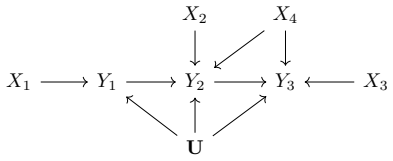
PLACID uses distance correlation to find which external variables are related to which primary variables, then peels off leaf nodes to learn the ancestral graph. Even when some instruments act on multiple variables, the method builds surrogate instruments from the candidate set; these are functions, such as centered products, that are orthogonal to the problematic parts. Moment equations involving these surrogates identify the direct causal effects one path length at a time, and generalized method of moments estimates them. The authors prove consistency, asymptotic normality, and false discovery rate control, and simulations show PLACID outperforming linear competitors.
The discrete-instrument version is the cleanest and most relevant for SNP data. For continuous instruments, the paper approximates an infinite-dimensional surrogate space with a finite basis but does not provide conditions that make the approximation error vanish, so the asymptotic guarantees are not fully supported in that setting. No code is provided, and some tuning choices are unspecified.
Extended reading notes
Core claim
Theorem 1 states that under Assumptions 1-4, the edge set E and causal parameters {β*_ij} in model (2) are identifiable. The paper further claims PLACID consistently learns ancestral relations and candidate IV sets (Theorem 2), produces asymptotically normal estimates (Theorem 3), and controls FDR in edge recovery (Theorem 4). If the paper is correct, practitioners can estimate direct causal effects among observed variables with hidden confounders and invalid instruments without specifying the functional form of instrument effects.
Load-bearing premise
The unstated condition that the finite basis chosen to approximate the infinite-dimensional surrogate space Zγ(XcaG(k)) is dense enough and truncated so that GMM bias vanishes is load-bearing for continuous instruments. The text defines Zγ as an infinite-dimensional Hilbert space for continuous X and then Algorithm 2 uses a finite set of polynomial tensor products; Theorem 3 gives no growth or approximation conditions, so if the truncation error does not vanish, the claimed asymptotic normality and FDR control do not follow. This is a tooling assumption distinct from the identification claim, which only asserts existence of a unique solution.
Signed reviews
Editorial analysis
A structured set of objections, weighed in public.
Assumptions & free parameters
free parameters (3)
- γ (minimum number of valid IVs per primary variable)
- Distance-correlation significance level α
- Finite basis set and dimension for continuous X
assumptions (7)
- domain assumption Partially linear SEM: Y_j = Σ β*_ij Y_i + g_j(X_inG(j)) + ε_j, X⊥⊥ε_j, and no edges from Y to X.
- domain assumption Assumption 1: candidate IVs are mutually independent.
- domain assumption Assumption 2: faithfulness when X intervenes on an unmediated parent.
- domain assumption Assumption 3: at least γ valid IVs per primary variable.
- domain assumption Assumption 4: surrogate IV relevance, ||E{Zγ Y_k}||_0 > 0.
- standard math Standard asymptotic results for distance correlation and GMM from Székely et al. (2007), Hall (2005), and Hansen (1982).
- domain assumption Regularity conditions B.1-B.8 for GMM inference.
Cite this review
Pith. "Pith review of Semiparametric Causal Discovery and Inference with Invalid Instruments." pith.science (2026). https://pith.science/paper/FYBSAVIV
@misc{pith2026250412085,
  author       = {Pith},
  title        = {Pith review of: Semiparametric Causal Discovery and Inference with Invalid Instruments},
  year         = {2026},
  howpublished = {\url{https://pith.science/paper/FYBSAVIV}},
  note         = {Machine review of arXiv:2504.12085}
}
read the original abstract
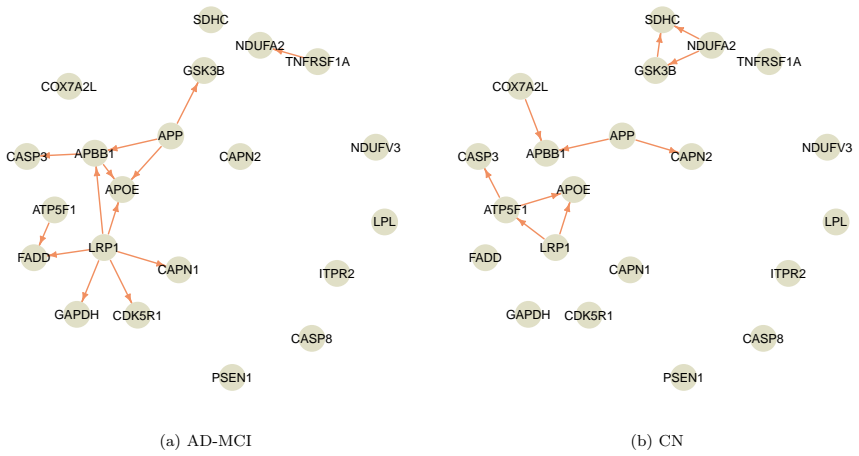
Learning causal relationships among a set of variables, as encoded by a directed acyclic graph, from observational data is complicated by the presence of unobserved confounders. Instrumental variables (IVs) are a popular remedy for this issue, but most existing methods either assume the validity of all IVs or postulate a specific form of relationship, such as a linear model, between the primary variables and the IVs. To overcome these limitations, we introduce a partially linear structural equation model for causal discovery and inference that accommodates potentially invalid IVs and allows for general dependence of the primary variables on the IVs. We establish identification under this semiparametric model by constructing surrogate valid IVs, and develop a finite-sample procedure for estimating the causal structures and effects. Theoretically, we show that our procedure consistently learns the causal structures, yields asymptotically normal estimates, and effectively controls the false discovery rate in edge recovery. Simulation studies demonstrate the superiority of our method over existing competitors, and an application to inferring gene regulatory networks in Alzheimer's disease illustrates its usefulness.
Figures

Figures from the paper (1 more)

Reference graph
Works this paper leans on
-
[1]
Agrawal, R., Squires, C., Prasad, N., and Uhler, C. (2023). The DeCAMFounder : Nonlinear causal discovery in the presence of hidden variables. Journal of the Royal Statistical Society, Series B , 85(5):1639--1658
work page 2023
-
[2]
D., Imbens, G
Angrist, J. D., Imbens, G. W., and Rubin, D. B. (1996). Identification of causal effects using instrumental variables. Journal of the American statistical Association , 91(434):444--455
1996
-
[3]
Baiocchi, M., Cheng, J., and Small, D. S. (2014). Instrumental variable methods for causal inference. Statistics in Medicine , 33(13):2297--2340
2014
-
[4]
Barab \'a si, A.-L., Gulbahce, N., and Loscalzo, J. (2011). Network medicine: A network-based approach to human disease. Nature Reviews Genetics , 12(1):56--68
work page 2011
-
[5]
and Yekutieli, D
Benjamini, Y. and Yekutieli, D. (2001). The control of the false discovery rate in multiple testing under dependency. The Annals of Statistics , 29(4):1165--1188
2001
-
[6]
Bloom, G. S. (2014). Amyloid- and tau: The trigger and bullet in A lzheimer disease pathogenesis. JAMA Neurology , 71(4):505--508
work page 2014
-
[7]
Bowden, J., Davey Smith, G., and Burgess, S. (2015). Mendelian randomization with invalid instruments: effect estimation and bias detection through egger regression. International Journal of Epidemiology , 44(2):512--525
work page 2015
-
[8]
Bowden, J., Davey Smith, G., Haycock, P. C., and Burgess, S. (2016). Consistent estimation in M endelian randomization with some invalid instruments using a weighted median estimator. Genetic Epidemiology , 40(4):304--314
work page 2016
Show all 71 references
-
[9]
C., Walker, I., and Glocker, B
Castro, D. C., Walker, I., and Glocker, B. (2020). Causality matters in medical imaging. Nature Communications , 11:3673
2020
-
[10]
A., and Willsky, A
Chandrasekaran, V., Parrilo, P. A., and Willsky, A. S. (2012). Latent variable graphical model selection via convex optimization. The Annals of Statistics , 40(4):1935--1967
2012
-
[11]
Chen, C., Ren, M., Zhang, M., and Zhang, D. (2018). A two-stage penalized least squares method for constructing large systems of structural equations. Journal of Machine Learning Research , 19(2):1--34
2018
-
[12]
L., and Lewis, G
Chen, J., Chen, D. L., and Lewis, G. (2020). Mostly harmless machine learning: Learning optimal instruments in linear IV models. In NeurIPS Workshop on Machine Learning for Economic Policy
2020
-
[13]
Chen, L., Li, C., Shen, X., and Pan, W. (2024). Discovery and inference of a causal network with hidden confounding. Journal of the American Statistical Association , 119(548):2572--2584
2024
-
[14]
Chen, S., Lin, Z., Shen, X., Li, L., and Pan, W. (2023). Inference of causal metabolite networks in the presence of invalid instrumental variables with GWAS summary data. Genetic Epidemiology , 47(8):585--599
2023
-
[15]
H., Kim, Y
Choi, S. H., Kim, Y. H., Hebisch, M., Sliwinski, C., Lee, S., D'Avanzo, C., Chen, H., Hooli, B., Asselin, C., Muffat, J., Klee, J. B., Zhang, C., Wainger, B. J., Peitz, M., Kovacs, D. M., Woolf, C. J., Wagner, S. L., Tanzi, R. E., and Kim, D. Y. (2014). A three-dimensional hum...
2014
-
[16]
Clarke, P. S. and Windmeijer, F. (2012). Instrumental variable estimators for binary outcomes. Journal of the American Statistical Association , 107(500):1638--1652
2012
-
[17]
H., Kalisch, M., and Richardson, T
Colombo, D., Maathuis, M. H., Kalisch, M., and Richardson, T. S. (2012). Learning high-dimensional directed acyclic graphs with latent and selection variables. The Annals of Statistics , 40(1):294--321
2012
-
[18]
Cook, R. D. (1993). Exploring partial residual plots. Technometrics , 35(4):351--362
1993
-
[19]
Didelez, V., Meng, S., and Sheehan, N. A. (2010). Assumptions of IV methods for observational epidemiology. Statistical Science , 25(1):22--40
2010
-
[20]
Dominici, F., McDermott, A., and Hastie, T. J. (2004). Improved semiparametric time series models of air pollution and mortality. Journal of the American Statistical Association , 99(468):938--948
2004
-
[21]
and B \"u hlmann, P
Emmenegger, C. and B \"u hlmann, P. (2021). Regularizing double machine learning in partially linear endogenous models. Electronic Journal of Statistics , 15(2):6461--6543
2021
-
[22]
F., Granger, C
Engle, R. F., Granger, C. W. J., Rice, J., and Weiss, A. (1986). Semiparametric estimates of the relation between weather and electricity sales. Journal of the American statistical Association , 81(394):310--320
1986
-
[23]
Florens, J.-P., Johannes, J., and Van Bellegem, S. (2012). Instrumental regression in partially linear models. The Econometrics Journal , 15(2):304--324
2012
-
[24]
Frot, B., Nandy, P., and Maathuis, M. H. (2019). Robust causal structure learning with some hidden variables. Journal of the Royal Statistical Society, Series B , 81(3):459--487
2019
-
[25]
Glymour, C., Zhang, K., and Spirtes, P. (2019). Review of causal discovery methods based on graphical models. Frontiers in Genetics , 10:524
2019
-
[26]
P., Rohrer, J
Grosz, M. P., Rohrer, J. M., and Thoemmes, F. (2020). The taboo against explicit causal inference in nonexperimental psychology. Perspectives on Psychological Science , 15(5):1243--1255
2020
-
[27]
T., and Small, D
Guo, Z., Kang, H., Cai, T. T., and Small, D. S. (2018). Confidence intervals for causal effects with invalid instruments by using two-stage hard thresholding with voting. Journal of the Royal Statistical Society, Series B , 80(4):793--815
2018
-
[28]
Hall, A. R. (2005). Generalized Method of Moments . Oxford University Press
2005
-
[29]
Hansen, L. P. (1982). Large sample properties of generalized method of moments estimators. Econometrica , 50(4):1029--1054
1982
-
[30]
P., Davey Smith, G., and Bowden, J
Hartwig, F. P., Davey Smith, G., and Bowden, J. (2017). Robust inference in summary data M endelian randomization via the zero modal pleiotropy assumption. International Journal of Epidemiology , 46(6):1985--1998
2017
-
[31]
H., and Meinshausen, N
Heinze-Deml, C., Maathuis, M. H., and Meinshausen, N. (2018). Causal structure learning. Annual Review of Statistics and Its Application , 5:371--391
2018
-
[32]
Hemani, G., Tilling, K., and Davey Smith, G. (2017). Orienting the causal relationship between imprecisely measured traits using GWAS summary data. PLoS Genetics , 13(11):e1007081
2017
-
[33]
Hines, O., Vansteelandt, S., and Diaz-Ordaz, K. (2021). Robust inference for mediated effects in partially linear models. Psychometrika , 86(2):595--618
2021
-
[34]
T., and Small, D
Kang, H., Zhang, A., Cai, T. T., and Small, D. S. (2016). Instrumental variables estimation with some invalid instruments and its application to M endelian randomization. Journal of the American Statistical Association , 111(513):132--144
2016
-
[35]
Koles \'a r, M., Chetty, R., Friedman, J., Glaeser, E., and Imbens, G. W. (2015). Identification and inference with many invalid instruments. Journal of Business & Economic Statistics , 33(4):474--484
2015
-
[36]
Li, C., Shen, X., and Pan, W. (2023). Inference for a large directed acyclic graph with unspecified interventions. Journal of Machine Learning Research , 24(73):1--48
2023
-
[37]
Li, C., Shen, X., and Pan, W. (2024). Nonlinear causal discovery with confounders. Journal of the American Statistical Association , 119(546):1205--1214
2024
-
[38]
Li, R., Zhong, W., and Zhu, L. (2012). Feature screening via distance correlation learning. Journal of the American Statistical Association , 107(499):1129--1139
2012
-
[39]
M., and Carroll, R
Liang, H., Wang, S., Robins, J. M., and Carroll, R. J. (2004). Estimation in partially linear models with missing covariates. Journal of the American Statistical Association , 99(466):357--367
2004
-
[40]
V., Zhang, J., Hoe, H.-S., Wang, B., Cole, S
Liu, Q., Zerbinatti, C. V., Zhang, J., Hoe, H.-S., Wang, B., Cole, S. L., Herz, J., Muglia, L., and Bu, G. (2007). Amyloid precursor protein regulates brain apolipoprotein E and cholesterol metabolism through lipoprotein receptor LRP1 . Neuron , 56(1):66--78
2007
-
[41]
and Danks, D
Malinsky, D. and Danks, D. (2018). Causal discovery algorithms: A practical guide. Philosophy Compass , 13(1):e12470
2018
-
[42]
C., Keller, M
Neto, E. C., Keller, M. P., Attie, A. D., and Yandell, B. S. (2010). Causal graphical models in systems genetics: A unified framework for joint inference of causal network and genetic architecture for correlated phenotypes. The Annals of Applied Statistics , 4(1):320--339
2010
-
[43]
Newey, W. K. (1990). Efficient instrumental variables estimation of nonlinear models. Econometrica , 58(4):809--837
1990
-
[44]
Newey, W. K. (1993). Efficient estimation of models with conditional moment restrictions. In Econometrics , volume 11 of Handbook of Statistics , pages 419--454. North-Holland, Amsterdam
1993
-
[45]
Newey, W. K. and Powell, J. L. (2003). Instrumental variable estimation of nonparametric models. Econometrica , 71(5):1565--1578
2003
-
[46]
J., Smith, J
Oates, C. J., Smith, J. Q., and Mukherjee, S. (2016). Estimating causal structure using conditional DAG models. Journal of Machine Learning Research , 17(54):1--23
2016
-
[47]
O'Brien, R. J. and Wong, P. C. (2011). Amyloid precursor protein processing and A lzheimer's disease. Annual Review of Neuroscience , 34:185--204
2011
-
[48]
A., Delaneau, O., Panousis, N
Ongen, H., Brown, A. A., Delaneau, O., Panousis, N. I., Nica, A. C., Consortium, G., and Dermitzakis, E. T. (2017). Estimating the causal tissues for complex traits and diseases. Nature Genetics , 49(12):1676--1683
2017
-
[49]
Pearl, J. (2009). Causality: Models, Reasoning, and Inference . Cambridge University Press, Cambridge, 2nd edition
2009
-
[50]
Peters, J., Janzing, D., and Sch \"o lkopf, B. (2017). Elements of Causal Inference: Foundations and Learning Algorithms . MIT Press, Cambridge, MA
2017
-
[51]
Purcell, S., Neale, B., Todd-Brown, K., Thomas, L., Ferreira, M. A. R., Bender, D., Maller, J., Sklar, P., de Bakker, P. I. W., Daly, M. J., and Sham, P. C. (2007). PLINK : A tool set for whole-genome association and population-based linkage analyses. American Journal of Human...
2007
-
[52]
N., Luna, G., Guzman, E., Audouard, M., Challis, C., Sibih, Y
Rauch, J. N., Luna, G., Guzman, E., Audouard, M., Challis, C., Sibih, Y. E., Leshuk, C., Hernandez, I., Wegmann, S., Hyman, B. T., Gradinaru, V., Kampmann, M., and Kosik, K. S. (2020). LRP1 is a master regulator of tau uptake and spread. Nature , 580(7803):381--385
2020
-
[53]
M., Mark, S
Robins, J. M., Mark, S. D., and Newey, W. K. (1992). Estimating exposure effects by modelling the expectation of exposure conditional on confounders. Biometrics , 48(2):479--495
1992
-
[54]
Robinson, P. M. (1988). Root- N -consistent semiparametric regression. Econometrica , 56(4):931--954
1988
-
[55]
a usler, D., Ernest, J., and B \
Rothenh \"a usler, D., Ernest, J., and B \"u hlmann, P. (2018). Causal inference in partially linear structural equation models. The Annals of Statistics , 46(6A):2904--2938
2018
-
[56]
Runge, J., Nowack, P., Kretschmer, M., Flaxman, S., and Sejdinovic, D. (2019). Detecting and quantifying causal associations in large nonlinear time series datasets. Science Advances , 5(11):eaau4996
2019
-
[57]
Serrano-Pozo, A., Das, S., and Hyman, B. T. (2021). APOE and A lzheimer's disease: Advances in genetics, pathophysiology, and therapeutic approaches. The Lancet Neurology , 20(1):68--80
2021
-
[58]
Spirtes, P., Glymour, C., and Scheines, R. (2001). Causation, Prediction, and Search . MIT Press, Cambridge, MA, 2nd edition
2001
-
[59]
E., Meister, S., Nahrath, J., Mei ner, J
Storck, S. E., Meister, S., Nahrath, J., Mei ner, J. N., Schubert, N., Di Spiezio, A., Baches, S., Vandenbroucke, R. E., Bouter, Y., Prikulis, I., Korth, C., Weggen, S., Heimann, A., Schwaninger, M., Bayer, T. A., and Pietrzik, C. U. (2016). Endothelial LRP1 transports amyloid...
2016
-
[60]
Sun, B., Liu, Z., and Tchetgen Tchetgen, E. J. (2023). Semiparametric efficient G -estimation with invalid instrumental variables. Biometrika , 110(4):953--971
2023
-
[61]
J., Rizzo, M
Sz \'e kely, G. J., Rizzo, M. L., and Bakirov, N. K. (2007). Measuring and testing dependence by correlation of distances. The Annals of Statistics , 35(6):2769--2794
2007
-
[62]
J., Robins, J
Tchetgen Tchetgen, E. J., Robins, J. M., and Rotnitzky, A. (2010). On doubly robust estimation in a semiparametric odds ratio model. Biometrika , 97(1):171--180
2010
-
[63]
Triantafillou, S., Lagani, V., Heinze-Deml, C., Schmidt, A., Tegner, J., and Tsamardinos, I. (2017). Predicting causal relationships from biological data: Applying automated causal discovery on mass cytometry data of human immune cells. Scientific Reports , 7:12724
2017
-
[64]
and Joffe, M
Vansteelandt, S. and Joffe, M. (2014). Structural nested models and G -estimation: The partially realized promise. Statistical Science , 29(4):707--731
2014
-
[65]
J., Camgoz, N
Vowels, M. J., Camgoz, N. C., and Bowden, R. (2022). D’ya like DAG s? A survey on structure learning and causal discovery. ACM Computing Surveys , 55(4):82
2022
-
[66]
Wang, X., Pan, W., Hu, W., Tian, Y., and Zhang, H. (2015). Conditional distance correlation. Journal of the American Statistical Association , 110(512):1726--1734
2015
-
[67]
Windmeijer, F., Farbmacher, H., Davies, N., and Davey Smith, G. (2019). On the use of the L asso for instrumental variables estimation with some invalid instruments. Journal of the American Statistical Association , 114(527):1339--1350
2019
-
[68]
and Pan, W
Xue, H. and Pan, W. (2020). Inferring causal direction between two traits in the presence of horizontal pleiotropy with GWAS summary data. PLOS Genetics , 16(11):e1009105
2020
-
[69]
Ye, T., Shao, J., and Kang, H. (2021). Debiased inverse-variance weighted estimator in two-sample summary-data M endelian randomization. The Annals of Statistics , 49(4):2079--2100
2021
-
[70]
Zhao, Q., Wang, J., Hemani, G., Bowden, J., and Small, D. S. (2020). Statistical inference in two-sample summary-data M endelian randomization using robust adjusted profile score. The Annals of Statistics , 48(3):1742--1769
2020
-
[71]
Zilinskas, R., Li, C., Shen, X., Pan, W., and Yang, T. (2024). Inferring a directed acyclic graph of phenotypes from GWAS summary statistics. Biometrics , 80(1):ujad039
2024
Reviewed August 16, 2026 · model on record in the stance chip above.
Discussion (0). Continue with ORCID to comment.