REVIEW 2 major objections 5 minor 68 references
Deep Generative Models for Bayesian Inference on High-Rate Sensor Data: Applications in Automotive Radar and Medical Imaging
T0 review · 2 major / 5 minor · reviewed 2026-08-16 · deepseek-v4-flash
Pith's one-line read A review of deep generative model techniques for Bayesian inverse problems in high-rate sensor data, covering structured noise, companding, model-based scores, and acceleration methods.
desk verdict A competent but heavily self-referential review of DGM-based Bayesian inference for radar and ultrasound; the synthesis is useful, but Eq (3.8) mixes domains and the core independence assumption needs a critical paragraph. read the letter →
The pith
A machine-rendered reading of the paper's core claim, the machinery that carries it, and where it could break.
The reading
The main examples are ultrasound imaging, where multipath reflections create a hazy look; automotive radar, where other cars' radar signals interfere; and MRI, where choosing which k-space lines to measure can speed up scans. The paper does not run new experiments. It describes methods from earlier papers, many by the same research group, and organizes them around two challenges: model mismatch, when the math model does not match reality, and real-time speed.
If the described methods work as claimed, they could eventually make medical imaging and self-driving car sensors faster and more reliable while using less data. But the evidence here is mostly taken from previous publications, and one key equation about companding appears to mix mathematical domains, so a careful reader should check the original sources before relying on the details.
Extended reading notes
Core claim
Central assertion: the direct application of natural-image generative models to raw sensor data is not straightforward, and the resulting challenges (high dynamic range, model mismatch, latency) can be addressed by the surveyed techniques: joint posterior sampling with learned structured-noise priors, companding of RF data, model-based score functions, temporal initialization, deep unfolding, and active compressed sensing. Stated in the abstract: 'we will discuss some of these challenges and offer approaches to address them, all in the context of high-rate real-time sensing applications in automotive radar and medical imaging.' If the paper is correct, these techniques extend DGM-based Bayesian posterior sampling to real-time automotive radar and medical ultrasound/MRI.
Load-bearing premise
The load-bearing premise is that structured noise n is statistically independent of the signal x. Introduced in Section 2(a) after Eq (2.1): 'Given the complexity of capturing potential dependencies between n and x, we assume independence, i.e., p(n|x) ≈ p(n) and instead learn the marginal distribution p(n) in a fully data-driven fashion.' This premise is required for the factorized joint posterior in Eq (3.1) and the coupled reverse diffusion in Eq (3.2). If multipath or interference depends on the scene x, the learned marginal prior p(n) is misspecified and the posterior samples are biased.
Signed reviews
Editorial analysis
A structured set of objections, weighed in public.
Referee Report
Summary. The manuscript is a review of deep generative model (DGM) based Bayesian inference for high-rate sensor data, with applications to automotive radar and medical imaging. It introduces a forward model y = Ax + n + ε, reviews score-based diffusion posterior sampling via Tweedie's formula, and then discusses three classes of methods for model mismatch: modeling structured noise with separate DGMs, companding to handle high dynamic range, and model-based score functions. It also reviews acceleration strategies (temporal initialization, deep unfolding, knowledge distillation) and active compressed sensing. The central claim is that these techniques make DGM-based posterior sampling applicable to real-time sensing, illustrated with ultrasound multipath dehazing, radar interference mitigation, and accelerated MRI.
Significance. The paper's background derivation of posterior sampling is clean and the survey of active compressed sensing covers several recent external methods, which gives it value as a structured introduction to the area. If the reviewed techniques are correct, they would indeed extend DGM-based Bayesian inference to high-rate sensing. However, the technical credibility of the main model-mismatch framework is undermined by a factorized joint posterior that relies on an independence assumption the paper itself contradicts for the ultrasound example, and by an algebraic error in the companding likelihood (Eq. (3.8)). These issues are fixable, but they are load-bearing for the paper's central claims.
major comments (2)
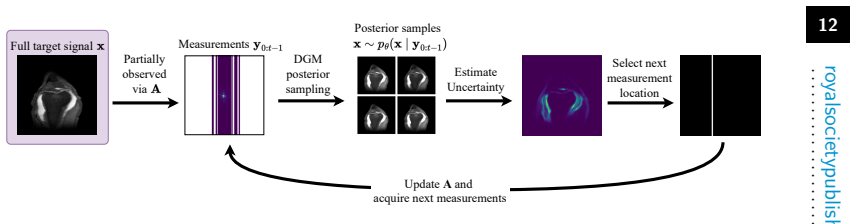
- [Section 2(a), Eq. (3.1), Box 3.1] The structured-noise framework assumes p(n|x) ≈ p(n) and learns only the marginal p(n), which is what justifies the factorized joint posterior in Eq. (3.1) and the coupled reverse-time SDEs in Eqs. (3.3)-(3.4). However, Section 2(a) itself states that in ultrasound multipath scattering, 'n is inherently a function of x', and Box 3.1 models clutter and multipath components as n generated by the same transmitted pulse. In this regime the independence assumption is misspecified: unpaired training of separate score models s_θ(x_τ) and s_ϕ(n_τ) captures only marginals, and the likelihood term must carry the full burden of enforcing consistency. The manuscript does not analyze the resulting bias in posterior samples, nor does it provide any calibration or validation study for exactly the multipath regime where the assumption is invoked. Since this framework is also used for radar interference mitigation, this concern is load-bearing for the claim that the surveyed techniques address model mismatch.
- [Section 3(b), Eq. (3.8)] The second equality in Eq. (3.8), C(A x_RF,0|τ + n_RF,0|τ) = C(C^{-1}(A x_{0|τ}) + C^{-1}(n_{0|τ})), is not correct. The companding functions C and C^{-1} act elementwise on RF-domain vectors, while A x_{0|τ} is a measurement-domain vector; applying C^{-1} to A x_{0|τ} is not a defined operation in this setup, and A and C^{-1} do not commute (A C^{-1}(x) ≠ C^{-1}(A x) in general). Moreover, if y in Eq. (3.7) is the raw RF measurement, the likelihood residual should be y - (A C^{-1}(x_{0|τ}) + C^{-1}(n_{0|τ})), not y - C(A C^{-1}(x_{0|τ}) + C^{-1}(n_{0|τ})). This invalidates the data consistency term used to produce the ultrasound results in Fig. 2 unless the variables are redefined and the derivation is corrected.
minor comments (5)
- [Section 3(b), Eq. (3.7)] The gradient on the right-hand side of Eq. (3.7) should be with respect to both x_τ and n_τ, not only x_τ; as written, the update for n_τ is undefined.
- [Section 3(b)] The notation x_RF,0|τ and x_{0|τ} is introduced without clearly stating whether these are Tweedie estimates in the RF domain or in the companded domain; please define both explicitly before Eq. (3.8).
- [Section 4(b), AdaSense paragraph] The text refers to 'principle components' of the posterior covariance; this should be 'principal components'.
- [Box 3.1] The phrase 'hundreds or thousands Gigabits per second' should be 'hundreds or thousands of gigabits per second'.
- [Section 4(a)(iii)] Knowledge distillation is described as a promising acceleration method, but no sensing-specific example or reference to high-rate sensing applications is given; the review should either provide one or explicitly state that this remains future work.
Assumptions & free parameters
free parameters (2)
- mu (companding parameter) =
hand-chosen, e.g., 255 or 50
- lambda_tau (sparsity penalty schedule) =
time-step dependent, hand-tuned
assumptions (5)
- domain assumption Structured noise n is independent of the signal x, i.e., p(n|x) ≈ p(n)
- domain assumption Thermal noise is additive white Gaussian with known variance σ²_ε
- standard math Tweedie's formula gives the MMSE estimate x0|τ from the score
- standard math Reverse-time SDE with substituted score yields samples from the posterior
- domain assumption Learned score functions sθ and sφ are accurate enough for posterior sampling
Cite this review
Pith. "Pith review of Deep Generative Models for Bayesian Inference on High-Rate Sensor Data: Applications in Automotive Radar and Medical Imaging." pith.science (2026). https://pith.science/paper/FZOEPIIY
@misc{pith2026250412154,
  author       = {Pith},
  title        = {Pith review of: Deep Generative Models for Bayesian Inference on High-Rate Sensor Data: Applications in Automotive Radar and Medical Imaging},
  year         = {2026},
  howpublished = {\url{https://pith.science/paper/FZOEPIIY}},
  note         = {Machine review of arXiv:2504.12154}
}
read the original abstract
Deep generative models have been studied and developed primarily in the context of natural images and computer vision. This has spurred the development of (Bayesian) methods that use these generative models for inverse problems in image restoration, such as denoising, inpainting, and super-resolution. In recent years, generative modeling for Bayesian inference on sensory data has also gained traction. Nevertheless, the direct application of generative modeling techniques initially designed for natural images on raw sensory data is not straightforward, requiring solutions that deal with high dynamic range signals acquired from multiple sensors or arrays of sensors that interfere with each other, and that typically acquire data at a very high rate. Moreover, the exact physical data-generating process is often complex or unknown. As a consequence, approximate models are used, resulting in discrepancies between model predictions and the observations that are non-Gaussian, in turn complicating the Bayesian inverse problem. Finally, sensor data is often used in real-time processing or decision-making systems, imposing stringent requirements on, e.g., latency and throughput. In this paper, we will discuss some of these challenges and offer approaches to address them, all in the context of high-rate real-time sensing applications in automotive radar and medical imaging.
Figures


Figures from the paper (2 more)

Reference graph
Works this paper leans on
-
[1]
2018 fastMRI: An open dataset and benchmarks for accelerated MRI
Zbontar J, Knoll F, Sriram A, Murrell T, Huang Z, Muckley MJ, Defazio A, Stern R, Johnson P, Bruno M et al.. 2018 fastMRI: An open dataset and benchmarks for accelerated MRI. arXiv preprint arXiv:1811.08839
arXiv 2018
-
[2]
2019 Deep learning in ultrasound imaging.Proceedings of the IEEE 108, 11–29
Van Sloun RJ, Cohen R, Eldar YC. 2019 Deep learning in ultrasound imaging.Proceedings of the IEEE 108, 11–29
work page 2019
-
[3]
Doris K, Filippi A, Jansen F. 2022 Reframing Fast-Chirp FMCW Transceivers for Future Automotive Radar: The pathway to higher resolution.IEEE Solid-State Circuits Magazine 14, 44–55
work page 2022
-
[4]
2022 Score-based diffusion models for accelerated MRI.Medical image analysis 80, 102479
Chung H, Ye JC. 2022 Score-based diffusion models for accelerated MRI.Medical image analysis 80, 102479
work page 2022
-
[5]
2022 High-resolution image synthesis with latent diffusion models
Rombach R, Blattmann A, Lorenz D, Esser P, Ommer B. 2022 High-resolution image synthesis with latent diffusion models. In Proceedings of the IEEE/CVF conference on computer vision and pattern recognition pp. 10684–10695
work page 2022
-
[6]
2024 The llama 3 herd of models.arXiv preprint arXiv:2407.21783
Dubey A, Jauhri A, Pandey A, Kadian A, Al-Dahle A, Letman A, Mathur A, Schelten A, Yang A, Fan A et al.. 2024 The llama 3 herd of models.arXiv preprint arXiv:2407.21783
arXiv 2024
-
[7]
2006 Near-optimal signal recovery from random projections: Universal encoding strategies?
Candes EJ, Tao T. 2006 Near-optimal signal recovery from random projections: Universal encoding strategies?. IEEE transactions on information theory 52, 5406–5425
work page 2006
-
[8]
2012 Compressed sensing: theory and applications
Eldar YC, Kutyniok G. 2012 Compressed sensing: theory and applications . Cambridge university press
work page 2012
Show all 68 references
-
[9]
2015Sampling theory: Beyond bandlimited systems
Eldar YC. 2015Sampling theory: Beyond bandlimited systems . Cambridge University Press
-
[10]
2018 A systematic review of compressive sensing: Concepts, implementations and applications.IEEE access 6, 4875–4894
Rani M, Dhok SB, Deshmukh RB. 2018 A systematic review of compressive sensing: Concepts, implementations and applications.IEEE access 6, 4875–4894
2018
-
[11]
2014 Fourier-domain beamforming: the path to compressed ultrasound imaging
Chernyakova T, Eldar YC. 2014 Fourier-domain beamforming: the path to compressed ultrasound imaging. IEEE transactions on ultrasonics, ferroelectrics, and frequency control 61, 1252–1267
2014
-
[12]
2019 Strategic undersampling and recovery using compressed sensing for enhancing ultrasound image quality
Ramkumar A, Thittai AK. 2019 Strategic undersampling and recovery using compressed sensing for enhancing ultrasound image quality. IEEE Transactions on Ultrasonics, Ferroelectrics, and Frequency Control 67, 547–556
2019
-
[13]
2020 Learning sub-sampling and signal recovery with applications in ultrasound imaging.IEEE Transactions on Medical Imaging 39, 3955–3966
Huijben IA, Veeling BS, Janse K, Mischi M, van Sloun RJ. 2020 Learning sub-sampling and signal recovery with applications in ultrasound imaging.IEEE Transactions on Medical Imaging 39, 3955–3966
2020
-
[14]
2011 Robust recovery of synthetic aperture radar data from uniformly under-sampled measurements
Nguyen LH, Tran TD. 2011 Robust recovery of synthetic aperture radar data from uniformly under-sampled measurements. In2011 IEEE International Geoscience and Remote Sensing Symposium pp. 3554–3557. IEEE. 16royalsocietypublishing.org/journal/rsta Phil. Trans. R. Soc. A 0000000
2011
-
[15]
2018 Sub-Nyquist radar systems: Temporal, spectral, and spatial compression
Cohen D, Eldar YC. 2018 Sub-Nyquist radar systems: Temporal, spectral, and spatial compression. IEEE Signal Processing Magazine 35, 35–58
2018
-
[16]
2019 Compressed sensing MRI: a review from signal processing perspective.BMC Biomedical Engineering 1, 8
Ye JC. 2019 Compressed sensing MRI: a review from signal processing perspective.BMC Biomedical Engineering 1, 8
2019
-
[17]
2023 Model-Based Deep Learning
Shlezinger N, Whang J, Eldar YC, Dimakis AG. 2023 Model-Based Deep Learning. Proceedings of the IEEE 111, 465–499
2023
-
[18]
Gorban AN, Tyukin IY. 2018 Blessing of dimensionality: mathematical foundations of the statistical physics of data.Philosophical Transactions of the Royal Society A: Mathematical, Physical and Engineering Sciences 376, 20170237
2018
-
[19]
2013 Auto-encoding variational bayes.arXiv preprint arXiv:1312.6114
Kingma DP. 2013 Auto-encoding variational bayes.arXiv preprint arXiv:1312.6114
2013 arXiv
-
[20]
2014 Generative adversarial nets
Goodfellow I, Pouget-Abadie J, Mirza M, Xu B, Warde-Farley D, Ozair S, Courville A, Bengio Y. 2014 Generative adversarial nets. Advances in neural information processing systems 27
2014
-
[21]
2018 Glow: Generative flow with invertible 1x1 convolutions
Kingma DP, Dhariwal P. 2018 Glow: Generative flow with invertible 1x1 convolutions. Advances in neural information processing systems 31
2018
-
[22]
2020 Score-Based Generative Modeling through Stochastic Differential Equations
Song Y, Sohl-Dickstein J, Kingma DP, Kumar A, Ermon S, Poole B. 2020 Score-Based Generative Modeling through Stochastic Differential Equations. InInternational Conference on Learning Representations
2020
-
[23]
Advances in neural information processing systems 32
SongY,Ermon S.2019Generativemodeling byestimating gradientsofthe datadistribution. Advances in neural information processing systems 32
-
[24]
2024 A regularized conditional GAN for posterior sampling in image recovery problems.Advances in Neural Information Processing Systems 36
Bendel M, Ahmad R, Schniter P. 2024 A regularized conditional GAN for posterior sampling in image recovery problems.Advances in Neural Information Processing Systems 36
2024
-
[25]
2023 Pseudoinverse-guided diffusion models for inverse problems
Song J, Vahdat A, Mardani M, Kautz J. 2023 Pseudoinverse-guided diffusion models for inverse problems. InInternational Conference on Learning Representations
2023
-
[26]
2023 A variational perspective on solving inverse problems with diffusion models.arXiv preprint arXiv:2305.04391
Mardani M, Song J, Kautz J, Vahdat A. 2023 A variational perspective on solving inverse problems with diffusion models.arXiv preprint arXiv:2305.04391
2023 arXiv
-
[27]
2024 A survey on diffusion models for inverse problems.arXiv preprint arXiv:2410.00083
Daras G, Chung H, Lai CH, Mitsufuji Y, Ye JC, Milanfar P, Dimakis AG, Delbracio M. 2024 A survey on diffusion models for inverse problems.arXiv preprint arXiv:2410.00083
2024 arXiv
-
[28]
2022 Diffusion posterior sampling for general noisy inverse problems.arXiv preprint arXiv:2209.14687
Chung H, Kim J, Mccann MT, Klasky ML, Ye JC. 2022 Diffusion posterior sampling for general noisy inverse problems.arXiv preprint arXiv:2209.14687
2022 arXiv
-
[29]
2011 Tweedie’s formula and selection bias.Journal of the American Statistical Association 106, 1602–1614
Efron B. 2011 Tweedie’s formula and selection bias.Journal of the American Statistical Association 106, 1602–1614
2011
-
[30]
2024 Denoising: A powerful building-block for imaging, inverse problems, and machine learning.arXiv preprint arXiv:2409.06219
Milanfar P, Delbracio M. 2024 Denoising: A powerful building-block for imaging, inverse problems, and machine learning.arXiv preprint arXiv:2409.06219
2024 arXiv
-
[31]
2024 Model-Based Diffusion for Mitigating Automotive Radar Interference
Overdevest J, Wei X, van Gorp H, van Sloun RJG. 2024 Model-Based Diffusion for Mitigating Automotive Radar Interference. In 2024 IEEE International Conference on Acoustics, Speech, and Signal Processing Workshops (ICASSPW) pp. 284–288
2024
-
[32]
2024 Dehazing Ultrasound using Diffusion Models.IEEE Transactions on Medical Imaging pp
Stevens TSW, Meral FC, Yu J, Apostolakis IZ, Robert JL, Van Sloun RJ. 2024 Dehazing Ultrasound using Diffusion Models.IEEE Transactions on Medical Imaging pp. 1–1
2024
-
[33]
StevensTSW,vanGorpH,MeralFC,ShinJ,YuJ,RobertJL,vanSlounRJ.2025Removing Structured Noise using Diffusion Models.Transactions on Machine Learning Research
-
[34]
2021 Compressed ultrasound imaging: From sub-Nyquist rates to super resolution.IEEE BITS the information theory magazine 1, 27–44
Drori O, Mamistvalov A, Solomon O, Eldar YC. 2021 Compressed ultrasound imaging: From sub-Nyquist rates to super resolution.IEEE BITS the information theory magazine 1, 27–44
2021
-
[35]
2019 The generalized contrast-to-noise ratio: A formal definition for lesion detectability
Rodriguez-Molares A, Rindal OMH, D’hooge J, Måsøy SE, Austeng A, Bell MAL, Torp H. 2019 The generalized contrast-to-noise ratio: A formal definition for lesion detectability. IEEE transactions on ultrasonics, ferroelectrics, and frequency control 67, 745–759
2019
-
[36]
2025 Unlimited sampling beyond modulo
Azar E, Mulleti S, Eldar YC. 2025 Unlimited sampling beyond modulo. Applied and Computational Harmonic Analysis 74, 101715
2025
-
[37]
2021 Automotive Radar — From First Efforts to Future Systems
Waldschmidt C, Hasch J, Menzel W. 2021 Automotive Radar — From First Efforts to Future Systems. IEEE Journal of Microwaves 1, 135–148
2021
-
[38]
2016 Chirp diversity waveform design and detection by stretch processing
Lulu A, Mobasseri BG. 2016 Chirp diversity waveform design and detection by stretch processing. In 2016 IEEE Radar Conference (RadarConf) pp. 1–6
2016
-
[39]
1991 A stepped chirp technique for range resolution enhancement
McGroary F, Lindell K. 1991 A stepped chirp technique for range resolution enhancement. In NTC ’91 - National Telesystems Conference Proceedings pp. 121–126
1991
-
[40]
2017 Automotive radar interference mitigation using a sparse sampling approach
Bechter J, Roos F, Rahman M, Waldschmidt C. 2017 Automotive radar interference mitigation using a sparse sampling approach. In2017 European Radar Conference (EURAD) pp. 90–93
2017
-
[41]
2020 Automotive Radar Signal Interference Mitigation Using RNN with Self Attention
Mun J, Ha S, Lee J. 2020 Automotive Radar Signal Interference Mitigation Using RNN with Self Attention. InICASSP 2020 - 2020 IEEE International Conference on Acoustics, Speech and Signal Processing (ICASSP) pp. 3802–3806. 17royalsocietypublishing.org/journal/rsta Phil. Trans. ...
2020
-
[42]
2020 Automotive Radar Interference Mitigation using a Convolutional Autoencoder
Fuchs J, Dubey A, Lübke M, Weigel R, Lurz F. 2020 Automotive Radar Interference Mitigation using a Convolutional Autoencoder. In 2020 IEEE International Radar Conference (RADAR) pp. 315–320
2020
-
[43]
2021 Estimating the Magnitude and Phase of Automotive Radar Signals Under Multiple Interference Sources With Fully Convolutional Networks
Ristea NC, Anghel A, Ionescu RT. 2021 Estimating the Magnitude and Phase of Automotive Radar Signals Under Multiple Interference Sources With Fully Convolutional Networks. IEEE Access 9, 153491–153507
2021
-
[44]
2021 Complex-valued convolutional neural networks for enhanced radar signal denoising and interference mitigation
Fuchs A, Rock J, Toth M, Meissner P, Pernkopf F. 2021 Complex-valued convolutional neural networks for enhanced radar signal denoising and interference mitigation. In2021 IEEE Radar Conference (RadarConf21) pp. 1–6. IEEE
2021
-
[45]
2023 Signal Reconstruction for FMCW Radar Interference Mitigation Using Deep Unfolding
Overdevest J, Koppelaar A, Bekooij M, Youn J, Sloun Rv. 2023 Signal Reconstruction for FMCW Radar Interference Mitigation Using Deep Unfolding. InICASSP 2023 - 2023 IEEE International Conference on Acoustics, Speech and Signal Processing (ICASSP) pp. 1–5
2023
-
[46]
2024 Neurally Augmented Deep Unfolding for Automotive Radar Interference Mitigation.IEEE Transactions on Radar Systems 2, 712–724
Overdevest J, Koppelaar AGC, Youn J, Wei X, Sloun RJGv. 2024 Neurally Augmented Deep Unfolding for Automotive Radar Interference Mitigation.IEEE Transactions on Radar Systems 2, 712–724
2024
-
[47]
2025 Sequential Posterior Sampling with Diffusion Models
Stevens TSW, Nolan O, Robert JL, Van Sloun RJ. 2025 Sequential Posterior Sampling with Diffusion Models. In 2025 IEEE International Conference on Acoustics, Speech and Signal Processing (ICASSP) Hyderabad, India
2025
-
[48]
2010 Learning fast approximations of sparse coding
Gregor K, LeCun Y. 2010 Learning fast approximations of sparse coding. InProceedings of the 27th International Conference on International Conference on Machine Learning ICML’10 p. 399–406 Madison, WI, USA. Omnipress
2010
-
[49]
2023 Learning to sample: Data-driven sampling and reconstruction of FRI signals.IEEE Access 11, 71048–71062
Mulleti S, Zhang H, Eldar YC. 2023 Learning to sample: Data-driven sampling and reconstruction of FRI signals.IEEE Access 11, 71048–71062
2023
-
[50]
Li Y, Bar-Shira O, Monga V, Eldar YC. 2023 p. 53–86. InDeep Algorithm Unrolling for Biomedical Imaging, p. 53–86. Cambridge University Press
2023
-
[51]
2022 Deep Unfolding With Normalizing Flow Priors for Inverse Problems.IEEE Transactions on Signal Processing 70, 2962–2971
Wei X, van Gorp H, Gonzalez-Carabarin L, Freedman D, Eldar YC, van Sloun RJG. 2022 Deep Unfolding With Normalizing Flow Priors for Inverse Problems.IEEE Transactions on Signal Processing 70, 2962–2971
2022
-
[52]
2017 Unrolled Generative Adversarial Networks
Metz L, Poole B, Pfau D, Sohl-Dickstein J. 2017 Unrolled Generative Adversarial Networks. arXiv preprint arXiv:1611.02163
2017 arXiv
-
[53]
2019 Compressing gans using knowledge distillation
Aguinaldo A, Chiang PY, Gain A, Patil A, Pearson K, Feizi S. 2019 Compressing gans using knowledge distillation. arXiv preprint arXiv:1902.00159
2019 arXiv
-
[54]
2022 Progressive distillation for fast sampling of diffusion models.arXiv preprint arXiv:2202.00512
Salimans T, Ho J. 2022 Progressive distillation for fast sampling of diffusion models.arXiv preprint arXiv:2202.00512
2022 arXiv
-
[55]
2021 Solving inverse problems in medical imaging with score-based generative models.arXiv preprint arXiv:2111.08005
Song Y, Shen L, Xing L, Ermon S. 2021 Solving inverse problems in medical imaging with score-based generative models.arXiv preprint arXiv:2111.08005
2021 arXiv
-
[56]
2019 Inverse GANs for accelerated MRI reconstruction
Narnhofer D, Hammernik K, Knoll F, Pock T. 2019 Inverse GANs for accelerated MRI reconstruction. In Wavelets and Sparsity XVIII vol. 11138 pp. 381–392. SPIE
2019
-
[57]
2015 Info-greedy sequential adaptive compressed sensing.IEEE Journal of selected topics in signal processing 9, 601–611
Braun G, Pokutta S, Xie Y. 2015 Info-greedy sequential adaptive compressed sensing.IEEE Journal of selected topics in signal processing 9, 601–611
2015
-
[58]
2021 Active deep probabilistic subsampling
Van Gorp H, Huijben I, Veeling BS, Pezzotti N, Van Sloun RJ. 2021 Active deep probabilistic subsampling. In International Conference on Machine Learning pp. 10509–10518. PMLR
2021
-
[59]
2020 Experimental design for MRI by greedy policy search
Bakker T, van Hoof H, Welling M. 2020 Experimental design for MRI by greedy policy search. Advances in Neural Information Processing Systems 33, 18954–18966
2020
-
[60]
2022 Accelerated intravascular ultrasound imaging using deep reinforcement learning
Stevens TSW, Chennakeshava N, de Bruijn FJ, Pekař M, van Sloun RJ. 2022 Accelerated intravascular ultrasound imaging using deep reinforcement learning. InICASSP 2022-2022 IEEE International Conference on Acoustics, Speech and Signal Processing (ICASSP) pp. 1216–1220. IEEE
2022
-
[61]
2020 Uncertainty-driven adaptive sampling via GANs
Sanchez T, Krawczuk I, Sun Z, Cevher V. 2020 Uncertainty-driven adaptive sampling via GANs. In NeurIPS 2020 Workshop on Deep Learning and Inverse Problems
2020
-
[62]
2023 Active Subsampling Using Deep Generative Models by Maximizing Expected Information Gain
van de Camp KC, Joudeh H, Antunes DJ, van Sloun RJ. 2023 Active Subsampling Using Deep Generative Models by Maximizing Expected Information Gain. InICASSP 2023-2023 IEEE International Conference on Acoustics, Speech and Signal Processing (ICASSP) pp. 1–5. IEEE
2023
-
[63]
2017 Improved training of wasserstein gans
Gulrajani I, Ahmed F, Arjovsky M, Dumoulin V, Courville AC. 2017 Improved training of wasserstein gans. Advances in neural information processing systems 30
2017
-
[64]
2007 Approximating the Kullback Leibler divergence between Gaussian mixture models
Hershey JR, Olsen PA. 2007 Approximating the Kullback Leibler divergence between Gaussian mixture models. In 2007 IEEE International Conference on Acoustics, Speech and Signal Processing-ICASSP’07 vol. 4 pp. IV–317. IEEE. 18royalsocietypublishing.org/journal/rsta Phil. Trans. ...
2007
-
[65]
1998 Gradient-based learning applied to document recognition
LeCun Y, Bottou L, Bengio Y, Haffner P. 1998 Gradient-based learning applied to document recognition. Proceedings of the IEEE 86, 2278–2324
1998
-
[66]
2024 Adaptive Compressed Sensing with Diffusion-Based Posterior Sampling
Elata N, Michaeli T, Elad M. 2024 Adaptive Compressed Sensing with Diffusion-Based Posterior Sampling. arXiv preprint arXiv:2407.08256
2024 arXiv
-
[67]
2022 Denoising diffusion restoration models.Advances in Neural Information Processing Systems 35, 23593–23606
Kawar B, Elad M, Ermon S, Song J. 2022 Denoising diffusion restoration models.Advances in Neural Information Processing Systems 35, 23593–23606
2022
-
[68]
2025 Active Diffusion Subsampling
Nolan O, Stevens TSW, van Nierop WL, Sloun RV. 2025 Active Diffusion Subsampling. Transactions on Machine Learning Research
2025
Reviewed August 16, 2026 · model on record in the stance chip above.
Discussion (0). Continue with ORCID to comment.