REVIEW 3 major objections 4 minor 156 references
Insights into environmental quenching at $z\sim1$: an enhancement of faint, low-mass passive galaxies in clusters
T0 review · 3 major / 4 minor · reviewed 2026-08-16 · deepseek-v4-flash
Pith's one-line read At z≈1, galaxy clusters already hold an excess of faint, low-mass dead galaxies.
desk verdict Deeper VLT data reveal the long-sought low-mass upturn in z~1 cluster passive SMFs; the result is robust except for an under-tested photometric shift in the field sample. read the letter →
The pith
A machine-rendered reading of the paper's core claim, the machinery that carries it, and where it could break.
The reading
What carries the argument
The load-bearing machinery is red-sequence selection using two VLT filters ($F_b$, $F_r$) that straddle the 4000Å break at each cluster redshift, isolating galaxies at the cluster redshift without needing photometric redshifts for the faint sources. The cluster and field luminosity/mass functions are measured with kernel density estimation, corrected for completeness through injection-recovery simulations, statistically background-subtracted using an outer annulus, and fit with Schechter functions via MCMC. The comparison that carries the argument is the faint-end slope $\alpha$: a shallower slope in clusters than in the field means relatively more low-mass passive galaxies in clusters.
What would settle it
Measure the passive SMF of the field in the same four narrow redshift slices using a survey that reaches the same depth as the cluster images with filters matched to the VLT bands, or with spectroscopic redshifts for the faint galaxies, bypassing the extrapolated magnitude shift; if the field slope then approaches $\alpha\approx-0.5$ the claimed enhancement vanishes, while if it stays near $\alpha\approx0.1$ the enhancement is confirmed.
Extended reading notes
Core claim
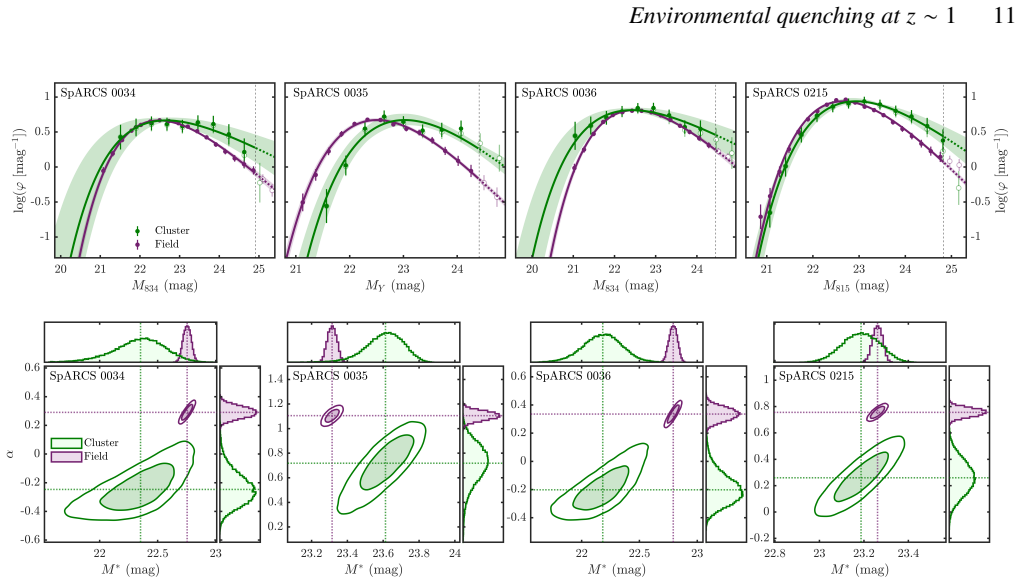
The paper's central claim is that at $0.8<z<1.3$, the passive red-sequence populations of clusters are relatively richer in faint, low-mass galaxies than the corresponding field population, demonstrated through Schechter-function fits to kernel-density-estimated luminosity and stellar mass functions. In the composite passive cluster SMF the low-mass slope is $\alpha=-0.54^{+0.03}_{-0.03}$ versus $\alpha=0.12^{+0.02}_{-0.02}$ for the field, with a two-tailed $p$-value below $10^{-74}$ for the difference. The authors estimate that reproducing the cluster slope requires quenching $25\pm5\%$ of the star-forming field population that falls into the clusters. They conclude that cluster environmental quenching processes are enhanced compared with the field and already operating by $z\sim1$, consistent with traditional independent mass-plus-environment quenching models.
Load-bearing premise
The result rests on a magnitude correction for the field comparison sample that was calibrated on bright galaxies and extrapolated to faint magnitudes the calibration survey never reached; if that extrapolation is wrong, the flat field slope that drives the cluster-field difference could be artificial.
Editorial extensions
If this is right
- If the result holds, environmental quenching in clusters was already reshaping the low-mass galaxy population at $z\sim1$, not just at later epochs.
- The faint-end slope of the passive stellar mass function becomes a practical diagnostic: high-redshift clusters should show a relative upturn below about $10^{10}\,M_\odot$, exactly where earlier surveys were incomplete.
- The estimated $25\pm5\%$ quenched fraction gives a quantitative target that simulations and semi-analytic models of galaxy formation should reproduce.
- Because the field sample itself contains overdensities, the true cluster-field quenching contrast is likely at least as large as measured, and may be larger.
Reading between the lines
- A direct test would be to measure the field slope with a deeper, filter-matched survey; if it stays near $0.12$ the cluster-field difference is a real environmental signal, while if it drops to roughly $-0.4$ the result may be an artifact of the magnitude-shift extrapolation.
- The discrepancy with earlier null results at the same redshifts likely reflects the red-sequence plus statistical background subtraction method and deeper detection images, which restore the low-mass galaxies that membership-correction methods dilute.
- The same two-filter red-sequence technique could be applied to hundreds of clusters from future wide surveys to map the redshift at which the low-mass upturn turns on.
- If the $25\pm5\%$ quenched fraction is physical, cluster infall regions at $z\sim1$ should contain a population of recently quenched, post-starburst low-mass galaxies that deep spectroscopy can identify.
Signed reviews
Editorial analysis
A structured set of objections, weighed in public.
Referee Report
Summary. The paper measures the luminosity functions and stellar mass functions of passive red-sequence galaxies in four SpARCS/GCLASS clusters at 0.8<z<1.3, using new deep VLT imaging in Fb/Fr filter pairs complemented by GCLASS/GOGREEN archival data. A field reference sample is assembled from COSMOS2020 photometry shifted to VLT-equivalent filters using PAUS overlap, with red-sequence and UVJ selection applied in the same way as to the clusters. Cluster membership for faint galaxies is handled with statistical background subtraction using cluster outskirts, completeness is calibrated through injection-recovery simulations, and Schechter parameters are fit to KDE estimates via MCMC. The central claim is that clusters show a relative excess of faint, low-mass passive galaxies, seen as shallower faint-end slopes; the composite cluster SMF gives alpha=-0.54 versus alpha=0.12 for the field, and the authors estimate that 25+/-5% of infalling star-forming field galaxies must be quenched to reproduce the cluster SMF. The paper interprets this as evidence that environmental quenching is already active at z~1.
Significance. The paper addresses a well-known tension in the literature: van der Burg et al. (2013, 2020) found nearly identical cluster and field passive SMF shapes at z~1, while traditional quenching models predict an upturn at low masses in clusters. This work goes deeper and reports the opposite result, so if the measurement holds it is an important observational constraint on environmental quenching at high redshift. The study makes good use of deep VLT imaging, includes an injection-recovery completeness correction, and presents several robustness checks (red-sequence width, background annulus, redshift-slice evolution, red-sequence versus no red-sequence selection). The use of public GCLASS/GOGREEN, COSMOS2020, and PAUS data is a strength, as is the candid discussion of limitations. The central comparison is a direct measurement rather than a fitted prediction, although the quoted 25% quenched fraction is a fitted normalization of a double-Schechter model and is presented as an estimate.
major comments (3)
- [Section 2.2.3] The field sample is constructed by fitting a linear shift between COSMOS2020 and PAUS magnitudes for bright sources (i<=23) and extrapolating that shift to the full COSMOS2020 depth, with shifts reaching 0.4 mag at magnitude 25. The central claim of the paper is the cluster-field difference in the faint-end Schechter slope, and the field alpha is measured from these shifted magnitudes; an error in the extrapolated shift directly changes which faint field galaxies enter the passive sample and can thereby alter alpha. The paper does not quantify the sensitivity of the field alpha to the uncertainty in this extrapolation. I request a robustness test in which the shift slope/intercept is varied by its fit uncertainty, or an alternative field sample built without the shift (using COSMOS2020 native filters or the PAUS-bright region only), with the resulting alpha and cluster-field difference reported. Without such a test, the load-bearing comparison rests on an unquantified calibration extrapolation.
- [Abstract / Section 4.2.1] The abstract states 'We find a significant enhancement in the abundance of faint/low-mass passive galaxies in both the LFs and SMFs of all four clusters compared to the field.' Section 4.2.1 reports, however, that for SpARCS 0215 the SMF cluster-field slope difference is insignificant, with a two-tailed p-value of 0.07. The text in Section 4.2.1 acknowledges this, but the abstract overstates the result. Please revise the abstract so that the SMF claim is limited to three of four clusters or to the composite SMF, with the LF result stated separately for all four clusters.
- [Section 4.2.2 / Figure 9] The composite field SMF is constructed by combining the four field samples, but these samples are not independent: SpARCS 0034 and SpARCS 0036 have redshifts of 0.867 and 0.869, so their +/-0.025 redshift slices are nearly identical, and all four slices are drawn from the same COSMOS2020/PAUS catalog. Combining them as independent measurements underestimates the field uncertainties and makes the quoted p<1e-74 for the composite slope difference overconfident. The cluster composite is still meaningful, but the field side needs to be handled with an estimate of the effective number of independent field galaxies, or by combining the overlapping redshift slices before fitting, or by fitting a single field sample per redshift and propagating that properly into the composite comparison.
minor comments (4)
- [Section 5.1 / Figure 11] The offset of 0.27 in alpha between red-sequence-selected and non-red-sequence-selected field samples is an important diagnostic, but the two curves in Figure 11 are difficult to distinguish in the printed caption; please use distinct line styles and add a legend so that the reader can directly see the offset as a function of redshift.
- [Section 3.3] The text notes that the solar-metallicity assumption can underestimate low-mass stellar masses by ~0.25 dex and states that this does not affect the cluster-field comparison because both samples use the same assumption. It would be useful to state explicitly whether the mass completeness limits, which are converted from magnitude limits using the fitted mass-luminosity relation, are also insensitive to this assumption to the same order.
- [Section 3.4] The KDE bandwidth is chosen with the Silverman rule of thumb, and the shape of the LF/SMF may depend on this choice even though binning is avoided. A brief statement that the fitted alpha is insensitive to changes in the bandwidth, or a test with an alternative bandwidth, would reassure the reader that the slope difference is not a smoothing artifact.
- [Section 5.2] The comparison with Hamadouche et al. (2024) equates the two components of their double Schechter function with internally and environmentally quenched populations; this is a strong interpretative assumption and should be flagged more explicitly as a working hypothesis rather than a direct measurement.
Circularity Check
No significant circularity: the cluster-field LF/SMF comparison is a direct measurement built from independent cluster and field photometry, with no fitted value renamed as a prediction.
full rationale
The paper's central claim is a differential measurement of observed luminosity and stellar mass functions. Cluster photometry comes from new VLT observations, while the field photometry comes from COSMOS2020 combined with PAUS; neither sample is defined in terms of the other, and the Schechter parameters in Tables 2 and 3 are fits to independently measured KDEs. The quoted low-mass slopes (cluster alpha = -0.54, field alpha = 0.12) are therefore direct outputs of separate fits, not quantities forced by construction. The 25 +/- 5% quenched fraction is explicitly a fitted normalization of a double Schechter model presented as an estimate ('To reproduce the observed passive cluster SMF, we estimate that 25 +/- 5% of the star-forming field population...'), not an out-of-sample prediction, so it does not qualify as fitted input called prediction. The extrapolated COSMOS2020/PAUS magnitude shift in Section 2.2.3 is a real systematic uncertainty affecting the faint end of the field sample, but it is not a circular reduction: no result is defined in terms of the cluster-field difference, and no fitted parameter is used to construct the quantity it is supposed to explain. Self-citations to GCLASS/GOGREEN DR1 and earlier cluster studies provide data and context rather than load-bearing uniqueness arguments. The internal inconsistency for SpARCS 0215 (SMF p = 0.07 in Section 4.2.1 versus the abstract's claim of significance in all four clusters) is an overclaim concern, not circularity. No circular step is identified.
Assumptions & free parameters
free parameters (4)
- Red-sequence selection width =
±0.3 mag (SpARCS 0035: ±0.5 mag)
- Cluster/control field boundary =
1 Mpc
- PAUS-COSMOS magnitude shift =
linear fit, up to 0.4 mag at magnitude 25
- Quenched fraction f_SF =
25±5%
assumptions (6)
- domain assumption Lambda CDM cosmology with Omega0=0.3, OmegaLambda=0.7, and H0=70 km/s/Mpc.
- domain assumption The red-sequence and UVJ criteria select the same passive galaxy population in clusters and field.
- domain assumption The outer annulus (r>1 Mpc) is a valid background for statistical subtraction.
- domain assumption Stellar masses from EAZY with solar metallicity and Chabrier IMF are unbiased enough for the mass function slopes.
- ad hoc to paper Separability of mass and environmental quenching in the Peng et al. (2010) model.
- ad hoc to paper Star-forming field galaxies represent the pre-quenching population of cluster galaxies.
Cite this review
Pith. "Pith review of Insights into environmental quenching at $z\sim1$: an enhancement of faint, low-mass passive galaxies in clusters." pith.science (2026). https://pith.science/paper/EE4AWLBT
@misc{pith2026250412394,
  author       = {Pith},
  title        = {Pith review of: Insights into environmental quenching at $z\sim1$: an enhancement of faint, low-mass passive galaxies in clusters},
  year         = {2026},
  howpublished = {\url{https://pith.science/paper/EE4AWLBT}},
  note         = {Machine review of arXiv:2504.12394}
}
abstract
Understanding the processes that transform star-forming galaxies into quiescent ones is key to unraveling the role of environment in galaxy evolution. We present measurements of the luminosity functions (LFs) and stellar mass functions (SMFs) of passive red-sequence galaxies in four galaxy clusters at $0.8 < z < 1.3$, selected using deep VLT observations complemented with data from the GCLASS and GOGREEN surveys. We find a significant enhancement in the abundance of faint/low-mass passive galaxies in both the LFs and SMFs of all four clusters compared to the field. This is further evidenced by a shallower low-mass slope in the composite passive cluster SMF, which yields a Schechter parameter $\alpha = -0.54^{+\,0.03}_{-0.03}$, compared to $\alpha = 0.12^{+\,0.01}_{-0.01}$ for the field. Our findings indicate that quenching processes that act in clusters are enhanced compared to the field, suggesting that environmental quenching mechanisms may already be active by $z\sim1$. To reproduce the observed passive cluster SMF, we estimate that $25\pm5\%$ of the star-forming field population that falls into the cluster must have been quenched. Our results largely support traditional quenching models but highlight the need for deeper studies of larger cluster samples to better understand the role of environmental quenching in the distant Universe.
Figures


Figures from the paper (9 more)




Reference graph
Works this paper leans on
-
[1]
Ahad S. L., Muzzin A., Bah \'e Y. M., Hoekstra H., 2024, @doi [ ] 10.1093/mnras/stae341 , https://ui.adsabs.harvard.edu/abs/2024MNRAS.528.6329A 528, 6329
-
[2]
Aihara H., et al., 2019, @doi [ ] 10.1093/pasj/psz103 , https://ui.adsabs.harvard.edu/abs/2019PASJ...71..114A 71, 114
-
[4]
B., Trinchieri G., Raichoor A., Ellis R
Andreon S., Newman A. B., Trinchieri G., Raichoor A., Ellis R. S., Treu T., 2014, @doi [ ] 10.1051/0004-6361/201323077 , https://ui.adsabs.harvard.edu/abs/2014A&A...565A.120A 565, A120
-
[5]
Annunziatella M., et al., 2014, @doi [ ] 10.1051/0004-6361/201424102 , https://ui.adsabs.harvard.edu/abs/2014A&A...571A..80A 571, A80
-
[6]
Annunziatella M., et al., 2016, @doi [ ] 10.1051/0004-6361/201527399 , https://ui.adsabs.harvard.edu/abs/2016A&A...585A.160A 585, A160
-
[7]
Appenzeller I., et al., 1998, The Messenger, https://ui.adsabs.harvard.edu/abs/1998Msngr..94....1A 94, 1
1998
-
[8]
Aragon-Salamanca A., Ellis R. S., Couch W. J., Carter D., 1993, @doi [ ] 10.1093/mnras/262.3.764 , https://ui.adsabs.harvard.edu/abs/1993MNRAS.262..764A 262, 764
-
[9]
Arcila-Osejo L., Sawicki M., 2013, @doi [ ] 10.1093/mnras/stt1354 , https://ui.adsabs.harvard.edu/abs/2013MNRAS.435..845A 435, 845
Show all 156 references
-
[10]
M., et al., 2017, @doi [ ] 10.1093/mnras/stx1403 , https://ui.adsabs.harvard.edu/abs/2017MNRAS.470.4186B 470, 4186
Bah \'e Y. M., et al., 2017, @doi [ ] 10.1093/mnras/stx1403 , https://ui.adsabs.harvard.edu/abs/2017MNRAS.470.4186B 470, 4186
2017 doi
-
[11]
K., Glazebrook K., Brinkmann J., Ivezi \'c Z ., Lupton R
Baldry I. K., Glazebrook K., Brinkmann J., Ivezi \'c Z ., Lupton R. H., Nichol R. C., Szalay A. S., 2004, @doi [ ] 10.1086/380092 , https://ui.adsabs.harvard.edu/abs/2004ApJ...600..681B 600, 681
2004 doi
-
[13]
L., Baldry I
Balogh M. L., Baldry I. K., Nichol R., Miller C., Bower R., Glazebrook K., 2004, @doi [ ] 10.1086/426079 , https://ui.adsabs.harvard.edu/abs/2004ApJ...615L.101B 615, L101
2004 doi
-
[14]
L., et al., 2016, @doi [ ] 10.1093/mnras/stv2949 , https://ui.adsabs.harvard.edu/abs/2016MNRAS.456.4364B 456, 4364
Balogh M. L., et al., 2016, @doi [ ] 10.1093/mnras/stv2949 , https://ui.adsabs.harvard.edu/abs/2016MNRAS.456.4364B 456, 4364
2016 doi
-
[15]
L., et al., 2017, @doi [ ] 10.1093/mnras/stx1370 , https://ui.adsabs.harvard.edu/abs/2017MNRAS.470.4168B 470, 4168
Balogh M. L., et al., 2017, @doi [ ] 10.1093/mnras/stx1370 , https://ui.adsabs.harvard.edu/abs/2017MNRAS.470.4168B 470, 4168
2017 doi
-
[16]
L., et al., 2021, @doi [ ] 10.1093/mnras/staa3008 , https://ui.adsabs.harvard.edu/abs/2021MNRAS.500..358B 500, 358
Balogh M. L., et al., 2021, @doi [ ] 10.1093/mnras/staa3008 , https://ui.adsabs.harvard.edu/abs/2021MNRAS.500..358B 500, 358
2021 doi
-
[17]
C., Cooper M
Baxter D. C., Cooper M. C., Fillingham S. P., 2021, @doi [ ] 10.1093/mnras/stab523 , https://ui.adsabs.harvard.edu/abs/2021MNRAS.503.1636B 503, 1636
2021 doi
-
[18]
C., et al., 2023, @doi [ ] 10.1093/mnras/stad2995 , https://ui.adsabs.harvard.edu/abs/2023MNRAS.526.3716B 526, 3716
Baxter D. C., et al., 2023, @doi [ ] 10.1093/mnras/stad2995 , https://ui.adsabs.harvard.edu/abs/2023MNRAS.526.3716B 526, 3716
2023 doi
-
[19]
F., et al., 2004, @doi [ ] 10.1086/420778 , https://ui.adsabs.harvard.edu/abs/2004ApJ...608..752B 608, 752
Bell E. F., et al., 2004, @doi [ ] 10.1086/420778 , https://ui.adsabs.harvard.edu/abs/2004ApJ...608..752B 608, 752
2004 doi
-
[20]
Bellhouse C., et al., 2017, @doi [ ] 10.3847/1538-4357/aa7875 , https://ui.adsabs.harvard.edu/abs/2017ApJ...844...49B 844, 49
2017 doi
-
[21]
Bellstedt S., Robotham A. S. G., 2024, ProGeny II: the impact of libraries and model configurations on inferred galaxy properties in SED fitting ( @eprint arXiv 2410.17698 ), https://arxiv.org/abs/2410.17698
2024 arXiv
-
[22]
Ben \' tez N., et al., 2009, @doi [ ] 10.1088/0004-637X/691/1/241 , https://ui.adsabs.harvard.edu/abs/2009ApJ...691..241B 691, 241
2009 doi
-
[23]
Bertin E., Arnouts S., 1996, @doi [ ] 10.1051/aas:1996164 , https://ui.adsabs.harvard.edu/abs/1996A&AS..117..393B 117, 393
1996 doi
-
[24]
Biviano A., van der Burg R. F. J., Muzzin A., Sartoris B., Wilson G., Yee H. K. C., 2016, @doi [ ] 10.1051/0004-6361/201628697 , https://ui.adsabs.harvard.edu/abs/2016A&A...594A..51B 594, A51
2016 doi
-
[25]
Biviano A., et al., 2021, @doi [ ] 10.1051/0004-6361/202140564 , https://ui.adsabs.harvard.edu/abs/2021A&A...650A.105B 650, A105
2021 doi
-
[26]
Boselli A., Gavazzi G., 2006, @doi [ ] 10.1086/500691 , https://ui.adsabs.harvard.edu/abs/2006PASP..118..517B 118, 517
2006 doi
-
[27]
Boselli A., et al., 2014, @doi [ ] 10.1051/0004-6361/201424419 , https://ui.adsabs.harvard.edu/abs/2014A&A...570A..69B 570, A69
2014 doi
-
[28]
Boselli A., Fossati M., Sun M., 2022, @doi [ ] 10.1007/s00159-022-00140-3 , https://ui.adsabs.harvard.edu/abs/2022A&ARv..30....3B 30, 3
2022 doi
-
[29]
G., Lucey J
Bower R. G., Lucey J. R., Ellis R. S., 1992, @doi [ ] 10.1093/mnras/254.4.589 , https://ui.adsabs.harvard.edu/abs/1992MNRAS.254..589B 254, 589
1992 doi
-
[30]
G., Kodama T., Terlevich A., 1998, @doi [ ] 10.1046/j.1365-8711.1998.01868.x , https://ui.adsabs.harvard.edu/abs/1998MNRAS.299.1193B 299, 1193
Bower R. G., Kodama T., Terlevich A., 1998, @doi [ ] 10.1046/j.1365-8711.1998.01868.x , https://ui.adsabs.harvard.edu/abs/1998MNRAS.299.1193B 299, 1193
1998
-
[31]
G., Benson A
Bower R. G., Benson A. J., Malbon R., Helly J. C., Frenk C. S., Baugh C. M., Cole S., Lacey C. G., 2006, @doi [ ] 10.1111/j.1365-2966.2006.10519.x , https://ui.adsabs.harvard.edu/abs/2006MNRAS.370..645B 370, 645
2006
-
[32]
Bradley L., et al., 2023, astropy/photutils: 1.9.0 , @doi 10.5281/zenodo.8248020
2023 doi
-
[33]
B., van Dokkum P
Brammer G. B., van Dokkum P. G., Coppi P., 2008, @doi [ ] 10.1086/591786 , https://ui.adsabs.harvard.edu/abs/2008ApJ...686.1503B 686, 1503
2008 doi
-
[34]
B., et al., 2011, @doi [ ] 10.1088/0004-637X/739/1/24 , https://ui.adsabs.harvard.edu/abs/2011ApJ...739...24B 739, 24
Brammer G. B., et al., 2011, @doi [ ] 10.1088/0004-637X/739/1/24 , https://ui.adsabs.harvard.edu/abs/2011ApJ...739...24B 739, 24
2011 doi
-
[35]
N., et al., 2018, @doi [ ] 10.1093/mnras/sty124 , https://ui.adsabs.harvard.edu/abs/2018MNRAS.476...12B 476, 12
Bremer M. N., et al., 2018, @doi [ ] 10.1093/mnras/sty124 , https://ui.adsabs.harvard.edu/abs/2018MNRAS.476...12B 476, 12
2018 doi
-
[36]
Chabrier G., 2003, @doi [ ] 10.1086/376392 , https://ui.adsabs.harvard.edu/abs/2003PASP..115..763C 115, 763
2003 doi
-
[37]
Chan J. C. C., et al., 2019, @doi [ ] 10.3847/1538-4357/ab2b3a , https://ui.adsabs.harvard.edu/abs/2019ApJ...880..119C 880, 119
2019 doi
-
[38]
E., 2010, @doi [ ] 10.1088/0004-637X/712/2/833 , https://ui.adsabs.harvard.edu/abs/2010ApJ...712..833C 712, 833
Conroy C., Gunn J. E., 2010, @doi [ ] 10.1088/0004-637X/712/2/833 , https://ui.adsabs.harvard.edu/abs/2010ApJ...712..833C 712, 833
2010 doi
-
[39]
E., White M., 2009, @doi [ ] 10.1088/0004-637X/699/1/486 , https://ui.adsabs.harvard.edu/abs/2009ApJ...699..486C 699, 486
Conroy C., Gunn J. E., White M., 2009, @doi [ ] 10.1088/0004-637X/699/1/486 , https://ui.adsabs.harvard.edu/abs/2009ApJ...699..486C 699, 486
2009 doi
-
[40]
Contini E., Kang X., 2015, @doi [ ] 10.1093/mnrasl/slv103 , https://ui.adsabs.harvard.edu/abs/2015MNRAS.453L..53C 453, L53
2015 doi
-
[41]
K., Kang X., 2020, @doi [ ] 10.3847/1538-4357/ab6730 , https://ui.adsabs.harvard.edu/abs/2020ApJ...889..156C 889, 156
Contini E., Gu Q., Ge X., Rhee J., Yi S. K., Kang X., 2020, @doi [ ] 10.3847/1538-4357/ab6730 , https://ui.adsabs.harvard.edu/abs/2020ApJ...889..156C 889, 156
2020 doi
-
[43]
J., Kenney J
Cramer W. J., Kenney J. D. P., Sun M., Crowl H., Yagi M., J \'a chym P., Roediger E., Waldron W., 2019, @doi [ ] 10.3847/1538-4357/aaefff , https://ui.adsabs.harvard.edu/abs/2019ApJ...870...63C 870, 63
2019 doi
-
[45]
Cucciati O., et al., 2018, @doi [ ] 10.1051/0004-6361/201833655 , https://ui.adsabs.harvard.edu/abs/2018A&A...619A..49C 619, A49
2018 doi
-
[46]
Daddi E., Cimatti A., Renzini A., Fontana A., Mignoli M., Pozzetti L., Tozzi P., Zamorani G., 2004, @doi [ ] 10.1086/425569 , https://ui.adsabs.harvard.edu/abs/2004ApJ...617..746D 617, 746
2004 doi
-
[48]
Darvish B., Mobasher B., Sobral D., Rettura A., Scoville N., Faisst A., Capak P., 2016, @doi [ ] 10.3847/0004-637X/825/2/113 , https://ui.adsabs.harvard.edu/abs/2016ApJ...825..113D 825, 113
2016 doi
-
[49]
C., Sobral D., Scoville N., Stroe A., Hemmati S., Kartaltepe J., 2017, @doi [ ] 10.3847/1538-4357/837/1/16 , https://ui.adsabs.harvard.edu/abs/2017ApJ...837...16D 837, 16
Darvish B., Mobasher B., Martin D. C., Sobral D., Scoville N., Stroe A., Hemmati S., Kartaltepe J., 2017, @doi [ ] 10.3847/1538-4357/837/1/16 , https://ui.adsabs.harvard.edu/abs/2017ApJ...837...16D 837, 16
2017 doi
-
[50]
Darvish B., et al., 2020, @doi [ ] 10.3847/1538-4357/ab75c3 , https://ui.adsabs.harvard.edu/abs/2020ApJ...892....8D 892, 8
2020 doi
-
[51]
Davidzon I., et al., 2016, @doi [ ] 10.1051/0004-6361/201527129 , https://ui.adsabs.harvard.edu/abs/2016A&A...586A..23D 586, A23
2016 doi
-
[53]
Dekel A., Silk J., 1986, @doi [ ] 10.1086/164050 , https://ui.adsabs.harvard.edu/abs/1986ApJ...303...39D 303, 39
1986 doi
-
[54]
Demarco R., et al., 2010, @doi [ ] 10.1088/0004-637X/711/2/1185 , https://ui.adsabs.harvard.edu/abs/2010ApJ...711.1185D 711, 1185
2010 doi
-
[55]
S., Smail I., Dressler A., Couch W
Ellis R. S., Smail I., Dressler A., Couch W. J., Oemler Augustus J., Butcher H., Sharples R. M., 1997, @doi [ ] 10.1086/304261 , https://ui.adsabs.harvard.edu/abs/1997ApJ...483..582E 483, 582
1997 doi
-
[56]
Erben T., et al., 2005, @doi [Astronomische Nachrichten] 10.1002/asna.200510396 , https://ui.adsabs.harvard.edu/abs/2005AN....326..432E 326, 432
2005 doi
-
[57]
Euclid Collaboration et al., 2022, @doi [ ] 10.1051/0004-6361/202142361 , https://ui.adsabs.harvard.edu/abs/2022A&A...658A.126E 658, A126
2022 doi
-
[58]
Foltz R., et al., 2015, @doi [ ] 10.1088/0004-637X/812/2/138 , https://ui.adsabs.harvard.edu/abs/2015ApJ...812..138F 812, 138
2015 doi
-
[59]
Foltz R., et al., 2018, @doi [ ] 10.3847/1538-4357/aad80d , https://ui.adsabs.harvard.edu/abs/2018ApJ...866..136F 866, 136
2018 doi
-
[60]
Forrest B., et al., 2023, @doi [ ] 10.1093/mnrasl/slad114 , https://ui.adsabs.harvard.edu/abs/2023MNRAS.526L..56F 526, L56
2023 doi
-
[61]
Forrest B., et al., 2024, @doi [ ] 10.3847/1538-4357/ad5e78 , https://ui.adsabs.harvard.edu/abs/2024ApJ...971..169F 971, 169
2024 doi
-
[62]
J., 2016, @doi [ ] 10.1093/mnras/stv2400 , https://ui.adsabs.harvard.edu/abs/2016MNRAS.455.2028F 455, 2028
Fossati M., Fumagalli M., Boselli A., Gavazzi G., Sun M., Wilman D. J., 2016, @doi [ ] 10.1093/mnras/stv2400 , https://ui.adsabs.harvard.edu/abs/2016MNRAS.455.2028F 455, 2028
2016 doi
-
[63]
Gobat R., et al., 2011, @doi [ ] 10.1051/0004-6361/201016084 , https://ui.adsabs.harvard.edu/abs/2011A&A...526A.133G 526, A133
2011 doi
-
[64]
Gozaliasl G., et al., 2019, @doi [ ] 10.1093/mnras/sty3203 , https://ui.adsabs.harvard.edu/abs/2019MNRAS.483.3545G 483, 3545
2019 doi
-
[65]
E., Gott J
Gunn J. E., Gott J. Richard I., 1972, @doi [ ] 10.1086/151605 , https://ui.adsabs.harvard.edu/abs/1972ApJ...176....1G 176, 1
1972 doi
-
[67]
Haines C., et al., 2023, @doi [The Messenger] 10.18727/0722-6691/5308 , https://ui.adsabs.harvard.edu/abs/2023Msngr.190...31H 190, 31
2023 doi
- [68]
-
[69]
K., 1970, @doi [Biometrika] 10.1093/biomet/57.1.97 , 57, 97
Hastings W. K., 1970, @doi [Biometrika] 10.1093/biomet/57.1.97 , 57, 97
1970 doi
-
[70]
W., Stubbs C
High F. W., Stubbs C. W., Rest A., Stalder B., Challis P., 2009, @doi [ ] 10.1088/0004-6256/138/1/110 , https://ui.adsabs.harvard.edu/abs/2009AJ....138..110H 138, 110
2009 doi
-
[71]
Ishikawa S., Kashikawa N., Toshikawa J., Onoue M., 2015, @doi [ ] 10.1093/mnras/stv1927 , https://ui.adsabs.harvard.edu/abs/2015MNRAS.454..205I 454, 205
2015 doi
-
[72]
Ito K., et al., 2023, @doi [ ] 10.3847/2041-8213/acb49b , https://ui.adsabs.harvard.edu/abs/2023ApJ...945L...9I 945, L9
2023 doi
-
[73]
L., et al., 2018, @doi [ ] 10.1093/mnras/sty500 , https://ui.adsabs.harvard.edu/abs/2018MNRAS.476.4753J 476, 4753
Jaff \'e Y. L., et al., 2018, @doi [ ] 10.1093/mnras/sty500 , https://ui.adsabs.harvard.edu/abs/2018MNRAS.476.4753J 476, 4753
2018 doi
-
[74]
H., Chester T., Cutri R., Schneider S., Skrutskie M., Huchra J
Jarrett T. H., Chester T., Cutri R., Schneider S., Skrutskie M., Huchra J. P., 2000, @doi [ ] 10.1086/301330 , https://ui.adsabs.harvard.edu/abs/2000AJ....119.2498J 119, 2498
2000 doi
-
[75]
Johnston R., 2011, @doi [ ] 10.1007/s00159-011-0041-9 , https://ui.adsabs.harvard.edu/abs/2011A&ARv..19...41J 19, 41
2011 doi
-
[76]
D., Parker L
Joshi G. D., Parker L. C., Wadsley J., 2016, @doi [ ] 10.1093/mnras/stw1699 , https://ui.adsabs.harvard.edu/abs/2016MNRAS.462..761J 462, 761
2016 doi
-
[77]
Kauffmann G., et al., 2003, @doi [ ] 10.1046/j.1365-8711.2003.06291.x , https://ui.adsabs.harvard.edu/abs/2003MNRAS.341...33K 341, 33
2003
-
[78]
Kawinwanichakij L., et al., 2017, @doi [ ] 10.3847/1538-4357/aa8b75 , https://ui.adsabs.harvard.edu/abs/2017ApJ...847..134K 847, 134
2017 doi
-
[79]
K., 2020, @doi [ ] 10.3847/1538-4357/abbfa6 , https://ui.adsabs.harvard.edu/abs/2020ApJ...905...12K 905, 12
Kim S., Contini E., Choi H., Han S., Lee J., Oh S., Kang X., Yi S. K., 2020, @doi [ ] 10.3847/1538-4357/abbfa6 , https://ui.adsabs.harvard.edu/abs/2020ApJ...905...12K 905, 12
2020 doi
-
[80]
Kissler-Patig M., et al., 2008, @doi [ ] 10.1051/0004-6361:200809910 , https://ui.adsabs.harvard.edu/abs/2008A&A...491..941K 491, 941
2008 doi
-
[81]
J., Arag'on-Salamanca A., 1998, @doi [ ] 10.48550/arXiv.astro-ph/9802245 , https://ui.adsabs.harvard.edu/abs/1998A&A...334...99K 334, 99
Kodama T., Arimoto N., Barger A. J., Arag'on-Salamanca A., 1998, @doi [ ] 10.48550/arXiv.astro-ph/9802245 , https://ui.adsabs.harvard.edu/abs/1998A&A...334...99K 334, 99
-
[82]
Kova c K., et al., 2010, @doi [ ] 10.1088/0004-637X/708/1/505 , https://ui.adsabs.harvard.edu/abs/2010ApJ...708..505K 708, 505
2010 doi
-
[83]
Kova c K., et al., 2014, @doi [ ] 10.1093/mnras/stt2241 , https://ui.adsabs.harvard.edu/abs/2014MNRAS.438..717K 438, 717
2014 doi
-
[84]
Kriek M., Conroy C., 2013, @doi [ ] 10.1088/2041-8205/775/1/L16 , https://ui.adsabs.harvard.edu/abs/2013ApJ...775L..16K 775, L16
2013 doi
-
[85]
Kukstas E., et al., 2023, @doi [ ] 10.1093/mnras/stac3438 , https://ui.adsabs.harvard.edu/abs/2023MNRAS.518.4782K 518, 4782
2023 doi
-
[86]
Laigle C., et al., 2016, @doi [ ] 10.3847/0067-0049/224/2/24 , https://ui.adsabs.harvard.edu/abs/2016ApJS..224...24L 224, 24
2016 doi
-
[87]
B., 1974, @doi [ ] 10.1093/mnras/169.2.229 , https://ui.adsabs.harvard.edu/abs/1974MNRAS.169..229L 169, 229
Larson R. B., 1974, @doi [ ] 10.1093/mnras/169.2.229 , https://ui.adsabs.harvard.edu/abs/1974MNRAS.169..229L 169, 229
1974 doi
-
[88]
B., Tinsley B
Larson R. B., Tinsley B. M., Caldwell C. N., 1980, @doi [ ] 10.1086/157917 , https://ui.adsabs.harvard.edu/abs/1980ApJ...237..692L 237, 692
1980 doi
-
[89]
B., et al., 2017, @doi [ ] 10.3847/1538-4357/aa7948 , https://ui.adsabs.harvard.edu/abs/2017ApJ...844...43L 844, 43
Lee-Brown D. B., et al., 2017, @doi [ ] 10.3847/1538-4357/aa7948 , https://ui.adsabs.harvard.edu/abs/2017ApJ...844...43L 844, 43
2017 doi
-
[91]
Lidman C., et al., 2013, @doi [ ] 10.1093/mnras/stt777 , https://ui.adsabs.harvard.edu/abs/2013MNRAS.433..825L 433, 825
2013 doi
-
[92]
Lotz M., Remus R.-S., Dolag K., Biviano A., Burkert A., 2019, @doi [ ] 10.1093/mnras/stz2070 , https://ui.adsabs.harvard.edu/abs/2019MNRAS.488.5370L 488, 5370
2019 doi
-
[93]
M., Gal R
Lubin L. M., Gal R. R., Lemaux B. C., Kocevski D. D., Squires G. K., 2009, @doi [The Astronomical Journal] 10.1088/0004-6256/137/6/4867 , 137, 4867–4883
2009 doi
-
[94]
180] 10.18727/0722-6691/5197 , pp
Maiolino R., et al., 2020, @doi [Published in The Messenger vol. 180] 10.18727/0722-6691/5197 , pp. 24-29, June 2020
2020 doi
-
[95]
A., Biviano A., Bou \'e G., 2013, @doi [ ] 10.1093/mnras/sts565 , https://ui.adsabs.harvard.edu/abs/2013MNRAS.429.3079M 429, 3079
Mamon G. A., Biviano A., Bou \'e G., 2013, @doi [ ] 10.1093/mnras/sts565 , https://ui.adsabs.harvard.edu/abs/2013MNRAS.429.3079M 429, 3079
2013 doi
-
[96]
L., Gonzalez A
Mancone C. L., Gonzalez A. H., Brodwin M., Stanford S. A., Eisenhardt P. R. M., Stern D., Jones C., 2010, @doi [ ] 10.1088/0004-637X/720/1/284 , https://ui.adsabs.harvard.edu/abs/2010ApJ...720..284M 720, 284
2010 doi
-
[97]
L., et al., 2012, @doi [ ] 10.1088/0004-637X/761/2/141 , https://ui.adsabs.harvard.edu/abs/2012ApJ...761..141M 761, 141
Mancone C. L., et al., 2012, @doi [ ] 10.1088/0004-637X/761/2/141 , https://ui.adsabs.harvard.edu/abs/2012ApJ...761..141M 761, 141
2012 doi
-
[98]
G., F \"o rster Schreiber N
Marchesini D., van Dokkum P. G., F \"o rster Schreiber N. M., Franx M., Labb \'e I., Wuyts S., 2009, @doi [ ] 10.1088/0004-637X/701/2/1765 , https://ui.adsabs.harvard.edu/abs/2009ApJ...701.1765M 701, 1765
2009 doi
-
[99]
Matharu J., et al., 2019, @doi [ ] 10.1093/mnras/sty3465 , https://ui.adsabs.harvard.edu/abs/2019MNRAS.484..595M 484, 595
2019 doi
-
[100]
Matharu J., et al., 2021, @doi [ ] 10.3847/1538-4357/ac26c3 , https://ui.adsabs.harvard.edu/abs/2021ApJ...923..222M 923, 222
2021 doi
-
[101]
McConachie I., et al., 2022, @doi [ ] 10.3847/1538-4357/ac2b9f , https://ui.adsabs.harvard.edu/abs/2022ApJ...926...37M 926, 37
2022 doi
-
[102]
J., et al., 2012, @doi [ ] 10.1051/0004-6361/201219507 , https://ui.adsabs.harvard.edu/abs/2012A&A...544A.156M 544, A156
McCracken H. J., et al., 2012, @doi [ ] 10.1051/0004-6361/201219507 , https://ui.adsabs.harvard.edu/abs/2012A&A...544A.156M 544, A156
2012 doi
-
[103]
McNab K., et al., 2021, @doi [ ] 10.1093/mnras/stab2558 , https://ui.adsabs.harvard.edu/abs/2021MNRAS.508..157M 508, 157
2021 doi
-
[104]
W., Rosenbluth M
Metropolis N., Rosenbluth A. W., Rosenbluth M. N., Teller A. H., Teller E., 1953, @doi [J. Chem. Phys.] 10.1063/1.1699114 , 21, 1087
1953 doi
-
[105]
Milvang-Jensen B., et al., 2013, @doi [ ] 10.1051/0004-6361/201321814 , https://ui.adsabs.harvard.edu/abs/2013A&A...560A..94M 560, A94
2013 doi
-
[106]
Originally published in: 2012A&A...544A.156M
Moneti A., et al., 2023, VizieR Online Data Catalog: The fourth UltraVISTA data release (DR4) (Moneti+, 2019) , VizieR On-line Data Catalog: II/373. Originally published in: 2012A&A...544A.156M
2023
-
[107]
Moore B., Katz N., Lake G., Dressler A., Oemler A., 1996, @doi [ ] 10.1038/379613a0 , https://ui.adsabs.harvard.edu/abs/1996Natur.379..613M 379, 613
1996 doi
-
[108]
Moretti A., et al., 2022, @doi [ ] 10.3847/1538-4357/ac36c7 , https://ui.adsabs.harvard.edu/abs/2022ApJ...925....4M 925, 4
2022 doi
-
[109]
G., Stadtmuller U., 1999, Journal of the Royal Statistical Society
Muller H. G., Stadtmuller U., 1999, Journal of the Royal Statistical Society. Series B (Statistical Methodology), 61, 439
1999
-
[110]
Muzzin A., et al., 2009, @doi [ ] 10.1088/0004-637X/698/2/1934 , https://ui.adsabs.harvard.edu/abs/2009ApJ...698.1934M 698, 1934
2009 doi
-
[111]
Muzzin A., et al., 2012, @doi [ ] 10.1088/0004-637X/746/2/188 , https://ui.adsabs.harvard.edu/abs/2012ApJ...746..188M 746, 188
2012 doi
-
[112]
Muzzin A., et al., 2013, @doi [ ] 10.1088/0004-637X/777/1/18 , https://ui.adsabs.harvard.edu/abs/2013ApJ...777...18M 777, 18
2013 doi
-
[113]
Muzzin A., et al., 2014, @doi [ ] 10.1088/0004-637X/796/1/65 , https://ui.adsabs.harvard.edu/abs/2014ApJ...796...65M 796, 65
2014 doi
-
[114]
B., et al., 2016, @doi [ ] 10.1051/0004-6361/201628663 , https://ui.adsabs.harvard.edu/abs/2016A&A...592A.161N 592, A161
Nantais J. B., et al., 2016, @doi [ ] 10.1051/0004-6361/201628663 , https://ui.adsabs.harvard.edu/abs/2016A&A...592A.161N 592, A161
2016 doi
-
[116]
Padilla C., et al., 2019, @doi [ ] 10.3847/1538-3881/ab0412 , https://ui.adsabs.harvard.edu/abs/2019AJ....157..246P 157, 246
2019 doi
-
[117]
Papovich C., et al., 2018, @doi [ ] 10.3847/1538-4357/aaa766 , https://ui.adsabs.harvard.edu/abs/2018ApJ...854...30P 854, 30
2018 doi
-
[118]
Parzen E., 1962, @doi [The Annals of Mathematical Statistics] 10.1214/aoms/1177704472 , 33, 1065
1962
-
[119]
G., Holden B
Patel S. G., Holden B. P., Kelson D. D., Franx M., van der Wel A., Illingworth G. D., 2012, @doi [ ] 10.1088/2041-8205/748/2/L27 , https://ui.adsabs.harvard.edu/abs/2012ApJ...748L..27P 748, L27
2012 doi
-
[120]
Peng Y.-j., et al., 2010, @doi [ ] 10.1088/0004-637X/721/1/193 , https://ui.adsabs.harvard.edu/abs/2010ApJ...721..193P 721, 193
2010 doi
-
[121]
J., Renzini A., Carollo M., 2012, @doi [ ] 10.1088/0004-637X/757/1/4 , https://ui.adsabs.harvard.edu/abs/2012ApJ...757....4P 757, 4
Peng Y.-j., Lilly S. J., Renzini A., Carollo M., 2012, @doi [ ] 10.1088/0004-637X/757/1/4 , https://ui.adsabs.harvard.edu/abs/2012ApJ...757....4P 757, 4
2012 doi
-
[122]
Pintos-Castro I., Yee H. K. C., Muzzin A., Old L., Wilson G., 2019, @doi [ ] 10.3847/1538-4357/ab14ee , https://ui.adsabs.harvard.edu/abs/2019ApJ...876...40P 876, 40
2019 doi
-
[123]
Pozzetti L., et al., 2010, @doi [ ] 10.1051/0004-6361/200913020 , https://ui.adsabs.harvard.edu/abs/2010A&A...523A..13P 523, A13
2010 doi
-
[124]
Presotto V., et al., 2012, @doi [ ] 10.1051/0004-6361/201118293 , https://ui.adsabs.harvard.edu/abs/2012A&A...539A..55P 539, A55
2012 doi
-
[125]
Quadri R., et al., 2007, @doi [ ] 10.1086/520330 , https://ui.adsabs.harvard.edu/abs/2007AJ....134.1103Q 134, 1103
2007 doi
-
[126]
D., Parker L
Roberts I. D., Parker L. C., Joshi G. D., Evans F. A., 2015, @doi [ ] 10.1093/mnrasl/slu188 , https://ui.adsabs.harvard.edu/abs/2015MNRAS.448L...1R 448, L1
2015 doi
-
[127]
Rosenblatt M., 1956, @doi [The Annals of Mathematical Statistics] 10.1214/aoms/1177728190 , 27, 832
1956
-
[128]
Rowan-Robinson M., 1968, @doi [ ] 10.1093/mnras/138.4.445 , https://ui.adsabs.harvard.edu/abs/1968MNRAS.138..445R 138, 445
1968 doi
-
[129]
Rowe B. T. P., et al., 2015, @doi [Astronomy and Computing] 10.1016/j.ascom.2015.02.002 , https://ui.adsabs.harvard.edu/abs/2015A&C....10..121R 10, 121
2015 doi
-
[130]
Rudnick G., et al., 2009, @doi [ ] 10.1088/0004-637X/700/2/1559 , https://ui.adsabs.harvard.edu/abs/2009ApJ...700.1559R 700, 1559
2009 doi
-
[131]
Sawicki M., et al., 2019, @doi [ ] 10.1093/mnras/stz2522 , https://ui.adsabs.harvard.edu/abs/2019MNRAS.489.5202S 489, 5202
2019 doi
-
[132]
Schechter P., 1976, @doi [ ] 10.1086/154079 , https://ui.adsabs.harvard.edu/abs/1976ApJ...203..297S 203, 297
1976 doi
-
[133]
Schirmer M., 2013, @doi [ ] 10.1088/0067-0049/209/2/21 , https://ui.adsabs.harvard.edu/abs/2013ApJS..209...21S 209, 21
2013 doi
-
[134]
Schmidt M., 1968, @doi [ ] 10.1086/149446 , https://ui.adsabs.harvard.edu/abs/1968ApJ...151..393S 151, 393
1968 doi
-
[135]
W., 1986, Density estimation for statistics and data analysis
Silverman B. W., 1986, Density estimation for statistics and data analysis . Chapman & Hall/CRC monographs on statistics and applied probability, Chapman and Hall, London, https://cds.cern.ch/record/1070306
1986
-
[136]
E., et al., 2014, @doi [ ] 10.1088/0067-0049/214/2/24 , https://ui.adsabs.harvard.edu/abs/2014ApJS..214...24S 214, 24
Skelton R. E., et al., 2014, @doi [ ] 10.1088/0067-0049/214/2/24 , https://ui.adsabs.harvard.edu/abs/2014ApJS..214...24S 214, 24
2014 doi
-
[137]
R., et al., 2012, @doi [ ] 10.1088/2041-8205/748/2/L21 , https://ui.adsabs.harvard.edu/abs/2012ApJ...748L..21S 748, L21
Spitler L. R., et al., 2012, @doi [ ] 10.1088/2041-8205/748/2/L21 , https://ui.adsabs.harvard.edu/abs/2012ApJ...748L..21S 748, L21
2012 doi
-
[138]
A., et al., 2012, @doi [ ] 10.1088/0004-637X/753/2/164 , https://ui.adsabs.harvard.edu/abs/2012ApJ...753..164S 753, 164
Stanford S. A., et al., 2012, @doi [ ] 10.1088/0004-637X/753/2/164 , https://ui.adsabs.harvard.edu/abs/2012ApJ...753..164S 753, 164
2012 doi
-
[139]
Strateva I., et al., 2001, @doi [ ] 10.1086/323301 , https://ui.adsabs.harvard.edu/abs/2001AJ....122.1861S 122, 1861
2001 doi
-
[140]
Tanaka M., Finoguenov A., Ueda Y., 2010, @doi [ ] 10.1088/2041-8205/716/2/L152 , https://ui.adsabs.harvard.edu/abs/2010ApJ...716L.152T 716, L152
2010 doi
-
[141]
Tanaka M., et al., 2024, @doi [ ] 10.3847/1538-4357/ad5316 , https://ui.adsabs.harvard.edu/abs/2024ApJ...970...59T 970, 59
2024 doi
-
[142]
Taniguchi Y., et al., 2007, @doi [ ] 10.1086/516596 , https://ui.adsabs.harvard.edu/abs/2007ApJS..172....9T 172, 9
2007 doi
-
[143]
Taniguchi Y., et al., 2015, @doi [ ] 10.1093/pasj/psv106 , https://ui.adsabs.harvard.edu/abs/2015PASJ...67..104T 67, 104
2015 doi
-
[144]
R., et al., 2017, @doi [ ] 10.1093/mnras/stx2245 , https://ui.adsabs.harvard.edu/abs/2017MNRAS.472.3512T 472, 3512
Tomczak A. R., et al., 2017, @doi [ ] 10.1093/mnras/stx2245 , https://ui.adsabs.harvard.edu/abs/2017MNRAS.472.3512T 472, 3512
2017 doi
-
[145]
Vulcani B., et al., 2011, @doi [ ] 10.1111/j.1365-2966.2010.17904.x , https://ui.adsabs.harvard.edu/abs/2011MNRAS.412..246V 412, 246
2011
-
[146]
Vulcani B., et al., 2013, @doi [ ] 10.1051/0004-6361/201118388 , https://ui.adsabs.harvard.edu/abs/2013A&A...550A..58V 550, A58
2013 doi
-
[147]
M., Smith R., Moretti A., Jaff \'e Y
Vulcani B., Poggianti B. M., Smith R., Moretti A., Jaff \'e Y. L., Gullieuszik M., Fritz J., Bellhouse C., 2022, @doi [ ] 10.3847/1538-4357/ac4809 , https://ui.adsabs.harvard.edu/abs/2022ApJ...927...91V 927, 91
2022 doi
-
[148]
Wang T., et al., 2016, @doi [ ] 10.3847/0004-637X/828/1/56 , https://ui.adsabs.harvard.edu/abs/2016ApJ...828...56W 828, 56
2016 doi
-
[149]
R., et al., 2022, @doi [ ] 10.3847/1538-4365/ac3078 , https://ui.adsabs.harvard.edu/abs/2022ApJS..258...11W 258, 11
Weaver J. R., et al., 2022, @doi [ ] 10.3847/1538-4365/ac3078 , https://ui.adsabs.harvard.edu/abs/2022ApJS..258...11W 258, 11
2022 doi
-
[150]
R., et al., 2023, @doi [ ] 10.1051/0004-6361/202245581 , https://ui.adsabs.harvard.edu/abs/2023A&A...677A.184W 677, A184
Weaver J. R., et al., 2023, @doi [ ] 10.1051/0004-6361/202245581 , https://ui.adsabs.harvard.edu/abs/2023A&A...677A.184W 677, A184
2023 doi
-
[151]
Webb K., et al., 2020, @doi [ ] 10.1093/mnras/staa2752 , https://ui.adsabs.harvard.edu/abs/2020MNRAS.498.5317W 498, 5317
2020 doi
-
[152]
M., van den Bosch F
Weinmann S. M., van den Bosch F. C., Yang X., Mo H. J., 2006, @doi [ ] 10.1111/j.1365-2966.2005.09865.x , https://ui.adsabs.harvard.edu/abs/2006MNRAS.366....2W 366, 2
2006
-
[153]
M., Pasquali A., Oppenheimer B
Weinmann S. M., Pasquali A., Oppenheimer B. D., Finlator K., Mendel J. T., Crain R. A., Macci \`o A. V., 2012, @doi [ ] 10.1111/j.1365-2966.2012.21931.x , https://ui.adsabs.harvard.edu/abs/2012MNRAS.426.2797W 426, 2797
2012
-
[154]
V., Hatch N
Werner S. V., Hatch N. A., Muzzin A., van der Burg R. F. J., Balogh M. L., Rudnick G., Wilson G., 2022, @doi [ ] 10.1093/mnras/stab3484 , https://ui.adsabs.harvard.edu/abs/2022MNRAS.510..674W 510, 674
2022 doi
-
[155]
E., et al., 2011, @doi [ ] 10.1088/0004-637X/735/2/86 , https://ui.adsabs.harvard.edu/abs/2011ApJ...735...86W 735, 86
Whitaker K. E., et al., 2011, @doi [ ] 10.1088/0004-637X/735/2/86 , https://ui.adsabs.harvard.edu/abs/2011ApJ...735...86W 735, 86
2011 doi
-
[156]
J., Quadri R
Williams R. J., Quadri R. F., Franx M., van Dokkum P., Labb \'e I., 2009, @doi [ ] 10.1088/0004-637X/691/2/1879 , https://ui.adsabs.harvard.edu/abs/2009ApJ...691.1879W 691, 1879
2009 doi
-
[157]
Wilson G., et al., 2009, @doi [ ] 10.1088/0004-637X/698/2/1943 , https://ui.adsabs.harvard.edu/abs/2009ApJ...698.1943W 698, 1943
2009 doi
-
[158]
Wuyts S., et al., 2007, @doi [ ] 10.1086/509708 , https://ui.adsabs.harvard.edu/abs/2007ApJ...655...51W 655, 51
2007 doi
-
[159]
J., Wang J., 2020, @doi [ ] 10.3847/1538-4365/ab855b , https://ui.adsabs.harvard.edu/abs/2020ApJS..248....1Y 248, 1
Yuan Z., Jarvis M. J., Wang J., 2020, @doi [ ] 10.3847/1538-4365/ab855b , https://ui.adsabs.harvard.edu/abs/2020ApJS..248....1Y 248, 1
2020 doi
-
[160]
V., Nagai D., 2018, @doi [ ] 10.1093/mnras/stx3329 , https://ui.adsabs.harvard.edu/abs/2018MNRAS.475.3654Z 475, 3654
Zinger E., Dekel A., Kravtsov A. V., Nagai D., 2018, @doi [ ] 10.1093/mnras/stx3329 , https://ui.adsabs.harvard.edu/abs/2018MNRAS.475.3654Z 475, 3654
2018 doi
-
[161]
C., Aquino D., Yang X., Mo H
van den Bosch F. C., Aquino D., Yang X., Mo H. J., Pasquali A., McIntosh D. H., Weinmann S. M., Kang X., 2008, @doi [ ] 10.1111/j.1365-2966.2008.13230.x , https://ui.adsabs.harvard.edu/abs/2008MNRAS.387...79V 387, 79
2008
-
[162]
van der Burg R. F. J., et al., 2013, @doi [ ] 10.1051/0004-6361/201321237 , https://ui.adsabs.harvard.edu/abs/2013A&A...557A..15V 557, A15
2013 doi
-
[163]
van der Burg R. F. J., Muzzin A., Hoekstra H., Wilson G., Lidman C., Yee H. K. C., 2014, @doi [ ] 10.1051/0004-6361/201322771 , https://ui.adsabs.harvard.edu/abs/2014A&A...561A..79V 561, A79
2014 doi
-
[164]
van der Burg R. F. J., McGee S., Aussel H., Dahle H., Arnaud M., Pratt G. W., Muzzin A., 2018, @doi [ ] 10.1051/0004-6361/201833572 , https://ui.adsabs.harvard.edu/abs/2018A&A...618A.140V 618, A140
2018 doi
-
[165]
van der Burg R. F. J., et al., 2020, @doi [ ] 10.1051/0004-6361/202037754 , https://ui.adsabs.harvard.edu/abs/2020A&A...638A.112V 638, A112
2020 doi
Reviewed August 16, 2026 · model on record in the stance chip above.
Discussion (0). Continue with ORCID to comment.