REVIEW 4 major objections 6 minor 58 references
Frustrated kagome-lattice bilayer quantum Heisenberg antiferromagnet
T0 review · 4 major / 6 minor · reviewed 2026-08-16 · deepseek-v4-flash
Pith's one-line read For strong interlayer coupling and fields just below saturation, the low-temperature physics of the kagome-lattice bilayer Heisenberg antiferromagnet reduces to a classical gas of hard rhombi, ruling out a singlet-ordering phase…
desk verdict The localized-magnon mapping for the kagome bilayer is solid and the no-transition claim holds, but the shape-dependent specific heat is a nice conjecture that currently rests on an unproven boundary mapping; the abstract oversells it. read the letter →
The pith
A machine-rendered reading of the paper's core claim, the machinery that carries it, and where it could break.
The reading
What carries the argument
The central object is the hard-rhombus lattice gas on the kagome lattice, which is equivalent to hard dimers on a honeycomb lattice with N=2N/3 honeycomb sites. The grand canonical partition function of this gas, with activity z=$e^{{(hsat−h)/T}}$ and infinite nearest-neighbor repulsion, reproduces the low-temperature quantum partition function (Eq. 12). The lattice gas also maps to a kagome-lattice Ising model in a field, and its residual entropy for full covering is computed through Elser's formula for dimer coverings on hexagonal domains, which is the mechanism that produces shape-dependent bulk entropy and, via the entropy sum rule, a shape-dependent specific heat.
What would settle it
Compute the low-temperature specific heat of the hard-rhombus model on large open hexagonal kagome samples with two distinct side ratios, extrapolating to the thermodynamic limit; if the c(T) curves converge to the same function for both shapes, the predicted shape dependence is falsified. Alternatively, check whether exact diagonalization for larger quantum clusters (N≥48) continues to match the hard-rhombi degeneracies at low temperatures as T→0; any systematic deviation would undermine the classical-sector dominance.
Extended reading notes
Core claim
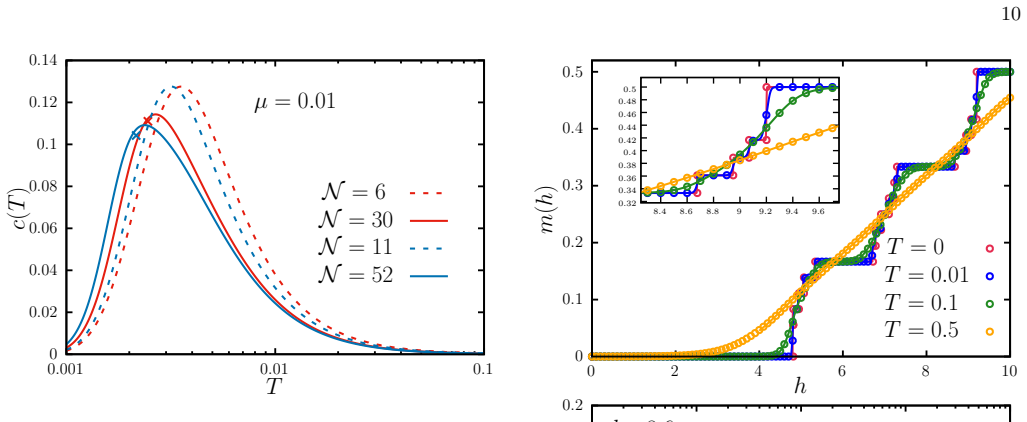
For J2>2J, the low-energy eigenstates of the quantum spin model are products of localized singlets on interlayer J2 bonds surrounded by polarized triplets, and these states satisfy a hard-core exclusion on the kagome lattice. The paper proves that the canonical partition function of these singlet configurations is identical to the grand canonical partition function of a hard-rhombi lattice gas with activity z=exp((hsat−h)/T), where hsat=4J+J2. This equivalence, validated by full diagonalization and finite-temperature Lanczos data on N=36 and N=42 clusters, yields two principal results: (i) there is no finite-temperature order-disorder transition linked to singlet ordering, and (ii) for the 2/3-magnetization plateau just below saturation, the zero-temperature entropy per site is s0=s(x,y,z)/6 with s(x,y,z) from Elser's formula, which depends on the aspect ratios of an open hexagonal boundary; via the sum rule the low-temperature specific heat inherits this shape dependence.
Load-bearing premise
The localized-singlet (rhombus) sector is assumed to carry all of the low-temperature thermodynamic weight of the quantum Heisenberg model in the thermodynamic limit, so that the classical lattice gas fully determines both the absence of ordering and the specific heat.
Editorial extensions
If this is right
- For J2>2J and h just below hsat, the kagome bilayer's low-temperature entropy, susceptibility, and magnetization are quantitatively given by the hard/soft rhombi classical model; hard rhombi work up to T≈0.15 and soft rhombi up to T≈0.45.
- There is no order-disorder phase transition associated with singlet ordering in this parameter regime, in contrast to the frustration-induced Ising (square/honeycomb) and Potts (triangular) transitions in other bilayer lattices.
- The specific heat of an open-boundary, thermodynamically large sample just below saturation should vary with the sample's hexagon shape even in the thermodynamic limit, with a regular hexagon giving the maximum boundary-dependent entropy.
- Particle-hole symmetry of the lattice gas implies a relation between thermodynamic quantities at hsat−h and at h−h1, echoing the symmetry of the magnetization curve around the 1/3 plateau.
- Slightly away from full frustration (J1≠Jx), an effective XXZ model on the kagome lattice reproduces the magnetization and specific heat of the N=36 quantum system, so the classical description extends to weakly violated flat-band conditions.
Reading between the lines
- If the shape dependence of specific heat persists in a real material realization, it would create a macroscopic sample-geometry dependence of a bulk observable, an unusual consequence of frustration worth exploiting in caloric or sensing applications.
- The same hard-rhombi reasoning may apply to other flat-band magnets whose localized magnons form exhaustive hard-core configurations on a Bravais lattice; the absence of ordering may be a general feature whenever the lattice-gas ground states have a non-vanishing entropy density.
- A direct numerical check of the shape dependence on larger open-boundary systems (e.g., via classical Monte Carlo for hard rhombi with hundreds of sites) would determine the rate of convergence to Elser's thermodynamic-limit values and is feasible with current resources.
Signed reviews
Editorial analysis
A structured set of objections, weighed in public.
Referee Report
Summary. The paper studies the S=1/2 Heisenberg antiferromagnet on a frustrated kagome-lattice bilayer with strong interlayer coupling J2, in the fully frustrated case J1=Jx=J. It identifies localized singlet states on J2 bonds, represents their spatial configurations as hard or soft rhombi on the kagome lattice, and maps the low-temperature, high-field thermodynamics to a classical lattice gas (Eqs. 12-15). The authors validate the mapping against exact diagonalization and finite-temperature Lanczos data on N=36 and N=42 clusters, count hard-rhombi configurations on periodic clusters, and compute magnetization, susceptibility, entropy, and specific heat. The two headline claims are (i) the absence of an order-disorder transition associated with singlet ordering, and (ii) sensitivity of the low-temperature specific heat to the shape of the system just below saturation even in the thermodynamic limit, the latter obtained by combining Elser's honeycomb-dimer entropy formula (Eq. 18) with the entropy sum rule (Eq. 19).
Significance. If the central claims hold, the paper provides a parameter-free exact low-energy description of a frustrated quantum bilayer in a strong field: the one-magnon flat-band spectrum, the degenerate manifold counting in Tables I-VII, and the agreement of hard- and soft-rhombi thermodynamics with exact numerics are genuine strengths. The comparison with exact diagonalization is not circular because the lattice-gas activity is fixed by the derived saturation field and the rhombus overlap energy is the exact singlet-pair energy penalty. The conclusion that a frustrated bilayer can avoid singlet ordering, in contrast to the square, honeycomb, and triangular bilayer cases, is interesting and plausible. The shape-dependent thermodynamic-limit specific heat, however, is a much stronger statement and currently rests on an unproven boundary correspondence and preliminary small-size numerics; this is the main load-bearing weakness.
major comments (4)
- [Sec. III.D, Eq. (18), Fig. 7] The step from the open-boundary spin bilayer to Elser's hexagonal dimer domain is asserted rather than derived. Elser's formula applies to close-packed dimer coverings of a honeycomb hexagon with fixed side ratios k:l:m and specific fixed-height boundary conditions. The manuscript provides only a pictorial correspondence in Fig. 7 and does not specify the open-boundary Hamiltonian of the spin model or prove that its physical boundary realizes Elser's boundary conditions. If the open boundary instead imposes free height boundary conditions, the entropy density would maximize over height slopes and the shape dependence of the thermodynamic-limit entropy could disappear. Because the shape-dependence claim (ii) follows from this step, a derivation of the boundary mapping, or at least a direct numerical check on the spin model itself, is required.
- [Sec. III.D, Fig. 8] The numerical evidence for a shape-dependent specific heat is explicitly preliminary: the hard-rhombi systems have N=6, 11, 30 and 52 sites, and only the peak position of c(T) is linearly extrapolated in 1/N. This does not establish that the integral in the sum rule (Eq. 19), i.e., the full low-temperature weight of c(T)/T, differs between shapes in the thermodynamic limit. To support the claim, the authors should compare finite-size scaling of the integrated quantity, not only the peak position, for several aspect ratios, and ideally check the boundary mapping on the spin model with open boundary conditions.
- [Sec. I and Sec. V] The absence of an order-disorder transition is introduced with the heuristic phrase 'one cannot expect' and is not backed by a precise statement about the effective model. Since this is a central claim, the authors should state explicitly that the hard-rhombi sector is equivalent to hard dimers on the honeycomb lattice (or to the exactly solved kagome Ising model) and explain why no finite-temperature ordering transition occurs in that representation. Large ground-state degeneracy alone does not preclude a finite-temperature transition, as the Potts-model examples in the cited bilayer literature show; the argument should be made rigorous in the text.
- [Sec. III.C, Eq. (12)] The assertion that the localized-singlet sector 'is a dominant contribution at low temperatures and high fields' is validated numerically only for N=36 and N=42 periodic clusters. Since the thermodynamic-limit claims (i) and (ii) presuppose that this sector controls the low-temperature weight uniformly in the large-system limit, the authors should state this assumption explicitly and give an estimate of the error incurred by neglecting dispersive magnon bands and other excited states at small but nonzero T.
minor comments (6)
- [Sec. III.A, Eq. (6)] The phrase 'hard-hegaxon states' contains a typo; it should read 'hard-hexagon states'.
- [Appendix B, Table VI caption] The caption contains the typo 'kagome lattise' instead of 'kagome lattice'.
- [Fig. 7] The figure caption reproduces 'Figure 1' and 'Figure 2' labels from the source in Elser's paper; these should be removed and replaced by a self-contained caption explaining the k:l:m hexagon and the corresponding kagome rhombus domain.
- [Sec. III.B and III.C] The notation N, N, and N/2 is used for kagome sites, honeycomb sites, and bilayer sites without a consistent glossary; the relation N = 2N/3 is easy to misread because of the similar symbols. A table or explicit definitions would improve clarity.
- [Sec. IV, Eq. (20)] The coupling J_z = (J1+Jx)/2 and the anisotropy J = J1-Jx reuse the symbol J that was previously fixed to unity; this is potentially confusing and should be relabeled, for example as J_zz and J_perp.
- [Sec. III.D, Fig. 8] The curves for the two hexagon shapes are described only in the caption; labeling them directly in the figure (red 1:1:1, blue 2:1:1) would make the preliminary result easier to assess.
Circularity Check
No material circularity: the kagome-bilayer-to-rhombi mapping is derived from exact localized eigenstates, not fitted; the no-transition and shape-entropy inputs are external exact results; the shape-dependence claim is hedged as preliminary.
full rationale
The central derivation chain is self-contained and not circular. The localized-singlet states (7) are shown to be exact eigenstates of the fully frustrated Hamiltonian via the t/d representation (8), and the hard/soft-rhombus energies EFM+n*eps0 plus the overlap penalty V=J are derived rather than fitted. Equation (12) then follows with the activity z fixed by hsat = -eps0 = 4J+J2, which is obtained from the one-magnon flat band (5); no parameter is adjusted to reproduce the thermodynamics. The lattice-gas mapping is checked against exact diagonalization of the same Hamiltonian (Tables III/IV, Fig. 6), which is an independent numerical validation rather than a circular reuse. The absence of an order-disorder transition is imported from the exact solution of the kagome Ising / honeycomb dimer models (Refs. 33-36, 40), which are external results, not self-citations. The shape-dependence claim uses Elser's exact formula (18) and the exact sum rule (19); the unproven step is the identification of the open-boundary spin-bilayer sample with Elser's hexagonal dimer domain, and Fig. 8 is explicitly called preliminary. That is a correctness/gap concern, not a circular reduction: the conclusion is not assumed in the premises. Self-citations (Refs. 7, 13, 14, 16, 41) set the general bilayer methodology, but the kagome-specific derivation is presented and tested in this paper. No fitted input is renamed as a prediction, and no load-bearing uniqueness claim is imported from the authors' prior work.
Assumptions & free parameters
assumptions (6)
- domain assumption For J2 > 2J and low temperatures, the localized singlet (rhombus) eigenstates dominate the partition function of the quantum Heisenberg bilayer.
- standard math The kagome hard-rhombus problem is equivalent to the honeycomb hard-dimer problem.
- standard math The kagome Ising/lattice-gas representation has no finite-temperature singlet-ordering transition.
- standard math Elser's formula gives the thermodynamic-limit entropy per dimer for open hexagonal honeycomb domains, and this entropy depends on shape.
- standard math The thermodynamic sum rule integral of c(T)/T equals ln 2 minus the zero-temperature entropy.
- domain assumption The first-order perturbation effective Hamiltonian (20) captures the weakly violated flat-band case J1 not equal Jx.
Cite this review
Pith. "Pith review of Frustrated kagome-lattice bilayer quantum Heisenberg antiferromagnet." pith.science (2026). https://pith.science/paper/JYLE2PI5
@misc{pith2026250412878,
  author       = {Pith},
  title        = {Pith review of: Frustrated kagome-lattice bilayer quantum Heisenberg antiferromagnet},
  year         = {2026},
  howpublished = {\url{https://pith.science/paper/JYLE2PI5}},
  note         = {Machine review of arXiv:2504.12878}
}
abstract
We consider the $S=1/2$ antiferromagnetic Heisenberg model on a frustrated kagome-lattice bilayer with strong nearest-neighbor interlayer coupling and examine its low-temperature magnetothermodynamics using a mapping onto a rhombi gas on the kagome lattice. Besides, we use finite-size numerics to illustrate the validity of the classical lattice-gas description. Among our findings there are i) the absence of an order-disorder phase transition and ii) the sensitivity of the specific heat at low temperatures to the shape of the system just below the saturation magnetic field even in the thermodynamic limit.
Figures


Figures from the paper (9 more)




Reference graph
Works this paper leans on
-
[1]
Savary and L
L. Savary and L. Balents, Quantum spin liquids: a re- view, Reports on Progress in Physics 80, 016502 (2016)
2016
-
[2]
= 2 e2 (N = 36a) and a1 = (6, 0), a2 = (0, 2 √
-
[3]
are the unit lattice vectors (here the triangle side has unit length), α = 1, 2, 3 denote the sites of the unit cell within a layer, and l =a,b is the layer label. tween the already studied frustrated bilayers and the not yet examined frustrated kagome-lattice bilayer inspired us to take a closer look at the latter in this publication. In the present pape...
-
[4]
(N = 36b), see Appendix A. The cluster with N = 42 is determined by the edge vec- tors a1 = (7,− √ 3), a2 = (0, 2 √ 3). For ideal flat-band ge- ometryJ1 =Jx = 1 we examine severalJ2 = 1, 2, 3, 5, see Secs. II, III, and Appendix A. Small deviations from the flat band geometry are represented by the set J1 = 1.1, Jx = 0.9,J2 = 5, see Sec. IV. We use full di...
-
[5]
(N = 18 a) and a1 = (6, 0), a2 = (0, 2 √ 3) (N = 18 b). For N = 48 two clusters are determined by the edge vectors a1 =me1, a2 =ne2, m =n = 4 (N = 48a) and a1 =me1, a2 =−e1 +ne2, m =n = 4 (N = 48b). N = 18 n g18a(n), N = 18a g18b(n), N = 18b 1 18 18 2 117 117 3 336 336 4 417 420 5 186 192 6 17 20 N = 48 n g48a(n), N = 48a g48b(n), N = 48b 1 48 48 2 1 032 ...
work page 1961
-
[6]
Frustrated quantum spin models to explain the properties of magnets over wide temperature range
Switching on V ̸= 0 lifts the degeneracy in the model space, and an effective Hamil- tonian Heff, which acts in this space and describes the low-energy properties of H around the limit V = 0, can be constructed perturbatively [42]. Calculating the first term in the expansion Heff = P (Hmain +V )P +O(V 2) and introducing the pseudo-spin one-half operators ...
work page 2023
-
[7]
(N = 36a or N = 18a) and (bottom) determined by the edge vectors a1 = (6, 0), a2 = (0, 2 √
-
[8]
(N = 36b orN = 18b). Union under grant agreement No. 871072. O. D. acknowl- edges the kind hospitality of the University of Bielefeld in October-December of 2023 (supported by Erasmus+ and DFG). O. D. acknowledges the hospitality of the MPIPKS, Dresden at the Intercontinental Binodal Work- shop Flat bands and high-order Van Hove singularities (27 May - 7 ...
work page 2023
Show all 58 references
-
[9]
C. K. Majumdar and D. K. Ghosh, On Next-Nearest- Neighbor Interaction in Linear Chain. I, Journal of Math- ematical Physics 10, 1388 (1969)
1969
-
[10]
C. K. Majumdar and D. K. Ghosh, On Next-Nearest- Neighbor Interaction in Linear Chain. II, Journal of Mathematical Physics 10, 1399 (1969)
1969
-
[11]
Lin and J
H.-Q. Lin and J. Shen, Exact ground states and excited states of net spin models, Journal of the Physical Society of Japan 69, 878 (2000)
2000
-
[12]
Richter, O
J. Richter, O. Derzhko, and T. Krokhmalskii, Finite- temperature order-disorder phase transition in a frus- trated bilayer quantum Heisenberg antiferromagnet in strong magnetic fields, Phys. Rev. B 74, 144430 (2006)
2006
-
[13]
Chen, C.-Y
P. Chen, C.-Y. Lai, and M.-F. Yang, Field-induced spin supersolidity in frustrated S = 1 2 spin-dimer models, Phys. Rev. B 81, 020409 (2010)
2010
-
[14]
Derzhko, T
O. Derzhko, T. Krokhmalskii, and J. Richter, Emergent Ising degrees of freedom in frustrated two-leg ladder and bilayers = 1 2 Heisenberg antiferromagnets, Phys. Rev. B 82, 214412 (2010)
2010
-
[15]
A. F. Albuquerque, N. Laflorencie, J.-D. Picon, and F. Mila, Phase separation versus supersolid behavior in frustrated antiferromagnets, Phys. Rev. B 83, 174421 (2011)
2011
-
[16]
Oitmaa and R
J. Oitmaa and R. R. P. Singh, Ground-state properties, excitation spectra, and phase transitions in the S = 1 2 and S = 3 2 bilayer Heisenberg models on the honeycomb lattice, Phys. Rev. B 85, 014428 (2012)
2012
-
[17]
Murakami, T
Y. Murakami, T. Oka, and H. Aoki, Supersolid states in a spin system: Phase diagram and collective excitations, 16 Table VI. Counting the number ofn hard-rhombi spatial con- figurations on the kagome lattise ofN sites with two types of periodic boundary conditions imposed. The...
2013
-
[18]
Tanaka, N
H. Tanaka, N. Kurita, M. Okada, E. Kunihiro, Y. Shi- rata, K. Fujii, H. Uekusa, A. Matsuo, K. Kindo, and H. Nojiri, Almost Perfect Frustration in the Dimer Mag- net Ba 2CoSi2O6Cl2, Journal of the Physical Society of Japan 83, 103701 (2014)
2014
-
[19]
F. Alet, K. Damle, and S. Pujari, Sign-Problem-Free Monte Carlo Simulation of Certain Frustrated Quantum Magnets, Phys. Rev. Lett. 117, 197203 (2016)
2016
-
[20]
Krokhmalskii, V
T. Krokhmalskii, V. Baliha, O. Derzhko, J. Schulenburg, and J. Richter, Frustrated honeycomb-lattice bilayer quantum antiferromagnet in a magnetic field: Uncon- ventional phase transitions in a two-dimensional isotropic Heisenberg model, Phys. Rev. B 95, 094419 (2017)
2017
-
[21]
Richter, O
J. Richter, O. Krupnitska, V. Baliha, T. Krokhmal- skii, and O. Derzhko, Thermodynamic properties of Ba2CoSi2O6Cl2 in a strong magnetic field: Realization of flat-band physics in a highly frustrated quantum mag- net, Phys. Rev. B 97, 024405 (2018)
2018
-
[22]
Stapmanns, P
J. Stapmanns, P. Corboz, F. Mila, A. Honecker, B. Nor- mand, and S. Wessel, Thermal Critical Points and Quan- tum Critical End Point in the Frustrated Bilayer Heisen- berg Antiferromagnet, Phys. Rev. Lett. 121, 127201 (2018)
2018
-
[23]
Streˇ cka, K
J. Streˇ cka, K. Karˇlov´ a, V. Baliha, and O. Derzhko, Ising versus Potts criticality in low-temperature magnetother- modynamics of a frustrated spin- 1 2 Heisenberg triangular bilayer, Phys. Rev. B 98, 174426 (2018)
2018
-
[24]
Kurita, D
N. Kurita, D. Yamamoto, T. Kanesaka, N. Furukawa, S. Ohira-Kawamura, K. Nakajima, and H. Tanaka, Local- ized Magnetic Excitations in the Fully Frustrated Dimer- ized Magnet Ba 2CoSi2O6Cl2, Phys. Rev. Lett. 123, 027206 (2019)
2019
-
[25]
Y. Fan, N. Xi, C. Liu, B. Normand, and R. Yu, Field- controlled multicritical behavior and emergent universal- ity in fully frustrated quantum magnets, npj Quantum Materials 9, 25 (2024)
2024
-
[26]
Jakliˇ c and P
J. Jakliˇ c and P. Prelovˇ sek, Lanczos method for the calcu- lation of finite-temperature quantities in correlated sys- tems, Phys. Rev. B 49, 5065 (1994)
1994
-
[27]
Schnack, J
J. Schnack, J. Richter, and R. Steinigeweg, Accuracy of the finite-temperature Lanczos method compared to sim- ple typicality-based estimates, Phys. Rev. Res. 2, 013186 (2020)
2020
-
[28]
Mirsky, ed., An Introduction to Linear Algebra (Ox- ford at the Clarendon Press, 1955) pp
L. Mirsky, ed., An Introduction to Linear Algebra (Ox- ford at the Clarendon Press, 1955) pp. p. 110, problem 36
1955
-
[29]
J. R. Silvester, Determinants of block matrices, The Mathematical Gazette 84, 460 (2000)
2000
-
[30]
Schulenburg, A
J. Schulenburg, A. Honecker, J. Schnack, J. Richter, and H.-J. Schmidt, Macroscopic Magnetization Jumps due to Independent Magnons in Frustrated Quantum Spin Lat- tices, Phys. Rev. Lett. 88, 167207 (2002)
2002
-
[31]
Derzhko and J
O. Derzhko and J. Richter, Finite low-temperature en- tropy of some strongly frustrated quantum spin lattices in the vicinity of the saturation field, Phys. Rev. B 70, 104415 (2004)
2004
-
[32]
M. E. Zhitomirsky and H. Tsunetsugu, Exact low- temperature behavior of a kagom´ e antiferromagnet at high fields, Phys. Rev. B 70, 100403 (2004)
2004
-
[33]
Derzhko, J
O. Derzhko, J. Richter, A. Honecker, and H.-J. Schmidt, Universal properties of highly frustrated quantum mag- nets in strong magnetic fields, Low Temperature Physics 33, 745 (2007). 17 Table VII. Nonzero G(Σ1, Σ2) for the kagome lattice of N = 18a sites, see Eq. (B.1). Along ...
2007
-
[34]
Derzhko, J
O. Derzhko, J. Richter, and M. Maksymenko, Strongly correlated flat-band systems: The route from Heisen- berg spins to Hubbard electrons, International Journal of Modern Physics B 29, 1530007 (2015)
2015
-
[35]
Honecker, F
A. Honecker, F. Mila, and M. Troyer, Magnetization plateaux and jumps in a class of frustrated ladders: A simple route to a complex behaviour, The European Physical Journal B - Condensed Matter and Complex Systems 15, 227 (2000)
2000
-
[36]
R. J. Baxter, Exactly solved models in statistical mechan- ics (Academic Press, 1982)
1982
-
[37]
Frenkel and A
D. Frenkel and A. A. Louis, Phase separation in binary hard-core mixtures: An exact result, Phys. Rev. Lett. 68, 3363 (1992)
1992
-
[38]
Lafuente and J
L. Lafuente and J. A. Cuesta, Density Functional Theory for General Hard-Core Lattice Gases, Phys. Rev. Lett. 93, 130603 (2004)
2004
-
[39]
H. C. M. Fernandes, J. J. Arenzon, and Y. Levin, Monte Carlo simulations of two-dimensional hard core lattice gases, The Journal of Chemical Physics 126, 114508 18 (2007)
2007
-
[40]
F. Y. Wu, Dimers on two-dimensional lattices, Interna- tional Journal of Modern Physics B 20, 5357 (2006)
2006
-
[41]
R. J. Baxter, Planar lattice gases with nearest-neighbor exclusion, Annals of Combinatorics 3, 191 (1999)
1999
-
[42]
Syˆ ozi, Statistics of Kagom´ e Lattice, Progress of Theo- retical Physics 6, 306 (1951)
I. Syˆ ozi, Statistics of Kagom´ e Lattice, Progress of Theo- retical Physics 6, 306 (1951)
1951
-
[43]
Kanˆ o and S
K. Kanˆ o and S. Naya, Antiferromagnetism. The Kagom´ e Ising Net, Progress of Theoretical Physics10, 158 (1953)
1953
-
[44]
Kasteleyn, The statistics of dimers on a lattice: I
P. Kasteleyn, The statistics of dimers on a lattice: I. The number of dimer arrangements on a quadratic lattice, Physica 27, 1209 (1961)
1961
-
[45]
Korepin and P
V. Korepin and P. Zinn-Justin, Thermodynamic limit of the six-vertex model with domain wall boundary condi- tions, Journal of Physics A: Mathematical and General 33, 7053 (2000)
2000
-
[46]
H. Cohn, R. Kenyon, and J. Propp, A Variational Prin- ciple for Domino Tilings, Journal of the American Math- ematical Society 14, 297 (2001)
2001
-
[47]
Elser, Solution of the dimer problem on a hexagonal lattice with boundary, Journal of Physics A: Mathemat- ical and General 17, 1509 (1984)
V. Elser, Solution of the dimer problem on a hexagonal lattice with boundary, Journal of Physics A: Mathemat- ical and General 17, 1509 (1984)
1984
-
[48]
Derzhko, J
O. Derzhko, J. Richter, O. Krupnitska, and T. Krokhmal- skii, Frustrated quantum Heisenberg antiferromagnets at high magnetic fields: Beyond the flat-band scenario, Phys. Rev. B 88, 094426 (2013)
2013
-
[49]
Fulde, Electron Correlations in Molecules and Solids (Springer-Verlag Berlin, Heidelberg, New York, 1995)
P. Fulde, Electron Correlations in Molecules and Solids (Springer-Verlag Berlin, Heidelberg, New York, 1995)
1995
-
[50]
Ulaga, J
M. Ulaga, J. Kokalj, A. Wietek, A. Zorko, and P. Prelovˇ sek, Finite-temperature properties of the easy- axis Heisenberg model on frustrated lattices, Phys. Rev. B 109, 035110 (2024)
2024
-
[51]
Matsuda, M
M. Matsuda, M. Azuma, M. Tokunaga, Y. Shimakawa, and N. Kumada, Disordered Ground State and Mag- netic Field-Induced Long-Range Order in an S = 3/2 Antiferromagnetic Honeycomb Lattice Compound Bi3Mn4O12(NO3), Phys. Rev. Lett. 105, 187201 (2010)
2010
-
[52]
H. C. Kandpal and J. van den Brink, Calculation of mag- netic exchange couplings in the S = 3/2 honeycomb sys- tem (Bi3Mn4O12)NO3 from first principles, Phys. Rev. B 83, 140412 (2011)
2011
-
[53]
Y. Fu, H. Ge, J. Chen, J. Xiao, Y. Tan, L. Wang, J. Wang, C. Dong, Z. Qu, M. He, C. Xi, L. Ling, B. Xi, and J.-W. Mei, Berezinskii-Kosterlitz-Thouless re- gion and magnetization plateaus in easy-axis triangu- lar weak-dimer antiferromagnet K 2Co2(SeO3)3 (2025), arXiv:2501.0961...
2025 arXiv
-
[54]
M. E. Zhitomirsky, Enhanced magnetocaloric effect in frustrated magnets, Phys. Rev. B 67, 104421 (2003)
2003
-
[55]
L. Zhu, M. Garst, A. Rosch, and Q. Si, Universally di- verging Gr¨ uneisen parameter and the magnetocaloric ef- fect close to quantum critical points, Phys. Rev. Lett.91, 066404 (2003)
2003
-
[56]
Schnack, J
J. Schnack, J. Schulenburg, A. Honecker, and J. Richter, Magnon crystallization in the kagome lattice antiferro- magnet, Phys. Rev. Lett. 125, 117207 (2020)
2020
-
[57]
Yu, Ising antiferromagnet on the Archimedean lat- tices, Phys
U. Yu, Ising antiferromagnet on the Archimedean lat- tices, Phys. Rev. E 91, 062121 (2015)
2015
-
[58]
D. J. J. Farnell, O. G¨ otze, J. Schulenburg, R. Zinke, R. F. Bishop, and P. H. Y. Li, Interplay between lattice topol- ogy, frustration, and spin quantum number in quantum antiferromagnets on Archimedean lattices, Phys. Rev. B 98, 224402 (2018)
2018
Reviewed August 16, 2026 · model on record in the stance chip above.
Discussion (0). Continue with ORCID to comment.