REVIEW 2 major objections 5 minor 60 references
FashionDPO:Fine-tune Fashion Outfit Generation Model using Direct Preference Optimization
T0 review · 2 major / 5 minor · reviewed 2026-08-16 · deepseek-v4-flash
Pith's one-line read Fine-tuning a fashion outfit generator with direct preference optimization on multi-expert feedback produces more diverse, compatible, and personalized fashion items than supervised training.
desk verdict A plausible DPO-for-diffusion fine-tuning recipe with a multi-expert AI feedback module, but the personalization claim rests on a CLIP score that is both the training label and the evaluation metric. read the letter →
The pith
A machine-rendered reading of the paper's core claim, the machinery that carries it, and where it could break.
The reading
What carries the argument
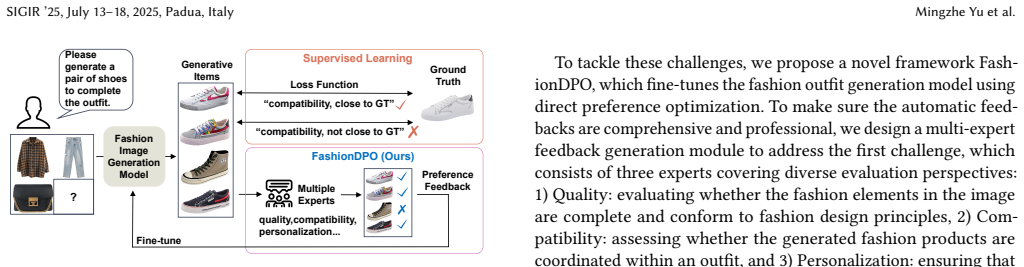
The load-bearing object is the multi-expert feedback pipeline paired with a DPO fine-tuning loop. Direct Preference Optimization is a training objective that upweights preferred outputs and downweights dispreferred ones relative to a frozen reference policy. For each generated candidate $i_{k,j,0}$, three scorers produce a weighted total: MiniCPM assigns a ten-level quality grade; a VBPR-style model scores visual compatibility between the candidate and the incomplete outfit; and a CLIP image encoder scores personalization as the cosine similarity between the candidate's embedding and the mean embedding of the user's same-category history. Candidates above the mean total score are labeled good, below are bad, and all within-outfit good-bad pairs enter the preference set. Fine-tuning then applies the DPO loss to the saved latents of each denoising timestep, with LoRA-restricted updates, so the pre-trained generator is pushed toward preferred candidates and away from dispreferred ones without training a reward model.
What would settle it
Run an independent preference study in which human raters or held-out click data compare FashionDPO and DiFashion outputs for the same users, and check whether human-preferred items score higher on Per than the model's choices; alternatively, retrain with a different personalization encoder and see whether the personalization gain of 60.39 versus 55.86 survives unchanged. If CLIP similarity to a mean embedding is not tracking true taste, the personalization improvement should shrink or reverse in such tests.
Extended reading notes
Core claim
On its own terms, the paper's central claim is that direct preference optimization can replace supervised imitation in fashion outfit generation when the preference signal comes from several automatic experts rather than human labels. Concretely, starting from DiFashion, the framework generates several candidate items for an incomplete outfit, scores each with quality, compatibility, and personalization experts, forms good-bad pairs from the weighted scores, and fine-tunes the diffusion model with a DPO loss at every saved denoising timestep. The reported results on iFashion PFITB are Inception Score 33.80 versus 29.99, compatibility 0.74 versus 0.58, and personalization 60.39 versus 55.86 for DiFashion, with analogous gains on Polyvore-U and on the from-scratch GOR task. The paper reads these gains as evidence that the model learns broader styling principles and user alignment than ground-truth imitation allows.
Load-bearing premise
The load-bearing premise is that a similarity score between a generated garment image and the averaged image of the user's past same-category items captures that user's fashion taste; because the same score both labels training examples and measures personalization, the claimed personalization gain could be partly an artifact of training to the evaluator.
Editorial extensions
If this is right
- If FashionDPO is right, a single fine-tuned model can serve both fill-in-the-blank and from-scratch outfit generation, since its reported scores are similar across the PFITB and GOR tasks.
- The framework removes the need for task-specific reward models or new human annotations for each trend cycle, because feedback experts can be swapped or upgraded without redesigning the pipeline.
- Because each expert contributes an independent signal, dropping any one of them measurably hurts its corresponding metric, so practitioners can diagnose which weakness needs a stronger expert.
- Using preference pairs instead of ground-truth imitation increases output diversity, as reflected in the Inception Score jump from 29.99 to 33.80 on iFashion PFITB, which matters for users who want alternatives rather than one canonical item.
Reading between the lines
- I infer that the reported personalization gain partly conflates training signal with evaluation metric: since the same CLIP similarity both labels preference pairs and defines Per, part of the 60.39 versus 55.86 gap may measure the model's fit to the metric rather than to human taste; an independent judgment test would separate these.
- Beyond the paper, the same generate-candidates, score-with-multiple-experts, DPO-fine-tune loop should transfer to other creative generation tasks with one-of-many ground truth, such as interior staging, recipe pairing, or logo design, because it needs no task-specific reward model.
- The ablation results suggest the experts are not equally easy to replace: swapping the compatibility scorer changes behavior more than swapping quality or personalization scorers, so investing in a stronger compatibility model is likely the highest-leverage next step.
Signed reviews
Editorial analysis
A structured set of objections, weighed in public.
Referee Report
Summary. The paper proposes FashionDPO, a framework that fine-tunes a pre-trained fashion outfit generation model (DiFashion, itself based on Stable Diffusion) using direct preference optimization (DPO). The key idea is to replace supervised fine-tuning on ground-truth items with preference learning driven by automatically generated multi-expert feedback. Three experts are used: a quality expert based on MiniCPM, a compatibility expert based on VBPR, and a personalization expert based on CLIP cosine similarity between a generated item and the averaged same-category interaction history embedding. The experts' scores are combined into a weighted total, thresholded to label generated items as 'Good' or 'Bad', and the resulting preference pairs are used in a DPO loss to fine-tune the diffusion model. Experiments on iFashion and Polyvore-U compare FashionDPO against several baselines and report improvements in Inception Score (IS), IS-accuracy, compatibility (measured by the OutfitGAN discriminator), and personalization (measured by CLIP cosine similarity). The paper also includes ablations, a small expert human study, analyses of data/time cost, alternative expert implementations, and hyperparameter sensitivity.
Significance. If the reported gains are robust, FashionDPO offers a useful recipe for aligning generative fashion models with user preferences without hand-designed reward functions, and the code release supports reproducibility. The framework's generality is a strength: the three evaluation perspectives are modular and the authors show that experts can be replaced. The diversity (IS) and compatibility (Comp.) improvements rest on metrics that are not identical to the training feedback, which is good. However, the personalization pillar is weakened by a train-on-the-evaluator issue: the same CLIP score is used both to construct preference labels and to evaluate personalization, so the reported Per. gains are not independent evidence. In addition, the quantitative comparisons lack error bars and significance tests. The central claim therefore needs additional evidence to be fully supported.
major comments (2)
- [Section 4.2, Eq. (10); Section 5.1.3; Table 1] The personalization expert score in Eq. (10) is the CLIP cosine similarity between a generated item and the averaged same-category history embedding, and the Per. evaluation metric in Section 5.1.3 is the same quantity. Because Eq. (11) incorporates this score into the weighted total that decides 'Good' vs 'Bad' labels, and the DPO loss in Eq. (18) is trained to increase the probability of the preferred item, the Per. improvements in Table 1 (e.g., 60.39 vs 55.86 on iFashion PFITB) can be at least partly attributed to training directly against the evaluation metric. This is not an independent measure of whether the generated items match an individual user's taste; it may simply reward stronger category-typical stylization. The paper should evaluate personalization with a metric that is not part of the training signal, for example a held-out user-item prediction model, a personalized retrieval task, or a human study that specifically tests whether generated items reflect the target user's style.
- [Table 1 and Table 2] All quantitative results are point estimates without variance, confidence intervals, or significance tests. Diffusion sampling and LoRA fine-tuning are stochastic, and some reported gains are small (e.g., IS-acc 0.90 to 0.91, Polyvore-U Comp. 0.80 to 0.83). To substantiate the claim that FashionDPO consistently outperforms DiFashion and other baselines, the paper should report means and standard deviations over multiple seeds or bootstrap resampling, and where appropriate apply paired significance tests over the test outfits.
minor comments (5)
- [Section 4.2, Eq. (11)] The min-max normalization norm(·) is not defined over which set of scores; please specify whether it is computed per-outfit over the m generated candidates or globally across the dataset.
- [Section 5.1.4 and Eq. (18)] The implementation states that the loss LDPO is computed and gradients are updated at each timestep, but it is unclear whether the final loss is a sum, an average, or a randomly sampled timestep loss over T steps. Please clarify the exact training procedure.
- [Section 5.3.3, Table 3] The human evaluation uses five fashion experts and 30 sets, but the paper does not describe how the 30 sets were sampled, whether each expert evaluated both models for the same incomplete outfits, or whether there was any inter-annotator agreement check. Reporting Fleiss' kappa or a similar measure would strengthen this evidence.
- [Section 5.4.2, Table 4] The 'Accuracy' metric in Table 4 is not defined. The paper should state the ground truth used to compute accuracy for each expert (e.g., human labels, agreement with another expert, or an external gold standard) so the reader can interpret the numbers.
- [Contributions list and Eq. (2)] There is a typo in the contributions list ('mulitple' should be 'multiple'). Also, Eq. (2) uses beta_1 and beta_2 without defining them, while Section 5.1.4 introduces beta_w and beta_l; please unify the notation.
Circularity Check
The personalization evaluation metric is the same CLIP cosine score used to label the DPO preference pairs, so the reported Per. gains are partly trained-to-the-evaluator.
-
fitted input called prediction
[Section 4.2, Eq. (10)-(13); Section 5.1.3; Table 1]
"Personalization. ... s_p = CLIP_Score(v_k, h_k) = (v_k·h_k)/(||v_k||||h_k||). (10) ... Personalization (Per.): We use the foundation model CLIP [31] to extract the image embeddings of the items that a user has interacted in the history. Then we calculate the cosine similarity between generated fashion items and history image embeddings."
The personalization expert score in Eq. (10) is a CLIP cosine similarity between a generated item and the user's history condition. This score enters the weighted total in Eq. (11), which determines whether an item is labeled 'Good' or 'Bad' in Eq. (13), and the DPO loss in Eq. (18) is optimized to increase that score. Section 5.1.3 defines the Per. evaluation metric as the same CLIP cosine similarity between generated items and history image embeddings, and Table 1 reports Per. as evidence of personalization. Consequently, the reported Per.
full rationale
The central circular step is confined to the personalization pillar. Eq. (10) defines the personalization expert as a CLIP cosine similarity to the history condition, Eq. (13) turns that score into DPO preference labels, and Section 5.1.3 reports the same type of CLIP cosine similarity as the Per. metric. Thus the model is explicitly fine-tuned to increase the quantity later reported as a personalization evaluation, making that portion of the headline result partly circular by construction. The other two pillars are evaluated with different instruments than their training experts: quality uses MiniCPM feedback but Inception Score evaluation, and compatibility uses VBPR feedback but the OutfitGAN discriminator for evaluation, so those claims retain independent content. The human evaluation in Table 3 was performed by fashion experts rating style, color, fabric, and variety, which supports compatibility and diversity but does not independently validate user-specific personalization. Self-citations to DiFashion and related prior work are not load-bearing for a circular argument; DiFashion is used as a base model, and the DPO framework is grounded in standard external references. Overall, the circularity is real but partial, affecting one of the three claimed evaluation perspectives.
Assumptions & free parameters
free parameters (6)
- beta (beta_w, beta_l) =
0.5
- expert weights alpha_q, alpha_c, alpha_p =
1, 1, 1
- preference threshold t =
average of scores
- number of generated candidates m =
7
- training subset size =
1000 outfits
- number of epochs =
5
assumptions (6)
- domain assumption If a final generated image is preferred, then the state and action at every intermediate denoising timestep are also preferred.
- domain assumption CLIP cosine similarity between a generated item and the average latent of the user's same-category history is a valid personalization signal.
- domain assumption VBPR trained with BPR on outfit-item matching accurately measures fashion compatibility.
- domain assumption MiniCPM's 10-level quality scores reflect human-perceived fashion image quality.
- domain assumption The Bradley-Terry preference model and the DPO derivation from Rafailov et al. apply to diffusion model outputs.
- domain assumption The pretrained DiFashion model provides a valid base policy and reference model.
Cite this review
Pith. "Pith review of FashionDPO:Fine-tune Fashion Outfit Generation Model using Direct Preference Optimization." pith.science (2026). https://pith.science/paper/N5I77JDN
@misc{pith2026250412900,
  author       = {Pith},
  title        = {Pith review of: FashionDPO:Fine-tune Fashion Outfit Generation Model using Direct Preference Optimization},
  year         = {2026},
  howpublished = {\url{https://pith.science/paper/N5I77JDN}},
  note         = {Machine review of arXiv:2504.12900}
}
read the original abstract
Personalized outfit generation aims to construct a set of compatible and personalized fashion items as an outfit. Recently, generative AI models have received widespread attention, as they can generate fashion items for users to complete an incomplete outfit or create a complete outfit. However, they have limitations in terms of lacking diversity and relying on the supervised learning paradigm. Recognizing this gap, we propose a novel framework FashionDPO, which fine-tunes the fashion outfit generation model using direct preference optimization. This framework aims to provide a general fine-tuning approach to fashion generative models, refining a pre-trained fashion outfit generation model using automatically generated feedback, without the need to design a task-specific reward function. To make sure that the feedback is comprehensive and objective, we design a multi-expert feedback generation module which covers three evaluation perspectives, \ie quality, compatibility and personalization. Experiments on two established datasets, \ie iFashion and Polyvore-U, demonstrate the effectiveness of our framework in enhancing the model's ability to align with users' personalized preferences while adhering to fashion compatibility principles. Our code and model checkpoints are available at https://github.com/Yzcreator/FashionDPO.
Figures


Figures from the paper (4 more)


Reference graph
Works this paper leans on
-
[1]
Wen Chen, Pipei Huang, Jiaming Xu, Xin Guo, Cheng Guo, Fei Sun, Chao Li, Andreas Pfadler, Huan Zhao, and Binqiang Zhao. 2019. POG: Personalized Outfit Generation for Fashion Recommendation at Alibaba iFashion. In KDD. ACM, 2662–2670
2019
-
[2]
Yujuan Ding, Zhihui Lai, P. Y. Mok, and Tat-Seng Chua. 2024. Computational Technologies for Fashion Recommendation: A Survey. ACM Comput. Surv. 56, 5 (2024), 121:1–121:45
work page 2024
-
[3]
Yujuan Ding, Yunshan Ma, Wenqi Fan, Yige Yao, Tat-Seng Chua, and Qing Li
-
[4]
Yujuan Ding, Yunshan Ma, Lizi Liao, Wai Keung Wong, and Tat-Seng Chua. 2022. Leveraging Multiple Relations for Fashion Trend Forecasting Based on Social Media. IEEE Trans. Multim. 24 (2022), 2287–2299
work page 2022
-
[5]
Yujuan Ding, P. Y. Mok, Yunshan Ma, and Yi Bin. 2023. Personalized fashion outfit generation with user coordination preference learning. Inf. Process. Manag. 60, 5 (2023), 103434
work page 2023
-
[6]
Xue Dong, Xuemeng Song, Fuli Feng, Peiguang Jing, Xin-Shun Xu, and Liqiang Nie. 2019. Personalized Capsule Wardrobe Creation with Garment and User Modeling. In ACM Multimedia. ACM, 302–310
work page 2019
-
[7]
Xiaoyu Du, Kun Qian, Yunshan Ma, and Xinguang Xiang. 2023. Enhancing item-level bundle representation for bundle recommendation. ACM Transactions on Recommender Systems (2023)
work page 2023
-
[8]
Junhong Gou, Siyu Sun, Jianfu Zhang, Jianlou Si, Chen Qian, and Liqing Zhang
Show all 60 references
-
[9]
Xintong Han, Zuxuan Wu, Yu-Gang Jiang, and Larry S. Davis. 2017. Learning Fashion Compatibility with Bidirectional LSTMs. In ACM Multimedia. ACM, 1078–1086
2017
-
[10]
Xintong Han, Zuxuan Wu, Zhe Wu, Ruichi Yu, and Larry S. Davis. 2018. VITON: An Image-Based Virtual Try-On Network. InCVPR. Computer Vision Foundation / IEEE Computer Society, 7543–7552
2018
-
[11]
Kaiming He, Xiangyu Zhang, Shaoqing Ren, and Jian Sun. 2015. Deep Residual Learning for Image Recognition. CoRR abs/1512.03385 (2015)
2015 arXiv
-
[12]
Ruining He and Julian J. McAuley. 2016. VBPR: Visual Bayesian Personalized Ranking from Implicit Feedback. In AAAI. AAAI Press, 144–150
2016
-
[13]
Jonathan Ho and Tim Salimans. 2022. Classifier-Free Diffusion Guidance. CoRR abs/2207.12598 (2022)
2022 arXiv
-
[14]
Qihan Huang, Long Chan, Jinlong Liu, Wanggui He, Hao Jiang, Mingli Song, and Jie Song. 2024. PatchDPO: Patch-level DPO for Finetuning-free Personalized Image Generation. CoRR abs/2412.03177 (2024)
2024 arXiv
-
[15]
Cong Phuoc Huynh, Arri Ciptadi, Ambrish Tyagi, and Amit Agrawal. 2018. CRAFT: Complementary Recommendations Using Adversarial Feature Trans- former. CoRR abs/1804.10871 (2018)
2018 arXiv
-
[16]
Jeongho Kim, Gyojung Gu, Minho Park, Sunghyun Park, and Jaegul Choo. 2023. StableVITON: Learning Semantic Correspondence with Latent Diffusion Model for Virtual Try-On. CoRR abs/2312.01725 (2023)
2023 arXiv
-
[17]
Hyeon-Ju Lee and Seok-Jun Buu. 2024. Deep Generative Replay With Denoising Diffusion Probabilistic Models for Continual Learning in Audio Classification. IEEE Access 12 (2024), 134714–134727
2024
-
[18]
Harrison Lee, Samrat Phatale, Hassan Mansoor, Kellie Lu, Thomas Mesnard, Colton Bishop, Victor Carbune, and Abhinav Rastogi. 2023. RLAIF: Scaling Reinforcement Learning from Human Feedback with AI Feedback. CoRR abs/2309.00267 (2023)
2023 arXiv
-
[19]
Harrison Lee, Samrat Phatale, Hassan Mansoor, Thomas Mesnard, Johan Ferret, Kellie Lu, Colton Bishop, Ethan Hall, Victor Carbune, Abhinav Rastogi, and Sushant Prakash. 2024. RLAIF vs. RLHF: Scaling Reinforcement Learning from Human Feedback with AI Feedback. In ICML. OpenReview.net
2024
-
[20]
Xingchen Li, Xiang Wang, Xiangnan He, Long Chen, Jun Xiao, and Tat-Seng Chua. 2020. Hierarchical Fashion Graph Network for Personalized Outfit Recom- mendation. In SIGIR. ACM, 159–168
2020
-
[21]
Zhanhao Liang, Yuhui Yuan, Shuyang Gu, Bohan Chen, Tiankai Hang, Ji Li, and Liang Zheng. 2024. Step-aware Preference Optimization: Aligning Preference with Denoising Performance at Each Step. CoRR abs/2406.04314 (2024)
2024 arXiv
-
[22]
Luping Liu, Yi Ren, Zhijie Lin, and Zhou Zhao. 2022. Pseudo Numerical Methods for Diffusion Models on Manifolds. In ICLR. OpenReview.net
2022
-
[23]
Xiaohao Liu, Jie Wu, Zhulin Tao, Yunshan Ma, Yinwei Wei, and Tat-Seng Chua
-
[24]
Zhi Lu, Yang Hu, Yan Chen, and Bing Zeng. 2021. Personalized Outfit Recom- mendation With Learnable Anchors. In CVPR. Computer Vision Foundation / IEEE, 12722–12731
2021
-
[25]
Zhi Lu, Yang Hu, Yunchao Jiang, Yan Chen, and Bing Zeng. 2019. Learning Binary Code for Personalized Fashion Recommendation. In CVPR. Computer Vision Foundation / IEEE, 10562–10570
2019
-
[26]
Yunshan Ma, Yujuan Ding, Xun Yang, Lizi Liao, Wai Keung Wong, and Tat-Seng Chua. 2020. Knowledge Enhanced Neural Fashion Trend Forecasting. In ICMR. ACM, 82–90
2020
-
[27]
Yunshan Ma, Yingzhi He, Xiang Wang, Yinwei Wei, Xiaoyu Du, Yuyangzi Fu, and Tat-Seng Chua. 2024. MultiCBR: Multi-view Contrastive Learning for Bundle Recommendation. ACM Trans. Inf. Syst. 42, 4 (2024), 100:1–100:23
2024
-
[28]
Maryam Moosaei, Yusan Lin, Ablaikhan Akhazhanov, Huiyuan Chen, Fei Wang, and Hao Yang. 2022. OutfitGAN: Learning Compatible Items for Generative Fashion Outfits. In CVPR Workshops. IEEE, 2272–2276
2022
-
[29]
Sanghyeon Na, Yonggyu Kim, and Hyunjoon Lee. 2024. Boost Your Own Human Image Generation Model via Direct Preference Optimization with AI Feedback. CoRR abs/2405.20216 (2024)
2024 arXiv
-
[30]
Gaurav Parmar, Richard Zhang, and Jun-Yan Zhu. 2022. On Aliased Resizing and Surprising Subtleties in GAN Evaluation. In CVPR. IEEE, 11400–11410
2022
-
[31]
Alec Radford, Jong Wook Kim, Chris Hallacy, Aditya Ramesh, Gabriel Goh, Sandhini Agarwal, Girish Sastry, Amanda Askell, Pamela Mishkin, Jack Clark, Gretchen Krueger, and Ilya Sutskever. 2021. Learning Transferable Visual Models From Natural Language Supervision. In ICML (Proce...
2021
-
[32]
Manning, Stefano Ermon, and Chelsea Finn
Rafael Rafailov, Archit Sharma, Eric Mitchell, Christopher D. Manning, Stefano Ermon, and Chelsea Finn. 2023. Direct Preference Optimization: Your Language Model is Secretly a Reward Model. In NeurIPS
2023
-
[33]
Steffen Rendle, Christoph Freudenthaler, Zeno Gantner, and Lars Schmidt-Thieme
-
[34]
Robin Rombach, Andreas Blattmann, Dominik Lorenz, Patrick Esser, and Björn Ommer. 2022. High-Resolution Image Synthesis with Latent Diffusion Models. In CVPR. IEEE, 10674–10685
2022
-
[35]
Yong-Siang Shih, Kai-Yueh Chang, Hsuan-Tien Lin, and Min Sun. 2018. Com- patibility Family Learning for Item Recommendation and Generation. In AAAI. AAAI Press, 2403–2410
2018
-
[36]
David Silver, Aja Huang, Chris J. Maddison, Arthur Guez, Laurent Sifre, George van den Driessche, Julian Schrittwieser, Ioannis Antonoglou, Vedavyas Pan- neershelvam, Marc Lanctot, Sander Dieleman, Dominik Grewe, John Nham, Nal Kalchbrenner, Ilya Sutskever, Timothy P. Lillicra...
2016
-
[37]
Lillicrap, Fan Hui, Laurent Sifre, George van den Driess- che, Thore Graepel, and Demis Hassabis
David Silver, Julian Schrittwieser, Karen Simonyan, Ioannis Antonoglou, Aja Huang, Arthur Guez, Thomas Hubert, Lucas Baker, Matthew Lai, Adrian Bolton, Yutian Chen, Timothy P. Lillicrap, Fan Hui, Laurent Sifre, George van den Driess- che, Thore Graepel, and Demis Hassabis. 201...
2017
-
[38]
Jiaming Song, Chenlin Meng, and Stefano Ermon. 2021. Denoising Diffusion Implicit Models. In ICLR. OpenReview.net
2021
-
[39]
Christian Szegedy, Vincent Vanhoucke, Sergey Ioffe, Jonathon Shlens, and Zbig- niew Wojna. 2016. Rethinking the Inception Architecture for Computer Vision. In CVPR. IEEE Computer Society, 2818–2826
2016
-
[40]
Bram Wallace, Meihua Dang, Rafael Rafailov, Linqi Zhou, Aaron Lou, Senthil Purushwalkam, Stefano Ermon, Caiming Xiong, Shafiq Joty, and Nikhil Naik
-
[41]
Yuxiang Wei, Yabo Zhang, Zhilong Ji, Jinfeng Bai, Lei Zhang, and Wangmeng Zuo
-
[42]
Zhenyu Xie, Zaiyu Huang, Xin Dong, Fuwei Zhao, Haoye Dong, Xijin Zhang, Feida Zhu, and Xiaodan Liang. 2023. GP-VTON: Towards General Purpose Virtual Try-On via Collaborative Local-Flow Global-Parsing Learning. In CVPR. IEEE, 23550–23559
2023
-
[43]
Yiyan Xu, Wenjie Wang, Fuli Feng, Yunshan Ma, Jizhi Zhang, and Xiangnan He
-
[44]
Yuhui Xu, Lingxi Xie, Xiaotao Gu, Xin Chen, Heng Chang, Hengheng Zhang, Zhengsu Chen, Xiaopeng Zhang, and Qi Tian. 2024. QA-LoRA: Quantization- Aware Low-Rank Adaptation of Large Language Models. In ICLR. OpenRe- view.net
2024
-
[45]
CoRR abs/2311.12908 (2023)
Diffusion Model Alignment Using Direct Preference Optimization. CoRR abs/2311.12908 (2023)
2023 arXiv
-
[46]
Zilin Yang, Zhuo Su, Yang Yang, and Ge Lin. 2018. From recommendation to generation: A novel fashion clothing advising framework. In2018 7th International Conference on Digital Home (ICDH) . IEEE, 180–186
2018
-
[47]
ELITE: Encoding Visual Concepts into Textual Embeddings for Customized Text-to-Image Generation. In ICCV. IEEE, 15897–15907
-
[48]
Mingzhe Yu, Yunshan Ma, Lei Wu, Kai Cheng, Xue Li, Lei Meng, and Tat-Seng Chua. 2024. Smart Fitting Room: A One-stop Framework for Matching-aware Virtual Try-On. In ICMR. ACM, 184–192
2024
-
[49]
Patel, Haochen Wang, Xun Huang, Ting-Chun Wang, Ming-Yu Liu, and Yogesh Balaji
Yu Zeng, Vishal M. Patel, Haochen Wang, Xun Huang, Ting-Chun Wang, Ming-Yu Liu, and Yogesh Balaji. 2024. JeDi: Joint-Image Diffusion Models for Finetuning- Free Personalized Text-to-Image Generation. In CVPR. IEEE, 6786–6795. FashionDPO: Fine-tune Fashion Outfit Generation Mod...
2024
-
[50]
In SIGIR
Diffusion Models for Generative Outfit Recommendation. In SIGIR. ACM, 1350–1359
-
[51]
Lvmin Zhang, Anyi Rao, and Maneesh Agrawala. 2023. Adding Conditional Control to Text-to-Image Diffusion Models. In ICCV. IEEE, 3813–3824
2023
-
[52]
Kai Yang, Jian Tao, Jiafei Lyu, Chunjiang Ge, Jiaxin Chen, Qimai Li, Weihan Shen, Xiaolong Zhu, and Xiu Li. 2023. Using Human Feedback to Fine-tune Diffusion Models without Any Reward Model. CoRR abs/2311.13231 (2023)
2023 arXiv
-
[54]
Yuan Yao, Tianyu Yu, Ao Zhang, Chongyi Wang, Junbo Cui, Hongji Zhu, Tianchi Cai, Haoyu Li, Weilin Zhao, Zhihui He, et al. 2024. MiniCPM-V: A GPT-4V Level MLLM on Your Phone. arXiv preprint arXiv:2408.01800 (2024)
2024 arXiv
-
[57]
Huijing Zhan, Jie Lin, Kenan Emir Ak, Boxin Shi, Ling-Yu Duan, and Alex C. Kot. 2022. $Aˆ3$-FKG: Attentive Attribute-Aware Fashion Knowledge Graph for Outfit Preference Prediction. IEEE Trans. Multim. 24 (2022), 819–831
2022
-
[59]
Efros, Eli Shechtman, and Oliver Wang
Richard Zhang, Phillip Isola, Alexei A. Efros, Eli Shechtman, and Oliver Wang
-
[2009]
BPR: Bayesian Personalized Ranking from Implicit Feedback. In UAI. AUAI Press, 452–461
-
[2018]
The Unreasonable Effectiveness of Deep Features as a Perceptual Metric. In CVPR. Computer Vision Foundation / IEEE Computer Society, 586–595
-
[2023]
In ACM Multimedia
Taming the Power of Diffusion Models for High-Quality Virtual Try-On with Appearance Flow. In ACM Multimedia. ACM, 7599–7607
-
[2024]
In WWW (Companion Volume)
FashionReGen: LLM-Empowered Fashion Report Generation. In WWW (Companion Volume). ACM, 991–994
-
[2025]
In KDD (1)
Fine-tuning Multimodal Large Language Models for Product Bundling. In KDD (1). ACM, 848–858
Reviewed August 16, 2026 · model on record in the stance chip above.
Discussion (0). Continue with ORCID to comment.