REVIEW 2 major objections 6 minor 113 references
Customizing Emotional Support: How Do Individuals Construct and Interact With LLM-Powered Chatbots
T0 review · 2 major / 6 minor · reviewed 2026-08-16 · deepseek-v4-flash
Pith's one-line read This paper reports that, given a customizable LLM chatbot, socially lonely adults construct personas for emotional reliance, confronting stressors, intellectual discourse, self-discovery, and therapeutic support, then enrich them with…
desk verdict A useful RtD study of LLM persona customization, but the protocol's explicit nudge to customize means the taxonomy partly reflects the probe's demands. read the letter →
The pith
A machine-rendered reading of the paper's core claim, the machinery that carries it, and where it could break.
The reading
What carries the argument
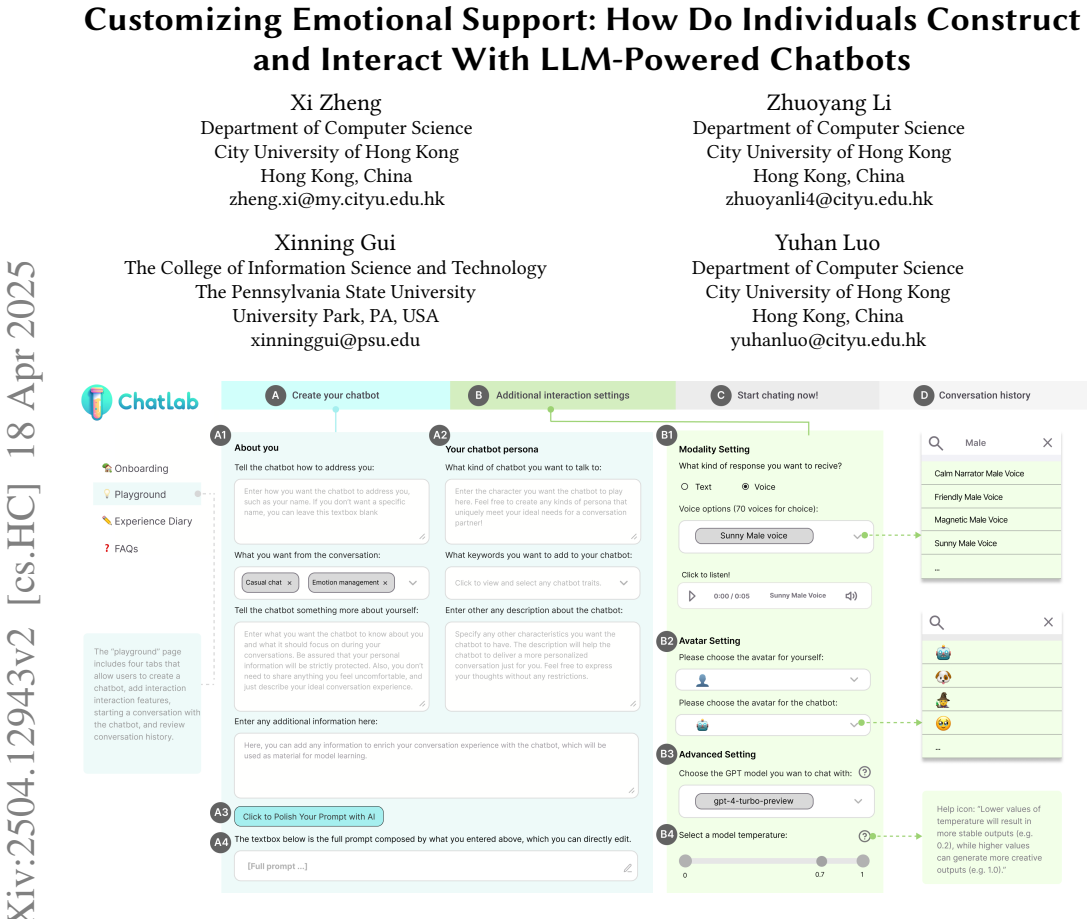
The carrying object is ChatLab, a research prototype built as a design probe. Its customization interface combines a structured template of text boxes in which users describe themselves and their desired chatbot persona, with hints and an optional AI-polish feature that composes the entries into a prompt; an editable full prompt sent to the language model; a library of 70 Mandarin voices and 77 emoji avatars; and model and temperature controls. This machinery matters because it lets verbal and non-verbal cues be customized in the same loop, which is what revealed the practices of persona enrichment and relationship shaping.
What would settle it
Run the same deployment with the same customization tool but remove the daily reminders, the five-diary-entry minimum, and the tutorial's encouragement to be creative, and compare whether participants still construct multiple personas and actively adjust voices and avatars; if most users settle into one default persona and rarely touch voice or avatar settings, the claim that such construction is a natural practice would be contradicted.
Extended reading notes
Core claim
The central discovery is that lay users treat an LLM chatbot's customization surface as a staging ground for conversations, not merely an output setting. Participants wrote themselves and their chatbot into roles—a beloved pet, a crush, an irritable advisor, an ex-partner, a philosopher, a mirror of the self, a psychologist—and matched those roles with voices and avatars to make the interaction feel coherent and emotionally charged. The paper argues these construction practices serve real emotional work: confronting unresolved stressors, exploring existential questions, experiencing alternative perspectives through role play, and pushing the chatbot past polite neutrality toward candor. It also documents that attempts to make chatbots deliberately 'bad,' angry, or intense often failed because the models stayed too neutral, which the paper treats as a limitation of current LLM behavior in this context.
Load-bearing premise
The load-bearing premise is that the personas and interaction choices observed reflect the participants' own needs and creativity, rather than being substantially manufactured by the study's daily reminders, required diary entries, tutorial urging creativity, and template hints with an AI polish feature.
Editorial extensions
If this is right
- Chatbot customization for emotional support will be used for purposes beyond getting comfort, including confronting people or situations that cause stress and exploring philosophical questions.
- Voice and avatar choices function as social cues that users align with persona identity and use to express their own mood, so design should treat them as first-class customization options rather than decorations.
- Users will write personal anecdotes and role-play instructions into prompts to steer conversational dynamics, asking for autonomy, emotional intensity, and even profanity to escape neutral assistant tones.
- Current LLMs respond too neutrally to sustain deliberately negative or confrontational personas, so users' attempts at emotionally intense role play often fall flat.
- Future support tools should offer proactive learning from user traces, adjustable memory retention and blocking, AI-assisted persona construction, and community sharing of personas.
Reading between the lines
- If the customization template itself is what prompts reflection, then a structured persona-builder could serve as a lightweight emotional articulation tool independent of the chatbot's response quality; a testable extension would compare well-being outcomes between users who write detailed personas and users who pick preset personas.
- The repeated failure of 'too neutral' responses suggests a design space for user-controlled emotional intensity and safety constraints, in which users could authorize the chatbot to be harsh or provocative in a bounded role-play setting.
- The emphasis on local accents and well-known regional voices in this Chinese sample implies dialect-localized voice libraries may be a decisive customization feature for non-English emotional-support chatbots, rather than a peripheral nicety.
- Participants' varied memory preferences point toward 'blockable' rather than deletable memory as a mechanism that respects evolving emotional states; this could be studied by testing whether blocked memories resurface in later sessions.
Signed reviews
Editorial analysis
A structured set of objections, weighed in public.
Referee Report
Summary. The paper reports a Research through Design (RtD) study of ChatLab, a prototype platform that lets users construct custom LLM-powered chatbots for emotional support by specifying persona descriptions, avatars, voices, model choice, and temperature. Twenty-two Chinese participants experiencing moderate to high social loneliness used ChatLab for seven to ten days, completed diary entries, and took part in interviews and design activities. The authors identify five categories of persona construction (emotional reliance, confronting stressors, intellectual discourse, self-discovery, and therapeutic support), describe how participants enriched personas with voice/avatar choices and relationship dynamics, and synthesize design implications for future emotional-support chatbots. The main claimed contributions are an empirical account of real-world customization practices and design implications for individualized emotional support in the age of generative AI.
Significance. If the descriptive findings are taken as evidence about how lay users customize LLM chatbots, the paper fills a real gap: prior work emphasized surface-level customization or prompt engineering, while this study captures rich, longitudinal data on persona construction and multimodal enrichment. The paper's strengths include a systematic thematic analysis grounded in 693 codes, abundant participant quotes, conversation logs, diary entries, and transparent reporting of the prototype and procedure. The authors also deserve credit for acknowledging in Section 7.1 that the customization template nudged participants to reflect on themselves and their chatbot. The all-Chinese sample is acknowledged in Section 8. However, the central claim about 'real-world practices' is weakened by a protocol that actively encouraged customization, and the manuscript does not analyze this confound; this is the main correctness risk.
major comments (2)
- [Sections 3.1.3, 4.2.2, 4.2.3, and 7.1] The protocol actively prompted the very behavior the paper claims to observe. Section 3.1.3 states that the design needed to 'encourage active customization throughout the study period'; Section 4.2.2 reports that participants were explicitly 'encouraged to be creative and explore various ways to construct a conversation partner'; and Section 4.2.3 required daily use, at least five diary entries, and daily reminders. The diary form itself asked about customization settings and reasons, and Section 7.1 concedes that the template 'explicitly nudged participants to enter information about themselves and the chatbot.' The paper frames its findings as answering RQ1 ('how individuals construct and interact') and as 'real-world practices' in the contribution statement in Section 1, yet it never analyzes whether the observed customization was induced by these study pressures. This is load-bearing because the five-category taxonomy in Table 3 may reflect demand characteristics of the probe rather than naturalistic user behavior. I ask the authors to either provide evidence that persona creation was not clustered around reminders or diary deadlines (e.g., time-stamped logs relative to reminders), compare early versus late days of the study, or explicitly reframe the contribution as 'practices within a customization-encouraging probe' and discuss the consequence for generalizability. Section 8 does not currently address this issue.
- [Table 2 and Section 5.1] The paper reports a wide range of persona counts (1 to 13 per participant) and engagement levels (total rounds from 31 to 148), but it does not connect this variability to the protocol's encouragements. If the goal is to describe how individuals construct personas, the analysis should distinguish personas that arose from the participant's own initiative from those that were produced to satisfy the minimum diary requirement or after a reminder. The authors have the conversation logs and diary timestamps needed to perform this check; without it, the claim that participants 'actively constructed' personas for the five purposes in Table 3 is not fully supported. A targeted analysis of persona-creation timing and diary-entry timing would substantially strengthen the central descriptive claim.
minor comments (6)
- [Section 7.2] Typo: 'custimization' should be 'customization' in the heading 'Opportunities for Individualized Emotional Support.'
- [Section 4.2.4] Typo: 'custmoize' should be 'customize' in the description of the design activity.
- [Table 2, footnote c] The voice name 'Onxy' should be 'Onyx' for consistency with OpenAI's naming.
- [Table 3] The philosopher 'Jean-Paul Sartre' is misspelled as 'Satre' in the 'Philosophical figure' row and in the text near Section 5.4.1; please correct this.
- [Abstract and Section 5.1] The abstract lists four persona purposes and then 'etc.', while the paper identifies five categories; consider listing all five in the abstract for accuracy.
- [Section 3.2.2 and Section 4.2.2] There is a tension between the design goal of an open, non-leading customization interface (DR1) and the tutorial's explicit encouragement to 'be creative and explore various ways to construct a conversation partner'; the paper should reconcile these descriptions or explain the intended balance.
Circularity Check
No circularity: the paper's claims are empirical findings grounded in participant data, and self-citations are background only.
full rationale
This is a qualitative Research through Design study with no quantitative derivation, fitted parameters, or formal prediction that could reduce to its inputs. The central claims—that participants constructed chatbot personas for emotional reliance, confronting stressors, intellectual discourse, self-discovery, and therapeutic support, and that they enriched personas with voices and avatars—are supported by participant customization logs, diary entries, interviews, and design artifacts (e.g., Table 2 and Table 3). The five-category taxonomy emerges from thematic analysis of that independent participant data, not from a prior definition that presupposes the result. The paper's self-citations (e.g., refs. 50 and 51) are used as related-work background and design inspiration, not as load-bearing arguments that force the findings. The concern that the field protocol actively encouraged customization (tutorial, reminders, required diary entries, structured template) is a legitimate study-validity limitation, and the paper itself acknowledges that the template 'explicitly nudged participants to enter information about themselves and the chatbot' (Section 7.1), but this is a question of ecological validity or demand characteristics, not circularity. No step in the paper's reasoning is equivalent to its inputs by construction. Score 0.
Assumptions & free parameters
assumptions (3)
- domain assumption Participants' self-reports in interviews and diaries are truthful reflections of their emotional needs and customization motivations.
- domain assumption A social loneliness score above 40 on the UCLA Loneliness Scale identifies individuals with moderate to high social loneliness in the Chinese recruitment context.
- domain assumption Behavior in a 7 to 10 day compensated study with daily reminders reflects real-world chatbot customization practices.
Cite this review
Pith. "Pith review of Customizing Emotional Support: How Do Individuals Construct and Interact With LLM-Powered Chatbots." pith.science (2026). https://pith.science/paper/Y6W34YCX
@misc{pith2026250412943,
  author       = {Pith},
  title        = {Pith review of: Customizing Emotional Support: How Do Individuals Construct and Interact With LLM-Powered Chatbots},
  year         = {2026},
  howpublished = {\url{https://pith.science/paper/Y6W34YCX}},
  note         = {Machine review of arXiv:2504.12943}
}
read the original abstract
Personalized support is essential to fulfill individuals' emotional needs and sustain their mental well-being. Large language models (LLMs), with great customization flexibility, hold promises to enable individuals to create their own emotional support agents. In this work, we developed ChatLab, where users could construct LLM-powered chatbots with additional interaction features including voices and avatars. Using a Research through Design approach, we conducted a week-long field study followed by interviews and design activities (N = 22), which uncovered how participants created diverse chatbot personas for emotional reliance, confronting stressors, connecting to intellectual discourse, reflecting mirrored selves, etc. We found that participants actively enriched the personas they constructed, shaping the dynamics between themselves and the chatbot to foster open and honest conversations. They also suggested other customizable features, such as integrating online activities and adjustable memory settings. Based on these findings, we discuss opportunities for enhancing personalized emotional support through emerging AI technologies.
Figures


Reference graph
Works this paper leans on
-
[1]
Abd-alrazaq, Mohannad Alajlani, Ali Abdallah Alalwan, Bridgette M
Alaa A. Abd-alrazaq, Mohannad Alajlani, Ali Abdallah Alalwan, Bridgette M. Bewick, Peter Gardner, and Mowafa Househ. 2019. An overview of the features of chatbots in mental health: A scoping review. International Journal of Medical Informatics 132 (2019), 103978. https://doi.org/10.1016/j.ijmedinf.2019.103978
-
[2]
Pi AI. 2024. Pi, your personal AI. https://pi.ai/talk. Accessed: 2024-08-01
2024
-
[3]
Dwivedi, Shahriar Sajib, Kumar Biswas, Ruwan J
Shahriar Akter, Yogesh K. Dwivedi, Shahriar Sajib, Kumar Biswas, Ruwan J. Bandara, and Katina Michael. 2022. Algorithmic bias in machine learning- based marketing models. Journal of Business Research 144 (2022), 201–216. https://doi.org/10.1016/j.jbusres.2022.01.083
-
[4]
Alaa Alslaity, Gerry Chan, Rita Orji, and Richard Wilson. 2022. Insights From Longitudinal Evaluation of Moodie Mental Health App. In Extended Abstracts of the 2022 CHI Conference on Human Factors in Computing Systems (New Orleans, LA, USA) (CHI EA ’22). Association for Computing Machinery, New York, NY, USA, Article 308, 8 pages. https://doi.org/10.1145/...
arXiv 2022
-
[5]
Anxiety & Depression Association of America (ADAA). 2023. Anxiety Disor- ders - Facts & Statistics. https://adaa.org/understanding-anxiety/facts-statistics. Accessed: 2024-08-01
2023
-
[6]
Daniel Luccas Arenas, Anna Viduani, and Renata Brasil Araujo. 2022. Ther- apeutic use of role-playing game (RPG) in mental health: A scoping review. Simulation & Gaming 53, 3 (2022), 285–311
2022
-
[7]
Merve Aydın and Fatma Yasemin Kutlu. 2021. The Effect of Group Art Therapy on Loneliness and Hopelessness Levels of Older Adults Living Alone: A Ran- domized Controlled Study. Florence Nightingale Journal of Nursing 29, 3 (Oct 2021), 271–284. https://doi.org/10.5152/FNJN.2021.20224
-
[8]
Amid Ayobi, Paul Marshall, and Anna L Cox. 2020. Trackly: A customisable and pictorial self-tracking app to support agency in multiple sclerosis self-care. In Proceedings of the 2020 CHI Conference on Human Factors in Computing Systems . 1–15. https://doi.org/10.1145/3313831.3376809
arXiv 2020
Show all 113 references
-
[9]
Johnna Blair, Yuhan Luo, Ning F Ma, Sooyeon Lee, and Eun Kyoung Choe
-
[10]
Cowan, Anja Thieme, and Gavin Doherty
Robert Bowman, Benjamin R. Cowan, Anja Thieme, and Gavin Doherty. 2022. Beyond Subservience: Using Joint Commitment to Enable Proactive CUIs for Mood Logging. In Proceedings of the 4th Conference on Conversational User Interfaces (CUI ’22). Association for Computing Machinery,...
2022
-
[11]
Virginia Braun and Victoria Clarke. 2006. Using thematic analysis in psy- chology. Qualitative research in psychology 3, 2 (2006), 77–101. https: //doi.org/1478088706qp063oa
2006
-
[12]
Evelien PM Brouwers. 2020. Social stigma is an underestimated contributing factor to unemployment in people with mental illness or mental health issues: position paper and future directions. BMC psychology 8 (2020), 1–7. https: //doi.org/10.1186/s40359-020-00399-0
2020 doi
-
[13]
Yekta Said Can and Cem Ersoy. 2021. Privacy-preserving federated deep learning for wearable IoT-based biomedical monitoring. ACM Transactions on Internet Technology (TOIT) 21, 1 (2021), 1–17. https://doi.org/10.1145/3428152
2021 doi
-
[14]
Stevie Chancellor and Munmun De Choudhury. 2020. Methods in predictive techniques for mental health status on social media: a critical review.NPJ digital medicine 3, 1 (2020), 43. https://www.nature.com/articles/s41746-020-0233-7
2020
-
[15]
character.ai. 2024. character.ai. https://character.ai/. Accessed: 2024-08-01
2024
-
[16]
Siyuan Chen, Mengyue Wu, Kenny Q Zhu, Kunyao Lan, Zhiling Zhang, and Lyuchun Cui. 2023. LLM-empowered Chatbots for Psychiatrist and Patient Simulation: Application and Evaluation. arXiv preprint arXiv:2305.13614 (2023). https://arxiv.org/abs/2305.13614
2023 arXiv
- [17]
-
[18]
I’m Hurt Too
Liz L Chung and Jeannie Kang. 2023. “I’m Hurt Too”: The Effect of a Chatbot’s Reciprocal Self-Disclosures on Users’ Painful Experiences. Archives of Design Research 36, 4 (2023), 67–84. http://dx.doi.org/10.15187/adr.2023.11.36.4.67
2023 doi
-
[20]
Joseph Crawford, Kelly-Ann Allen, Bianca Pani, and Michael Cowling. 2024. When artificial intelligence substitutes humans in higher education: the cost of loneliness, student success, and retention. Studies in Higher Education 49, 5 (2024), 883–897. https://doi.org/10.1080/030...
2024
-
[21]
Ebert, Ceren Acarturk, Gerhard Andersson, and Ioana A
Pim Cuijpers, David D. Ebert, Ceren Acarturk, Gerhard Andersson, and Ioana A. Cristea. 2016. Personalized Psychotherapy for Adult Depression: A Meta- Analytic Review. Behavior Therapy 47, 6 (2016), 966–980. https://doi.org/ 10.1016/j.beth.2016.04.007 Special 50th Anniversary I...
2016 doi
-
[22]
Paula Maia de Souza, Isabella da Costa Pires, Vivian Genaro Motti, He- lena Medeiros Caseli, Jair Barbosa Neto, Larissa C Martini, and Vânia Paula de Almeida Neris. 2022. Design recommendations for chatbots to support people with depression. In Proceedings of the 21st Brazilia...
2022
-
[23]
LangChain Developers. 2024. LangChain. https://www.langchain.com/. Ac- cessed: 2024-08-01
2024
-
[24]
Streamlit Developers. 2024. Streamlit. https://streamlit.io/. Accessed: 2024-08- 01
2024
-
[25]
Xianghua Ding, Linda Tran, Yanling Liu, Conor O’Neill, and Stephen Lindsay
-
[27]
Jasper Feine, Ulrich Gnewuch, Stefan Morana, and Alexander Maedche. 2019. A Taxonomy of Social Cues for Conversational Agents. International Journal of Human-Computer Studies 132 (2019), 138–161. https://doi.org/10.1016/j.ijhcs. 2019.07.009
2019 doi
-
[28]
Firebase. 2024. Firebase. https://firebase.google.com/. Accessed: 2024-08-01
2024
-
[29]
Kathleen Kara Fitzpatrick, Alison Darcy, and Molly Vierhile. 2017. Deliver- ing Cognitive Behavior Therapy to Young Adults With Symptoms of Depres- sion and Anxiety Using a Fully Automated Conversational Agent (Woebot): A Randomized Controlled Trial. JMIR Ment Health 4, 2 (06 ...
2017 doi
-
[30]
Marc Galanter and David Brook. 2001. Network Therapy for Addiction: Bringing Family and Peer Support into Office Practice. International Journal of Group Psychotherapy 51, 1 (2001), 101–122. https://doi.org/10.1521/ijgp.51.1.101.49734 PMID: 11191590
2001 doi
-
[31]
Gallup. 2023. Almost a Quarter of the World Feels Lonely. https://news.gallup.com/opinion/gallup/512618/almost-quarter-world- feels-lonely.aspx. Accessed: 2024-08-01
2023
-
[32]
Alyson Gamble. 2020. Artificial intelligence and mobile apps for mental health- care: a social informatics perspective. Aslib Journal of Information Management 72, 4 (2020), 509–523. https://doi.org/10.1108/AJIM-11-2019-0316
2020 doi
-
[33]
Ge Gao, Jian Zheng, Eun Kyoung Choe, and Naomi Yamashita. 2022. Taking a language detour: How international migrants speaking a minority language seek covid-related information in their host countries. Proceedings of the ACM on Human-Computer Interaction 6, CSCW2 (2022), 1–32....
2022
-
[34]
Ruth Guest. 2024. TikTok & the self: The relationship between self-concept clarity and self-presentation in adult TikTok creators . Ph. D. Dissertation. Institute of Art, Design+ Technology
2024
-
[35]
Abhijit Guha, Timna Bressgott, Dhruv Grewal, Dominik Mahr, Martin Wetzels, and Elisa Schweiger. 2023. How artificiality and intelligence affect voice assistant evaluations. Journal of the Academy of Marketing Science 51, 4 (2023), 843–866. https://doi.org/10.1007/s11747-022-00874-7
2023 doi
-
[36]
Xinning Gui, Yu Chen, Yubo Kou, Katie Pine, and Yunan Chen. 2017. Investigat- ing Support Seeking from Peers for Pregnancy in Online Health Communities. Proc. ACM Hum.-Comput. Interact. 1, CSCW, Article 50 (dec 2017), 19 pages. https://doi.org/10.1145/3134685
2017 doi
-
[38]
Salah Hamdoun, Rebecca Monteleone, Terri Bookman, and Katina Michael
-
[39]
M D Romael Haque and Sabirat Rubya. 2023. An Overview of Chatbot-Based Mobile Mental Health Apps: Insights From App Description and User Reviews. JMIR Mhealth Uhealth 11 (22 May 2023), e44838. https://doi.org/10.2196/44838
2023 doi
-
[40]
Camilla Gudmundsen Høiland, Asbjørn Følstad, and Amela Karahasanovic
-
[41]
IEEE Technology and Society Magazine 42, 1 (2023), 25–36
AI-Based and Digital Mental Health Apps: Balancing Need and Risk. IEEE Technology and Society Magazine 42, 1 (2023), 25–36. https://doi.org/10.1109/ MTS.2023.3241309
2023
-
[42]
Eunkyung Jo, Daniel A Epstein, Hyunhoon Jung, and Young-Ho Kim. 2023. Understanding the benefits and challenges of deploying conversational AI leveraging large language models for public health intervention. In Proceed- ings of the 2023 CHI Conference on Human Factors in Compu...
2023
-
[43]
Corey LM Keyes. 2012. Promoting and protecting positive mental health: Early and often throughout the lifespan. In Mental well-being: International contributions to the study of positive mental health . Springer, 3–28. https: //doi.org/10.1007/978-94-007-5195-8_1
2012 doi
-
[44]
Killgore, Sara A
William D.S. Killgore, Sara A. Cloonan, Emily C. Taylor, and Natalie S. Dailey
-
[45]
Anam Jamil, Jaweria Syed, Sumaira Kanwal, Qurrat ul Ain, Nazma Namroz, Areej Gul, and Aniqa Jamil. 2023. Loneliness and mental health related impacts of COVID-19: a narrative review. International Journal of Adolescent Medicine and Health 35, 1 (2023), 21–30. https://doi.org/1...
2023 doi
-
[46]
Sung-In Kim, Eunkyung Jo, Myeonghan Ryu, Inha Cha, Young-Ho Kim, Heejung Yoo, and Hwajung Hong. 2019. Toward becoming a better self: Understanding self-tracking experiences of adolescents with autism spectrum disorder using custom trackers. In Proceedings of the 13th EAI Inter...
2019
-
[47]
Taewan Kim, Donghoon Shin, Young-Ho Kim, and Hwajung Hong. 2024. Di- aryMate: Understanding User Perceptions and Experience in Human-AI Collab- oration for Personal Journaling. In Proceedings of the CHI Conference on Human Factors in Computing Systems . 1–15. https://doi.org/1...
2024
-
[48]
Minha Lee, Sander Ackermans, Nena Van As, Hanwen Chang, Enzo Lucas, and Wijnand IJsselsteijn. 2019. Caring for Vincent: a chatbot for self-compassion. In Proceedings of the 2019 CHI Conference on Human Factors in Computing Systems . 1–13. https://doi.org/10.1145/3290605.3300932
2019
-
[49]
Psychiatry Research 290 (2020), 113117
Loneliness: A signature mental health concern in the era of COVID-19. Psychiatry Research 290 (2020), 113117. https://doi.org/10.1016/j.psychres.2020. 113117
2020 doi
-
[50]
Byeongho Kim, Sanghoon Cha, Sangsoo Park, Jieun Lee, Sukhan Lee, Shin- haeng Kang, Jinin So, Kyungsoo Kim, Jin Jung, Jong-Geon Lee, et al. 2024. The Breakthrough Memory Solutions for Improved Performance on LLM Inference. IEEE Micro (2024). https://doi.org/10.1109/MM.2024.3375352
2024
-
[51]
This is Human Intelligence Debugging Artificial Intelligence
Zhuoyang Li, Zihao Zhu, Xinning Gui, and Yuhan Luo. [n. d.]. “This is Human Intelligence Debugging Artificial Intelligence”: Examining How People Prompt GPT in Seeking Mental Health Support. A vailable at SSRN 4875898 ([n. d.]). https://ssrn.com/abstract=4875898
-
[52]
Sebastian Linxen, Christian Sturm, Florian Brühlmann, Vincent Cassau, Klaus Opwis, and Katharina Reinecke. 2021. How WEIRD is CHI?. In Proceedings of the 2021 CHI Conference on Human Factors in Computing Systems (Yokohama, Japan) (CHI ’21). Association for Computing Machinery,...
2021
- [53]
-
[54]
Yi-Chieh Lee, Naomi Yamashita, and Yun Huang. 2020. Designing a Chatbot as a Mediator for Promoting Deep Self-Disclosure to a Real Mental Health Professional. Proc. ACM Hum.-Comput. Interact. 4, CSCW1, Article 31 (may Customizing Emotional Support Conference’17, July 2017, Was...
2020 doi
-
[55]
Zhuoyang Li, Minhui Liang, Ray Lc, and Yuhan Luo. 2024. StayFocused: Ex- amining the Effects of Reflective Prompts and Chatbot Support on Compul- sive Smartphone Use. In Proceedings of the CHI Conference on Human Fac- tors in Computing Systems (Honolulu, HI, USA) (CHI ’24) . A...
2024
-
[56]
Yuhan Luo, Young-Ho Kim, Bongshin Lee, Naeemul Hassan, and Eun Kyoung Choe. 2021. FoodScrap: Promoting Rich Data Capture and Reflective Food Journaling Through Speech Input.. In Proceedings of the 2021 Conference on Designing Interactive System. ACM. https://doi.org/10.1145/34...
2021
-
[57]
Yuhan Luo, Bongshin Lee, and Eun Kyoung Choe. 2020. TandemTrack: shaping consistent exercise experience by complementing a mobile app with a smart speaker. In Proceedings of the 2020 CHI Conference on Human Factors in Comput- ing Systems. ACM, 1–13. https://doi.org/10.1145/331...
2020
-
[58]
Yuhan Luo, Bongshin Lee, Young-Ho Kim, Eun Kyoung Choe, et al. 2022. Note- Wordy: Investigating Touch and Speech Input on Smartphones for Personal Data Capture. proc. of the ACM on Human-Computer Interaction, Interactive Surfaces and Spaces (ISS), (To appear) . https://doi.org...
2022 doi
-
[59]
Pengfei Liu, Weizhe Yuan, Jinlan Fu, Zhengbao Jiang, Hiroaki Hayashi, and Graham Neubig. 2023. Pre-train, Prompt, and Predict: A Systematic Survey of Prompting Methods in Natural Language Processing. ACM Comput. Surv. 55, 9, Article 195 (jan 2023), 35 pages. https://doi.org/10...
2023 doi
-
[60]
Maria Lundvall, Lina Palmér, Ulrica Hörberg, Gunilla Carlsson, and Elisabeth Lindberg. 2022. Finding an existential place to rest: enabling well-being in young adults. International Journal of Qualitative Studies on Health and Well-being 17, 1 (2022), 2109812. https://doi.org/...
2022
-
[61]
Robert J Meyers, Hendrik G Roozen, and Jane Ellen Smith. 2011. The community reinforcement approach: An update of the evidence. Alcohol Research & Health 33, 4 (2011), 380. https://pubmed.ncbi.nlm.nih.gov/23580022/
2011
- [62]
-
[63]
Steven Todd Mortenson. 1999. Cultural variations in emotion and effective emotional support processes: Documenting differences in the experience, expression, and management of emotional distress . Ph. D. Dissertation. Purdue University. https://www.proquest.com/docview/276331172
1999
- [64]
-
[65]
Jingbo Meng and Yue Dai. 2021. Emotional support from AI chatbots: Should a supportive partner self-disclose or not? Journal of Computer-Mediated Commu- nication 26, 4 (2021), 207–222. https://doi.org/10.1093/jcmc/zmab005
2021 doi
-
[66]
OpenAI. 2024. OpenAIgpt. https://openai.com/index/openai-api/. Accessed: 2024-08-01
2024
-
[67]
World Health Organization. 2019. Mental disorders. https://www.who.int/news- room/fact-sheets/detail/mental-disorders. Accessed: 2024-08-01
2019
-
[68]
World Health Organization. 2023. Stress. https://applications.emro.who.int/docs/WHOEMMNH236E-eng.pdf?ua=1. Accessed: 2024-08-01
2023
-
[69]
John A Naslund and Kelly A Aschbrenner. 2019. Risks to privacy with use of social media: understanding the views of social media users with serious mental illness. Psychiatric services 70, 7 (2019), 561–568. https://doi.org/10.1176/appi. ps.201800520
2019 doi
-
[70]
OpenAI. 2024. Memory and new controls for ChatGPT. https://openai.com/index/memory-and-new-controls-for-chatgpt/. Ac- cessed: 2024-08-01
2024
-
[71]
Pennebaker
James W. Pennebaker. 1997. Writing About Emotional Experiences as a Therapeutic Process. Psychological Science 8, 3 (1997), 162–166. https:// doi.org/10.1111/j.1467-9280.1997.tb00403.x arXiv:https://doi.org/10.1111/j.1467- 9280.1997.tb00403.x
1997
-
[72]
Hua Xuan Qin, Shan Jin, Ze Gao, Mingming Fan, and Pan Hui. 2024. Char- acterMeet: Supporting Creative Writers’ Entire Story Character Construction Processes Through Conversation with LLM-Powered Chatbot Avatars. In Pro- ceedings of the CHI Conference on Human Factors in Comput...
2024
-
[73]
Quora. 2024. Poe. https://poe.com/. Accessed: 2024-08-01
2024
-
[75]
Stephen C Paul, Nina Bartmann, and Jenna L Clark. 2021. Customizability in conversational agents and their impact on health engagement. Human Behavior and Emerging Technologies 3, 5 (2021), 1141–1152. https://doi.org/10.1002/hbe2. 320
2021 doi
-
[76]
Peplau, and Mary L
Daniel Russell, Letitia A. Peplau, and Mary L. Ferguson. 1978. Developing a measure of loneliness. Journal of Personality Assessment 42 (1978), 290–294. https://pubmed.ncbi.nlm.nih.gov/660402/
1978
-
[77]
Rebecca L Schneider, Joanna J Arch, and Kate B Wolitzky-Taylor. 2015. The state of personalized treatment for anxiety disorders: A systematic review of treatment moderators. Clinical psychology review 38 (2015), 39–54. https: //pubmed.ncbi.nlm.nih.gov/25795293/
2015
-
[78]
Crisitina Segalin, Alessandro Perina, Marco Cristani, and Alessandro Vinciarelli
-
[79]
Replika. 2024. Replika: The AI Friend. https://replika.ai. Accessed: 2024-08-01
2024
-
[80]
Jacqueline M Roehl and Darci J Harland. 2022. Imposter participants: Overcom- ing methodological challenges related to balancing participant privacy with data quality when using online recruitment and data collection. The qualitative report 27, 11 (2022), 2469–2485. https://do...
2022
-
[81]
Ashish Sharma, Kevin Rushton, Inna Wanyin Lin, Theresa Nguyen, and Tim Althoff. 2024. Facilitating Self-Guided Mental Health Interventions Through Human-Language Model Interaction: A Case Study of Cognitive Restructuring. In Proceedings of the CHI Conference on Human Factors i...
2024
-
[82]
Will Simm, Maria Angela Ferrario, Adrian Gradinar, Marcia Tavares Smith, Stephen Forshaw, Ian Smith, and Jon Whittle. 2016. Anxiety and Autism: Towards Personalized Digital Health. In Proceedings of the 2016 CHI Confer- ence on Human Factors in Computing Systems (San Jose, Cal...
2016
-
[83]
Gregory E Simon and Roy H Perlis. 2010. Personalized medicine for depression: can we match patients with treatments? American Journal of Psychiatry 167, 12 (2010), 1445–1455. https://doi.org/10.1176/appi.ajp.2010.09111680
2010 arXiv
-
[84]
Stephanie G Six, Kaileigh A Byrne, Heba Aly, and Maggie W Harris. 2022. The effect of mental health app customization on depressive symptoms in college students: randomized controlled trial. JMIR Mental Health 9, 8 (2022), e39516. https://mental.jmir.org/2022/8/e39516
2022
-
[85]
Abdulla Shafeeg, Ilman Shazhaev, Dimitry Mihaylov, Arbi Tularov, and Islam Shazhaev. 2023. Voice assistant integrated with chat gpt. Indonesian Journal of Computer Science 12, 1 (2023)
2023
-
[86]
Ashish Sharma, Monojit Choudhury, Tim Althoff, and Amit Sharma. 2020. Engagement patterns of peer-to-peer interactions on mental health platforms. In Proceedings of the international AAAI conference on web and social media , Vol. 14. 614–625. https://arxiv.org/abs/2004.04999
2020 arXiv
-
[87]
Pendse, Neha Kumar, and Munmun De Choudhury
Inhwa Song, Sachin R. Pendse, Neha Kumar, and Munmun De Choudhury. 2024. The Typing Cure: Experiences with Large Language Model Chatbots for Mental Health Support. (2024). arXiv:2401.14362 [cs.HC] https://arxiv.org/abs/2401. 14362
2024 arXiv
-
[88]
Strömel, Stanislas Henry, Tim Johansson, Jasmin Niess, and Paweł W
Konstantin R. Strömel, Stanislas Henry, Tim Johansson, Jasmin Niess, and Paweł W. Woźniak. 2024. Narrating Fitness: Leveraging Large Language Models for Reflective Fitness Tracker Data Interpretation. In Proceedings of the CHI Conference on Human Factors in Computing Systems (...
2024
-
[89]
TikTok. 2024. TikTok Volcano With Sound. https://www.tiktok.com/discover/volcano-with-sound. Accessed: 2024- 08-01. Conference’17, July 2017, Washington, DC, USA Xi Zheng, Zhuoyang Li, Xinning Gui, and Yuhan Luo
2024
-
[90]
Kashavan, and John Blake Torous
Aditya Nrusimha Vaidyam, Hannah Wisniewski, John David Halamka, Matcheri S. Kashavan, and John Blake Torous. 2019. Chatbots and Conver- sational Agents in Mental Health: A Review of the Psychiatric Landscape. The Canadian Journal of Psychiatry 64, 7 (2019), 456–464. https://do...
2019
-
[91]
Marita Skjuve, Asbjørn Følstad, Knut Inge Fostervold, and Petter Bae Brandtzaeg
-
[92]
Pere-Pau Vázquez. 2024. Are LLMs ready for Visualization?. In 2024 IEEE 17th Pacific Visualization Conference (PacificVis) . IEEE, 343–352. https://doi.org/10. 1109/PacificVis60374.2024.00049
2024
-
[93]
Joshua M. Smyth. 1998. Written emotional expression: Effect sizes, outcome types, and moderating variables. Journal of Consulting and Clinical Psychology 66, 1 (1998), 174–184. https://doi.org/10.1037/0022-006X.66.1.174
1998 doi
-
[94]
Jingyi Wang, Farhana Mann, Brynmor Lloyd-Evans, Ruimin Ma, and Sonia Johnson. 2018. Associations between loneliness and perceived social support and outcomes of mental health problems: a systematic review. BMC psychiatry 18 (2018), 1–16. https://doi.org/10.1186/s12888-018-1736-5
2018 doi
-
[95]
Pema Wangchuk. 2021. Humankind’s existential crisis amid COVID-19 pan- demic: A theoretical perspective. Asian Journal of Education and Social Studies 20, 1 (2021), 1–9. https://doi.org/10.9734/AJESS/2021/v20i130474
2021 doi
-
[96]
WebMD. 2024. The Difference Between Mental and Emo- tional Health: What Your OrganizationCan Do to Support Both. https://www.webmdhealthservices.com/blog/the-difference-between-mental- and-emotional-health-what-your-organization-can-do-to-support-both/. Accessed: 2024-08-01
2024
-
[97]
Monica Therese Whitty, James Doodson, Sadie Creese, and Duncan Hodges
- [98]
-
[99]
Jun Xiao, John Stasko, and Richard Catrambone. 2007. The role of choice and customization on users’ interaction with embodied conversational agents: effects on perception and performance. In Proceedings of the SIGCHI Conference on Human Factors in Computing Systems (San Jose, ...
2007
-
[100]
Milton L Wainberg, Pamela Scorza, James M Shultz, Liat Helpman, Jennifer J Mootz, Karen A Johnson, Yuval Neria, Jean-Marie E Bradford, Maria A Oquendo, and Melissa R Arbuckle. 2017. Challenges and opportunities in global mental health: a research-to-practice perspective. Curre...
2017 doi
-
[101]
Conversation
Anna Xygkou, Panote Siriaraya, Alexandra Covaci, Holly Gwen Prigerson, Robert Neimeyer, Chee Siang Ang, and Wan-Jou She. 2023. The "Conversation" about Loss: Understanding How Chatbot Technology was Used in Supporting People in Grief.. In Proceedings of the 2023 CHI Conference...
2023
-
[102]
Irvin D Yalom. 2020. Existential psychotherapy. Hachette UK
2020
-
[103]
Zamfirescu-Pereira, Heather Wei, Amy Xiao, Kitty Gu, Grace Jung, Matthew G Lee, Bjoern Hartmann, and Qian Yang
J.D. Zamfirescu-Pereira, Heather Wei, Amy Xiao, Kitty Gu, Grace Jung, Matthew G Lee, Bjoern Hartmann, and Qian Yang. 2023. Herding AI Cats: Lessons from Designing a Chatbot by Prompting GPT-3. (2023), 2206–2220. https://doi.org/10.1145/3563657.3596138
2023
-
[104]
Zamfirescu-Pereira, Richmond Y
J.D. Zamfirescu-Pereira, Richmond Y. Wong, Bjoern Hartmann, and Qian Yang
-
[105]
Personality and Individual Differences 133 (2018), 109–114
A picture tells a thousand words: What Facebook and Twitter images convey about our personality. Personality and Individual Differences 133 (2018), 109–114. https://doi.org/10.1016/j.paid.2016.12.050 Examining Personality and Individual Differences in Cyberspace
2018 doi
-
[106]
Siyi Wu, Feixue Han, Bingsheng Yao, Tianyi Xie, Xuan Zhao, and Dakuo Wang
-
[107]
John Zimmerman, Jodi Forlizzi, and Shelley Evenson. 2007. Research through design as a method for interaction design research in HCI. In Proceedings of the SIGCHI conference on Human factors in computing systems . 493–502. https: //doi.org/10.1145/1240624.1240704
2007
-
[109]
Dey, and Dakuo Wang
Xuhai Xu, Bingsheng Yao, Yuanzhe Dong, Saadia Gabriel, Hong Yu, James Hendler, Marzyeh Ghassemi, Anind K. Dey, and Dakuo Wang. 2024. Mental- LLM: Leveraging Large Language Models for Mental Health Prediction via Online Text Data. Proc. ACM Interact. Mob. Wearable Ubiquitous Te...
2024 doi
-
[114]
Association for Computing Machinery, New York, NY, USA, Article 437, 21 pages
Why Johnny Can’t Prompt: How Non-AI Experts Try (and Fail) to Design LLM Prompts (CHI ’23). Association for Computing Machinery, New York, NY, USA, Article 437, 21 pages. https://doi.org/10.1145/3544548.3581388
-
[115]
Ringland, Melina Paan, David C
Renwen Zhang, Kathryn E. Ringland, Melina Paan, David C. Mohr, and Madhu Reddy. 2021. Designing for Emotional Well-being: Integrating Persuasion and Customization into Mental Health Technologies. In Proceedings of the 2021 CHI Conference on Human Factors in Computing Systems (...
2021
-
[116]
John Zimmerman and Jodi Forlizzi. 2014. Research through design in HCI. In Ways of Knowing in HCI. Springer, 167–189. https://doi.org/10.1007/978-1-4939- 0378-8_8
2014 doi
-
[2017]
IEEE Transactions on Affective Computing 8, 2 (2017), 268–285
The Pictures We Like Are Our Image: Continuous Mapping of Favorite Pictures into Self-Assessed and Attributed Personality Traits. IEEE Transactions on Affective Computing 8, 2 (2017), 268–285. https://doi.org/10.1109/TAFFC. 2016.2516994
2017
-
[2018]
In AMIA Annual Symposium Proceedings , Vol
OneNote Meal: A photo-based diary study for reflective meal tracking. In AMIA Annual Symposium Proceedings , Vol. 2018. American Medical Informatics Association, 252. https://www.ncbi.nlm.nih.gov/pmc/articles/PMC6371351/ Conference’17, July 2017, Washington, DC, USA Xi Zheng, ...
2018
-
[2020]
Human Technology 16, 2 (2020), 139–169
Hi, can I help? Exploring how to design a mental health chatbot for youths. Human Technology 16, 2 (2020), 139–169. https://doi.org/10.17011/ht/ urn.202008245640
2020 doi
-
[2021]
International Journal of Human-Computer Studies 149 (2021), 102601
My Chatbot Companion - a Study of Human-Chatbot Relationships. International Journal of Human-Computer Studies 149 (2021), 102601. https: //www.sciencedirect.com/science/article/pii/S1071581921000197
2021
-
[2023]
In Proceedings of the 2023 CHI Conference on Human Factors in Computing Systems
Infrastructural Work Behind The Scene: A Study of Formalized Peer- support Practices for Mental Health. In Proceedings of the 2023 CHI Conference on Human Factors in Computing Systems . 1–14. https://doi.org/10.1145/3544548. 3580657
2023 doi
-
[2024]
Sunnie: An Anthropomorphic LLM-Based Conversational Agent for Mental Well-Being Activity Recommendation. (2024). arXiv:2405.13803 [cs.HC] https://arxiv.org/abs/2405.13803
2024 arXiv
Reviewed August 16, 2026 · model on record in the stance chip above.
Discussion (0). Continue with ORCID to comment.