REVIEW 5 major objections 3 minor 79 references
A global structure-preserving kernel method for the learning of Poisson systems
T0 review · 5 major / 3 minor · reviewed 2026-08-16 · deepseek-v4-flash
Pith's one-line read A closed-form kernel regression recovers Hamiltonian functions on Poisson manifolds from noisy vector-field data.
desk verdict A genuinely new manifold extension of a structure-preserving kernel method with a repairable proof gap and uneven numerical validation. read the letter →
The pith
A machine-rendered reading of the paper's core claim, the machinery that carries it, and where it could break.
The reading
What carries the argument
The object that carries the argument is the compatible structure $J=B^{\sharp}\circ g^{\flat}$, the bundle map over a Riemannian metric $g$ that writes every Hamiltonian vector field as $X_h=J\nabla h$; locally $J=-Bg$. On it rest three tools: the differential reproducing property on Riemannian manifolds, $D^k f(y)\cdot v=\langle D^{(k,0)}K(y,\cdot)\cdot v,f\rangle_{H_K}$, which converts differentials into RKHS inner products; the generalized differential Gram matrix $G_N$, whose symmetry and positive semidefiniteness make the ridge problem well posed; and the operator $Q=A^*A$, whose spectral decomposition together with the source condition $H=Q^\gamma\psi$ produces the convergence rates. Group-invariant kernels feed into the same machinery, so Noether's theorem carries momentum conservation to the estimated flow.
What would settle it
On a Poisson manifold with nontrivial Casimir directions, take a target Hamiltonian $H$ that is a known kernel section in the source space (as in Section 5.1.3), generate noisy vector-field samples with positive variance, estimate with $\lambda=cN^{-\alpha}$, and measure the empirical RKHS error over many independent trials. If, for a compatible structure that violates Assumption 3.7 on the sampling support, the error still decays at the claimed rate with high probability, then the boundedness assumption is not necessary; if the decay breaks, it is confirmed as the load-bearing condition the paper states it to be.
Extended reading notes
Core claim
On the paper's own terms, the central discovery is that learning $H$ from $X_H=B^{\sharp}(dH)=J\nabla H$ reduces to a non-standard kernel ridge regression whose minimizer is a differential version of the Representer Theorem on Poisson manifolds: $$\hat h_{\$\lambda$,N}=g_N\!\left(\hat c,\,X_{K_\cdot}(Z_N)\right),\qquad \hat c=(G_N+\$\lambda$ N I)^{-1}X_{\$sigma^{2}$,N},$$ where $G_N$ is the generalized differential Gram matrix built from the compatible structure $J$ and the kernel sections. The estimator is globally defined and chart-independent; it is unique for $\lambda>0$, and it automatically lies in the orthogonal complement of the kernel of the operator $h\mapsto J\nabla h$, which is what resolves the ambiguity caused by Casimir functions. Around this formula the paper builds an operator framework ($Q=A^*A$, $Q_N=A_N^*A_N$) that yields high-probability estimation and approximation error bounds, and a flow-approximation statement under a boundedness assumption on $J$.
Load-bearing premise
The load-bearing premise is that the skew structure of the system never amplifies a gradient into arbitrarily long vector fields at the sampled points, in a quadratic sense bounded by an $L^1(\mu_Z)$ function (Assumption 3.7); without this, the estimator can still be computed, but the convergence and flow-approximation theorems do not apply.
Editorial extensions
If this is right
- Hamiltonian discovery on Poisson manifolds becomes a one-step convex problem: compute one $dN$-dimensional linear system from $N$ noisy vector-field samples, and the output is a global Hamiltonian, not a patchwise model.
- The learned vector field is Hamiltonian by construction, so the manifold constraint and the conservation of Casimirs are built in exactly rather than enforced as soft losses.
- Ridge regularization gives a unique estimator even though adding a Casimir function would leave the observed vector field unchanged; the estimator lies in $H^{\perp}_{\mathrm{null}}$.
- If the kernel is invariant under a canonical group action, the estimated Hamiltonian is invariant and every momentum map of that action is exactly conserved by the estimated flow.
- Under the source condition and bounded-compatible-structure assumption, finite-sample high-probability error bounds hold, and the continuous-time flow of the learned system stays within order of the RKHS error of the true flow over finite time intervals.
Reading between the lines
- Extension the paper leaves implicit: the same operator argument should transfer to any inverse problem whose observed quantity is a bundle map applied to the differential of an unknown function, such as learning a potential from measured forces in a gradient or controlled system; the rates in this paper constrain the data-observation model more than the Hamiltonian character of the dynamics.
- Balancing the two exponents in $N^{-\min\{\alpha\gamma,(1-3\alpha)/2\}}$—an optimization the paper does not perform—yields an optimal regularization choice $\alpha=1/(2\gamma+3)$ with rate $\gamma/(2\gamma+3)$, and under coercivity $\alpha=1/(2\gamma+2)$ with rate $\gamma/(2\gamma+2)$.
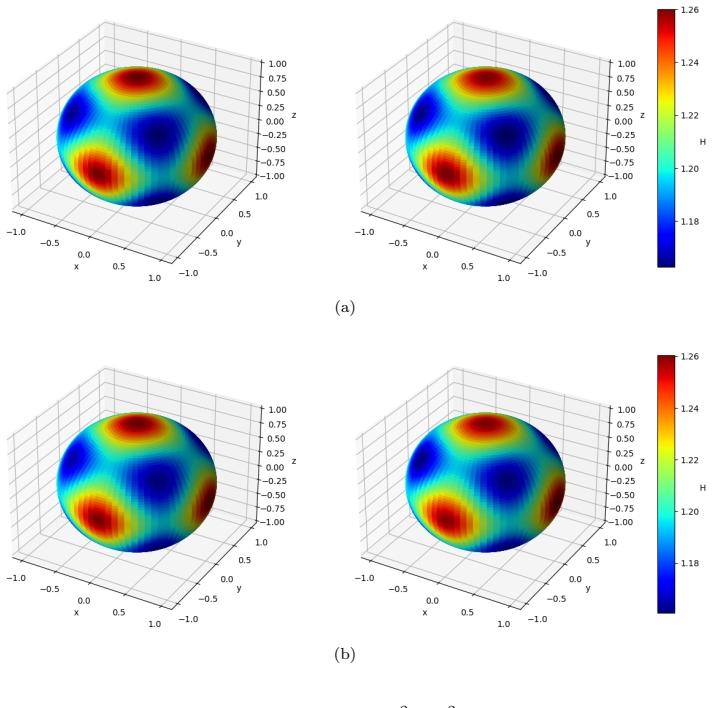
- The two-vortex experiment, where the true Hamiltonian is singular and outside the RKHS, suggests the practical method is wider than the theorem: qualitative structure is still learned, while error concentrates near the singular set—an inviting test bed for singular-aware or locally refined kernels.
Signed reviews
Editorial analysis
A structured set of objections, weighed in public.
Referee Report
Summary. The paper proposes a structure-preserving kernel ridge regression estimator for Hamiltonian functions on Poisson manifolds from noisy observations of Hamiltonian vector fields. The estimator is given in closed form as a finite linear combination of kernel sections (Theorem 3.13), with an operator representation and a detailed error analysis yielding PAC-type rates under a source condition (Theorems 4.6 and 4.8) and a flow-approximation statement (Proposition 4.10). The method is designed to handle the non-identifiability caused by Casimir functions through Tikhonov regularization, and a symmetry preservation result is stated in terms of invariant kernels and Noether's theorem. Numerical experiments cover Lie-Poisson systems (rigid body, underwater vehicle), exact recovery in a Gaussian RKHS on R^3, and Hamiltonian systems on S^2 x S^2 (spherical 3-norm and two-vortex dynamics).
Significance. If the technical gaps identified below are repaired, this would be a valuable contribution to structure-preserving learning: it provides a global, coordinate-free estimator on Poisson manifolds, a closed-form representer-type formula, explicit handling of Casimir degeneracy via regularization, and convergence rates in the RKHS norm under a source condition. The paper also gives detailed proofs and nontrivial numerical examples, including singular vector fields. The claimed results are plausible, but because the current proof gaps affect the derivation of the estimator and the main convergence and flow-approximation statements, the significance is conditional on those repairs.
major comments (5)
- [Section 3.4, Theorem 3.13, Eqs. (3.18)-(3.19)] The passage from the function identity (3.18) to the coefficient equation (3.19) is valid only if the map c in T_{Z_N}P |-> g_N(c, X_{K·}(Z_N)) in H_K is injective. This injectivity is neither stated nor proved, and it fails in degenerate Poisson structures: for the zero Poisson bracket, X_{K_z}=0 for every z, so (3.18) reduces to 0=0 and cannot imply G_N c + lambda N c = X_{sigma^2,N}. The theorem statement is likely still correct, and the gap is repairable: define c_0=(G_N+lambda N I)^{-1}X_{sigma^2,N}, set h_0=g_N(c_0,X_{K·}(Z_N)), and prove directly that (Q_N+lambda I)h_0=(1/sqrt N)A_N^*X_{sigma^2,N} using Q_N g_N(c,X_{K·}(Z_N))=(1/N)g_N(G_N c,X_{K·}(Z_N)) and the definition of G_N. Please replace the present inference with this argument or add an explicit injectivity assumption.
- [Section 4, Theorem 4.8] The first displayed bound in Theorem 4.8 has a prefactor C(gamma,delta,kappa)=max{||B^{-gamma}H||, 8 sqrt(4 log(8/delta)) d^{3/2} kappa^3 ||H||} that is independent of the noise variance sigma^2 and of the constant c in the choice lambda=cN^{-alpha}. This is inconsistent with Lemma 4.2, whose noisy-sampling bound contains sigma kappa lambda^{-1} N^{-1/2}; substituting lambda=cN^{-alpha} gives a contribution with prefactor sigma kappa/c multiplied by N^{alpha-1/2}, so this factor must appear in C. As written, the theorem claims a rate that cannot hold uniformly for arbitrary sigma>0. In addition, 'B^{-gamma}H' is undefined in the statement; the source condition (4.2) uses Q, so the notation should be Q^{-gamma}H or the operator should be defined.
- [Section 4, Lemma 4.9 and Proposition 4.10] Lemma 4.9 is false as stated: X_h[f]=df(X_h) is not the same as the quantity Dh(y) with y=(z,X_f(z)) that is used in the proof; the latter is X_f[h]. In a Euclidean symplectic chart on a compact manifold, take h=1/2 sin^2(x_1) and f=M sin(x_2) on the two-torus with the standard symplectic form. Then X_h[f]=M cos(x_2) sin(x_1) cos(x_1), whose Lipschitz constant grows linearly in M, while ||h||_{C^2_b} is independent of M. The claimed bound with constant ||h||_{C^2_b} therefore fails for large M. The proof also chooses the curve v(t) in TP to be parallel along the geodesic, which does not in general interpolate X_f(z_1) and X_f(z_2). Since Proposition 4.10 uses this lemma directly, the flow-approximation statement needs a corrected statement with additional assumptions on the test functions f and a repaired proof.
- [Section 5, numerical experiments] The numerical section does not validate the noisy-data setting advertised in the abstract and used in the theory. The rigid-body experiment explicitly states sigma=0; the underwater vehicle, exact-recovery, S^2 x S^2, and two-vortex experiments do not state a noise level either, and none of the reported tests appears to inject observation noise. Since the main formal contribution concerns recovery from noisy vector-field observations, please add experiments with nonzero sigma^2 and report the estimator and vector-field errors as sigma varies.
- [Section 3.5, Definition 3.15 and Proposition 3.16] The definition of argumentwise invariance is K(g·x,g'·x')=K(x,x') for all g,g'. From this condition it does not follow immediately that K(g·x,·)=K(x,·) for each g, which is the property needed to conclude that every f in H_K is G-invariant via f(gx)=<f,K(gx,·)>_{H_K}. The assertion that the RKHS consists exclusively of G-invariant functions therefore needs either a proof from the stated definition or an alignment of the definition with the property cited from [Gins 12, Property 3.13] (for example, first-argument invariance K(gx,y)=K(x,y)).
minor comments (3)
- [Section 4, Theorem 4.8] The phrase 'with probability as least 1-delta' should read 'with probability at least 1-delta'.
- [Section 5.2.4] The analysis paragraph refers to 'Theorem 3.2 (iii)'; the intended reference appears to be Theorem 3.3 (iii).
- [Section 3.4, local coordinate formula] In the local-coordinate expression following Eq. (3.21), the index ordering in G_{i,j}^N=B(z^{(i)}) partial_{1,2}K(z^{(i)},z^{(j)}) B^T(z^{(j)}) g^{(j)} should be checked for consistency with the definition (3.15), particularly the order of the two points in the kernel derivative, since the text alternates between (z^{(i)},z^{(j)}) and (z^{(j)},z^{(i)}).
Circularity Check
No significant circularity: the Poisson kernel estimator and its convergence analysis are derived in-paper; the [Hu 24] citations are independent Euclidean results that do not presuppose the Poisson estimator.
full rationale
No circularity found. The manifold differential reproducing property (Theorem 3.3), the compatible-structure operator calculus (Propositions 3.8–3.12), and the Poisson differential representer theorem (Theorem 3.13) are proved within the paper; the final closed form (3.16)–(3.19) is derived from the minimizer of the stated risk, not assumed. The convergence-rate theorem (Theorem 4.8) combines the in-paper noisy-sampling bound (Lemma 4.2) with [Hu 24, Theorem 4.7]; that cited theorem is a separate Euclidean-statement result with its own assumptions and does not presuppose the Poisson estimator, so the self-citation is not a circular reduction. The 'exact recovery' experiments intentionally choose H inside the RKHS; these are consistency checks of the theory rather than fitted parameters relabeled as predictions, and the Casimir-correction constants in Section 5.1 are explicitly described as trial-and-error adjustments. The proof step from (3.18) to (3.19) in Theorem 3.13 requires an injectivity justification that is not supplied; this is a correctness risk, not circularity, because the estimator is not defined in terms of its own output. Therefore the derivation is self-contained for circularity purposes.
Assumptions & free parameters
free parameters (4)
- Gaussian kernel width η =
η=2.5, 5, 0.9, 0.7, 2 in different experiments
- Regularization scale c in λ = c N^{-α} =
c=2.5e-5, 7.5e-6, 1e-4, 0.01
- Adaptive regularization exponent α =
α=0.4
- Casimir correction coefficient a in rigid body =
a=1.85
assumptions (6)
- domain assumption The compatible structure J = B^♯ ∘ g^♭ satisfies the boundedness condition (3.10), with γ positive and bounded above or γ ∈ L^1(µ_Z).
- domain assumption The unknown Hamiltonian H lies in the source space Ω_γ^S = {h = Q^γ ψ, ||ψ||_{H_K} < S} for some γ ∈ (0,1).
- domain assumption The Mercer kernel K belongs to C_b^{2s+1}(P×P), and in particular to C_b^3(P×P) for the learning problem.
- standard math The Poisson manifold P is complete with a Riemannian metric, and the Sasaki metric on TP is complete.
- domain assumption The geodesic distance d(·,y) is in C_b^1(P) for each y, with uniform bound on its C_b^1 norm over y.
- domain assumption The coercivity condition (4.4) holds when improved rates are claimed.
Cite this review
Pith. "Pith review of A global structure-preserving kernel method for the learning of Poisson systems." pith.science (2026). https://pith.science/paper/LTFKQ6NS
@misc{pith2026250413396,
  author       = {Pith},
  title        = {Pith review of: A global structure-preserving kernel method for the learning of Poisson systems},
  year         = {2026},
  howpublished = {\url{https://pith.science/paper/LTFKQ6NS}},
  note         = {Machine review of arXiv:2504.13396}
}
read the original abstract
A structure-preserving kernel ridge regression method is presented that allows the recovery of globally defined, potentially high-dimensional, and nonlinear Hamiltonian functions on Poisson manifolds out of datasets made of noisy observations of Hamiltonian vector fields. The proposed method is based on finding the solution of a non-standard kernel ridge regression where the observed data is generated as the noisy image by a vector bundle map of the differential of the function that one is trying to estimate. Additionally, it is shown how a suitable regularization solves the intrinsic non-identifiability of the learning problem due to the degeneracy of the Poisson tensor and the presence of Casimir functions. A full error analysis is conducted that provides convergence rates using fixed and adaptive regularization parameters. The good performance of the proposed estimator is illustrated with several numerical experiments.
Figures


Figures from the paper (5 more)



Reference graph
Works this paper leans on
-
[1]
R. Abraham and J. E. Marsden. Foundations of Mechanics . Addison-Wesley, Reading, MA, 2nd Ed., 1978
work page 1978
- [2]
-
[3]
J. Baj \=a rs. ``Locally-symplectic neural networks for learning volume-preserving dynamics''. Journal of Computational Physics , Vol. 476, p. 111911, 2023
work page 2023
-
[4]
T. Beckers, J. Seidman, P. Perdikaris, and G. J. Pappas. ``Gaussian Process Port-Hamiltonian Systems: Bayesian Learning with Physics Prior''. In: 2022 IEEE 61st Conference on Decision and Control (CDC) , pp. 1447--1453, 2022
work page 2022
-
[5]
V. Borovitskiy, A. Terenin, P. Mostowsky, and M. P. Deisenroth. ``Mat\' e rn Gaussian processes on riemannian manifolds''. In: Proceedings of the 34th International Conference on Neural Information Processing Systems , Curran Associates Inc., Red Hook, NY, USA, 2020
work page 2020
-
[6]
B. Brantner and M. Kraus. ``Symplectic Autoencoders for Model Reduction of Hamiltonian Systems''. 2023
work page 2023
-
[7]
S. L. Brunton, J. L. Proctor, and J. N. Kutz. ``Discovering governing equations from data by sparse identification of nonlinear dynamical systems''. Proceedings of the National Academy of Sciences , Vol. 113, No. 15, pp. 3932--3937, 2016
work page 2016
-
[8]
Z. Chen, J. Zhang, M. Arjovsky, and L. Bottou. ``Symplectic recurrent neural networks''. arXiv preprint arXiv:1909.13334 , 2019
arXiv 1909
Show all 79 references
-
[9]
Chen and M
R. Chen and M. Tao. ``Data-driven Prediction of General Hamiltonian Dynamics via Learning Exactly-Symplectic Maps''. In: M. Meila and T. Zhang, Eds., Proceedings of the 38th International Conference on Machine Learning , pp. 1717--1727, PMLR, 18--24 Jul 2021
2021
-
[10]
X. Chen, J. Duan, J. Hu, and D. Li. ``Data-driven method to learn the most probable transition pathway and stochastic differential equation''. Physica D: Nonlinear Phenomena , 2022
2022
-
[11]
Chossat, J.-P
P. Chossat, J.-P. Ortega, and T. S. Ratiu. `` Hamiltonian Hopf bifurcation with symmetry ''. Archive for Rational Mechanics and Analysis , Vol. 163, pp. 1--33, 2002
2002
-
[12]
Chossat, D
P. Chossat, D. Lewis, J.-P. Ortega, and T. S. Ratiu. `` Bifurcation of relative equilibria in mechanical systems with symmetry ''. Advances in Applied Mathematics , Vol. 31, pp. 10--45, 2003
2003
-
[13]
Christmann and I
A. Christmann and I. Steinwart. ``Universal Kernels on Non-Standard Input Spaces''. In: J. Lafferty, C. Williams, J. Shawe-Taylor, R. Zemel, and A. Culotta, Eds., Advances in Neural Information Processing Systems , p. , Curran Associates, Inc., 2010
2010
-
[14]
J. B. Conway. A Course in Functional Analysis . Springer Science & Business Media, second Ed., 2007
2007
-
[15]
Cranmer, S
M. Cranmer, S. Greydanus, S. Hoyer, P. Battaglia, D. Spergel, and S. Ho. ``Lagrangian neural networks''. arXiv preprint arXiv:2003.04630 , 2020
2003 arXiv
-
[16]
Da Costa , C
N. Da Costa , C. Mostajeran, and J.-P. Ortega. `` The Gaussian kernel on the circle and spaces that admit isometric embeddings of the circle ''. In: International Conference on Geometric Science of Information , pp. 426--435, Springer, 2023
2023
-
[17]
Da Costa, C
N. Da Costa, C. Mostajeran, J.-P. Ortega, and S. Said. ``Geometric Learning with Positively Decomposable Kernels''. arXiv preprint arXiv:2310.13821 , 2023
2023 arXiv
-
[18]
David and F
M. David and F. M \'e hats. ``Symplectic learning for Hamiltonian neural networks''. Journal of Computational Physics , Vol. 494, p. 112495, 2023
2023
-
[19]
De Vito, L
E. De Vito, L. Rosasco, A. Caponnetto, U. De Giovannini, F. Odone, and P. Bartlett. ``Learning from Examples as an Inverse Problem.''. Journal of Machine Learning Research , Vol. 6, No. 5, 2005
2005
-
[20]
Doumèche, G
N. Doumèche, G. Biau, and C. Boyer. ``Convergence and error analysis of PINNs''. 2023
2023
-
[21]
Eldred, F
C. Eldred, F. Gay-Balmaz, and V. Putkaradze. ``CLPNets: Coupled Lie-Poisson Neural Networks for Multi-Part Hamiltonian Systems with Symmetries''. arXiv preprint arXiv:2408.16160 , 2024
2024 arXiv
-
[22]
Eldred, F
C. Eldred, F. Gay-Balmaz, S. Huraka, and V. Putkaradze. ``Lie–Poisson Neural Networks (LPNets): Data-based computing of Hamiltonian systems with symmetries''. Neural Networks , Vol. 173, p. 106162, 2024
2024
-
[23]
\'E mery
M. \'E mery. Stochastic calculus in manifolds . Springer Science & Business Media, 2012
2012
-
[24]
J. Feng, C. Kulick, Y. Ren, and S. Tang. ``Learning particle swarming models from data with G aussian processes''. Mathematics of Computation , 2023
2023
-
[25]
Feragen, F
A. Feragen, F. Lauze, and S. Hauberg. ``Geodesic exponential kernels: When curvature and linearity conflict''. In: Proceedings of the IEEE conference on computer vision and pattern recognition , pp. 3032--3042, 2015
2015
-
[26]
J. C. Ferreira and V. A. Menegatto. ``Reproducing properties of differentiable M ercer-like kernels''. Mathematische Nachrichten , Vol. 285, No. 8-9, pp. 959--973, 2012
2012
-
[27]
Ginsbourger, X
D. Ginsbourger, X. Bay, O. Roustant, and L. Carraro. ``Argumentwise invariant kernels for the approximation of invariant functions''. In: Annales de la Facult \'e des sciences de Toulouse: Math \'e matiques , pp. 501--527, 2012
2012
-
[28]
Greydanus, M
S. Greydanus, M. Dzamba, and J. Yosinski. ``Hamiltonian neural networks''. Advances in neural information processing systems , Vol. 32, 2019
2019
-
[29]
D. D. Holm, T. Schmah, and C. Stoica. Geometric mechanics and symmetry: from finite to infinite dimensions . Vol. 12, Oxford University Press, 2009
2009
-
[30]
D. D. Holm. Geometric Mechanics. Part I: Dynamics and Symmetry . World Scientific Publishing Company, second Ed., 2011
2011
-
[31]
D. D. Holm. Geometric Mechanics. Part II: Rotating, Translating and Rolling . World Scientific, second Ed., 2011
2011
-
[32]
E. P. Hsu. Stochastic analysis on manifolds . American Mathematical Soc., 2002
2002
-
[33]
Hu, J.-P
J. Hu, J.-P. Ortega, and D. Yin. ``A Structure-Preserving Kernel Method for Learning Hamiltonian Systems''. arXiv preprint arXiv:2403.10070 , 2024
2024 arXiv
-
[34]
P. Jin, Z. Zhang, A. Zhu, Y. Tang, and G. E. Karniadakis. ``SympNets: Intrinsic structure-preserving symplectic networks for identifying Hamiltonian systems''. Neural Networks , Vol. 132, pp. 166--179, 2020
2020
-
[35]
P. Jin, Z. Zhang, I. G. Kevrekidis, and G. E. Karniadakis. ``Learning Poisson systems and trajectories of autonomous systems via Poisson neural networks''. IEEE Transactions on Neural Networks and Learning Systems , 2022
2022
-
[36]
B. Kostant. ``Orbits, symplectic structures and representation theory''. Collected Papers , pp. 482--482, 2009
2009
-
[37]
Leok and T
M. Leok and T. Shingel. ``General techniques for constructing variational integrators''. Frontiers of Mathematics in China , Vol. 7, pp. 273--303, 2012
2012
-
[38]
N. E. Leonard and J. E. Marsden. ``Stability and drift of underwater vehicle dynamics: mechanical systems with rigid motion symmetry''. Physica D: Nonlinear Phenomena , Vol. 105, No. 1-3, pp. 130--162, 1997
1997
-
[39]
S. Li. ``Gaussian kernels on nonsimply connected closed Riemannian manifolds are never positive definite''. Bulletin of the London Mathematical Society , 2023
2023
-
[40]
Libermann and C.-M
P. Libermann and C.-M. Marle. Symplectic Geometry and Analytical Mechanics . Vol. 35, Springer Science & Business Media, 2012
2012
-
[41]
Lie and F
S. Lie and F. Engel. Theorie der Transformationsgruppen . Vol. 3, Teubner, 1893
-
[42]
F. Lu, M. Zhong, S. Tang, and M. Maggioni. ``Nonparametric inference of interaction laws in systems of agents from trajectory data''. Proceedings of the National Academy of Sciences , Vol. 116, No. 29, pp. 14424--14433, 2019
2019
-
[43]
Maggioni, J
M. Maggioni, J. Miller, H. Qiu, and M. Zhong. ``Learning Interaction Kernels for Agent Systems on Riemannian Manifolds''. 2021
2021
-
[44]
J. E. Marsden and M. West. ``Discrete mechanics and variational integrators''. Acta numerica , Vol. 10, pp. 357--514, 2001
2001
-
[45]
J. E. Marsden and A. Weinstein. `` Reduction of symplectic manifolds with symmetry ''. Reports on Mathematical Physics , Vol. 5, No. 1, pp. 121--130, 1974
1974
-
[46]
J. E. Marsden and T. S. Ratiu. Introduction to Mechanics and Symmetry . Springer-Verlag, New York, second Ed., 1999
1999
-
[47]
C. A. Micchelli, Y. Xu, and H. Zhang. ``Universal Kernels.''. Journal of Machine Learning Research , Vol. 7, No. 12, 2006
2006
-
[48]
H. Q. Minh. ``Some properties of G aussian reproducing kernel H ilbert spaces and their implications for function approximation and learning theory''. Constructive Approximation , Vol. 32, pp. 307--338, 2010
2010
-
[49]
J. A. Montaldi. `` Persistance d'orbites p \' e riodiques relatives dans les syst \` e mes hamiltoniens sym \' e triques ''. C. R. Acad. Sci. Paris S \' e r. I Math. , Vol. 324, pp. 553--558, 1997
1997
-
[50]
J. A. Montaldi. `` Persistence and stability of relative equilibria ''. Nonlinearity , Vol. 10, pp. 449--466, 1997
1997
-
[51]
Mroueh, S
Y. Mroueh, S. Voinea, and T. A. Poggio. ``Learning with Group Invariant Features: A Kernel Perspective.''. Advances in neural information processing systems , Vol. 28, 2015
2015
-
[52]
o nig. Gesellsch. d. Wiss. zu G \
E. Noether. `` Invariante Variationsprobleme ''. Nachr. d. K \" o nig. Gesellsch. d. Wiss. zu G \" o ttingen Math. Physik , Vol. 2, pp. 235--257, 1918
1918
-
[53]
Nomizu and H
K. Nomizu and H. Ozeki. `` The existence of complete Riemannian metrics ''. Proceedings of the American Mathematical Society , Vol. 12, No. 6, pp. 889--891, 1961
1961
-
[54]
Novak, M
E. Novak, M. Ullrich, H. Wo \'z niakowski, and S. Zhang. ``Reproducing kernels of S obolev spaces on R ^d and applications to embedding constants and tractability''. Analysis and Applications , Vol. 16, No. 05, pp. 693--715, 2018
2018
-
[55]
C. Offen. ``Machine learning of continuous and discrete variational ODEs with convergence guarantee and uncertainty quantification''. 2024
2024
-
[56]
Ortega and T
J.-P. Ortega and T. S. Ratiu. Momentum Maps and Hamiltonian Reduction . Birkhauser Verlag, 2004
2004
-
[57]
Ortega, V
J.-P. Ortega, V. Planas-Bielsa, and T. S. Ratiu. `` Asymptotic and Lyapunov stability of constrained and Poisson equilibria ''. Journal of Differential Equations , Vol. 214, No. 1, pp. 92--127, jul 2005
2005
-
[58]
Ortega and D
J.-P. Ortega and D. Yin. ``Learnability of Linear Port-Hamiltonian Systems''. Journal of Machine Learning Research , Vol. 25, No. 68, pp. 1--56, 2024
2024
-
[59]
Ortega and T
J.-P. Ortega and T. S. Ratiu. `` Persistence and smoothness of critical relative elements in Hamiltonian systems with symmetry ''. Comptes Rendus de l'Acad \' e mie des Sciences - Series I - Mathematics , Vol. 325, No. 10, pp. 1107--1111, nov 1997
1997
-
[60]
Owhadi and C
H. Owhadi and C. Scovel. ``Separability of reproducing kernel spaces''. Proceedings of the American Mathematical Society , Vol. 145, No. 5, pp. 2131--2138, 2017
2017
-
[61]
X. Pennec. ``Intrinsic statistics on Riemannian manifolds: Basic tools for geometric measurements''. Journal of Mathematical Imaging and Vision , Vol. 25, pp. 127--154, 2006
2006
-
[62]
Pennec, S
X. Pennec, S. Sommer, and T. Fletcher. Riemannian Geometric Statistics in Medical Image Analysis . Academic Press, 2019
2019
-
[63]
Pförtner, I
M. Pförtner, I. Steinwart, P. Hennig, and J. Wenger. ``Physics-Informed Gaussian Process Regression Generalizes Linear PDE Solvers''. 2024
2024
-
[64]
Raissi, P
M. Raissi, P. Perdikaris, and G. Karniadakis. ``Physics-informed neural networks: A deep learning framework for solving forward and inverse problems involving nonlinear partial differential equations''. Journal of Computational Physics , Vol. 378, pp. 686--707, 2019
2019
-
[65]
K. Rath, C. G. Albert, B. Bischl, and U. von Toussaint. `` Symplectic Gaussian process regression of maps in Hamiltonian systems ''. Chaos: An Interdisciplinary Journal of Nonlinear Science , Vol. 31, No. 5, p. 053121, 05 2021
2021
-
[66]
Rudelson, R
M. Rudelson, R. Vershynin, et al. ``Hanson-wright inequality and sub- G aussian concentration''. Electronic Communications in Probability , Vol. 18, 2013
2013
-
[67]
Shin, YeonjongDarbon and G
J. Shin, YeonjongDarbon and G. Em Karniadakis. ``On the Convergence of Physics Informed Neural Networks for Linear Second-Order Elliptic and Parabolic Type PDEs''. Communications in Computational Physics , Vol. 28, No. 5, pp. 2042--2074, 2020
2020
-
[68]
J.-M. Souriau. G \'e om \'e trie de l'espace de phases: calcul des variations et m \'e canique quantique . Facult \'e des sciences de Marseille, 1965
1965
-
[69]
J.-M. Souriau. `` Quantification g \' e om \' e trique ''. Comm. Math. Phys. , Vol. 1, pp. 374--398, 1966
1966
-
[70]
J.-M. Souriau. Structure des Syst \` e mes Dynamiques . Dunod, Paris, 1969
1969
-
[71]
Steinwart
I. Steinwart. ``On the influence of the kernel on the consistency of support vector machines''. Journal of machine learning research , Vol. 2, No. Nov, pp. 67--93, 2001
2001
-
[72]
L. W. Tu. An Introduction to Manifolds . Springer, 2008
2008
-
[73]
I. Vaisman. Lectures on the Geometry of Poisson Manifolds . Vol. 118, Birkh \"a user, 2012
2012
-
[74]
Van Den Berg, J
C. Van Den Berg, J. P. R. Christensen, and P. Ressel. Harmonic Analysis on Semigroups: Theory of Positive Definite and Related Functions . Vol. 100, Springer Science & Business Media, 2012
2012
-
[75]
Weinstein
A. Weinstein. ``The local structure of Poisson manifolds''. Journal of differential geometry , Vol. 18, No. 3, pp. 523--557, 1983
1983
-
[76]
Yurinsky
V. Yurinsky. Sums and Gaussian Vectors. Lecture Notes in Mathematics . Springer Berlin, Heidelberg, 1995
1995
-
[77]
D.-X. Zhou. ``Derivative reproducing properties for kernel methods in learning theory''. Journal of Computational and Applied Mathematics , Vol. 220, No. 1-2, pp. 456--463, 2008
2008
-
[78]
A. Zhu, P. Jin, and Y. Tang. ``Deep Hamiltonian networks based on symplectic integrators''. 2020
2020
-
[79]
write newline
" write newline "" before.all 'output.state := FUNCTION fin.entry add.period write newline FUNCTION new.block output.state before.all = 'skip after.block 'output.state := if FUNCTION new.sentence output.state after.block = 'skip output.state before.all = 'skip after.sentence '...
Reviewed August 16, 2026 · model on record in the stance chip above.
Discussion (0). Continue with ORCID to comment.