REVIEW 3 major objections 5 minor 82 references
Rabi Oscillations of Strongly Driven Bose Polarons
T0 review · 3 major / 5 minor · reviewed 2026-08-16 · deepseek-v4-flash
Pith's one-line read Rabi oscillations of a repulsive Bose polaron gain an extra peak from its coexisting attractive branch.
desk verdict Genuinely new problem and a plausible qualitative prediction for driven Bose polarons, but the dropped Hartree term and unchecked one-phonon truncation make the quantitative claims premature. read the letter →
The pith
A machine-rendered reading of the paper's core claim, the machinery that carries it, and where it could break.
The reading
What carries the argument
The machinery is the truncated trial wavefunction of Eq. (5), $|\psi(t)\rangle=\sum_\sigma(\psi_\sigma^{(0)}(t)f^\dagger_{0,\sigma}+(1/\sqrt{V})\sum_k\psi_{k,\sigma}^{(1)}(t)f^\dagger_{-k,\sigma}\beta^\dagger_k)|G\rangle$, which keeps at most one Bogoliubov quasiparticle on top of the condensate. With this ansatz the full many-body evolution reduces to coupled equations that can be solved in closed form after a Laplace transform when the condensate is non-interacting. The organizing identity is the retarded impurity Green's function $G^R_\downarrow(\Omega)=[\Omega-\Delta-(\Omega_0/2)^2/(\Omega-n\Pi^{-1}(\Omega))]^{-1}$: its poles are the hybridized excitation energies, and the Rabi spectrum is governed by the differences between them. For $k_n a>0$, keeping both the attractive-pole and repulsive-branch contributions in the unperturbed spectral function yields three poles, which is the structural reason for the anomalous oscillations and the extra steady-state peak.
What would settle it
Measure the long-time magnetization $M(\Delta)$ on the repulsive side ($k_n a=1$) with $\Omega_0/k_n^2=1$ and scan the detuning: if no peak appears near $\Delta\approx -1.34\,k_n^2$ (the attractive polaron energy), Eq. (15) is falsified. Alternatively, include two-phonon states in the calculation and check whether the anomalous oscillations and the peak survive.
Extended reading notes
Core claim
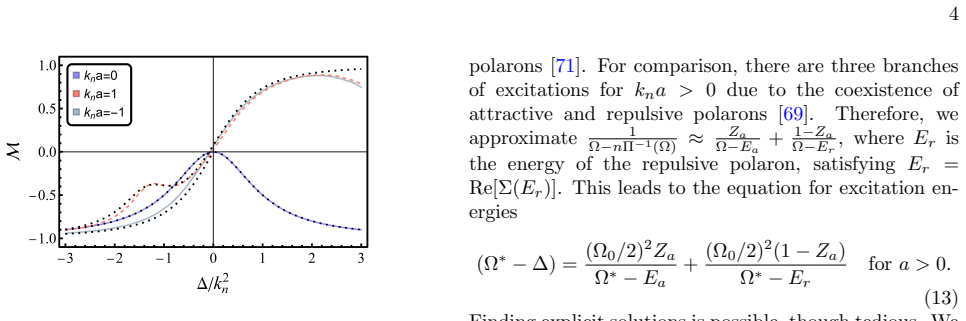
The discovery is a concrete mechanism by which a strong drive exposes both quasiparticle branches of a Bose polaron. For $k_n a>0$, the driven impurity spectral function carries three hybridized branches—mixtures of the bare spin-$\downarrow$ impurity, the attractive polaron, and the repulsive polaron—and the energy differences among these branches appear as extra frequencies in the Rabi spectrum, producing the anomalous, multi-frequency magnetization oscillations. In the long-time limit the magnetization is not the monotonic detuning curve of a free spin; instead an additional peak appears near $\Delta \approx E_a$, described by $M=\Delta/\sqrt{\Delta^2+\Omega_0^2}+Z^2\Omega_0^2/((\Delta-E_a)^2+Z\Omega_0^2)$, where $Z$ is the residue of the second branch at $\Delta=E_a$. For $k_n a<0$ only two branches hybridize, so the oscillations stay single-frequency and the steady-state magnetization follows the simpler zero-temperature noninteracting-spin formula.
Load-bearing premise
The load-bearing assumption is that the impurity's motion is described well with at most one quantum of excitation in the condensate; if multi-phonon correlations matter at the strong couplings studied ($k_n a=\pm1$), the computed magnetization dynamics, including the steady-state peak, would be inaccurate.
Editorial extensions
If this is right
- For $k_n a>0$ and negative detuning, the impurity magnetization will show several oscillation frequencies rather than a single damped Rabi frequency.
- The steady-state magnetization as a function of detuning will display a detectable peak near the attractive polaron energy $E_a$, a direct dynamical fingerprint of the attractive branch on the repulsive side.
- Weak repulsive interactions between condensate atoms leave both the anomalous oscillations and the steady-state peak qualitatively unchanged.
- The analytical formula for $M(\Delta)$ can be used to extract the attractive polaron energy and quasiparticle residue from time-domain magnetization measurements.
Reading between the lines
- If two-phonon correlations are important at these coupling strengths, the extra steady-state peak may be broadened, shifted, or split; a calculation with two Bogoliubov excitations would settle how much of the qualitative picture survives.
- The same three-branch mechanism should appear in any strongly driven impurity system where attractive and repulsive quasiparticle branches coexist, so a similar peak should be sought in Rabi-driven Fermi polarons near the polaron-to-molecule crossover.
- Finite temperature is not treated here, and thermal phonons would likely dephase some of the coherent multi-frequency beats; observing the peak at finite temperature would test whether the steady-state formula is a zero-temperature idealization.
- A cleaner experimental discriminator is the ratio of the steady-state peak's height to the background magnetization: Eq. (15) makes a definite prediction for this ratio in terms of the residue $Z$.
Signed reviews
Editorial analysis
A structured set of objections, weighed in public.
Referee Report
Summary. The manuscript studies the real-time dynamics of a single spin-1/2 impurity immersed in a Bose gas, with the spin-up state interacting with the condensate and a Rabi drive switched on at t=0. Using a trial wavefunction truncated to at most one Bogoliubov excitation, the authors derive equations of motion, present a Laplace-domain solution for non-interacting bosons, and compute the magnetization dynamics. They find anomalous Rabi oscillations and a steady-state magnetization peak for repulsive impurity-boson interactions (kna>0), which they attribute to the coexistence of attractive and repulsive polaron branches, and they propose a simple analytic formula for the steady-state magnetization. The same signatures are shown to persist for weakly interacting bosons.
Significance. If correct, the results would provide a concrete theoretical prediction for a strongly driven Bose polaron system, extending the recent Fermi-polaron experiment by Vivanco et al. to the Bose case and connecting polaron spectral functions to non-equilibrium Rabi dynamics. The main conceptual claim—that coexistence of attractive and repulsive branches produces a characteristic steady-state peak near the attractive polaron energy—is interesting and testable. The manuscript also provides a closed-form Laplace-domain expression for the non-interacting boson case, which is a useful starting point for further work. However, two load-bearing issues, described below, currently prevent the results from being accepted as quantitative predictions.
major comments (3)
- [Main text Eqs. (7)-(10); SM Eqs. (7)-(10)] The equations of motion in Eq. (7) contain the Hartree mean-field term gn0 acting on the spin-up sector, both in the equations for psi0_up and psi_k_up. In the Laplace-domain solution, however, the denominators are written as D0 = is(is-Delta)-(Omega0/2)^2 and Dk = (is-epsilon_k)(is-epsilon_k-Delta)-(Omega0/2)^2, with no gn0 in the first factor of each; the same replacement occurs between SM Eq. (8), where Dk,g still contains gn0, and SM Eq. (10), where Dk,g is silently replaced by Dk. Because the Rabi coupling mixes the two spin sectors, this is not a harmless common energy shift: a common shift would replace Delta by Delta-gn0, while a phase rotation of only the spin-up sector would make the Rabi term time-dependent. The printed equations therefore solve a different Hamiltonian from the one stated in Eq. (7). For the equal-mass parameters used in the paper, gn0/k_n^2 is of order 0.2 at kna=1, which is not negligible compared with the distance between Ea=-1.34 k_n^2 and the Hartree-shifted peak; the central peak in Fig. 4 and Eq. (15) may be shifted or altered. Please either include gn0 in D0 and Dk and redo the numerics, or state explicitly the rotating-frame convention and show that all quoted detunings are measured relative to gn0.
- [Eq. (5) and Figs. 2-5] All dynamical results are computed within the trial wavefunction of Eq. (5), which contains at most one Bogoliubov excitation. The Hamiltonian's linear coupling g*sqrt(n0)*R_k*(beta_k + beta_-k^dagger) connects the one-phonon sector to the two-phonon sector, and the parameters studied (kna=+/-1, Omega0/k_n^2=1) are not in a weak-coupling regime. The manuscript explicitly acknowledges that two-excitation sectors are 'straightforward to include' but does not include them, and no convergence check against the two-phonon sector or an independent method is provided. If multi-phonon dressing renormalizes or broadens the attractive polaron branch, the predicted additional peak near Ea in Fig. 4 and Eq. (15) could change in position, width, or even existence. Please provide a quantitative estimate of the error of the one-phonon truncation, for example by including the two-phonon sector for the spectral function and steady-state magnetization, or by comparing with a strong-coupling reference calculation.
- [Eq. (15)] The steady-state formula (15) is introduced as a 'simple formula' without derivation. The text defines Z as the residue of 'the second solution' of Eq. (13) at Delta=Ea, but does not specify which solution is meant, how the formula is obtained, or over what range of Delta it is intended to apply. Since Eq. (15) is used to draw the curves in Fig. 4 that validate the central claim, please provide a derivation or a precise statement of the approximation, including the treatment of the continuum contribution, so that the agreement shown is not only a fit to the numerical data.
minor comments (5)
- [SM Eq. (10)] The printed Supplementary Material contains corrupted TeX in Eq. (10), including characters such as '/rad]cal sqrt sqrt sqrt'; this formula is part of the claimed closed-form solution and must be readable. Please regenerate the source files.
- [General] The phrase 'BEC side' and 'BCS side' used for kna=1 and kna=-1 is borrowed from Fermi-polaron terminology and may confuse readers for a Bose gas, where there is no BCS side; please define the notation or use 'repulsive' and 'attractive' instead.
- [Introduction] The statement that the trial wavefunction approach 'provides an accurate description of the dynamical evolution for arbitrarily long times' overstates the status of the approximation; the Laplace transform is analytical but the inverse transform is done numerically, and the accuracy of the one-phonon truncation at strong coupling is exactly what needs to be checked.
- [Numerical methods] Please specify the numerical implementation of the inverse Laplace transform, including the discretization of k, the number of grid points, the time step, and convergence checks, so that the results in Figs. 2-5 are reproducible.
- [Acknowledgements] The acknowledgements sentence lacks a subject: 'would like to thank' should be 'The authors would like to thank'.
Circularity Check
No circularity: the dynamics and spectral functions are computed from the stated model Hamiltonian, and the analytic formulas are consistency checks rather than fitted inputs.
full rationale
The paper is a self-contained model calculation. The trial wavefunction (Eq. 5), the equations of motion (Eq. 7), the Laplace-domain solutions (Eqs. 9-10), the driven impurity Green's function (Eq. 11), and the magnetization (Eq. 8) are all derived from the stated Hamiltonian. No quantity is fitted to external data, and no parameter is defined in terms of the quantity it is later used to predict. The approximate dispersion relations in Eqs. (12) and (13) use polaron energies Ea, Er and residues Za, Z that are themselves outputs of the same model (Eqs. 10, 30, 33); these approximations are compared with the numerical solutions as consistency checks, not used as input to generate those solutions. The steady-state formula in Eq. (15) is explicitly proposed as a simple fitting form ('We propose a simple formula to capture both contributions'), and the numerical steady-state magnetization in Fig. 4 is computed before Eq. (15) is introduced, so the claim of a peak near Ea rests on the numerics rather than on the formula. The citations to Chevy and to Li and Das Sarma concern established variational trial-wavefunction methods and are not load-bearing self-citations, nor do they smuggle in the paper's central result. The at-most-one-phonon truncation in Eq. (5) is an uncontrolled approximation and a legitimate physics concern, but that is a correctness risk, not a circularity: the derivation does not assume the conclusion it claims to establish. No circular step satisfying the quoted-evidence threshold was found.
Assumptions & free parameters
assumptions (4)
- domain assumption Single-excitation truncation of the Hilbert space is accurate for the parameters considered (kna=±1).
- domain assumption The bosonic bath is described by Bogoliubov theory, with the condensate mode replaced by a c-number and depletion neglected (n≈n0).
- standard math The impurity-boson contact interaction is renormalized by the two-body T-matrix relation 1/g = m/(2πa) - (1/V)Σ 2m/k².
- ad hoc to paper The Hartree mean-field energy gn0 of the spin-up impurity is omitted in the Laplace-domain solution (main text Eq. (9), SM Eq. (7)), effectively changing the energy zero of the ↑ state.
Cite this review
Pith. "Pith review of Rabi Oscillations of Strongly Driven Bose Polarons." pith.science (2026). https://pith.science/paper/MP6AW4ZV
@misc{pith2026250413688,
  author       = {Pith},
  title        = {Pith review of: Rabi Oscillations of Strongly Driven Bose Polarons},
  year         = {2026},
  howpublished = {\url{https://pith.science/paper/MP6AW4ZV}},
  note         = {Machine review of arXiv:2504.13688}
}
abstract
Understanding the dynamical behavior of quasiparticles is essential for uncovering novel quantum many-body phenomena. Among these phenomena, the polaron in ultracold atomic gases has attracted considerable interest due to its precise controllability. By engineering the underlying Hamiltonian, polarons serve as a versatile platform for studying both equilibrium properties and non-equilibrium dynamics. In this work, we investigate the quantum dynamics of strongly driven Bose polarons, where minority atoms are described as mobile impurities with spin-1/2, and majority atoms are bosons. The spin-$\uparrow$ impurity interacts with majority atoms through a tunable scattering length $a$, while the spin-$\downarrow$ impurity remains non-interacting. After turning on the Rabi coupling, we calculate the evolution of the total magnetization using a trial wavefunction. We identify the exhibition of anomalous Rabi oscillation and steady-state magnetization for $a>0$, due to the interplay between attractive and repulsive polarons. Our results provide a concrete example that illustrates how Rabi oscillations are dressed by system-environment coupling.
Figures


Figures from the paper (5 more)


Reference graph
Works this paper leans on
-
[1]
L. D. Landau, Electron Motion in Crystal Lattices, Phys. Z. Sowjetunion 3, 10.1016/b978-0-08-010586-4.50015-8 (1933)
-
[2]
L. D. Landau and S. I. Pekar, The Effective Mass of the Polaron, J. Exp. Theor. Phys. 18, 10.1016/b978-0- 08-010586-4.50072-9 (1948)
doi:10.1016/b978-0- 1948
-
[3]
L. D. Landau, The Theory of a Fermi Liquid, J. Exp. Theor. Phys. 30, 10.1016/b978-0-08-010586-4.50095-x (1956)
-
[4]
C. Chin, R. Grimm, P. Julienne, and E. Tiesinga, Fesh- bach resonances in ultracold gases, Rev. Mod. Phys. 82, 1225 (2010), arXiv:0812.1496 [cond-mat]
arXiv 2010
- [5]
-
[6]
K. Sacha and E. Timmermans, Self-Localized Impurities Embedded in a One-Dimensional Bose-Einstein Conden- sate and Their Quantum Fluctuations, Phys. Rev. A 73, 063604 (2006), arXiv:cond-mat/0603454 [cond-mat]
work page Pith review arXiv 2006
-
[7]
F. M. Cucchietti and E. Timmermans, Strong-Coupling Polarons in Dilute Gas Bose-Einstein Condensates, Phys. Rev. Lett. 96, 210401 (2006)
2006
-
[8]
Self-trapping of impurities in Bose-Einstein condensates: Strong attractive and repulsive coupling
M. Bruderer, W. Bao, and D. Jaksch, Self-trapping of impurities in Bose-Einstein condensates: Strong at- tractive and repulsive coupling, EPL 82, 30004 (2008), arXiv:0801.4000 [quant-ph]
work page Pith review arXiv 2008
Show all 82 references
-
[9]
Tempere, W
J. Tempere, W. Casteels, M. K. Oberthaler, S. Knoop, E. Timmermans, and J. T. Devreese, Feynman Path- Integral Treatment of the BEC-impurity Polaron, Phys. Rev. B 80, 184504 (2009), arXiv:0906.4455 [cond-mat]
2009 arXiv
-
[10]
Bei-Bing and W
H. Bei-Bing and W. Shao-Long, Polaron in Bose–Einstein-Condensation System, Chinese. Phys. Lett. 26, 080302 (2009)
2009
-
[11]
Catani, G
J. Catani, G. Lamporesi, D. Naik, M. Gring, M. Inguscio, F. Minardi, A. Kantian, and T. Giamarchi, Quantum Dynamics of Impurities in a One-Dimensional Bose Gas, Phys. Rev. A 85, 023623 (2012)
2012
-
[12]
Spethmann, F
N. Spethmann, F. Kindermann, S. John, C. Weber, D. Meschede, and A. Widera, Dynamics of Single Neutral Impurity Atoms Immersed in an Ultracold Gas, Phys. Rev. Lett. 109, 235301 (2012), arXiv:1204.6051 [cond- mat]
2012 arXiv
-
[13]
Scelle, T
R. Scelle, T. Rentrop, A. Trautmann, T. Schuster, and M. K. Oberthaler, Motional Coherence of Fermions Im- mersed in a Bose Gas, Phys. Rev. Lett. 111, 070401 (2013), arXiv:1306.3308 [cond-mat]
2013 arXiv
-
[14]
J. B. Balewski, A. T. Krupp, A. Gaj, D. Peter, H. P. B¨ uchler, R. L¨ ow, S. Hofferberth, and T. Pfau, Coupling a Single Electron to a Bose–Einstein Condensate, Nature 502, 664 (2013), arXiv:1306.5181 [physics]
2013 arXiv
-
[15]
A. A. Blinova, M. G. Boshier, and E. Timmermans, Two Polaron Flavors of the Bose-Einstein Condensate Impu- rity, Phys. Rev. A 88, 053610 (2013)
2013
-
[16]
S. P. Rath and R. Schmidt, Field-Theoretical Study of the Bose Polaron, Phys. Rev. A 88, 053632 (2013), arXiv:1308.3457 [cond-mat]
2013 arXiv
-
[18]
G. E. Marti, A. MacRae, R. Olf, S. Lourette, F. Fang, and D. M. Stamper-Kurn, Coherent Magnon Optics in a Ferromagnetic Spinor Bose-Einstein Condensate, Phys. Rev. Lett. 113, 155302 (2014), arXiv:1404.5631 [cond- mat]
2014 arXiv
-
[19]
Shashi, F
A. Shashi, F. Grusdt, D. A. Abanin, and E. Dem- ler, Radio-Frequency Spectroscopy of Polarons in Ul- tracold Bose Gases, Phys. Rev. A 89, 053617 (2014), arXiv:1401.0952 [cond-mat]
2014 arXiv
-
[20]
L. A. P. Ardila and S. Giorgini, Impurity in a Bose- Einstein Condensate: Study of the Attractive and Repul- sive Branch Using Quantum Monte Carlo Methods, Phys. Rev. A 92, 033612 (2015), arXiv:1507.07427 [cond-mat]
2015 arXiv
-
[21]
R. S. Christensen, J. Levinsen, and G. M. Bruun, Quasi- particle Properties of a Mobile Impurity in a Bose- Einstein Condensate, Phys. Rev. Lett. 115, 160401 (2015), arXiv:1503.06979 [cond-mat]
2015 arXiv
-
[22]
Grusdt, Y
F. Grusdt, Y. E. Shchadilova, A. N. Rubtsov, and E. Demler, Renormalization Group Approach to the Fr¨ ohlich Polaron Model: Application to Impurity- BEC Problem, Scientific Reports 5, 12124 (2015), arXiv:1410.2203 [cond-mat]
2015 arXiv
-
[23]
M.-G. Hu, M. J. Van de Graaff, D. Kedar, J. P. Cor- son, E. A. Cornell, and D. S. Jin, Bose Polarons in the Strongly Interacting Regime, Phys. Rev. Lett. 117, 055301 (2016), arXiv:1605.00729 [cond-mat]
2016 arXiv
-
[24]
N. B. Jørgensen, L. Wacker, K. T. Skalmstang, M. M. Parish, J. Levinsen, R. S. Christensen, G. M. Bruun, and J. J. Arlt, Observation of Attractive and Repulsive Polarons in a Bose-Einstein Condensate, Phys. Rev. Lett. 117, 055302 (2016), arXiv:1604.07883 [cond-mat]
2016 arXiv
-
[25]
Y. E. Shchadilova, R. Schmidt, F. Grusdt, and E. Demler, Quantum Dynamics of Ultracold Bose Polarons, Phys. Rev. Lett. 117, 113002 (2016), arXiv:1604.06469 [cond- mat]
2016 arXiv
-
[26]
Levinsen, M
J. Levinsen, M. M. Parish, R. S. Christensen, J. J. Arlt, and G. M. Bruun, Finite-Temperature Behavior of the Bose Polaron, Phys. Rev. A 96, 063622 (2017), arXiv:1708.09172 [cond-mat]
2017 arXiv
-
[27]
S. M. Yoshida, Z.-Y. Shi, J. Levinsen, and M. M. Parish, Few-Body States of Bosons Interacting with a Heavy Quantum Impurity, Phys. Rev. A 98, 062705 (2018), arXiv:1807.09992 [cond-mat]
2018 arXiv
-
[28]
S. M. Yoshida, S. Endo, J. Levinsen, and M. M. Parish, Universality of an Impurity in a Bose-Einstein Conden- sate, Phys. Rev. X 8, 011024 (2018), arXiv:1710.02968 [cond-mat]
2018 arXiv
-
[29]
Grusdt, R
F. Grusdt, R. Schmidt, Y. E. Shchadilova, and E. Demler, Strong-Coupling Bose Polarons in a Bose- Einstein Condensate, Phys. Rev. A 96, 013607 (2017), arXiv:1704.02605 [cond-mat]
2017 arXiv
-
[30]
Guenther, P
N.-E. Guenther, P. Massignan, M. Lewenstein, and G. M. Bruun, Bose Polarons at Finite Temperature and Strong Coupling, Phys. Rev. Lett. 120, 050405 (2018), arXiv:1708.08861 [cond-mat]
2018 arXiv
-
[31]
Z. Z. Yan, Y. Ni, C. Robens, and M. W. Zwierlein, Bose Polarons near Quantum Criticality, Science 368, 190 (2020), arXiv:1904.02685 [cond-mat]
2020 arXiv
-
[32]
Field, J
B. Field, J. Levinsen, and M. M. Parish, Fate of the Bose Polaron at Finite Temperature, Phys. Rev. A 101, 013623 (2020), arXiv:1910.02620 [cond-mat]
2020 arXiv
-
[33]
Drescher, M
M. Drescher, M. Salmhofer, and T. Enss, Real-Space Dy- namics of Attractive and Repulsive Polarons in Bose- Einstein Condensates, Phys. Rev. A 99, 023601 (2019), arXiv:1810.11296 [cond-mat]
2019 arXiv
-
[34]
Drescher, M
M. Drescher, M. Salmhofer, and T. Enss, Theory of a Resonantly Interacting Impurity in a Bose- Einstein Condensate, Phys. Rev. Res. 2, 032011 (2020), arXiv:2003.01982 [cond-mat]
2020 arXiv
-
[35]
M. G. Skou, T. G. Skov, N. B. Jørgensen, K. K. Nielsen, A. Camacho-Guardian, T. Pohl, G. M. Bruun, and J. J. Arlt, Non-Equilibrium Quantum Dynamics and Forma- tion of the Bose Polaron, Nature Physics 17, 731 (2021), arXiv:2005.00424 [cond-mat]
2021 arXiv
-
[36]
Levinsen, L
J. Levinsen, L. A. P. Ardila, S. M. Yoshida, and M. M. Parish, Quantum Behavior of a Heavy Impurity Strongly Coupled to a Bose Gas, Phys. Rev. Lett. 127, 033401 (2021), arXiv:2102.06368 [cond-mat]
2021 arXiv
-
[37]
Massignan, N
P. Massignan, N. Yegovtsev, and V. Gurarie, Universal Aspects of a Strongly Interacting Impurity in a Dilute Bose Condensate, Phys. Rev. Lett. 126, 123403 (2021), arXiv:2011.00846 [cond-mat]
2021 arXiv
-
[38]
M. G. Skou, K. K. Nielsen, T. G. Skov, A. M. Morgen, N. B. Jørgensen, A. Camacho-Guardian, T. Pohl, G. M. Bruun, and J. J. Arlt, Life and Death of the Bose Polaron, Phys. Rev. Res. 4, 043093 (2022), arXiv:2204.01424 [cond-mat]
2022 arXiv
-
[39]
Cayla, P
H. Cayla, P. Massignan, T. Giamarchi, A. Aspect, C. I. Westbrook, and D. Cl´ ement, Observation of $1/{k}ˆ{4}$-Tails after Expansion of Bose-Einstein Con- densates with Impurities, Phys. Rev. Lett. 130, 153401 (2023), arXiv:2204.10697 [cond-mat]
2023 arXiv
-
[40]
Schmidt and T
R. Schmidt and T. Enss, Self-Stabilized Bose Polarons, SciPost Physics 13, 054 (2022), arXiv:2102.13616 [cond- mat]
2022 arXiv
-
[41]
Mostaan, N
N. Mostaan, N. Goldman, and F. Grusdt, A Unified The- ory of Strong Coupling Bose Polarons: From Repulsive Polarons to Non-Gaussian Many-Body Bound States, arXiv:2305.00835 [cond-mat]
-
[42]
F. J. Vivanco, A. Schuckert, S. Huang, G. L. Schumacher, G. G. T. Assump¸ c˜ ao, Y. Ji, J. Chen, M. Knap, and N. Navon, The Strongly Driven Fermi Polaron, Nature Physics 21, 564 (2025), arXiv:2308.05746 [cond-mat]
2025 arXiv
-
[43]
A. M. Morgen, S. S. Balling, K. K. Nielsen, T. Pohl, G. M. Bruun, and J. J. Arlt, Quantum Beat Spectroscopy of Repulsive Bose Polarons, Phys. Rev. Res. 7, L022002 (2025), arXiv:2310.18183 [cond-mat]
2025 arXiv
-
[44]
Etrych, G
J. Etrych, G. Martirosyan, A. Cao, C. J. Ho, Z. Hadz- ibabic, and C. Eigen, Universal Quantum Dynamics of Bose Polarons, arXiv:2402.14816 [cond-mat]
-
[45]
Levinsen, M
J. Levinsen, M. M. Parish, and G. M. Bruun, Impurity in a Bose-Einstein Condensate and the Efimov Effect, Phys. Rev. Lett. 115, 125302 (2015), arXiv:1505.04530 [cond-mat]
2015 arXiv
-
[46]
Levinsen, O
J. Levinsen, O. Bleu, and M. M. Parish, Medium- Enhanced Polaron Repulsion in a Dilute Bose Mixture, arXiv:2409.03406 [cond-mat]
-
[47]
Nakano, M
Y. Nakano, M. M. Parish, and J. Levinsen, Variational Approach to the Two-Dimensional Bose Polaron, Phys. Rev. A 109, 013325 (2024), arXiv:2306.17397 [cond-mat]
2024 arXiv
-
[48]
Christianen, J
A. Christianen, J. I. Cirac, and R. Schmidt, Phase Dia- gram for Strong-Coupling Bose Polarons, SciPost Physics 16, 067 (2024), arXiv:2306.09075 [cond-mat]
2024 arXiv
-
[50]
C. Lobo, A. Recati, S. Giorgini, and S. Stringari, Normal 7 State of a Polarized Fermi Gas at Unitarity, Phys. Rev. Lett. 97, 200403 (2006), arXiv:cond-mat/0607730 [cond- mat]
2006 arXiv
-
[51]
Combescot, A
R. Combescot, A. Recati, C. Lobo, and F. Chevy, Normal State of Highly Polarized Fermi Gases: Simple Many- Body Approaches, Phys. Rev. Lett. 98, 180402 (2007), arXiv:cond-mat/0702314 [cond-mat]
2007 arXiv
-
[52]
Prokof’ev and B
N. Prokof’ev and B. Svistunov, Fermi-Polaron Prob- lem: Diagrammatic Monte Carlo Method for Divergent Sign-Alternating Series, Phys. Rev. B 77, 020408 (2008), arXiv:0707.4259 [cond-mat]
2008 arXiv
-
[53]
Combescot and S
R. Combescot and S. Giraud, Normal State of Highly Po- larized Fermi Gases: Full Many-Body Treatment, Phys. Rev. Lett. 101, 050404 (2008), arXiv:0804.2638 [cond- mat]
2008 arXiv
-
[54]
Pilati and S
S. Pilati and S. Giorgini, Phase Separation in a Polarized Fermi Gas at Zero Temperature, Phys. Rev. Lett. 100, 030401 (2008), arXiv:0710.1549 [cond-mat]
2008 arXiv
-
[55]
Nascimb` ene, N
S. Nascimb` ene, N. Navon, K. J. Jiang, L. Tarruell, M. Te- ichmann, J. McKeever, F. Chevy, and C. Salomon, Col- lective Oscillations of an Imbalanced Fermi Gas: Axial Compression Modes and Polaron Effective Mass, Phys. Rev. Lett. 103, 170402 (2009), arXiv:0907.3032 [cond- mat]
2009 arXiv
-
[56]
Schirotzek, C.-H
A. Schirotzek, C.-H. Wu, A. Sommer, and M. W. Zwier- lein, Observation of Fermi Polarons in a Tunable Fermi Liquid of Ultracold Atoms, Phys. Rev. Lett. 102, 230402 (2009), arXiv:0902.3021 [cond-mat]
2009 arXiv
-
[57]
Cui, Fermi Polaron Revisited: Polaron-molecule Tran- sition and Coexistence, Phys
X. Cui, Fermi Polaron Revisited: Polaron-molecule Tran- sition and Coexistence, Phys. Rev. A102, 061301 (2020), arXiv:2003.11710 [cond-mat]
2020 arXiv
-
[58]
Kohstall, M
C. Kohstall, M. Zaccanti, M. Jag, A. Trenkwalder, P. Massignan, G. M. Bruun, F. Schreck, and R. Grimm, Metastability and Coherence of Repulsive Polarons in a Strongly Interacting Fermi Mixture, Nature 485, 615 (2012), arXiv:1112.0020 [cond-mat]
2012 arXiv
-
[59]
Koschorreck, D
M. Koschorreck, D. Pertot, E. Vogt, B. Fr¨ ohlich, M. Feld, and M. K¨ ohl, Attractive and Repulsive Fermi Po- larons in Two Dimensions, Nature 485, 619 (2012), arXiv:1203.1009 [cond-mat]
2012 arXiv
-
[60]
Zhang, W
Y. Zhang, W. Ong, I. Arakelyan, and J. E. Thomas, Polaron-to-Polaron Transitions in the Radio-Frequency Spectrum of a Quasi-Two-Dimensional Fermi Gas, Phys. Rev. Lett. 108, 235302 (2012), arXiv:1201.3560 [cond- mat]
2012 arXiv
-
[61]
A. N. Wenz, G. Z¨ urn, S. Murmann, I. Brouzos, T. Lompe, and S. Jochim, From Few to Many: Observing the For- mation of a Fermi Sea One Atom at a Time, Science342, 457 (2013), arXiv:1307.3443 [cond-mat]
2013 arXiv
-
[62]
Cetina, M
M. Cetina, M. Jag, R. S. Lous, I. Fritsche, J. T. M. Wal- raven, R. Grimm, J. Levinsen, M. M. Parish, R. Schmidt, M. Knap, and E. Demler, Ultrafast Many-Body Interfer- ometry of Impurities Coupled to a Fermi Sea, Science 354, 96 (2016), arXiv:1604.07423 [cond-mat]
2016 arXiv
-
[63]
Li and X
W. Li and X. Cui, Repulsive Fermi Polarons with Neg- ative Effective Mass, Phys. Rev. A 96, 053609 (2017), arXiv:1708.00134 [cond-mat]
2017 arXiv
-
[64]
Scazza, G
F. Scazza, G. Valtolina, P. Massignan, A. Recati, A. Am- ico, A. Burchianti, C. Fort, M. Inguscio, M. Zaccanti, and G. Roati, Repulsive Fermi Polarons in a Resonant Mix- ture of Ultracold $ˆ{6}\mathrm{Li}$ Atoms, Phys. Rev. Lett. 118, 083602 (2017), arXiv:1609.09817 [cond-mat]
2017 arXiv
-
[65]
W. E. Liu, J. Levinsen, and M. M. Parish, Variational Approach for Impurity Dynamics at Finite Temperature, Phys. Rev. Lett. 122, 205301 (2019), arXiv:1805.10013 [cond-mat]
2019 arXiv
-
[66]
Z. Yan, P. B. Patel, B. Mukherjee, R. J. Fletcher, J. Struck, and M. W. Zwierlein, Boiling a Unitary Fermi Liquid, Phys. Rev. Lett. 122, 093401 (2019), arXiv:1811.00481 [cond-mat]
2019 arXiv
-
[67]
Darkwah Oppong, L
N. Darkwah Oppong, L. Riegger, O. Bettermann, M. H¨ ofer, J. Levinsen, M. M. Parish, I. Bloch, and S. F¨ olling, Observation of Coherent Multiorbital Polarons in a Two-Dimensional Fermi Gas, Phys. Rev. Lett. 122, 193604 (2019), arXiv:1901.09105 [cond-mat]
2019 arXiv
-
[68]
G. Ness, C. Shkedrov, Y. Florshaim, O. K. Diessel, J. von Milczewski, R. Schmidt, and Y. Sagi, Observa- tion of a Smooth Polaron-Molecule Transition in a De- generate Fermi Gas, Phys. Rev. X 10, 041019 (2020), arXiv:2001.10450 [cond-mat]
2020 arXiv
-
[69]
Cui and H
X. Cui and H. Zhai, Stability of a Fully Magnetized Ferromagnetic State in Repulsively Interacting Ultra- cold Fermi Gases, Phys. Rev. A 81, 041602 (2010), arXiv:1001.5139 [cond-mat]
2010 arXiv
-
[70]
C. Peng, R. Liu, W. Zhang, and X. Cui, Nature of the Polaron-Molecule Transition in Fermi Polarons, Phys. Rev. A 103, 063312 (2021), arXiv:2102.13344 [cond-mat]
2021 arXiv
-
[71]
B. C. Mulkerin, J. Levinsen, and M. M. Parish, Rabi Oscillations and Magnetization of a Mobile Spin-1/2 Im- purity in a Fermi Sea, Phys. Rev. A 109, 023302 (2024), arXiv:2308.06659 [cond-mat]
2024
-
[72]
Baroni, B
C. Baroni, B. Huang, I. Fritsche, E. Dobler, G. Anich, E. Kirilov, R. Grimm, M. A. Bastarrachea-Magnani, P. Massignan, and G. M. Bruun, Mediated Interac- tions between Fermi Polarons and the Role of Impu- rity Quantum Statistics, Nature Physics 20, 68 (2024), arXiv:2305.04915 ...
2024 arXiv
-
[73]
Efimov, Energy levels arising form the resonant two- body forces in a three-body system, Phys
V. Efimov, Energy levels arising form the resonant two- body forces in a three-body system, Phys. Lett. B 33, 563 (1970)
1970
-
[74]
Kraemer, M
T. Kraemer, M. Mark, P. Waldburger, J. G. Danzl, C. Chin, B. Engeser, A. D. Lange, K. Pilch, A. Jaakkola, H.-C. N¨ agerl, and R. Grimm, Evidence for Efimov quan- tum states in an ultracold gas of caesium atoms, Nature 440, 315 (2006), arXiv:cond-mat/0512394 [cond-mat]
2006 arXiv
-
[75]
Pires, J
R. Pires, J. Ulmanis, S. H¨ afner, M. Repp, A. Arias, E. D. Kuhnle, and M. Weidem¨ uller, Observation of Efimov Res- onances in a Mixture with Extreme Mass Imbalance, Phys. Rev. Lett. 112, 250404 (2014), arXiv:1403.7246 [cond-mat]
2014 arXiv
-
[76]
Huang, L
B. Huang, L. A. Sidorenkov, R. Grimm, and J. M. Hut- son, Observation of the Second Triatomic Resonance in Efimov’s Scenario, Phys. Rev. Lett. 112, 190401 (2014), arXiv:1402.6161v2 [cond-mat]
2014 arXiv
-
[77]
S.-K. Tung, K. Jim´ enez-Garc´ ıa, J. Johansen, C. V. Parker, and C. Chin, Geometric Scaling of Efi- mov States in a $ˆ{6}\mathrm{Li}\text{\ensuremath{- }}ˆ{133}\mathrm{Cs}$ Mixture, Phys. Rev. Lett. 113, 240402 (2014), arXiv:1402.5943 [cond-mat]
2014 arXiv
-
[78]
Z.-Y. Shi, H. Zhai, and X. Cui, Efimov Physics and Universal Trimers in Spin-Orbit-Coupled Ultracold Atomic Mixtures, Phys. Rev. A 91, 023618 (2015), arXiv:1411.7488 [cond-mat]
2015 arXiv
-
[79]
M. Sun, H. Zhai, and X. Cui, Visualizing the Efimov Cor- relation in Bose Polarons, Phys. Rev. Lett. 119, 013401 (2017), arXiv:1702.06303 [cond-mat]
2017 arXiv
-
[80]
A. N. Zulli, B. C. Mulkerin, M. M. Parish, and J. Levin- sen, Universal Efimov Scaling in the Rabi-Coupled Few- 8 Body Spectrum, arXiv:2501.18844 [cond-mat]
-
[81]
Zhai, Ultracold atomic physics (Cambridge University Press, 2021)
H. Zhai, Ultracold atomic physics (Cambridge University Press, 2021)
2021
-
[82]
xIrg7o7MG+z2ceiMoKCu42j7PAo=
See supplementary material for: (1) Derivation of Eq. (7) in the main text; (2) Analytical results of Eq. (7) in the main text when knab = 0; (3) Solution of Eq. (7) in the main text with 0 < k nab≪ 1; (4) Quasiparticle proper- ties without Rabi coupling; (5) Quasiparticle pro...
2025
-
[83]
Chevy, Universal phase diagram of a strongly interacting Fermi gas with unbalanced spin populations, Phys
F. Chevy, Universal phase diagram of a strongly interacting Fermi gas with unbalanced spin populations, Phys. Rev. A 74, 063628 (2006), arXiv:cond-mat/0605751 [cond-mat]
2006 arXiv
-
[84]
Li and S
W. Li and S. Das Sarma, V ariational Study of Polarons in Bose-Einstein Condensates, Phys. Rev. A 90, 013618 (2014) , arXiv:1404.4054 [cond-mat]
2014 arXiv
Reviewed August 16, 2026 · model on record in the stance chip above.
Discussion (0). Continue with ORCID to comment.