REVIEW 4 major objections 4 minor 40 references
Probing the Kinematics of Multiple- and Single-Protostar Systems in Perseus with N2H+
T0 review · 4 major / 4 minor · reviewed 2026-08-16 · deepseek-v4-flash
Pith's one-line read Dense gas around young protostars shows no coherent rotation on scales of 1000–2700 AU.
desk verdict New 3" ALMA N2H+ data for two Perseus cores, feathered with GBT, are carefully handled and genuinely fill a resolution gap, but the central "not rotation" claim rests on a J(r) diagnostic that cannot discriminate rotation — worth a serious referee, not a desk reject. read the letter →
The pith
A machine-rendered reading of the paper's core claim, the machinery that carries it, and where it could break.
The reading
What carries the argument
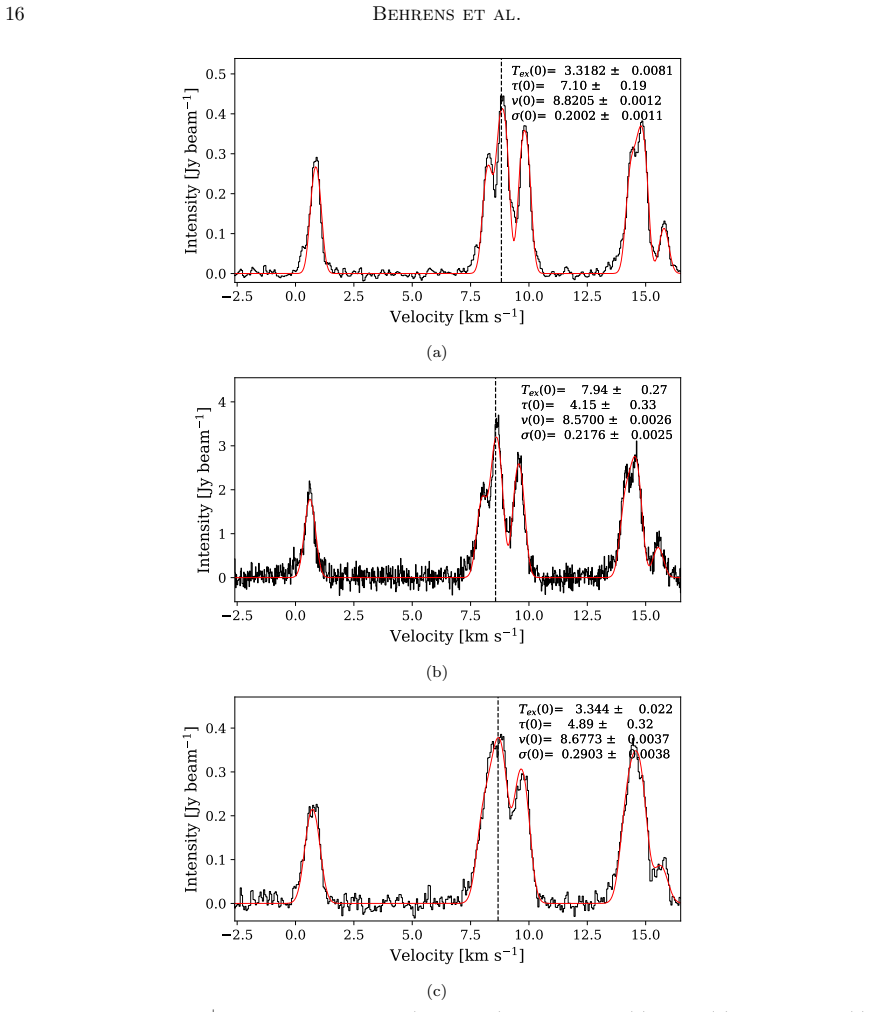
The argument runs on three pieces of machinery. First is the N2H+ J=1–0 hyperfine spectrum, whose 15 hyperfine components are fitted with a spectral fitting routine to deliver centroid velocities with uncertainties around $10^{-3}$ km s$^{-1}$ per pixel. Second is the feather method, which combines ALMA interferometric images with GBT single-dish images in the Fourier plane so that the analysis is sensitive to both compact and diffuse gas. Third is the rotation diagnostic: the linear velocity gradient $\nabla v$ is averaged within circular apertures of radius 5–30 arcseconds centered on each protostar, and converted to specific angular momentum through the identity $J = r^2 \nabla v$, following the standard relation from Goodman et al. (1993). The key test is whether $J$ stays roughly constant with radius, which would indicate conserved angular momentum and coherent rotation, or rises with radius, which the paper interprets as turbulence and non-rotational structure.
What would settle it
Run a radiative-transfer model of a rotating, infalling envelope with the same density and temperature profiles as Per 30 and IRAS 7, and compare the predicted N2H+ J=1–0 centroid velocities to the feathered maps: if the model reproduces the observed rise of specific angular momentum with radius, then rotation is not excluded by the data. A simpler observational check is to measure the velocity gradient in a smaller-aperture tracer like C18O or H2CO at radii below 1500 AU; a coherent, outflow-perpendicular gradient there would show that rotation resumes just inside the scales this paper probes.
Extended reading notes
Core claim
On the paper's own terms, the central discovery is a null result: in four protostellar systems spanning one isolated source and one quintuple system, the N2H+ emission shows no evidence for organized, coherent rotation on scales of roughly 1000–2700 AU (0.005–0.01 pc). At every radius tested, the specific angular momentum $J = r^2 \nabla v$ increases outward rather than remaining constant, which the authors take as the signature of a region that does not conserve angular momentum as a rotating unit. This holds for the ALMA-only, GBT-only, and feathered data, although the small-scale ALMA maps show larger, less coherent gradients and position-angle swings up to 90 degrees while the larger-scale GBT maps are smoother. Because the isolated source Per 30 behaves like the members of IRAS 7, the authors argue that multiplicity is not the cause of the complex kinematics. They instead attribute the velocity structure to torques produced by irregular or asymmetric density distributions, in line with non-axisymmetric collapse scenarios, and note that previous subarcsecond observations do see rotation around Per 18 on disk scales below 1000 AU.
Load-bearing premise
The no-rotation conclusion assumes that true rotation would show up as a roughly constant amount of rotational motion per unit mass at every distance from the star; if a rotating envelope that is also falling inward can make that quantity grow with distance instead, the data would not rule out rotation.
Editorial extensions
If this is right
- Rotation in these protostellar systems, if it exists, must set in below about 1000 AU, between the scales probed here and the subarcsecond disk scales where rotation has been detected.
- Angular momentum is not simply passed down from core to disk in Per 30 and IRAS 7, so disk formation in these sources likely needs another channel than direct inheritance of core rotation.
- The velocity gradients measured here are more naturally read as turbulence plus torques from irregular density structure than as solid-body rotation.
- Because the isolated source and the multiple system behave the same way, the lack of a rotational signature is a property of the gas on these scales rather than an artifact of multiplicity.
- Future surveys that combine interferometric and single-dish data can use the same $J(r)$ test, but must resolve scales below 1000 AU to catch rotation.
Reading between the lines
- A rotating envelope that is also collapsing inward can produce specific angular momentum that grows with radius, so the $J(r)$ trend alone may not fully exclude rotation; modeling an infalling rotating envelope against these spectra would test the authors' interpretation.
- One testable extension: the same feathered-data analysis applied to a chemically different tracer such as C18O, which survives closer to the protostar, could reveal rotation just inside the N2H+ depletion zone.
- If torques from irregular density distributions drive the kinematics, the orientation of the velocity gradient relative to the outflow should vary with radius and time, so repeated observations may show the gradient direction wandering.
- The result supports non-axisymmetric collapse as a disk-formation path, implying that disks can form in cores with little or no net angular momentum.
Signed reviews
Editorial analysis
A structured set of objections, weighed in public.
Referee Report
Summary. This paper analyzes N2H+ J=1-0 emission toward two Perseus protostellar cores, Per 30 and NGC 1333 IRAS 7, combining ALMA and GBT data with CASA feather to recover intermediate spatial scales. The authors fit the hyperfine structure with PySpecKit, construct centroid-velocity maps, measure linear velocity gradients in circular apertures of 5–30 arcsec, and compute specific angular momentum J = r^2 \nabla v_{lsr} as a function of radius. The central claim, stated in the abstract and developed in Sections 4.2 and 5, is that the observed velocity structure is 'likely not a result of core rotation' and is instead attributed to torques from irregular density distributions. The paper also reports scale-dependent behavior: smaller-scale ALMA gas appears clumpy and turbulent, while larger-scale GBT/Feather gas shows smoother gradients.
Significance. If the central claim survives scrutiny, the paper would provide an interesting data point on the scales at which coherent rotation emerges in protostellar cores, with implications for angular-momentum transport and disk formation. The observational methodology has real strengths: the multi-scale feathering is carefully checked against single-dish spectra, the hyperfine fitting is standard and yields very small formal centroid-velocity uncertainties, Table 2 gives gradient values and uncertainties in a transparent form, and the authors successfully reproduce the earlier GBT gradient measurements of Chen et al. (2019). The paper is also honest about the large scatter in the ALMA gradients. However, the main quantitative diagnostic used to exclude rotation is flawed, and this flaw directly affects the paper's headline conclusion.
major comments (4)
- [Sections 3.3 and 4.2, Figure 9] The diagnostic J = r^2 \nabla v_{lsr} with the expectation that rotation would give constant J is not valid for the type of rotation expected on core scales. For a core in solid-body rotation, the centroid-velocity gradient is approximately constant (|\nabla v| \approx \Omega), so J = \Omega r^2 increases with aperture radius. The observed increase of J in Figure 9 is therefore fully consistent with solid-body rotation, and a rotating infalling envelope with differential rotation can likewise produce a rising J(r). The statement in Section 4.2 that 'Jcore increases with distance rather than remaining constant' does not support the conclusion that the velocity structure is 'likely not a result of core rotation' (abstract, Section 4.2, Section 5). The paper conflates a lack of angular-momentum conservation with a lack of rotation. To make the no-rotation claim, the authors need a quantitative test that distinguishes rotation from turbulence, for example by comparing measured centroid-velocity maps or PV diagrams with synthetic observations of a rotating envelope, or by quantifying the coherence of gradient directions across apertures.
- [Figure 9 and Table 2] Figure 9 plots J(r) without any error bars, yet Table 2 reports gradient uncertainties, and for many rows those uncertainties are enormous: for example, the ALMA gradient for Per 30 at radius 10 arcsec is 107.6 +/- 700.4 km/s/pc, and at radius 20 arcsec for Per 18 it is 30.6 +/- 618.9 km/s/pc. Even for the smoother GBT data, uncertainties at radii above 15 arcsec become comparable to or larger than the gradient values (e.g., Per 18 at 25 arcsec: 3.6 +/- 4.2 km/s/pc). Without propagating these uncertainties into J(r), the claimed monotonic increase in Figure 9 has no demonstrated statistical significance. The central interpretation should be re-examined after propagating the Table 2 uncertainties, and the large-aperture points where the gradients are formally consistent with zero should be identified.
- [Section 3.2 versus Sections 4.2 and 5] The paper's own qualitative description of Per 30 is in tension with the abstract's no-rotation conclusion. Section 3.2 states that the Per 30 maps show 'the most likely indications of rotation among our four protostars' and a 'clear transition from redshifted to blueshifted gas from east to west,' which is precisely the signature that earlier studies such as Goodman et al. (1993) associate with rotation. The PV diagrams in Section 4.2 are described as not showing coherent rotation, but for Per 30 this is not reconciled with the centroid-velocity morphology. The claim that the N2H+ velocity structure is 'likely not a result of core rotation' therefore rests heavily on the flawed J(r) argument and is not supported by the qualitative maps alone.
- [Section 4.3] The alternative explanation proposed in Section 4.3, that torques from irregular density distributions produce the observed velocity structure, is offered without a quantitative test against a rotating-envelope model. Since the paper's conclusion depends on excluding rotation, the authors should either provide a concrete model comparison (e.g., a rotating infalling envelope with and without an asymmetric density distribution, compared to the observed centroid-velocity maps and J(r) profiles) or substantially weaken the conclusion to state that the data do not require coherent rotation, rather than asserting that rotation is likely absent.
minor comments (4)
- [Table 2, Per 21 row, radius 15 arcsec] The entry '91 , 8' appears to be a typo; it should presumably be '91.8'.
- [Figure 9] The y-axis tick labels appear malformed in the preprint, with '10^3', '10^1', and '101' rendered inconsistently; the axis should be checked so that the logarithmic scale is legible.
- [Section 2.2] The statement that 'at spatial frequencies where there is overlap in the GBT and ALMA images, the emission in the two datasets is equal' could be clarified: the adopted single-dish scaling factor of 1.0 is an assumption, not a measured result, and the comparison in Figure 4 only verifies recovery of flux at the protostar positions, not across the full field.
- [Section 4.1] The discussion of ALMA gradient uncertainties would benefit from explicitly stating how many pixels contribute to each aperture measurement, since the large standard deviations at radii >15 arcsec are attributed to edge pixels with low SNR; reporting the number of fitted pixels per aperture would make this point easier to evaluate.
Circularity Check
No circularity: the kinematic conclusion rests on measured centroid velocities and a standard J(r) definition, not on a fitted input or on a self-citation chain.
full rationale
The paper's quantitative chain is self-contained: N2H+ hyperfine spectra are fit with PySpecKit to obtain centroid velocities (Section 2.3); velocity gradients are computed numerically from these maps over apertures (Section 3.3); and specific angular momentum is formed from the standard definition J = r^2 * grad(v) (Section 3.3). The conclusion that the kinematics are 'likely not a result of core rotation' follows from comparing the observed J(r) profile with a physical expectation of conserved angular momentum (Section 4.2) and from qualitative centroid-velocity and PV-diagram inspection (Section 4.2). No parameter is fitted to the target conclusion, and no equation is defined in terms of the result; the constant-J rotation template is a physical assumption about what rotation would look like, not a definitional identity. The cited prior work, including Chen et al. (2019) and Li et al. (2014), supplies the GBT data, the measurement method, and literature context, but the no-rotation conclusion is not imported from those citations; it depends on the new ALMA+GBT measurements and the paper's own gradient calculations. A possible weakness, noted in the reader's take, is that solid-body rotation would also produce a rising J(r) because J = Omega * r^2, so the diagnostic template may be physically questionable. That is an interpretation/correctness concern, not a circular reduction: the paper does not define rotation in terms of constant J and then relabel that definition as a prediction. The central claim is therefore an observational inference with independent content, and no circular step can be exhibited from the text.
Assumptions & free parameters
free parameters (3)
- SNR threshold for spectral fitting =
5 sigma
- Single-dish scaling factor in CASA feather =
1.0
- Aperture radii for gradient measurement =
5, 10, 15, 20, 25, and 30 arcsec
assumptions (3)
- domain assumption N2H+ J=1-0 hyperfine emission traces the bulk dense gas kinematics in these cores
- domain assumption A single velocity component is sufficient when fitting N2H+ spectra
- domain assumption Constant specific angular momentum with radius is the expected signature of rotation, so an increasing J(r) rules out rotation
Cite this review
Pith. "Pith review of Probing the Kinematics of Multiple- and Single-Protostar Systems in Perseus with N2H+." pith.science (2026). https://pith.science/paper/52KLJ66I
@misc{pith2026250413998,
  author       = {Pith},
  title        = {Pith review of: Probing the Kinematics of Multiple- and Single-Protostar Systems in Perseus with N2H+},
  year         = {2026},
  howpublished = {\url{https://pith.science/paper/52KLJ66I}},
  note         = {Machine review of arXiv:2504.13998}
}
read the original abstract
We analyze the dense gas kinematics in two Class 0/I protostellar cores, Per 30 and NGC 1333 IRAS 7, in the Perseus molecular cloud to determine whether their velocity structures are indicative of rotation. We examine the hyperfine structure of the N2H+ J=1-0 transition by combining 3" (900 AU) Atacama Large Millimeter/Submillimeter Array (ALMA) measurements with 9" (2700 AU) measurements from the Green Bank Telescope (GBT). We use the CASA Feather method to combine these data in order to maximize our sensitivity across spatial scales. We fit the N2H+ spectra to constrain the centroid velocity of the gas at each pixel and use these values to calculate the linear velocity gradient and specific angular momentum within apertures centered on each protostar with radii ranging from 5-60". Our results indicate that the velocity structure probed by the N2H+ emission is likely not a result of core rotation. These findings are consistent with other studies in the literature which indicate rotation is often not evident on scales less than 1000 AU. We instead suggest that the velocity structure we see is a result of torques caused by irregular density distributions in these protostellar systems.
Figures


Figures from the paper (7 more)



Reference graph
Works this paper leans on
-
[1]
, " * write output.state after.block = add.period write newline
ENTRY address archivePrefix author booktitle chapter doi edition editor eprint howpublished institution journal key month number organization pages publisher school series title misctitle type volume year version url label extra.label sort.label short.list INTEGERS output.state before.all mid.sentence after.sentence after.block FUNCTION init.state.consts ...
-
[2]
write newline
" write newline "" before.all 'output.state := FUNCTION format.url url empty "" new.block "" url * "" * if FUNCTION format.eprint eprint empty "" archivePrefix empty "" archivePrefix "arXiv" = new.block " " eprint * " " * new.block " " eprint * " " * if if if FUNCTION format.doi doi empty "" " " doi * " " * if FUNCTION format.pid doi empty eprint empty ur...
-
[3]
0s QСC3<3ʪV&, X[͈# @! V @uYE - j +S O4Dy9Y z!U
thebibliography [1] 20pt to REFERENCES 6pt =0pt -12pt 10pt plus 3pt =0pt =0pt =1pt plus 1pt =0pt =0pt -12pt =13pt plus 1pt =20pt =13pt plus 1pt \@M =10000 =-1.0em =0pt =0pt 0pt =0pt =1.0em @enumiv\@empty 10000 10000 `\.\@m \@noitemerr \@latex@warning Empty `thebibliography' environment \@ifnextchar \@reference \@latexerr Missing key on reference command E...
arXiv 2021
-
[4]
2022, PASP, 134, 114501, 10.1088/1538-3873/ac9642
CASA Team , Bean , B., Bhatnagar , S., et al. 2022, PASP, 134, 114501, 10.1088/1538-3873/ac9642
-
[5]
Caselli , P., Benson , P. J., Myers , P. C., & Tafalla , M. 2002, ApJ, 572, 238, 10.1086/340195
doi:10.1086/340195 2002
-
[6]
2019, MNRAS, 490, 527, 10.1093/mnras/stz2633
Chen , C.-Y., Storm , S., Li , Z.-Y., et al. 2019, MNRAS, 490, 527, 10.1093/mnras/stz2633
-
[7]
2024, , 527, 10279, 10.1093/mnras/stad3868
Chen , C.-Y., Friesen , R., Li , J., et al. 2024, , 527, 10279, 10.1093/mnras/stad3868
-
[8]
C.-Y., Di Francesco , J., Pineda , J
Chen , M. C.-Y., Di Francesco , J., Pineda , J. E., Offner , S. S. R., & Friesen , R. K. 2022, ApJ, 935, 57, 10.3847/1538-4357/ac7d4a
Show all 40 references
-
[9]
L., Evans , II, N
Enoch , M. L., Evans , II, N. J., Sargent , A. I., & Glenn , J. 2009, ApJ, 692, 973, 10.1088/0004-637X/692/2/973
2009 doi
-
[10]
J., Belloche , A., et al
Gaudel , M., Maury , A. J., Belloche , A., et al. 2020, A&A, 637, A92, 10.1051/0004-6361/201936364
2020 doi
-
[11]
2011, PySpecKit: Python Spectroscopic Toolkit , Astrophysics Source Code Library, record ascl:1109.001
Ginsburg , A., & Mirocha , J. 2011, PySpecKit: Python Spectroscopic Toolkit , Astrophysics Source Code Library, record ascl:1109.001. 1109.001
2011
-
[12]
2022, AJ, 163, 291, 10.3847/1538-3881/ac695a
Ginsburg , A., Sokolov , V., de Val-Borro , M., et al. 2022, AJ, 163, 291, 10.3847/1538-3881/ac695a
2022 doi
-
[13]
A., Benson , P
Goodman , A. A., Benson , P. J., Fuller , G. A., & Myers , P. C. 1993, ApJ, 406, 528, 10.1086/172465
1993 doi
- [14]
-
[15]
2017, A&A, 606, A123, 10.1051/0004-6361/201630348
Hacar , A., Tafalla , M., & Alves , J. 2017, A&A, 606, A123, 10.1051/0004-6361/201630348
2017 doi
-
[16]
Hoffman , M., & Kepley , A. 2018, Correcting ALMA 12-m Array Data for Missing Short Spacings Using the Green Bank Telescope , Green Bank Telescope Memorandum 300, North American ALMA Science Center Memo 116, September 28, 2018, 17 pages
2018
-
[17]
G., Mardones , D., Kong , S., & Plunkett , A
Hsieh , C.-H., Arce , H. G., Mardones , D., Kong , S., & Plunkett , A. 2021, ApJ, 908, 92, 10.3847/1538-4357/abd034
2021 doi
-
[18]
R., Bate , M
Krumholz , M. R., Bate , M. R., Arce , H. G., et al. 2014, in Protostars and Planets VI, ed. H. Beuther , R. S. Klessen , C. P. Dullemond , & T. Henning , 243--266, 10.2458/azu_uapress_9780816531240-ch011
2014 doi
-
[19]
2019, ApJ, 876, 33, 10.3847/1538-4357/ab12ce
Kuznetsova , A., Hartmann , L., & Heitsch , F. 2019, ApJ, 876, 33, 10.3847/1538-4357/ab12ce
2019 doi
-
[20]
J., & Lada , E
Lada , C. J., & Lada , E. A. 2003, ARA&A, 41, 57, 10.1146/annurev.astro.41.011802.094844
2003 arXiv
-
[21]
Y., Banerjee , R., Pudritz , R
Li , Z. Y., Banerjee , R., Pudritz , R. E., et al. 2014, in Protostars and Planets VI, ed. H. Beuther , R. S. Klessen , C. P. Dullemond , & T. Henning , 173--194, 10.2458/azu_uapress_9780816531240-ch008
2014 doi
-
[22]
J., Belloche , A., Andr \'e , P., et al
Maury , A. J., Belloche , A., Andr \'e , P., et al. 2014, A&A, 563, L2, 10.1051/0004-6361/201323033
2014 doi
-
[23]
2023, ApJ, 943, 76, 10.3847/1538-4357/aca88d
Misugi , Y., Inutsuka , S.-i., & Arzoumanian , D. 2023, ApJ, 943, 76, 10.3847/1538-4357/aca88d
2023 doi
-
[24]
Offner , S. S. R., Clark , P. C., Hennebelle , P., et al. 2014, in Protostars and Planets VI, ed. H. Beuther , R. S. Klessen , C. P. Dullemond , & T. Henning , 53--75, 10.2458/azu_uapress_9780816531240-ch003
2014 doi
- [25]
-
[26]
N., Loinard , L., Dzib , S
Ortiz-Le \'o n , G. N., Loinard , L., Dzib , S. A., et al. 2018, ApJ, 865, 73, 10.3847/1538-4357/aada49
2018 doi
-
[27]
E., Zhao , B., Schmiedeke , A., et al
Pineda , J. E., Zhao , B., Schmiedeke , A., et al. 2019, ApJ, 882, 103, 10.3847/1538-4357/ab2cd1
2019 doi
-
[28]
E., Arzoumanian , D., Andre , P., et al
Pineda , J. E., Arzoumanian , D., Andre , P., et al. 2023, in Astronomical Society of the Pacific Conference Series, Vol. 534, Protostars and Planets VII, ed. S. Inutsuka , Y. Aikawa , T. Muto , K. Tomida , & M. Tamura , 233, 10.48550/arXiv.2205.03935
-
[29]
K., Tobin , J
Reynolds , N. K., Tobin , J. J., Sheehan , P. D., et al. 2024, ApJ, 963, 164, 10.3847/1538-4357/ad151d
2024 doi
-
[30]
Sai , J. I. C., Ohashi , N., Yen , H.-W., Maury , A. J., & Maret , S. 2023, ApJ, 944, 222, 10.3847/1538-4357/acb3bd
2023 doi
-
[31]
M., Looney , L
Segura-Cox , D. M., Looney , L. W., Tobin , J. J., et al. 2018, ApJ, 866, 161, 10.3847/1538-4357/aaddf3
2018 doi
-
[32]
H., Adams , F
Shu , F. H., Adams , F. C., & Lizano , S. 1987, , 25, 23, 10.1146/annurev.aa.25.090187.000323
1987
-
[33]
W., Dunham , M
Stephens , I. W., Dunham , M. M., Myers , P. C., et al. 2017, ApJ, 846, 16, 10.3847/1538-4357/aa8262
2017 doi
-
[34]
2018, ApJS, 237, 22, 10.3847/1538-4365/aacda9
---. 2018, ApJS, 237, 22, 10.3847/1538-4365/aacda9
2018 doi
-
[35]
J., Bergin , E
Tobin , J. J., Bergin , E. A., Hartmann , L., et al. 2013, ApJ, 765, 18, 10.1088/0004-637X/765/1/18
2013 doi
-
[36]
J., Looney , L
Tobin , J. J., Looney , L. W., Li , Z.-Y., et al. 2016, ApJ, 818, 73, 10.3847/0004-637X/818/1/73
2016 doi
-
[37]
2018, ApJ, 867, 43, 10.3847/1538-4357/aae1f7
---. 2018, ApJ, 867, 43, 10.3847/1538-4357/aae1f7
2018 doi
-
[38]
F., Rosotti , G
Tychoniec , ., Manara , C. F., Rosotti , G. P., et al. 2020, A&A, 640, A19, 10.1051/0004-6361/202037851
2020 doi
-
[39]
van 't Hoff , M. L. R., Walsh , C., Kama , M., Facchini , S., & van Dishoeck , E. F. 2017, A&A, 599, A101, 10.1051/0004-6361/201629452
2017 doi
-
[40]
J., & Gaudel , M
Verliat , A., Hennebelle , P., Maury , A. J., & Gaudel , M. 2020, A&A, 635, A130, 10.1051/0004-6361/201936394
2020 doi
Reviewed August 16, 2026 · model on record in the stance chip above.
Discussion (0). Continue with ORCID to comment.