REVIEW 3 major objections 5 minor 44 references
Max-Min Fairness for Stacked Intelligent Metasurface-Assisted Multi-User MISO Systems
T0 review · 3 major / 5 minor · reviewed 2026-08-16 · deepseek-v4-flash
Pith's one-line read The paper claims that fairness in a SIM-assisted multi-user downlink can be optimized by alternating geometric programming for power allocation with gradient-based phase updates, giving order-of-magnitude minimum-rate gains over…
desk verdict Solid SIM max-min fairness paper with a correctable but load-bearing typo in the GP power-allocation step; the statistical-CSI bound is the real contribution. read the letter →
The pith
A machine-rendered reading of the paper's core claim, the machinery that carries it, and where it could break.
The reading
What carries the argument
The object carrying the argument is the SIM's wave-based beamforming matrix $G_\vartheta = \left(\prod_{k=1}^{L-1}\Theta_{L+1-k}W^{(L+1-k)}\right)\Theta_1$, the product of inter-layer diffraction matrices $W^{(\ell)}$ and diagonal phase-shift matrices $\Theta_\ell$, with the phase entries as the optimization variables. The solution mechanism is alternating optimization: an epigraph variable converts the power-allocation problem into standard geometric programming, while the phase problem is handled by defining a weighted sum of SINRs and updating the weights and phases with gradient descent-ascent, with the discrete phase constraint enforced by final quantization. For the statistical-CSI variant, the key step is bounding the average minimum rate by an integral over products of exponential complementary CDFs, which turns the stochastic problem into the minimization of a sum of reciprocal terms whose gradients with respect to each phase are derived in closed form.
What would settle it
Run the proposed algorithm on a small SIM configuration, for example L=2 and M=4, with many random phase initializations and compare against exhaustive search over the discrete phase set; if the gradient descent-ascent phase update yields final minimum rates that vary widely or sit far below the exhaustive optimum, the central claim that the alternating algorithm reaches the max-min operating point is not supported. Independently, evaluate the true average minimum rate for the statistical-CSI policy by Monte Carlo at mid and high SNR; if the gap between the proposed bound and the simulated truth grows large, the claim that the bound is a good stand-in fails.
Extended reading notes
Core claim
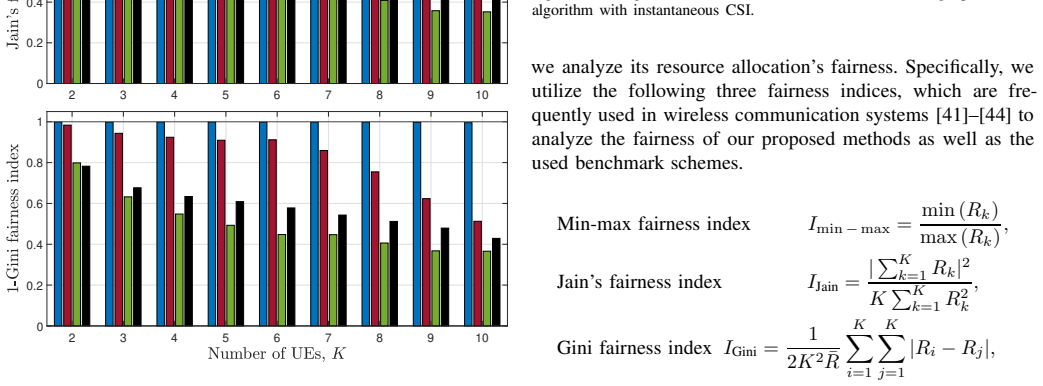
The central claim is that a SIM-assisted multi-user MISO downlink can be operated fairly by maximizing the minimum SINR, and that the joint optimization splits cleanly: for fixed phase shifts, the power-allocation subproblem is a geometric program; for fixed powers, the phase-shift subproblem can be attacked by relaxing discrete phases to continuous values and applying gradient descent-ascent on a min-max surrogate. Numerical experiments then show that the resulting scheme gives roughly 45 to 60 times the minimum rate of equal power with random phase shifts, about 20 times the rate of optimal power with random phases, and about 1.2 to 1.3 times the rate of equal power with optimized phases; fairness indices stay near 1 up to 10 users. In the statistical-CSI variant, the exact average minimum rate is replaced by an upper bound obtained by replacing each user's SINR by its SNR, whose distribution is exponential; minimizing the sum of reciprocal SNR terms yields the power and phase policies, and this bound is tight in the low-SNR regime. The paper also reports that the wave-based beamforming optimization contributes far more to the gains than the power allocation, and that eight-bit phase quantization recovers essentially the continuous-phase performance.
Load-bearing premise
The whole performance claim depends on the phase-update loop reliably finding a good point of a difficult nonconvex problem; the paper gives no convergence guarantee and borrows its step-size rule from a heuristic, so a stalled or cycling run would erase the gains.
Editorial extensions
If this is right
- A SIM can be configured for near-equal user rates using only its passive phase layers plus a power split, so the fairness burden moves from digital precoding to the wave domain.
- With instantaneous CSI the configuration must be recomputed per coherence interval, whereas with statistical CSI one configuration serves many coherence intervals and approximates the average rate well at low SNR.
- Eight-bit phase quantization recovers essentially the continuous-phase performance, which matters for hardware because it limits feedback and control complexity.
- The power-allocation step alone captures only a small part of the gain; most of the fairness improvement comes from optimizing the phase profile of the SIM.
- The max-min formulation avoids exhaustive search over $2^{bML}$ phase combinations, making the problem tractable at realistic layer and element counts.
Reading between the lines
- A natural next test is whether the reported 45-to-60x gains survive imperfect or delayed channel estimation, since the instantaneous-CSI algorithm assumes error-free channels in every coherence interval; the statistical-CSI algorithm should degrade more gracefully because it only needs the covariance.
- The same alternating geometric-programming-plus-gradient recipe likely transfers to SIM designs with amplitude control or inter-element coupling, because the power subproblem stays polynomial and the phase objective stays smooth.
- The low-SNR tightness of the bound suggests an operating rule the authors do not state explicitly: use statistical-CSI max-min optimization in power-limited or feedback-limited regimes, and reserve instantaneous-CSI optimization for high-SNR periods.
- Near-unit fairness indices up to ten users suggest the max-min policy does not merely rescue the worst user but equalizes the whole rate distribution; plotting full rate histograms would expose any middle-user sacrifice.
Signed reviews
Editorial analysis
A structured set of objections, weighed in public.
Referee Report
Summary. The manuscript studies a downlink stacked intelligent metasurface (SIM)-assisted multiuser MISO system and develops two max-min fairness algorithms. For the instantaneous-CSI case, the problem (P1) is decomposed into a geometric-programming power-allocation step and a gradient descent-ascent (GDA) wave-based beamforming step, followed by discrete phase quantization. For the statistical-CSI case, the average minimum achievable rate is upper-bounded by replacing each user's SINR with its SNR, yielding a deterministic objective (P6) that is minimized via alternating GP and gradient descent; the resulting policy is evaluated against an exhaustive search. Numerical simulations report substantial gains over equal-power/random-phase benchmarks and a tight upper bound in the low-SNR regime.
Significance. The problem is timely, and the statistical-CSI max-min fairness formulation for SIM-assisted systems appears to be new. The analytical building blocks—the gradient derivations in Lemmas I and II and the bounding chain in Eqs. (38)-(46)—are detailed and mostly correct, and the paper gives a clear comparison with exhaustive search for the statistical case. If the issues below are fixed, the claimed order-of-magnitude improvements and the fairness comparisons would be useful for the SIM literature. However, the paper does not provide convergence guarantees for the nonconvex subproblems, and the printed GP step is not equivalent to the stated power-allocation problem, so the numerical claims are not yet fully grounded.
major comments (3)
- [Section III-B1, Eqs. (14)-(15)] The GP reformulation (P2.2) is not equivalent to (P2.1). Starting from (14b), the constraint must read sum_{j≠k} |h_k^H G w_j|^2 p_j + sigma_k^2 ≤ |h_k^H G w_k|^2 p_k / t, that is, with s_{k,j}=|h_k^H G w_j|^2, sum_{j≠k} s_{k,j} p_j + sigma_k^2 ≤ s_{k,k} p_k / t. The printed (15b) has s_{k,k}/t on the right-hand side with no p_k, and the line defining s_{k,k} uses |h_k^H G w_j|^2 instead of |h_k^H G w_k|^2. As written, Algorithm 1's power-allocation step does not solve (P2.1), and because every instantaneous-CSI result in Section V-A relies on alternating this step with the GDA phase update, the numerical claims cannot be traced to the stated problem. This must be corrected, and the simulation implementation should be checked to confirm that it includes p_k in the numerator of the SINR constraint.
- [Section III-B2, Algorithm 2 and Problem (P3.1)] No convergence guarantee is provided for the GDA loop. The objective f(lambda, theta) in (16a) is nonconvex in theta and only linear in lambda, so the two-timescale step-size rule epsilon = tau*mu with tau=10, described after Eq. (25), has no established convergence guarantee for this problem class; the cited reference [39] requires structural conditions that are not verified here. Since the central numerical claim—an order-of-magnitude improvement over equal-power/random-phase benchmarks—depends on Algorithm 2 reaching a useful point, the authors should either supply a convergence analysis under explicit assumptions or clearly state that convergence is empirical and scope the claims accordingly. Figure 9 alone, for one configuration, is not a substitute for such a statement.
- [Section IV, Eq. (46)] The displayed equality tilde_R(tilde_theta^*, tilde_p^*) = exp(zeta sigma^2) E_1(zeta sigma^2) drops the factor log_2 e that appears on the preceding line. If the statistical-CSI curves in Fig. 10 evaluate (46) literally, the upper-bound curve is scaled by 1/log_2 e, which would invalidate the claimed tightness against the exhaustive search of the actual average rate in bps. The factor should be restored, and the simulation should be checked to ensure it uses the corrected expression.
minor comments (5)
- [Section V, system setup] The simulation setup says 'The BS has an M-antenna array along the x-axis,' but the system model in Section II uses N transmit antennas, with N=K in the simulations; this should be N-antenna array for consistency.
- [Algorithm 2 and Section III-B2] The symbol epsilon is used both as the bisection accuracy in the lambda projection (after Eq. (24)) and as the GDA step size in (17a) and (25a), and the input list includes both epsilon and tau; renaming one of these quantities would remove a serious notational clash.
- [Algorithm 1 and Fig. 9] Algorithm 1 says 'Repeat steps 2 and 3 until convergence,' but no stopping criterion is specified; the convergence plots in Figs. 9 and 12 should state the actual criterion used (for example, relative change in the minimum rate).
- [Section III-B2, Eq. (24)] The claim that g(eta) is monotonic in eta is stated without proof, and the displayed bounds on eta* are not derived; a short monotonicity argument and derivation of the bisection interval would make the projection step self-contained.
- [Section V-A, Figs. 3-8] The benchmark names are described in the text, but the legends in Figs. 3-8 are not all visible in the typeset version; please ensure every curve is labeled in the figure files so that the reported gains can be verified.
Circularity Check
No significant circularity: the GP/GDA reformulations and the statistical-CSI upper bound are self-contained with external anchors, the only self-citation is non-load-bearing background, and the flagged (15b) defect is a correctness typo rather than a circular reduction.
full rationale
The derivation chain is self-contained and no step reduces to its own inputs by construction. For the instantaneous-CSI branch, (P2) is a textbook epigraph max-min SINR problem, and (P2.2) is the standard geometric-programming rewrite of that epigraph constraint; a load-bearing equivalence, not a restatement of the result. The printed (15b) drops the user's own p_k and defines s_{k,k} with w_j instead of w_k, so the displayed GP subproblem is not literally equivalent to (P2.1) - but that is a transcription/soundness bug in the manuscript, not circularity, since the intended identity is an ordinary equivalent transformation rather than an equation that assumes what it claims to prove. The beamforming subproblem (P3) is rewritten as the minimax form (P3.1) via the standard identity that the minimum over the probability simplex of a finite list is attained at the vertex carrying the minimum element, a fact cited to the external reference [30]; the GDA update is a heuristic transparently adopted from external references [30] and [39], with no convergence guarantee, which is a robustness risk rather than a circular step. For the statistical-CSI branch, the upper bound is derived analytically: SINR is replaced by the interference-free SNR (37), the CDF of the exponentially distributed SNR is computed (39), and the product is integrated (40)-(41); the bound's tightness is then checked numerically against an exhaustive search of the original problem (P4) (Fig. 10), which is the correct ground truth for a tightness claim even though the comparison is performed on the authors' own simulation model. No parameter is fitted to any subset of results and then 'predicted' elsewhere: the algorithmic hyperparameters (kappa1, nu1, tau, epsilon, b) are fixed a priori, not calibrated to the reported curves, and the performance claims are direct simulation comparisons. The only self-citation, reference [10] (de Sena, Rasti, Mahmood, Latva-aho), appears in the introduction as background literature alongside [7]-[9] and plays no role in the derivations, so it is non-load-bearing. The paper's own stated limitations - that the exact average rate is intractable, that the exhaustive-search validation covers only small L and M, and that the bound is overly optimistic in the high-SNR regime - are honest qualifications rather than admissions of circularity.
Assumptions & free parameters
free parameters (2)
- Backtracking and GDA step sizes (instantaneous CSI) =
kappa1=0.8, nu1=0.3, tau=10, epsilon=1e-4
- Backtracking step size (statistical CSI) =
kappa2=0.8, nu2=0.3
assumptions (5)
- domain assumption Rayleigh-Sommerfeld diffraction model for inter-layer propagation (Eq. 3)
- domain assumption Far-field, isotropic scattering and spatial correlation matrix R_RIS (Eq. 5-6)
- domain assumption User channels are independent across users
- standard math Monotonicity of E{1/(a+Z)} in a for exponential Z
- standard math GP standard form and global solvability
Cite this review
Pith. "Pith review of Max-Min Fairness for Stacked Intelligent Metasurface-Assisted Multi-User MISO Systems." pith.science (2026). https://pith.science/paper/2SKBWBGB
@misc{pith2026250414584,
  author       = {Pith},
  title        = {Pith review of: Max-Min Fairness for Stacked Intelligent Metasurface-Assisted Multi-User MISO Systems},
  year         = {2026},
  howpublished = {\url{https://pith.science/paper/2SKBWBGB}},
  note         = {Machine review of arXiv:2504.14584}
}
read the original abstract
Stacked intelligent metasurface (SIM) is an emerging technology that uses multiple reconfigurable surface layers to enable flexible wave-based beamforming. In this paper, we focus on an \ac{SIM}-assisted multi-user multiple-input single-output system, where it is essential to ensure that all users receive a fair and reliable service level. To this end, we develop two max-min fairness algorithms based on instantaneous channel state information (CSI) and statistical CSI. For the instantaneous CSI case, we propose an alternating optimization algorithm that jointly optimizes power allocation using geometric programming and wave-based beamforming coefficients using the gradient descent-ascent method. For the statistical CSI case, since deriving an exact expression for the average minimum achievable rate is analytically intractable, we derive a tight upper bound and thereby formulate a stochastic optimization problem. This problem is then solved, capitalizing on an alternating approach combining geometric programming and gradient descent algorithms, to obtain the optimal policies. Our numerical results show significant improvements in the minimum achievable rate compared to the benchmark schemes. In particular, for the instantaneous CSI scenario, the individual impact of the optimal wave-based beamforming is significantly higher than that of the power allocation strategy. Moreover, the proposed upper bound is shown to be tight in the low signal-to-noise ratio regime under the statistical CSI.
Figures


Figures from the paper (5 more)




Reference graph
Works this paper leans on
-
[21]
E. Shi, J. Zhang, Y . Zhu, J. An, C. Y uen, and B. Ai, “Harnes sing stacked intelligent metasurface for enhanced cell-free massive MI MO systems: A low-power and cost approach,” arXiv preprint arXiv:2409.12851 , 2024
work page Pith review arXiv 2024
-
[39]
Two-timescale gradien t descent ascent algorithms for nonconvex minimax optimization,
T. Lin, C. Jin, and M. I. Jordan, “Two-timescale gradien t descent ascent algorithms for nonconvex minimax optimization,” Journal of Machine Learning Research, vol. 26, no. 11, pp. 1–45, 2025
work page 2025
-
[1]
Stacked intell igent metasurfaces for multiuser beamforming in the wave domain,
J. An, M. Di Renzo, M. Debbah, and C. Y uen, “Stacked intell igent metasurfaces for multiuser beamforming in the wave domain, ” in 2023 IEEE Int. Conf. Commun. (ICC) , 2023, pp. 2834–2839
work page 2023
-
[2]
Stacked intelligent metasurfaces for efficient holograp hic MIMO communications in 6G,
J. An et al. , “Stacked intelligent metasurfaces for efficient holograp hic MIMO communications in 6G,” IEEE J. Sel. Areas Commun. , vol. 41, no. 8, pp. 2380–2396, 2023
2023
-
[3]
M. Nerini and B. Clerckx, “Physically consistent modeli ng of stacked intelligent metasurfaces implemented with beyond diagona l RIS,” IEEE Commun. Lett. , vol. 28, no. 7, pp. 1693–1697, 2024
work page 2024
-
[4]
Stacked intelligent metasurface-aided MIMO transceive r design,
J. An et al. , “Stacked intelligent metasurface-aided MIMO transceive r design,” IEEE Wireless Commun. , vol. 31, no. 4, pp. 123–131, 2024
work page 2024
-
[5]
M. D. Renzo, “State-of-the-art on stacked intelligent m etasurfaces: Communication, sensing and computing in the wave domain,” 2 024. [Online]. Available: https://arxiv.org/abs/2411.19687
-
[6]
A survey of recent advances in optimization methods for wireless communications,
Y .-F. Liu et al. , “A survey of recent advances in optimization methods for wireless communications,” IEEE J. Sel. Areas Commun. , vol. 42, no. 11, pp. 2992–3031, 2024
work page 2024
Show all 44 references
-
[7]
A tutorial on cross-la yer optimization in wireless networks,
X. Lin, N. Shroff, and R. Srikant, “A tutorial on cross-la yer optimization in wireless networks,” IEEE J. Sel. Areas Commun. , vol. 24, no. 8, pp. 1452–1463, 2006
2006
-
[8]
Wireless network optimization by perron-fro benius theory,
C. W. Tan, “Wireless network optimization by perron-fro benius theory,” in 2014 48th Annual Conference on Information Sciences and Sys tems (CISS), 2014, pp. 1–6. 14
2014
-
[9]
Power control by geometric programming,
M. Chiang, C. W. Tan, D. P . Palomar, D. O’neill, and D. Juli an, “Power control by geometric programming,” IEEE Trans. Wireless Commun. , vol. 6, no. 7, pp. 2640–2651, 2007
2007
-
[10]
Beyond diagonal RIS for multi-band multi-cell MIMO networ ks: A practical frequency-dependent model and performance anal ysis,
A. Sousa de Sena, M. Rasti, N. Huda Mahmood, and M. Latva- aho, “Beyond diagonal RIS for multi-band multi-cell MIMO networ ks: A practical frequency-dependent model and performance anal ysis,” IEEE Trans. Wireless Commun. , vol. 24, no. 1, pp. 749–766, 2025
2025
-
[11]
A unified framework fo r max- min and min-max fairness with applications,
B. Radunovic and J.-Y . Le Boudec, “A unified framework fo r max- min and min-max fairness with applications,” IEEE/ACM Trans. Netw. , vol. 15, no. 5, pp. 1073–1083, 2007
2007
-
[12]
A unified analysi s of max- min weighted SINR for MIMO downlink system,
D. W. H. Cai, T. Q. S. Quek, and C. W. Tan, “A unified analysi s of max- min weighted SINR for MIMO downlink system,” IEEE Trans. Signal Process., vol. 59, no. 8, pp. 3850–3862, 2011
2011
-
[13]
A mu lti-cell beamforming design by uplink-downlink max-min SINR dualit y,
S. He, Y . Huang, L. Y ang, A. Nallanathan, and P . Liu, “A mu lti-cell beamforming design by uplink-downlink max-min SINR dualit y,” IEEE Trans. Wireless Commun. , vol. 11, no. 8, pp. 2858–2867, 2012
2012
-
[14]
Achievable rate optimization for large stacked intel- ligent metasurfaces based on statistical CSI,
A. Papazafeiropoulos, P . Kourtessis, S. Chatzinotas, D. I. Kaklamani, and I. S. V enieris, “Achievable rate optimization for large stacked intel- ligent metasurfaces based on statistical CSI,” IEEE Wireless Commun. Lett., vol. 13, no. 9, pp. 2337–2341, 2024
2024
-
[15]
Stacked intelligent metasurfaces for multiuser d ownlink beamforming in the wave domain,
J. An, M. D. Renzo, M. Debbah, H. V . Poor, and C. Y uen, “Stacked intelligent metasurfaces for multiuser d ownlink beamforming in the wave domain,” 2023. [Online]. Available : https://arxiv.org/abs/2309.02687
2023 arXiv
-
[16]
Achievable rate optimization for stacked intelligent metasurface-assisted holographic MIMO communications,
A. Papazafeiropoulos, J. An, P . Kourtessis, T. Ratnara jah, and S. Chatzinotas, “Achievable rate optimization for stacked intelligent metasurface-assisted holographic MIMO communications,” IEEE Trans. Wireless Commun., vol. 23, no. 10, pp. 13 173–13 186, 2024
2024
-
[17]
Stacked intelligent metasurf aces for fully- analog wideband beamforming design,
Z. Li, J. An, and C. Y uen, “Stacked intelligent metasurf aces for fully- analog wideband beamforming design,” in 2024 IEEE VTS Asia Pacific Wireless Communications Symposium (APWCS) , 2024, pp. 1–5
2024
-
[18]
Multi-user MISO with stacked intelligent metasurf aces: a DRL-based sum-rate optimization approach,
H. Liu, J. An, G. C. Alexandropoulos, D. W. K. Ng, C. Y uen, and L. Gan, “Multi-user MISO with stacked intelligent metasurf aces: a DRL-based sum-rate optimization approach,” 2024. [Online ]. Available: https://arxiv.org/abs/2408.04837
2024 arXiv
-
[19]
DRL-based orchestration of multi-user MISO systems with s tacked intelligent metasurfaces,
H. Liu, J. An, D. W. K. Ng, G. C. Alexandropoulos, and L. Ga n, “DRL-based orchestration of multi-user MISO systems with s tacked intelligent metasurfaces,” in ICC 2024 - IEEE International Conference on Communications , 2024, pp. 4991–4996
2024
-
[20]
Design of stacked intelli- gent metasurfaces with reconfigurable amplitude and phase f or multiuser downlink beamforming,
D. Darsena, F. V erde, I. Iudice, and V . Galdi, “Design of stacked intelli- gent metasurfaces with reconfigurable amplitude and phase f or multiuser downlink beamforming,” IEEE Open Journal of the Communications Society, vol. 6, pp. 531–550, 2025
2025
-
[22]
Transmit beamforming design for ISAC with stacked intelli gent meta- surfaces,
S. Li, F. Zhang, T. Mao, R. Na, Z. Wang, and G. K. Karagiann idis, “Transmit beamforming design for ISAC with stacked intelli gent meta- surfaces,” IEEE Trans. V eh. Technol., pp. 1–6, 2024
2024
-
[23]
Ma x - min rate optimization for group- transmissive RIS- based tr ansmitter architectures,
H. Cheng, J. Huang, G. Li, F. Wang, W. Hao, and S. Y ang, “Ma x - min rate optimization for group- transmissive RIS- based tr ansmitter architectures,” in 2024 IEEE 99th V ehicular Technology Conference (VTC2024-Spring), 2024, pp. 1–5
2024
-
[24]
Max-min fairness in IRS-ai ded multi-cell MISO systems with joint transmit and reflective beamforming ,
H. Xie, J. Xu, and Y .-F. Liu, “Max-min fairness in IRS-ai ded multi-cell MISO systems with joint transmit and reflective beamforming ,” IEEE Trans. Wireless Commun. , vol. 20, no. 2, pp. 1379–1393, 2021
2021
-
[25]
Asymptotic max-min SINR analysis of reconfigurab le intelli- gent surface assisted MISO systems,
Q.-U.-A. Nadeem, A. Kammoun, A. Chaaban, M. Debbah, and M.-S. Alouini, “Asymptotic max-min SINR analysis of reconfigurab le intelli- gent surface assisted MISO systems,” IEEE Trans. Wireless Commun. , vol. 19, no. 12, pp. 7748–7764, 2020
2020
-
[26]
Max-min rate optimiz ation for uplink IRS-NOMA with receive beamforming,
L. Cantos, M. Awais, and Y . H. Kim, “Max-min rate optimiz ation for uplink IRS-NOMA with receive beamforming,” IEEE Wireless Commun. Lett., vol. 11, no. 12, pp. 2512–2516, 2022
2022
-
[27]
On the performance of reconfigurable intelligent surface- aided cell-free massive MIMO uplink,
M. Bashar, K. Cumanan, A. G. Burr, P . Xiao, and M. Di Renzo , “On the performance of reconfigurable intelligent surface- aided cell-free massive MIMO uplink,” in GLOBECOM 2020 - 2020 IEEE Global Communications Conference, 2020, pp. 1–6
2020
-
[28]
Max-min SINR optimization for RIS-aide d uplink communications with green constraints,
A. Subhash, A. Kammoun, A. Elzanaty, S. Kalyani, Y . H. Al -Badarneh, and M.-S. Alouini, “Max-min SINR optimization for RIS-aide d uplink communications with green constraints,” IEEE Wireless Commun. Lett. , vol. 12, no. 6, pp. 942–946, 2023
2023
-
[29]
An efficien t convex-hull relaxation based algorithm for multi-user discrete passiv e beamforming,
W. Lai, Z. Wu, Y . Feng, K. Shen, and Y .-F. Liu, “An efficien t convex-hull relaxation based algorithm for multi-user discrete passiv e beamforming,” IEEE Signal Process. Lett. , vol. 31, pp. 2275–2279, 2024
2024
-
[30]
Passive refleccommuntion o ptimization for IRS-aided multicast beamforming with discrete phase sh ifts,
G. Y an, L. Zhu, and R. Zhang, “Passive refleccommuntion o ptimization for IRS-aided multicast beamforming with discrete phase sh ifts,” IEEE Wireless Commun. Lett. , vol. 12, no. 8, pp. 1424–1428, 2023
2023
-
[31]
Achievab le rate analysis and max-min SINR optimization in intelligent refle cting surface assisted cell-free MIMO uplink,
Q.-U.-A. Nadeem, A. Zappone, and A. Chaaban, “Achievab le rate analysis and max-min SINR optimization in intelligent refle cting surface assisted cell-free MIMO uplink,” IEEE Open J. Commun. Soc. , vol. 3, pp. 1295–1322, 2022
2022
-
[32]
Max-min SINR analysis of STAR-RIS assisted massive MIMO systems wit h hardware impairments,
A. Papazafeiropoulos, P . Kourtessis, and S. Chatzinot as, “Max-min SINR analysis of STAR-RIS assisted massive MIMO systems wit h hardware impairments,” IEEE Trans. Wireless Commun. , vol. 23, no. 5, pp. 4255–4268, 2024
2024
-
[33]
Statistical CSI bas ed phase-shift and transmit power optimization for RIS-aided massive MIMO ,
D. Gunasinghe and G. Amarasuriya, “Statistical CSI bas ed phase-shift and transmit power optimization for RIS-aided massive MIMO ,” in GLOBECOM 2022 - 2022 IEEE Global Communications Conference , 2022, pp. 4007–4012
2022
-
[34]
Statistic al CSI- based design for RIS-assisted communication systems,
Z. Y u, Y . Han, M. Matthaiou, X. Li, and S. Jin, “Statistic al CSI- based design for RIS-assisted communication systems,” IEEE Wireless Commun. Lett. , vol. 11, no. 10, pp. 2115–2119, 2022
2022
-
[35]
Statistical CSI-bas ed design for reconfigurable intelligent surface-aided massive MIMO systems with direct links,
K. Zhi, C. Pan, H. Ren, and K. Wang, “Statistical CSI-bas ed design for reconfigurable intelligent surface-aided massive MIMO systems with direct links,” IEEE Wireless Commun. Lett. , vol. 10, no. 5, pp. 1128– 1132, 2021
2021
-
[36]
Stat istical CSI- based beamforming for RIS-aided multiuser MISO systems via deep reinforcement learning,
M. Eskandari, H. Zhu, A. Shojaeifard, and J. Wang, “Stat istical CSI- based beamforming for RIS-aided multiuser MISO systems via deep reinforcement learning,” IEEE Wireless Commun. Lett. , vol. 13, no. 2, pp. 570–574, 2024
2024
-
[37]
All-optical machine learning using diffractive deep neu ral networks,
X. Lin et al., “All-optical machine learning using diffractive deep neu ral networks,” Science, vol. 361, no. 6406, pp. 1004–1008, 2018. [Online]. Available: https://www.science.org/doi/abs/10.1126/science.aat8084
2018 doi
-
[38]
Boyd and L
S. Boyd and L. V andenberghe, Convex Optimization. Cambridge, UK: Cambridge University Press, 2004
2004
-
[40]
Toward ma ssive MIMO 2.0: Understanding spatial correlation, interference suppres sion, and pilot contamination,
L. Sanguinetti, E. Bj¨ ornson, and J. Hoydis, “Toward ma ssive MIMO 2.0: Understanding spatial correlation, interference suppres sion, and pilot contamination,” IEEE Trans. Commun. , vol. 68, no. 1, pp. 232–257, 2020
2020
-
[41]
A new fairness index fo r radio resource allocation in wireless networks,
M. Dianati, X. Shen, and S. Naik, “A new fairness index fo r radio resource allocation in wireless networks,” in IEEE Wireless Communi- cations and Networking Conference, 2005 , vol. 2, 2005, pp. 712–717 V ol. 2
2005
-
[42]
A quantitative measure of fairness and discrimination,
R. K. Jain, D.-M. W. Chiu, W. R. Hawe et al. , “A quantitative measure of fairness and discrimination,” Eastern Research Laboratory, Digital Equipment Corporation, Hudson, MA , vol. 21, no. 1, 1984
1984
-
[43]
Fairness in cognitive radio networks: Models, measuremen t methods, applications, and future research directions,
U. U. Khan, N. Dilshad, M. H. Rehmani, and T. Umer, “Fairness in cognitive radio networks: Models, measuremen t methods, applications, and future research directions,” Journal of Network and Computer Applications , vol. 73, pp. 12–26, 2016. [Online]. Available: https://www.sci...
2016
-
[44]
Energy-efficient re source allocation for downlink non-orthogonal multiple access sy stems,
Y . Cui, P . Liu, Y . Zhou, and W. Duan, “Energy-efficient re source allocation for downlink non-orthogonal multiple access sy stems,” Applied Sciences , vol. 12, no. 19, 2022. [Online]. Available: https://www.mdpi.com/2076-3417/12/19/9740
2022
Reviewed August 16, 2026 · model on record in the stance chip above.
Discussion (0). Continue with ORCID to comment.