REVIEW 3 major objections 4 minor 74 references
GLITTER: An AI-assisted Platform for Material-Grounded Asynchronous Discussion in Flipped Learning
T0 review · 3 major / 4 minor · reviewed 2026-08-16 · deepseek-v4-flash
Pith's one-line read This paper presents GLITTER, an AI-assisted discussion platform that turns scattered pre-class posts into engaged, prepared students.
desk verdict The system is thoughtfully designed, but because every 'peer' post in both studies was GPT-4o-generated, the paper never actually tests peer discussion. read the letter →
The pith
A machine-rendered reading of the paper's core claim, the machinery that carries it, and where it could break.
The reading
What carries the argument
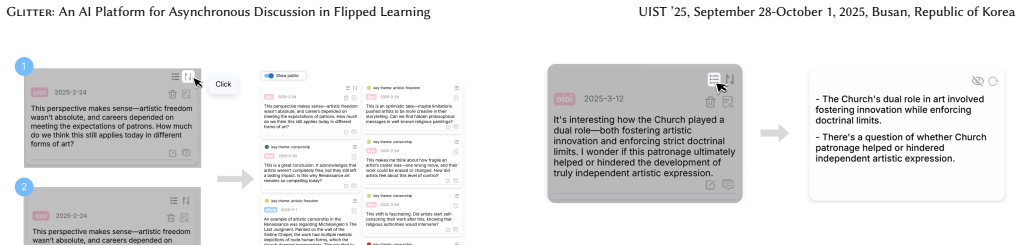
The load-bearing mechanism is conceptual blending—the cognitive operation of merging ideas from two mental spaces into a new integrated understanding—which GLITTER externalizes as a user-facing workflow. Students select one 'aspect' from their own post and one from a peer's post, the system generates a discussion question that bridges the two, and a retrieval-augmented generator pulls supporting quotes from the course materials only. Around this core sit three supporting mechanisms: affinity-based navigation with color-coded relevance, LLM content summarization, and personalized interactive reports that visualize reading behavior, discussion topics, and peer interactions.
What would settle it
Run a larger, between-subjects field test in a real course: students using GLITTER versus students using an identical interface whose AI outputs are replaced by random or deliberately wrong affinity labels and summaries. If the two groups show the same discussion activity, self-rated engagement, and in-class preparedness, then the AI scaffolding is not the active ingredient; if the wrong-label group collapses, the specific AI-generated content is doing the work.
Extended reading notes
Core claim
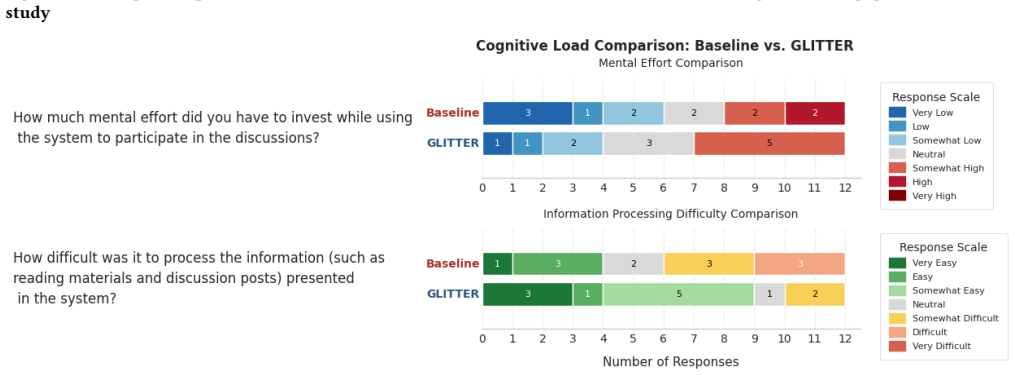
GLITTER's central discovery is that material-grounded asynchronous discussion can be scaffolded by applying Conceptual Blending Theory to peer posts: when the system labels posts with shared affinity dimensions, highlights key terms under similarity, contrast, and complement frameworks, and offers AI-generated 'Inspiring Questions' with evidence retrieved from the course materials, students report feeling more able to start, more likely to generate new ideas, and better prepared for class. The lab results show a statistically significant increase in the number of posts (6 vs. 4.25) and self-reported gains on engagement, ideation, and preparation, without a significant increase in perceived cognitive load. The paper treats the AI outputs as cognitive scaffolds rather than authoritative answers, preserving student-led meaning-making.
Load-bearing premise
The entire benefit rides on the AI-generated affinity labels, summaries, and blending questions being accurate and pedagogically useful; participants already reported inconsistent granularity and occasional unreliability, so if those outputs degrade in larger or more heterogeneous courses, the engagement and preparedness gains may not survive.
Editorial extensions
If this is right
- In flipped courses, students may need less raw reading volume or forum monitoring to participate meaningfully; color-coded affinity mapping lets them enter a discussion without reading every post.
- The 'inspiring question plus material evidence' pattern gives students a low-anxiety starting point, addressing the contribution anxiety the formative study identified.
- Personalized reports turn pre-class discussion from a forgotten activity into a reviewable artifact, so students arrive at class able to recall what they read and said.
- Because the evidence retrieval is restricted to the course corpus, the AI's discussion prompts stay anchored to the assigned material rather than drifting to general knowledge.
Reading between the lines
- If the effect is real, the platform's value may transfer to any asynchronous knowledge work, not just flipped classrooms: peer review, seminar preparation, or collaborative reading groups could reuse the same blend-and-evidence loop.
- The paper's own user challenges suggest a testable threshold: when LLM labels are too vague or too specific, the engagement gains likely shrink; future versions could expose confidence scores or let students adjust affinity granularity.
- Because the lab used short readings and pre-generated peer posts, the key open question is whether the scaffolding remains useful when students read long texts and write authentic, messy posts; the exploratory deployment with much longer readings hints it may.
Signed reviews
Editorial analysis
A structured set of objections, weighed in public.
Referee Report
Summary. GLITTER is an AI-assisted discussion platform for pre-class asynchronous discussion in flipped classrooms. The paper reports a formative study (n=4), a within-subjects lab study (n=12) comparing GLITTER to a simplified baseline, and an exploratory in-class deployment (n=21). The central claims are that GLITTER improves discussion engagement, sparks new ideas, supports reflection, and increases preparedness for in-class activities. The system implements affinity-based navigation, AI summarization, multi-framework keyword highlighting, conceptual blending with RAG-grounded evidence, and personalized reflection reports.
Significance. If the headline results held in authentic peer discussion, GLITTER would be a useful contribution to the CSCW/EdTech space: the design goals are grounded in a formative study, the system addresses metacognitive support that existing tools largely lack, and the appendix provides concrete LLM prompts that aid reproducibility. The paper is also commendable for reporting negative participant feedback about AI output quality and for labeling the classroom study as exploratory. However, the evaluation design means the evidence does not yet license the claims as stated, because both studies substitute GPT-4o-generated posts for real peer contributions.
major comments (3)
- [§5.1.2, §6.2, §8] The central claims concern 'peer discussion,' but in both studies all discussion partners are pre-generated GPT-4o posts: the lab study used 25 pre-generated posts per reading and the deployment used 30 pre-generated posts per article. The paper never separates interactions with student-authored posts from interactions with AI-generated posts, and the Limitations section does not list this as a threat. As a result, the observed increases in post count, self-reported engagement, idea inspiration, reflection, and preparedness may be responses to the quality and coherence of GPT-4o content rather than to GLITTER's support of peer dialogue. This is a construct-validity threat to the headline claim. To make the claim defensible, the authors should either run a study with real, student-authored peer posts, or explicitly restrict the claims to AI-scaffolded discussion and add the synthetic-peer issue to the Limitations.
- [§5.2.1, Table 1] The quantitative engagement result (Glitter: 6 posts vs. Baseline: 4.25 posts, p = 0.004) is confounded by time on task: Glitter also took significantly longer (23.17 vs. 15.5 minutes, p = 0.006). No analysis adjusts for time or discusses whether the extra time is a cost or a benefit. With a 30-minute session, the higher post count may simply reflect that participants spent 7.67 more minutes interacting. The paper should report posts per minute or otherwise control for time, and should interpret the time difference substantively.
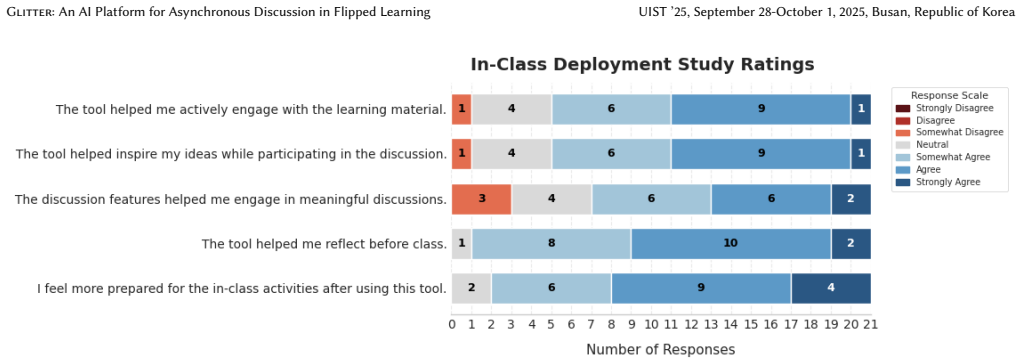
- [§5.2.2, Figure 6] The three significant self-report comparisons for engagement, idea inspiration, and preparedness are all reported with exactly the same Z value (−3.059) but different p-values (0.0044, 0.0031, 0.0066). This is not credible as reported and needs clarification: the authors should state whether these are exact Wilcoxon signed-rank probabilities, whether ties were handled, and should report effect sizes. Since these self-report results are the main quantitative support for the reflection and preparedness claims, the discrepancy matters for the evidence base.
minor comments (4)
- [Figures 6–10] The bar charts of self-reported questionnaire results do not show error bars, individual data points, or scale ranges, making it difficult to assess variability and the practical size of the reported effects.
- [§5.2.3, KF2] Describing the AI as a 'third participant' in the conversation is vivid but further undercuts the peer-discussion framing; consider reframing this as AI-generated content serving as discussion prompts, or clarify how this relates to authentic peer interaction.
- [§6.2] The deployment report does not quantify how many posts were student-authored versus GPT-4o-generated; reporting that breakdown would help readers judge the authenticity of the 'peer' discussion in the classroom setting.
- [§8] The Limitations section acknowledges small sample sizes and the lab setting but omits the synthetic-peer design choice; adding an explicit statement about this threat would make the limitations discussion more complete.
Circularity Check
No significant circularity: the evaluation compares GLITTER against a simplified baseline using external behavioral and self-report measures, and no claim reduces by construction to its own inputs.
full rationale
The paper's central claim is that GLITTER improves discussion engagement, sparks new ideas, supports reflection, and increases preparedness for in-class activities, as demonstrated by a within-subjects lab study (n=12) and an exploratory deployment (n=21). I walked the derivation chain and found no step where the claimed result is defined in terms of the input, no fitted parameter that is later renamed a prediction, and no load-bearing self-citation chain. The evaluation uses external benchmarks: counts of posts, time on task, Wilcoxon signed-rank tests on participant questionnaire ratings, and semi-structured interview themes (Sections 5.2.1-5.2.3, 6.3). The design draws on Conceptual Blending Theory as a generative design framework, but the theory does not define the outcome measures; the measures are participants' own reports and observable posting behavior. The baseline is a simplified version of the same system without the AI-assisted features, and both conditions used the same pre-generated GPT-4o discussion posts (Section 5.1.2), so the comparison isolates the system features rather than encoding the conclusion in the condition definitions. The paper does not fit any model parameters to the outcome data and then 'predict' those same outcomes. Self-citations (e.g., references [58], [59], [60]) appear in related-work discussions of AI-assisted writing and collaboration tools, but they do not supply the paper's central premise or forbid alternative explanations, so they are not circularity under the stated rules. The strongest skeptical concern--that both evaluations used GPT-4o-generated peer posts rather than authentic student-authored posts, threatening construct validity of 'peer discussion' (Sections 5.1.2 and 6.2)--is a legitimate external-validity and ecological-validity risk, and the Limitations section (Section 8) does not list it as a threat. However, that concern does not make the derivation circular: the outcome measures are not logically entailed by the inputs, and the AI-generated posts were held constant across conditions, so the observed differences between GLITTER and baseline are attributable to the manipulated features rather than to a fitted or self-referential quantity.
Assumptions & free parameters
assumptions (5)
- domain assumption Participant self-reports of engagement, reflection, and preparedness correspond to actual cognitive and learning outcomes.
- domain assumption The 30-minute lab task with pre-generated GPT-4o posts is representative of real pre-class discussion in flipped classrooms.
- domain assumption The AI-generated affinity labels, summaries, and inspiring questions are of sufficient quality to support learning without systematic errors.
- domain assumption Conceptual Blending Theory provides a valid pedagogical foundation for the system's features.
- standard math The Wilcoxon signed-rank test is appropriate for the paired, small-sample data.
Cite this review
Pith. "Pith review of GLITTER: An AI-assisted Platform for Material-Grounded Asynchronous Discussion in Flipped Learning." pith.science (2026). https://pith.science/paper/A4SP2E4F
@misc{pith2026250414695,
  author       = {Pith},
  title        = {Pith review of: GLITTER: An AI-assisted Platform for Material-Grounded Asynchronous Discussion in Flipped Learning},
  year         = {2026},
  howpublished = {\url{https://pith.science/paper/A4SP2E4F}},
  note         = {Machine review of arXiv:2504.14695}
}
read the original abstract
Flipped classrooms promote active learning by having students engage with materials independently before class, allowing in-class time for collaborative problem-solving. During this pre-class phase, asynchronous online discussions help students build knowledge and clarify concepts with peers. However, it remains difficult to engage with temporally dispersed peer contributions, connect discussions with static learning materials, and prepare for in-class sessions based on their self-learning outcome. Our formative study identified cognitive challenges students encounter, including navigation barriers, reflection gaps, and contribution difficulty and anxiety. We present GLITTER, an AI-assisted discussion platform for pre-class learning in flipped classrooms. GLITTER helps students identify posts with shared conceptual dimensions, scaffold knowledge integration through conceptual blending, and enhance metacognition via personalized reflection reports. A lab study within subjects (n = 12) demonstrates that GLITTER improves discussion engagement, sparks new ideas, supports reflection, and increases preparedness for in-class activities.
Figures


Figures from the paper (6 more)




Reference graph
Works this paper leans on
-
[1]
Lakmal Abeysekera and Phillip Dawson. 2015. Motivation and cognitive load in the flipped classroom: definition, rationale and a call for research. Higher Education Research & Development 34, 1 (2015), 1–14. https://doi.org/10.1080/ 07294360.2014.934336
arXiv 2015
-
[2]
Gökçe Akçayır and Murat Akçayır. 2018. The flipped classroom: A review of its advantages and challenges. Computers & Education 126 (2018), 334–345
work page 2018
-
[3]
Lorin W Anderson and David R Krathwohl. 2001. A taxonomy for learning, teaching, and assessing: A revision of Bloom’s taxonomy of educational objectives . Longman
work page 2001
-
[4]
Jonathan Bergmann and Aaron Sams. 2012. Flip your classroom: Reach every student in every class every day. International society for technology in education
work page 2012
-
[5]
Vasiliki Betihavas, Heather Bridgman, Rachel Kornhaber, and Merylin Cross. 2016. The evidence for ‘flipping out’: A systematic review of the flipped classroom in nursing education. Nurse education today 38 (2016), 15–21
work page 2016
-
[6]
Jacob L. Bishop and Matthew A. Verleger. 2013. The Flipped Classroom: A Survey of the Research. In 120th ASEE National Conference and Exposition . American Society for Engineering Education, Atlanta, GA. Paper ID 6219
work page 2013
-
[7]
Margaret A. Boden. 1998. Creativity and artificial intelligence. Artificial Intelli- gence 103, 1-2 (1998), 347–356. https://doi.org/10.1016/S0004-3702(98)00055-1
-
[8]
Virginia Braun and Victoria Clarke. 2012. Thematic analysis. American Psycho- logical Association
2012
Show all 74 references
-
[9]
Stephen D Brookfield and Stephen Preskill. 2012. Discussion as a way of teaching: Tools and techniques for democratic classrooms . John Wiley & Sons
2012
-
[10]
Amy Bruckman. 2014. Research Ethics and HCI . Springer New York, New York, NY, 449–468. https://doi.org/10.1007/978-1-4939-0378-8_18
2014 doi
-
[11]
A. J. Brush, D. Bargeron, J. Grudin, A. Borning, and A. Gupta. 2002. Support- ing interaction outside of class: Anchored discussions vs. discussion boards. In Proceedings of CSCL 2002 . Lawrence Erlbaum, 425–434
2002
-
[12]
Joseph Chee Chang, Amy X Zhang, Jonathan Bragg, Andrew Head, Kyle Lo, Doug Downey, and Daniel S Weld. 2023. Citesee: Augmenting citations in scientific papers with persistent and personalized historical context. In Proceedings of the 2023 CHI Conference on Human Factors in Com...
2023
-
[13]
Liwen Chen, Tung-Liang Chen, and Nian-Shing Chen. 2015. Students’ perspec- tives of using cooperative learning in a flipped statistics classroom. Australasian Journal of Educational Technology 31, 6 (2015)
2015
-
[14]
Yunglung Chen, Yuping Wang, Nian-Shing Chen, et al. 2014. Is FLIP enough? Or should we use the FLIPPED model instead? Computers & Education 79 (2014), 16–27. Glitter: An AI Platform for Asynchronous Discussion in Flipped Learning UIST ’25, September 28-October 1, 2025, Busan, ...
2014
-
[15]
Michelene TH Chi and Ruth Wylie. 2014. The ICAP framework: Linking cognitive engagement to active learning outcomes. Educational psychologist 49, 4 (2014), 219–243
2014
-
[16]
Chilton, Ecenaz Jen Ozmen, and Sam H
Lydia B. Chilton, Ecenaz Jen Ozmen, and Sam H. Ross. 2020. VisiFit: AI Tools to Iteratively Improve Visual Blends. In Proceedings of the 2020 CHI Conference on Human Factors in Computing Systems (CHI ’20) . ACM, New York, NY, USA, 1–13. https://doi.org/10.1145/3313831.3376471
2020
-
[17]
Chilton, Savvas Petridis, and Maneesh Agrawala
Lydia B. Chilton, Savvas Petridis, and Maneesh Agrawala. 2019. VisiBlends: A Flexible Workflow for Visual Blends. In Proceedings of the 2019 CHI Conference on Human Factors in Computing Systems (CHI ’19) . ACM, New York, NY, USA, 1–14. https://doi.org/10.1145/3290605.3300402
2019
-
[18]
John Joon Young Chung and Eytan Adar. 2023. Artinter: AI-Powered Boundary Objects for Commissioning Visual Arts. InProceedings of the 2023 ACM Designing Interactive Systems Conference (DIS ’23) . ACM, Pittsburgh, PA, USA, 1–15. https: //doi.org/10.1145/3563657.3595981
2023
-
[19]
Tristan Cui and Jeff Wang. 2024. Empowering active learning: A social annotation tool for improving student engagement. British Journal of Educational Technology 55, 2 (2024), 712–730. https://doi.org/10.1111/bjet.13403
2024 doi
-
[20]
Schermerhorn, Johan Deprez, Martin Goedhart, John R
Sofie Van den Eynde, Benjamin P. Schermerhorn, Johan Deprez, Martin Goedhart, John R. Thompson, and Mieke De Cock. 2020. Dynamic conceptual blending analysis to model student reasoning processes while integrating mathematics and physics: A case study in the context of the heat...
2020
-
[21]
Veronica Diaz. 2011. Blended and Flipped: Avoiding Common Mistakes in Blended Course Design. Faculty Focus Special Report (2011)
2011
-
[22]
Pierre Dillenbourg. 1999. Collaborative learning: Cognitive and computational approaches. Vol. 1. Elsevier
1999
-
[23]
Dow, Julie Fortuna, Dan Schwartz, Beth Altringer, Daniel L
Steven P. Dow, Julie Fortuna, Dan Schwartz, Beth Altringer, Daniel L. Schwartz, and Scott R. Klemmer. 2011. Prototyping Dynamics: Sharing Multiple Designs Improves Exploration, Group Rapport, and Results. In Proceedings of the SIGCHI Conference on Human Factors in Computing Sy...
2011
-
[24]
Edmodo. n.d.. Edmodo. https://new.edmodo.com. Accessed: 2025-04-10
2025
-
[26]
Gilles Fauconnier and Mark Turner. 1998. Conceptual integration networks. Cog- nitive Science 22, 2 (1998), 133–187. https://doi.org/10.1207/s15516709cog2202_1
1998 doi
-
[27]
2002.The Way We Think: Conceptual Blending and the Mind’s Hidden Complexities
Gilles Fauconnier and Mark Turner. 2002.The Way We Think: Conceptual Blending and the Mind’s Hidden Complexities . Basic Books, New York, NY
2002
-
[28]
Mary Beth Gilboy, Scott Heinerichs, and Gina Pazzaglia. 2015. Enhancing student engagement using the flipped classroom. Journal of nutrition education and behavior 47, 1 (2015), 109–114
2015
-
[29]
Google. n.d.. Google Classroom. https://classroom.google.com. Accessed: 2025-04-10
2025
-
[30]
Bor Gregorcic and Jesper Haglund. 2021. Conceptual Blending as an Interpretive Lens for Student Engagement with Technology: Exploring Celestial Motion on an Interactive Whiteboard. Research in Science Education 51 (2021), 235–275. https://doi.org/10.1007/s11165-018-9794-8
2021 doi
-
[31]
Hoehn and Noah D
Jessica R. Hoehn and Noah D. Finkelstein. 2018. Students’ flexible use of ontolo- gies and the value of tentative reasoning: Examples of conceptual understanding in three canonical topics of quantum mechanics. Physical Review Physics Educa- tion Research 14, 1 (2018), 010122. ...
2018 doi
-
[32]
Sanjay Rebello
Dehui Hu and N. Sanjay Rebello. 2013. Using conceptual blending to describe how students use mathematical integrals in physics. Physical Review Special Topics - Physics Education Research 9, 2 (2013), 020118. https://doi.org/10.1103/ PhysRevSTPER.9.020118
2013
-
[33]
Manuel Imaz and David Benyon. 2007. Designing with Blends: Conceptual Foun- dations of Human-Computer Interaction and Software Engineering . MIT Press, Cambridge, MA
2007
-
[34]
Instructure. n.d.. Canvas LMS. https://www.instructure.com/canvas. Accessed: 2025-04-10
2025
-
[35]
Shih, and Kyungsik Han
Youngseung Jeon, Seungwan Jin, Patrick C. Shih, and Kyungsik Han. 2021. FashionQ: An AI-Driven Creativity Support Tool for Facilitating Ideation in Fashion Design. In Proceedings of the 2021 CHI Conference on Human Fac- tors in Computing Systems (CHI ’21) . ACM, Yokohama, Japa...
2021
-
[36]
Jennifer Johnson. 2017. Social Annotation in College Classrooms: Information Overload and Student Motivation. Journal of Interactive Learning Research 28, 3 (2017), 295–315
2017
-
[37]
Shivani Kapania, Ruiyi Wang, Toby Jia-Jun Li, Tianshi Li, and Hong Shen. 2025. ’I’m Categorizing LLM as a Productivity Tool’: Examining Ethics of LLM Use in HCI Research Practices. Proc. ACM Hum.-Comput. Interact. 9, 2, Article CSCW102 (May 2025), 26 pages. https://doi.org/10....
2025 doi
-
[38]
Min Kyu Kim, So Mi Kim, Ojal Khera, and Jordan Getman. 2014. Flipped classroom in engineering education: A survey of the research. International Journal of Engineering Education 30, 1 (2014), 21–37
2014
-
[39]
Chih-Hao Lai and Gwo-Jen Hwang. 2021. Self-regulated learning in flipped classrooms: A systematic review and meta-analysis. Educational Technology Research and Development 69, 4 (2021), 1851–1878
2021
-
[40]
Chiu-Lin Lai and Gwo-Jen Hwang. 2016. A self-regulated flipped classroom approach to improving students’ learning performance in a mathematics course. Computers & Education 100 (2016), 126–140
2016
-
[41]
Byungjoo Lee, Olli Savisaari, and Antti Oulasvirta. 2016. Spotlights: Attention- optimized highlights for skim reading. In Proceedings of the 2016 CHI Conference on Human Factors in Computing Systems . 5203–5214
2016
-
[42]
Vivian Liu, Jo Vermeulen, George Fitzmaurice, and Justin Matejka. 2023. 3DALL- E: Integrating Text-to-Image AI in 3D Design Workflows. InProceedings of the 2023 ACM Designing Interactive Systems Conference . ACM, Pittsburgh, PA, USA, 1955–1977. https://doi.org/10.1145/3563657.3596098
2023
-
[43]
Chung Kwan Lo and Khe Foon Hew. 2017. A critical review of flipped classroom challenges in K-12 education: possible solutions and recommendations for future research. Research and Practice in Technology Enhanced Learning 12 (2017), 4. https://doi.org/10.1186/s41039-016-0044-2
2017 doi
-
[44]
Frank Lyman. 1987. Think-Pair-Share: An expanding teaching technique. MAA- CIE Cooperative News 1, 1 (1987), 1–2
1987
-
[45]
Tor Ole B. Odden. 2021. How Conceptual Blends Support Sensemaking: A Case Study from Introductory Physics. Science Education 105, 5 (2021), 989–1012. https://doi.org/10.1002/sce.21674
2021 doi
-
[46]
Eileen O’Shea and Christine Stone. 2015. Asynchronous discussion forums in online learning. Clinical Nurse Specialist 29, 1 (2015), 22–27
2015
-
[47]
Perusall. n.d.. Perusall. https://www.perusall.com. Accessed: 2025-04-10
2025
-
[48]
Marlene Scardamalia and Carl Bereiter. 2006. Knowledge building: Theory, peda- gogy, and technology. Cambridge University Press
2006
-
[49]
Ben Shneiderman and Pattie Maes. 1997. Direct manipulation vs. interface agents. Interactions 4, 6 (1997), 42–61
1997
-
[50]
J Dominic Smith. 2013. Student attitudes toward flipping the general chemistry classroom. Chemistry Education Research and Practice 14, 4 (2013), 607–614
2013
-
[51]
Gerry Stahl. 2006. Group cognition: Computer support for building collaborative knowledge. MIT Press
2006
-
[52]
Jerry Chih-Yuan Sun, Yu-Ting Wu, and Wei-I Lee. 2017. The effect of the flipped classroom approach to OpenCourseWare instruction on students’ self-regulation. British Journal of Educational Technology 48, 3 (2017), 713–729
2017
-
[53]
Daniel D. Suthers. 2008. Empirical studies of the value of conceptually explicit notations in collaborative learning. In Handbook of research on educational communications and technology. Routledge, 343–354
2008
-
[54]
Tony Veale. 2019. From Conceptual Mash-ups to Badass Blends: A Robust Compu- tational Model of Conceptual Blending. In Computational Creativity: The Philoso- phy and Engineering of Autonomously Creative Systems, Tony Veale and F. Amílcar Cardoso (Eds.). Springer, 71–89. https:...
2019 doi
-
[55]
Sitong Wang, Savvas Petridis, Taeahn Kwon, Xiaojuan Ma, and Lydia B. Chilton
-
[56]
Amy X Zhang and Justin Cranshaw. 2018. Making sense of group chat through collaborative tagging and summarization. Proceedings of the ACM on Human- Computer Interaction 2, CSCW (2018), 1–27
2018
-
[57]
Zhang, Lea Verou, and David R
Amy X. Zhang, Lea Verou, and David R. Karger. 2017. Wikum: Bridging Discus- sion Forums and Wikis Using Recursive Summarization. In Proceedings of the ACM Conference on Computer-Supported Cooperative Work and Social Computing (CSCW 2017). ACM, 2082–2096. https://doi.org/10.114...
2017
-
[58]
Zheng Zhang, Jie Gao, Ranjodh Singh Dhaliwal, and Toby Jia-Jun Li. 2023. VISAR: A Human-AI Argumentative Writing Assistant with Visual Programming and Rapid Draft Prototyping. In Proceedings of the 36th Annual ACM Symposium on User Interface Software and Technology (San Franci...
2023
-
[59]
Zheng Zhang, Weirui Peng, Xinyue Chen, Luke Cao, and Toby Jia-Jun Li. 2025. LADICA: A Large Shared Display Interface for Generative AI Cognitive Assis- tance in Co-Located Team Collaboration. In Proceedings of the SIGCHI Conference on Human Factors in Computing Systems (CHI 2015)
2025
-
[60]
Zheng Zhang, Ying Xu, Yanhao Wang, Bingsheng Yao, Daniel Ritchie, Tong- shuang Wu, Mo Yu, Dakuo Wang, and Toby Jia-Jun Li. 2022. StoryBuddy: A Human-AI Collaborative Chatbot for Parent-Child Interactive Storytelling with Flexible Parental Involvement. In Proceedings of the 202...
2022
-
[61]
Nanxuan Zhao, Nam Wook Kim, Laura Mariah Herman, Hanspeter Pfister, Rynson W. H. Lau, Jose Echevarria, and Zoya Bylinskii. 2020. ICONATE: Au- tomatic Compound Icon Generation and Ideation. In Proceedings of the 2020 CHI Conference on Human Factors in Computing Systems . ACM, 1...
2020
-
[62]
Shu-Ran Zhao and Hong Li. 2021. Unpacking peer collaborative experiences in pre-class learning of flipped classroom with a production-oriented approach. UIST ’25, September 28-October 1, 2025, Busan, Republic of Korea Peng et al. SAGE Open 11, 4 (2021), 1–15
2021
-
[63]
Sacha Zyto, David Karger, Mark Ackerman, and Sanjoy Mahajan. 2012. Successful classroom deployment of a social document annotation system. In Proceedings of the sigchi conference on human factors in computing systems . 1883–1892. Glitter: An AI Platform for Asynchronous Discus...
2012
-
[65]
Relevance Analysis: - Compare the content of the primary card with each card in the collection - Calculate relevance scores - Generate a ranked order based on content relevance - Ensure the primary card’s original position is preserved at the top
-
[66]
Shared affinity types Identification: - For each comparison, identify a affinity type (1-2 words) that captures the conceptual relationship - Affinity type should reflect the nature of the connection between cards - Use "none" if no meaningful relationship is found
-
[67]
The question should align with one of these discussion styles: Discussion Styles: 1
Relevance Classification: - Categorize relationships as: high, medium, or low - Assign percentage scores to indicate relative strength - Provide specific themes for each relationship Inspiring Question Generate a thought-provoking discussion question based on the provided cont...
-
[68]
Contrastive Focus - Promote respectful debate of different viewpoints - Encourage critical analysis of opposing arguments - Develop skills in defending positions
-
[69]
For each piece of evidence: 1
Complementary Focus - Guide students to find ways ideas can enhance each other - Identify how different perspectives fill knowledge gaps - Explore how combining viewpoints creates deeper understanding Requirements: - Question should be clear and engaging - Length: 20-30 words ...
-
[70]
Provide the exact text from the article that supports this concept 3. Maintain all original formatting, including punctuation and capitalization Purpose: - Support students in developing well-reasoned responses to the discussion question - Help students connect specific parts ...
-
[71]
Discussion Topic Analysis: - Identify key discussion topics and convert them to 1-2 word keywords - Summarize each user’s specific contributions under these topics - Provide strategic suggestions for deepening these discussions
-
[72]
Individual Engagement Analysis: - Review the user’s comments to identify: a) Topics of High Engage- ment: Extract keywords from sections with active participation b) Topics of Low Engagement: Identify keywords for less-engaged sections
-
[73]
You discussed
Community Focus Analysis: - Identify "hotSpot" sections that generated significant discussion - For each hotSpot: Create concise keywords (1-2 words) Discussion Analysis Analyze a student’s discussion contribution for a specific paragraph in the article. Input provided: 1. The...
-
[74]
Evidence Selection: - For each relationship type with non-zero percentage: * Extract brief quotes (1-3 words) from original text * Select from card1.content and card2.content only
-
[75]
Discussion Direction: - For each non-zero relationship: * Provide a discussion aspect (1-10 words) Content summarization Generate a concise summary of the nested object’s content. Task: Create 1-3 bullet-point summaries that: - Capture the main ideas from the object’s content ...
-
[2023]
In Proceedings of the 2023 CHI Conference on Human Factors in Computing Systems (CHI ’23)
PopBlends: Strategies for Conceptual Blending with Large Language Models. In Proceedings of the 2023 CHI Conference on Human Factors in Computing Systems (CHI ’23). ACM, New York, NY, USA. https://doi.org/10.1145/3544548.3580948
2023
Reviewed August 16, 2026 · model on record in the stance chip above.
Discussion (0). Continue with ORCID to comment.