REVIEW 3 major objections 5 minor 70 references
Quasi-thermal Photosphere Emission from Structured Jets of Gamma-Ray Bursts
T0 review · 3 major / 5 minor · reviewed 2026-08-16 · deepseek-v4-flash
Pith's one-line read Structured GRB jets emit photosphere spectra that depend strongly on viewing angle: off-axis emission is fainter, softer, and slower to evolve, and the usual infinite-boundary treatment hides an early hard high-frequency component.
desk verdict Useful off-axis structured-jet photosphere spectra, but the headline hard component rests on applying the saturated temperature law in the acceleration phase; conditionally accept after major revision. read the letter →
The pith
A machine-rendered reading of the paper's core claim, the machinery that carries it, and where it could break.
The reading
What carries the argument
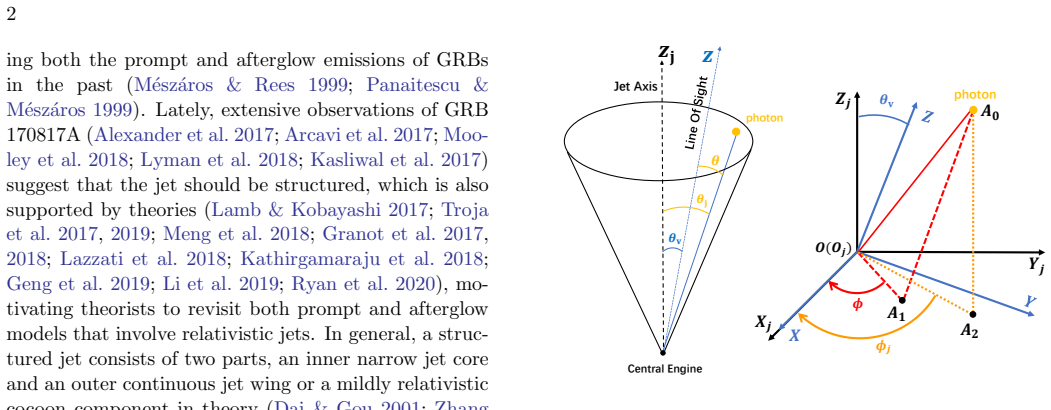
The load-bearing object is the last-scattering photosphere of the structured jet: the shell where the optical depth to the observer reaches unity, whose radius and temperature vary with polar angle through the power-law profiles $L(\theta_j)$ and $\Gamma(\theta_j)$. The argument runs through the comoving temperature profile $T'(r,\theta_j)$ with its saturation radius $r_s = \Gamma(\theta_j) r_0$ and photosphere radius $r_{\rm ph}$ (set by $\tau = 1$), the Doppler-boosted probability density $P(r,\theta,\phi)$ for the last scattering, and the time-delay geometry $t_{\rm obs}/(1+z) = \hat{t} + r u/(\beta c)$ that maps emission latitude onto observed time. The decisive element is the treatment of the outflow's outer boundary: an infinite boundary integrates the optical depth to infinity, whereas the finite-boundary treatment lets photons catch up with the expanding edge at $r_{\rm out} = \beta(\theta_j) c \hat{t}$, which brightens the early flux and produces the hard high-frequency component. The viewing-angle dependence enters through the Doppler factor $D = [\Gamma(\theta_j)(1 - \beta(\theta_j)\cos\theta)]^{-1}$ and the geometric relation $\theta_j(\theta,\phi,\theta_v)$.
What would settle it
Detect the early X-ray spectrum of a 170817A-like short burst at about 200 Mpc viewed 10–30 degrees off-axis: the finite-boundary, saturated-jet model predicts a quasi-thermal spectrum with a $\nu^2 \to \nu^{1.5}$ low-energy slope, a peak migrating into the 0.5–4 keV band, and a hard tail that persists past 100 s at $\theta_v = 20^\circ$; observing instead a pure blackbody cutoff, a fast on-axis-like evolution, or no thermal component at all would rule out the model.
Extended reading notes
Core claim
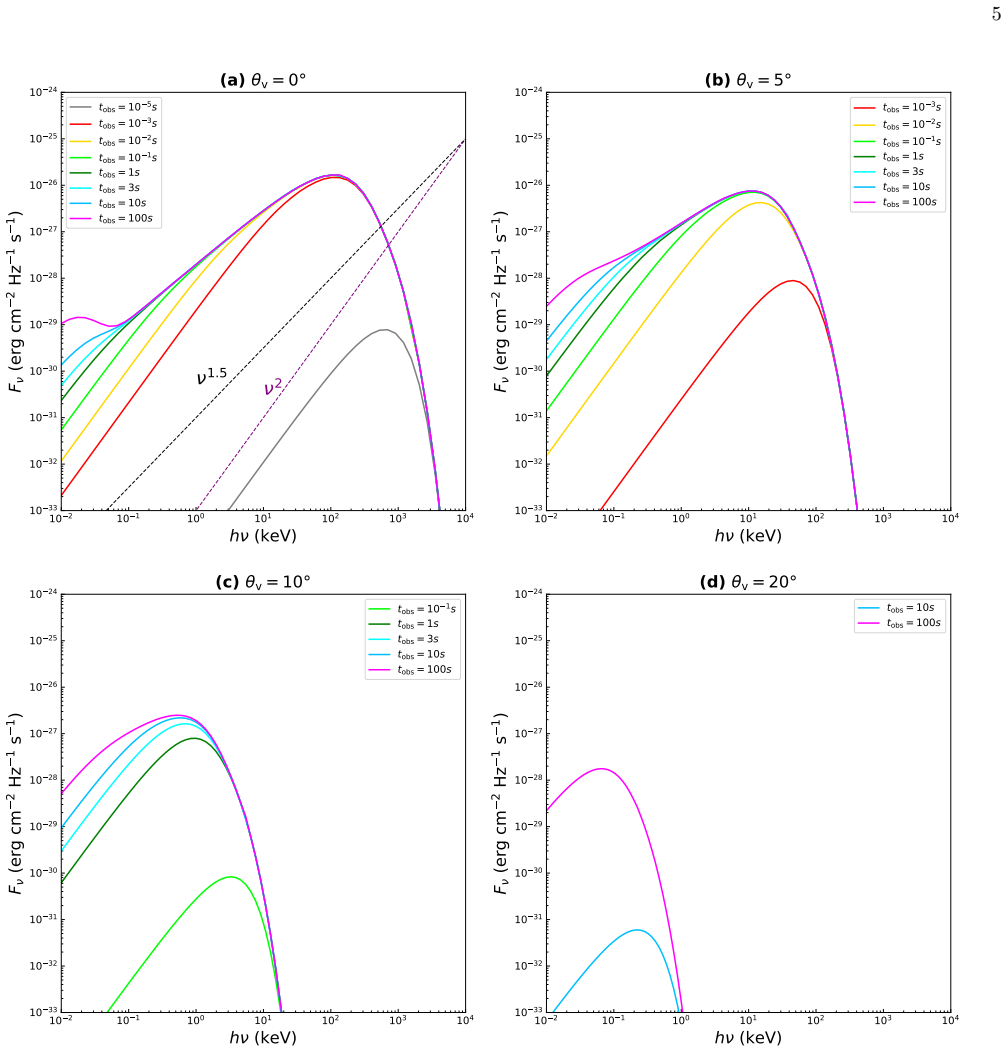
The central claim is that the observed photosphere spectrum of a structured GRB jet is a strong function of the viewing angle. Because luminosity and Lorentz factor fall off as power laws away from the jet core, an off-axis line of sight samples a larger photosphere radius at lower temperature: the flux density and peak energy drop, and the spectrum takes much longer to settle into its quasi-saturated shape — about $10^{-4}$ s on-axis versus $\sim 10^2$ s at $\theta_v = 20^\circ$. The paper also claims that the standard infinite-boundary approximation is wrong at early times: when the outflow's finite outer boundary is treated properly, early photons escape before accumulating an artificial optical depth, so the flux is orders of magnitude higher and a power-law-like hard component sits above the thermal peak, disappearing gradually as the photosphere radius converges to the infinite-boundary value. As a corollary, the spectral peak energy tracks inversely with the luminosity history (hard-to-soft in the rise, soft-to-hard in the decay), with all evolution delayed for off-axis observers. The paper closes by predicting that EP-WXT and SVOM-ECLAIRs can detect quasi-thermal photosphere emission from 170817A-like short bursts out to roughly 200 Mpc when the viewing angle is below about $10^\circ$.
Load-bearing premise
The load-bearing premise is that the jet is already fully accelerated at every latitude before its light escapes (the photosphere lies beyond the saturation radius), so the simple temperature profile of Equation (6) holds everywhere — a condition the paper itself says may fail for dim parts of the jet.
Editorial extensions
If this is right
- Off-axis photosphere spectra are fainter, peak at lower energy, and evolve more slowly than on-axis spectra, so the saturation timescale itself — from about $10^{-4}$ s on-axis to about $10^2$ s at $20^\circ$ — becomes a viewing-angle diagnostic.
- The finite-boundary treatment raises the early flux by orders of magnitude and reveals a hard high-frequency component that persists for tens of seconds at large viewing angles; the infinite-boundary approximation cannot reproduce these features.
- With a variable central engine, the peak flux tracks the luminosity history while the peak energy anti-correlates with it (hard-to-soft during the rise, soft-to-hard during the decay), with off-axis evolution delayed relative to $(1+z) t_p$.
- EP-WXT and SVOM-ECLAIRs should detect quasi-thermal emission from 170817A-like short bursts out to about 200 Mpc as long as the viewing angle stays below roughly $10^\circ$.
- The detection flux falls with viewing angle more steeply than the luminosity profile, because the optical depth also grows off-axis; for EP-WXT, the most favorable viewing angle is structure-dependent rather than on-axis, since the off-axis peak energy moves into its 0.5–4 keV band.
Reading between the lines
- The predicted drift of the low-energy spectral index from $\nu^2$ toward $\nu^{1.5}$, together with the persistent hard tail, offers a discriminating test against synchrotron emission in joint fits of the same off-axis events, since the two mechanisms predict different index trajectories over time.
- If the saturation assumption fails at some latitudes ($r_s > r_{\rm ph}$), the clean scaling of peak energy with viewing angle breaks down; measuring the peak energy versus viewing angle across a sample of off-axis short bursts would directly probe which latitudes of the jet are actually saturated.
- Wide, soft X-ray surveys such as EP-WXT may be systematically biased toward off-axis thermal events, because the redshifted peak energy of off-axis emission lands squarely in their 0.5–4 keV band; this selection effect could be checked by comparing the inferred viewing-angle distribution of soft-band and hard-band detected GRBs.
- Extending the calculation to include sub-photospheric Comptonization, which the paper itself lists as needed future work, would show whether the hard high-frequency component survives spectral processing by scattering before the photons escape.
Signed reviews
Editorial analysis
A structured set of objections, weighed in public.
Referee Report
Summary. This paper presents numerical calculations of instantaneous photosphere emission spectra from a structured gamma-ray burst jet, with an angularly dependent luminosity and Lorentz factor, for observers at different viewing angles. The authors compute spectra for constant and variable central-engine luminosity, compare an infinite outer boundary with a finite outflow boundary, and estimate the detectability of quasi-thermal photosphere emission by EP-WXT, SVOM-ECLAIRs, and Swift-BAT. The central claims are that off-axis spectra are fainter, peak at lower energies, and evolve more slowly than on-axis spectra; that treating the outflow boundary as finite enhances the early flux and produces a hard high-frequency component; and that short GRBs similar to GRB 170817A should be detectable to about 200 Mpc for viewing angles below 10 degrees.
Significance. If the finite-boundary result holds, the paper offers a new observational handle on GRB jet structure through quasi-thermal photosphere spectra, linking prompt-emission modeling to the structured-jet picture favored by afterglow observations. The forward-modeling approach is a strength: the spectra are derived self-consistently from the assumed jet structure, and the short-GRB jet parameters are taken from independent afterglow fits (Li et al. 2019) rather than fitted to the predicted outputs. The predicted differences between on-axis and off-axis temporal and spectral evolution are falsifiable with current and upcoming wide-field X-ray instruments. However, the quantitative early-time results and the detectability estimates rest on two assumptions that are not adequately validated: the application of the saturated-regime temperature law to radii below the saturation radius, and the photon-number-conservation normalization of the last-scattering probability.
major comments (3)
- [Section 3.2, Figs. 5-6, Eqs. (6), (8), (24)] The finite-boundary early-time spectra are computed at emission radii far below the saturation radius. For the fiducial parameters used in the figures (r0=10^7 cm, Γc=300, Eq. 30), rs=Γr0≈3×10^9 cm, whereas rout=βct is about 3×10^5 cm at t=10^-5 s and 3×10^7 cm at t=10^-3 s. In this regime the local Lorentz factor is still Γ(r)≈r/r0, not Γ(θj), so the density in Eq. (16), the Doppler factor in Eq. (5), and the optical depth in Eq. (26) are evaluated with an incorrect Lorentz factor. Since the hard high-frequency component and the early flux enhancement are the paper's headline new signatures, their quantitative support is missing unless the acceleration phase is modeled. The Section 4 caveat about an unsaturated situation acknowledges the general issue but does not identify that the earliest finite-boundary curves in Figs. 3-5 lie in the sub-saturation-radius regime; the authors should either implement a proper acceleration-phase treatment or restrict the finite-boundary claims to times when rout exceeds rs.
- [Section 3.1, Eqs. (18)-(19)] The normalization of the last-scattering probability P(r,Ω) is replaced by global photon-number conservation over all observer directions. However, Eq. (11) uses P as a probability density weighting the contribution of individual injected photons to a specific observer, for which the natural normalization is ∫∫P dr dΩ=1 per injection direction. Because the Doppler factor D and the optical depth τ depend on the observer direction θv, the constant A determined by Eq. (19) is an observer-averaged quantity. The manuscript does not show that this global normalization is equivalent to the per-observer probability normalization, and the issue affects the absolute flux level in every figure, including the detectability estimates. A derivation or a numerical validation against the spherically symmetric limit (e.g., Pe'er 2008) is needed.
- [Section 3.4, Fig. 9, Eq. (30)] The detectability conclusion that EP-WXT and SVOM-ECLAIRs can detect 170817A-like bursts within a viewing angle of 10 degrees out to 200 Mpc depends on the correctness of the early-time finite-boundary spectra, which are affected by the sub-saturation-radius problem noted above. In addition, the flux-angle dependence in Fig. 9 is presented only for a few parameter variations, with fixed r0 and fixed luminosity-history indices; given that r0 enters the peak-energy scaling in Eq. (30) and that the short-GRB case uses θv=27.6 degrees with Lc=10^51 erg/s, the 200-Mpc reach should be framed as conditional on the acceleration-phase treatment and on the parameter choices, not as a robust prediction.
minor comments (5)
- [Section 2.2, Eq. (13)] The text refers to a "Plank distribution"; this should be "Planck distribution".
- [Section 3.1, Eq. (22)] Equation (22) cites Eq. (26) for the optical depth, but Eq. (26) is introduced later in Section 3.2; please reorder the equations or adjust the cross-reference.
- [Section 3.3, Eq. (28)] The luminosity history is written as 10^{ar log t+br}; this is equivalent to a broken power law, and writing Lc(t)=Lcp(t/tp)^ar and Lc(t)=Lcp(t/tp)^ad for the two branches would be clearer.
- [Section 3.2 and Appendix C] The numerical method is described only in words; a reproducibility statement with the grid resolution, integration tolerances, and convergence checks would strengthen the paper, especially because the finite-boundary case requires solving for r2 in Eq. (25) numerically.
- [Eq. (30)] The peak-energy scaling in Eq. (30) is stated without intermediate steps; a short derivation in an appendix would help readers verify the exponents 5/12 ke - 8/3 kΓ.
Circularity Check
No significant circularity: the photosphere spectra follow from the assumed structured-jet profiles and standard photosphere formalism, and the one overlapping-author input (Li et al. 2019 jet parameters) is an external afterglow fit rather than a quantity fitted to the predicted spectra.
full rationale
The paper's derivation chain is self-contained rather than circular. The jet is specified in Eqs. (2)-(3) by power-law luminosity and Lorentz-factor profiles, and the temperature law in Eq. (6) is taken from standard photosphere emission literature (Meszaros & Rees 2000; Rees & Meszaros 2005; Pe'er et al. 2010), not from the spectra the paper later computes. The instantaneous spectra are obtained by integrating the last-scattering probability density of Eqs. (13)-(14) together with a Planck photon distribution and an optical-depth integral; no parameter is fitted to the resulting spectra, light curves, or detectability curves. The finite-versus-infinite boundary comparison in Section 3.2 is an internal modeling choice and therefore cannot reduce to the output. The variable-luminosity spectral evolution is checked against Deng & Zhang (2014), but that is an external consistency comparison, not an input. For the short-GRB detectability claim, the jet structure and viewing angle are taken from Li et al. (2019), an earlier afterglow fit to GRB 170817A; although one of the present authors co-authored that paper, the parameters are constrained by afterglow observations, not by the photosphere spectra predicted here, so the citation carries independent evidentiary weight. The caveat in Section 4 that an unsaturated situation may hold for parts of the jet flags a potential validity limit of the adopted temperature prescription, especially for the early finite-boundary curves, but this is a correctness/applicability concern, not a case in which the predicted quantity equals its input by construction. Accordingly, no circular step can be exhibited, and the appropriate score is 0.
Assumptions & free parameters
free parameters (8)
- Core luminosity Lc =
10^52 erg/s (long GRB models); 10^51 erg/s (short GRB fiducial)
- Core Lorentz factor Γc =
300 (long GRB models); 100 (short GRB fiducial)
- Core half-opening angle θc =
3 degrees (long); 5.1 degrees (short, from Li et al. 2019)
- Outer jet half-opening angle θm =
30 degrees
- Luminosity angular index ke =
2 (long); 4.3 (short)
- Lorentz factor angular index kΓ =
2
- Base radius r0 =
10^7 cm (implied by Eq 30)
- Luminosity history indices ar, ad, tp =
ar=0.75, ad=-2, tp=2.4 s (long); tp=0.3 s (short)
assumptions (6)
- domain assumption Standard photosphere temperature profile for a relativistic steady wind (Eq 6)
- domain assumption Saturation regime rs < rph so that η(θj) = Γ(θj)
- ad hoc to paper Last-scattering probability density for a structured jet (Eq 14) normalized by global photon number conservation (Eqs 18-19) rather than per-observer probability normalization
- domain assumption Comoving photon spectrum is Planckian at the local temperature (Eq 13)
- domain assumption Power-law angular structure of luminosity and Lorentz factor (Eqs 2-3)
- domain assumption Broken power-law luminosity history of the central engine (Eq 28)
Cite this review
Pith. "Pith review of Quasi-thermal Photosphere Emission from Structured Jets of Gamma-Ray Bursts." pith.science (2026). https://pith.science/paper/RMM5AVWZ
@misc{pith2026250415011,
  author       = {Pith},
  title        = {Pith review of: Quasi-thermal Photosphere Emission from Structured Jets of Gamma-Ray Bursts},
  year         = {2026},
  howpublished = {\url{https://pith.science/paper/RMM5AVWZ}},
  note         = {Machine review of arXiv:2504.15011}
}
read the original abstract
The prompt emission of gamma-ray bursts (GRBs) is supposed to be released from the relativistic jet launched from the central engine. Apart from the non-thermal nature of the spectra in a majority of GRBs, there is evidence for the presence of quasi-thermal components in the prompt emission of a few GRBs according to observations by Fermi satellite. On the other hand, the GRB jet has been revealed as structured in recent research. The theoretical observed spectra of photosphere emissions by an off-axis observer and the dependence of the spectra on the viewing angle under the assumption of structured jets remain unexplored. In this paper, we numerically calculate the instantaneous photosphere spectra by different viewing angles from a structured jet, from which relevant temporal and spectral characteristics are derived. Moreover, we address the necessity of proper treatment of the outflow boundary in the photosphere emission scenario. Furthermore, our calculations suggest that the Einstein Probe and Space-based multi-band astronomical Variable Object Monitor will have the capability to detect the short GRBs similar to GRB 170817A up to a luminosity distance of 200Mpc if the off-axis viewing angle is less than 10 degrees.
Figures

Figures from the paper (7 more)


Reference graph
Works this paper leans on
-
[1]
A., Ackermann, M., Ajello, M., et al
Abdo, A. A., Ackermann, M., Ajello, M., et al. 2009, ApJL, 706, L138, doi: 10.1088/0004-637X/706/1/L138
-
[2]
Abramowicz, M. A., Novikov, I. D., & Paczynski, B. 1991, ApJ, 369, 175, doi: 10.1086/169748
doi:10.1086/169748 1991
-
[3]
2024, in High Energy Phenomena in Relativistic Outflows VIII, 18
Alamaa, F., Ryde, F., & Lundman, C. 2024, in High Energy Phenomena in Relativistic Outflows VIII, 18
work page 2024
-
[4]
D., Berger, E., Fong, W., et al
Alexander, K. D., Berger, E., Fong, W., et al. 2017, The Astrophysical Journal Letters, 848, L21, doi: 10.3847/2041-8213/aa905d
-
[5]
Arcavi, I., Hosseinzadeh, G., Howell, D. A., et al. 2017, Nature, 551, 64–66, doi: 10.1038/nature24291
-
[6]
2012, The Astrophysical Journal, 757, L31, doi: 10.1088/2041-8205/757/2/l31
Axelsson, M., Baldini, L., Barbiellini, G., et al. 2012, The Astrophysical Journal, 757, L31, doi: 10.1088/2041-8205/757/2/l31
-
[7]
1993, ApJ, 413, 281, doi: 10.1086/172995
Band, D., Matteson, J., Ford, L., et al. 1993, ApJ, 413, 281, doi: 10.1086/172995
doi:10.1086/172995 1993
-
[8]
Beloborodov, A. M. 2010, MNRAS, 407, 1033, doi: 10.1111/j.1365-2966.2010.16770.x
arXiv 2010
Show all 70 references
-
[9]
Beloborodov, A. M. 2011, The Astrophysical Journal, 737, 68, doi: 10.1088/0004-637X/737/2/68
2011 doi
-
[10]
M., B´ egu´ e, D., Greiner, J., et al
Burgess, J. M., B´ egu´ e, D., Greiner, J., et al. 2020, Nature Astronomy, 4, 174, doi: 10.1038/s41550-019-0911-z
2020 doi
-
[11]
M., Preece, R
Burgess, J. M., Preece, R. D., Baring, M. G., et al. 2011, The Astrophysical Journal, 741, 24, doi: 10.1088/0004-637X/741/1/24
2011 doi
-
[12]
G., & Gou, L
Dai, Z. G., & Gou, L. J. 2001, The Astrophysical Journal, 552, 72, doi: 10.1086/320463
2001 doi
-
[13]
2011, A&A, 526, A110, doi: 10.1051/0004-6361/201015457
Daigne, F., Boˇ snjak,ˇZ., & Dubus, G. 2011, A&A, 526, A110, doi: 10.1051/0004-6361/201015457
2011 doi
-
[15]
2014, The Astrophysical Journal, 785, 112, doi: 10.1088/0004-637X/785/2/112
Deng, W., & Zhang, B. 2014, The Astrophysical Journal, 785, 112, doi: 10.1088/0004-637X/785/2/112
2014 doi
-
[16]
V., Kocharovsky, V
Derishev, E. V., Kocharovsky, V. V., & Kocharovsky, V. V. 2001, A&A, 372, 1071, doi: 10.1051/0004-6361:20010586
2001 doi
-
[17]
2008, MNRAS, 387, 92, doi: 10.1111/j.1365-2966.2008.12886.x
Fan, Y.-Z., Xu, D., & Wei, D.-M. 2008, MNRAS, 387, 92, doi: 10.1111/j.1365-2966.2008.12886.x
2008
- [18]
-
[19]
2021, A&A, 656, A134, doi: 10.1051/0004-6361/202141647
Gao, H.-X., Geng, J.-J., & Huang, Y.-F. 2021, A&A, 656, A134, doi: 10.1051/0004-6361/202141647
2021 doi
- [20]
-
[21]
2018, The Astrophysical Journal, 862, 115, doi: 10.3847/1538-4357/aacd05
Geng, J.-J., Huang, Y.-F., Wu, X.-F., Song, L.-M., & Zong, H.-S. 2018, The Astrophysical Journal, 862, 115, doi: 10.3847/1538-4357/aacd05
2018 doi
-
[22]
2018, ApJS, 234, 3, doi: 10.3847/1538-4365/aa9e84
Geng, J.-J., Huang, Y.-F., Wu, X.-F., Zhang, B., & Zong, H.-S. 2018, ApJS, 234, 3, doi: 10.3847/1538-4365/aa9e84
2018 doi
-
[23]
2019, ApJL, 877, L40, doi: 10.3847/2041-8213/ab224b
Geng, J.-J., Zhang, B., K¨ olligan, A., Kuiper, R., & Huang, Y.-F. 2019, ApJL, 877, L40, doi: 10.3847/2041-8213/ab224b
2019 doi
-
[24]
2002, A&A, 393, 409, doi: 10.1051/0004-6361:20021038
Ghirlanda, G., Celotti, A., & Ghisellini, G. 2002, A&A, 393, 409, doi: 10.1051/0004-6361:20021038
2002 doi
-
[25]
2018, MNRAS, 479, 588, doi: 10.1093/mnras/sty1462
Gottlieb, O., Nakar, E., Piran, T., & Hotokezaka, K. 2018, MNRAS, 479, 588, doi: 10.1093/mnras/sty1462
2018 doi
-
[26]
2018, MNRAS, 481, 1597, doi: 10.1093/mnras/sty2308
Granot, J., Gill, R., Guetta, D., & De Colle, F. 2018, MNRAS, 481, 1597, doi: 10.1093/mnras/sty2308
2018 doi
-
[27]
2017, ApJL, 850, L24, doi: 10.3847/2041-8213/aa991d
Granot, J., Guetta, D., & Gill, R. 2017, ApJL, 850, L24, doi: 10.3847/2041-8213/aa991d
2017 doi
-
[28]
S., et al
Guiriec, S., Connaughton, V., Briggs, M. S., et al. 2011, The Astrophysical Journal, 727, L33, doi: 10.1088/2041-8205/727/2/l33
2011 doi
-
[29]
2018, ApJ, 866, 13, doi: 10.3847/1538-4357/aadc07
Hou, S.-J., Zhang, B.-B., Meng, Y.-Z., et al. 2018, ApJ, 866, 13, doi: 10.3847/1538-4357/aadc07
2018 doi
-
[30]
M., Nakar, E., Singer, L
Kasliwal, M. M., Nakar, E., Singer, L. P., et al. 2017, Science, 358, 1559–1565, doi: 10.1126/science.aap9455
2017 doi
-
[31]
2018, MNRAS, 473, L121, doi: 10.1093/mnrasl/slx175
Kathirgamaraju, A., Barniol Duran, R., & Giannios, D. 2018, MNRAS, 473, L121, doi: 10.1093/mnrasl/slx175
2018 doi
-
[32]
W., Strong, I
Klebesadel, R. W., Strong, I. B., & Olson, R. A. 1973, ApJL, 182, L85, doi: 10.1086/181225
1973 doi
-
[33]
2003, The Astrophysical Journal, 591, 1075, doi: 10.1086/375186
Kumar, P., & Granot, J. 2003, The Astrophysical Journal, 591, 1075, doi: 10.1086/375186
2003 doi
-
[34]
P., & Kobayashi, S
Lamb, G. P., & Kobayashi, S. 2017, Monthly Notices of the Royal Astronomical Society, 472, 4953–4964, doi: 10.1093/mnras/stx2345
2017 doi
-
[35]
2021, MNRAS, 508, 52, doi: 10.1093/mnras/stab2508
Lan, G.-X., Wei, J.-J., Zeng, H.-D., Li, Y., & Wu, X.-F. 2021, MNRAS, 508, 52, doi: 10.1093/mnras/stab2508
2021 doi
-
[36]
2019, MNRAS, 488, 4607, doi: 10.1093/mnras/stz2011
Lan, G.-X., Zeng, H.-D., Wei, J.-J., & Wu, X.-F. 2019, MNRAS, 488, 4607, doi: 10.1093/mnras/stz2011
2019 doi
-
[37]
J., et al
Lazzati, D., Perna, R., Morsony, B. J., et al. 2018, PhRvL, 120, 241103, doi: 10.1103/PhysRevLett.120.241103
2018 doi
-
[38]
2019, The Astrophysical Journal, 880, 39, doi: 10.3847/1538-4357/ab275d
Li, L.-B., Geng, J.-J., Huang, Y.-F., & Li, B. 2019, The Astrophysical Journal, 880, 39, doi: 10.3847/1538-4357/ab275d
2019 doi
-
[39]
D., Lamb, G
Lyman, J. D., Lamb, G. P., Levan, A. J., et al. 2018, Nature Astronomy, 2, 751, doi: 10.1038/s41550-018-0511-3
2018 doi
-
[40]
2022, Astrophys
Meng, Y.-Z. 2022, Astrophys. J. Suppl., 263, 39, doi: 10.3847/1538-4365/ac98b1
2022 doi
-
[41]
Meng, Y.-Z., Geng, J.-J., & Wu, X.-F. 2023, in 16th Marcel Grossmann Meeting on Recent Developments in Theoretical and Experimental General Relativity, Astrophysics and Relativistic Field Theories, doi: 10.1142/9789811269776 0240
2023 doi
-
[42]
2019, The Astrophysical Journal, 882, 26, doi: 10.3847/1538-4357/ab30c7
Meng, Y.-Z., Liu, L.-D., Wei, J.-J., Wu, X.-F., & Zhang, B.-B. 2019, The Astrophysical Journal, 882, 26, doi: 10.3847/1538-4357/ab30c7
2019 doi
-
[43]
2018, The Astrophysical Journal, 860, 72, doi: 10.3847/1538-4357/aac2d9 M´ esz´ aros, P., & Rees, M
Meng, Y.-Z., Geng, J.-J., Zhang, B.-B., et al. 2018, The Astrophysical Journal, 860, 72, doi: 10.3847/1538-4357/aac2d9 M´ esz´ aros, P., & Rees, M. J. 2000, ApJ, 530, 292, doi: 10.1086/308371
2018 doi
-
[44]
P., Nakar, E., Hotokezaka, K., et al
Mooley, K. P., Nakar, E., Hotokezaka, K., et al. 2018, Nature, 554, 207, doi: 10.1038/nature25452
2018 doi
-
[45]
2013, in 48th Rencontres de Moriond on Very High Energy Phenomena in the Universe, VHEPU 2013, 9 March 2013 through 16 March 2013, ARISF, 293–297 M´ esz´ aros, P., & Rees, M
Moretti, E., et al. 2013, in 48th Rencontres de Moriond on Very High Energy Phenomena in the Universe, VHEPU 2013, 9 March 2013 through 16 March 2013, ARISF, 293–297 M´ esz´ aros, P., & Rees, M. J. 1999, Monthly Notices of the Royal Astronomical Society, 306, L39, doi: 10.1046...
2013
-
[46]
2011, A&A, 530, A21, doi: 10.1051/0004-6361/201016270
Nava, L., Ghirlanda, G., Ghisellini, G., & Celotti, A. 2011, A&A, 530, A21, doi: 10.1051/0004-6361/201016270
2011 doi
-
[47]
1999, The Astrophysical Journal, 526, 707, doi: 10.1086/308005
Panaitescu, A., & M´ esz´ aros, P. 1999, The Astrophysical Journal, 526, 707, doi: 10.1086/308005
1999 doi
-
[48]
2011, Comptes Rendus Physique, 12, 298, doi: 10.1016/j.crhy.2011.01.009 Pe’er, A
Paul, J., Wei, J., Basa, S., & Zhang, S.-N. 2011, Comptes Rendus Physique, 12, 298, doi: 10.1016/j.crhy.2011.01.009 Pe’er, A. 2008, ApJ, 682, 463, doi: 10.1086/588136 Pe’er, A., M´ esz´ aros, P., & Rees, M. J. 2006, ApJ, 642, 995, doi: 10.1086/501424 Pe’er, A., & Ryde, F. 2011...
2011 doi
-
[49]
Rees, M. J. 2007, ApJL, 664, L1, doi: 10.1086/520534 Pe’er, A., Zhang, B.-B., Ryde, F., et al. 2010, AIP Conference Proceedings, 1358, doi: 10.1063/1.3621745
2007 doi
-
[50]
2003, The Astrophysical Journal, 594, 379, doi: 10.1086/376772
Perna, R., Sari, R., & Frail, D. 2003, The Astrophysical Journal, 594, 379, doi: 10.1086/376772
2003 doi
-
[51]
2016, A&A, 587, A40, doi: 10.1051/0004-6361/201526760
Pescalli, A., Ghirlanda, G., Salvaterra, R., et al. 2016, A&A, 587, A40, doi: 10.1051/0004-6361/201526760
2016 doi
-
[52]
D., Briggs, M
Preece, R. D., Briggs, M. S., Mallozzi, R. S., et al. 1998, The Astrophysical Journal, 506, L23, doi: 10.1086/311644 —. 2000, The Astrophysical Journal Supplement Series, 126, 19, doi: 10.1086/313289
1998 doi
- [53]
-
[54]
J., & M´ esz´ aros, P
Rees, M. J., & M´ esz´ aros, P. 2005, ApJ, 628, 847, doi: 10.1086/430818 17
2005 doi
-
[55]
Rossi, E., Lazzati, D., & Rees, M. J. 2002, MNRAS, 332, 945, doi: 10.1046/j.1365-8711.2002.05363.x
2002
-
[56]
2020, ApJ, 896, 166, doi: 10.3847/1538-4357/ab93cf
Ryan, G., van Eerten, H., Piro, L., & Troja, E. 2020, ApJ, 896, 166, doi: 10.3847/1538-4357/ab93cf
2020 doi
-
[57]
2009, The Astrophysical Journal, 702, 1211, doi: 10.1088/0004-637X/702/2/1211
Ryde, F., & Pe’er, A. 2009, The Astrophysical Journal, 702, 1211, doi: 10.1088/0004-637X/702/2/1211
2009 doi
-
[58]
B., et al
Ryde, F., Axelsson, M., Zhang, B. B., et al. 2010, The Astrophysical Journal Letters, 709, L172, doi: 10.1088/2041-8205/709/2/L172
2010 doi
-
[59]
D., et al
Salvaterra, R., Campana, S., Vergani, S. D., et al. 2012, The Astrophysical Journal, 749, 68, doi: 10.1088/0004-637X/749/1/68
2012 doi
-
[60]
2023, The Astrophysical Journal, 956, 42, doi: 10.3847/1538-4357/ace441
Samuelsson, F., & Ryde, F. 2023, The Astrophysical Journal, 956, 42, doi: 10.3847/1538-4357/ace441
2023 doi
-
[61]
C., Daigne, F., & Drenkhahn, G
Spruit, H. C., Daigne, F., & Drenkhahn, G. 2001, A&A, 369, 694, doi: 10.1051/0004-6361:20010131
2001 doi
-
[62]
1994, Monthly Notices of the Royal Astronomical Society, 270, 480
Thompson, C. 1994, Monthly Notices of the Royal Astronomical Society, 270, 480
1994
-
[63]
2017, Nature, 551, 71, doi: 10.1038/nature24290
Troja, E., Piro, L., van Eerten, H., et al. 2017, Nature, 551, 71, doi: 10.1038/nature24290
2017 doi
-
[64]
2019, MNRAS, 489, 1919, doi: 10.1093/mnras/stz2248
Troja, E., van Eerten, H., Ryan, G., et al. 2019, MNRAS, 489, 1919, doi: 10.1093/mnras/stz2248
2019 doi
-
[65]
L., & Zhang, B
Uhm, Z. L., & Zhang, B. 2014, Nature Physics, 10, 351–356, doi: 10.1038/nphys2932
2014 doi
-
[66]
M., & Poutanen, J
Vurm, I., Beloborodov, A. M., & Poutanen, J. 2011, ApJ, 738, 77, doi: 10.1088/0004-637X/738/1/77
2011 doi
-
[67]
2022, The Einstein Probe Mission (Springer Nature Singapore), 1–30, doi: 10.1007/978-981-16-4544-0 151-1
Yuan, W., Zhang, C., Chen, Y., & Ling, Z. 2022, The Einstein Probe Mission (Springer Nature Singapore), 1–30, doi: 10.1007/978-981-16-4544-0 151-1
2022 doi
-
[68]
2018, The Physics of Gamma-Ray Bursts, doi: 10.1017/9781139226530
Zhang, B. 2018, The Physics of Gamma-Ray Bursts, doi: 10.1017/9781139226530
2018 doi
-
[69]
2002, ApJ, 571, 876, doi: 10.1086/339981
Zhang, B., & M´ esz´ aros, P. 2002, ApJ, 571, 876, doi: 10.1086/339981
2002 doi
-
[70]
2022, Astroparticle Physics, 137, 102668, doi: 10.1016/j.astropartphys.2021.102668
Zhang, J., Qi, L., Yang, Y., et al. 2022, Astroparticle Physics, 137, 102668, doi: 10.1016/j.astropartphys.2021.102668
2022
-
[71]
2014, ApJ, 780, 12, doi: 10.1088/0004-637X/780/1/12
Zhao, X., Li, Z., Liu, X., et al. 2014, ApJ, 780, 12, doi: 10.1088/0004-637X/780/1/12
2014 doi
Reviewed August 16, 2026 · model on record in the stance chip above.
Discussion (0). Continue with ORCID to comment.