REVIEW 3 major objections 4 minor 10 references
LACE: Controlled Image Prompting and Iterative Refinement with GenAI for Professional Visual Art Creators
T0 review · 3 major / 4 minor · reviewed 2026-08-16 · deepseek-v4-flash
Pith's one-line read LACE embeds generative AI in Photoshop as editable layers, and a 21-person pilot finds artists rate this workflow significantly higher on usability, ownership, and satisfaction than text-only prompting.
desk verdict A useful design contribution with a real, nameable confound: LACE's benefits over text-only baselines are plausible but the pilot doesn't isolate the interface from the image-to-image generative mode. read the letter →
The pith
A machine-rendered reading of the paper's core claim, the machinery that carries it, and where it could break.
The reading
What carries the argument
The central mechanism is LACE (Latent Auto-recursive Composition Engine), a Photoshop-integrated system that imports each AI output as an individual layer rather than a flattened image, so artists can isolate foreground, mid-ground, and background elements with Photoshop's native masks, blending modes, curves, and adjustments. It also implements two COFI-grounded collaboration modes: turn-taking, where prompts and outputs alternate step by step, and parallel mode, where AI adapts to snapshots of the evolving canvas in real time. A modular AI pipeline lets users swap or configure the underlying generative model. This mechanism separates the what of generation from the where and how of composition, letting iterative refinement happen through image editing instead of prompt rewriting.
What would settle it
Run the same within-subject comparison with the generative model mode held constant: give the text-based conditions the same image-to-image latent-consistency backend that LACE uses, or give LACE a text-to-image backend. If the usability and ownership advantage disappears, the effect cannot be attributed to LACE's layer-based design.
Extended reading notes
Core claim
The central claim, on the authors' own terms, is that LACE's combination of layer-based prompting and flexible turn-taking and parallel collaboration modes materially improves the human-AI creative process. In their pilot, Friedman tests showed significant differences across workflows for satisfaction ($p=0.039$), ownership ($p=0.009$), usability ($p=0.003$), and artistic perception ($p=0.005$), with post-hoc comparisons favoring LACE over both text-only and text-based-iterative workflows. Participants preferred turn-taking in early ideation and parallel modes for later refinement, and usability ratings correlated with ownership and satisfaction only in LACE, not in text-based workflows. The authors interpret this as evidence that direct manipulation of layered AI outputs gives artists a sense of control that text prompting cannot.
Load-bearing premise
The load-bearing premise is that the three workflows differ only in interface and interaction mode, so any preference for LACE is caused by its design rather than by the fact that W3 uses image-to-image generation with latent consistency while W1 and W2 use text-to-image generation.
Editorial extensions
If this is right
- If LACE is right, professional artists can adopt generative AI without leaving the editing environment they already use in production.
- Layer-based outputs mean later revisions no longer require regenerating a whole flattened image; artists can keep the elements they like and replace the rest.
- Because ownership and usability are correlated only in LACE, tools that give users direct control over generated content may reduce the detached feeling reported in pure text workflows.
- Task-stage preferences suggest co-creative systems should offer both turn-taking and parallel modes rather than a single interaction paradigm.
- The same layer-and-direct-manipulation pattern could extend beyond image editing, as the authors note, to 3D rendering and animation pipelines.
Reading between the lines
- A stronger test would hold the generative backend fixed across all conditions, giving the text-based workflows the same image-to-image latent-consistency pipeline LACE uses, to show whether the preference is driven by the interface or by the generative mode.
- If user agency is the active ingredient, then other direct-manipulation interfaces over AI outputs, not only layer-based editing, should reproduce some of the ownership gain; this pilot does not test that.
- The mixed feedback on the pixel-art task suggests layer editing can cost extra time, so a follow-up could measure whether presets or training close that gap for novices.
- Comparing self-reported ownership with expert-rated output quality would separate perceived control from objective quality, a distinction the current metrics leave open.
Signed reviews
Editorial analysis
A structured set of objections, weighed in public.
Referee Report
Summary. The paper presents LACE, a Photoshop-integrated system for AI-assisted image generation that imports AI outputs as editable layers and supports both turn-taking and parallel human-AI collaboration modes. The authors report a within-subject pilot study with 21 participants who completed one of three art tasks using three workflows: W1 (text-to-image), W2 (text-to-image with latent consistency), and W3 (LACE, image-to-image with latent consistency). Quantitative results show significant Friedman test differences in satisfaction, ownership, usability, and artistic perception, and the paper claims that LACE significantly improves these outcomes compared with text-based workflows. The paper also reports qualitative preferences for turn-taking during early ideation and parallel interaction during refinement, and it explicitly states that this shorter workshop paper presents key insights while comprehensive findings are deferred to a longer version on arXiv.
Significance. If the central claim were fully supported, LACE would be a valuable contribution to professional creative tools by addressing three documented pain points: limited expressiveness of text prompting, difficulty in maintaining coherence during iterative refinement, and incompatibility with established artist workflows. The system's grounding in the COFI framework, its modular AI pipeline, and its integration into Photoshop are concrete design innovations. The study also provides a plausible qualitative account of how artists switch between turn-taking and parallel collaboration modes. Notably, the paper is transparent about its preliminary nature and points to a longer version for full analysis. However, the significance is currently bounded by a confounded experimental comparison and a small, underpowered sample, so the headline quantitative claims must be read as exploratory rather than conclusive.
major comments (3)
- [Section 3, Workflow comparison] The comparison between W3 (LACE) and W1/W2 varies two factors at once: the interface (layer-based, Photoshop-integrated editing versus text prompting) and the generative mode (image-to-image with latent consistency versus text-to-image). The statement in Section 3 that 'All generative model parameters remained consistent across conditions' does not equate the conditioning modality; image-to-image generation may itself offer more control, consistency, or perceived agency than text-to-image regardless of the LACE interface. Therefore, the paper's central claim that LACE's design improves usability, ownership, and satisfaction is not uniquely supported by the reported data. The authors should either add a control condition that isolates interface from generative mode (for example, LACE with a text-to-image pipeline, or a non-LACE image-to-image workflow) or substantially soften the causal language to describe the observed preference for the integrated LACE system.
- [Section 3.1, Quantitative analysis] The reported Friedman test p-values are unadjusted for multiple comparisons, no effect sizes are given, and no details are provided about the post-hoc tests or their directions (e.g., which workflows differ pairwise and by how much). With N=21 and four outcome variables, the claim that 'LACE outperforms both text-only (W1) and text-based iterative (W2) approaches' is stronger than the reported statistics support. Please report the test statistic, degrees of freedom, adjusted p-values or confidence intervals, and effect sizes; alternatively, explicitly label the findings as exploratory. As written, the quantitative evidence is not sufficient to support the definitive 'significantly improves' statement in the abstract and introduction.
- [Abstract and Introduction] The paper itself states that 'the comprehensive findings and detailed analysis are presented in a longer version available separately on arXiv.' This is an explicit acknowledgment that the current manuscript lacks the full analysis needed to substantiate the headline quantitative claim. In light of this, the abstract's assertion that 'LACE significantly improves usability, user ownership, and overall satisfaction compared to baseline AI workflows' overstates the evidence presented in this paper. The authors should either include the comprehensive analysis in this manuscript or rephrase the claims to indicate that these are preliminary pilot results requiring confirmation.
minor comments (4)
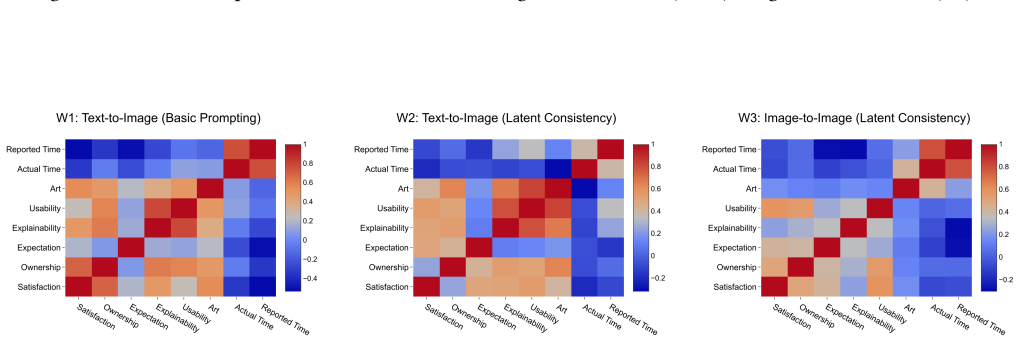
- [Figures 8-10] Figures 8, 9, and 10 are referenced in the appendix but lack in-text explanations and detailed captions; please add captions that describe the measures, scales, and what visual comparison the reader should draw.
- [Section 3.1, Statistical reporting] The p-values for the Friedman test are reported without the associated chi-square statistic or degrees of freedom; adding these values would allow readers to assess the magnitude of the effects.
- [Appendix A] The sampled qualitative results are presented as figures only; including representative participant quotes or a brief thematic summary would strengthen the qualitative findings.
- [Section 3.1.2] The Spearman correlation analysis is mentioned but no coefficients or p-values are reported; please include the actual correlation matrix or at least the key coefficients.
Circularity Check
No circular derivation; the central claim rests on a user study with external preference data, not on a fitted parameter or self-citation chain.
full rationale
LACE makes no mathematical prediction and contains no fitted parameter that is renamed as an outcome. Its central claim ('Our preliminary pilot study (N=21) indicates that LACE significantly improves usability, user ownership, and overall satisfaction compared to baseline AI workflows') is supported by an empirical within-subject study measuring self-reported Likert ratings, completion time, and workflow preferences. These are external to the system's design definition, so the result is not equivalent by construction to its input. There are no self-citations by the authors and no uniqueness theorem imported from prior author work; the COFI framework [8] is an external citation. Two concerns are noted but are not circularity: (1) the abstract explicitly defers detailed analysis to a longer version ('the comprehensive findings and detailed analysis are presented in a longer version available separately on arXiv'), which is a completeness limitation rather than a circular step; (2) Section 3 defines W3 as 'image-to-image with latent consistency' versus W1/W2 as text-to-image, so the comparison varies interface and generative mode simultaneously, a confound that threatens attribution but does not make the argument circular because no quantity is defined in terms of itself.
Assumptions & free parameters
assumptions (3)
- domain assumption Self-reported Likert ratings from 21 participants are a valid measure of usability, ownership, satisfaction, and artistic perception.
- domain assumption The workflows W1, W2, and W3 differ only in the interface and interaction mode, not in underlying generative model behavior.
- domain assumption The COFI framework's turn-taking and parallel categories fully describe the collaboration modes implemented in LACE.
Cite this review
Pith. "Pith review of LACE: Controlled Image Prompting and Iterative Refinement with GenAI for Professional Visual Art Creators." pith.science (2026). https://pith.science/paper/A7VVGQJ4
@misc{pith2026250415189,
  author       = {Pith},
  title        = {Pith review of: LACE: Controlled Image Prompting and Iterative Refinement with GenAI for Professional Visual Art Creators},
  year         = {2026},
  howpublished = {\url{https://pith.science/paper/A7VVGQJ4}},
  note         = {Machine review of arXiv:2504.15189}
}
read the original abstract
We present LACE, a hybrid Human-AI co-creative system integrated into Adobe Photoshop supporting turn-taking and parallel interaction modes for iterative image generation. Through a study with 21 participants across representational, abstract, and design tasks, we found turn-taking preferred in early stages for idea generation, and parallel modes suited for detailed refinement. While this shorter workshop paper provides key insights and highlights, the comprehensive findings and detailed analysis are presented in a longer version available separately on arXiv.
Figures


Figures from the paper (7 more)



Reference graph
Works this paper leans on
-
[1]
AC BD, Christine Bauer, and Afsaneh Doryab. 2016. Solving the Battle of First- Authorship: Using Interactive Technology to Highlight Contributions. InProceed- ings of the 2016 CHI Conference Extended Abstracts on Human Factors in Computing Systems (San Jose, California, USA) (CHI EA ’16). Association for Computing Ma- chinery, New York, NY, USA, 609–620. ...
arXiv 2016
-
[2]
Katica Bozsó, András Béres, and Bálint Gyires-Tóth. 2024. Semantic segmentation mask-guided diffusion models: A pathway to enriched datasets in autonomous systems. 79–84. https://doi.org/10.3311/WINS2024-014
-
[3]
Yu Cao, Xiangqiao Meng, PY Mok, Xueting Liu, Tong-Yee Lee, and Ping Li. 2023. AnimeDiffusion: Anime Face Line Drawing Colorization via Diffusion Models. arXiv preprint arXiv:2303.11137 (2023). GenAICHI 2025, April 27, 2025, Yokohama, Japan and Online Yen-Kai Huang and Zheng Ning
arXiv 2023
-
[4]
Fiona Draxler, Anna Werner, Florian Lehmann, Matthias Hoppe, Albrecht Schmidt, Daniel Buschek, and Robin Welsch. 2023. The AI Ghostwriter Ef- fect: Users Do Not Perceive Ownership of AI-Generated Text But Self-Declare as Authors. ArXiv abs/2303.03283 (2023). https://doi.org/10.48550/arXiv.2303.03283
-
[5]
Aosong Feng, Weikang Qiu, Jinbin Bai, Kaicheng Zhou, Zhen Dong, Xiao Zhang, Rex Ying, and Leandros Tassiulas. 2024. An Item is Worth a Prompt: Versatile Image Editing with Disentangled Control. arXiv preprint arXiv:2403.04880 (2024)
arXiv 2024
-
[6]
Steven Heller. 2024. How Worried Should Creative Professionals Be About Artificial Intelligence? https://www.printmag.com/web-interactive-design/how-worried- should-creative-professionals-be-about-artificial-intelligence/ Accessed: 2024- 10-01
work page 2024
-
[7]
Srishti Palani and Gonzalo Ramos. 2024. Evolving Roles and Workflows of Creative Practitioners in the Age of Generative AI. In Proceedings of the 16th Conference on Creativity & Cognition (Chicago, IL, USA) (C&C ’24). Association for Computing Machinery, New York, NY, USA, 170–184. https://doi.org/10. 1145/3635636.3656190
arXiv 2024
-
[8]
Jeba Rezwana and Mary Lou Maher. 2023. Designing Creative AI Partners with COFI: A Framework for Modeling Interaction in Human-AI Co-Creative Systems. In Proceedings of the CHI Conference on Human Factors in Computing Systems . ACM, 1–28
work page 2023
Show all 10 references
-
[9]
Qiucheng Wu, Yujian Liu, Handong Zhao, Ajinkya Kale, Trung Bui, Tong Yu, Zhe Lin, Yang Zhang, and Shiyu Chang. 2023. Uncovering the disentanglement capability in text-to-image diffusion models. In Proceedings of the IEEE/CVF conference on computer vision and pattern recognitio...
2023
-
[10]
A man reaching for a painting
Lingfeng Yang, Yueze Wang, Xiang Li, Xinlong Wang, and Jian Yang. 2024. Fine- grained visual prompting. Advances in Neural Information Processing Systems 36 (2024). LACE GenAICHI 2025, April 27, 2025, Yokohama, Japan and Online A SAMPLED QUALITATIVE RESULTS Figure 5: Results f...
2024
Reviewed August 16, 2026 · model on record in the stance chip above.
Discussion (0). Continue with ORCID to comment.