REVIEW 4 major objections 5 minor 46 references
Interpretable Locomotion Prediction in Construction Using a Memory-Driven LLM Agent With Chain-of-Thought Reasoning
T0 review · 4 major / 5 minor · reviewed 2026-08-16 · deepseek-v4-flash
Pith's one-line read Adding short-term and long-term memory to a language-model agent raises its ability to predict construction locomotion from spoken commands and smart-glasses video, lifting weighted F1 from 0.73 to 0.90 and sharply improving confidence…
desk verdict A useful application idea undermined by an ablation that lets the previous label leak through hard-coded transition rules; the 0.73-to-0.90 F1 story doesn't hold up as stated. read the letter →
The pith
A machine-rendered reading of the paper's core claim, the machinery that carries it, and where it could break.
The reading
What carries the argument
The load-bearing mechanism is a clarity-gated refinement loop with discrepancy-weighted retrieval. The perception module first produces a prediction plus four self-reported scores: vagueness, discrepancy, importance, and confidence. A weighted clarity score decides whether the prediction is accepted or sent to a refinement module that re-prompts the model with memories retrieved from the long-term store. The retrieval itself is score-driven: text and image embeddings are blended with weights $1-d$ and $d$, where $d$ is the discrepancy between the spoken command and the visual frames, so that when words and vision conflict, the visual evidence dominates. Retrieved events are ranked by a composite score that prioritizes similarity, importance, and confidence while penalizing vagueness and discrepancy, with safety-critical events decaying more slowly and being penalized less. Short-term memory supplies the immediate safety context, including explicit rules about safe locomotion transitions, such as allowing a ladder descent only after a ladder ascent. Together these components turn the language model from an open-loop classifier into one that reconsiders its answer when its own scores say the input is ambiguous.
What would settle it
Collect a larger dataset of real construction workers performing the same twelve locomotion modes on actual sites, with independent ground-truth labels and human-annotated command-scene agreement, then compare the memory agent's F1 and calibration under the same configuration. If the discrepancy score stops separating correct from incorrect predictions, or if a no-memory baseline matches the memory agent when the command set is realistic rather than simulated, the central claim would be contradicted.
Extended reading notes
Core claim
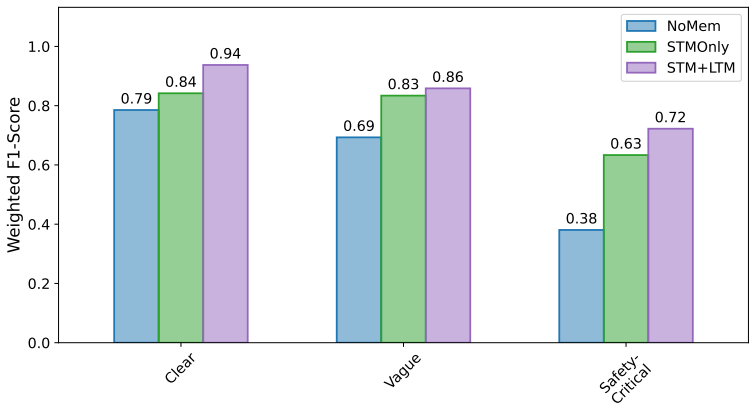
The central discovery is that memory—not more powerful perception—accounts for most of the accuracy gain in this agent. Without memory, the perception module alone, using chain-of-thought prompting, reaches a weighted F1 of only 0.73 on the 226-sample test set. Injecting short-term memory of recent locomotion events (retained for 45 seconds) raises this to 0.81, and adding long-term memory of similar past experiences retrieved from a vector store raises it further to 0.90. The memory modules also drive the calibration improvements: the Brier score drops from 0.244 to 0.090 and ECE from 0.222 to 0.044. The authors further find that on the subset of ambiguous samples that trigger refinement, long-term memory cuts incorrect predictions by more than two-thirds, from 31 to 9 errors, and that safety-critical commands, where the user's words conflict with the visual scene, improve from F1 0.38 without memory to 0.72 with both memories.
Load-bearing premise
The central premise is that the 226 hand-collected samples, with simulated commands issued in a controlled environment, genuinely represent the variety and noise of real construction locomotion, and that the language model's self-reported vagueness, discrepancy, and confidence scores are accurate enough to drive retrieval and refinement decisions.
Editorial extensions
If this is right
- On the paper's own ablation, every reported performance gain comes from memory: F1 rises 0.73→0.81 with short-term memory and 0.81→0.90 with long-term memory, so memory is the operative ingredient rather than the base LLM.
- Calibration metrics move in the same direction, so the agent not only predicts more often correctly but its stated confidence tracks its accuracy more tightly—a property that matters for safety systems that act on probabilities.
- The biggest improvements are on safety-critical commands, where the command contradicts the visual scene; the refinement module corrects most of these errors when long-term memory provides relevant similar events.
- Some classes remain hard: vertical ladder climbing (F1 0.62–0.67) and obstacle stepping (0.86–0.92) still confuse with level-ground navigation, especially under vague or safety-critical commands.
- The agent can override a misleading command (e.g., saying 'walk' while at the top of a ladder) by combining visual evidence with the recent context held in short-term memory.
Reading between the lines
- The same design could be tested on other intent-prediction tasks where users give terse or misleading commands—assistive wheelchairs, teleoperation, or surgical robots—but the authors do not claim this extension.
- A natural testable check is whether the improvement survives when retrieved memories are replaced with random past events matched for class and time: if random retrieval performs as well, the benefit would come from the refinement prompt rather than from genuinely similar history.
- The discrepancy score is doing double duty (gating refinement, weighting text versus image embeddings, and penalizing LTM ranking); a hidden risk is that if the LLM's discrepancy estimate is biased, all three mechanisms skew together. That is not examined in the paper.
- One could ablate the safety-transition rules in STM separately from the memory content; the rules encode domain knowledge, so removing them might separate the contribution of stored events from the contribution of the rule book.
Signed reviews
Editorial analysis
A structured set of objections, weighed in public.
Referee Report
Summary. The paper proposes an LLM-based locomotion prediction agent for exoskeleton assistance in construction. The system processes spoken commands and nine egocentric FOV frames through a gpt-4o Perception Module with chain-of-thought prompting, a Short-Term Memory (STM) for recent events, a Long-Term Memory (LTM) with vector retrieval, and a Refinement Module that re-prompts the LLM when a self-reported clarity score is low. On a 226-sample dataset with 12 locomotion modes and clear, vague, and safety-critical commands, the authors report weighted F1 of 0.73 (no memory), 0.81 (STM), and 0.90 (STM+LTM), with Brier Score falling from 0.244 to 0.090 and ECE from 0.222 to 0.044. The central claim is that adding memory systems improves prediction accuracy, calibration, and handling of safety-critical commands.
Significance. If the reported effects were robust, this would be a valuable demonstration that memory-augmented LLM agents can address locomotion intent recognition for exoskeletons in safety-critical, unstructured environments, going beyond the flat-ground walking tasks that dominate prior work. The paper deserves credit for publishing the full perception prompt (Figure 2), covering a multi-class dataset that includes ladders, obstacles, and low-space navigation, and reporting calibration metrics alongside F1. However, the central claim is not yet established: the ablation design does not separate the contribution of the memory modules from the contribution of the previous label and the hand-authored transition rules embedded in the prompt, and the evaluation lacks repeated runs and a held-out split. The paper's value is therefore conditional on a substantial revision of the evaluation protocol.
major comments (4)
- [§4.4, Figure 2, §5.2] The ablation confounds memory with the availability of the previous label and with deterministic transition rules. In the memory conditions, STM stores the previous locomotion mode (§3.3.1), and the Perception prompt in Figure 2 instructs the model to apply rules such as 'If the most recent memory shows the user climbing a construction ladder, they will 100% climb down the same construction ladder' and to restrict transitions to a listed safe set. The NoMem condition has neither the previous label nor these rules. Since the 226 samples form a continuous sequence (§5.2), STM effectively provides the immediately preceding prediction (usually the correct ground-truth label) for most samples, so the reported F1 gain from 0.73 to 0.81 to 0.90 measures the joint effect of previous-label availability, hand-authored rules, and memory modules rather than the incremental value of memory. Section 6 discusses limitations for vertical ladders and obstacle classes but does not address this confound. The paper needs a deterministic rule-based baseline that receives the same previous label and the same transition table but no LLM or learned retrieval, and an ablation that removes the prompt rules while keeping memory, to establish the central claim.
- [§4.2, §4.4, Tables 4–5] All reported metrics are point estimates from a single pass over 226 samples, with no error bars, no repeated runs, and no held-out split. This is particularly problematic because the Perception Module samples gpt-4o with temperature 0.7 (Table 3), making the results stochastic, and because the paper does not state whether any validation split was used before reporting the configuration in Table 3. The authors should report mean and standard deviation (or confidence intervals) over multiple independent runs, tune hyperparameters on a development set, and evaluate LTM generalization with memory built only from training samples and tested on unseen held-out samples.
- [§3.4, §5.3] The refinement trigger and LTM ranking are driven entirely by the LLM's self-reported confidence, vagueness, and discrepancy scores, but these scores are never validated against external ground truth or human judgments. The analysis in §5.3 itself shows that confidence is almost non-discriminative between correct and incorrect predictions (means 0.940 vs 0.920), yet confidence still enters the clarity score with weight 0.2 and the LTM composite score with weight 0.15. The claimed calibration improvement (Brier Score 0.244→0.090, ECE 0.222→0.044) is therefore partly self-referential, because the model's own confidence is used both to decide which samples to refine and to compute the calibration metrics. The authors should calibrate the self-reported scores against an independent measure (e.g., human raters or a supervised classifier), or remove the self-referential score from the decision rule.
- [§5.1, Figure 6] The attribution of error reduction to LTM in Figure 6 is not cleanly supported. The figure reports, for samples that undergo refinement in the full system, a shift from 17 correct/31 incorrect in NoMem to 39 correct/9 incorrect in STM+LTM. But the Refinement Module uses a different prompt at a different temperature with both STM and LTM context, so this comparison does not isolate LTM; moreover, the subset is selected by the full system's clarity threshold, which introduces selection on the outcome. The paper should report a matched comparison (e.g., STM+LTM with and without the Refinement Module) and full test-set confusion matrices for each condition before claiming that LTM 'reduces incorrect predictions by over two-thirds.'
minor comments (5)
- [§4.1] The phrase 'within a environment tailored to simulate' should be 'within an environment'; the paper should also report the number of participants, the data collection protocol, and whether the spoken commands were scripted or spontaneous.
- [Figure 2] The prompt display contains several garbled bullet characters and irregular sub-bullet formatting; please clean up the figure so that the exact prompt text is unambiguous.
- [§1, §6] The paper repeatedly describes the system as 'interpretable', but no human evaluation of the chain-of-thought explanations is reported; the authors should state precisely what interpretability claim they are making and support it.
- [§5.3] The claim that the score distributions 'justify' the clarity and LTM weights is post hoc, because those weights were already used to generate the scores; please rephrase or provide a validation-based justification.
- [References] Some references are incomplete as printed; for example, [23] (MemGPT) lacks a publication venue and page numbers, and a few other entries have inconsistent formatting.
Circularity Check
Memory gain is largely forced by previous-label leakage and hard-coded transition rules in the Perception prompt, not by the memory modules.
-
other
[Figure 2 (Perception Prompt, Safety Analysis) and Section 3.3.1 (STM); ablation results in Section 5.1]
"If the most recent memory shows the user climbing a construction ladder, they will 100% climb down the same construction ladder, and vice versa. ... The command is: "{command}" & Short-Term Memory context (starting from the most recent memories): "{stm_summary}" [Fig. 2] ... STM context is formatted as "At {timestamp}: {locomotion_mode} in a {environment} environment, interacting with a {primary_object}," derived from prior perception outputs [Sec. 3.3.1]."
The STM summary fed to the LLM is the immediately preceding locomotion mode from prior perception outputs. On the continuous 226-sample dataset, this is effectively the previous true label. The prompt then hard-codes a deterministic successor rule ('100% climb down the same construction ladder') and a list of safe transitions, so for ladder and other transition cases the current prediction is forced by the previous label plus a hand-authored rule. The NoMem ablation does not receive the previous label at all, so the reported gain (F1 0.73 to 0.90) measures the value of adding the previous label and the transition table, not the learned value of the memory modules.
full rationale
The paper's strongest evidence for its central claim is the ablation in Table 4, comparing NoMem, STMOnly, and STM+LTM. However, the Perception prompt in Figure 2 explicitly instructs the model to use the most recent memory as a deterministic transition trigger (e.g., ladder up implies 100% ladder down), and Section 3.3.1 confirms that STM context is the previous locomotion mode extracted from prior perception outputs. In a chronological dataset, this gives the memory conditions access to the previous true label, which the NoMem condition lacks. The ablation therefore compares a model with previous-label leakage plus hand-coded transition rules against a model without that input; the resulting F1 improvement is forced by construction rather than demonstrating emergent memory reasoning. The paper does not report a rule-based baseline that receives the same previous label and a transition table, and the LTM retrieval and refinement are driven by the LLM's own self-reported confidence, vagueness, and discrepancy scores, which are validated only against the system's own predictions. These are internal-validity concerns that undermine the causal attribution of the performance gain to the memory modules, warranting a partial circularity score. There is no self-citation load-bearing or uniqueness-theorem issue; the circularity is in the evaluation logic.
Assumptions & free parameters
free parameters (7)
- LTM similarity weight =
0.65
- LTM importance weight =
0.2
- LTM confidence weight =
0.15
- LTM discrepancy penalty =
0.3
- LTM vagueness penalty =
0.2
- Clarity score weights and threshold =
vagueness 0.3, discrepancy 0.5, confidence 0.2; threshold 0.35 to 0.75
- STM retention window =
45 seconds
assumptions (4)
- domain assumption The 226-sample dataset is accurately labeled and representative of construction locomotion and command patterns.
- domain assumption The LLM's self-reported confidence, vagueness, and discrepancy scores are reliable indicators of prediction correctness and are suitable for calibration.
- ad hoc to paper The safe-transition rules encoded in the Perception prompt are correct and complete.
- domain assumption GPT-4o can reliably interpret egocentric FOV frames and commands for locomotion intent.
Cite this review
Pith. "Pith review of Interpretable Locomotion Prediction in Construction Using a Memory-Driven LLM Agent With Chain-of-Thought Reasoning." pith.science (2026). https://pith.science/paper/YJPGLGCG
@misc{pith2026250415263,
  author       = {Pith},
  title        = {Pith review of: Interpretable Locomotion Prediction in Construction Using a Memory-Driven LLM Agent With Chain-of-Thought Reasoning},
  year         = {2026},
  howpublished = {\url{https://pith.science/paper/YJPGLGCG}},
  note         = {Machine review of arXiv:2504.15263}
}
read the original abstract
Construction tasks are inherently unpredictable, with dynamic environments and safety-critical demands posing significant risks to workers. Exoskeletons offer potential assistance but falter without accurate intent recognition across diverse locomotion modes. This paper presents a locomotion prediction agent leveraging Large Language Models (LLMs) augmented with memory systems, aimed at improving exoskeleton assistance in such settings. Using multimodal inputs - spoken commands and visual data from smart glasses - the agent integrates a Perception Module, Short-Term Memory (STM), Long-Term Memory (LTM), and Refinement Module to predict locomotion modes effectively. Evaluation reveals a baseline weighted F1-score of 0.73 without memory, rising to 0.81 with STM, and reaching 0.90 with both STM and LTM, excelling with vague and safety-critical commands. Calibration metrics, including a Brier Score drop from 0.244 to 0.090 and ECE from 0.222 to 0.044, affirm improved reliability. This framework supports safer, high-level human-exoskeleton collaboration, with promise for adaptive assistive systems in dynamic industries.
Figures


Figures from the paper (6 more)



Reference graph
Works this paper leans on
-
[1]
Mohamad Iyad Al-Khiami, Søren Munch Lindhard, and Søren Wandahl. Integrating exoskeletons in the construction sector: a systematic review of empirical evaluation tools and future directions. Engineering, Construction and Architectural Management, 2024
work page 2024
-
[2]
YejinBang,SamuelCahyawijaya,NayeonLee,WenliangDai,DanSu,BryanWilie,HolyLovenia, Ziwei Ji, Tiezheng Yu, Willy Chung, et al. A multitask, multilingual, multimodal evaluation of chatgpt on reasoning, hallucination, and interactivity.arXiv preprint arXiv:2302.04023, 2023
arXiv 2023
-
[3]
RomainBaud,AliRezaManzoori,AukeIjspeert,andMohamedBouri. Reviewofcontrolstrategies for lower-limb exoskeletons to assist gait.Journal of NeuroEngineering and Rehabilitation, 18: 1–34, 2021
work page 2021
-
[4]
Language models are few-shot learners.arXiv preprint arXiv:2005.14165, 2020
Tom B Brown. Language models are few-shot learners.arXiv preprint arXiv:2005.14165, 2020
arXiv 2005
-
[5]
Exoskeletonsforindustrialapplicationandtheirpotentialeffectsonphysicalworkload
Michiel P De Looze, Tim Bosch, Frank Krause, Konrad S Stadler, and Leonard W O’sullivan. Exoskeletonsforindustrialapplicationandtheirpotentialeffectsonphysicalworkload. Ergonomics, 59(5):671–681, 2016
work page 2016
-
[6]
Exoskeletons: Contribution to occupational health and safety.Bio- engineering, 10(9):1039, 2023
Omar Flor-Unda, Bregith Casa, Mauricio Fuentes, Santiago Solorzano, Fabián Narvaez-Espinoza, and Patricia Acosta-Vargas. Exoskeletons: Contribution to occupational health and safety.Bio- engineering, 10(9):1039, 2023
work page 2023
-
[7]
Speech-based human-exoskeleton interaction for lower limb motion planning
EddieGuo,ChristopherPerlette,MojtabaSharifi,LukasGrasse,MatthewTata,VivianKMushah- war, and Mahdi Tavakoli. Speech-based human-exoskeleton interaction for lower limb motion planning. In2024IEEE4thInternationalConferenceonHuman-MachineSystems(ICHMS) ,pages 1–6. IEEE, 2024
work page 2024
-
[8]
Ziheng Huang, Sebastian Gutierrez, Hemanth Kamana, and Stephen MacNeil. Memory sandbox: Transparentandinteractivememorymanagementforconversationalagents.In AdjunctProceedings of the36th AnnualACMSymposium onUser InterfaceSoftware andTechnology, pages1–3, 2023. 17
work page 2023
Show all 46 references
-
[9]
Kinematic-based locomotion mode recognition for power augmentation exoskeleton.International Journal of Advanced Robotic Systems, 14(5): 1729881417730321, 2017
Hongchul Kim, Young June Shin, and Jung Kim. Kinematic-based locomotion mode recognition for power augmentation exoskeleton.International Journal of Advanced Robotic Systems, 14(5): 1729881417730321, 2017
2017
-
[10]
Potential of exoskeleton technologies to enhance safety, health, and performance in construction: Industry perspectives and future re- search directions
Sunwook Kim, Albert Moore, Divya Srinivasan, Abiola Akanmu, Alan Barr, Carisa Harris- Adamson, David M Rempel, and Maury A Nussbaum. Potential of exoskeleton technologies to enhance safety, health, and performance in construction: Industry perspectives and future re- search di...
2019
-
[11]
Large language models are zero-shot reasoners.Advances in neural information processing systems, 35: 22199–22213, 2022
Takeshi Kojima, Shixiang Shane Gu, Machel Reid, Yutaka Matsuo, and Yusuke Iwasawa. Large language models are zero-shot reasoners.Advances in neural information processing systems, 35: 22199–22213, 2022
2022
-
[12]
Environment classificationforroboticlegprosthesesandexoskeletonsusingdeepconvolutionalneuralnetworks
Brokoslaw Laschowski, William McNally, Alexander Wong, and John McPhee. Environment classificationforroboticlegprosthesesandexoskeletonsusingdeepconvolutionalneuralnetworks. Frontiers in Neurorobotics, 15:730965, 2022
2022
-
[13]
Amultimodalframeworkbasedondeep belief network for human locomotion intent prediction.Biomedical Engineering Letters, pages 1–11, 2024
JiayiLi,JianhuaZhang,KexiangLi,JianCao,andHuiLi. Amultimodalframeworkbasedondeep belief network for human locomotion intent prediction.Biomedical Engineering Letters, pages 1–11, 2024
2024
-
[14]
Fusion of human gaze and machine vision for predicting intended locomotion mode.IEEE Transactions on Neural Systems and Reha- bilitation Engineering, 30:1103–1112, 2022
Minhan Li, Boxuan Zhong, Edgar Lobaton, and He Huang. Fusion of human gaze and machine vision for predicting intended locomotion mode.IEEE Transactions on Neural Systems and Reha- bilitation Engineering, 30:1103–1112, 2022
2022
-
[15]
Metaagents: Simulating interactions of human behav- iors for llm-based task-oriented coordination via collaborative generative agents.arXiv preprint arXiv:2310.06500, 2023
Yuan Li, Yixuan Zhang, and Lichao Sun. Metaagents: Simulating interactions of human behav- iors for llm-based task-oriented coordination via collaborative generative agents.arXiv preprint arXiv:2310.06500, 2023
2023 arXiv
-
[16]
Chain of thought empowers transformers to solve inherently serial problems.arXiv preprint arXiv:2402.12875, 2024
Zhiyuan Li, Hong Liu, Denny Zhou, and Tengyu Ma. Chain of thought empowers transformers to solve inherently serial problems.arXiv preprint arXiv:2402.12875, 2024
2024 arXiv
-
[17]
Agentsims: An open-sourcesandboxforlargelanguagemodelevaluation
Jiaju Lin, Haoran Zhao, Aochi Zhang, Yiting Wu, Huqiuyue Ping, and Qin Chen. Agentsims: An open-sourcesandboxforlargelanguagemodelevaluation. arXivpreprintarXiv:2308.04026 ,2023
2023 arXiv
-
[18]
Real-timelocomotionmoderecognitionandassistivetorquecontrol for unilateral knee exoskeleton on different terrains.IEEE/ASME Transactions on Mechatronics, 25(6):2722–2732, 2020
XiuhuaLiuandQiningWang. Real-timelocomotionmoderecognitionandassistivetorquecontrol for unilateral knee exoskeleton on different terrains.IEEE/ASME Transactions on Mechatronics, 25(6):2722–2732, 2020
2020
-
[19]
Pso-svm-based online locomotion mode identification for rehabilitation robotic exoskeletons.Sensors, 16(9):1408, 2016
Yi Long, Zhi-Jiang Du, Wei-Dong Wang, Guang-Yu Zhao, Guo-Qiang Xu, Long He, Xi-Wang Mao, and Wei Dong. Pso-svm-based online locomotion mode identification for rehabilitation robotic exoskeletons.Sensors, 16(9):1408, 2016
2016
-
[20]
Gaitactivityclassificationwithconvolutionalneuralnetworkusing lower limb angle measurement from inertial sensors.IEEE Sensors Journal, 2024
DavidMartínez-Pascual,JoséMCatalán,AndreaBlanco-Ivorra,MónicaSanchís,FranciscaArán- Ais,andNicolásGarcía-Aracil. Gaitactivityclassificationwithconvolutionalneuralnetworkusing lower limb angle measurement from inertial sensors.IEEE Sensors Journal, 2024
2024
-
[21]
Asurveyofsensorfusionmethodsinwearablerobotics
DomenNovakandRobertRiener. Asurveyofsensorfusionmethodsinwearablerobotics. Robotics and Autonomous Systems, 73:155–170, 2015
2015
-
[22]
Gpt-4v(ision) system card, 2023
OpenAI. Gpt-4v(ision) system card, 2023. URL https://cdn.openai.com/papers/GPTV_ System_Card.pdf. Accessed: 2025-03-19
2023
-
[23]
Memgpt: Towards llms as operating systems
CharlesPacker, VivianFang, Shishir_GPatil, KevinLin, SarahWooders, andJoseph_EGonzalez. Memgpt: Towards llms as operating systems. 2023. 18
2023
-
[24]
Generative agents: Interactive simulacra of human behavior
Joon Sung Park, Joseph O’Brien, Carrie Jun Cai, Meredith Ringel Morris, Percy Liang, and Michael S Bernstein. Generative agents: Interactive simulacra of human behavior. InProceedings of the 36th annual acm symposium on user interface software and technology, pages 1–22, 2023
2023
-
[25]
Ai deception: A survey of examples, risks, and potential solutions.Patterns, 5(5), 2024
Peter S Park, Simon Goldstein, Aidan O’Gara, Michael Chen, and Dan Hendrycks. Ai deception: A survey of examples, risks, and potential solutions.Patterns, 5(5), 2024
2024
-
[26]
Real-timehybridlocomotionmoderecogni- tionforlowerlimbwearablerobots
Andrea Parri, Kebin Yuan, Dario Marconi, Tingfang Yan, Simona Crea, Marko Munih, Raf- faeleMolinoLova,NicolaVitiello,andQiningWang. Real-timehybridlocomotionmoderecogni- tionforlowerlimbwearablerobots. IEEE/ASMETransactionsonMechatronics ,22(6):2480–2491, 2017
2017
-
[27]
Performance evaluation of lower limb exoskeletons: a systematic review.IEEE Transactions on Neural Systems and Rehabilitation Engineering, 28(7):1573–1583, 2020
David Pinto-Fernandez, Diego Torricelli, Maria del Carmen Sanchez-Villamanan, Felix Aller, KatjaMombaur,RobertoConti,NicolaVitiello,JuanCMoreno,andJoseLuisPons. Performance evaluation of lower limb exoskeletons: a systematic review.IEEE Transactions on Neural Systems and Rehab...
2020
-
[28]
Predictive locomotion mode recognition and accurate gait phase estimation for hip exoskeleton on various terrains.IEEE Robotics and Automation Letters, 7(3):6439–6446, 2022
Yuepeng Qian, Yining Wang, Chuheng Chen, Jingfeng Xiong, Yuquan Leng, Haoyong Yu, and Chenglong Fu. Predictive locomotion mode recognition and accurate gait phase estimation for hip exoskeleton on various terrains.IEEE Robotics and Automation Letters, 7(3):6439–6446, 2022
2022
-
[29]
Sayplan: Groundinglargelanguagemodelsusing3dscenegraphsforscalablerobottaskplanning
Krishan Rana, Jesse Haviland, Sourav Garg, Jad Abou-Chakra, Ian Reid, and Niko Suenderhauf. Sayplan: Groundinglargelanguagemodelsusing3dscenegraphsforscalablerobottaskplanning. arXiv preprint arXiv:2307.06135, 2023
2023 arXiv
-
[30]
Abhishek Sharma and Eric Rombokas. Improving imu-based prediction of lower limb kinematics in natural environments using egocentric optical flow.IEEE Transactions on Neural Systems and Rehabilitation Engineering, 30:699–708, 2022
2022
-
[31]
NoahShinn,FedericoCassano,AshwinGopinath,KarthikNarasimhan,andShunyuYao.Reflexion: Language agents with verbal reinforcement learning.Advances in Neural Information Processing Systems, 36:8634–8652, 2023
2023
-
[32]
Gemini 1.5: Unlocking multimodal understanding across millions of tokens of context.arXiv preprint arXiv:2403.05530, 2024
Gemini Team, Petko Georgiev, Ving Ian Lei, Ryan Burnell, Libin Bai, Anmol Gulati, Garrett Tanzer, Damien Vincent, Zhufeng Pan, Shibo Wang, et al. Gemini 1.5: Unlocking multimodal understanding across millions of tokens of context.arXiv preprint arXiv:2403.05530, 2024
2024 arXiv
-
[33]
In2023IEEEInternationalConferenceonRoboticsandAutomation(ICRA) ,pages10478–10482
OleksiiTsepa,RomanBurakov,BrokoslawLaschowski,andAlexMihailidis.Continuousprediction of leg kinematics during walking using inertial sensors, smart glasses, and embedded computing. In2023IEEEInternationalConferenceonRoboticsandAutomation(ICRA) ,pages10478–10482. IEEE, 2023
2023
-
[34]
Control strategies for active lowerextremityprostheticsandorthotics: areview
MichaelRTucker,JeremyOlivier,AnnaPagel,HannesBleuler,MohamedBouri,OlivierLambercy, José del R Millán, Robert Riener, Heike Vallery, and Roger Gassert. Control strategies for active lowerextremityprostheticsandorthotics: areview. Journalofneuroengineeringandrehabilitation , 12:...
2015
-
[35]
Language models don’t always say what they think: Unfaithful explanations in chain-of-thought prompting.Advances in Neural Information Processing Systems, 36:74952–74965, 2023
Miles Turpin, Julian Michael, Ethan Perez, and Samuel Bowman. Language models don’t always say what they think: Unfaithful explanations in chain-of-thought prompting.Advances in Neural Information Processing Systems, 36:74952–74965, 2023
2023
-
[36]
Integralreal-timelocomotionmoderecognitionbasedonga-cnnforlowerlimbexoskeleton
Jiaqi Wang, Dongmei Wu, Yongzhuo Gao, Xinrui Wang, Xiaoqi Li, Guoqiang Xu, and Wei Dong. Integralreal-timelocomotionmoderecognitionbasedonga-cnnforlowerlimbexoskeleton. Journal of Bionic Engineering, 19(5):1359–1373, 2022. 19
2022
-
[37]
A survey on large language model based autonomous agents
LeiWang,ChenMa,XueyangFeng,ZeyuZhang,HaoYang,JingsenZhang,ZhiyuanChen,Jiakai Tang, Xu Chen, Yankai Lin, et al. A survey on large language model based autonomous agents. Frontiers of Computer Science, 18(6):186345, 2024
2024
-
[38]
Recmind: Largelanguagemodelpoweredagent for recommendation.arXiv preprint arXiv:2308.14296, 2023
Yancheng Wang, Ziyan Jiang, Zheng Chen, Fan Yang, Yingxue Zhou, Eunah Cho, Xing Fan, XiaojiangHuang,YanbinLu,andYingzhenYang. Recmind: Largelanguagemodelpoweredagent for recommendation.arXiv preprint arXiv:2308.14296, 2023
2023 arXiv
-
[39]
Finetunedlanguagemodelsarezero-shotlearners
Jason Wei, Maarten Bosma, Vincent Y Zhao, Kelvin Guu, Adams Wei Yu, Brian Lester, Nan Du, AndrewMDai, andQuocVLe. Finetunedlanguagemodelsarezero-shotlearners. arXivpreprint arXiv:2109.01652, 2021
2021 arXiv
-
[40]
Chain-of-thought prompting elicits reasoning in large language models.Advances in neural information processing systems, 35:24824–24837, 2022
Jason Wei, Xuezhi Wang, Dale Schuurmans, Maarten Bosma, Fei Xia, Ed Chi, Quoc V Le, Denny Zhou, et al. Chain-of-thought prompting elicits reasoning in large language models.Advances in neural information processing systems, 35:24824–24837, 2022
2022
-
[41]
The rise and potential of large language model based agents: A survey.Science China Information Sciences, 68(2):121101, 2025
Zhiheng Xi, Wenxiang Chen, Xin Guo, Wei He, Yiwen Ding, Boyang Hong, Ming Zhang, Junzhe Wang, Senjie Jin, Enyu Zhou, et al. The rise and potential of large language model based agents: A survey.Science China Information Sciences, 68(2):121101, 2025
2025
-
[42]
AaronJYoungandLeviJHargrove.Aclassificationmethodforuser-independentintentrecognition for transfemoral amputees using powered lower limb prostheses.IEEE Transactions on Neural Systems and Rehabilitation Engineering, 24(2):217–225, 2015
2015
-
[43]
Artificial neural network-based activities classification, gait phase estimation, and prediction.Annals of biomedical engineering, 51(7):1471–1484, 2023
ShuangyueYu,JianfuYang,Tzu-HaoHuang,JunxiZhu,ChristopherJVisco,FarahHameed,Joel Stein, Xianlian Zhou, and Hao Su. Artificial neural network-based activities classification, gait phase estimation, and prediction.Annals of biomedical engineering, 51(7):1471–1484, 2023
2023
-
[44]
Explainability for large language models: A survey.ACM Transac- tions on Intelligent Systems and Technology, 15(2):1–38, 2024
Haiyan Zhao, Hanjie Chen, Fan Yang, Ninghao Liu, Huiqi Deng, Hengyi Cai, Shuaiqiang Wang, Dawei Yin, and Mengnan Du. Explainability for large language models: A survey.ACM Transac- tions on Intelligent Systems and Technology, 15(2):1–38, 2024
2024
-
[45]
Memorybank: Enhancing largelanguagemodelswithlong-termmemory
Wanjun Zhong, Lianghong Guo, Qiqi Gao, He Ye, and Yanlin Wang. Memorybank: Enhancing largelanguagemodelswithlong-termmemory. In ProceedingsoftheAAAIConferenceonArtificial Intelligence, volume 38, pages 19724–19731, 2024
2024
-
[46]
A novel motion intention recognition approach for soft exoskeleton via imu.Electronics, 9 (12):2176, 2020
Lu Zhu, Zhuo Wang, Zhigang Ning, Yu Zhang, Yida Liu, Wujing Cao, Xinyu Wu, and Chunjie Chen. A novel motion intention recognition approach for soft exoskeleton via imu.Electronics, 9 (12):2176, 2020. 20
2020
Reviewed August 16, 2026 · model on record in the stance chip above.
Discussion (0). Continue with ORCID to comment.