REVIEW 3 major objections 5 minor 83 references
Tidal phenomena in the Galactic Center: The curious case of X7
T0 review · 3 major / 5 minor · reviewed 2026-08-16 · deepseek-v4-flash
Pith's one-line read A grazing collision around 1950 can explain the mysterious dusty source X7 at the Galactic Center.
desk verdict A specific and useful progenitor scenario for X7, but the whole identification is conditional on one contested orbit and the match is partly tuned; worth reviewing, not worth believing yet. read the letter →
The pith
A machine-rendered reading of the paper's core claim, the machinery that carries it, and where it could break.
The reading
What carries the argument
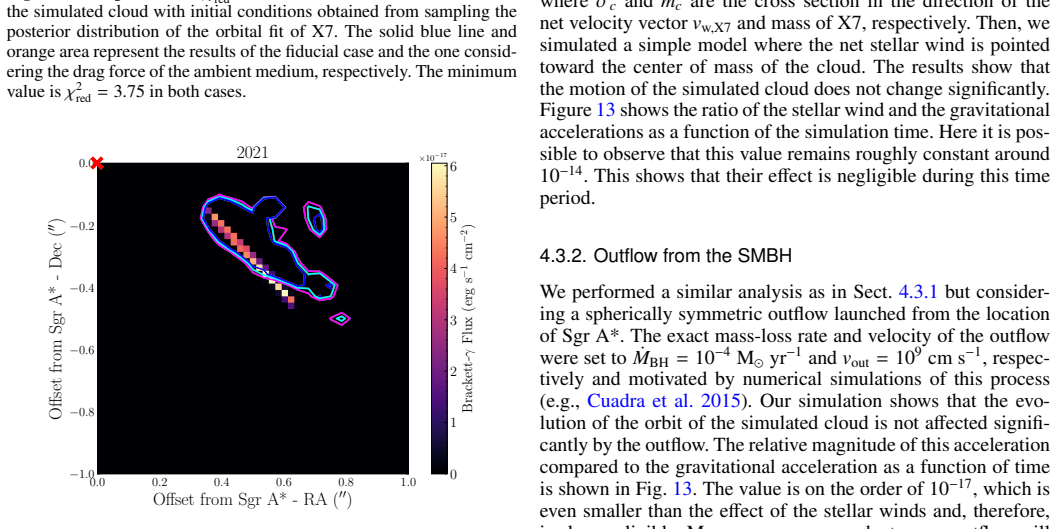
The central machinery is a set of test-particle simulations of a debris cloud moving only under the point-mass gravity of Sagittarius A* ($4.3\times10^6 M_\odot$), integrated with an adaptive leapfrog scheme. Initial conditions are obtained by extrapolating the observationally constrained orbits of X7 and the 195 stars into the past to locate the closest three-dimensional approach; S33/S0-30 and X7 meet this criterion in 1947 with separation about 610 AU and relative velocity about 505 km/s. The initial velocity of the cloud is fixed by requiring its specific angular momentum to match that of X7's tip, scanning $v_z$ to minimize the 2021 tip separation, and the initial shape that works best is an ellipsoid of length 200 AU at position angle about 75 degrees with a linear velocity gradient of about 100 km/s. This machinery converts the observed orbit into a small set of tunable launch conditions and then tests whether those conditions are physically plausible.
What would settle it
Adopt the Peißker et al. (2024b) orbit for X7, which is anchored by a 1999 L'-band data point: the closest any star in the sample comes to X7 over the past 200 years is more than 4000 AU, so the supposed 1947 encounter and the resulting S33/S0-30 connection disappear entirely. A second decisive test would be to resolve S33/S0-30 with high angular resolution and find no extended dusty envelope or evidence of recent surface agitation.
Extended reading notes
Core claim
The paper's central claim is that the observed dynamics and structure of X7 can be replicated, to a large extent, by ejecta launched from the star S33/S0-30 in roughly 1950, provided the ejecta were initially elongated (about 200 AU long), carried a velocity gradient of about 100 km/s from tip to tail, and had an initial maximum speed of about 610 km/s. By minimizing the three-dimensional separation and relative velocity between the simulated cloud's tip and X7's observed tip across epochs, the authors obtain a match of about 50 AU in 2021, well within the observational uncertainties. They interpret this as evidence that X7 is the debris of a grazing collision between S33/S0-30 and a field object such as a stellar-mass black hole or a Jupiter-mass object, with the collision happening near the time of closest approach in 1947. They also argue against the two main rival hypotheses: no high-mass-loss star came close enough to X7 to have formed it from a stellar wind, and ejecta from the similarly orbiting source G3 cannot be placed on X7's orbit. The analysis is explicitly conditional on adopting the X7 orbit derived by Ciurlo et al. (2023); if the alternative orbit of Peißker et al. (2024b) is used, no star in the sample has come within 4000 AU of X7 over the past 200 years, and the S33/S0-30 link disappears entirely.
Load-bearing premise
The entire reconstruction rests on the assumption that the Ciurlo et al. (2023) orbit of X7's tip is the correct one; if the alternative orbit derived by Peißker et al. (2024b) is adopted, no star in the 195-star sample comes within 4000 AU of X7 over the last 200 years, and the proposed S33/S0-30 connection vanishes.
Editorial extensions
If this is right
- If the scenario is correct, X7 will continue to stretch and begin fragmenting as it approaches pericenter around 2035, giving observers a decades-long forecast of a tidal disruption event near Sgr A* and a chance to watch for a resulting change in the black hole's accretion activity.
- S33/S0-30 should currently show observable aftermath of a grazing collision—an agitated stellar surface or an extended dusty envelope—that can be searched for with high-resolution spectroscopy and imaging.
- The rarity estimate in the paper implies that only a small fraction of B-type stars in the central parsec should show such filaments at any time; finding additional filaments around other stars would support the collision origin, while finding none would strain it.
- The paper rules out a dynamical link between X7 and the G object G3, so the two sources should not be treated as a merger pair in future studies of the G-object population.
- The conclusions depend on the adopted orbit of X7; if the alternative orbit anchored by the 1999 L'-band measurement is confirmed, then the collision scenario for this particular source fails.
Reading between the lines
- Editorial inference: If X7 is truly collision ejecta, then similar elongated dusty streams in the Galactic Center could be fossil records of recent stellar collisions, effectively turning X7-like sources into tracers of the hidden stellar-mass black hole population.
- Editorial inference: The model's assumed initial conditions could be tested hydrodynamically by simulating a grazing collision itself; a genuine collision should produce a coherent, expanding filament with a particular density and velocity stratification, whereas a wind or merger ejection would not.
- Editorial inference: A decisive archival test is possible before 2035: re-reducing the 1999 L'-band image that anchors the competing X7 orbit, or obtaining new high-accuracy astrometry of X7's tip, would settle which orbit is correct and therefore whether the S33/S0-30 encounter actually occurred.
- Editorial inference: If the impactor was a Jupiter-mass object, it may survive as a free-floating planet near Sgr A*, whereas a stellar-mass black hole would leave S33/S0-30 with a modest velocity kick; future astrometry of S33/S0-30's orbit might distinguish the two impactor types.
Signed reviews
Editorial analysis
A structured set of objections, weighed in public.
Referee Report
Summary. The paper investigates the origin of the Galactic Center dusty source X7, which is being tidally stretched by Sgr A* and is predicted to be disrupted around 2035. Under the assumption that X7 is a purely gaseous/dusty cloud with an age shorter than its ~200 yr orbital period, the authors test three formation scenarios: a massive stellar wind/LBV ejection, ejecta from a stellar merger (with G3 as the merger product), and ejecta from a grazing collision of a star with a compact field object. Using a sample of 195 stars with observationally constrained orbits, they find that the star S33/S0-30 had a close approach to X7 (Δr ~ 610 au, Δv ~ 505 km/s) around 1947, and they run test-particle simulations of an initially ellipsoidal cloud launched from S33/S0-30's position. By tuning the launch velocity, cloud length, orientation, and a tip-to-tail velocity gradient, they obtain a simulated cloud whose tip matches X7's 2021 position to ~50 au and whose length, orientation, and line-of-sight velocity structure resemble the observations. They conclude that a grazing collision between S33/S0-30 and a stellar-mass black hole or Jupiter-mass object is a viable origin for X7. They also argue against the wind and merger scenarios and show that stellar-wind ram pressure, a putative SMBH outflow, and a static ISM drag do not markedly alter the cloud's evolution.
Significance. If the central claim holds, X7 would be the first identified debris stream from a stellar grazing collision in the Galactic Center, with a concrete progenitor candidate (S33/S0-30), a launch epoch (~1947), and a falsifiable prediction that S33/S0-30 may still show an agitated state or a dusty envelope. The paper is commendably transparent about the limitations of the analysis: the authors disclose in Appendix B that an alternative published orbit for X7 (Peißker et al. 2024b) removes the S33/S0-30 connection entirely, they report the median reduced chi-square of the fit (χ²_red ~ 8), and they explicitly note that the initial velocity is obtained by solving for the angular momentum of X7 (Eq. 1), so part of the match is built in by construction. The treatment of secondary dynamical effects (WR winds, SMBH outflow, ISM drag) is careful, and the synthesis of Brγ emission for comparison with observations is a strength. However, the significance of the result is currently limited by the unresolved orbit degeneracy for X7 and by the fact that the agreement with the observed orbit is substantially a consequence of the fitting procedure rather than an independent prediction.
major comments (3)
- [Appendix B / Sec. 3.1] The entire candidate-selection and the S33/S0-30 connection depend on adopting the Ciurlo et al. (2023) orbit for X7. The authors show in Appendix B and Fig. B.1 that when the Peißker et al. (2024b) orbit is used, no star in the 195-star sample comes within 4000 au of X7 over the past 200 years, i.e., the proposed progenitor disappears entirely. The paper does not provide a quantitative justification for preferring the Ciurlo orbit; it merely notes the discrepancy. Because all subsequent encounter statistics, angular-momentum alignment, and the tuned ejection velocity (Eqs. 2-4) are predicated on this one orbit choice, this is a load-bearing issue. The authors should either re-run the full analysis with the Peißker orbit or provide a decisive, quantitative argument (e.g., astrometric-data quality, epoch coverage, or a model-comparison statistic) for why the Ciurlo orbit is the correct one to use.
- [Sec. 3.2.2, Eq. (1)] The initial ejection velocity is not independently predicted but is solved from X7's specific angular momentum using the position of S33/S0-30 in 1947 (Eq. 1), and the cloud length and position angle are then scanned to minimize the tip separation in 2021 (Sec. 3.2.3, Figs. 4 and 5). The resulting agreement of ~50 au in 2021 is therefore partly guaranteed by construction. The paper should state this more explicitly and provide a diagnostic that is not folded into the fitting procedure, such as a prediction of the morphological evolution prior to 2021 or of the pericenter-passage fragmentation pattern, to establish that the model has genuine predictive power beyond reproducing the target orbit.
- [Sec. 4.2, Fig. 10] The reported goodness of fit is marginal: the median reduced chi-square over 3000 realizations is ~8, with a minimum of 3.75, even though the model has several tuned parameters (initial velocity magnitude and direction, cloud length, position angle, and velocity-gradient amplitude). For a model with this many adjusted quantities, χ²_red ≈ 8 is not a tight fit, and the text's statement that the model 'can reproduce the observed orbit of X7 to a large extent' (Sec. 4.2) is stronger than the quantitative evidence supports. The authors should discuss this systematically, for example by estimating the effective number of degrees of freedom, or by showing that the residuals are dominated by systematic uncertainties in the orbit of X7 rather than by model deficiency.
minor comments (5)
- [Sec. 3, first paragraph] The sentence 'Once found find the best star candidate to be related to X7' contains a grammatical error and should be rephrased.
- [Sec. 3.2.3] The description of the ellipsoidal cloud initialization is confusing: the text states that the polar angle 0° < θ < 90° and azimuthal angle 0° < φ < 180° 'have, in practice, no effect on our overall results,' yet the position angle θ_ini = 75° for the ridge is later treated as an important, tuned parameter. Please clarify the distinction between the angular parameters that define the particle distribution within the ellipsoid and the global orientation angle of the ellipsoid's major axis.
- [Sec. 5.3] The sentence 'To date, there is no account of such effects for S33/S0-30, but future observations might be able to detect this' is vague; specifying what kind of observational signature (e.g., photometric variability, enhanced mass loss, or a compact companion) would test the collision scenario would strengthen the discussion.
- [Appendix B] The fact that the Peißker et al. (2024b) uncertainties are smaller by an order of magnitude is mentioned only in the appendix; this is relevant to the orbit-choice discussion and should at least be noted in Sec. 3.1 where the X7 orbit is adopted.
- [Throughout] The notation for the position angle is used inconsistently: θ (polar angle) and θ_ini (initial position angle) appear in close proximity in Sec. 3.2.3, which may confuse readers; distinct symbols (e.g., ψ for the ridge orientation) would help.
Circularity Check
The ejection velocity is defined in Eq. (1) as the velocity giving X7's angular momentum, and the paper itself describes the orbit match as 'by construction'; independent morphology and emission checks keep the circularity partial.
-
self definitional
[Section 3.2.2, Eq. (1).]
"To find the initial velocity of the cloud, we calculated the velocity required for ejecta from the position (r) of S33/S0-30 in 1947 to achieve the same observed specific angular momentum (l) of the tip of X7. To do so, we solved the following equation to find vX7(t = 1947), lX7 = rS33/S0-30(t = 1947) × vX7(t = 1947)."
The launch velocity is not an independent prediction: it is constructed as the velocity that puts the ejecta on X7's specific angular momentum. Since the orbit of a test particle around Sgr A* is determined by its initial position and velocity, imposing X7's angular momentum at the launch point builds the target orbit into the initial condition. The later claim that ejecta from S33/S0-30 'can be placed on a similar orbit to X7's' (Section 6, point 3) therefore restates the input constraint rather than testing it.
-
self definitional
[Section 4.1.]
"The sky-projected orbits have a strong correspondence (by construction) with the observed orbit, the three-dimensional spatial difference of ~50 au (see Table 1), is well within the uncertainty as reported by Ciurlo et al. (2023)."
This sentence explicitly concedes that the orbital correspondence is by construction. The simulated tip's orbit is forced to match X7's by the choice of launch velocity (same angular momentum) and by minimizing the 2021 tip separation, so the reported ~50 au agreement in 2021 is a restatement of the fitting criterion, not an emergent success of the S33/S0-30 scenario.
1 more flagged steps
-
fitted input called prediction
[Sections 3.2.2-3.2.3 and 4.2.]
"The agreement is best in the last epoch although this is not surprising since the initial velocity was selected so that tip of the cloud reproduces the position of X7 at this time."
The 2021 tip position is exactly the quantity minimized in the initial-condition search: |v_ej| is varied to minimize Delta r_tip and Delta v_tip in 2021 (Fig. 4), the initial length of ~200 au is chosen because it minimizes Delta r_tip in 2021 (Fig. 5), and the ridge position angle theta_ini = 75 deg is selected after testing angles. Citing the resulting last-epoch agreement as evidence that the model 'can reproduce the observed dynamics and structure of X7' is circular because the agreement at the fitting epoch is ensured by the minimization. Genuinely independent content remains in epochs and observables not used in the fit, such as the 2002-2015 morphology evolution, tail orientation, line-of-sight velocity crossover, and Br-gamma flux, so the circularity is only partial.
full rationale
The central dynamical match is partially circular. Eq. (1) defines the ejection velocity so that the ejecta carry the same specific angular momentum as the observed X7 tip, and Section 4.1 explicitly calls the orbit correspondence 'by construction'. The 2021 tip agreement is also the minimization target for the launch speed, cloud size, and ridge angle. Those fitted inputs are then presented as the paper's main support for the conclusion that X7 is S33/S0-30 ejecta. What keeps the paper from being fully circular is the set of observables not used in constructing the initial conditions: the simulated cloud's elongation and orientation over 2002-2021, the radial-velocity crossover from tip to tail, and the synthesized Br-gamma flux agree with X7 without being directly fitted (Sections 4.1-4.2, Figs. 8, 9, 11, C.1). The orbital-choice sensitivity shown in Appendix B (no star within 4000 au if the Peissker et al. 2024b orbit is used) is a robustness problem, not a circularity problem, because both orbits are external observational inputs and the paper discloses the alternative. Self-citations to Ciurlo et al. (2023) supply the observed orbit and the grazing-collision idea, but the present argument does not rest on a uniqueness theorem or on unverified claims from those papers. Overall, the dynamical 'prediction' reduces in part to the fit, while the morphological and radiative comparisons retain independent content; score 6.
Assumptions & free parameters
free parameters (4)
- initial ejection velocity v_ej =
~610-612 km/s (vx ~ -420 to -426, vy ~ 433-436, vz in -40 to -30 km/s)
- initial cloud length L =
200 au
- initial position angle theta_ini =
75 deg
- tip-to-tail velocity gradient =
~100 km/s
assumptions (5)
- domain assumption X7 is a purely gaseous/dusty source with no internal compact object; therefore its age is less than its ~200 yr orbital period.
- domain assumption The orbit of X7 derived by Ciurlo et al. (2023) is the correct orbit.
- domain assumption Star orbits are unchanged over the past 200 years, with Sgr A* as the only significant gravitational source.
- ad hoc to paper A grazing collision can produce the assumed elongated ejecta with a ~100 km/s velocity gradient and ~600 km/s bulk velocity.
- domain assumption The cloud has negligible self-gravity and internal pressure; test particles trace its motion.
Cite this review
Pith. "Pith review of Tidal phenomena in the Galactic Center: The curious case of X7." pith.science (2026). https://pith.science/paper/CAHBYO2S
@misc{pith2026250415337,
  author       = {Pith},
  title        = {Pith review of: Tidal phenomena in the Galactic Center: The curious case of X7},
  year         = {2026},
  howpublished = {\url{https://pith.science/paper/CAHBYO2S}},
  note         = {Machine review of arXiv:2504.15337}
}
abstract
Several enigmatic dusty sources have been detected in the central parsec of the Galactic Center. Among them is X7, located at only $\sim$0.02 pc from the central super-massive black hole, Sagittarius A* (Sgr A*). Recent observations have shown that it is becoming elongated due to the tidal forces of Sgr A*. X7 is expected to be fully disrupted during its pericenter passage around 2035 which might impact the accretion rate of Sgr A*. However, its origin and nature are still unknown. We investigated the tidal interaction of X7 with Sgr A* in order to constrain its origin. We tested the hypothesis that X7 was produced by one of the observed stars with constrained dynamical properties in the vicinity of Sgr A*. We employed a set of test-particle simulations to reproduce the observed structure and dynamics of X7. The initial conditions of the models were obtained by extrapolating the observationally constrained orbits of X7 and the known stars into the past, making it possible to find the time and source of origin by minimizing the three-dimensional separation and velocity difference between them. Our results show that ejecta from the star S33/S0-30, launched in $\sim$1950, can to a large extent, replicate the observed dynamics and structure of X7, provided that it is initially elongated with a velocity gradient across it, and with an initial maximum speed of $\sim$600~km~s$^{-1}$. Our results show that a grazing collision between the star S33/S0-30 and a field object such as a stellar mass black hole or a Jupiter-mass object is a viable scenario to explain the origin of X7. Nevertheless, such encounters are rare based on the observed stellar dynamics within the central parsec.
Figures


Figures from the paper (11 more)




Reference graph
Works this paper leans on
-
[1]
, " * write output.state after.block = add.period write newline
ENTRY address archiveprefix author booktitle chapter edition editor howpublished institution eprint journal key month note number organization pages publisher school series title type volume year label extra.label sort.label short.list INTEGERS output.state before.all mid.sentence after.sentence after.block FUNCTION init.state.consts #0 'before.all := #1 ...
-
[2]
write newline
" write newline "" before.all 'output.state := FUNCTION n.dashify 't := "" t empty not t #1 #1 substring "-" = t #1 #2 substring "--" = not "--" * t #2 global.max substring 't := t #1 #1 substring "-" = "-" * t #2 global.max substring 't := while if t #1 #1 substring * t #2 global.max substring 't := if while FUNCTION word.in bbl.in " " * FUNCTION format....
-
[3]
P., et al
Amorim , A., Baub \"o ck , M., Berger , J. P., et al. 2019, , 122, 101102
2019
-
[4]
Balakrishnan , M., Russell , C. M. P., Corrales , L., et al. 2024, , 974, 99
work page 2024
- [5]
-
[6]
Ballone , A., Schartmann , M., Burkert , A., et al. 2018, , 479, 5288
work page 2018
-
[7]
Ballone , A., Schartmann , M., Burkert , A., et al. 2016, , 819, L28
work page 2016
-
[8]
Begelman , M. C. 2012, , 420, 2912
work page 2012
Show all 83 references
-
[9]
Blandford , R. D. & Begelman , M. C. 1999, , 303, L1
1999
-
[10]
A., et al
Bouffard , \'E ., Haggard , D., Nowak , M. A., et al. 2019, , 884, 148
2019
-
[11]
2012, , 750, 58
Burkert , A., Schartmann , M., Alig , C., et al. 2012, , 750, 58
2012
-
[12]
2016, , 455, 4388
Calder \'o n , D., Ballone , A., Cuadra , J., et al. 2016, , 455, 4388
2016
-
[13]
Calder \'o n , D., Cuadra , J., Russell , C. M. P., et al. 2025, , 693, A180
2025
-
[14]
2018, , 478, 3494
Calder \'o n , D., Cuadra , J., Schartmann , M., et al. 2018, , 478, 3494
2018
-
[15]
2020 a , , 493, 447
Calder \'o n , D., Cuadra , J., Schartmann , M., et al. 2020 a , , 493, 447
2020
-
[16]
Calder \'o n , D., Cuadra , J., Schartmann , M., Burkert , A., & Russell , C. M. P. 2020 b , , 888, L2
2020
-
[17]
D., Morris , M
Ciurlo , A., Campbell , R. D., Morris , M. R., et al. 2023, , 944, 136
2023
-
[18]
D., Morris , M
Ciurlo , A., Campbell , R. D., Morris , M. R., et al. 2020, , 577, 337
2020
- [19]
-
[20]
2004, , 417, L15
Cl \'e net , Y., Rouan , D., Gendron , E., et al. 2004, , 417, L15
2004
-
[21]
Crowther , P. A. 2007, , 45, 177
2007
-
[22]
2008, , 383, 458
Cuadra , J., Nayakshin , S., & Martins , F. 2008, , 383, 458
2008
-
[23]
2005, , 360, L55
Cuadra , J., Nayakshin , S., Springel , V., & Di Matteo , T. 2005, , 360, L55
2005
-
[24]
2006, , 366, 358
Cuadra , J., Nayakshin , S., Springel , V., & Di Matteo , T. 2006, , 366, 358
2006
-
[25]
Cuadra , J., Nayakshin , S., & Wang , Q. D. 2015, , 450, 277
2015
-
[26]
E., Davies , M
Dale , J. E., Davies , M. B., Church , R. P., & Freitag , M. 2009, , 393, 1016
2009
-
[27]
B., Church , R
Davies , M. B., Church , R. P., Malmberg , D., et al. 2011, in Astronomical Society of the Pacific Conference Series, Vol. 439, The Galactic Center: a Window to the Nuclear Environment of Disk Galaxies, ed. M. R. Morris , Q. D. Wang , & F. Yuan , 212
2011
-
[28]
C., Contreras-Torres , F
De Colle , F., Raga , A. C., Contreras-Torres , F. F., & Toledo-Roy , J. C. 2014, , 789, L33
2014
-
[29]
2019 a , Science, 365, 664
Do , T., Hees , A., Ghez , A., et al. 2019 a , Science, 365, 664
2019
-
[30]
K., et al
Do , T., Witzel , G., Gautam , A. K., et al. 2019 b , , 882, L27
2019
-
[31]
2005, , 628, 246
Eisenhauer , F., Genzel , R., Alexander , T., et al. 2005, , 628, 246
2005
-
[32]
2006, , 649, 91
Freitag , M., Amaro-Seoane , P., & Kalogera , V. 2006, , 649, 91
2006
-
[33]
2010, Reviews of Modern Physics, 82, 3121
Genzel , R., Eisenhauer , F., & Gillessen , S. 2010, Reviews of Modern Physics, 82, 3121
2010
-
[34]
Genzel , R., Thatte , N., Krabbe , A., Kroker , H., & Tacconi-Garman , L. E. 1996, , 472, 153
1996
-
[35]
M., Duch \^e ne , G., Matthews , K., et al
Ghez , A. M., Duch \^e ne , G., Matthews , K., et al. 2003, , 586, L127
2003
-
[36]
M., Salim , S., Weinberg , N
Ghez , A. M., Salim , S., Weinberg , N. N., et al. 2008, , 689, 1044
2008
-
[37]
2009, , 692, 1075
Gillessen , S., Eisenhauer , F., Trippe , S., et al. 2009, , 692, 1075
2009
-
[38]
K., et al
Gillessen , S., Genzel , R., Fritz , T. K., et al. 2012, , 481, 51
2012
-
[39]
M., Eisenhauer , F., et al
Gillessen , S., Plewa , P. M., Eisenhauer , F., et al. 2017, , 837, 30
2017
-
[40]
M., Widmann , F., et al
Gillessen , S., Plewa , P. M., Widmann , F., et al. 2019, , 871, 126
2019
-
[41]
2022, , 657, L12
GRAVITY Collaboration , Abuter , R., Aimar , N., et al. 2022, , 657, L12
2022
-
[42]
2020, , 636, L5
GRAVITY Collaboration , Abuter , R., Amorim , A., et al. 2020, , 636, L5
2020
-
[43]
2019, , 872, L15
Habibi , M., Gillessen , S., Pfuhl , O., et al. 2019, , 872, L15
2019
-
[44]
R., Millman , K
Harris , C. R., Millman , K. J., van der Walt , S. J., et al. 2020, , 585, 357
2020
-
[45]
Hunter , J. D. 2007, Computing in Science and Engineering, 9, 90
2007
-
[46]
1962, , 67, 591
Kozai , Y. 1962, , 67, 591
1962
-
[47]
2006, in Society of Photo-Optical Instrumentation Engineers (SPIE) Conference Series, Vol
Larkin , J., Barczys , M., Krabbe , A., et al. 2006, in Society of Photo-Optical Instrumentation Engineers (SPIE) Conference Series, Vol. 6269, Ground-based and Airborne Instrumentation for Astronomy, ed. I. S. McLean & M. Iye , 62691A
2006
-
[48]
Lidov , M. L. 1962, , 9, 719
1962
-
[49]
Madigan , A.-M., McCourt , M., & O'Leary , R. M. 2017, , 465, 2310
2017
-
[50]
& Gualandris , A
Mapelli , M. & Gualandris , A. 2016, in Lecture Notes in Physics, Berlin Springer Verlag, ed. F. Haardt , V. Gorini , U. Moschella , A. Treves , & M. Colpi , Vol. 905, 205
2016
-
[51]
& Ripamonti , E
Mapelli , M. & Ripamonti , E. 2015, , 806, 197
2015
-
[52]
J., et al
Martins , F., Genzel , R., Hillier , D. J., et al. 2007, , 468, 233
2007
-
[53]
2008, , 672, L119
Martins , F., Gillessen , S., Eisenhauer , F., et al. 2008, , 672, L119
2008
-
[54]
& Meyer-Hofmeister , E
Meyer , F. & Meyer-Hofmeister , E. 2012, , 546, L2
2012
-
[55]
2012, , 756, 86
Miralda-Escud \'e , J. 2012, , 756, 86
2012
-
[56]
1993, , 408, 496
Morris , M. 1993, , 408, 496
1993
-
[57]
Murray-Clay , R. A. & Loeb , A. 2012, Nature Communications, 3, 1049
2012
-
[58]
2007, , 469, 993
Mu z i \'c , K., Eckart , A., Sch \"o del , R., Meyer , L., & Zensus , A. 2007, , 469, 993
2007
-
[59]
2016, , 54, 441
Naoz , S. 2016, , 54, 441
2016
-
[60]
K., et al
Paugnat , H., Do , T., Gautam , A. K., et al. 2024, , 977, 228
2024
-
[61]
2006, , 643, 1011
Paumard , T., Genzel , R., Martins , F., et al. 2006, , 643, 1011
2006
-
[62]
2021, , 909, 62
Pei ker , F., Ali , B., Zaja c ek , M., et al. 2021, , 909, 62
2021
-
[63]
E., Zaja c ek , M., et al
Pei ker , F., Hosseini , S. E., Zaja c ek , M., et al. 2020, , 634, A35
2020
-
[64]
2024 a , Nature Communications, 15, 10608
Pei ker , F., Zaja c ek , M., Labadie , L., et al. 2024 a , Nature Communications, 15, 10608
2024
-
[65]
2024 b , , 686, A235
Pei ker , F., Zaja c ek , M., Melamed , M., et al. 2024 b , , 686, A235
2024
-
[66]
2015, , 798, 111
Pfuhl , O., Gillessen , S., Eisenhauer , F., et al. 2015, , 798, 111
2015
-
[67]
Prodan , S., Antonini , F., & Perets , H. B. 2015, , 799, 118
2015
-
[68]
M., Quataert , E., & Stone , J
Ressler , S. M., Quataert , E., & Stone , J. M. 2018, , 478, 3544
2018
-
[69]
M., Quataert , E., & Stone , J
Ressler , S. M., Quataert , E., & Stone , J. M. 2020, , 492, 3272
2020
-
[70]
R., Jiang , Y.-F., Wang , Q
Roberts , S. R., Jiang , Y.-F., Wang , Q. D., & Ostriker , J. P. 2017, , 466, 1477
2017
-
[71]
C., Naoz , S., Gautam , A
Rose , S. C., Naoz , S., Gautam , A. K., et al. 2020, , 904, 113
2020
-
[72]
C., Naoz , S., Sari , R., & Linial , I
Rose , S. C., Naoz , S., Sari , R., & Linial , I. 2022, , 929, L22
2022
-
[73]
C., Naoz , S., Sari , R., & Linial , I
Rose , S. C., Naoz , S., Sari , R., & Linial , I. 2023, , 955, 30
2023
-
[74]
Russell , C. M. P., Wang , Q. D., & Cuadra , J. 2017, , 464, 4958
2017
-
[75]
2015, , 811, 155
Schartmann , M., Ballone , A., Burkert , A., et al. 2015, , 811, 155
2015
-
[76]
2002, , 419, 694
Sch \"o del , R., Ott , T., Genzel , R., et al. 2002, , 419, 694
2002
-
[77]
M., Murchikova , L., Stone , J
Solanki , S., Ressler , S. M., Murchikova , L., Stone , J. M., & Morris , M. R. 2023, , 953, 22
2023
-
[78]
J., Smith , B
Turk , M. J., Smith , B. D., Oishi , J. S., et al. 2011, , 192, 9
2011
-
[79]
, M., Eckart , A., Zaja c ek , M., et al
Valencia-S. , M., Eckart , A., Zaja c ek , M., et al. 2015, , 800, 125
2015
-
[80]
D., Gillessen , S., Stadler , J., et al
von Fellenberg , S. D., Gillessen , S., Stadler , J., et al. 2022, , 932, L6
2022
-
[81]
M., Morris , M
Witzel , G., Ghez , A. M., Morris , M. R., et al. 2014, , 796, L8
2014
-
[82]
N., Ghez , A
Witzel , G., Sitarski , B. N., Ghez , A. M., et al. 2017, , 847, 80
2017
-
[83]
2003, , 598, 301
Yuan , F., Quataert , E., & Narayan , R. 2003, , 598, 301
2003
Reviewed August 16, 2026 · model on record in the stance chip above.
Discussion (0). Continue with ORCID to comment.