REVIEW 3 major objections 5 minor 98 references
Rendezvous in CAVITY: Kinematics and gas properties of an isolated dwarf-dwarf merging pair in a cosmic void region
T0 review · 3 major / 5 minor · reviewed 2026-08-16 · deepseek-v4-flash
Pith's one-line read Two dwarf galaxies are merging nearly one-to-one at the centre of a cosmic void, with both components forming stars faster than comparable isolated dwarfs.
desk verdict A rare and honestly presented dwarf-dwarf merger in a void, but the 'nearly 1:1' mass ratio is anchored by a dynamical mass error bar that cannot support it. read the letter →
The pith
A machine-rendered reading of the paper's core claim, the machinery that carries it, and where it could break.
The reading
What carries the argument
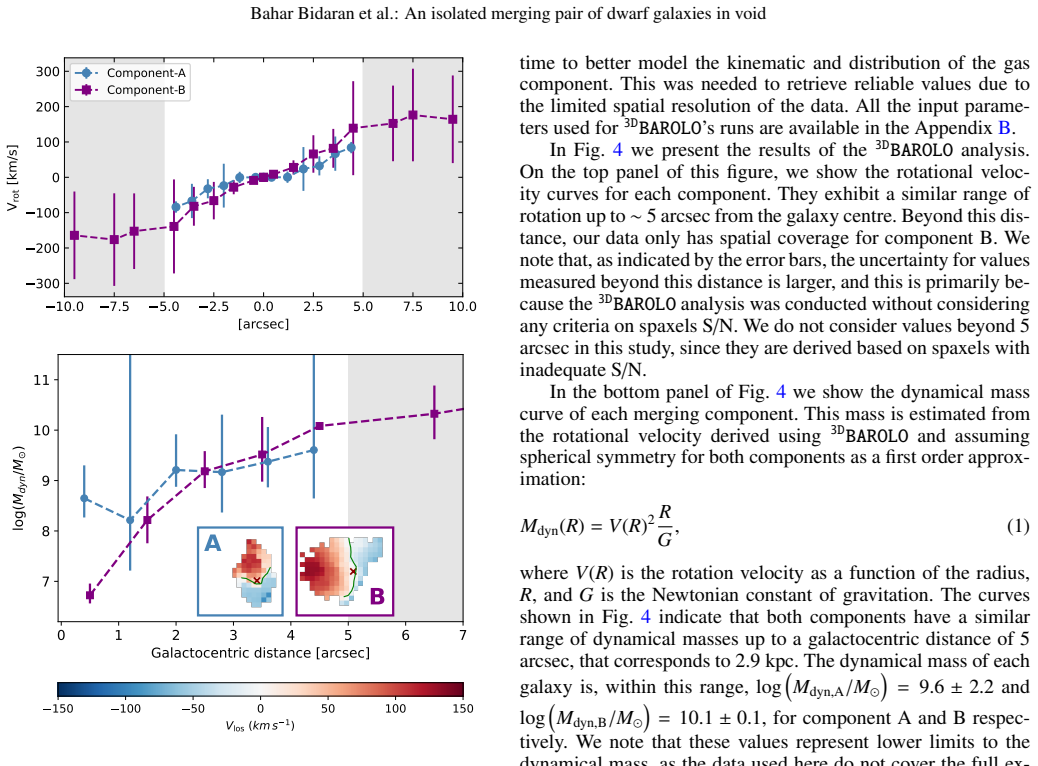
The load-bearing tool is the tilted-ring decomposition of the Hα emission-line velocity field, in which each galaxy is modelled as a set of concentric rotating rings with a fixed rotation velocity per radius. This recovers each component's rotation curve $V(R)$ despite the two galaxies being separated by only a few arcseconds against a 2.5 arcsecond beam. The rotation curve then enters the spherical dynamical-mass estimator $M_{\rm dyn}(R) = V(R)^2 R/G$, which converts the measured kinematics into enclosed mass under the assumption of spherical symmetry. A second ingredient is full spectral fitting of the stellar continuum, which provides the emission-line fluxes used for metallicities and star formation rates.
What would settle it
A higher-resolution observation that resolves each component with a beam well below their separation, or an independent geometrical constraint such as an HI velocity field, would either confirm or overturn the similar rotation curves; if the true inclinations differ from the fitted values, the dynamical masses would differ by more than the reported uncertainties. Alternatively, a numerical merger simulation seeded with the observed masses and relative velocity could show that the observed rotation curves are reproduced only when the two discs are not individually rotating as fitted.
Extended reading notes
Core claim
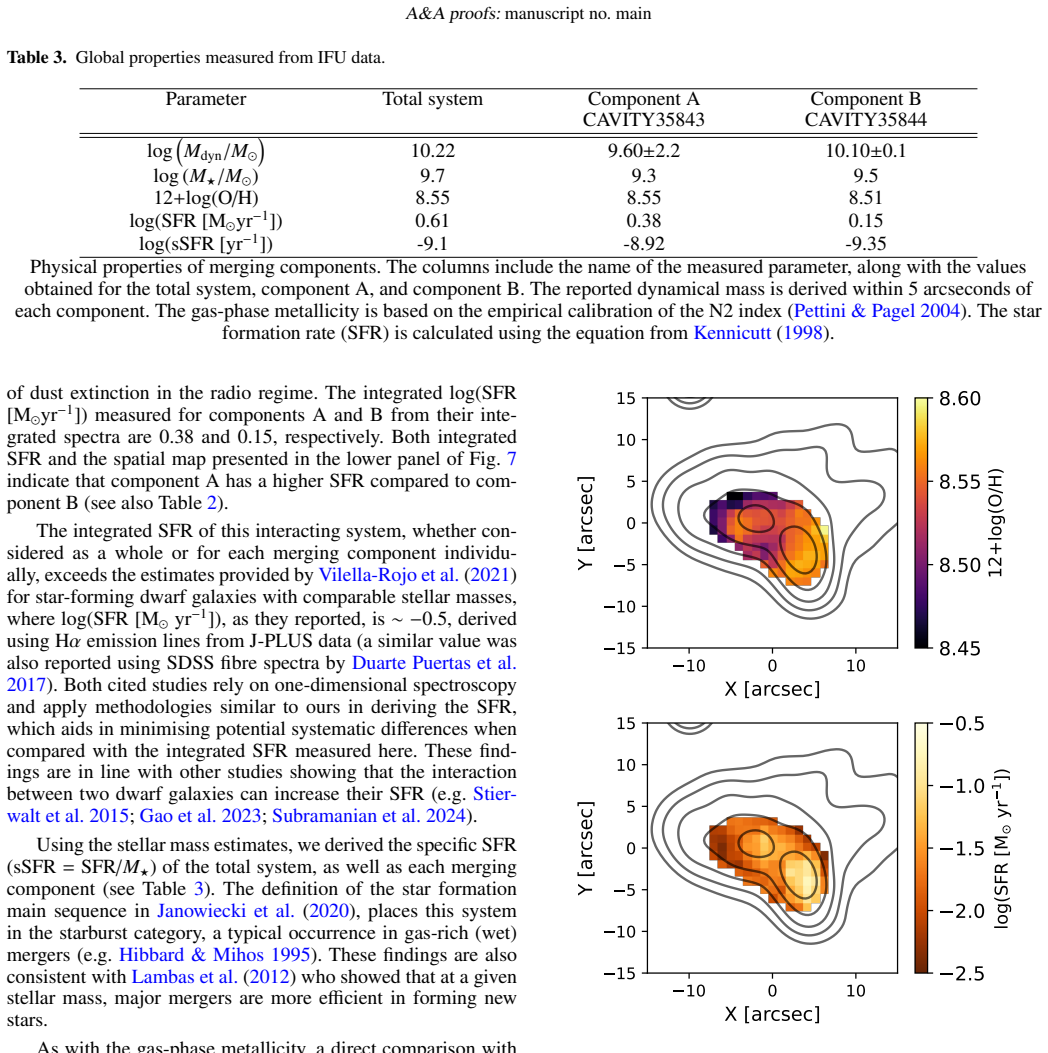
The central claim is that the two galaxies, called components A and B, are a nearly 1:1 dwarf-dwarf merging system located at about 0.13 of the void's effective radius from its centre. The favourable line-of-sight orientation lets the authors separate the two nuclei and fit a rotating-disc model to each component's Hα velocity field; both rotation curves rise similarly, and under spherical symmetry the enclosed dynamical masses agree within the uncertainties up to 2.9 kpc ($\log(M_{\rm dyn}/M_\odot)\sim 9.6$ and $10.1$). The same analysis indicates the pair was probably two star-forming, rotating disc dwarfs before the encounter. The paper also finds no AGN signature, near-solar gas-phase metallicities, and star formation rates in both components above those of comparable star-forming dwarfs, which it interprets as evidence that the merger has enhanced star formation.
Load-bearing premise
The argument collapses if the interacting components do not each retain enough disc symmetry for the tilted-ring fits to recover their true rotation, because the galaxies are separated by only a few arcseconds against a 2.5 arcsecond beam and the ongoing tidal interaction breaks disc symmetry; the recovered rotation curves and hence the similar dynamical masses depend on this assumption.
Editorial extensions
If this is right
- Major dwarf-dwarf mergers can take place in the centres of cosmic voids, not only in group-like environments, so void surveys should find more such pairs.
- Both components are in a starburst phase relative to equally massive star-forming dwarfs, supporting the view that dwarf-dwarf interactions enhance star formation.
- The similar dynamical masses and stellar masses of the two components imply a nearly 1:1 major merger, a configuration rare among isolated dwarf pairs.
- The system's high neutral-gas-to-stellar-mass ratio and rotating discs make it a useful test case for simulations of wet dwarf mergers.
- The absence of AGN activity in both components suggests that low-mass major mergers do not necessarily trigger black-hole growth at this stage.
Reading between the lines
- If the merger-enhanced star formation is real, void dwarf pairs may temporarily appear as starbursting galaxies whose optical colours are indistinguishable from dwarfs in denser environments, implying that environment is secondary during the merger phase.
- The system is a promising target for high-resolution molecular-gas follow-up: if gas is being funnelled inward, CO mapping should reveal a central concentration before coalescence.
- A statistical survey of void dwarf pairs could test whether such 1:1 mergers are recurrent in voids or whether this pair is an outlier triggered by a past three-body encounter.
- The retrograde, equal-mass configuration offers a clean laboratory for numerical merger simulations aimed at explaining the observed tidal tails and the survival of rotating discs.
Signed reviews
Editorial analysis
A structured set of objections, weighed in public.
Referee Report
Summary. The paper reports the serendipitous discovery of a merging pair of dwarf galaxies (CAVITY35843 and CAVITY35844) near the center of a cosmic void, studied with CAVITY PPAK-IFU spectroscopy and deep INT imaging. Using pPXF full spectral fitting, the authors derive gas and stellar kinematics, emission-line fluxes, gas-phase metallicities via the N2 index, SFRs from Hα, and ionisation diagnostics from BPT diagrams. They separate the two components along a high-velocity-dispersion line and fit tilted-ring rotation curves with 3DBAROLO, then use Eq. (1) to compute enclosed dynamical masses. The central claim is that both components have similar dynamical masses within galactocentric distances of up to 2.9 kpc, supporting a nearly 1:1 merger, and that both components show elevated SFRs compared with equally massive star-forming dwarf galaxies, indicating merger-enhanced star formation. The paper also reports no AGN signature, gas-phase metallicities consistent with the mass-metallicity relation, and no significant g-r colour difference relative to merging dwarfs in denser environments. The authors speculate that the merger may have been triggered by the dynamics of the void or by a past three-body encounter with the nearby dwarf CAVITY38680.
Significance. If the quantitative claims hold, this would be one of the first resolved studies of a roughly equal-mass dwarf-dwarf merger in the center of a cosmic void, offering a clean environment for separating merger-driven from environment-driven evolution. The paper's strengths include the detailed description of the data and methods, the honesty of the limitations discussion in Section 4.2, and the explicit tabulation of 3DBAROLO input parameters in Appendix B, which supports reproducibility. The qualitative results—an interacting pair with tidal tails, co-rotating gas and stars, starburst-level specific SFR, and absence of AGN—are well supported by the data. However, the central quantitative claim of a nearly 1:1 merger is not robust to the uncertainties quoted for the dynamical masses, and the corroborating stellar-mass estimates are undermined by the acknowledged difficulty of fitting the stellar continuum in an emission-line-dominated system. As a case study of a rare environment, the paper is valuable, but the strength of its conclusions exceeds what the current error bars can support, and the mass-ratio claim needs to be revised or re-framed.
major comments (3)
- [Section 4.2, Table 3, Eq. (1)] The dynamical-mass comparison that underlies the 'nearly 1:1 merger' claim is not supported by the quoted uncertainties. Table 3 lists log(Mdyn/Msun) = 9.60 ± 2.2 for component A and 10.10 ± 0.1 for component B. A 1σ error of ±2.2 dex corresponds to a factor of ~160 in mass, so the two components are consistent with mass ratios ranging from strongly minor to strongly major, while the central values differ by 0.5 dex. The statement in Section 4.2 that 'this test allowed us to confirm the hypothesis of a nearly 1:1 merger within the error bars' is logically problematic: an interval that merely contains the 1:1 hypothesis does not confirm it. Combined with the authors' own characterization of the 3DBAROLO decomposition as 'fundamentally risky' and the manual fine-tuning of initial parameters documented in Appendix B, the dynamical masses should be presented as order-of-magnitude estimates. The abstract and Section 5.1 should either be substantially caveated or the 'similar dynamical masses within 2.9 kpc' claim should be removed from the headline results.
- [Section 4.3, Table 3, Section 5.1] The stellar-mass estimates used to corroborate the 1:1 mass ratio and to interpret the SFR excess are not reliable. The paper states in Section 3 that the spectra are 'heavily dominated by emission lines whose presence makes analysis of the underlying stellar component challenging and unreliable,' yet Table 3 lists pPXF stellar masses of 9.3 and 9.5 for components A and B without error bars. These values are inconsistent with the MPA-JHU catalog value of 8.86 for component A quoted in Table 1, a 0.44 dex discrepancy that is not discussed. The mass-metallicity argument in Section 5.1, based on metallicities of 8.55 vs 8.51, cannot constrain the mass ratio given the ~0.2 dex systematic uncertainty of the N2 calibration and the intrinsic scatter of the mass-metallicity relation. Because the stellar masses are the only independent check on the dynamical-mass ratio, the paper's near-equal-mass conclusion lacks robust supporting evidence.
- [Section 4.5] The claimed SFR excess is not presented with a well-defined comparison sample. The text compares the integrated log(SFR) of the system (0.61) and of components A and B (0.38 and 0.15) with log(SFR) ≈ -0.5 from Vilella-Rojo et al. (2021) quoted for 'star-forming dwarf galaxies with comparable stellar masses,' but it does not specify the stellar mass range or selection of that comparison sample. Given the uncertainty in the stellar masses used in this paper (Major comment 2), the reader cannot assess whether the comparison is against equally massive dwarfs or substantially less massive ones. Please provide the stellar-mass distribution of the comparison sample and quantify how the uncertainty in the system's stellar mass affects the significance of the claimed SFR excess.
minor comments (5)
- [Table 2] The [SII] λ6716 flux for Component A is listed as 3112.8 ± 3.5 (×10^-16 erg/s/cm2), which is about a factor of ten larger than the total-system flux (510.5) and than Component B (172.7); this appears to be a typo, likely 311.28 or 31.28, and should be corrected.
- [Throughout] The manuscript inconsistently uses both 'CAVITY' and 'CA VITY' (with a space); please standardize to the survey's official spelling.
- [Section 4.5] The juxtaposition of 'The average log(SFR) over all the spaxels with S/N>15 in this system is -1.47' and 'The integrated SFR... is log(SFR)=0.61' is initially confusing; a sentence explaining that the average of per-spaxel logarithmic values differs from the logarithm of the summed flux would help.
- [Figure 8] The y-axis label of the bottom panel, 'normalized number of interacting dwarf pairs,' is vague; please clarify what normalization is applied.
- [Appendix B, Table B.1] The output position angle for component A changes from an input of 11 degrees to 43.8 degrees, a large shift; a brief comment on how this affects the derived rotation curve and dynamical mass would improve the reproducibility.
Circularity Check
No circular derivation: the central quantities (dynamical masses, SFR, metallicity) are measured through standard external calibrations and compared with independent literature samples, so any concerns are about data quality, not circularity.
full rationale
The derivation chain is not circular. Dynamical masses come from rotation velocities measured with 3DBAROLO and entered into the standard relation Mdyn = V^2 R / G (Eq. 1); the velocities are not defined in terms of the masses, and the comparison of the two components is an output, not an input. SFR and metallicity use the external Kennicutt (1998) and Pettini & Pagel (2004) calibrations applied to independently measured H-alpha and N2 fluxes. The comparison samples (Vilella-Rojo et al. 2021; Duarte Puertas et al. 2017; Paudel et al. 2018; Curti et al. 2020) are external to the paper, so the claims of enhanced SFR, consistent metallicity, and unremarkable g-r color are tested against outside data rather than against the same fitted values. The 3DBAROLO decomposition is explicitly acknowledged as 'fundamentally risky' and dependent on an assumption of symmetry (Section 4.2); this is a stated model-fitting limitation and a correctness risk, not a case where a prediction is forced by construction. Self-citations to the CAVITY survey and pipeline (e.g., Perez et al. 2024; Garcia-Benito et al. 2024) provide data provenance and reduction details; they do not carry the load of any derived physical result. The stellar masses used as supporting evidence for the 1:1 mass ratio are themselves recognized by the authors as approximations in a gas-dominated, entangled system, so the mass-ratio claim is weaker than presented, but weakness is not circularity. Overall, no step in the paper reduces to its own input or to a self-citation chain.
Assumptions & free parameters
free parameters (3)
- 3DBAROLO fitted and input geometric parameters (vrot, vdisp, inc, pa, xpos, ypos, z0, radsep, nradii) =
Appendix B: inputs vrot 75/150 km/s, inc 43/50 deg, pa 11/60 deg, z0=1 arcsec; outputs vrot 81.8/164.2 km/s, pa…
- Radial cutoff for dynamical mass comparison =
5 arcsec (2.9 kpc)
- S/N threshold for spaxel selection =
15
assumptions (5)
- domain assumption Equation 1 assumes spherical symmetry for the dynamical mass estimate (Mdyn = V^2 R / G)
- domain assumption Each interacting component is an axisymmetric, rotating, disky system that 3DBAROLO can model with tilted rings
- domain assumption Gas emission lines are single Gaussians
- domain assumption Standard cosmology and distance
- domain assumption Empirical calibrations: N2 metallicity (Pettini & Pagel 2004) and Kennicutt (1998) SFR from H-alpha
Cite this review
Pith. "Pith review of Rendezvous in CAVITY: Kinematics and gas properties of an isolated dwarf-dwarf merging pair in a cosmic void region." pith.science (2026). https://pith.science/paper/6POZU6WU
@misc{pith2026250415359,
  author       = {Pith},
  title        = {Pith review of: Rendezvous in CAVITY: Kinematics and gas properties of an isolated dwarf-dwarf merging pair in a cosmic void region},
  year         = {2026},
  howpublished = {\url{https://pith.science/paper/6POZU6WU}},
  note         = {Machine review of arXiv:2504.15359}
}
abstract
Galaxy mergers are pivotal events in the evolutionary history of galaxies, with their impact believed to be particularly significant in dwarf galaxies. We report the serendipitous identification of an isolated merging dwarf system with a total stellar mass of M$_{\rm \star}$$\sim$10$^{9.7}$M$_{\rm \odot}$, located in the centre of a cosmic void. This system is one of the rare examples, and possibly the first, of merging dwarf galaxy pairs studied within the central region of a cosmic void. Using CAVITY PPAK-IFU data combined with deep optical broadband imaging from the Isaac Newton Telescope, we analysed the kinematics and ionized gas properties of each dwarf galaxy in the system by employing a full spectral fitting technique. The orientation of this merging pair relative to the line of sight allowed us to determine the dynamical mass of each component, showing that both had similar dynamical masses within galactocentric distances of up to 2.9 kpc. While the gas-phase metallicity of both components is consistent with that of star-forming dwarf galaxies, the star formation rates observed in both components exceed those typically reported for equally massive star-forming dwarf galaxies. This indicates that the merger has presumably contributed to enhancing star formation. Furthermore, we found no significant difference in the optical g-r colour of this merging pair compared to other merging dwarf pairs across different environments. While most merging events occur in group-like environments with high galaxy density and the tidal influence of a host halo, and isolated mergers typically involve galaxies with significant mass differences, the identified merging pair does not follow these patterns. We speculate that the global dynamics of the void or past three-body encounters involving components of this pair and a nearby dwarf galaxy might have triggered this merging event.
Figures


Figures from the paper (5 more)



Reference graph
Works this paper leans on
-
[1]
D., Allende Prieto, C., et al
Alam, S., Albareti, F. D., Allende Prieto, C., et al. 2015, ApJS, 219, 12
2015
-
[2]
Alonso, S., Mesa, V ., Padilla, N., & Lambas, D. G. 2012, A&A, 539, A46
2012
-
[3]
C., Evans, N
Amorisco, N. C., Evans, N. W., & van de Ven, G. 2014, Nature, 507, 335
2014
-
[4]
2016, ApJ, 826, L27 Argudo-Fernández, M., Verley, S., Bergond, G., et al
Annibali, F., Nipoti, C., Ciotti, L., et al. 2016, ApJ, 826, L27 Argudo-Fernández, M., Verley, S., Bergond, G., et al. 2015, A&A, 578, A110
2016
-
[5]
J., Allende Prieto, C., & Kiselman, D
Asplund, M., Grevesse, N., Sauval, A. J., Allende Prieto, C., & Kiselman, D. 2004, A&A, 417, 751 Astropy Collaboration, Price-Whelan, A. M., Lim, P. L., et al. 2022, ApJ, 935, 167 Astropy Collaboration, Price-Whelan, A. M., Sip˝ocz, B. M., et al. 2018, AJ, 156, 123 Astropy Collaboration, Robitaille, T. P., Tollerud, E. J., et al. 2013, A&A, 558, A33
2004
-
[6]
A., Phillips, M
Baldwin, J. A., Phillips, M. M., & Terlevich, R. 1981, PASP, 93, 5
1981
-
[7]
2008, MNRAS, 388, L10
Bekki, K. 2008, MNRAS, 388, L10
2008
-
[8]
M., & van Gorkom, J
Beygu, B., Kreckel, K., van de Weygaert, R., van der Hulst, J. M., & van Gorkom, J. H. 2013, AJ, 145, 120
2013
Show all 98 references
-
[9]
2022, A&A, 666, A161
Bik, A., Östlin, G., Hayes, M., Melinder, J., & Menacho, V . 2022, A&A, 666, A161
2022
-
[10]
D., Burleigh, K., Dey, A., et al
Blum, R. D., Burleigh, K., Dey, A., et al. 2016, in American Astronomical So- ciety Meeting Abstracts, V ol. 228, American Astronomical Society Meeting Abstracts #228, 317.01
2016
-
[11]
& Gavazzi, G
Boselli, A. & Gavazzi, G. 2014, A&A Rev., 22, 74
2014
-
[12]
Brinchmann, J., Charlot, S., White, S. D. M., et al. 2004, MNRAS, 351, 1151 Calderón-Castillo, P., Nagar, N. M., Yi, S. K., et al. 2024, A&A, 686, A151 Calderón-Castillo, P. & Smith, R. 2024, A&A, 691, A82
2004
-
[13]
R., Dotti, M., V olonteri, M., et al
Capelo, P. R., Dotti, M., V olonteri, M., et al. 2017, MNRAS, 469, 4437
2017
-
[14]
2017, MNRAS, 466, 798
Cappellari, M. 2017, MNRAS, 466, 798
2017
-
[15]
& Emsellem, E
Cappellari, M. & Emsellem, E. 2004, PASP, 116, 138
2004
-
[16]
A., Clayton, G
Cardelli, J. A., Clayton, G. C., & Mathis, J. S. 1989, ApJ, 345, 245
1989
-
[17]
J., Peletier, R
Cenarro, A. J., Peletier, R. F., Sánchez-Blázquez, P., et al. 2007, MNRAS, 374, 664
2007
-
[18]
N., Pustilnik, S
Chengalur, J. N., Pustilnik, S. A., & Egorova, E. S. 2017, MNRAS, 465, 2342 Cid Fernandes, R., Stasi ´nska, G., Mateus, A., & Vale Asari, N. 2011, MNRAS, 413, 1687
2017
-
[19]
G., Baugh, C
Cole, S., Lacey, C. G., Baugh, C. M., & Frenk, C. S. 2000, MNRAS, 319, 168
2000
-
[20]
S., Bland-Hawthorn, J., et al
Coleman, M., Da Costa, G. S., Bland-Hawthorn, J., et al. 2004, AJ, 127, 832
2004
-
[21]
M., Nevin, R., Negus, J., et al
Comerford, J. M., Nevin, R., Negus, J., et al. 2024, ApJ, 963, 53
2024
-
[22]
M., González Delgado, R
Conrado, A. M., González Delgado, R. M., García-Benito, R., et al. 2024, A&A, 687, A98
2024
-
[23]
J., Bershady, M
Conselice, C. J., Bershady, M. A., Dickinson, M., & Papovich, C. 2003, AJ, 126, 1183
2003
-
[24]
M., van de Weygaert, R., Aubert, M., et al
Courtois, H. M., van de Weygaert, R., Aubert, M., et al. 2023, A&A, 673, A38 Crnojevi´c, D., Sand, D. J., Caldwell, N., et al. 2014, ApJ, 795, L35
2023
-
[25]
2020, MNRAS, 491, 944 de Gasperin, F., Intema, H
Curti, M., Mannucci, F., Cresci, G., & Maiolino, R. 2020, MNRAS, 491, 944 de Gasperin, F., Intema, H. T., & Frail, D. A. 2018, MNRAS, 474, 5008
2020
-
[26]
2014, ApJ, 794, 115
Deason, A., Wetzel, A., & Garrison-Kimmel, S. 2014, ApJ, 794, 115
2014
-
[27]
2009, ApJ, 703, 785 Di Teodoro, E
Dekel, A., Sari, R., & Ceverino, D. 2009, ApJ, 703, 785 Di Teodoro, E. M. & Fraternali, F. 2015, MNRAS, 451, 3021 Domínguez-Gómez, J., Pérez, I., Ruiz-Lara, T., et al. 2023, A&A, 680, A111 Duarte Puertas, S., Vilchez, J. M., Iglesias-Páramo, J., et al. 2017, A&A, 599, A71
2009
-
[28]
& Renaud, F
Duc, P.-A. & Renaud, F. 2013, in Lecture Notes in Physics, Berlin Springer Ver- lag, ed. J. Souchay, S. Mathis, & T. Tokieda, V ol. 861, 327
2013
-
[29]
A., Crone Odekon, M., et al
Durbala, A., Finn, R. A., Crone Odekon, M., et al. 2020, AJ, 160, 271
2020
-
[30]
L., Catinella, B., & Cortese, L
Ellison, S. L., Catinella, B., & Cortese, L. 2018, MNRAS, 478, 3447
2018
-
[31]
L., Mendel, J
Ellison, S. L., Mendel, J. T., Patton, D. R., & Scudder, J. M. 2013, MNRAS, 435, 3627
2013
-
[32]
2010, MNRAS, 406, 2267 Falcón-Barroso, J., Sánchez-Blázquez, P., Vazdekis, A., et al
Fakhouri, O., Ma, C.-P., & Boylan-Kolchin, M. 2010, MNRAS, 406, 2267 Falcón-Barroso, J., Sánchez-Blázquez, P., Vazdekis, A., et al. 2011, A&A, 532, A95
2010
-
[33]
2023, A&A, 677, A179
Gao, Y ., Gu, Q., Liu, G., et al. 2023, A&A, 677, A179
2023
-
[34]
K., Carigi, L., et al
Garay-Solis, Y ., Barrera-Ballesteros, J. K., Carigi, L., et al. 2024, MNRAS, 533, 880 García-Benito, R., Jiménez, A., Sánchez-Menguiano, L., et al. 2024, arXiv e- prints, arXiv:2410.08265
2024 arXiv
-
[35]
2024, scipy/scipy: SciPy 1.13.1
Gommers, R., Virtanen, P., Haberland, M., et al. 2024, scipy/scipy: SciPy 1.13.1
2024
-
[36]
W., Spitler, L
Graham, A. W., Spitler, L. R., Forbes, D. A., et al. 2012, ApJ, 750, 121
2012
-
[37]
2023, A&A, 669, A23
Grajales-Medina, D., Argudo-Fernández, M., Vásquez-Bustos, P., et al. 2023, A&A, 669, A23
2023
-
[38]
J., White, R
Helfand, D. J., White, R. L., & Becker, R. H. 2015, ApJ, 801, 26
2015
-
[39]
Hibbard, J. E. & Mihos, J. C. 1995, AJ, 110, 140
1995
-
[40]
F., Bundy, K., Croton, D., et al
Hopkins, P. F., Bundy, K., Croton, D., et al. 2010, ApJ, 715, 202
2010
-
[41]
F., Cox, T
Hopkins, P. F., Cox, T. J., Younger, J. D., & Hernquist, L. 2009, ApJ, 691, 1168
2009
-
[42]
Hunter, J. D. 2007, Computing In Science & Engineering, 9, 90
2007
-
[43]
2020, MN- RAS, 493, 1982
Janowiecki, S., Catinella, B., Cortese, L., Saintonge, A., & Wang, J. 2020, MN- RAS, 493, 1982
2020
-
[44]
E., Greco, J
Kado-Fong, E., Greene, J. E., Greco, J. P., et al. 2020, AJ, 159, 103
2020
-
[45]
M., Tremonti, C., et al
Kauffmann, G., Heckman, T. M., Tremonti, C., et al. 2003, MNRAS, 346, 1055
2003
-
[46]
1998, ARA&A, 36, 189
Kennicutt, Robert C., J. 1998, ARA&A, 36, 189
1998
-
[47]
C., Hao, C.-N., Calzetti, D., et al
Kennicutt, Jr., R. C., Hao, C.-N., Calzetti, D., et al. 2009, ApJ, 703, 1672
2009
-
[48]
J., Dopita, M
Kewley, L. J., Dopita, M. A., Sutherland, R. S., Heisler, C. A., & Trevena, J. 2001, ApJ, 556, 121
2001
-
[49]
E., Molina, M., Deller, A
Kimbro, E., Reines, A. E., Molina, M., Deller, A. T., & Stern, D. 2021, ApJ, 912, 89
2021
-
[50]
L., Knebe, A., et al
Klimentowski, J., Łokas, E. L., Knebe, A., et al. 2010, MNRAS, 402, 1899
2010
-
[51]
Knebe, A., Power, C., Gill, S. P. D., & Gibson, B. K. 2006, MNRAS, 368, 741
2006
-
[52]
A., et al
Kreckel, K., Platen, E., Aragón-Calvo, M. A., et al. 2011, AJ, 141, 4
2011
-
[53]
G., Alonso, S., Mesa, V ., & O’Mill, A
Lambas, D. G., Alonso, S., Mesa, V ., & O’Mill, A. L. 2012, A&A, 539, A45
2012
-
[54]
K., & Binggeli, B
Lisker, T., Grebel, E. K., & Binggeli, B. 2006, AJ, 132, 497
2006
-
[55]
A., Kaviraj, S., et al
Martin, G., Jackson, R. A., Kaviraj, S., et al. 2021, MNRAS, 500, 4937
2021
-
[56]
Martin, G., Kaviraj, S., Devriendt, J. E. G., Dubois, Y ., & Pichon, C. 2018, MN- RAS, 480, 2266 Martínez-Delgado, D., Cooper, A. P., Román, J., et al. 2023, A&A, 671, A141 Martínez-Delgado, D., Romanowsky, A. J., Gabany, R. J., et al. 2012, ApJ, 748, L24
2018
-
[57]
2010, in Proceedings of the 9th Python in Science Conference, ed
McKinney, W. 2010, in Proceedings of the 9th Python in Science Conference, ed. S. van der Walt & J. Millman, 51 – 56
2010
-
[58]
G., Alonso, M
Michel-Dansac, L., Lambas, D. G., Alonso, M. S., & Tissera, P. 2008, MNRAS, 386, L82 Mi´ci´c, M., Holmes, O. J., Wells, B. N., & Irwin, J. A. 2023, ApJ, 944, 160
2008
-
[59]
2014, MNRAS, 444, 3357
Naab, T., Oser, L., Emsellem, E., et al. 2014, MNRAS, 444, 3357
2014
-
[60]
C., Bottrell, C., Walmsley, M., et al
Omori, K. C., Bottrell, C., Walmsley, M., et al. 2023, A&A, 679, A142
2023
-
[61]
Osterbrock, D. E. 1984, QJRAS, 25, 1
1984
-
[62]
2014, MNRAS, 445, 630
Pak, M., Rey, S.-C., Lisker, T., et al. 2014, MNRAS, 445, 630
2014
-
[63]
C., V ogeley, M
Pan, D. C., V ogeley, M. S., Hoyle, F., Choi, Y .-Y ., & Park, C. 2012, MNRAS, 421, 926
2012
-
[64]
& Sengupta, C
Paudel, S. & Sengupta, C. 2017, ApJ, 849, L28
2017
-
[65]
2017, ApJ, 834, 66
Paudel, S., Smith, R., Duc, P.-A., et al. 2017, ApJ, 834, 66
2017
-
[66]
J., Calderón-Castillo, P., & Duc, P.-A
Paudel, S., Smith, R., Yoon, S. J., Calderón-Castillo, P., & Duc, P.-A. 2018, ApJS, 237, 36
2018
-
[67]
Peebles, P. J. E. 2001, ApJ, 557, 495 Pérez, F. & Granger, B. E. 2007, Computing in Science and Engineering, 9, 21 Pérez, I., Verley, S., Sánchez-Menguiano, L., et al. 2024, A&A, 689, A213
2001
-
[68]
& Pagel, B
Pettini, M. & Pagel, B. E. J. 2004, MNRAS, 348, L59
2004
-
[69]
2004, ApJ, 612, 168
Pietrinferni, A., Cassisi, S., Salaris, M., & Castelli, F. 2004, ApJ, 612, 168
2004
-
[70]
E., Orr, M
Porter, L. E., Orr, M. E., Burkhart, B., et al. 2022, MNRAS, 515, 3555
2022
-
[71]
M., Collins, M
Rich, R. M., Collins, M. L. M., Black, C. M., et al. 2012, Nature, 482, 192
2012
-
[72]
2013, MNRAS, 435, 222 Rodríguez-Medrano, A
Rieder, S., van de Weygaert, R., Cautun, M., Beygu, B., & Portegies Zwart, S. 2013, MNRAS, 435, 222 Rodríguez-Medrano, A. M., Springel, V ., Stasyszyn, F. A., & Paz, D. J. 2024, MNRAS, 528, 2822
2013
-
[73]
H., Lockhart, I
Rogstad, D. H., Lockhart, I. A., & Wright, M. C. H. 1974, ApJ, 193, 309 Román, J., Sánchez-Alarcón, P. M., Knapen, J. H., & Peletier, R. 2023, A&A, 671, L7 Román, J., Trujillo, I., & Montes, M. 2020, A&A, 644, A42
1974
-
[74]
Rosas-Guevara, Y ., Tissera, P., Lagos, C. d. P., Paillas, E., & Padilla, N. 2022, MNRAS, 517, 712
2022
-
[75]
2021, MNRAS, 501, 3962
Ruiz-Lara, T., Gallart, C., Monelli, M., et al. 2021, MNRAS, 501, 3962
2021
-
[76]
M., Charlot, S., et al
Salim, S., Rich, R. M., Charlot, S., et al. 2007, ApJS, 173, 267 Article number, page 14 of 17 Bahar Bidaran et al.: An isolated merging pair of dwarf galaxies in void Sánchez-Blázquez, P., Peletier, R. F., Jiménez-Vicente, J., et al. 2006, MNRAS, 371, 703
2007
-
[77]
L., McAlpine, W., et al
Satyapal, S., Ellison, S. L., McAlpine, W., et al. 2014, MNRAS, 441, 1297
2014
-
[78]
& Hernquist, L
Springel, V . & Hernquist, L. 2005, ApJ, 622, L9
2005
-
[79]
2015, ApJ, 805, 2
Stierwalt, S., Besla, G., Patton, D., et al. 2015, ApJ, 805, 2
2015
-
[80]
2024, A&A, 681, A8
Subramanian, S., Mondal, C., & Kalari, V . 2024, A&A, 681, A8
2024
-
[81]
2024, A&A, 686, A40
Sureshkumar, U., Durkalec, A., Pollo, A., et al. 2024, A&A, 686, A40
2024
-
[82]
D., Ellison, S
Thorp, M. D., Ellison, S. L., Simard, L., Sánchez, S. F., & Antonio, B. 2019, MNRAS, 482, L55
2019
-
[83]
B., Domínguez-Tenreiro, R., Scannapieco, C., & Sáiz, A
Tissera, P. B., Domínguez-Tenreiro, R., Scannapieco, C., & Sáiz, A. 2002, MN- RAS, 333, 327
2002
-
[84]
J., Helmi, A., et al
Tolstoy, E., Irwin, M. J., Helmi, A., et al. 2004, ApJ, 617, L119
2004
-
[85]
1977, in Evolution of Galaxies and Stellar Populations, ed
Toomre, A. 1977, in Evolution of Galaxies and Stellar Populations, ed. B. M. Tinsley & D. C. Larson, Richard B. Gehret, 401
1977
-
[86]
& Toomre, J
Toomre, A. & Toomre, J. 1972, ApJ, 178, 623
1972
-
[87]
H., Moustakas, J., Gonzalez, A
Tran, K.-V . H., Moustakas, J., Gonzalez, A. H., et al. 2008, ApJ, 683, L17
2008
-
[88]
A., Heckman, T
Tremonti, C. A., Heckman, T. M., Kauffmann, G., et al. 2004, ApJ, 613, 898 van de Weygaert, R. & Platen, E. 2011, in International Journal of Modern Physics Conference Series, V ol. 1, International Journal of Modern Physics Conference Series, 41–66 van der Walt, S., Colbert, ...
2004 arXiv
-
[89]
F., & Beckman, J
Vazdekis, A., Casuso, E., Peletier, R. F., & Beckman, J. E. 1996, ApJS, 106, 307
1996
-
[90]
2016, MNRAS, 463, 3409
Vazdekis, A., Koleva, M., Ricciardelli, E., Röck, B., & Falcón-Barroso, J. 2016, MNRAS, 463, 3409
2016
-
[91]
2010, MNRAS, 404, 1639
Vazdekis, A., Sánchez-Blázquez, P., Falcón-Barroso, J., et al. 2010, MNRAS, 404, 1639
2010
-
[92]
A., Shetrone, M
Venn, K. A., Shetrone, M. D., Irwin, M. J., et al. 2012, ApJ, 751, 102
2012
-
[93]
2021, A&A, 650, A68
Vilella-Rojo, G., Logroño-García, R., López-Sanjuan, C., et al. 2021, A&A, 650, A68
2021
-
[94]
E., et al
Virtanen, P., Gommers, R., Oliphant, T. E., et al. 2020, Nature Methods, 17, 261
2020
-
[95]
R., Deason, A
Wetzel, A. R., Deason, A. J., & Garrison-Kimmel, S. 2015, ApJ, 807, 49
2015
-
[96]
& Bekki, K
Yozin, C. & Bekki, K. 2012, ApJ, 756, L18
2012
-
[97]
2020, ApJ, 891, L23
Zhang, H.-X., Paudel, S., Smith, R., et al. 2020, ApJ, 891, L23
2020
-
[98]
2021, MN- RAS, 500, 2359 Article number, page 15 of 17 A&A proofs: manuscript no
Zurita, A., Florido, E., Bresolin, F., Pérez-Montero, E., & Pérez, I. 2021, MN- RAS, 500, 2359 Article number, page 15 of 17 A&A proofs: manuscript no. main 10 0 10 X [arcsec] 15 10 5 0 5 10 15 Y [arcsec] V[OIII]5007 10 0 10 X [arcsec] 15 10 5 0 5 10 15 VH 10 0 10 X [arcsec] 1...
2021
Reviewed August 16, 2026 · model on record in the stance chip above.
Discussion (0). Continue with ORCID to comment.