REVIEW 5 major objections 6 minor 40 references
Tracing Cross-chain Transactions between EVM-based Blockchains: An Analysis of Ethereum-Polygon Bridges
T0 review · 5 major / 6 minor · reviewed 2026-08-16 · deepseek-v4-flash
Pith's one-line read A heuristic that joins public transaction records on address, time, token, and value is claimed to trace up to 99.65% of Ethereum-Polygon bridge deposits and 92.78% of withdrawals.
desk verdict Useful empirical study of Polygon bridge flows, but the headline match rates are uniqueness rates, not validated accuracy—the time tolerance is in-sample and there is no ground truth. read the letter →
The pith
A machine-rendered reading of the paper's core claim, the machinery that carries it, and where it could break.
The reading
What carries the argument
The load-bearing object is Algorithm 1, a join-based matching heuristic. For each source-chain transaction it fetches all target-chain transactions sent to the same address, then keeps only rows whose timestamp difference lies within the tolerance, whose token name or address matches (WETH treated as Ether for deposits), and whose value is equal (for ERC-721, token ID equality replaces value equality). The algorithm's output is a one-to-one assignment where uniqueness is equated with validity; the time tolerance is a tuned parameter, selected from a 10,000-transaction sample and applied globally to all later analysis.
What would settle it
Compare a random sample of the paper's unique matches against Polygon's official bridge explorer or against the bridge contracts' own event logs, such as checkpoint and state-sync records. If a material share of unique matches, especially ERC-20 withdrawals within the 6.4-day tolerance, are not the true lock-mint or burn-exit pair but ordinary transfers of the same token and amount, then the exact-match-is-valid assumption fails and the reported match rates overstate accuracy.
Extended reading notes
Core claim
The central claim is that an exact match under four criteria is a valid cross-chain transaction. The algorithm takes each Ethereum-side lock event (LockedEther, LockedERC20, LockedERC721) and finds the unique Polygon-side transaction sent to the same address with the same token and value inside a tunable time tolerance; the tolerance is chosen by maximizing exact-match rate on a 10,000-transaction sample, giving about 24.2 minutes for deposits and about 9,167 minutes (roughly 6.4 days) for withdrawals. The paper reports match rates of 94.97% for Ether deposits, 93.04% for ERC-20 deposits, and 99.65% for NFT deposits, with withdrawal rates of 81.74%, 67.55%, and 92.78% respectively. It then treats the matched set as ground truth for an empirical analysis of cross-chain timing, volumes, and user behavior.
Load-bearing premise
The paper's central assumption is that uniqueness under the four matching criteria equals correctness: a transaction that matches exactly one counterpart is taken to be the actual cross-chain transfer, even though withdrawals are matched under a multi-day tolerance and stablecoins often transfer identical rounded amounts.
Editorial extensions
If this is right
- Most bridged assets move one way, from Ethereum to Polygon: withdrawal-to-deposit ratios stay below 50% for most of the study period, with a temporary reversal around the time of the Ethereum Merge.
- Stablecoins (USDC.e, USDT, DAI) dominate ERC-20 cross-chain activity, so stablecoin flows should be central to any bridge risk monitoring.
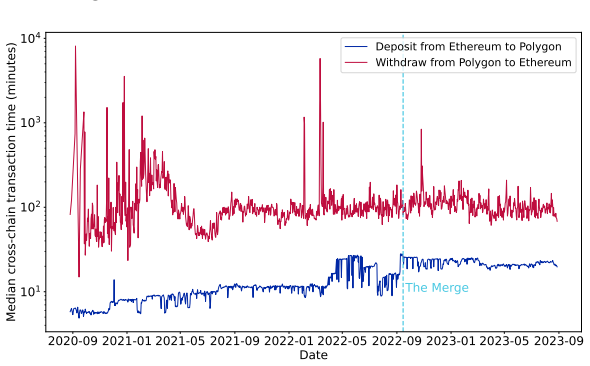
- Deposit completion times roughly doubled after the Ethereum Merge and stabilized near 20 minutes, linking consensus finality changes to bridge latency.
- Withdrawals are slower and more variable than deposits because they require a separate user-initiated claim step, and extreme delays—up to six months—leave funds unclaimed and expose users to governance and double-spend risks.
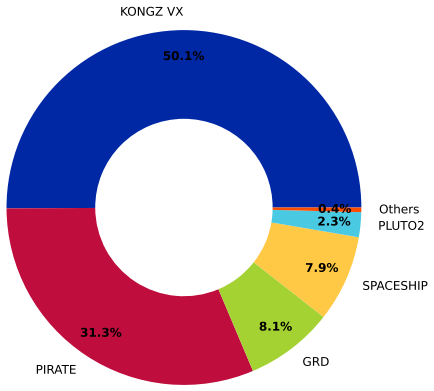
- NFT traffic across the bridge is concentrated in a few collections, and the largest collection's secondary trading remains on Ethereum despite Polygon's lower fees.
Reading between the lines
- If the same matching rule is applied to other EVM pairs (for example Ethereum-Arbitrum or Ethereum-Optimism), the address-consistency property should recover comparable flow-level statistics, but the time tolerance would need to be re-estimated because bridge finality differs from Polygon's.
- The 6.4-day withdrawal tolerance means any two identical-value transfers of the same token from the same address within that window will collide; for stablecoins with repeated rounded amounts, this could systematically overcount ordinary transfers as genuine withdrawals—an editorial check, not a claim the paper makes.
- A stronger test of the method would use bridge-internal data, such as the official bridge explorer's deposit and withdrawal records or state-sync events, as ground truth and measure precision rather than only the exact-match rate.
- The released matched dataset could support downstream studies of cross-chain arbitrage and MEV, but any such estimates inherit the false-positive error in withdrawal matches, so direction-specific error bars would be needed.
Signed reviews
Editorial analysis
A structured set of objections, weighed in public.
Referee Report
Summary. This paper proposes a heuristic algorithm to match cross-chain transactions between Ethereum and Polygon, using the fact that user addresses are identical on EVM-compatible chains and combining transaction time, value, and token identification. The algorithm is applied to roughly two million bridge transactions from August 2020 to August 2023, and the paper reports deposit match rates of up to 99.65% and withdrawal match rates of up to 92.78% across Ether, ERC-20, and ERC-721 assets. Using the matched dataset, the paper analyzes cross-chain time costs, transaction counts and volumes, withdrawal-to-deposit ratios, a case study of the KONGZ VX NFT collection, and discusses security and governance implications of the Polygon PoS bridge.
Significance. The paper addresses a timely and practically important problem: cross-chain transactions are opaque, which hampers auditing, compliance, and behavioral analysis. The data collection effort is substantial, and the descriptive findings—one-way asset flow, stablecoin dominance, the effect of the Ethereum Merge on deposit times, and the NFT case study—are potentially valuable. The proposed matching heuristic, if properly validated, could be extended to other EVM bridge pairs and would be a useful tool for the community. However, the central claim of high matching accuracy is not currently supported: the reported match rates are uniqueness rates computed under an in-sample-fitted time tolerance, not correctness rates validated against ground truth. Because every downstream statistic in Section 5 is computed on the matched set, this validation gap is load-bearing.
major comments (5)
- [Section 3.2 and Table 5] The paper defines an 'exact match' as a transaction with exactly one candidate counterpart, and then states 'an exact match is a valid cross-chain transaction.' This equates uniqueness with correctness without any ground-truth validation. The match rates reported in Table 5 are therefore uniqueness rates, not accuracy rates. Moreover, the time tolerance is selected by maximizing this exact-match rate on a 10,000-transaction sample drawn from the same dataset (Figure 3), so the full-data rates in Table 5 are in-sample and may substantially overstate true matching accuracy. To support the headline claims, the authors should validate against a ground-truth set (e.g., bridge explorer records, manual inspection of a random sample) and report precision, recall, and confidence intervals.
- [Section 3.2, Algorithm 1] The withdrawal time tolerance is fitted to about 9,166 minutes (roughly 6.4 days). For fungible ERC-20 tokens, particularly stablecoins such as USDC, USDT, and DAI, addresses frequently make repeated transfers of identical amounts. Within a 6.4-day window, a unique candidate can easily be the wrong counterpart. Consequently, the reported withdrawal match rate for ERC-20 (67.55%) and all withdrawal-related statistics in Section 5.2 rest on a matched set whose false-positive rate is unknown and potentially material. The authors should quantify this risk, for example by testing on known bridge transactions or by incorporating additional transaction attributes (e.g., transaction hashes or internal call structure) to reduce ambiguity.
- [Section 4 and Section 5.1.1] The Polygon-side data are collected via the Polygonscan API, which has query limits that can omit transactions for high-volume addresses, as the paper acknowledges. In addition, the withdrawal sample is restricted to addresses with previous deposits, and withdrawals are identified by a single method ID (0x3805550f). These choices affect both recall and precision of the matched set. Unmatched records may reflect data-collection incompleteness rather than algorithm failure, and the matched set may be biased toward less active addresses. The authors should report the number of affected addresses, provide robustness checks against an alternative data source (e.g., a full Polygon node), and discuss how the known incompleteness affects the match-rate estimates and downstream analyses.
- [Section 5.2.1 and Figures 5–7] Because the deposit time tolerance is set to approximately 24.2 minutes, the deposit time-cost distribution is censored at that threshold. The reported median time costs and the claim that the Ethereum Merge prolonged deposit times could be artifacts of this censoring. The authors should either use a larger, validated tolerance (and report how the additional matches are verified) or explicitly analyze the sensitivity of the Merge conclusion to the tolerance choice.
- [Algorithm 1 and Table 3] There is an inconsistency between the pseudocode and the stated matching criteria. Table 3 defines the time criterion as |E.timestamp - P.timestamp| ≤ time tolerance, but Algorithm 1 (lines 5 and 10) drops rows only when p.timestamp - e.timestamp ≥ time tolerance. This one-sided check would keep a Polygon transaction that occurs long before the Ethereum transaction, contrary to the stated rule. The authors should correct the pseudocode or the table and confirm that the implementation matches the reported results.
minor comments (6)
- [Section 3.2] The heading 'Address consistency in EVM-based blockhains' contains a typo: 'blockhains' should be 'blockchains.'
- [Section 3.2 and Figure 3] The y-axis ranges in Figure 3 (deposit match rate peaking around 0.80) appear inconsistent with the full-data match rates in Table 5 (e.g., 94.97% for Ether deposits). The authors should clarify whether Figure 3 uses a different definition or a restricted sample, and reconcile the numbers.
- [Section 4, Table 4] The text states 'we filtered out transactions from addresses that have received tokens before,' but the intent appears to be the opposite: the withdrawal sample keeps only addresses that had received tokens before (i.e., depositors). Please rephrase to avoid confusion.
- [Section 4] The number of ERC-721 deposits is given as 34,135 in the text but 34,315 in Table 4. One of these is a typo; please correct.
- [Section 5.2.2] The text refers to 'withdrawal rates' but the right-hand axis in Figures 8–10 shows values up to 3.0, which suggests these are withdrawal-to-deposit ratios rather than percentages. Please use consistent terminology and label the axis accordingly.
- [References] Reference [29] is listed as 'Untitled' and is incomplete, and references [27] and [28] use masked hashes that are not reproducible. Please provide complete and accessible references.
Circularity Check
Reported matching rates are in-sample, self-defined counts: the time tolerance is tuned to maximize the exact-match rate, and the same uniqueness-based definition is then used as the evaluation metric without ground-truth validation.
-
fitted input called prediction
[Section 3.2 (time-tolerance fitting, Figure 3) and Section 5.1 (match-rate evaluation, Table 5)]
"To determine the optimal value, we randomly sample 10,000 cross-chain transactions to test the match rate of our algorithm. We run the algorithm with different values of time tolerance and record the percentage of an exact match. An exact match is defined as a match where a transaction from Ethereum is matched to only one transaction on Polygon. ... Therefore, an exact match is a valid cross-chain transaction. ... the match rates shown in Figure 3 represent performance on the sampled dataset only and do not capture the match rates of the full transactions."
The time tolerance is selected by maximizing the exact-match rate on a 10,000-transaction sample from the same dataset, and the same exact-match rate, defined by the algorithm's uniqueness criterion, is then reported as the evaluation metric on the full data in Table 5. Because there is no held-out validation and no ground-truth labels, the reported match rate measures the fitting objective itself: increasing the time window will, by construction, increase unique matches until duplicate candidates appear. The assertion that 'an exact match is a valid cross-chain transaction' converts this self-defined uniqueness into accuracy, so the headline matching rates are not an independent test of correctness.
full rationale
The paper's matching procedure is built on real on-chain fields (same EVM address, token identity, value, and timestamps) and produces an actual matched dataset, so the central reconstruction is not a derivation that reduces to its inputs. However, the headline performance claim is partially circular: the time-tolerance parameter is fitted on a 10,000-transaction sample by maximizing the exact-match rate, and the same exact-match definition is then used as the evaluation metric on the full dataset, with the statement 'an exact match is a valid cross-chain transaction' equating uniqueness with correctness. No held-out set or ground truth is used, so the match rates partly reflect the fitting objective rather than an independent measure of accuracy. No load-bearing self-citation, imported uniqueness theorem, or renamed known result appears; self-citations such as Huang et al. on Stargate are background only. Score 4 reflects partial circularity in the evaluation metric, not in the construction of the matched data itself.
Assumptions & free parameters
free parameters (2)
- time tolerance (deposits) =
24.2 minutes
- time tolerance (withdrawals) =
9,166.7 minutes
assumptions (6)
- domain assumption Users control the same address on Ethereum and Polygon for EVM-compatible chains.
- domain assumption The Polygon PoS Bridge operations are fully captured by the listed events, including LockedEther, LockedERC20, LockedERC721, ExitedEther, ExitedERC721, and ERC20 Transfer.
- ad hoc to paper A transaction matching the same address, token, value, and time window is the corresponding cross-chain counterpart.
- ad hoc to paper An exact match, meaning exactly one counterpart, is a valid cross-chain transaction.
- domain assumption Polygonscan API returns sufficiently complete transaction histories for the sampled addresses.
- domain assumption Method ID 0x3805550f in the input field indicates a withdrawal from Polygon.
Cite this review
Pith. "Pith review of Tracing Cross-chain Transactions between EVM-based Blockchains: An Analysis of Ethereum-Polygon Bridges." pith.science (2026). https://pith.science/paper/WB5OHPV5
@misc{pith2026250415449,
  author       = {Pith},
  title        = {Pith review of: Tracing Cross-chain Transactions between EVM-based Blockchains: An Analysis of Ethereum-Polygon Bridges},
  year         = {2026},
  howpublished = {\url{https://pith.science/paper/WB5OHPV5}},
  note         = {Machine review of arXiv:2504.15449}
}
read the original abstract
Ethereum's scalability has been a major concern due to its limited transaction throughput and high fees. To address these limitations, Polygon has emerged as a sidechain solution that facilitates asset transfers between Ethereum and Polygon, thereby improving scalability and reducing costs. However, current cross-chain transactions, particularly those between Ethereum and Polygon, lack transparency and traceability. This paper proposes a method to track cross-chain transactions across EVM-compatible blockchains. It leverages the unique feature that user addresses are consistent across EVM-compatible blockchains. We develop a matching heuristic algorithm that links transactions between the source and target chains by combining transaction time, value, and token identification. Applying our methodology to over 2 million cross-chain transactions (August 2020-August 2023) between Ethereum and Polygon, we achieve matching rates of up to 99.65% for deposits and 92.78% for withdrawals, across different asset types including Ether, ERC-20 tokens, and NFTs. In addition, we provide a comprehensive analysis of various properties and characteristics of cross-chain transactions. Our methodology and findings contribute to a better understanding of cross-chain transaction dynamics and bridge performance, with implications for improving bridge efficiency and security in cross-chain operations.
Figures


Figures from the paper (13 more)






Reference graph
Works this paper leans on
-
[1]
Bez, M., Fornari, G. & Vardanega, T. The scalability challenge of ethereum: An initial quantitative analysis. In 2019 IEEE International Conference on Service-Oriented System Engineering (SOSE) , 167–176 (IEEE, 2019)
work page 2019
-
[2]
Dennis, R. & Disso, J. P. An analysis into the scalability of bitcoin and ethereum. In Third International Congress on Information and Communication Technology: ICICT 2018, London , 619–627 (Springer, 2019)
work page 2018
- [3]
-
[4]
Performance and scalability of blockchain networks and smart contracts (2017)
Scherer, M. Performance and scalability of blockchain networks and smart contracts (2017)
work page 2017
-
[5]
de Azevedo Sousa, J. E. et al. An analysis of the fees and pending time correlation in ethereum. Int. J. Netw. Manag. 31, e2113 (2021)
work page 2021
-
[6]
Donmez, A. & Karaivanov, A. Transaction fee economics in the ethereum blockchain. Econ. Inq. 60, 265–292 (2022)
work page 2022
-
[7]
The cost of delay: Evidence from the ethereum transaction fee market
Zhao, Y . The cost of delay: Evidence from the ethereum transaction fee market. Available at SSRN (2023)
work page 2023
-
[8]
What does tps stand for in blockchain performance? (2023)
Chainspect. What does tps stand for in blockchain performance? (2023). [Online; accessed 2024-12-01]
work page 2023
Show all 40 references
-
[9]
& Vergani, A
Sguanci, C., Spatafora, R. & Vergani, A. M. Layer 2 blockchain scaling: A survey. arXiv preprint arXiv:2107.10881 (2021)
2021 arXiv
-
[10]
Hafid, A., Hafid, A. S. & Samih, M. Scaling blockchains: A comprehensive survey. IEEE access 8, 125244–125262 (2020)
2020
-
[11]
& Arjun, A
Kanani, J., Nailwal, S. & Arjun, A. Matic whitepaper. Polygon, Bengaluru, India, Tech. Rep., Sep (2021)
2021
-
[12]
Singh, A. et al. Sidechain technologies in blockchain networks: An examination and state-of-the-art review. J. Netw. Comput. Appl. 149, 102471 (2020)
2020
-
[13]
Kemal, M. U. Anti-money laundering regulations and its effectiveness. J. Money Laund. Control. 17, 416–427 (2014)
2014
-
[14]
A next-generation smart contract and decentralized application platform
Buterin, V .et al. A next-generation smart contract and decentralized application platform. white paper 3, 2–1 (2014)
2014
-
[15]
Defining the ethereum virtual machine for interactive theorem provers
Hirai, Y . Defining the ethereum virtual machine for interactive theorem provers. In Financial Cryptography and Data Security: FC 2017 International Workshops, WAHC, BITCOIN, VOTING, WTSC, and TA, Sliema, Malta, April 7, 2017, Revised Selected Papers 21, 520–535 (Springer, 2017)
2017
-
[16]
Polygon: An overview of the leading layer 2 scaling solution on ethereum — by hari pandey — medium — coinmonks
Pandey, H. Polygon: An overview of the leading layer 2 scaling solution on ethereum — by hari pandey — medium — coinmonks. https://medium.com/coinmonks/ polygon-an-overview-of-the-leading-layer-2-scaling-solution-on-ethereum-9b81d3c088 (2023). (Accessed on 02/14/2024)
2023
-
[17]
Ou, W. et al. An overview on cross-chain: Mechanism, platforms, challenges and advances. Comput. Networks 218, 109378 (2022)
2022
-
[18]
& Lesani, M
Shadab, N., Houshmand, F. & Lesani, M. Cross-chain transactions. In 2020 IEEE International Conference on Blockchain and Cryptocurrency (ICBC), 1–9 (IEEE, 2020)
2020
-
[19]
O., Kreutz, D., Xu, X
Chervinski, J. O., Kreutz, D., Xu, X. & Yu, J. Analyzing the performance of the inter-blockchain communication protocol. In 2023 53rd Annual IEEE/IFIP International Conference on Dependable Systems and Networks (DSN) , 151–164 (IEEE, 2023)
2023
-
[20]
Cao, L., Zhao, S., Gao, Z. & Du, X. Cross-chain data traceability mechanism for cross-domain access. The J. Supercomput. 79, 4944–4961 (2023)
2023
-
[21]
Mandal, M., Chishti, M. S. & Banerjee, A. Investigating layer-2 scalability solutions for blockchain applications. In 2023 IEEE International Conference on High Performance Computing & Communications, Data Science & Systems, Smart City & Dependability in Sensor , Cloud & Big D...
2023
-
[22]
& Banister, C
Zarick, R., Pellegrino, B. & Banister, C. Layerzero: Trustless omnichain interoperability protocol. arXiv preprint arXiv:2110.13871 (2021)
2021 arXiv
-
[23]
The bridging trilemma
Zarick, R. The bridging trilemma. we introduce a fully composable native. . . — by ryan zarick — stargate official — medium (2021). [Online; accessed 2024-10-31]. 16/17
2021
-
[24]
& Tessone, C
Huang, C., Yan, T. & Tessone, C. J. Seamlessly transferring assets through layer-0 bridges: An empirical analysis of stargate bridge’s architecture and dynamics. In Companion Proceedings of the ACM on Web Conference 2024 , 1776–1784 (2024)
2024
-
[25]
[Online; accessed 2024-01-30]
Same address for all evm chains. [Online; accessed 2024-01-30]
2024
-
[26]
& Sirer, E
Rocket, T., Yin, M., Sekniqi, K., van Renesse, R. & Sirer, E. G. Scalable and probabilistic leaderless bft consensus through metastability. arXiv preprint arXiv:1906.08936 (2019)
2019 arXiv
-
[27]
Polygon transaction hash: 0x1b217e516b
PolygonScan.com. Polygon transaction hash: 0x1b217e516b... — polygonscan. [Online; accessed 2025-03-22]
2025
-
[28]
Ethereum transaction hash: 0x5683ce6412
etherscan.io. Ethereum transaction hash: 0x5683ce6412... — etherscan. [Online; accessed 2025-03-22]
2025
-
[29]
[Online; accessed 2025-03-25]
Untitled. [Online; accessed 2025-03-25]
2025
-
[30]
[Online; accessed 2025-03-03]
Learn how to bridge assets from ethereum to polygon fast (2024). [Online; accessed 2025-03-03]
2024
-
[31]
How to withdraw and how long does it take for the withdrawal process of my assets in polygon plasma bridge? : Polygon support
Gupta, S. How to withdraw and how long does it take for the withdrawal process of my assets in polygon plasma bridge? : Polygon support. [Online; accessed 2025-01-01]
2025
-
[32]
Lost in translation: Polygon bridge’s unclaimed millions — zengo (2022)
Be’ery, T. Lost in translation: Polygon bridge’s unclaimed millions — zengo (2022). [Online; accessed 2025-03-15]
2022
-
[33]
Zhang, J. et al. Xscope: Hunting for cross-chain bridge attacks. In Proceedings of the 37th IEEE/ACM International Conference on Automated Software Engineering, 1–4 (2022)
2022
-
[34]
& Lin, Z
Zhang, M., Zhang, X., Zhang, Y . & Lin, Z. Security of cross-chain bridges: Attack surfaces, defenses, and open problems. In Proceedings of the 27th International Symposium on Research in Attacks, Intrusions and Defenses , 298–316 (2024)
2024
-
[35]
[Online; accessed 2025-03-03]
The merge is here: Everything the polygon ecosystem needs to know. [Online; accessed 2025-03-03]
2025
-
[36]
& Tessone, C
Yan, T., Shang, Q., Zhang, Y . & Tessone, C. J. Optimizing arbitrage strategies on uniswap: The impact of trading path length on profitability and opportunity frequency. In Proceedings of Blockchain Kaigi 2023 (BCK23) , 011007 (2024)
2024
-
[37]
& Tessone, C
Zhang, Y ., Yan, T., Lin, J., Kraner, B. & Tessone, C. J. An improved algorithm to identify more arbitrage opportunities on decentralized exchanges. In 2024 IEEE International Conference on Blockchain and Cryptocurrency (ICBC) , 1–7 (IEEE, 2024)
2024
-
[38]
Sok: Cross-domain mev
McMenamin, C. Sok: Cross-domain mev. arXiv preprint arXiv:2308.04159 (2023)
2023 arXiv
-
[39]
& Livshits, B
Gogol, K., Messias, J., Miori, D., Tessone, C. & Livshits, B. Cross-rollup mev: Non-atomic arbitrage across l2 blockchains. arXiv preprint arXiv:2406.02172 (2024)
2024 arXiv
-
[40]
& Livshits, B
Gogol, K., Messias, J., Miori, D., Tessone, C. & Livshits, B. Layer-2 arbitrage: An empirical analysis of swap dynamics and price disparities on rollups. arXiv e-prints arXiv–2406 (2024). 17/17
2024
Reviewed August 16, 2026 · model on record in the stance chip above.
Discussion (0). Continue with ORCID to comment.