REVIEW 4 major objections 6 minor 17 references
A primer on Kitaev Model: Basic aspects, material realization, and recent experiments
T0 review · 4 major / 6 minor · reviewed 2026-08-16 · deepseek-v4-flash
Pith's one-line read The Kitaev honeycomb model is exactly solvable through Majorana fermionization, and recent experiments on α-RuCl3 and related materials indicate a temperature range where Kitaev spin-liquid physics is dominantly present.
desk verdict A useful pedagogical review of Kitaev model basics whose experimental conclusion overstates what its own cited evidence supports; fix technical errors and soften Section VI. read the letter →
The pith
A machine-rendered reading of the paper's core claim, the machinery that carries it, and where it could break.
The reading
What carries the argument
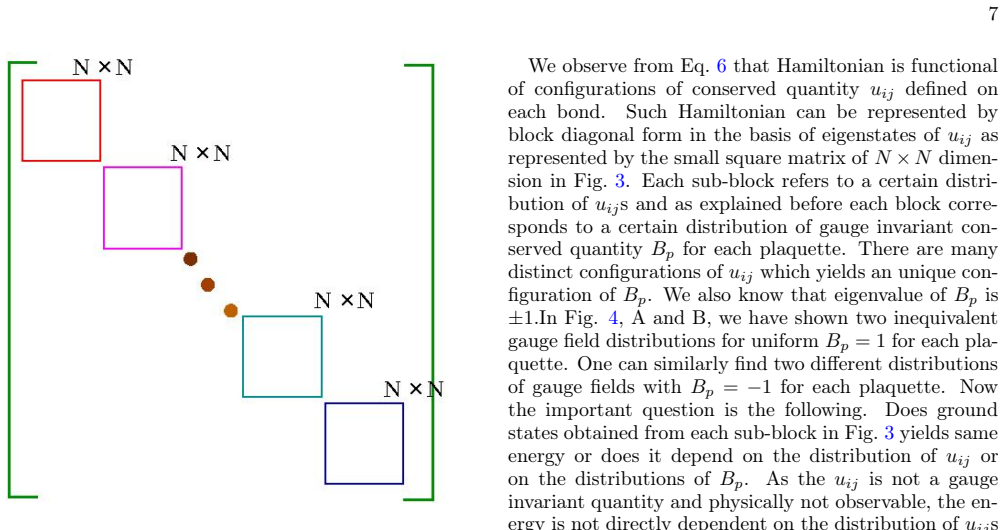
The load-bearing object is the Majorana fermion representation $\sigma^\alpha_i = i c^\alpha_i c_i$ with four Majorana operators per site, together with the bond operators $u^\alpha_{ij}=i c^\alpha_i c^\alpha_j$ that commute with the Hamiltonian and become conserved $\mathbb{Z}_2$ gauge fields; the plaquette fluxes $B_p$ are products of six such bond operators. This machinery makes the Hamiltonian quadratic in the remaining Majorana fermions for each fixed gauge configuration, so all eigenvalues follow from diagonalizing a single-particle hopping matrix; regrouping the bond Majoranas into complex fermions $\chi_{\langle ij\rangle_\alpha}$ then gives exact correlation functions, and Wilson-loop operators $W_1,W_2$ on the torus expose the topological degeneracy.
What would settle it
A decisive check: in a clean single crystal of α-RuCl3, measure whether the low-temperature specific heat contains the linear-in-T term expected from itinerant Majorana fermions and whether the half-quantized thermal Hall plateau follows the Majorana band structure as field angle and temperature vary. Absence of the linear term, as one 2019 study in the review reports, would contradict the Majorana explanation of the thermodynamic signal.
Extended reading notes
Core claim
On the paper's own terms, the central discovery is that Kitaev's honeycomb spin-1/2 model can be solved completely by rewriting each spin as four Majorana fermions, which turns the interacting spin Hamiltonian into a free Majorana hopping problem coupled to conserved Z2 gauge fields; the ground state sits in the uniform flux sector selected by Lieb's theorem. From this solution the review derives, in closed form, the exact two-spin correlation function (nonzero only on nearest-neighbor bonds of the matching type, e.g. −0.52 at the isotropic point), the vanishing of magnetization at every site, the fractionalization of a spin into a dynamic Majorana fermion plus two static fluxes, and the fourfold topological degeneracy on a torus. It then argues that the same physics is approximately realized in real materials, with α-RuCl3 as the leading candidate, and that recent thermodynamic and transport experiments indicate a temperature interval where Kitaev spin-liquid physics dominates.
Load-bearing premise
The review's material-realization conclusion rests on reading the half-quantized thermal Hall plateau in α-RuCl3 as a Majorana-fermion signal and the specific-heat bumps as flux and Majorana excitations; if those signals come from magnetic-wave or lattice-vibration excitations instead, the claim of a temperature window dominated by Kitaev spin-liquid physics collapses.
Editorial extensions
If this is right
- For the pure model, any attempt to measure magnetic order fails: magnetization vanishes at every site and the equal-time spin correlation is nonzero only on nearest-neighbor bonds whose type matches the spin component, falling to zero beyond.
- On a torus the ground state is fourfold degenerate, with the four states distinguished by the conserved loop operators $W_1$ and $W_2$; this topological degeneracy is a direct signature of the underlying long-range entanglement.
- The gapless phase acquires a gap when a magnetic field is applied; the gapped phase hosts Abelian anyons and the field-induced gapped phase hosts non-Abelian anyons, the excitations needed for Kitaev's quantum-computation proposal.
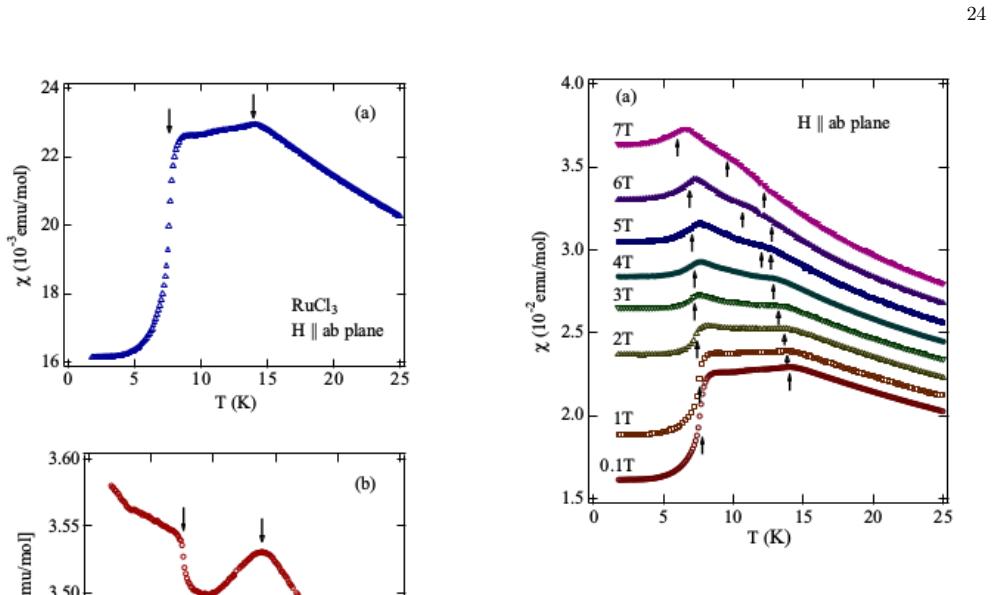
- For candidate materials, the review predicts that the specific heat shows two peaks associated with localized flux and itinerant Majorana excitations and that the thermal Hall conductivity can be half-quantized; experiments on α-RuCl3 are cited as observing both in an intermediate temperature range.
- If this is right, α-RuCl3 and related compounds are working platforms for probing fractionalized excitations rather than mere theoretical curiosities.
Reading between the lines
- Our inference: the same bond-fermion machinery should extend to Kitaev models on other tricoordinated lattices and to disordered versions, where flux sectors are no longer uniform; the exact correlation-function approach gives a benchmark for numerical methods in those settings.
- Our inference: the conflict the review itself reports—a 2019 specific-heat study lacking the linear-in-$T$ term while a thermal Hall experiment shows half-quantization—suggests the most informative next experiment would measure both quantities on the same single crystal across the purported Kitaev window.
- Our inference: if future experiments verify the Majorana origin of the half-quantized thermal Hall plateau, the temperature window in α-RuCl3 becomes a practical laboratory for manipulating non-Abelian anyons, not just evidence for a spin liquid.
Signed reviews
Editorial analysis
A structured set of objections, weighed in public.
Referee Report
Summary. This manuscript is a pedagogical review of the Kitaev honeycomb model and its material candidates. It covers the exact solution via Majorana fermionization, the extended Hilbert space and projection to physical states, flux sectors and Lieb's theorem, two-spin and multi-spin correlations, topological degeneracy on the torus, the Kitaev-Heisenberg-Gamma material Hamiltonian and its microscopic origin, and a survey of experiments on alpha-RuCl3 and related compounds, focusing on susceptibility, magnetization, specific heat, thermal Hall effect, and neutron scattering. The review concludes that there is a temperature range in which Kitaev spin liquid physics is dominantly present in candidate materials.
Significance. If its presentation were reliable, the review would be a useful entry point for graduate students: it collects the Majorana solution, the flux-sector counting, the short-range correlation result, and the topological degeneracy argument in one place, and it connects these theoretical features to a broad set of recent experiments. The experimental sections usefully gather results from multiple groups and clearly identify the role of non-Kitaev couplings. However, the manuscript's central concluding claim is not supported by the experimental evidence it itself cites, and several equations in the exact-solution and correlation-function sections are technically inaccurate or internally inconsistent. The pedagogical value is real, but the manuscript in its current form cannot be recommended without substantial revision.
major comments (4)
- [Section VI and Sections V.B-V.C] The concluding claim that "All of these experiments seem to confirm that there is a range of temperature where Kitaev spin liquid physics is dominantly present" is not supported by the review's own survey. In Section V.B the text states that Ref. 217 "critically questioned" the half-quantized thermal Hall effect because no accompanying phase transition was observed, and in Section V.C it reports that Ref. 124 finds "absence of linear T dependence," favors "a magnon like behavior," attributes the field-induced state to "field induced PM AFM phase and no Kitaev-type quantum spin liquid phase," and "does not convey a strong results in support of localized Majorana excitations." These statements directly contradict the categorical conclusion in Section VI. The conclusion must be rewritten to present the evidence as mixed and the existence of a dominant Kitaev regime as an open, actively debated question, consistent with the qualification already stated in Section I.
- [Section II.C, Eq. (6)] The representation H = Φ† H([u]) Φ is not a well-defined quadratic form for Majorana operators. Because each Majorana satisfies c_i† = c_i, the row vector Φ† is the same as the transpose of the column vector Φ, and the expression Φ† H Φ equals Σ_{ij} H_ij c_i c_j up to ordering; only the antisymmetric part of H contributes, and the standard Majorana hopping Hamiltonian additionally requires an explicit factor i and a factor 1/2, i.e. H = (i/4) Σ_{ij} A_ij c_i c_j with real antisymmetric A. As written, Eq. (6) lacks these ingredients, and the subsequent counting of N single-particle eigenvalues leading to 2^{N/2} many-body states is not justified. The section should be rewritten using the standard antisymmetric-matrix form and should explain explicitly how pairs of Majorana modes are combined into complex fermions before occupation-number states are used.
- [Section III.C, Eq. after Eq. (45)] The displayed expression for the equal-time correlation function, S^{αα}_{⟨ij⟩α}(0) = (√3/16π²) ∫ cos θ(k1,k2) dk1 dk2 with cos θ = ε_k/E_k, E_k = √(ε_k² + Δ_k²), is garbled and cannot be checked as printed. The definitions of ε_k and Δ_k appear to use a different momentum convention than the f_k defined in Eq. (17), the integration measure and prefactor are not derived, and the quoted isotropic value -0.52 is stated without a verifiable derivation. Since the exact short-range correlation function is one of the advertised results of the review, this formula must be corrected, properly referenced, or replaced by a clearly stated known result.
- [Section IV and Fig. 34 caption] The sign conventions for the Kitaev-Heisenberg model are inconsistent. Equation (56) is written with -K S^γ_i S^γ_j and positive J and Γ, and the text says the Kitaev interaction is ferromagnetic while the other interactions are antiferromagnetic. Equation (57) then writes K S^γ_i S^γ_j + J S_i·S_j without the minus sign. In the discussion of the neutron scattering fits, the text says K and J are taken as 7.0 meV and -4.6 meV, but the Fig. 34 caption reports (K,J)=(-4.6 meV, 7.0 meV). These sign conventions are essential to the physical comparison with alpha-RuCl3 and must be made consistent and explicit.
minor comments (6)
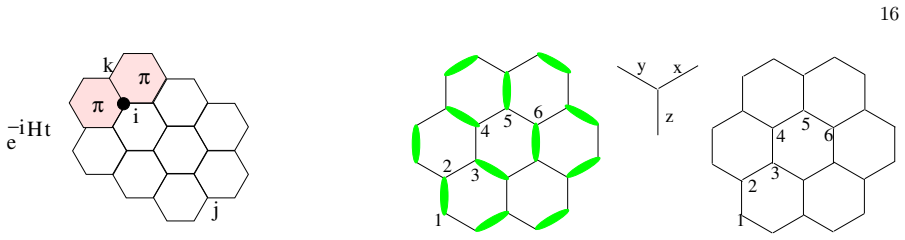
- [Section II.A, Eq. (2)] The plaquette operator B_p is printed as σ^y_1 σ^z_2 σ^x_x σ^y_4 σ^z_5 σ^x_6; the third factor appears to be a typo for σ^x_3.
- [Section II.B] The anticommutation relation is written as [c_α,c_β] = 2 δ_{α,β} using square brackets; for anticommutators the curly-brace notation {c_α,c_β} should be used, especially in a pedagogical primer.
- [Section III.A, Eqs. (24)-(26)] The bond fermion is defined as χ_{⟨ij⟩α} = (1/2)(c^α_i + i c^α_j) in Eqs. (24)-(25), but Eq. (26) writes χ_{⟨23⟩z} = (c^z_2 + i c^z_3) without the factor 1/2; the two definitions are inconsistent.
- [Section II.D, Eqs. (16)-(20)] The momentum-space Hamiltonian and the unitary transformation are written with a confusing mix of c_k and c†_k notation for Majorana operators; given c_k = c†_{-k}, the half-Brillouin-zone treatment should be stated more carefully so that the Bogoliubov transformation to η_k and ξ_k is unambiguous.
- [Sections I and V] The manuscript contains numerous typographical and grammatical errors, including "noncummutivity," "Suscpetibility," "Crystral structure," "folowing," and several run-on sentences; the text would benefit from a careful proofreading pass.
- [Section II.C] The sentence "This on site interaction involves the Majorana fermions at a given site only" and the surrounding discussion of the four-Majorana interaction contain unclear wording and should be rewritten for readability.
Circularity Check
No significant circularity: the exact-solution and correlation-function derivations are self-contained, and the experimental synthesis rests on external measurements rather than on the paper's own claims.
full rationale
The paper is a review whose theoretical core re-derives the Kitaev exact solution from the Hamiltonian (Eq. 1) through Majorana fermionization, the conserved Z2 gauge fields u_{ij}, the plaquette operators B_p, the Lieb-theorem ground-state sector, the Fourier diagonalization, and the resulting short-range, bond-dependent two-spin correlations. These steps are shown with explicit equations (Eqs. 2-23, 40-45) and do not require the conclusions as inputs. The fractionalization and deconfinement discussion follows from the action of a spin operator on an eigenstate (Eq. 35) and the orthogonality of different flux sectors (Eq. 36), again derived within the review. The topological degeneracy argument constructs the Wilson-loop operators W1, W2 and states (Eqs. 50-54), with the equality of energies in the thermodynamic limit citing the author's prior work (Ref. 111); this self-citation is for a known published result and is not used to force any new conclusion. Similarly, the time-dependent correlation function is delegated to Ref. 110 (a prior paper by the author and collaborators), but the equal-time result is derived in the text, so the citation is supplementary rather than load-bearing. The experimental section reviews external data on magnetization, susceptibility, specific heat, thermal Hall effect, and neutron scattering from Refs. 119-124, 239; the claim in Section VI that 'there is a range of temperature where Kitaev spin liquid physics is dominantly present' is an interpretive summary of those external experiments, not a quantity derived from the model equations. The review itself reports dissenting evidence, e.g., Ref. 124's 'absence of linear T dependence' and Ref. 217's critical questioning of half-quantization; this creates internal tension in the interpretive claim but is a scientific disagreement about external evidence, not circular reasoning. No fitted parameter is renamed as a prediction, no ansatz is smuggled in via self-citation, and no equation reduces to its own input by construction. Therefore the appropriate circularity score is 0.
Assumptions & free parameters
free parameters (3)
- K (Kitaev exchange) in alpha-RuCl3 =
7.0 meV
- J (Heisenberg exchange) in alpha-RuCl3 =
-4.6 meV
- Phonon background rescaling factor for RhCl3 =
0.92
assumptions (3)
- standard math Lieb's theorem guarantees the uniform vortex-free sector B_p = 1 is the ground state flux configuration.
- domain assumption The projection operator P = product (1+D_i)/2 maps the extended Majorana Hilbert space to the physical spin Hilbert space.
- domain assumption Materials like alpha-RuCl3 realize the Jackeli-Khaliullin mechanism, with dominant bond-dependent Kitaev interactions and small Heisenberg/Gamma perturbations.
Cite this review
Pith. "Pith review of A primer on Kitaev Model: Basic aspects, material realization, and recent experiments." pith.science (2026). https://pith.science/paper/6X6SXWOI
@misc{pith2026250415788,
  author       = {Pith},
  title        = {Pith review of: A primer on Kitaev Model: Basic aspects, material realization, and recent experiments},
  year         = {2026},
  howpublished = {\url{https://pith.science/paper/6X6SXWOI}},
  note         = {Machine review of arXiv:2504.15788}
}
read the original abstract
This elementary review article is aimed to the beginning graduate students interested to know basic aspects of Kitaev model. We begin with a very lucid introduction of Kitaev model and present its exact solution, Hilbert space structure, fractionalisation, spin-spin correlation function and topological degeneracy in an elementary way. We then discuss the recent proposal of realizing Kitaev interaction in certain materials. Finally we present some recent experiments done on these materials, mainly magnetization, susceptibility, specific heat and thermal Hall effect to elucidate the recent status of material realization of coveted Kitaev spin-liquid phase. We end with a brief discussion on other theoretical works on Kitaev model from different many-body aspects.
Figures


Figures from the paper (29 more)






Reference graph
Works this paper leans on
-
[2]
Permission from the authors to reuse the figure from Phys
The arrows denote magnetic anomalies and it is present for both the cases i.e for magnetic field par- allel and perpendicular to ‘ab’ plane. Permission from the authors to reuse the figure from Phys. Rev. B 91, 094422 (2015)120 is gratefully acknowledged.. such aspect. In Fig. 26 we present the results obtained in the study
work page 2015
-
[7]
Here transverse thermal Hall conductivity is plot- ted against H⊥ for θ = 60◦ in (a,b,c) and forθ = 45◦ in (e,f,g) at different temperatures as mentioned at the upper left corner of the panel. It is interesting to ob- serve that for a large interval of magnetic field the half- quantization is observed. Secondly the departure of half- quantization and the ...
work page 2017
-
[23]
The magnetic field is kept at 0.1 T
In the upper panel magnetic susceptibilities χ = M/H of α− RuCl3 has been shown against tempera- ture for magnetic field parallel and perpendicular to the ‘ab’ plane as indicated. The magnetic field is kept at 0.1 T. In panel (b) inverse susceptibilities have been shown. It reveals minor discontinuity shown by arrow and it indicates struc- tural phase tra...
work page 2015
-
[25]
The arrows in- dicate specific heat anomalies at that temperature
Magnetic susceptibilities of α− RuCl3 have been plotted against temperature up to 25 K for a series of external magnetic fields applied parallel to ‘ab’ plane. The arrows in- dicate specific heat anomalies at that temperature. For a bet- ter visualization the susceptibility data are shifted upward by multiples of2× 10−3 emu/mol. Permission from the author...
work page 2015
-
[26]
In panel (a), temperature dependence of magnetization is shown for poly-crystalline sample of OsxCl3
(c) (2020) The Physical Society of Japan. In panel (a), temperature dependence of magnetization is shown for poly-crystalline sample of OsxCl3. Magnetic field of 1 Tesla is applied and temperature was brought down up to 2 Kelvin. The inset shows the inverse susceptibilities which fits well with Curie-Weiss formula(shown by black line) at high and moderate...
work page 2020
-
[27]
In (c) a phase diagram is shown inT−H∥ plane
In panel (a) and (b) the schematic experimental set up of thermal Hall effect is shown for ordinary electron and Kitaev system respectively. In (c) a phase diagram is shown inT−H∥ plane. For more detail see text.Permission from the authors to reuse the figure from Nature559, 227-231 (2018)122 is gratefully acknowledged. mal effect magnetically ordered pha...
work page 2018
-
[28]
The temperature for upper, lower and middle panels are taken as 3.7 K, 4.3 K and 4.9 K respectively
Transverse Hall conductivity is plotted againstµ0H⊥ for various temperature and angle of applied external magnetic field forθ = 60◦ in (a,b,c) and forθ = 45◦ in (e,f,g). The temperature for upper, lower and middle panels are taken as 3.7 K, 4.3 K and 4.9 K respectively. The dashed line indicates the rescaled value corresponding to 1/2 quantization.Permiss...
work page 2018
-
[29]
In panel (a), static magnetic susceptibility(χ) ofα−RuCl3 is plotted
In all the panel above the horizontal axis repre- sents temperature presented in semi-log scale. In panel (a), static magnetic susceptibility(χ) ofα−RuCl3 is plotted. The red line represents the normal Curie-Weiss dependence and a depurture from it belowT = 140 K is obvious as shown by blue circles. The kink atTN = 6.5K signifies onset of zig-zag- type AF...
work page 2017
Show all 17 references
-
[30]
The temperature is plotted on a semi- logarithmic plot
The blue open circles denote the temperature dependence of heat capacities C/T of α− RuCl3 while the green open circles denote the same forRhCl3, a nonmagnetic reference compound. The temperature is plotted on a semi- logarithmic plot. The solid red line denotes a fit accordin...
2019
-
[31]
As before the temperature scale is on a semi-logarithmic one
Excess heat capacity(after subtracting the back- ground phonon contribution)∆C is plotted for a series of in plane magnetic field. As before the temperature scale is on a semi-logarithmic one. Though the quantum criticality associ- ated with AFM transition vanishes for field s...
2019
-
[32]
31, more results on the spe- cific heat in the presence of in plane magnetic field is shown in (a) for a range of external magnetic fields
In continuation of Fig. 31, more results on the spe- cific heat in the presence of in plane magnetic field is shown in (a) for a range of external magnetic fields. In (b) scaled spe- cific heatC/T3 is shown where heat capacity ofRhCl3 is also indicated by magenta line. In the ...
2019
-
[33]
Neutrons with 25 meV are used
Here inelastic neutron scattering data depicting collective magnetic modes are presented. Neutrons with 25 meV are used. Panel (a) and (b) shows the false color plot of the data at 5K and 15 K respectively. A density plot of the intensity is plotted in E-Q plane where E stands...
2016
-
[34]
In panel (a) spin wave simulation for the Kitaev-Heisenberg model wth (K,J )= (-4.6 meV, 7.0meV) is plotted with zig-zag ground state being considered
Spin wave theory calculations. In panel (a) spin wave simulation for the Kitaev-Heisenberg model wth (K,J )= (-4.6 meV, 7.0meV) is plotted with zig-zag ground state being considered. Panel (b) shows the calculated powder-averaged scattering including the magnetic form factor. ...
2016
-
[240]
which are obtained by equating the experimental peak at E1 and E2 with the theoretically obtained peak values
Permission from the authors to reuse the figure from Nature Materials15, 733-740 (2016)239 is gratefully acknowledged. which are obtained by equating the experimental peak at E1 and E2 with the theoretically obtained peak values. From Fig. 34 b, we find that the calculated spi...
2016
-
[246]
Magnetic field causes various interest- ing effect in Kitaev related model such as i) oscillations in the thermal conductivity in the presence of perpen- dicular magnetic field214, ii) existence of an intermediate quantum spin liquid phase as observed theoretically us- ing DMR...
2021
-
[1977]
https://doi.org/10.1007/BFb0107758
pp. 55–84 url="https://doi.org/10.1007/BFb0107758" 10 Cannella V and Mydosh J A 1974AIP Conference Pro- ceedings18 651–655 11 Hasegawa R and Levy R A 1977Amorphous Magnetism II (Springer US). 12 Mydosh J A 2015 Reports on Progress in Physics 78 052501 13 Cao G and DeLong L 202...
2023 arXiv
-
[2010]
p. i–iv. 89 Lieb E, Schultz T and Mattis D 1961Annals of Physics 16 407–466 90 Majumdar C K and Ghosh D K 1969Journal of Mathe- matical Physics10 1388–1398 91 Majumdar C K and Ghosh D K 1969Journal of Mathe- matical Physics10 1399–1402 92 Jordan P and Wigner E 1928Zeitschrift ...
2021 arXiv
Reviewed August 16, 2026 · model on record in the stance chip above.
Discussion (0). Continue with ORCID to comment.