REVIEW 3 major objections 5 minor 1 cited by
Stochastic low-frequency variability of 50 massive stars in the Cygnus OB associations and the Small Magellanic Cloud
T0 review · 3 major / 5 minor · reviewed 2026-08-16 · deepseek-v4-flash
Pith's one-line read The paper finds that the stochastic low-frequency flicker of 103 O- and B-type stars is best explained by subsurface convection in the iron opacity zone, matching 3-D simulation predictions.
desk verdict Solid measurements, overstated mechanism claim: the new Cygnus OB sample and cadence-robust parameters are worth having, but the data do not uniquely identify sub-surface convection. read the letter →
The pith
A machine-rendered reading of the paper's core claim, the machinery that carries it, and where it could break.
The reading
What carries the argument
The argument is carried by two characterization tools and a comparison. The first is a Lorentzian-like fit to the power density spectrum, $M(\nu) = \eta(\nu)\,\alpha_0 / (1 + (\nu/\nu_{\rm char})^{\gamma}) + C_W$, which yields the zero-frequency amplitude $\alpha_0$, the characteristic frequency $\nu_{\rm char}$, and the slope $\gamma$. The second is model-independent: the RMS of the residual light curve plus the cumulative integrated power $P_{\rm int}(\nu)$, from which the paper derives $\nu_{20\%}$, $\nu_{50\%}$, $\nu_{80\%}$ and the width $w = (\nu_{80\%}-\nu_{20\%})/\nu_{50\%}$. To compare stars across samples, bolometric luminosities are converted to spectroscopic luminosities via $L_{\rm spec} = L\,(M/M_\odot)^{-1}$, which makes the stellar mass a load-bearing input. The decisive comparison is observed $\nu_{\rm char}$ against predictions from 3-D radiation-hydrodynamical simulations of subsurface convection in the iron opacity zone, along with predictions for internal gravity waves from convective cores.
What would settle it
Take a subset of the Cygnus OB stars and measure their masses independently from binary orbits or asteroseismology, then re-derive the correlations; if the spectroscopic-luminosity trends vanish, the central comparison fails. Alternatively, run a 3-D envelope simulation at SMC metallicity for a star near 35 $M_\odot$ and check whether its $\nu_{\rm char}$ falls on the observed relation, or test whether observed $\nu_{\rm char}$ tracks the thermal timescale of the iron-opacity convection zone across stars with and without such zones.
Extended reading notes
Core claim
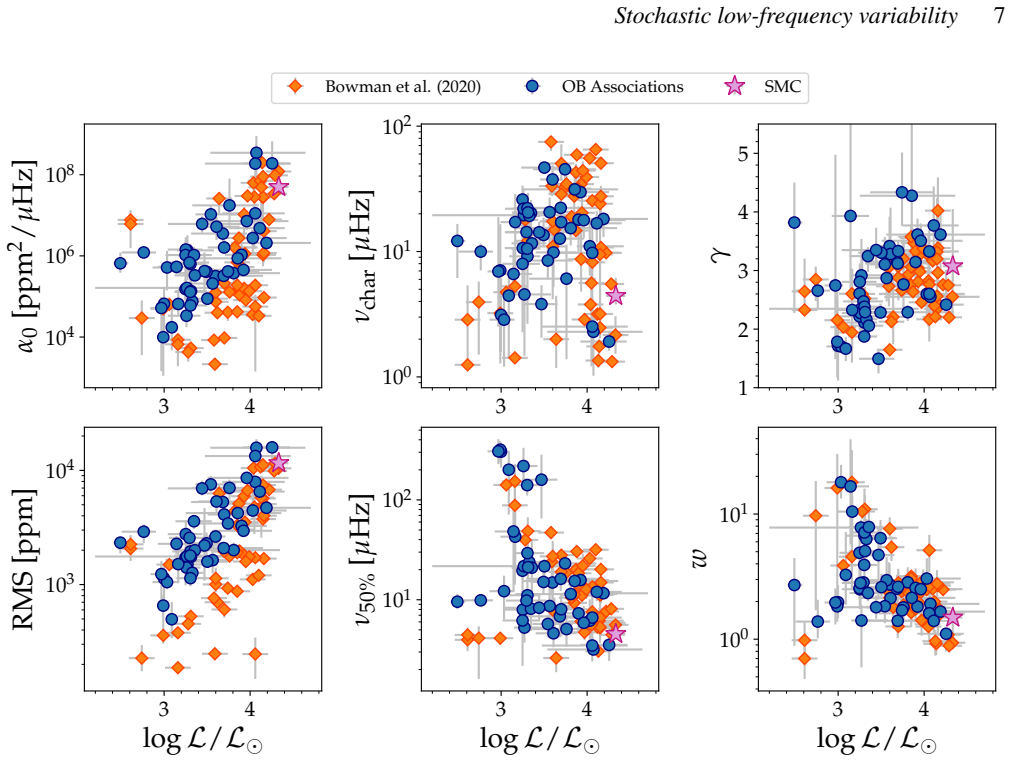
On the paper's own terms, the central discovery is that the stochastic low-frequency variability of massive main-sequence O- and B-type stars scales systematically with stellar luminosity and evolution, and that its characteristic frequency $\nu_{\rm char}$ matches the predictions of 3-D simulations of subsurface convection in the iron opacity zone. The paper reports significant correlations between spectroscopic luminosity and $\alpha_0$, $\gamma$, RMS, $\nu_{50\%}$, and $w$ across the full sample of 103 stars; $\alpha_0$ and RMS increase for more evolved stars while $\nu_{\rm char}$ and $\nu_{50\%}$ decrease. Against the alternative explanations of surface granulation, internal gravity waves excited by the convective core, and stellar winds, the $\nu_{\rm char}$ comparison favours subsurface convection, with only partial overlap for internal gravity waves and no support from the granulation scaling relations.
Load-bearing premise
The entire luminosity trend and the comparison to simulations assume that the stellar masses taken from published spectral analyses are accurate; if those masses are systematically biased, the spectroscopic luminosities shift and the reported correlations could weaken or disappear.
Editorial extensions
If this is right
- Stochastic low-frequency variability is nearly universal among massive O- and B-type stars above $\log L/L_\odot \geq 4$, with 49 of 54 such stars in the Cygnus OB sample showing the signal.
- Because $\alpha_0$ and RMS increase while $\nu_{\rm char}$ and $\nu_{50\%}$ decrease with evolution, SLF parameters can serve as coarse evolutionary-stage indicators for massive stars.
- The RMS, $\nu_{50\%}$, and $w$ parameters are much less affected by TESS observing cadence than $\alpha_0$ and $\nu_{\rm char}$, so future surveys with only 10-minute FFI data can still characterize SLF variability reliably.
- If the $\nu_{\rm char}$ agreement with subsurface-convection simulations holds, TESS flicker observations become a direct probe of convection in the iron opacity zone of massive stars.
Reading between the lines
- If subsurface convection is the driver, then $\nu_{\rm char}$ should track the thermal timescale of the iron-opacity convection zone; this can be tested directly by computing that timescale from 1-D stellar models for each star in the sample.
- Because about two-thirds of the stars show negative skewness but the skewness does not correlate with luminosity, photometric skewness alone is unlikely to isolate stellar winds; combining TESS light curves with UV spectroscopy could separate wind and convection contributions.
- A natural extension is to apply the same RMS/$\nu_{50\%}$/$w$ analysis to the larger LMC and SMC samples with known metallicities, where the predicted absence of iron-opacity convection below certain masses would make the subsurface-convection hypothesis falsifiable.
Signed reviews
Editorial analysis
A structured set of objections, weighed in public.
Referee Report
Summary. The paper analyzes stochastic low-frequency (SLF) variability in a new sample of 49 O- and B-type stars in six Cygnus OB associations plus the SMC star AV 232, reanalyzes 53 previously studied SLF variables from Bowman et al. (2020), and characterizes the variability by two methods: a Lorentzian-like fit to the power density spectrum (yielding alpha0, nu_char, gamma, C_W) and a model-independent approach (RMS, nu_50%, width w). The authors report Spearman correlations between these parameters and spectroscopic luminosity, place the stars in spectroscopic Hertzsprung-Russell diagrams, and compare the observed nu_char versus luminosity relation to simulations of sub-surface convection, internal gravity waves, and stellar winds. The central claim is that observed nu_char agrees with predictions from sub-surface convection, thereby identifying the physical origin of the SLF variability.
Significance. If the empirical characterization holds, this is a valuable homogeneous sample addition: it extends SLF variability studies to Cygnus OB associations, demonstrates that the new model-independent parameters (RMS, nu_50%, w) are less cadence-dependent than nu_char and gamma, and strengthens the evidence that SLF variability is common among massive stars and scales with spectroscopic luminosity. The paper is careful in several respects: it details the iterative prewhitening, uses nested-sampling Bayesian fits with a well-justified likelihood, explicitly tests cadence-dependent biases (Appendix C), reports Spearman coefficients with p-values, and makes residual light curves, tables, and figure-reconstruction data publicly available on Zenodo. The main weakness is that the physical-origin conclusion is supported only by a qualitative visual comparison to three simulation points, while the paper itself acknowledges that IGW predictions also fall within the observed parameter range.
major comments (3)
- [Abstract; Sect. 5.3; Fig. 9] The abstract's claim of 'good agreement between the observed nu_char of our sample and predictions from sub-surface convection' is not quantitatively established and is inconsistent with the paper's own discussion. The comparison in Fig. 9 rests on only three simulation points (T42L5.2, T35L5.0, M13TAMS) with no goodness-of-fit or statistical test. Section 5.3 states that the Anders et al. (2023) IGW predictions 'do fall in regions in Fig. 9 that are covered by the observations' and that the rescaled Edelmann et al. (2019) predictions 'approximately spans the observed range in nu_char', and Section 5.2 concedes that the sub-surface convection theory is weak at lower metallicities. The data are therefore degenerate between sub-surface convection and IGW mechanisms. The authors should either add a quantitative discriminator (e.g., a likelihood or residual-based comparison for each mechanism) or soften the abstract and conclusions from 'good agreement' to 'consistent with'.
- [Table 1; Abstract] The abstract states that 'nu_char and nu_50% both decrease' for more evolved stars, but in the full sample the Spearman correlation between log L/L_sun and nu_char is r_s = 0.061 with p > 0.05, i.e., statistically insignificant. Only nu_50% shows a significant negative correlation with log L/L_sun (r_s = -0.381). The nu_char trend appears only as a qualitative impression from the colors in the spectroscopic HR diagram (Fig. 6). Please either quantify the nu_char trend separately with an appropriate significance statement or revise the abstract so that the luminosity-correlation claims match the reported statistics in Table 1.
- [Sect. 2.4; Appendix C; Tables C1-C2] The sector-averaged values of nu_char used in Figs. 8-9 are obtained by mixing 10-min FFI data and 2-min cadence data for different stars, while the B20 comparison sample is entirely 2-min data. The paper's own cadence test in Appendix C shows that resampling 2-min data to 10-min cadence changes the normalized nu_char by a factor 1.285 +/- 0.87 on average, with a standard deviation sigma(Delta nu_char) = 4.35 microHz (Table C1). This is comparable to the scatter seen in Fig. 9 and could introduce a systematic offset between the Cyg OB and B20 points in the simulation comparison. Please quantify the impact of this cadence mismatch on the reported nu_char values and on the conclusions drawn from Figs. 8-9, or restrict the simulation comparison to a homogeneous-cadence subset.
minor comments (5)
- [Data Availability] The text 'Michulski Archive for Space Telescopes' should read 'Mikulski Archive for Space Telescopes'.
- [Table B2 caption] The caption contains 'he averages' and should read 'The averages'.
- [Fig. C3 caption] The caption contains the garbled expression 'w >= w12'; this should likely be 'w >= 12'.
- [Sect. 4, Fig. 5] The exclusion of 'one low-luminosity star... a clear outlier' is described only qualitatively; please state the quantitative criterion used for this exclusion and, ideally, show that the reported correlations are robust to including or excluding this star.
- [Eq. (7)] The notation in Eq. (7) is ambiguous: the left-hand side is a ratio of spectroscopic luminosities but is written with the same symbol L used for the bolometric luminosity. Please introduce an explicit symbol such as L_spec and state the solar constants explicitly, e.g., L_spec/L_spec,sun = (L/L_sun)(M/M_sun)^(-1).
Circularity Check
No circularity: SLF parameters are measured from TESS data and compared to external, un-fitted simulation predictions; self-citations are present but not load-bearing.
full rationale
The paper's derivation chain is self-contained against the data. The amplitude and frequency parameters (alpha0, nu_char, gamma, RMS, nu_50%, w) are either fitted to the observed TESS power density spectra via Eq. (2) or computed directly from the residual light curves via Eqs. (5)-(6); none of these quantities is defined in terms of the simulation predictions that the paper compares against in Figs. 8 and 9. The sub-surface convection predictions (Schultz et al. 2022, 2023b), IGW predictions (Edelmann et al. 2019; Anders et al. 2023; Thompson et al. 2024), and wind predictions (Krticka & Feldmeier 2018, 2021) are published external simulations and are not fitted to this sample, so the agreement claimed for nu_char is not forced by construction. Some of those simulation papers share authors with the present work (Bildsten in Schultz et al.; Pedersen in Edelmann et al.), and the paper cites Pedersen et al. (in prep) for light-curve extraction and prewhitening thresholds, but these citations are not the sole justification of the central claim and do not reduce the observed-versus-predicted comparison to an identity. The paper explicitly concedes that the IGW predictions also fall in regions covered by the observations and that more simulations are needed, which weakens the uniqueness of the sub-surface convection interpretation as a scientific inference but does not constitute circular reasoning. Eq. (7) is an observational luminosity conversion using literature masses and is not a circular restatement of the target result. No circular step can be quoted from the text.
Assumptions & free parameters
free parameters (5)
- alpha0 (PDS at zero frequency) =
log alpha0 ranges from about 3.5 to 8.5 ppm^2/muHz across the sample (Tables A3 and B2)
- nu_char (characteristic frequency) =
Ranges from about 1 to 75 muHz across the sample
- gamma (slope) =
Ranges from about 1.5 to 4.5
- C_W (white noise level) =
log C_W ranges from about 1 to 4 ppm^2/muHz
- nu0 = 1.157 muHz (lower frequency cutoff) =
Fixed by hand at 1.157 muHz
assumptions (5)
- domain assumption The residual light curve noise is Gaussian in the time domain, so the PDS follows a chi-squared distribution with two degrees of freedom, leading to the log-likelihood in Eq. (4).
- domain assumption The power attenuation factor eta(nu) in Eq. (3) correctly accounts for time averaging of high-frequency signals due to TESS exposure times.
- domain assumption The stellar parameters (log Teff, log L, mass M) from Quintana & Wright (2021) for the Cygnus OB stars and from Bouret et al. (2021) for the SMC star are accurate.
- domain assumption A single Lorentzian-like profile (Eq. 2) adequately models the stochastic low-frequency variability in the PDS.
- domain assumption The sub-surface convection simulations of Schultz et al. (2022, 2023b) provide valid predictions for the characteristic frequency of SLF variability in the studied mass and luminosity range.
Cite this review
Pith. "Pith review of Stochastic low-frequency variability of 50 massive stars in the Cygnus OB associations and the Small Magellanic Cloud." pith.science (2026). https://pith.science/paper/32SCL7M2
@misc{pith2026250415861,
  author       = {Pith},
  title        = {Pith review of: Stochastic low-frequency variability of 50 massive stars in the Cygnus OB associations and the Small Magellanic Cloud},
  year         = {2026},
  howpublished = {\url{https://pith.science/paper/32SCL7M2}},
  note         = {Machine review of arXiv:2504.15861}
}
abstract
In recent years, high-precision high-cadence space photometry has revealed that stochastic low frequency (SLF) variability is common in the light curves of massive stars. We use the data from the Transiting Exoplanet Survey Satellite (TESS) to study and characterize the SLF variability found in a sample of 49 O- and B-type main-sequence stars across six Cygnus OB~associations and one low-metallicity SMC star AV~232. We compare these results to 53 previously studied SLF variables. We adopt two different methods for characterizing the signal. In the first, we follow earlier work and fit a Lorentzian-like profile to the power density spectrum of the residual light curve to derive the amplitude $\alpha_0$, characteristic frequency $\nu_{\rm char}$, and slope $\gamma$ of the variability. In our second model-independent method, we calculate the root-mean-square (RMS) of the photometric variability as well as the frequency at 50\% of the accumulated power spectral density, $\nu_{50\%}$, and the width of the cumulative integrated power density, $w$. For the full sample of 103 SLF variables, we find that $\alpha_0$, $\gamma$, RMS, $\nu_{50\%}$, and $w$ correlate with the spectroscopic luminosity of the stars. Both $\alpha_0$ and RMS appear to increase for more evolved stars whereas $\nu_{\rm char}$ and $\nu_{50\%}$ both decrease. Finally, we compare our results to 2-D and 3-D simulations of subsurface convection, core-generated internal gravity waves, and surface stellar winds, and find good agreement between the observed $\nu_{\rm char}$ of our sample and predictions from sub-surface convection.
Figures


Figures from the paper (7 more)



Forward citations
Cited by 1 Pith paper
-
The symphony of pulsations and binarity among massive stars using HERMES spectroscopy and TESS photometry
An ensemble analysis of 873 O/B stars shows photometric variability in >93%, pulsations in ~82%, and evidence of binarity in at least 14%, including 30 newly discovered eclipsing binaries.
Reference graph
Works this paper leans on
-
[1]
C., 1979, in Conti P
Abbott D. C., 1979, in Conti P. S., De Loore C. W. H., eds, IAU Symposium Vol. 83, Mass Loss and Evolution of O-Type Stars. pp 237--239
1979
-
[2]
C., 1982, @doi [ ] 10.1086/160166 , https://ui.adsabs.harvard.edu/abs/1982ApJ...259..282A 259, 282
Abbott D. C., 1982, @doi [ ] 10.1086/160166 , https://ui.adsabs.harvard.edu/abs/1982ApJ...259..282A 259, 282
doi:10.1086/160166 1982
-
[3]
Abbott D. C., Hummer D. G., 1985, @doi [ ] 10.1086/163297 , https://ui.adsabs.harvard.edu/abs/1985ApJ...294..286A 294, 286
-
[4]
Aerts C., Rogers T. M., 2015, @doi [ ] 10.1088/2041-8205/806/2/L33 , https://ui.adsabs.harvard.edu/abs/2015ApJ...806L..33A 806, L33
-
[5]
Aerts C., et al., 2018, @doi [ ] 10.1093/mnras/sty308 , https://ui.adsabs.harvard.edu/abs/2018MNRAS.476.1234A 476, 1234
-
[6]
Aigrain S., Favata F., Gilmore G., 2004, @doi [ ] 10.1051/0004-6361:20034039 , https://ui.adsabs.harvard.edu/abs/2004A&A...414.1139A 414, 1139
-
[7]
Anders E. H., et al., 2023, @doi [Nature Astronomy] 10.1038/s41550-023-02040-7 , https://ui.adsabs.harvard.edu/abs/2023NatAs...7.1228A 7, 1228
-
[8]
Astropy Collaboration et al., 2013, @doi [ ] 10.1051/0004-6361/201322068 , https://ui.adsabs.harvard.edu/abs/2013A&A...558A..33A 558, A33
Show all 123 references
-
[9]
Astropy Collaboration et al., 2018, @doi [ ] 10.3847/1538-3881/aabc4f , https://ui.adsabs.harvard.edu/abs/2018AJ....156..123A 156, 123
2018 doi
-
[10]
Astropy Collaboration et al., 2022, @doi [ ] 10.3847/1538-4357/ac7c74 , https://ui.adsabs.harvard.edu/abs/2022ApJ...935..167A 935, 167
2022 doi
-
[11]
D., Cotton D
Bailey J., Howarth I. D., Cotton D. V., Kedziora-Chudczer L., De Horta A., Martell S. L., Eldridge C., Luckas P., 2024, @doi [ ] 10.1093/mnras/stae548 , https://ui.adsabs.harvard.edu/abs/2024MNRAS.529..374B 529, 374
2024 doi
-
[12]
A., 1992, @doi [ ] 10.1093/mnras/254.3.404 , https://ui.adsabs.harvard.edu/abs/1992MNRAS.254..404B 254, 404
Balona L. A., 1992, @doi [ ] 10.1093/mnras/254.3.404 , https://ui.adsabs.harvard.edu/abs/1992MNRAS.254..404B 254, 404
1992 doi
-
[13]
Blomme R., et al., 2011, @doi [ ] 10.1051/0004-6361/201116949 , https://ui.adsabs.harvard.edu/abs/2011A&A...533A...4B 533, A4
2011 doi
-
[14]
G., Hartman J
Bouma L. G., Hartman J. D., Bhatti W., Winn J. N., Bakos G. \'A ., 2019, @doi [ ] 10.3847/1538-4365/ab4a7e , https://ui.adsabs.harvard.edu/abs/2019ApJS..245...13B 245, 13
2019 doi
-
[15]
C., Martins F., Hillier D
Bouret J. C., Martins F., Hillier D. J., Marcolino W. L. F., Rocha-Pinto H. J., Georgy C., Lanz T., Hubeny I., 2021, @doi [ ] 10.1051/0004-6361/202039890 , https://ui.adsabs.harvard.edu/abs/2021A&A...647A.134B 647, A134
2021 doi
-
[16]
M., Dorn-Wallenstein T
Bowman D. M., Dorn-Wallenstein T. Z., 2022, @doi [ ] 10.1051/0004-6361/202243545 , https://ui.adsabs.harvard.edu/abs/2022A&A...668A.134B 668, A134
2022 doi
-
[17]
M., et al., 2018, in PHysics of Oscillating STars
Bowman D. M., et al., 2018, in PHysics of Oscillating STars. p. 31 ( @eprint arXiv 1811.12930 ), @doi 10.5281/zenodo.1745562
2018 arXiv
-
[18]
M., et al., 2019a, @doi [Nature Astronomy] 10.1038/s41550-019-0768-1 , https://ui.adsabs.harvard.edu/abs/2019NatAs...3..760B 3, 760
Bowman D. M., et al., 2019a, @doi [Nature Astronomy] 10.1038/s41550-019-0768-1 , https://ui.adsabs.harvard.edu/abs/2019NatAs...3..760B 3, 760
-
[19]
M., et al., 2019b, @doi [ ] 10.1051/0004-6361/201833662 , https://ui.adsabs.harvard.edu/abs/2019A&A...621A.135B 621, A135
Bowman D. M., et al., 2019b, @doi [ ] 10.1051/0004-6361/201833662 , https://ui.adsabs.harvard.edu/abs/2019A&A...621A.135B 621, A135
-
[20]
M., Burssens S., Sim \'o n-D \' az S., Edelmann P
Bowman D. M., Burssens S., Sim \'o n-D \' az S., Edelmann P. V. F., Rogers T. M., Horst L., R \"o pke F. K., Aerts C., 2020, @doi [ ] 10.1051/0004-6361/202038224 , https://ui.adsabs.harvard.edu/abs/2020A&A...640A..36B 640, A36
2020 doi
-
[21]
M., Van Daele P., Michielsen M., Van Reeth T., 2024, @doi [arXiv e-prints] 10.48550/arXiv.2410.12726 , https://ui.adsabs.harvard.edu/abs/2024arXiv241012726B p
Bowman D. M., Van Daele P., Michielsen M., Van Reeth T., 2024, @doi [arXiv e-prints] 10.48550/arXiv.2410.12726 , https://ui.adsabs.harvard.edu/abs/2024arXiv241012726B p. arXiv:2410.12726
-
[22]
E., Phillip C., Fleming S
Brasseur C. E., Phillip C., Fleming S. W., Mullally S. E., White R. L., 2019, Astrocut: Tools for creating cutouts of TESS images ( @eprint ascl 1905.007 )
2019
-
[23]
K., Brun A
Browning M. K., Brun A. S., Toomre J., 2004, @doi [ ] 10.1086/380198 , https://ui.adsabs.harvard.edu/abs/2004ApJ...601..512B 601, 512
2004 doi
-
[24]
Buchner J., 2016, @doi [Statistics and Computing] 10.1007/s11222-014-9512-y , https://ui.adsabs.harvard.edu/abs/2016S&C....26..383B 26, 383
2016 doi
-
[25]
Buchner J., 2019, @doi [ ] 10.1088/1538-3873/aae7fc , https://ui.adsabs.harvard.edu/abs/2019PASP..131j8005B 131, 108005
2019 doi
-
[26]
Buchner J., 2021, @doi [The Journal of Open Source Software] 10.21105/joss.03001 , https://ui.adsabs.harvard.edu/abs/2021JOSS....6.3001B 6, 3001
2021 doi
-
[27]
Burssens S., et al., 2020, @doi [ ] 10.1051/0004-6361/202037700 , https://ui.adsabs.harvard.edu/abs/2020A&A...639A..81B 639, A81
2020 doi
-
[28]
A., et al., 2020, @doi [Research Notes of the American Astronomical Society] 10.3847/2515-5172/abc9b3 , https://ui.adsabs.harvard.edu/abs/2020RNAAS...4..201C 4, 201
Caldwell D. A., et al., 2020, @doi [Research Notes of the American Astronomical Society] 10.3847/2515-5172/abc9b3 , https://ui.adsabs.harvard.edu/abs/2020RNAAS...4..201C 4, 201
2020 doi
-
[29]
Cantiello M., et al., 2009, @doi [ ] 10.1051/0004-6361/200911643 , https://ui.adsabs.harvard.edu/abs/2009A&A...499..279C 499, 279
2009 doi
-
[30]
S., Grassitelli L., 2021, @doi [ ] 10.3847/1538-4357/ac03b0 , https://ui.adsabs.harvard.edu/abs/2021ApJ...915..112C 915, 112
Cantiello M., Lecoanet D., Jermyn A. S., Grassitelli L., 2021, @doi [ ] 10.3847/1538-4357/ac03b0 , https://ui.adsabs.harvard.edu/abs/2021ApJ...915..112C 915, 112
2021 doi
-
[31]
J., et al., 2011, @doi [ ] 10.1088/0004-637X/732/1/54 , https://ui.adsabs.harvard.edu/abs/2011ApJ...732...54C 732, 54
Chaplin W. J., et al., 2011, @doi [ ] 10.1088/0004-637X/732/1/54 , https://ui.adsabs.harvard.edu/abs/2011ApJ...732...54C 732, 54
2011 doi
-
[32]
J., Elsworth Y., Davies G
Chaplin W. J., Elsworth Y., Davies G. R., Campante T. L., Handberg R., Miglio A., Basu S., 2014, @doi [ ] 10.1093/mnras/stu1811 , https://ui.adsabs.harvard.edu/abs/2014MNRAS.445..946C 445, 946
2014 doi
-
[33]
N., et al., 2011, @doi [ ] 10.1088/0004-637X/735/1/34 , https://ui.adsabs.harvard.edu/abs/2011ApJ...735...34C 735, 34
Chen \'e A. N., et al., 2011, @doi [ ] 10.1088/0004-637X/735/1/34 , https://ui.adsabs.harvard.edu/abs/2011ApJ...735...34C 735, 34
2011 doi
-
[34]
D., 2016, @doi [ ] 10.3847/0004-637X/823/2/102 , https://ui.adsabs.harvard.edu/abs/2016ApJ...823..102C 823, 102
Choi J., Dotter A., Conroy C., Cantiello M., Paxton B., Johnson B. D., 2016, @doi [ ] 10.3847/0004-637X/823/2/102 , https://ui.adsabs.harvard.edu/abs/2016ApJ...823..102C 823, 102
2016 doi
-
[35]
R., et al., 2016, @doi [ ] 10.1093/mnras/stv2593 , https://ui.adsabs.harvard.edu/abs/2016MNRAS.456.2183D 456, 2183
Davies G. R., et al., 2016, @doi [ ] 10.1093/mnras/stv2593 , https://ui.adsabs.harvard.edu/abs/2016MNRAS.456.2183D 456, 2183
2016 doi
-
[36]
O., Moens N., Van der Sijpt C., Verhamme O., Poniatowski L
Debnath D., Sundqvist J. O., Moens N., Van der Sijpt C., Verhamme O., Poniatowski L. G., 2024, @doi [ ] 10.1051/0004-6361/202348206 , https://ui.adsabs.harvard.edu/abs/2024A&A...684A.177D 684, A177
2024 doi
-
[37]
G., 2000, @doi [ ] 10.1086/317068 , 543, 395
Deupree R. G., 2000, @doi [ ] 10.1086/317068 , 543, 395
2000 doi
-
[38]
Z., Levesque E
Dorn-Wallenstein T. Z., Levesque E. M., Davenport J. R. A., 2019, @doi [ ] 10.3847/1538-4357/ab223f , https://ui.adsabs.harvard.edu/abs/2019ApJ...878..155D 878, 155
2019 doi
-
[39]
Z., Levesque E
Dorn-Wallenstein T. Z., Levesque E. M., Neugent K. F., Davenport J. R. A., Morris B. M., Gootkin K., 2020, @doi [ ] 10.3847/1538-4357/abb318 , https://ui.adsabs.harvard.edu/abs/2020ApJ...902...24D 902, 24
2020 doi
-
[40]
Dotter A., 2016, @doi [ ] 10.3847/0067-0049/222/1/8 , https://ui.adsabs.harvard.edu/abs/2016ApJS..222....8D 222, 8
2016 doi
-
[41]
Duvall T. L. J., Harvey J. W., 1986, in Gough D. O., ed., NATO Advanced Study Institute (ASI) Series C Vol. 169, Seismology of the Sun and the Distant Stars. pp 105--116
1986
-
[42]
Edelmann P. V. F., Ratnasingam R. P., Pedersen M. G., Bowman D. M., Prat V., Rogers T. M., 2019, @doi [ ] 10.3847/1538-4357/ab12df , https://ui.adsabs.harvard.edu/abs/2019ApJ...876....4E 876, 4
2019 doi
-
[43]
Elliott A., et al., 2022, @doi [ ] 10.1093/mnras/stab3112 , https://ui.adsabs.harvard.edu/abs/2022MNRAS.509.4246E 509, 4246
2022 doi
-
[44]
Feldmeier A., Puls J., Pauldrach A. W. A., 1997, , https://ui.adsabs.harvard.edu/abs/1997A&A...322..878F 322, 878
1997
-
[45]
Ginsburg A., et al., 2019, @doi [ ] 10.3847/1538-3881/aafc33 , https://ui.adsabs.harvard.edu/abs/2019AJ....157...98G 157, 98
2019 doi
-
[46]
A., Jiang Y.-F., Bildsten L., 2022, @doi [ ] 10.3847/1538-4357/ac5ab3 , https://ui.adsabs.harvard.edu/abs/2022ApJ...929..156G 929, 156
Goldberg J. A., Jiang Y.-F., Bildsten L., 2022, @doi [ ] 10.3847/1538-4357/ac5ab3 , https://ui.adsabs.harvard.edu/abs/2022ApJ...929..156G 929, 156
2022 doi
-
[47]
Handberg R., et al., 2021, @doi [ ] 10.3847/1538-3881/ac09f1 , https://ui.adsabs.harvard.edu/abs/2021AJ....162..170H 162, 170
2021 doi
-
[48]
R., et al., 2020, @doi [Nature] 10.1038/s41586-020-2649-2 , 585, 357
Harris C. R., et al., 2020, @doi [Nature] 10.1038/s41586-020-2649-2 , 585, 357
2020 doi
-
[49]
235, Future Missions in Solar, Heliospheric & Space Plasma Physics
Harvey J., 1985, in Rolfe E., Battrick B., eds, ESA Special Publication Vol. 235, Future Missions in Solar, Heliospheric & Space Plasma Physics. p. 199
1985
-
[50]
Herwig F., et al., 2023, @doi [ ] 10.1093/mnras/stad2157 , https://ui.adsabs.harvard.edu/abs/2023MNRAS.525.1601H 525, 1601
2023 doi
-
[51]
E., Bell K
Higgins M. E., Bell K. J., 2023, @doi [ ] 10.3847/1538-3881/acb20c , https://ui.adsabs.harvard.edu/abs/2023AJ....165..141H 165, 141
2023 doi
-
[52]
Hon M., et al., 2021, @doi [ ] 10.3847/1538-4357/ac14b1 , https://ui.adsabs.harvard.edu/abs/2021ApJ...919..131H 919, 131
2021 doi
- [53]
-
[54]
Huber D., et al., 2022, @doi [ ] 10.3847/1538-3881/ac3000 , https://ui.adsabs.harvard.edu/abs/2022AJ....163...79H 163, 79
2022 doi
-
[55]
D., 2007, @doi [Computing in Science & Engineering] 10.1109/MCSE.2007.55 , 9, 90
Hunter J. D., 2007, @doi [Computing in Science & Engineering] 10.1109/MCSE.2007.55 , 9, 90
2007 doi
-
[56]
A., Rogers F
Iglesias C. A., Rogers F. J., Wilson B. G., 1992, @doi [ ] 10.1086/171827 , https://ui.adsabs.harvard.edu/abs/1992ApJ...397..717I 397, 717
1992 doi
-
[57]
M., et al., 2016, in Chiozzi G., Guzman J
Jenkins J. M., et al., 2016, in Chiozzi G., Guzman J. C., eds, Society of Photo-Optical Instrumentation Engineers (SPIE) Conference Series Vol. 9913, Software and Cyberinfrastructure for Astronomy IV. p. 99133E, @doi 10.1117/12.2233418
2016 doi
-
[58]
S., Anders E
Jermyn A. S., Anders E. H., Cantiello M., 2022, @doi [ ] 10.3847/1538-4357/ac4e89 , https://ui.adsabs.harvard.edu/abs/2022ApJ...926..221J 926, 221
2022 doi
-
[59]
Jiang Y.-F., 2023, @doi [Galaxies] 10.3390/galaxies11050105 , https://ui.adsabs.harvard.edu/abs/2023Galax..11..105J 11, 105
2023 doi
-
[60]
M., 2010, @doi [ ] 10.1088/2041-8205/711/1/L35 , https://ui.adsabs.harvard.edu/abs/2010ApJ...711L..35K 711, L35
Kallinger T., Matthews J. M., 2010, @doi [ ] 10.1088/2041-8205/711/1/L35 , https://ui.adsabs.harvard.edu/abs/2010ApJ...711L..35K 711, L35
2010 doi
-
[61]
Kallinger T., et al., 2014, @doi [ ] 10.1051/0004-6361/201424313 , https://ui.adsabs.harvard.edu/abs/2014A&A...570A..41K 570, A41
2014 doi
-
[62]
L., Szab \'o G
Kiss L. L., Szab \'o G. M., Bedding T. R., 2006, @doi [ ] 10.1111/j.1365-2966.2006.10973.x , https://ui.adsabs.harvard.edu/abs/2006MNRAS.372.1721K 372, 1721
2006
- [63]
-
[64]
Kjeldsen H., et al., 2005, @doi [ ] 10.1086/497530 , https://ui.adsabs.harvard.edu/abs/2005ApJ...635.1281K 635, 1281
2005 doi
- [65]
-
[66]
Krti c ka J., 2016, @doi [ ] 10.1051/0004-6361/201629222 , https://ui.adsabs.harvard.edu/abs/2016A&A...594A..75K 594, A75
2016 doi
-
[67]
Krti c ka J., Feldmeier A., 2018, @doi [ ] 10.1051/0004-6361/201731614 , https://ui.adsabs.harvard.edu/abs/2018A&A...617A.121K 617, A121
2018 doi
-
[68]
Krti c ka J., Feldmeier A., 2021, @doi [ ] 10.1051/0004-6361/202040148 , https://ui.adsabs.harvard.edu/abs/2021A&A...648A..79K 648, A79
2021 doi
-
[69]
Kudritzki R.-P., Puls J., 2000, @doi [ ] 10.1146/annurev.astro.38.1.613 , https://ui.adsabs.harvard.edu/abs/2000ARA&A..38..613K 38, 613
2000 doi
-
[70]
Lamontagne R., Moffat A. F. J., 1987, @doi [ ] 10.1086/114535 , https://ui.adsabs.harvard.edu/abs/1987AJ.....94.1008L 94, 1008
1987 doi
-
[71]
Lecoanet D., Edelmann P. V. F., 2023, @doi [Galaxies] 10.3390/galaxies11040089 , https://ui.adsabs.harvard.edu/abs/2023Galax..11...89L 11, 89
2023 doi
-
[72]
Lecoanet D., Quataert E., 2013, @doi [ ] 10.1093/mnras/stt055 , https://ui.adsabs.harvard.edu/abs/2013MNRAS.430.2363L 430, 2363
2013 doi
-
[73]
Lenoir-Craig G., et al., 2022, @doi [ ] 10.3847/1538-4357/ac397d , https://ui.adsabs.harvard.edu/abs/2022ApJ...925...79L 925, 79
2022 doi
-
[74]
L \'e pine S., Moffat A. F. J., 1999, @doi [ ] 10.1086/306958 , https://ui.adsabs.harvard.edu/abs/1999ApJ...514..909L 514, 909
1999 doi
-
[75]
R., Li T., Bi S., Stello D., Zhou Y., White T
Li Y., Bedding T. R., Li T., Bi S., Stello D., Zhou Y., White T. R., 2020, @doi [ ] 10.1093/mnras/staa1335 , https://ui.adsabs.harvard.edu/abs/2020MNRAS.495.2363L 495, 2363
2020 doi
-
[76]
J., 1952, @doi [Proceedings of the Royal Society of London Series A] 10.1098/rspa.1952.0060 , https://ui.adsabs.harvard.edu/abs/1952RSPSA.211..564L 211, 564
Lighthill M. J., 1952, @doi [Proceedings of the Royal Society of London Series A] 10.1098/rspa.1952.0060 , https://ui.adsabs.harvard.edu/abs/1952RSPSA.211..564L 211, 564
1952
-
[77]
Lightkurve Collaboration et al., 2018, Lightkurve: Kepler and TESS time series analysis in Python , Astrophysics Source Code Library ( @eprint ascl 1812.013 )
2018
-
[78]
R., 1976, @doi [ ] 10.1007/BF00648343 , https://ui.adsabs.harvard.edu/abs/1976Ap&SS..39..447L 39, 447
Lomb N. R., 1976, @doi [ ] 10.1007/BF00648343 , https://ui.adsabs.harvard.edu/abs/1976Ap&SS..39..447L 39, 447
1976 doi
-
[79]
N., et al., 2017, @doi [ ] 10.3847/1538-4357/835/2/172 , https://ui.adsabs.harvard.edu/abs/2017ApJ...835..172L 835, 172
Lund M. N., et al., 2017, @doi [ ] 10.3847/1538-4357/835/2/172 , https://ui.adsabs.harvard.edu/abs/2017ApJ...835..172L 835, 172
2017 doi
-
[80]
P., de Mink S
Ma L., Johnston C., Bellinger E. P., de Mink S. E., 2024, @doi [ ] 10.3847/1538-4357/ad38bc , https://ui.adsabs.harvard.edu/abs/2024ApJ...966..196M 966, 196
2024 doi
-
[81]
Michel E., Samadi R., Baudin F., Barban C., Appourchaux T., Auvergne M., 2009, @doi [ ] 10.1051/0004-6361:200810353 , https://ui.adsabs.harvard.edu/abs/2009A&A...495..979M 495, 979
2009 doi
-
[82]
Moffat A. F. J., et al., 2008, in de Koter A., Smith L. J., Waters L. B. F. M., eds, Astronomical Society of the Pacific Conference Series Vol. 388, Mass Loss from Stars and the Evolution of Stellar Clusters. p. 29
2008
-
[83]
R., et al., 2007, @doi [ ] 10.1051/0004-6361:20077545 , https://ui.adsabs.harvard.edu/abs/2007A&A...473..603M 473, 603
Mokiem M. R., et al., 2007, @doi [ ] 10.1051/0004-6361:20077545 , https://ui.adsabs.harvard.edu/abs/2007A&A...473..603M 473, 603
2007 doi
-
[84]
Montalb \'a n J., Schatzman E., 2000, , https://ui.adsabs.harvard.edu/abs/2000A&A...354..943M 354, 943
2000
-
[85]
Nardiello D., et al., 2019, @doi [ ] 10.1093/mnras/stz2878 , https://ui.adsabs.harvard.edu/abs/2019MNRAS.490.3806N 490, 3806
2019 doi
-
[86]
Naz \'e Y., Rauw G., Gosset E., 2021, @doi [ ] 10.1093/mnras/stab133 , https://ui.adsabs.harvard.edu/abs/2021MNRAS.502.5038N 502, 5038
2021 doi
-
[87]
Newville M., et al., 2024, lmfit/lmfit-py: 1.3.2, Zenodo, @doi 10.5281/zenodo.12785036
2024 doi
-
[88]
B., et al., 2021, @doi [ ] 10.3847/1538-3881/abcd39 , https://ui.adsabs.harvard.edu/abs/2021AJ....161...62N 161, 62
Nielsen M. B., et al., 2021, @doi [ ] 10.3847/1538-3881/abcd39 , https://ui.adsabs.harvard.edu/abs/2021AJ....161...62N 161, 62
2021 doi
-
[89]
I., et al., 2017, @doi [ ] 10.1051/0004-6361/201629814 , https://ui.adsabs.harvard.edu/abs/2017A&A...598A..74P 598, A74
P \'a pics P. I., et al., 2017, @doi [ ] 10.1051/0004-6361/201629814 , https://ui.adsabs.harvard.edu/abs/2017A&A...598A..74P 598, A74
2017 doi
-
[90]
Paxton B., Bildsten L., Dotter A., Herwig F., Lesaffre P., Timmes F., 2011, @doi [ ] 10.1088/0067-0049/192/1/3 , https://ui.adsabs.harvard.edu/abs/2011ApJS..192....3P 192, 3
2011 doi
-
[91]
Paxton B., et al., 2013, @doi [ ] 10.1088/0067-0049/208/1/4 , https://ui.adsabs.harvard.edu/abs/2013ApJS..208....4P 208, 4
2013 doi
-
[92]
Paxton B., et al., 2015, @doi [ ] 10.1088/0067-0049/220/1/15 , https://ui.adsabs.harvard.edu/abs/2015ApJS..220...15P 220, 15
2015 doi
-
[93]
G., Bell K
Pedersen M. G., Bell K. J., 2023, @doi [ ] 10.3847/1538-3881/accc31 , https://ui.adsabs.harvard.edu/abs/2023AJ....165..239P 165, 239
2023 doi
-
[94]
G., et al., 2019, @doi [ ] 10.3847/2041-8213/ab01e1 , https://ui.adsabs.harvard.edu/abs/2019ApJ...872L...9P 872, L9
Pedersen M. G., et al., 2019, @doi [ ] 10.3847/2041-8213/ab01e1 , https://ui.adsabs.harvard.edu/abs/2019ApJ...872L...9P 872, L9
2019 doi
-
[95]
Quataert E., Shiode J., 2012, @doi [ ] 10.1111/j.1745-3933.2012.01264.x , https://ui.adsabs.harvard.edu/abs/2012MNRAS.423L..92Q 423, L92
2012
-
[96]
L., Wright N
Quintana A. L., Wright N. J., 2021, @doi [ ] 10.1093/mnras/stab2663 , https://ui.adsabs.harvard.edu/abs/2021MNRAS.508.2370Q 508, 2370
2021 doi
-
[97]
L., Wright N
Quintana A. L., Wright N. J., 2022, @doi [ ] 10.1093/mnras/stac232 , https://ui.adsabs.harvard.edu/abs/2022MNRAS.511.1224Q 511, 1224
2022 doi
-
[98]
Ramiaramanantsoa T., et al., 2018, @doi [ ] 10.1093/mnras/sty1897 , https://ui.adsabs.harvard.edu/abs/2018MNRAS.480..972R 480, 972
2018 doi
-
[99]
Ramiaramanantsoa T., et al., 2019, @doi [ ] 10.1093/mnras/stz2895 , https://ui.adsabs.harvard.edu/abs/2019MNRAS.490.5921R 490, 5921
2019 doi
-
[100]
R., et al., 2014, in Oschmann Jacobus M
Ricker G. R., et al., 2014, in Oschmann Jacobus M. J., Clampin M., Fazio G. G., MacEwen H. A., eds, Society of Photo-Optical Instrumentation Engineers (SPIE) Conference Series Vol. 9143, Space Telescopes and Instrumentation 2014: Optical, Infrared, and Millimeter Wave. p. 9143...
2014 arXiv
-
[101]
M., McElwaine J
Rogers T. M., McElwaine J. N., 2017, @doi [ ] 10.3847/2041-8213/aa8d13 , https://ui.adsabs.harvard.edu/abs/2017ApJ...848L...1R 848, L1
2017 doi
-
[102]
M., Lin D
Rogers T. M., Lin D. N. C., McElwaine J. N., Lau H. H. B., 2013, @doi [ ] 10.1088/0004-637X/772/1/21 , https://ui.adsabs.harvard.edu/abs/2013ApJ...772...21R 772, 21
2013 doi
-
[103]
C., Owocki S
Runacres M. C., Owocki S. P., 2002, @doi [ ] 10.1051/0004-6361:20011526 , https://ui.adsabs.harvard.edu/abs/2002A&A...381.1015R 381, 1015
2002 doi
-
[104]
D., 1982, @doi [ ] 10.1086/160554 , https://ui.adsabs.harvard.edu/abs/1982ApJ...263..835S 263, 835
Scargle J. D., 1982, @doi [ ] 10.1086/160554 , https://ui.adsabs.harvard.edu/abs/1982ApJ...263..835S 263, 835
1982 doi
-
[105]
Schofield M., et al., 2019, @doi [ ] 10.3847/1538-4365/ab04f5 , https://ui.adsabs.harvard.edu/abs/2019ApJS..241...12S 241, 12
2019 doi
-
[106]
C., Bildsten L., Jiang Y.-F., 2022, @doi [ ] 10.3847/2041-8213/ac441f , https://ui.adsabs.harvard.edu/abs/2022ApJ...924L..11S 924, L11
Schultz W. C., Bildsten L., Jiang Y.-F., 2022, @doi [ ] 10.3847/2041-8213/ac441f , https://ui.adsabs.harvard.edu/abs/2022ApJ...924L..11S 924, L11
2022 doi
-
[107]
C., Tsang B
Schultz W. C., Tsang B. T. H., Bildsten L., Jiang Y.-F., 2023a, @doi [ ] 10.3847/1538-4357/acb701 , https://ui.adsabs.harvard.edu/abs/2023ApJ...945...58S 945, 58
-
[108]
C., Bildsten L., Jiang Y.-F., 2023b, @doi [ ] 10.3847/2041-8213/acdf50 , https://ui.adsabs.harvard.edu/abs/2023ApJ...951L..42S 951, L42
Schultz W. C., Bildsten L., Jiang Y.-F., 2023b, @doi [ ] 10.3847/2041-8213/acdf50 , https://ui.adsabs.harvard.edu/abs/2023ApJ...951L..42S 951, L42
- [109]
-
[110]
Shen D.-X., Zhu C.-H., L \"u G.-L., Lu X.-z., He X.-l., 2024, @doi [ ] 10.3847/1538-4365/ad71d3 , https://ui.adsabs.harvard.edu/abs/2024ApJS..275....2S 275, 2
2024 doi
-
[111]
Spearman C., 1904, The American Journal of Psychology, 15, 72
1904
-
[112]
B., Chin C.-W., 1993, @doi [ ] 10.1086/186837 , https://ui.adsabs.harvard.edu/abs/1993ApJ...408L..85S 408, L85
Stothers R. B., Chin C.-W., 1993, @doi [ ] 10.1086/186837 , https://ui.adsabs.harvard.edu/abs/1993ApJ...408L..85S 408, L85
1993 doi
-
[113]
W., et al., 2015, @doi [ ] 10.1088/0004-637X/809/1/77 , https://ui.adsabs.harvard.edu/abs/2015ApJ...809...77S 809, 77
Sullivan P. W., et al., 2015, @doi [ ] 10.1088/0004-637X/809/1/77 , https://ui.adsabs.harvard.edu/abs/2015ApJ...809...77S 809, 77
2015 doi
-
[114]
R., Mao H., Denissenkov P., Bowman D
Thompson W., Herwig F., Woodward P. R., Mao H., Denissenkov P., Bowman D. M., Blouin S., 2024, @doi [ ] 10.1093/mnras/stae1162 , https://ui.adsabs.harvard.edu/abs/2024MNRAS.531.1316T 531, 1316
2024 doi
-
[115]
Tkachenko A., et al., 2014, @doi [ ] 10.1093/mnras/stt2421 , https://ui.adsabs.harvard.edu/abs/2014MNRAS.438.3093T 438, 3093
2014 doi
-
[116]
Toutain T., Appourchaux T., 1994, , https://ui.adsabs.harvard.edu/abs/1994A&A...289..649T 289, 649
1994
-
[117]
A., 1966, @doi [Journal of Fluid Mechanics] 10.1017/S0022112066000661 , https://ui.adsabs.harvard.edu/abs/1966JFM....24..307T 24, 307
Townsend A. A., 1966, @doi [Journal of Fluid Mechanics] 10.1017/S0022112066000661 , https://ui.adsabs.harvard.edu/abs/1966JFM....24..307T 24, 307
1966 doi
-
[118]
P., Vanon R., Edelmann P
Varghese A., Ratnasingam R. P., Vanon R., Edelmann P. V. F., Rogers T. M., 2023, @doi [ ] 10.3847/1538-4357/aca092 , https://ui.adsabs.harvard.edu/abs/2023ApJ...942...53V 942, 53
2023 doi
-
[119]
Virtanen P., et al., 2020, @doi [Nature Methods] 10.1038/s41592-019-0686-2 , https://rdcu.be/b08Wh 17, 261
2020 doi
-
[120]
pp 56 -- 61, @doi 10.25080/Majora-92bf1922-00a
W es M c K inney 2010, in S t\'efan van der W alt J arrod M illman eds, P roceedings of the 9th P ython in S cience C onference. pp 56 -- 61, @doi 10.25080/Majora-92bf1922-00a
2010 doi
- [121]
-
[122]
pandas development team T., 2020, pandas-dev/pandas: Pandas, @doi 10.5281/zenodo.3509134 , https://doi.org/10.5281/zenodo.3509134
2020 doi
-
[123]
write newline
" write newline "" before.all 'output.state := FUNCTION fin.entry write newline FUNCTION new.block output.state before.all = 'skip after.block 'output.state := if FUNCTION new.sentence output.state after.block = 'skip output.state before.all = 'skip after.sentence 'output.stat...
Reviewed August 16, 2026 · model on record in the stance chip above.
Discussion (0). Continue with ORCID to comment.