REVIEW 3 major objections 4 minor 135 references
Tracing the W3/W4/W5 and Perseus complex dynamical evolution with star clusters
T0 review · 3 major / 4 minor · reviewed 2026-08-16 · deepseek-v4-flash
Pith's one-line read The Perseus complex is not dispersing: the paper argues that the apparent Hubble-like expansion is a projection effect caused by stars at different line-of-sight depths orbiting the Galaxy at different speeds.
desk verdict A solid, honest paper that makes a plausible case that the Perseus complex's apparent expansion is a projection effect, though the argument leans on a contested SAI 24 velocity and the abstract slightly overstates the constraint. read the letter →
The pith
A machine-rendered reading of the paper's core claim, the machinery that carries it, and where it could break.
The reading
What carries the argument
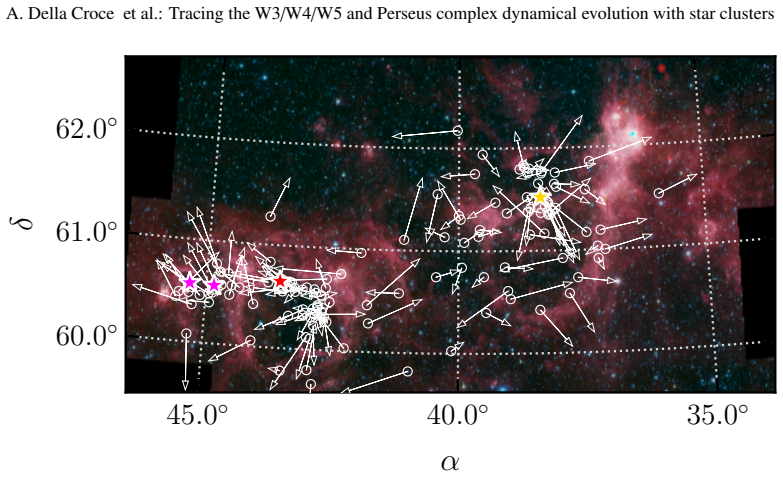
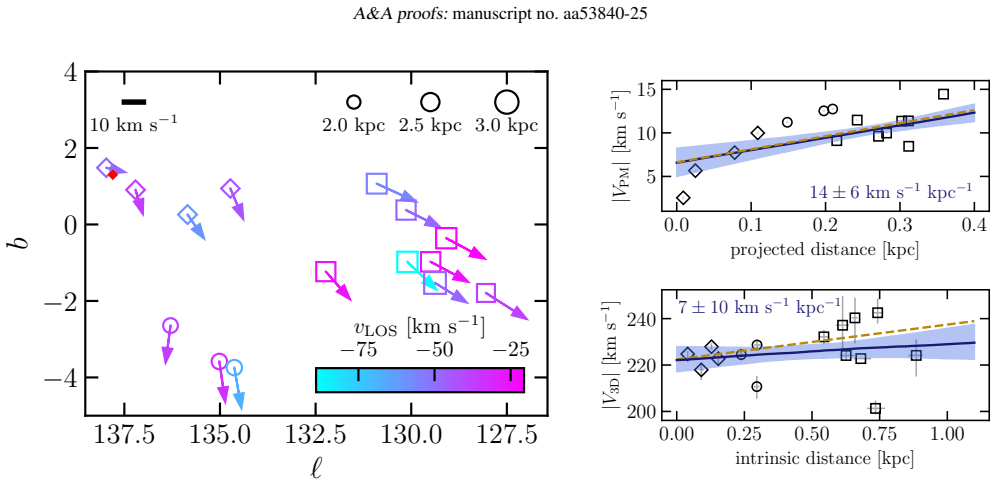
The load-bearing tool is the star cluster used as a six-dimensional tracer: each cluster supplies a 3D position (sky position plus parallax-based distance) and a 3D velocity (proper motion plus line-of-sight velocity), so the same data can be viewed as a projected flow or as true Galactic orbits. The decisive comparison is the projected velocity–distance diagram versus the intrinsic (3D) velocity–distance diagram, computed after de-projecting cluster positions relative to IC 1805; the first shows an expansion-like slope, the second does not. The orbit integrations themselves are carried out in a Galactic potential using an action–angle-based integration scheme, with 500 resamplings of distance and line-of-sight velocity errors, and the backward integrations reverse the velocity vectors to trace where the cluster aggregates came from. For internal kinematics, the paper uses the mean radial velocity to velocity dispersion ratio $\langle v_R\rangle/\sigma_R$ to quantify how strongly a young cluster is expanding.
What would settle it
Take high-resolution spectra of SAI 24 and of the three clusters with no line-of-sight velocity at all (UBC 420, Basel 10, NGC 637), and recompute the 3D velocity–distance slope and the backward orbits. If the true SAI 24 velocity comes out near +52 km/s rather than −48 km/s, or the newly measured velocities shift the W345–LISCA I convergence time by much more than the quoted few-Myr errors, the claim that the complex is not dispersing loses its support.
Extended reading notes
Core claim
Stated on the paper's own terms: the Perseus complex is not undergoing a bulk expansion. When the clusters' on-sky proper motions are plotted against projected distance from the putative expansion center, the data reproduce the previously claimed 15 km/s/kpc (here 14 ± 6 km/s/kpc) trend; but when the same clusters are placed in three dimensions using parallaxes and line-of-sight velocities, the intrinsic velocity–distance relation is 7 ± 10 km/s/kpc, consistent with no net divergence. The complex spans about 1.2 kpc along the line of sight, so stars at different Galactic radii simply orbit at different speeds, and projection manufactures the appearance of a flow. Backward orbit integrations add a formation statement: LISCA I and the W345 system were a few hundred parsecs apart roughly 25 Myr ago, while LISCA II was born roughly 0.6–1 kpc away. Adding spiral-arm perturbations to the Galactic potential does not change the short-term picture and tends to drag clusters toward arm-density peaks, which can keep the components closer together for longer than an axisymmetric potential would.
Load-bearing premise
The whole orbit-based story leans on the adopted line-of-sight velocities, and the most fragile single number is the velocity chosen for the cluster SAI 24, whose two catalog values (+52 ± 22 km/s and −48 ± 5 km/s) disagree by 3.7 sigma and pull the W345 mean in opposite directions.
Editorial extensions
If this is right
- The 15 km/s/kpc Hubble-like expansion reported for the Perseus complex is a projection artifact; the complex itself shows no net 3D divergence (7 ± 10 km/s/kpc).
- LISCA I and the W345 system were separated by only a few hundred parsecs about 20–30 Myr ago; LISCA II formed roughly 0.6–1 kpc from them.
- Spiral-arm perturbations drag star clusters toward higher-density regions and can keep the components of the complex closer together for over 200 Myr compared to the axisymmetric case.
- The three youngest W345 clusters (IC 1805, IC 1848, SAI 24, age ≈ 5 Myr) are internally expanding with $\langle v_R\rangle/\sigma_R$ up to about 1–2, while the older Berkeley 65 and UBC 420 are near equilibrium, matching the age trend for young clusters.
- Aggregating clusters into the W345, LISCA I, and LISCA II systems gives cleaner orbits than individual clusters, whose 6D initial conditions are too sensitive to line-of-sight velocity errors.
Reading between the lines
- Editorial inference: if the projection interpretation is right, other young complexes seen through a large line-of-sight depth inside spiral arms may show spurious Hubble flows; re-doing such analyses with 3D velocities would reveal how common shear artifacts are.
- Editorial inference: the SAI 24 velocity disagreement is the first place to look for a revision; a decisive measurement would either confirm the adopted W345 mean or reopen the formation-scenario conclusion.
- Editorial inference: the spiral-arm toy model predicts that arm trapping can keep clusters together for hundreds of Myr, which would make hierarchical merging among the Perseus components more likely; this could be tested with self-consistent N-body simulations of cluster aggregates in the same potential.
- Editorial inference: the same cluster-as-6D-tracer method could be applied to other Galactic star-forming complexes to quantify the fraction of observed 'expansions' that are actually Galactic shear projection.
Signed reviews
Editorial analysis
A structured set of objections, weighed in public.
Referee Report
Summary. The paper presents a multi-scale study of the W3/W4/W5 (W345) region and the larger Perseus complex using Gaia DR3 and complementary catalogs. The authors identify five known clusters in W345, characterize their structure, ages, and internal kinematics, and find that the three youngest clusters show expansion while the two older ones are near equilibrium. They then assemble 6D phase-space data for 15 clusters across W345, LISCA I, and LISCA II, and integrate cluster aggregate orbits in the axisymmetric McMillan (2017) potential, as well as in models with spiral-arm perturbations and a bar. The central claims are that the Hubble-like expansion reported by Román-Zúñiga et al. (2019) is likely a projection effect caused by different orbital velocities of stars at slightly different Galactocentric distances; that LISCA I and W345 formed 20--30 Myr ago only a few hundred parsecs apart; and that spiral-arm perturbations can keep the aggregates closer for longer.
Significance. If the conclusions hold, the paper provides a novel and important reinterpretation of the kinematics of the Perseus complex, replacing an internal-expansion interpretation with a Galactic-orbit interpretation. The work is careful in several respects: it uses homogeneous astrometric selections and membership criteria, it propagates distance and line-of-sight velocity errors into orbit integrations via Monte Carlo sampling, it makes the AGAMA orbit integrations reproducible, and it explores perturbations of the Galactic potential (spiral arms, bar, varying perturbation strength) in appendices. The cluster characterization in Section 3 is a useful contribution in its own right, and the YSO kinematic analysis in Section 4 adds value. The main weakness is that the dynamical conclusions, especially the no-expansion statement and the LISCA I--W345 co-formation epoch, rest on a small number of line-of-sight velocity measurements, one of which (SAI 24) shows a 3.7-sigma discrepancy between two catalogs. The authors acknowledge this discrepancy but do not demonstrate that their conclusions are robust to the alternative value.
major comments (3)
- [Section 5.1, Table 4] The choice of vLOS for SAI 24 is load-bearing for the paper's central conclusion. Tarricq et al. (2021) report +52 ± 22 km/s while Hunt & Reffert (2023) report -48 ± 5 km/s, and the authors adopt the latter because it is closer to the W345 mean velocity. This selection is based on consistency with the quantity being averaged rather than on an independent validation of either measurement. SAI 24 enters the W345 aggregate; switching to the Tarricq value changes the four-cluster W345 mean vLOS from approximately -47 km/s to approximately -22 km/s. Since the backward orbit integrations in Section 5.3 (Fig. 14) drive the claim of a LISCA I--W345 minimum distance 20--30 Myr ago, the authors should repeat the aggregate mean and orbit integrations using the Tarricq value, and also with SAI 24 excluded, and show whether the conclusions survive.
- [Section 5.2, Fig. 10] The direct 3D distance--velocity regression gives 7 ± 10 km/s/kpc, which is formally consistent with both zero expansion and a mild expansion at the level claimed by Román-Zúñiga et al. (2019). The statement that 'we do not observe a Hubble-like expansion' is therefore not established by this regression alone; it rests on the orbit-integration analysis. Moreover, the regression is performed on absolute 3D velocities in the Galactocentric frame, which include the large common orbital velocity of the complex. The slope could be dominated by the gradient of Galactic rotation across the ~1.2 kpc line-of-sight depth rather than by any internal expansion. I ask the authors to add a test using velocities relative to the complex mean motion, or an explicit forward model of the projection signature, to demonstrate that the absence of a 3D slope is specifically informative about internal dispersal.
- [Section 5.1 and 5.3] Three clusters in Table 4 (UBC 420, Basel 10, and NGC 637) have no line-of-sight velocity measurement in any catalog, yet they are included in the aggregate positions and velocities used for the orbit integrations. The paper does not state which clusters actually contribute to each aggregate's vLOS, nor does it quantify the sensitivity of the aggregate means or the resulting inter-aggregate distances to excluding these clusters (or to assigning them the aggregate mean as a proxy). Given that vLOS is explicitly identified as a primary uncertainty source in the orbit reconstruction, this missing sensitivity analysis compounds the SAI 24 concern and should be reported.
minor comments (4)
- [Throughout] There are several typographical and formatting issues: 'Identifing' in the Section 2 title, 'genearlly' in Section 5.3, 'Persues' in Section 5.3, 'Publicy' in a footnote, and frequent 'di fferent' (spurious spaces) throughout the text. These should be corrected in a final pass.
- [Section 3.3] The text says that for clusters not in Tarricq et al. (2021), the authors adopt a mean LOS velocity of -39 km/s from Fanelli et al. (2022b). It would help to state explicitly that this adopted value is used only for the internal expansion analysis (Fig. 8) and not for the orbit integrations in Section 5.3, since the latter require per-cluster vLOS values.
- [Section 5.3, Fig. 12-14] The captions and text refer to 'median orbits' but it is not always clear whether the medians are taken across the 500 initial-condition realizations at each time step or across time. A one-sentence clarification in the caption of Fig. 12 would resolve this.
- [Section 5.4] The discussion of spiral-arm perturbation strength (f) is clear, but the choice f = 0.3 as the 'reference model' is presented without a quantitative justification beyond the statement that f_HI = 0.53-0.66 is an upper limit. The authors should briefly restate why 0.3 is a reasonable intermediate value for the stellar arm-to-interarm contrast.
Circularity Check
Mild consistency-based selection of SAI 24 vLOS is the only circularity-adjacent step; the no-dispersal and formation conclusions are not forced by construction.
-
other
[Section 5.1, SAI 24 vLOS selection (Table 4; used in Section 5.3 orbit initial conditions).]
"Tarricq et al. (2021) measured vLOS = +52± 22 km s−1 (using 8 stars), whereas Hunt & Reffert (2023) found vLOS = −48±5 km s−1 (using 7 stars). The two measurements are highly discrepant (3.7σ), possibly due to different membership compilations. However, the measurement from Hunt & Reffert (2023) is closer to the mean LOS velocity of the W345 complex (around −40 km s−1, Fanelli et al. 2022b) it belongs to. We thus adopted the value by Hunt & Reffert (2023)."
The SAI 24 vLOS is selected because it is close to the W345 complex mean vLOS, and SAI 24 is then included in the W345 aggregate whose mean vLOS feeds the orbit integrations (Section 5.3, Figs. 12-14). The input is therefore chosen for consistency with the aggregate property it helps determine, making the W345 aggregate kinematics partly self-referential. However, the main no-expansion/projection-effect conclusion also rests on the 15-cluster sample and the comparison of projected vs 3D slopes, so this is a mild consistency-based circularity rather than a full reduction of the central claim.
full rationale
The paper's central claims are not circularly forced. The no-dispersal conclusion comes from comparing the projected distance-velocity slope (14±6 km/s/kpc) with the intrinsic 3D slope (7±10 km/s/kpc) computed from cluster distances and vLOS, and from direct backward orbit integrations in the McMillan (2017) potential. These are measured outputs, not identities with the inputs. The LISCA I/II definitions (Dalessandro et al. 2021; Della Croce et al. 2023), the cumulative-luminosity age method (Della Croce et al. 2023), and the ⟨vR⟩/σR expansion metric (Della Croce et al. 2024) are inherited from the authors' prior work, but they are used as inputs or diagnostic tools rather than as the conclusions being derived. The one mild circularity-adjacent step is the SAI 24 vLOS choice: the paper rejects Tarricq et al. (2021) in favor of Hunt & Reffert (2023) because the latter is closer to the W345 complex mean vLOS, and SAI 24 subsequently enters the W345 aggregate mean used for orbit integrations. This makes the aggregate kinematics partially self-consistent by selection; the paper itself identifies vLOS as a primary uncertainty source. Repeating the aggregate analysis with the Tarricq value would be the appropriate robustness test. Because the central projection-effect and LISCA I-W345 proximity claims depend on the full 15-cluster sample and on orbit integrations that do not algebraically reduce to the adopted input, this is a minor consistency-based input selection rather than a load-bearing circularity.
Assumptions & free parameters
free parameters (3)
- Spiral perturbation amplitude f =
0.3 (reference), explored over 0.1 to 0.5
- Perseus arm average pitch angle psi =
9.5 degrees
- HDBSCAN clustering parameters =
min_cluster_size = 50, min_samples = 30
assumptions (4)
- domain assumption The adopted line-of-sight velocity for SAI 24 from Hunt and Reffert (2023) is correct despite a 3.7-sigma disagreement with Tarricq et al. (2021).
- domain assumption Clusters with missing or single-star line-of-sight velocities can be included in aggregate mean velocities without biasing the result.
- domain assumption The McMillan (2017) axisymmetric potential, with Cox and Gomez (2002) spiral perturbations, adequately describes Galactic forces over 200 Myr for orbits near the Perseus arm.
- domain assumption Extinction coefficients calibrated for effective temperatures 3500 to 10000 K can be extrapolated to 30000 K for the youngest clusters.
Cite this review
Pith. "Pith review of Tracing the W3/W4/W5 and Perseus complex dynamical evolution with star clusters." pith.science (2026). https://pith.science/paper/HQPNVFLC
@misc{pith2026250416159,
  author       = {Pith},
  title        = {Pith review of: Tracing the W3/W4/W5 and Perseus complex dynamical evolution with star clusters},
  year         = {2026},
  howpublished = {\url{https://pith.science/paper/HQPNVFLC}},
  note         = {Machine review of arXiv:2504.16159}
}
abstract
The Perseus complex offers an ideal testbed to study cluster formation and early evolution as it hosts two major hierarchical structures (namely LISCA I and LISCA II) and the W3/W4/W5 (W345) region characterized by recent star formation. This work aims to provide a full characterization of the population of star clusters in the W345 region, in terms of their structural, photometric, and kinematic properties. Clusters are then used to probe the dynamical properties of the W345 region and, on a larger scale, to investigate the evolution of the Perseus complex. We used Gaia DR3 data to search for star clusters in the W345 region and characterize them in terms of their density structure, ellipticity, internal dynamical state, and ages. We identified five stellar clusters belonging to the W345 complex. The three younger clusters are still partially embedded in the gas and show evidence of expansion, while the older ones cleared the surrounding gas. We also found that YSOs trace the parent gas structure and possibly its kinematics. Thanks to the 6D information available for star clusters, we followed their orbital evolution to assess the formation conditions and evolution of the complex. When accounting for the Galactic potential, we find that the Perseus complex is not dispersing. The observed expansion might be a projection effect due to stars orbiting the Galaxy at different velocities. In addition, we find that the LISCA I and W345 systems formed some $20-30$ Myr ago just a few hundred parsecs away, while LISCA II was originally $\simeq 0.75-1$ kpc apart. Finally, we also assessed the impact of spiral arm perturbations by constructing tailored Galactic potential which matches the observed Galactic spiral arm structure. We find spiral structures drag star clusters toward higher-density regions, possibly keeping clusters closer for longer than the unperturbed, axisymmetric case.
Figures


Figures from the paper (12 more)




Reference graph
Works this paper leans on
-
[1]
C., Lada , C
Adams , F. C., Lada , C. J., & Shu , F. H. 1987, , 312, 788
1987
-
[2]
E., Calvet , N., D'Alessio , P., et al
Allen , L. E., Calvet , N., D'Alessio , P., et al. 2004, , 154, 363
2004
-
[3]
2016, , 460, 2472
Baba , J., Morokuma-Matsui , K., Miyamoto , Y., Egusa , F., & Kuno , N. 2016, , 460, 2472
2016
-
[4]
& Lardo , C
Bastian , N. & Lardo , C. 2018, , 56, 83
2018
-
[5]
& Kroupa , P
Baumgardt , H. & Kroupa , P. 2007, , 380, 1589
2007
-
[6]
& Bovy , J
Bennett , M. & Bovy , J. 2021, , 503, 376
2021
-
[7]
1989, , 346, 735
Bertoldi , F. 1989, , 346, 735
1989
-
[8]
& McKee , C
Bertoldi , F. & McKee , C. F. 1990, , 354, 529
1990
Show all 135 references
-
[9]
& Tremaine , S
Binney , J. & Tremaine , S. 2008, Galactic Dynamics: Second Edition
2008
-
[10]
1964, , 2, 213
Blaauw , A. 1964, , 2, 213
1964
-
[11]
W., & Roweis , S
Bovy , J., Hogg , D. W., & Roweis , S. T. 2011, Annals of Applied Statistics, 5, 1657
2011
-
[12]
2012, , 427, 127
Bressan , A., Marigo , P., Girardi , L., et al. 2012, , 427, 127
2012
-
[13]
2017, , 600, A49
Brinkmann , N., Banerjee , S., Motwani , B., & Kroupa , P. 2017, , 600, A49
2017
-
[14]
& Anders , F
Cantat-Gaudin , T. & Anders , F. 2020, , 633, A99
2020
-
[15]
2020, , 640, A1
Cantat-Gaudin , T., Anders , F., Castro-Ginard , A., et al. 2020, , 640, A1
2020
-
[16]
2018, , 618, A93
Cantat-Gaudin , T., Jordi , C., Vallenari , A., et al. 2018, , 618, A93
2018
-
[17]
J., et al
Cantat-Gaudin , T., Jordi , C., Wright , N. J., et al. 2019, , 626, A17
2019
-
[18]
Carpenter , J. M. 2000, , 120, 3139
2000
-
[19]
& Whitworth , A
Cartwright , A. & Whitworth , A. P. 2004, , 348, 589
2004
-
[20]
2022, , 661, A118
Castro-Ginard , A., Jordi , C., Luri , X., et al. 2022, , 661, A118
2022
-
[21]
J., Luri , X., et al
Castro-Ginard , A., McMillan , P. J., Luri , X., et al. 2021, , 652, A162
2021
-
[22]
2024, , 167, 12
Cavallo , L., Spina , L., Carraro , G., et al. 2024, , 167, 12
2024
-
[23]
K., Samal , M
Chauhan , N., Ogura , K., Pandey , A. K., Samal , M. R., & Bhatt , B. C. 2011 a , , 63, 795
2011
-
[24]
K., Ogura , K., et al
Chauhan , N., Pandey , A. K., Ogura , K., et al. 2011 b , , 415, 1202
2011
-
[25]
Cox , D. P. & G \'o mez , G. C. 2002, , 142, 261
2002
-
[26]
M., Wright , E
Cutri , R. M., Wright , E. L., Conrow , T., et al. 2013, Explanatory Supplement to the AllWISE Data Release Products , Explanatory Supplement to the AllWISE Data Release Products, by R. M. Cutri et al
2013
-
[27]
M., Wright , E
Cutri , R. M., Wright , E. L., Conrow , T., et al. 2021, VizieR Online Data Catalog: AllWISE Data Release (Cutri+ 2013) , VizieR On-line Data Catalog: II/328. Originally published in: IPAC/Caltech (2013)
2013
-
[28]
2024, , 691, A94
Dalessandro , E., Cadelano , M., Della Croce , A., et al. 2024, , 691, A94
2024
-
[29]
L., Tiongco , M., et al
Dalessandro , E., Varri , A. L., Tiongco , M., et al. 2021, , 909, 90
2021
-
[30]
2019, , 623, A25
Damiani , F., Prisinzano , L., Micela , G., & Sciortino , S. 2019, , 623, A25
2019
-
[31]
2018, , 614, A19
Danielski , C., Babusiaux , C., Ruiz-Dern , L., Sartoretti , P., & Arenou , F. 2018, , 614, A19
2018
-
[32]
R., Gupta , S., Prakash , P., Samal , M., & Jose , J
Das , S. R., Gupta , S., Prakash , P., Samal , M., & Jose , J. 2023, , 948, 7
2023
-
[33]
D., et al
Deharveng , L., Zavagno , A., Anderson , L. D., et al. 2012, , 546, A74
2012
-
[34]
2024, , 683, A10
Della Croce , A., Dalessandro , E., Livernois , A., & Vesperini , E. 2024, , 683, A10
2024
-
[35]
2023, , 674, A93
Della Croce , A., Dalessandro , E., Livernois , A., et al. 2023, , 674, A93
2023
-
[36]
N., Giacobbo , N., Mapelli , M., et al
Di Carlo , U. N., Giacobbo , N., Mapelli , M., et al. 2019, , 487, 2947
2019
-
[37]
S., Monteiro , H., Moitinho , A., et al
Dias , W. S., Monteiro , H., Moitinho , A., et al. 2021, , 504, 356
2021
-
[38]
& Kroupa , P
Dinnbier , F. & Kroupa , P. 2020 a , , 640, A84
2020
-
[39]
& Kroupa , P
Dinnbier , F. & Kroupa , P. 2020 b , , 640, A85
2020
-
[40]
Dinnbier , F., Kroupa , P., & Anderson , R. I. 2022, , 660, A61
2022
-
[41]
2023, , 670, A10
Drimmel , R., Khanna , S., D'Onghia , E., et al. 2023, , 670, A10
2023
-
[42]
Drimmel , R., Khanna , S., Poggio , E., & Skowron , D. M. 2024, arXiv e-prints, arXiv:2406.09127
2024 arXiv
-
[43]
Elmegreen , B. G. 1983, , 203, 1011
1983
-
[44]
Elmegreen , B. G. & Hunter , D. A. 2010, , 712, 604
2010
-
[45]
2022 a , , 931, 61
Fanelli , C., Origlia , L., Mucciarelli , A., et al. 2022 a , , 931, 61
2022
-
[46]
2022 b , , 660, A7
Fanelli , C., Origlia , L., Oliva , E., et al. 2022 b , , 660, A7
2022
-
[47]
Farias , J. P. & Tan , J. C. 2023, , 523, 2083
2023
-
[48]
Feigelson , E. D. & Townsley , L. K. 2008, , 673, 354
2008
-
[49]
W., Lang , D., & Goodman , J
Foreman-Mackey , D., Hogg , D. W., Lang , D., & Goodman , J. 2013, , 125, 306
2013
-
[50]
2018, , 616, A10
Gaia Collaboration , Babusiaux , C., van Leeuwen , F., et al. 2018, , 616, A10
2018
-
[51]
F., Baumgardt , H., et al
Gieles , M., Portegies Zwart , S. F., Baumgardt , H., et al. 2006, , 371, 793
2006
-
[52]
Goodwin , S. P. & Bastian , N. 2006, , 373, 752
2006
-
[53]
2019, , 27, 8
Gratton , R., Bragaglia , A., Carretta , E., et al. 2019, , 27, 8
2019
-
[54]
2019, , 625, L10
GRAVITY Collaboration , Abuter , R., Amorim , A., et al. 2019, , 625, L10
2019
-
[55]
& Telleschi , A
G \"u del , M. & Telleschi , A. 2007, , 474, L25
2007
-
[56]
A., Myers , P
Gutermuth , R. A., Myers , P. C., Megeath , S. T., et al. 2008, , 674, 336
2008
-
[57]
M., et al
Hachisuka , K., Brunthaler , A., Menten , K. M., et al. 2006, , 645, 337
2006
-
[58]
2002, , 579, L95
Hofner , P., Delgado , H., Whitney , B., Churchwell , E., & Linz , H. 2002, , 579, L95
2002
-
[59]
Hunt , E. L. & Reffert , S. 2021, , 646, A104
2021
-
[60]
Hunt , E. L. & Reffert , S. 2023, , 673, A114
2023
-
[61]
V., Kroupa , P., Wu , W., Pflamm-Altenburg , J., & Thies , I
Jadhav , V. V., Kroupa , P., Wu , W., Pflamm-Altenburg , J., & Thies , I. 2024, , 687, A89
2024
-
[62]
M., et al
Jordi , C., Gebran , M., Carrasco , J. M., et al. 2010, , 523, A48
2010
-
[63]
S., Herczeg , G
Jose , J., Kim , J. S., Herczeg , G. J., et al. 2016, , 822, 49
2016
-
[64]
Karr , J. L. & Martin , P. G. 2003, , 595, 900
2003
-
[65]
2023, , 674, A5
Katz , D., Sartoretti , P., Guerrier , A., et al. 2023, , 674, A5
2023
-
[66]
Kawata , D., Baba , J., Hunt , J. A. S., et al. 2021, , 508, 728
2021
-
[67]
P., Allen , L
Koenig , X. P., Allen , L. E., Gutermuth , R. A., et al. 2008, , 688, 1142
2008
-
[68]
2018, , 156, 84
Kounkel , M., Covey , K., Su \'a rez , G., et al. 2018, , 156, 84
2018
-
[69]
2001, , 321, 699
Kroupa , P., Aarseth , S., & Hurley , J. 2001, , 321, 699
2001
-
[70]
Kruijssen , J. M. D., Pelupessy , F. I., Lamers , H. J. G. L. M., Portegies Zwart , S. F., & Icke , V. 2011, , 414, 1339
2011
-
[71]
A., Hillenbrand , L
Kuhn , M. A., Hillenbrand , L. A., Carpenter , J. M., & Avelar Menendez , A. R. 2020, , 899, 128
2020
-
[72]
A., Hillenbrand , L
Kuhn , M. A., Hillenbrand , L. A., Sills , A., Feigelson , E. D., & Getman , K. V. 2019, , 870, 32
2019
-
[73]
Lada , C. J. & Lada , E. A. 2003, , 41, 57
2003
-
[74]
& Lazareff , B
Lefloch , B. & Lazareff , B. 1994, , 289, 559
1994
-
[75]
& Lazareff , B
Lefloch , B. & Lazareff , B. 1995, , 301, 522
1995
-
[76]
S., Blitz , L., & Heiles , C
Levine , E. S., Blitz , L., & Heiles , C. 2006, Science, 312, 1773
2006
-
[77]
2020, , 899, 121
Lim , B., Hong , J., Yun , H.-S., et al. 2020, , 899, 121
2020
-
[78]
2022, , 163, 266
Lim , B., Naz \'e , Y., Hong , J., et al. 2022, , 163, 266
2022
-
[79]
Lin , C. C. & Shu , F. H. 1964, , 140, 646
1964
-
[80]
2021 a , , 649, A4
Lindegren , L., Bastian , U., Biermann , M., et al. 2021 a , , 649, A4
2021
-
[81]
A., Hern \'a ndez , J., et al
Lindegren , L., Klioner , S. A., Hern \'a ndez , J., et al. 2021 b , , 649, A2
2021
-
[82]
N., Kruijssen , J
Longmore , S. N., Kruijssen , J. M. D., Bastian , N., et al. 2014, in Protostars and Planets VI, ed. H. Beuther , R. S. Klessen , C. P. Dullemond , & T. Henning , 291--314
2014
-
[83]
E., & Degioia-Eastwood , K
Massey , P., Johnson , K. E., & Degioia-Eastwood , K. 1995, , 454, 151
1995
-
[84]
Mathieu , R. D. 1983, , 267, L97
1983
-
[85]
2017, The Journal of Open Source Software, 2, 205
McInnes , L., Healy , J., & Astels , S. 2017, The Journal of Open Source Software, 2, 205
2017
-
[86]
McMillan , P. J. 2017, , 465, 76
2017
-
[87]
T., Townsley , L
Megeath , S. T., Townsley , L. K., Oey , M. S., & Tieftrunk , A. R. 2008, in Handbook of Star Forming Regions, Volume I, ed. B. Reipurth , Vol. 4, 264
2008
-
[88]
& Bate , M
Moeckel , N. & Bate , M. R. 2010, , 404, 721
2010
-
[89]
K., Thompson , M
Morgan , L. K., Thompson , M. A., Urquhart , J. S., White , G. J., & Miao , J. 2004, , 426, 535
2004
-
[90]
K., Urquhart , J
Morgan , L. K., Urquhart , J. S., & Thompson , M. A. 2009, , 400, 1726
2009
-
[91]
& Shaviv , N
Naoz , S. & Shaviv , N. J. 2007, , 12, 410
2007
-
[92]
2009, , 500, 1119
Niwa , T., Tachihara , K., Itoh , Y., et al. 2009, , 500, 1119
2009
-
[93]
R., Pandey , A
Panwar , N., Samal , M. R., Pandey , A. K., et al. 2017, , 468, 2684
2017
-
[94]
R., Pandey , A
Panwar , N., Samal , M. R., Pandey , A. K., Singh , H. P., & Sharma , S. 2019, , 157, 112
2019
-
[95]
Pelupessy , F. I. & Portegies Zwart , S. 2012, , 420, 1503
2012
-
[96]
& Kaczmarek , T
Pfalzner , S. & Kaczmarek , T. 2013, , 555, A135
2013
-
[97]
Plummer , H. C. 1911, , 71, 460
1911
-
[98]
2017, , 465, 1621
Portail , M., Gerhard , O., Wegg , C., & Ness , M. 2017, , 465, 1621
2017
-
[99]
& Naz \'e , Y
Rauw , G. & Naz \'e , Y. 2016, , 594, A82
2016
-
[100]
Reid , M. J. & Brunthaler , A. 2020, , 892, 39
2020
-
[101]
J., Menten , K
Reid , M. J., Menten , K. M., Brunthaler , A., et al. 2019, , 885, 131
2019
-
[102]
G., Roman-Lopes , A., Tapia , M., Hern \'a ndez , J., & Ram \' rez-Preciado , V
Rom \'a n-Z \'u \ n iga , C. G., Roman-Lopes , A., Tapia , M., Hern \'a ndez , J., & Ram \' rez-Preciado , V. 2019, , 871, L12
2019
-
[103]
G., Ybarra , J
Rom \'a n-Z \'u \ n iga , C. G., Ybarra , J. E., Meg \' as , G. D., et al. 2015, , 150, 80
2015
-
[104]
2024, , 534, 2566
S \'a nchez-Sanju \'a n , S., Hern \'a ndez , J., P \'e rez-Villegas , \'A ., et al. 2024, , 534, 2566
2024
-
[105]
2010, , 403, 1829
Sch \"o nrich , R., Binney , J., & Dehnen , W. 2010, , 403, 1829
2010
-
[106]
Sellwood , J. A. & Carlberg , R. G. 1984, , 282, 61
1984
-
[107]
Shu , F. H. 2016, , 54, 667
2016
-
[108]
Sivia, D. S. & Skilling, J. 2006, Data Analysis - A Bayesian Tutorial , 2nd edn., Oxford Science Publications (Oxford University Press)
2006
-
[109]
D., Hester , J
Snider , K. D., Hester , J. J., Desch , S. J., Healy , K. R., & Bally , J. 2009, , 700, 506
2009
-
[110]
C., Gerhard , O., Portail , M., Vasiliev , E., & Clarke , J
Sormani , M. C., Gerhard , O., Portail , M., Vasiliev , E., & Clarke , J. 2022, , 514, L1
2022
-
[111]
1991, , 77, 59
Sugitani , K., Fukui , Y., & Ogura , K. 1991, , 77, 59
1991
-
[112]
& Ogura , K
Sugitani , K. & Ogura , K. 1994, , 92, 163
1994
-
[113]
S., Chun , M.-Y., et al
Sung , H., Bessell , M. S., Chun , M.-Y., et al. 2017, , 230, 3
2017
-
[114]
2021, , 917, 21
Swiggum , C., D'Onghia , E., Alves , J., et al. 2021, , 917, 21
2021
-
[115]
2021, , 647, A19
Tarricq , Y., Soubiran , C., Casamiquela , L., et al. 2021, , 647, A19
2021
-
[116]
Tchernyshyov , K., Peek , J. E. G., & Zasowski , G. 2018, , 156, 248
2018
-
[117]
A., White , G
Thompson , M. A., White , G. J., Morgan , L. K., et al. 2004, , 414, 1017
2004
-
[118]
K., Broos , P
Townsley , L. K., Broos , P. S., Garmire , G. P., & Povich , M. S. 2019, , 244, 28
2019
-
[119]
2022, , 659, A95
Tsantaki , M., Pancino , E., Marrese , P., et al. 2022, , 659, A95
2022
-
[120]
2009, , 497, 209
van Leeuwen , F. 2009, , 497, 209
2009
-
[121]
2019 a , , 482, 1525
Vasiliev , E. 2019 a , , 482, 1525
2019
-
[122]
2019 b , , 489, 623
Vasiliev , E. 2019 b , , 489, 623
2019
-
[123]
E., et al
Virtanen, P., Gommers, R., Oliphant, T. E., et al. 2020, Nature Methods, 17, 261
2020
-
[124]
A., Indebetouw , R., Babler , B
Whitney , B. A., Indebetouw , R., Babler , B. L., et al. 2004, , 154, 315
2004
-
[125]
A., Wood , K., Bjorkman , J
Whitney , B. A., Wood , K., Bjorkman , J. E., & Cohen , M. 2003 a , , 598, 1079
2003
-
[126]
A., Wood , K., Bjorkman , J
Whitney , B. A., Wood , K., Bjorkman , J. E., & Wolff , M. J. 2003 b , , 591, 1049
2003
-
[127]
L., Eisenhardt , P
Wright , E. L., Eisenhardt , P. R. M., Mainzer , A. K., et al. 2010, , 140, 1868
2010
-
[128]
J., Jeffries , R
Wright , N. J., Jeffries , R. D., Jackson , R. J., et al. 2019, , 486, 2477
2019
-
[129]
J., Jeffries , R
Wright , N. J., Jeffries , R. D., Jackson , R. J., et al. 2024, , 533, 705
2024
-
[130]
Wright , N. J. & Mamajek , E. E. 2018, , 476, 381
2018
-
[131]
J., Zheng , X
Xu , Y., Reid , M. J., Zheng , X. W., & Menten , K. M. 2006, Science, 311, 54
2006
-
[132]
K., Pandey , A
Yadav , R. K., Pandey , A. K., Sharma , S., et al. 2016, , 461, 2502
2016
-
[133]
Y., Gnedin , N
Zemp , M., Gnedin , O. Y., Gnedin , N. Y., & Kravtsov , A. V. 2011, , 197, 30
2011
-
[134]
, " * write output.state after.block = add.period write newline
ENTRY address archiveprefix author booktitle chapter edition editor howpublished institution eprint journal key month note number organization pages publisher school series title type volume year label extra.label sort.label short.list INTEGERS output.state before.all mid.sent...
-
[135]
write newline
" write newline "" before.all 'output.state := FUNCTION n.dashify 't := "" t empty not t #1 #1 substring "-" = t #1 #2 substring "--" = not "--" * t #2 global.max substring 't := t #1 #1 substring "-" = "-" * t #2 global.max substring 't := while if t #1 #1 substring * t #2 gl...
Reviewed August 16, 2026 · model on record in the stance chip above.
Discussion (0). Continue with ORCID to comment.