REVIEW 2 major objections 4 minor 70 references
Simulating X-point radiator turbulence
T0 review · 2 major / 4 minor · reviewed 2026-08-16 · deepseek-v4-flash
Pith's one-line read Global turbulence simulations reproduce a detached X-point radiator in a tokamak and show that the radiating front is strongly turbulent, a result the paper links to ELM suppression.
desk verdict First turbulence-resolving XPR simulation, worth a serious referee, but the neutral-gas height-modulation claim is confounded by simultaneous changes in c_imp and T_N,min. read the letter →
The pith
A machine-rendered reading of the paper's core claim, the machinery that carries it, and where it could break.
The reading
What carries the argument
The load-bearing element is the impurity-radiation power density $p_{\rm rad}^{\rm imp} = -L_{\rm imp}(T_e)\,n^2\,c_{\rm imp}$, added to the electron temperature equation with a coronal-equilibrium nitrogen rate coefficient $L_{\rm imp}(T_e)$ that peaks near 7–15 eV. Around it sit two numerical and physics additions: a fluid neutral model whose perpendicular diffusivity has a temperature floor $T_{N,\min}$ meant to mimic kinetic non-local neutral spreading, and an implicit treatment of parallel resistivity that removes the $T_e^{-3/2}$ stiffness of Ohm's law at low temperature. The fixed impurity fraction determines whether a radiation front can persist; the divertor neutral density and the neutral diffusivity floor control its height. On top of this, the turbulence is generated by GRILLIX's full-$f$ drift-fluid model, which evolves the whole profile rather than only fluctuations, letting the extreme fluctuation levels develop self-consistently.
What would settle it
A turbulence simulation that evolves the nitrogen charge-state distribution self-consistently, or uses a kinetic treatment of neutrals, should be run for the same discharge; if the front height no longer sits near 12 cm or the radiated fraction moves away from about 80%, the fixed-fraction and fixed-neutral-density assumptions are doing the work attributed to the physics.
Extended reading notes
Core claim
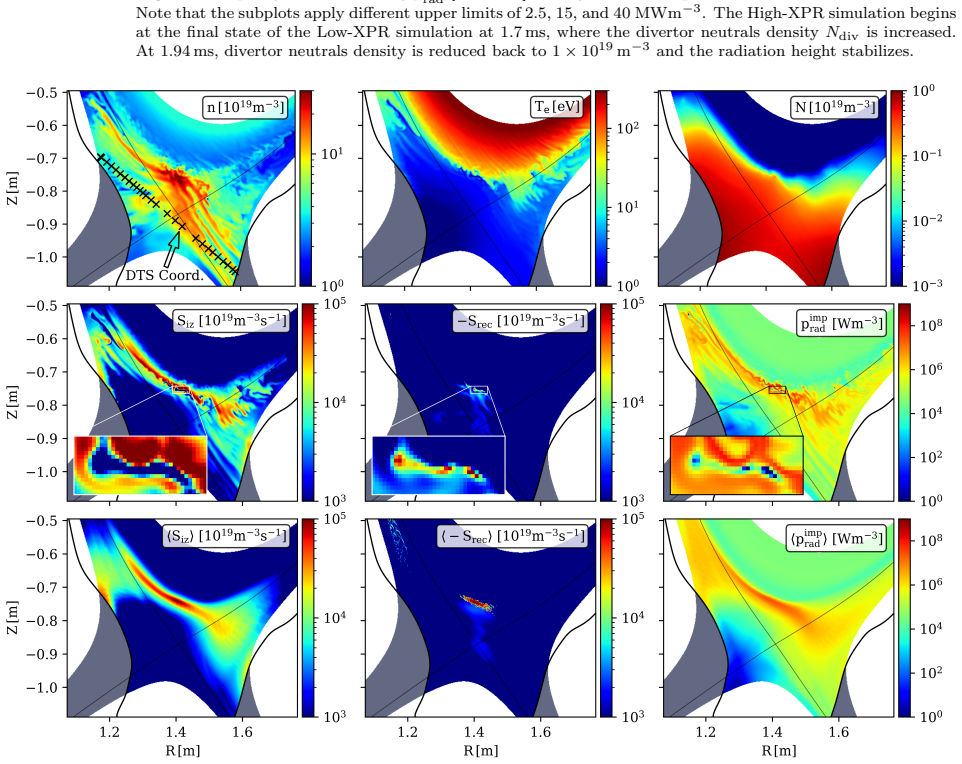
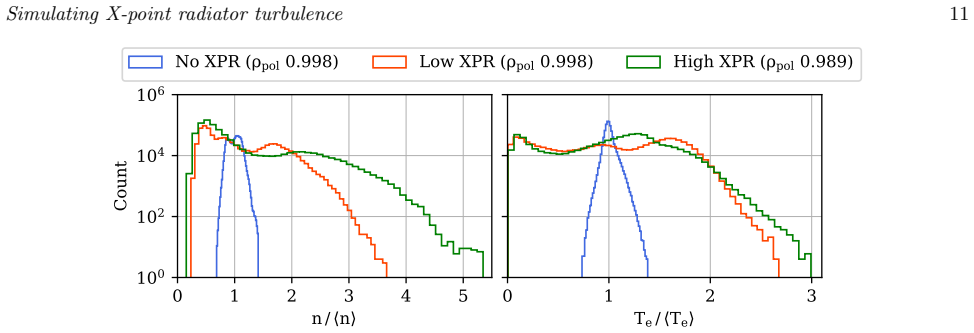
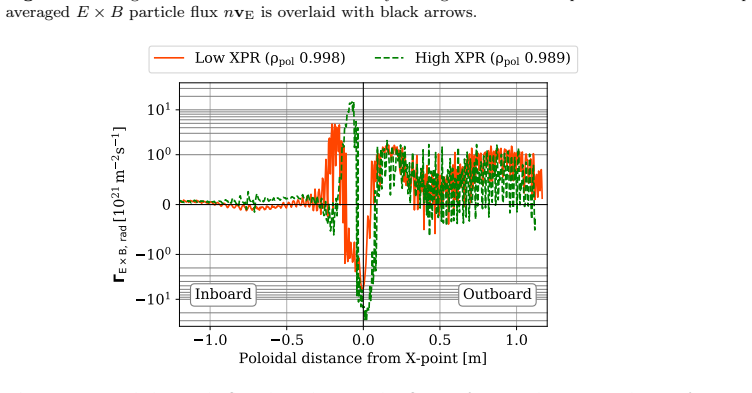
The paper's central claim is that a global, full-f turbulence code can reproduce a detached X-point radiator state in a tokamak. With nitrogen modeled as a fixed fraction of electron density, $c_{\rm imp}=10\%$ (later $5\%$), radiating in coronal equilibrium, GRILLIX forms dense radiation fronts at 5 cm and 12 cm above the X-point that radiate about 80% of the input heating power. The taller front matches the experimental divertor temperature and bolometry profiles of ASDEX Upgrade discharge #40333 especially well. The discovery is that the XPR is not a smooth radiating shell but a strongly turbulent structure: intermittent cold recombining cores sit inside fluctuating ionization and radiation mantles, density fluctuations reach more than 400% of the background (40% in the attached reference), and the averaged electrostatic potential becomes poloidally asymmetric, producing a stationary E×B vortex whose radial particle fluxes exceed outboard turbulent transport by up to an order of magnitude. The paper argues these effects may explain the ELM suppression seen when the XPR is tall.
Load-bearing premise
The whole result leans on treating nitrogen as a fixed slice of the electron density whose cooling is precomputed from temperature, and on setting the neutral gas density in the divertor and a minimum neutral diffusivity by hand; if real impurity transport, non-equilibrium charge states, or kinetic neutral spreading shift the front's height or brightness, the agreement with the experiment is not predictive.
Editorial extensions
If this is right
- Detached X-point radiators can now be studied in global turbulence simulations, so the radiating front, neutral gas, and turbulent transport no longer have to be packaged into heuristic transport coefficients.
- Neutral gas acts as the control knob for XPR height: raising the divertor neutral density and the minimum neutral diffusivity moves the front from 5 cm to 12 cm above the X-point.
- The High-XPR simulation reproduces the measured divertor temperature and peaked bolometry profile, supporting the experimental picture of a tall radiating front in discharge #40333.
- The time-averaged structure of the turbulent XPR matches earlier transport simulations, but only the turbulence simulation shows the intermittency: cold recombining cores and fluctuating ionization and radiation mantles that a mean-field picture misses.
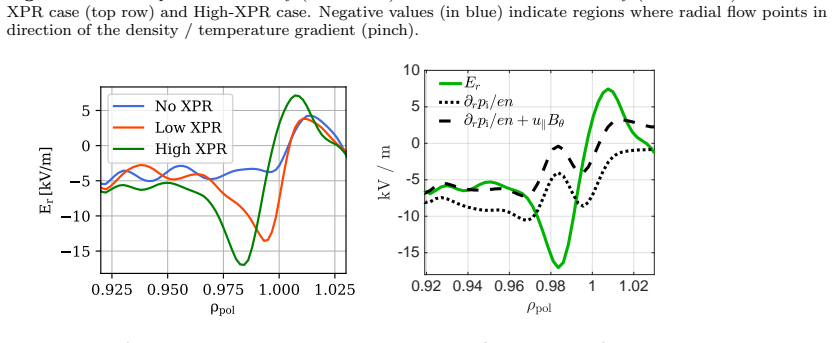
- The XPR shifts the radial electric field well inward, breaks poloidal potential symmetry, and drives an E×B vortex with radial flows an order of magnitude above outboard transport, which the paper links to the observed ELM suppression.
Reading between the lines
- If the fixed-fraction and coronal assumptions were replaced by self-consistent nitrogen transport, the front height and radiation fraction might shift; that calculation would separate physics from prescription and is a direct next step.
- The negative and space-dependent effective diffusivities found near the XPR imply that mean-field transport codes used for reactor extrapolation may need qualitatively new closure models in detached regimes, not just higher diffusivity values.
- The E×B vortex intensity is a testable predictor for ELM suppression: scanning simulated XPR height and correlating vortex-driven radial transport with the experimentally observed height threshold around 7 cm would check the causal link directly.
- Since averaged atomic rates differ from rates evaluated on averaged profiles, synthetic diagnostics applied to the instantaneous turbulent fields could quantify how much the intermittency changes predicted ionization, recombination, and radiation balances.
Signed reviews
Editorial analysis
A structured set of objections, weighed in public.
Referee Report
Summary. The manuscript presents first-of-kind turbulence simulations of detached X-point radiator (XPR) conditions in ASDEX Upgrade using the GRILLIX code. The plasma model is extended with a fixed-impurity-fraction radiation term, an implicit parallel resistivity scheme, and a lower bound on the neutral diffusivity. Two XPR states are reported, with radiation fronts at 5 cm and 12 cm above the X-point, radiating about 80% of the input heating power; they are compared with an attached reference case and validated against outboard-midplane, divertor, and bolometry measurements. The paper further analyzes fluctuation statistics, radial transport coefficients, the radial electric field, and E×B flows, and argues that neutral gas is critical for detachment and for modulating the XPR height, and that the observed turbulence and flows may relate to ELM suppression.
Significance. If the conclusions hold, this is a valuable step: it is the first global turbulence simulation of a detached XPR, and it demonstrates the feasibility of coupling drift-fluid turbulence with neutral and impurity effects in a diverted geometry. The numerical extensions are verified with the Method of Manufactured Solutions, and the paper is generally transparent about the modeling assumptions. The reported intermittent recombination cores and the large (400%) fluctuation amplitudes are interesting and potentially relevant to the ELM-suppressed XPR regime. The main caveat is that the XPR height and radiation fraction are strongly influenced by tunable parameters (c_imp, N_div, T_N,min, and a temporary neutral source), so the validation is partly a consistency check rather than an independent predictive test.
major comments (2)
- [§3.3 (and abstract)] The claim that neutral gas modulates the XPR height is not supported by the presented simulations, because the High-XPR case differs from the Low-XPR case in three parameters simultaneously. The text states that N_div is transiently raised and T_N,min is increased, and then 'the impurity concentration parameter was reduced from c_imp = 10%→5%.' After N_div is restored to 1e19 m^-3, the final High-XPR state differs from Low-XPR in both T_N,min (30→50 eV) and c_imp (10%→5%). Since Eq. (1) makes p_rad proportional to c_imp, and §3.2 shows that reducing c_imp strongly affects XPR persistence and position, the lower c_imp is a plausible alternative driver of the 12 cm front. To support the stated conclusion, a control simulation that varies only N_div (or a clear statement that the height is a combined effect of all three changes) is required.
- [§4.3 and Table 1] The bolometric validation is partially circular. The DLX diode data is scaled 'such that the experimental peak aligns approximately with the peak value obtained in the High-XPR case,' and the High-XPR state itself is obtained by tuning N_div, T_N,min, and c_imp. Moreover, the radiation fraction of 0.8 in Table 1 is a direct consequence of the chosen c_imp and the imposed neutral sources; it is not an emergent prediction. The sentence 'The agreement of the High-XPR case is remarkable' therefore overstates the evidential value: the comparison demonstrates that the model can localize a strong radiator at the tuned height, but it does not independently validate the predicted height or the 80% radiation fraction.
minor comments (4)
- [§3.1] The statement that 'whenever simulation data is shown ... it has been averaged over ... the last 50 snapshots, spanning 0.1 ms' should be accompanied by a sensitivity check or a statement on statistical convergence, since 0.1 ms is short compared to the 1 ms quasi-steady interval quoted in §3.2.
- [§3.2] The temporary neutral source is a significant ad hoc element. The paper says the front persists after removal, but no quantitative diagnostic is shown to demonstrate that the quasi-steady state is unaffected by the source's memory; a brief comparison of fields before and after removal would be useful.
- [§4.3] The phrase 'though note that some overestimation should be expected due to higher radiation compared to the experiment' is vague; it would be clearer to state that the simulated heating power and radiated power are higher than the experimental values (Table 1) by specific amounts.
- [Figure 10] The histograms are presented with a count axis (log scale) but not as normalized probability densities; please clarify in the caption how the counts are obtained and whether the 400% figure corresponds to the sample maximum or a percentile.
Circularity Check
Radiation fraction and High-XPR height are substantially controlled by scanned inputs (cimp, Ndiv, TN,min), making the bolometric validation partly circular; the turbulence and transport results remain independent.
-
fitted input called prediction
[Section 2.1, Eq. (1); Section 3.1; Section 3.2]
"The impurity-radiated power density then reads pimp rad = −Limp (Te)n2cimp. ... Impurity concentration is set to cimp = 10% after scanning over multiple simulations from cimp = 2%− 10%. ... Reducing cimp from 10% to 2%, for example, while not destroying the XPR outright, leads to the ionization/radiation structure gradually drifting below the separatrix, after which it vanishes entirely."
The model's radiated power is proportional to the free parameter cimp, and cimp is selected (10%) precisely because lower values do not sustain an XPR. The headline 'accounting for 80% of the input heating power' is therefore not a parameter-free prediction from first-principles impurity transport: it is largely enforced by the chosen impurity fraction and the coronal equilibrium assumption. The bolometric validation then checks a state whose radiation magnitude is heavily influenced by a tuned input, so the radiation-fraction agreement is partly circular, although the matched Te profile and turbulence statistics are independent.
-
fitted input called prediction
[Section 3.3]
"This was achieved by continuing the 'Low XPR' simulation from 1.7 ms with higher divertor neutrals density Ndiv = 1× 10¹⁹ → 2× 10¹⁹ m−3 and enforcing a minimum diffusivity TN,min = 30 → 50 eV. ... Concurrently, the impurity concentration parameter was reduced from cimp = 10% → 5%. This was found to prevent the radiation front from rising too high."
The 12 cm High-XPR front is not derived from neutral-gas physics alone: it is produced by jointly changing Ndiv, TN,min, and cimp, then restoring Ndiv while retaining the other two changes. The paper presents this case as evidence that neutral gas modulates XPR height and validates its bolometry, but the final Low-XPR vs High-XPR comparison is confounded by the simultaneous cimp and TN,min changes. The height is thus a tuned outcome rather than an independent prediction, making the neutral-gas height-modulation claim and the High-XPR bolometric agreement weaker than presented.
full rationale
The paper is transparent about its modeling assumptions, and much of the turbulence content is genuinely emergent: fluctuation PDFs, 400% amplitude increases, radial transport coefficients, inward Er shift, and the E×B vortex near the XPR are outputs not fitted to experiment. The Te profiles are matched without tuning to those profiles, so the validation has independent content. However, the two headline quantitative claims — 80% radiation fraction and the 12 cm XPR height — are substantially controlled by scanned inputs: cimp is chosen at the edge of the persistence scan, and the High-XPR state is produced by a coordinated change of Ndiv, TN,min, and cimp. Because the bolometry comparison is performed on a state whose radiation peak height and magnitude were effectively tuned, the validation of those specific numbers is partially circular. The confounded parameter change also undermines the causal attribution of height modulation to neutral gas. Overall a moderate partial circularity, not a wholesale derivation-from-inputs.
Assumptions & free parameters
free parameters (5)
- c_imp nitrogen concentration fraction =
10% (Low XPR); 5% (High XPR)
- N_div divertor neutral density boundary =
1e19 m^-3; 2e19 m^-3 during the High-XPR push
- T_N,min minimum neutrals temperature in diffusivity limiter =
30 eV (Low XPR); 50 eV (High XPR)
- Temporary neutral source =
1.8e19 D over 0.5 ms, 10 cm Gaussian width
- Free-streaming heat-flux limiter coefficients =
f_FS^e = 0.3, f_FS^i = 1
assumptions (5)
- ad hoc to paper Fixed, uniform impurity concentration n_imp = c_imp n in coronal equilibrium.
- domain assumption ADAS coronal-equilibrium nitrogen radiation rate coefficient L_imp(T_e) is valid locally, including in strong fluctuation regions.
- domain assumption Fluid neutral model with minimum diffusivity T_N,min reproduces kinetic non-local neutral spreading.
- domain assumption Drift-reduced Braginskii fluid closures with free-streaming heat flux limits remain valid in the detached XPR regime.
- ad hoc to paper Temporary neutral source does not bias the quasi-steady turbulent state once removed.
Cite this review
Pith. "Pith review of Simulating X-point radiator turbulence." pith.science (2026). https://pith.science/paper/JFTFRMDB
@misc{pith2026250416190,
  author       = {Pith},
  title        = {Pith review of: Simulating X-point radiator turbulence},
  year         = {2026},
  howpublished = {\url{https://pith.science/paper/JFTFRMDB}},
  note         = {Machine review of arXiv:2504.16190}
}
read the original abstract
Coupling a high-performance burning plasma core to a detached boundary solution is critical for realizing magnetic confinement fusion power. Predictive simulations of the edge and scrape-off layer are therefore essential and must self-consistently account for turbulence and the interplay between the plasma, neutral gas, and impurities. We present results on controlled full detachment in ASDEX Upgrade with an X-point radiator (XPR), obtained with the edge turbulence code GRILLIX. Assuming a fixed nitrogen concentration (in terms of the electron density) in coronal equilibrium, two simulations are discussed: they exhibit dense nitrogen radiation fronts, located 5 and 12 cm above the X-point, accounting for 80 % of the input heating power. In validations against density, temperature, and bolometry measurements, the simulations show good agreement and reproduce the detached divertor conditions observed in the experiment. Neutral gas is critical for achieving detachment and modulating the height of the XPR front, in agreement with previous SOLPS-ITER transport modeling and analytical power balance studies. In addition, the front structure is highly dynamic due to turbulence, consisting of ionizing and radiative mantles surrounding intermittent cold spots of recombining plasma. Near the detachment front, density and temperature fluctuation amplitudes exceed the background by more than 400 %, compared to 40 % in an attached reference case. The radial electric field shifts inward, poloidal symmetry of the electrostatic potential is broken (inducing strong radial flows around the XPR), and radial particle and heat transport into the low-field side scrape-off layer increases. These effects may explain the ELM suppression observed in the H-mode XPR regime.
Figures


Figures from the paper (12 more)





Reference graph
Works this paper leans on
-
[1]
E. Viezzer, M. Austin, M. Bernert et al. Prospects of core–edge integrated no-ELM and small-ELM scenarios for future fusion devices. Nuclear Materials and Energy , 34, 101308 (2023)
work page 2023
-
[2]
H. Zohm, C. Angioni, E. Fable et al. On the physics guidelines for a tokamak DEMO. Nuclear Fusion, 53 (7), 073019 (2013)
work page 2013
-
[3]
R. A. Pitts, X. Bonnin, F. Escourbiac et al. Physics basis for the first ITER tungsten divertor. Nuclear Materials and Energy, 20, 100696 (2019)
work page 2019
- [4]
-
[5]
M. Wischmeier, A. U. Team et al. High density operation for reactor-relevant power exhaust. Journal of Nuclear Materials , 463, 22 (2015)
work page 2015
-
[6]
P. C. Stangeby et al. The Plasma Boundary of Magnetic Fusion Devices , volume 224. Institute of Physics Pub. Philadelphia, Pennsylvania (2000)
work page 2000
- [7]
-
[8]
H. Zohm, F. Militello, T. Morgan et al. The EU strategy for solving the DEMO exhaust problem. Fusion Engineering and Design, 166, 112307 (2021)
work page 2021
Show all 70 references
-
[9]
Krasheninnikov and A
S. Krasheninnikov and A. Kukushkin. Physics of ultimate detachment of a tokamak divertor plasma. Journal of Plasma Physics, 83 (5), 155830501 (2017)
2017
-
[10]
Pshenov, A
A. Pshenov, A. Kukushkin and S. Krasheninnikov. Energy balance in plasma detachment. Nuclear Materials and Energy , 12, 948 (2017)
2017
-
[11]
Wiesen, D
S. Wiesen, D. Reiter, V. Kotov et al. The new SOLPS-ITER code package. Journal of Nuclear Materials , 463, 480 (2015)
2015
-
[12]
Bufferand, B
H. Bufferand, B. Bensiali, J. Bucalossi et al. Near wall plasma simulation using penalization technique with the transport code SOLEDGE2D-EIRENE. Journal of Nuclear Materials , 438, S445 (2013)
2013
-
[13]
Y. Feng, H. Frerichs, M. Kobayashi et al. Recent improvements in the EMC3-Eirene code. Contributions to Plasma Physics , 54 (4-6), 426 (2014)
2014
-
[14]
Bucalossi, J
J. Bucalossi, J. Achard, O. Agullo et al. Operating a full tungsten actively cooled tokamak: overview of WEST first phase of operation. Nuclear Fusion, 62 (4), 042007 (2022)
2022
-
[15]
Stroth, D
U. Stroth, D. Aguiam, E. Alessi et al. Progress from ASDEX Upgrade experiments in preparing the physics basis of ITER operation and DEMO scenario development. Nuclear Fusion, 62 (4), 042006 (2022)
2022
-
[16]
Wersal and P
C. Wersal and P. Ricci. A first-principles self-consistent model of plasma turbulence and kinetic neutral dynamics in the tokamak scrape-off layer. Nuclear Fusion, 55 (12), 123014 (2015)
2015
-
[17]
Kvist, A
K. Kvist, A. S. Thrysøe, T. Haugbølle et al. A direct Monte Carlo approach for the modeling of neutrals at the plasma edge and its self-consistent coupling with the 2D fluid plasma edge turbulence model HESEL. Physics of Plasmas, 31 (3) (2024)
2024
-
[18]
Quadri, P
V. Quadri, P. Tamain, Y. Marandet et al. Self-organization of plasma edge turbulence in interaction with recycling neutrals. Contributions to Plasma Physics , 64 (7-8), e202300146 (2024)
2024
-
[19]
K. Eder, A. Stegmeir, W. Zholobenko et al. Self-consistent plasma-neutrals fluid modeling of edge and scrape-off layer turbulence in diverted tokamaks. Plasma Physics and Controlled Fusion , 67 (6), 065034 (2025)
2025
-
[20]
Mancini, P
D. Mancini, P. Ricci, N. Vianello et al. Self-consistent multi-component simulation of plasma turbulence and neutrals in detached conditions. Nuclear Fusion, 64 (1), 016012 (2023)
2023
-
[21]
Kallenbach, R
A. Kallenbach, R. Dux, V. Mertens et al. H mode discharges with feedback controlled radiative boundary in the ASDEX Upgrade tokamak. Nuclear Fusion, 35 (10), 1231 (1995)
1995
-
[22]
Lowry, D
C. Lowry, D. Campbell, S. Davies et al. Divertor configuration studies on JET. Journal of Nuclear Materials , 241, 438 (1997)
1997
-
[23]
Pitts, A
R. Pitts, A. Refke, B. Duval et al. Experimental investigation of the effects of neon injection in TCV. Journal of Nuclear Materials, 266, 648 (1999)
1999
-
[24]
J.-S. Park, R. Pitts, J. Jang et al. Bifurcation-like transition of divertor conditions induced by X-point radiation in KSTAR L-mode plasmas. Nuclear Fusion, 63 (8), 086018 (2023)
2023
-
[25]
Goetz, C
J. Goetz, C. Kurz, B. LaBombard et al. Comparison of detached and radiative divertor operation in Alcator C-Mod. Physics of Plasmas, 3 (5), 1908 (1996)
1996
-
[26]
Reimold, M
F. Reimold, M. Wischmeier, M. Bernert et al. Divertor studies in nitrogen induced completely detached H-modes in full tungsten ASDEX Upgrade. Nuclear Fusion, 55 (3), 033004 (2015)
2015
-
[27]
Gl¨ oggler, M
S. Gl¨ oggler, M. Wischmeier, E. Fableet al. Characterisation of highly radiating neon seeded plasmas in JET-ILW. Nuclear Fusion, 59 (12), 126031 (2019). Simulating X-point radiator turbulence 16
2019
-
[28]
Bernert, F
M. Bernert, F. Janky, B. Sieglin et al. X-point radiation, its control and an ELM suppressed radiating regime at the ASDEX Upgrade tokamak. Nuclear Fusion, 61 (2), 024001 (2021)
2021
-
[29]
Lipschultz, B
B. Lipschultz, B. LaBombard, E. Marmar et al. Marfe: an edge plasma phenomenon. Nuclear Fusion, 24 (8), 977 (1984)
1984
-
[30]
Bernert, T
M. Bernert, T. Bosman, T. Lunt et al. X-point radiation: From discovery to potential application in a future reactor. Nuclear Materials and Energy , 43, 101916 (2025)
2025
-
[31]
Bernert, S
M. Bernert, S. Wiesen, O. F´ evrieret al. The X-Point radiating regime at ASDEX Upgrade and TCV. Nuclear Materials and Energy, 34, 101376 (2023)
2023
-
[32]
Rivals, N
N. Rivals, N. Fedorczak, P. Tamain et al. Experiments and SOLEDGE3X modeling of dissipative divertor and X-point Radiator regimes in WEST. Nuclear Materials and Energy , 40, 101723 (2024)
2024
-
[33]
Bosman, M
T. Bosman, M. Bernert, L. Ceelen et al. X-point radiator control and its dynamics in ASDEX Upgrade and JET deuterium–tritium discharges. Nuclear Fusion, 65 (1), 016057 (2024)
2024
-
[34]
Reimerdes, C
H. Reimerdes, C. Theiler, M. Bernert et al. Access to an ELM-suppressed X-point radiator regime in TCV snowflake minus configurations. Nuclear Materials and Energy , 41, 101784 (2024)
2024
-
[35]
I. Y. Senichenkov, E. Kaveeva, V. Rozhansky et al. Approaching the radiating X-point in SOLPS-ITER modeling of ASDEX Upgrade H-mode discharges. Plasma Physics and Controlled Fusion , 63 (5), 055011 (2021)
2021
-
[36]
O. Pan, M. Bernert, T. Lunt et al. SOLPS-ITER simulations of an X-point radiator in the ASDEX Upgrade tokamak. Nuclear Fusion, 63 (1), 016001 (2022)
2022
-
[37]
G. Sun. SOLPS-ITER simulation of an X-point radiator in TCV. arXiv preprint: https://arxiv.org/abs/2311.07295 (2023)
2023 arXiv
-
[38]
Poletaeva, V
A. Poletaeva, V. Rozhansky, E. Kaveeva et al. First SOLPS-ITER modelling of an X-point radiator in ITER. Nuclear Fusion, 64 (12), 126038 (2024)
2024
-
[39]
Y. Feng, V. Winters, D. Zhang et al. Conditions and benefits of X-point radiation for the island divertor. Nuclear Fusion, 64 (8), 086027 (2024)
2024
-
[40]
Winters, F
V. Winters, F. Reimold, Y. Feng et al. First experimental confirmation of island SOL geometry effects in a high radiation regime on W7-X. Nuclear Fusion, 64 (12), 126047 (2024)
2024
-
[41]
Kobayashi, S
M. Kobayashi, S. Masuzaki, I. Yamada et al. Control of 3D edge radiation structure with resonant magnetic perturbation fields applied to the stochastic layer and stabilization of radiative divertor plasma in LHD. Nuclear Fusion, 53 (9), 093032 (2013)
2013
-
[42]
Faitsch, T
M. Faitsch, T. Eich, G. Harrer et al. Broadening of the power fall-off length in a high density, high confinement H-mode regime in ASDEX Upgrade. Nuclear Materials and Energy , 26, 100890 (2021)
2021
-
[43]
Greenwald, R
M. Greenwald, R. Boivin, P. Bonoli et al. Characterization of enhanced D α high-confinement modes in Alcator C-Mod. Physics of Plasmas , 6 (5), 1943 (1999)
1999
-
[44]
T. Lunt, M. Bernert, D. Brida et al. Compact radiative divertor experiments at ASDEX Upgrade and their consequences for a reactor. Physical Review Letters, 130 (14), 145102 (2023)
2023
-
[45]
Stegmeir, A
A. Stegmeir, A. Ross, T. Body et al. Global turbulence simulations of the tokamak edge region with GRILLIX. Physics of Plasmas, 26 (5) (2019)
2019
-
[46]
Stegmeir, D
A. Stegmeir, D. Coster, O. Maj et al. The field line map approach for simulations of magnetically confined plasmas. Computer Physics Communications, 198, 139 (2016)
2016
-
[47]
Stegmeir, T
A. Stegmeir, T. Body and W. Zholobenko. Analysis of locally-aligned and non-aligned discretisation schemes for reactor-scale tokamak edge turbulence simulations. Computer Physics Communications , 290, 108801 (2023)
2023
-
[48]
T. Body, A. Stegmeir, W. Zholobenko et al. Treatment of advanced divertor configurations in the flux-coordinate independent turbulence code GRILLIX. Contributions to Plasma Physics , 60 (5-6), e201900139 (2019)
2019
-
[49]
Stegmeir, M
A. Stegmeir, M. Finkbeiner, C. Pitzal et al. GRILLIX as unified fluid turbulence code for tokamaks and stellarators. Available at SSRN 5104975 (2024)
2024
-
[50]
Zhang, W
K. Zhang, W. Zholobenko, A. Stegmeir et al. Magnetic flutter effect on validated edge turbulence simulations. Nuclear Fusion, 64 (3), 036016 (2024)
2024
-
[51]
Zholobenko, K
W. Zholobenko, K. Zhang, A. Stegmeir et al. Tokamak edge-SOL turbulence in H-mode conditions simulated with a global, electromagnetic, transcollisional drift-fluid model. Nuclear Fusion, 64 (10), 106066 (2024)
2024
-
[52]
Zholobenko, A
W. Zholobenko, A. Stegmeir, M. Griener et al. The role of neutral gas in validated global edge turbulence simulations. Nuclear Fusion, 61 (11), 116015 (2021)
2021
-
[53]
Braginskii
S. Braginskii. Transport processes in a plasma. Reviews of Plasma Physics , 1, 205 (1965)
1965
-
[54]
Zeiler, J
A. Zeiler, J. F. Drake and B. Rogers. Nonlinear reduced Braginskii equations with ion thermal dynamics in toroidal plasma. Physics of Plasmas , 4 (6), 2134 (1997)
1997
-
[55]
Horsten, G
N. Horsten, G. Samaey and M. Baelmans. Development and assessment of 2D fluid neutral models that include atomic databases and a microscopic reflection model. Nuclear Fusion, 57 (11), 116043 (2017)
2017
-
[56]
Van Uytven, M
W. Van Uytven, M. Blommaert, W. Dekeyser et al. Implementation of a separate fluid-neutral energy equation in SOLPS- ITER and its impact on the validity range of advanced fluid-neutral models. Contributions to Plasma Physics , 60 (5-6), e201900147 (2020)
2020
-
[57]
Stotler, J
D. Stotler, J. Lang, C. Chang et al. Neutral recycling effects on ITG turbulence. Nuclear Fusion, 57 (8), 086028 (2017)
2017
-
[58]
Zhang and S
Y. Zhang and S. I. Krasheninnikov. Effect of neutrals on the anomalous edge plasma transport. Plasma Physics and Controlled Fusion, 62 (11), 115018 (2020)
2020
-
[59]
Stroth, M
U. Stroth, M. Bernert, D. Brida et al. Model for access and stability of the X-point radiator and the threshold for marfes in tokamak plasmas. Nuclear Fusion, 62 (7), 076008 (2022)
2022
-
[60]
Stroth, M
U. Stroth, M. Bernert, T. Lunt et al. Model for the X-point radiator height and its energetic coupling to the plasma edge. Plasma Physics and Controlled Fusion , 67 (3), 035001 (2025)
2025
-
[61]
https://open.adas.ac.uk/
Atomic Data and Analysis Structure. https://open.adas.ac.uk/
-
[62]
S. O. Makarov. Development and Implementation of a Generalized Multi-Ion Transport Model in Plasma Edge Fluid Codes . Ph.D. thesis, Technische Universit¨ at M¨ unchen (2024)
2024
-
[63]
Fischer, C
R. Fischer, C. Fuchs, B. Kurzan et al. Integrated Data Analysis of Profile Diagnostics at ASDEX Upgrade. Fusion Science and Technology, 58 (2), 675 (2010)
2010
-
[64]
D. Fan, Y. Marandet, P. Tamain et al. Effect of turbulent fluctuations on neutral particles transport with the TOKAM3X- EIRENE turbulence code. Nuclear Materials and Energy , 18, 105 (2019)
2019
-
[65]
Zholobenko, J
W. Zholobenko, J. Pfennig, A. Stegmeir et al. Filamentary transport in global edge-SOL simulations of ASDEX Upgrade. Nuclear Materials and Energy , 34, 101351 (2023)
2023
-
[66]
Bernert, T
M. Bernert, T. Eich, A. Burckhart et al. Application of AXUV diode detectors at ASDEX Upgrade. Review of scientific Instruments, 85 (3) (2014)
2014
-
[67]
Senichenkov, E
I. Senichenkov, E. Kaveeva, V. Rozhansky et al. Features of radial electric field in impurity-seeded, detached plasma in a Simulating X-point radiator turbulence 17 tokamak. Physics of Plasmas , 28 (6) (2021)
2021
-
[68]
Zholobenko, T
W. Zholobenko, T. Body, P. Manz et al. Electric field and turbulence in global Braginskii simulations across the ASDEX Upgrade edge and scrape-off layer. Plasma Physics and Controlled Fusion , 63 (3), 034001 (2021)
2021
-
[69]
P. H. Diamond, S. Itoh, K. Itoh et al. Zonal flows in plasma—a review. Plasma Physics and Controlled Fusion , 47 (5), R35 (2005)
2005
-
[70]
P. J. Roache. Code Verification by the Method of Manufactured Solutions. Journal of Fluids Engineering , 124 (1), 4 (2002)
2002
Reviewed August 16, 2026 · model on record in the stance chip above.
Discussion (0). Continue with ORCID to comment.