REVIEW 3 major objections 5 minor 181 references
Review of the experimental and theoretical landscape of electron transport in noble liquids
T0 review · 3 major / 5 minor · reviewed 2026-08-16 · deepseek-v4-flash
Pith's one-line read The paper shows that a multi-term Boltzmann solver with structure-modified elastic cross-sections and screened, bulk-modified potentials reproduces measured electron transport coefficients in liquid argon without empirical tuning.
desk verdict A genuinely useful review and curated database, but the paper's flagship ab initio validation claim is weaker than the prose suggests. read the letter →
The pith
A machine-rendered reading of the paper's core claim, the machinery that carries it, and where it could break.
The reading
What carries the argument
The load-bearing object is the structure-modified differential cross-section $\Sigma(v,\theta) = \sigma(v,\theta)\,S(2m_e v/\hbar \sin(\theta/2))$, which multiplies the binary electron–atom cross-section by the liquid's static structure factor $S(q)$ to encode coherent scattering. Around it sits an effective potential $U_{\mathrm{eff}}(r) = U_1(r) + U_2(r)$, where $U_1$ is the focus atom's static potential plus its polarization potential screened by surrounding atoms (through Lekner's screening function $f(r)$, with the Lorentz screening factor at large $r$), and $U_2$ is the averaged contribution of the bulk atoms. Scattering phase shifts are evaluated at a matching radius $r_m$, avoiding artificial potential shifts and setting the conduction-band energy scale. These pieces feed a multi-term spherical-harmonic expansion of the Boltzmann equation, and the work they do is to make the low-energy elastic collision operator genuinely liquid rather than gas-like; the paper shows that dropping either the coherence factor or the potential modification breaks agreement with measured drift velocity and characteristic energy.
What would settle it
Measure the drift velocity and longitudinal and transverse diffusion of electrons in ultrapure liquid argon at 85–90 K over $10^{-4}$ to $10^{-1}$ Td with independent density and impurity characterization. If the inferred momentum-transfer cross-section differs from the Liq+Coh prediction by more than the combined uncertainties, the screening and coherence model fails. Separately, a high-field ionization-coefficient measurement in liquid xenon above about 10 Td would discriminate between the four inelastic scenarios the paper compares, since the existing data stop at low reduced fields.
Extended reading notes
Core claim
The paper's central claim is that a multi-term solution of the Boltzmann equation, using structure-modified elastic cross-sections and ab initio potentials screened and shifted by the liquid environment, reproduces measured electron transport coefficients in liquid argon without tuning. In the elastic regime below a few Townsends, applying gas-phase cross-sections scaled by density is insufficient: the Ramsauer minimum is suppressed in the liquid, the momentum-transfer cross-section becomes nearly energy-independent at low energy, and both coherent scattering (encoded through the static structure factor) and the potential modifications must be included simultaneously for quantitative agreement. The same methodology is reported to extend to liquid xenon, liquid krypton, and positron transport in liquid helium. For inelastic channels the paper is deliberately cautious: liquid-phase excitation and ionization cross-sections are approximated by gas-phase cross-sections shifted to the measured band gap, exciton-forming clusters are not separated from perturbed atomic transitions, and the remaining validation data are limited to low reduced fields.
Load-bearing premise
The load-bearing premise is that the liquid can be represented by gas-phase electron–atom potentials plus classical structure-factor and screening corrections, and that inelastic channels can be approximated by gas-phase cross-sections shifted to the measured liquid band gap; if those proxies do not capture the actual liquid environment, the quantitative agreement and its extension to high fields would not follow.
Editorial extensions
If this is right
- Gas-phase scaling is not a valid short-cut at liquid densities: any transport model that ignores coherence and potential screening will mispredict low-field drift velocity and characteristic energy in liquid argon.
- The same ab initio elastic machinery can be carried over to liquid xenon, liquid krypton, and positron systems, giving detector simulations a parameter-free alternative to empirically fitted mobility and diffusion.
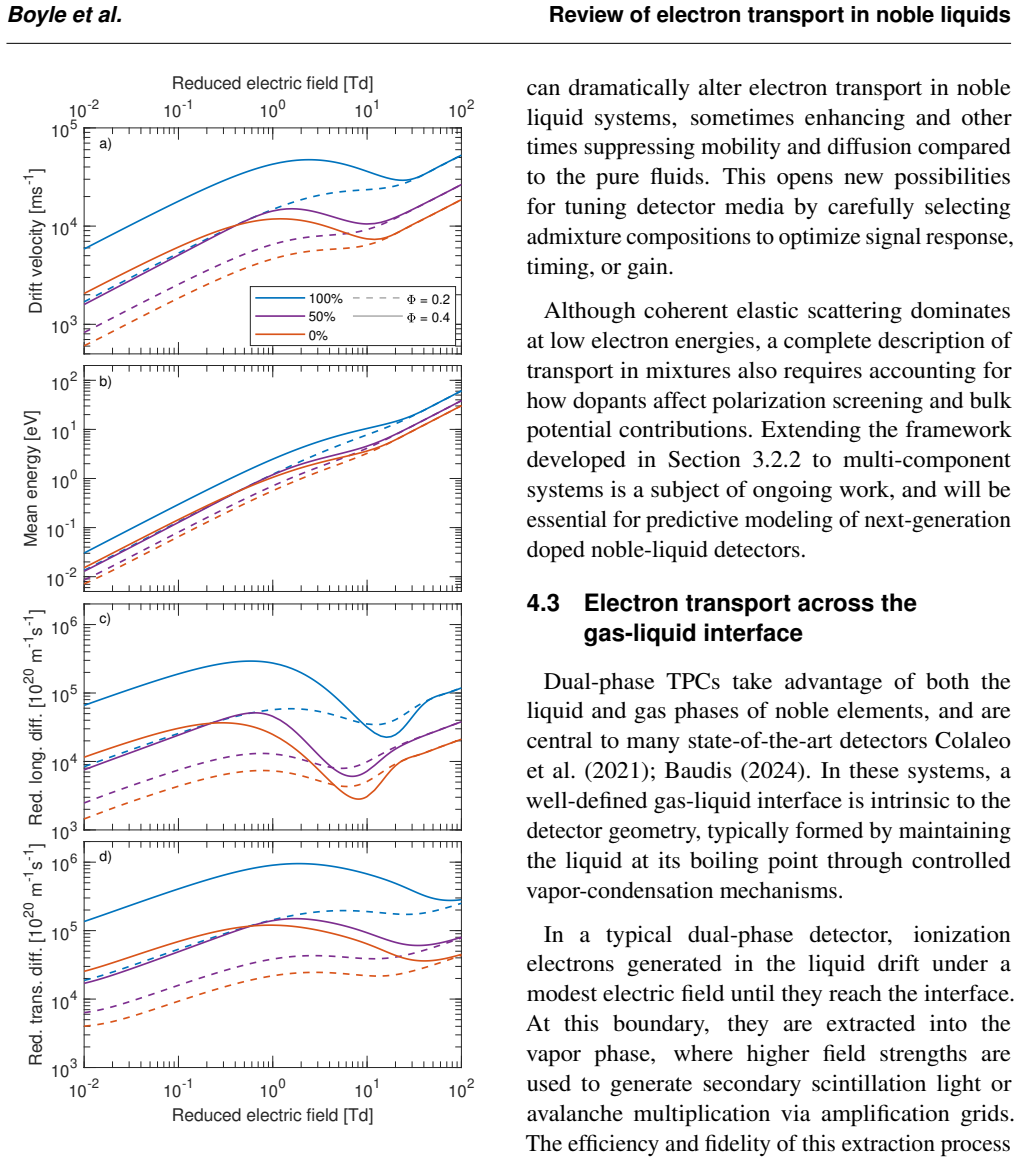
- In doped and mixed liquids, transport coefficients can lie outside the range bounded by the pure species, so mixture modeling requires partial static structure factors and cannot be interpolated from pure-fluid properties.
- Modeling the gas–liquid interface as a smooth density gradient with a spatially varying conduction-band energy $V_0$ yields an effective field that can either inhibit or assist electron extraction in dual-phase time projection chambers.
- Accurate inelastic rate coefficients for interband transitions and excitations, which become dominant above roughly $20$ Td in liquid xenon, are required inputs for scintillation and discharge modeling; they are not yet known from first principles.
Reading between the lines
- If the band-gap-shifted gas-phase cross-sections for inelastic scattering are validated against high-field drift, diffusion, and ionization data from large TPCs, the same scaling could be used to predict scintillation yields without invoking fitted light-yield parameters; this is an extension the paper leaves for future work.
- The open database's standardized $E/N$ and $N\mu$ entries could be used as training data for inverse-swarm machine-learning extraction of liquid-phase cross-sections, in parallel with the gas-phase deep-learning methods the paper cites, giving a testable route to close the inelastic gap.
- The non-linear mixture behaviour at high packing fraction suggests that small dopant concentrations might be tuned to engineer mobility or diffusion, but only if the partial structure factors are known; that tuning knob is an implicit consequence of the review's mixture formalism.
Signed reviews
Editorial analysis
A structured set of objections, weighed in public.
Referee Report
Summary. This manuscript reviews the experimental and theoretical understanding of electron transport in liquid argon and xenon, with emphasis on time projection chamber applications. It introduces an open-access database of mobility and diffusion measurements, surveys historical and modern swarm experiments, and contrasts empirical models (NEST, BNL) with the authors' multi-term Boltzmann framework that incorporates structure-modified elastic cross-sections, screened polarization potentials, and bulk potential modifications. The central theoretical claim is that this framework reproduces measured transport coefficients in liquid argon quantitatively without empirical tuning (Section 3.2.3). The review also discusses inelastic scattering approximations, electron self-trapping, scintillation, doped mixtures, and gas-liquid interfaces.
Significance. If the central claim holds, the paper offers a parameter-light ab initio alternative to empirical transport models for noble-liquid detectors, and the open-access database is a useful community resource for benchmarking swarm data. The review is careful in flagging inconsistent legacy measurements and in distinguishing flux from bulk transport coefficients, and it explicitly acknowledges the limitations of current inelastic models, for which no validated liquid cross-sections exist. These strengths make the review informative. However, the quantitative validation of the central claim is imported from self-cited prior papers and is not accompanied by in-paper error or sensitivity analysis, which limits the weight that can be placed on the 'no empirical tuning' assertion.
major comments (3)
- [Section 3.2.3, Figure 6] The central claim that the structure-modified, screened-potential framework reproduces LAr transport 'without the need for empirical tuning' is under-constrained by the evidence shown. Figure 6 is reproduced from Boyle et al. (2015) without in-paper verification, and no sensitivity analysis is provided for the matching radius r_m defined in Section 3.2.2, which is set by the first turning point of U_eff. Because alternative criteria, such as the Wigner-Seitz radius used by Atrazhev and collaborators, give nearby but different values, the dependence of W and (3/2)D_T/µ on r_m should be shown; if a small change in r_m shifts the computed coefficients by more than the experimental scatter, the quantitative agreement is not robust. In addition, the characteristic-energy panel of Figure 6 compares the 85 K liquid calculation to only one liquid dataset, Shibamura et al. (1979), whose caption states the liquid temperature was unmeasured; an unknown temperature implies unknown density and structure factor, so this single comparison is not a controlled validation. I recommend either adding a sensitivity and uncertainty analysis or tempering the 'no empirical tuning' claim to what the reproduced figure actually supports.
- [Section 3.2.4] The inelastic-scattering treatment assumes that liquid-phase cross-sections can be approximated by gas-phase cross-sections shifted to the measured liquid band gap, with atomic excitation cross-sections used for excitons and n>1 Wannier excitons omitted. The paper itself concedes that 'the fraction of clusters that support exciton formation versus those contributing only perturbed atomic transitions remains unknown' and that the ionization data used for validation in Figure 7 are limited to low reduced fields. Since the rate coefficients shown in Figure 8 and the scintillation discussion in Section 4.1 depend on these inelastic cross-sections, the quantitative part of the theoretical narrative for inelastic processes and high-field behavior is not established. The limitation is acknowledged, but it should be presented as an open problem rather than as part of the validated framework described in the abstract.
- [Section 2.1 and Tables 1-2] The new database is a central contribution, but many entries have missing density and pressure, and the text states that densities are estimated along the saturated liquid line from NIST when not reported. Since the reduced field E/N is obtained using these densities, an unquantified density estimate propagates directly into the quantities plotted in Figures 1-2. The repository should document, for each entry, whether density was reported or estimated, the estimation method, and an uncertainty estimate; without this, the transparent benchmarking goal is only partially met.
minor comments (5)
- [Section 1] The Introduction contains the duplicated phrase 'for for'; please correct it.
- [Section 3.2.2] The notation in Equation (18) should be checked: the screening function f(t) and the polarizability alpha_d(t) are used in a product inside the integral, but the distinction between the screening function and the dipole polarizability is not consistently annotated in the surrounding text.
- [Figure 6 caption] The legend labels contain typos ('Hal ern', 'Towse dBaile') and the reference 'Townsend and A., B. V.' is malformed; these should be corrected.
- [Author Contributions] The Author Contributions list contains 'IS' twice, with one entry appearing to be a duplicate; please remove the redundant entry.
- [Section 3.2.2] The text uses 'Wigner-Seitz diameter' in one place and 'Wigner-Seitz cell radii' earlier in the paper; please standardize the terminology.
Circularity Check
No significant circularity: the paper's theoretical claims are anchored in externally benchmarked gas-phase potentials and experimental transport data, with honest caveats.
full rationale
This paper is a review, not a derivation of new empirical predictions. Its central theoretical narrative—structure-modified elastic cross-sections plus screened and bulk-modified potentials reproduce liquid-argon transport coefficients—is carried by Figures 5 and 6, both reproduced from Boyle et al. (2015). The load-bearing content in that citation is not a fitted parameter renamed as a prediction: the elastic potential is validated against the independent Buckman et al. (2000) gas-phase benchmark, and the liquid-phase transport is compared to external measurements (Miller et al., 1968; Halpern et al., 1967; Shibamura et al., 1979). The matching radius rm is fixed by a stated physical criterion, the first turning point of Ueff, rather than optimized against the target data. The inelastic section explicitly presents four scenarios and compares them to Derenzo et al. (1974), acknowledging that 'the fraction of clusters that support exciton formation versus those contributing only perturbed atomic transitions remains unknown' and that the ionization data are 'limited to relatively low reduced electric fields'—an admission of uncertainty, not a circularity. The mixture results (Figures 10–11) are benchmark demonstrations on a hard-sphere system, not predictions requiring empirical input. Self-citations are frequent but they are used as pointers to published, externally falsifiable computations; no uniqueness theorem or definitional equivalence is invoked to force the conclusions. The concerns raised about the unmeasured liquid temperature in the Shibamura point and the absence of sensitivity analysis for rm are validation-strength issues that belong in a correctness assessment, not a circularity finding.
Assumptions & free parameters
free parameters (3)
- liquid band-gap threshold shifts for inelastic cross-sections =
adjusted to match band gaps (LXe 9.22 eV, etc.)
- scattering-cell matching radius r_m =
r_m approximately 4.3 a0 for LAr
- density estimates for unreported liquid conditions =
NIST saturated-liquid-line values
assumptions (5)
- domain assumption The Boltzmann collision operator with the Wang Chang-Uhlenbeck-de Boer form (Eq. 3) applies to electrons in dense liquids.
- domain assumption Coherent scattering is fully described by the single-scatterer approximation with the static structure factor S(q) (Eq. 17).
- ad hoc to paper Lekner's screening integral equation (Eq. 18) with Lorentz asymptotic limit (Eq. 20) correctly captures polarization screening in noble liquids.
- ad hoc to paper Liquid-phase inelastic cross-sections can be approximated by gas-phase cross-sections, shifted by the band gap, with optically forbidden and n>1 excitons neglected.
- domain assumption Free-particle boundary conditions with constant potential beyond the matching radius r_m are valid for computing phase shifts.
Cite this review
Pith. "Pith review of Review of the experimental and theoretical landscape of electron transport in noble liquids." pith.science (2026). https://pith.science/paper/AEJKL6CY
@misc{pith2026250416338,
  author       = {Pith},
  title        = {Pith review of: Review of the experimental and theoretical landscape of electron transport in noble liquids},
  year         = {2026},
  howpublished = {\url{https://pith.science/paper/AEJKL6CY}},
  note         = {Machine review of arXiv:2504.16338}
}
read the original abstract
We present a review of the current experimental and theoretical understanding of electron transport in noble liquids. Special attention is given to recent measurements that coincide with the development of time projection chambers (TPCs) using liquid xenon and argon as detector media. To enable transparent benchmarking of simulations and to facilitate the comparison between early studies and modern TPC data, we introduce a new open-access database of electron mobility and diffusion measurements. In particular, we emphasize the transition to large-scale detector designs which incorporate extended drift distances alongside improved purity control and field uniformity. On the theoretical side, we contrast empirical transport models with ab initio approaches, highlighting our recent efforts to incorporate low-energy, liquid-specific scattering phenomena, including coherent scattering, polarization screening, and bulk potential modifications. While elastic transport has seen substantial theoretical progress, inelastic processes in liquids, including ionization, exciton formation and interband transitions, remain poorly understood due to the lack of experimental cross sections and validated models. We also discuss the applications and challenges of modeling scintillation, doped and mixture-liquid targets, and gas-liquid interface behavior, all of which are critical for the design and optimization of next-generation detectors.
Figures


Figures from the paper (7 more)


Reference graph
Works this paper leans on
-
[1]
Aalbers, J., Akerib, D. S., Akerlof, C. W., Al Musalhi, A. K., Alder, F., Alqahtani, A., et al. (2023). First Dark Matter Search Results from the LUX-ZEPLIN ( LZ ) Experiment . Physical Review Letters 131, 041002. doi:10.1103/PhysRevLett.131.041002 LUX-ZEPLINCollaboration2023
-
[2]
Abel, B. (2013). Hydrated interfacial ions and electrons. Annual review of physical chemistry 64, 533--552 Abel2013
2013
-
[3]
A., Acciarri, R., Acero, M., Adamov, G., Adamowski, M., et al
Abi, B., Abud, A. A., Acciarri, R., Acero, M., Adamov, G., Adamowski, M., et al. (2020). First results on ProtoDUNE-SP liquid argon time projection chamber performance from a beam test at the CERN Neutrino Platform . Journal of Instrumentation 15, P12004. doi:10.1088/1748-0221/15/12/P12004 Abi2020
-
[4]
Abratenko, P., Alrashed, M., An, R., Anthony, J., Asaadi, J., Ashkenazi, A., et al. (2021 a ). Cosmic Ray Background Rejection with Wire-Cell LArTPC Event Reconstruction in the MicroBooNE Detector . Physical Review Applied 15, 064071. doi:10.1103/PhysRevApplied.15.064071 Abratenko2021
-
[5]
Abratenko, P., An, R., Anthony, J., Asaadi, J., Ashkenazi, A., Balasubramanian, S., et al. (2021 b ). Measurement of the longitudinal diffusion of ionization electrons in the MicroBooNE detector. Journal of Instrumentation 16, P09025. doi:10.1088/1748-0221/16/09/P09025 microboone2021
-
[6]
A., Abi, B., Acciarri, R., Acero, M
Abud, A. A., Abi, B., Acciarri, R., Acero, M. A., Adames, M., Adamov, G., et al. (2024). Doping liquid argon with xenon in protodune single-phase: effects on scintillation light. Journal of Instrumentation 19, P08005 DUNE2024
2024
-
[7]
Acciarri, R., Antonello, M., Baibussinov, B., Baldo-Ceolin, M., Benetti, P., Calaprice, F., et al. (2010). Oxygen contamination in liquid argon: combined effects on ionization electron charge and scintillation light. Journal of Instrumentation 5, P05003 Acciarri2010
2010
-
[8]
B., Barbeau, P
Albert, J. B., Barbeau, P. S., Beck, D., Belov, V., Breidenbach, M., Brunner, T., et al. (2017). Measurement of the drift velocity and transverse diffusion of electrons in liquid xenon with the EXO-200 detector. Physical Review C 95, 025502 Albert2017
2017
Show all 181 references
-
[9]
D., Antochi, V
Aprile, E., Agostini, F., Alfonsi, M., Althueser, L., Amaro, F. D., Antochi, V. C., et al. (2019). XENON1T dark matter data analysis: Signal and background models and statistical inference. Physical Review D 99, 112009. doi:10.1103/PhysRevD.99.112009 Aprile2019
2019 doi
-
[10]
Aprile, E., Arisaka, K., Arneodo, F., Askin, A., Baudis, L., Behrens, A., et al. (2012). The XENON100 dark matter experiment. Astroparticle Physics 35, 573--590. doi:10.1016/j.astropartphys.2012.01.003 Aprile2012
2012 doi
-
[11]
and Baudis, L
Aprile, E. and Baudis, L. (2010). Liquid noble gases. In Particle Dark Matter, ed. G. Bertone (Cambridge University Press). 413–436. doi:10.1017/cbo9780511770739.022 AprileBaudis2010
2010 doi
-
[12]
and Steinberger, I
Asaf, U. and Steinberger, I. T. (1971). Wannier excitons in liquid xenon. Physics Letters A 34, 207--208. doi:https://doi.org/10.1016/0375-9601(71)90831-0 Asaf1971
1971 doi
-
[13]
and Steinberger, I
Asaf, U. and Steinberger, I. T. (1974). Photoconductivity and electron transport parameters in liquid and solid xenon. Phys. Rev. B 10, 4464--4468. doi:10.1103/PhysRevB.10.4464 Asaf1974
1974 doi
-
[14]
Atrazhev, V., Iakubov, I., and Pogosov, V. (1995). Evolution of the ramsauer effect on scattering of electrons in liquids. Physics Letters A 204, 393--398 AtrazhevIakubovPogosov_1995
1995
-
[15]
Atrazhev, V. M. and Iakubov, I. T. (1981). Hot electrons in non-polar liquids. Journal of Physics C: Solid State Physics 14, 5139. doi:10.1088/0022-3719/14/33/021 AtrazhevIakubov_1981
1981 doi
-
[16]
Atrazhev, V. M. and Timoshkin, I. V. (1996). Electron scattering by a cut-off atomic potential: Application to electron properties in atomic liquids. Phys. Rev. B 54, 11252--11260. doi:10.1103/PhysRevB.54.11252 AtrazhevTimoshkin1996
1996 doi
-
[17]
Atrazhev, V. M. and Timoshkin, I. V. (1998). Transport of electrons in atomic liquids in high electric fields. IEEE Transactions on Dielectrics and Electrical Insulation 5, 450--457. doi:10.1109/94.689434 AtrazhevTimoshkin1998
1998 doi
-
[18]
Barrelet, E., Andrieu, B., Babaev, A., Banas, E., Bederede, D., Biddulph, P., et al. (2002). A purity monitoring system for the h1 liquid argon calorimeter. Nuclear Instruments and Methods in Physics Research Section A: Accelerators, Spectrometers, Detectors and Associated Equ...
2002
-
[19]
Baudis, L. (2024). Dual-phase xenon time projection chambers for rare-event searches. Philosophical Transactions of the Royal Society A 382, 20230083 Baudis2024
2024
-
[20]
P., Cuenca-Garc \'i a , J
Baudis, L., Biondi, Y., Bismark, A., Cimental Ch \'a vez, A. P., Cuenca-Garc \'i a , J. J., Franchi, J., et al. (2023). Electron transport measurements in liquid xenon with Xenoscope , a large-scale DARWIN demonstrator. The European Physical Journal C 83, 717. doi:10.1140/epjc...
2023 doi
-
[21]
Baudis, L., Biondi, Y., Capelli, C., Galloway, M., Kazama, S., Kish, A., et al. (2018). A dual-phase xenon TPC for scintillation and ionisation yield measurements in liquid xenon. The European Physical Journal C 78, 351. doi:10.1140/epjc/s10052-018-5801-5 Baudis2018
2018 doi
-
[22]
Baur, D., Bismark, A., Brown, A., Dierle, J., Fischer, H., Glade-Beucke , R., et al. (2023). The XeBRA platform for liquid xenon time projection chamber development. Journal of Instrumentation 18, T02004. doi:10.1088/1748-0221/18/02/T02004 Baur2023
2023 doi
-
[23]
Beaglehole, D. (1965). Reflection studies of excitons in liquid and solid xenon. Phys. Rev. Lett. 15, 551--553. doi:10.1103/PhysRevLett.15.551 Beaglehole1965
1965 doi
-
[24]
Beever, Z., Caratelli, D., Fava, A., Pietropaolo, F., Stocker, F., and Zettlemoyer, J. (2024). TRANSLATE - a Monte Carlo simulation of electron transport in liquid argon. Computer Physics Communications 297, 109056. doi:10.1016/j.cpc.2023.109056 Beever2024
2024
-
[25]
Boer, D., Verhoeven, S., Graef, W., Carbone, E., and van Dijk , J. (2023). Lxcat 3: A novel data platform for low temperature plasma physics. In International Conference on Phenomena in Ionized Gases XXXV, ICPIG XXXV ; Conference date: 09-07-2023 Through 14-07-2023. 165 Boer2023
2023
-
[26]
u ber das W \
Boltzmann, L. (1872). Weitere S tudien \"u ber das W \"a rmegleichgewicht unter G asmolek \"u len. Wiener Berichte 66, 275--370 Boltzmann1872
-
[27]
Bonivento, W. M. and Terranova, F. (2024). The science and technology of liquid argon detectors. Rev. Mod. Phys. 96, 045001. doi:10.1103/RevModPhys.96.045001 Bonivento2024
2024 doi
-
[29]
Borghesani, A. F. (2014). Electron swarm experiments in dense rare gases: A review. The European Physical Journal D 68, 62 Borghesani2014
2014
-
[30]
Borghesani, A. F. (2021). Accurate electron drift mobility measurements in moderately dense helium gas at several temperatures. Atoms 9, 52 Borghesani2021-fk
2021
-
[31]
F., Bruschi, L., Santini, M., and Torzo, G
Borghesani, A. F., Bruschi, L., Santini, M., and Torzo, G. (1988). Electron mobility in neon at high densities. Physical Review A 37, 4828--4835. doi:10.1103/PhysRevA.37.4828 Borghesani1988
1988 doi
-
[32]
Borghesani, A. F. and Santini, M. (1994). Density and field dependence of excess electron mobility in high-density noble gases. In Linking the Gaseous and Condensed Phases of Matter: The Behavior of Slow Electrons (Springer). 259--279 BorghesaniSantini1994
1994
-
[33]
F., Santini, M., and Lamp, P
Borghesani, A. F., Santini, M., and Lamp, P. (1992). Excess electron mobility in high-density argon gas. Physical Review A 46, 7902--7909. doi:10.1103/PhysRevA.46.7902 Borghesani1992a
1992 doi
-
[34]
J., Garland, N
Boyle, G. J., Garland, N. A., McEachran, R. P., Mirihana, K. A., Robson, R. E., Sullivan, J. P., et al. (2024). Electron scattering and transport in simple liquid mixtures. Journal of Physics B: Atomic, Molecular and Optical Physics 57, 015202. doi:10.1088/1361-6455/ad1d35 Boyle_2024
2024 doi
-
[35]
J., McEachran, R
Boyle, G. J., McEachran, R. P., Cocks, D. G., Brunger, M. J., Buckman, S. J., Dujko, S., et al. (2016). Ab initio electron scattering cross-sections and transport in liquid xenon. Journal of Physics D: Applied Physics 49, 355201. doi:10.1088/0022-3727/49/35/355201 BoyleEtal2016
2016 doi
-
[36]
J., McEachran, R
Boyle, G. J., McEachran, R. P., Cocks, D. G., and White, R. D. (2015). Electron scattering and transport in liquid argon . The Journal of Chemical Physics 142, 154507. doi:10.1063/1.4917258 BoyleEtal2015
2015 doi
-
[37]
J., Stokes, P
Boyle, G. J., Stokes, P. W., Robson, R. E., and White, R. D. (2023). Boltzmann’s equation at 150: Traditional and modern solution techniques for charged particles in neutral gases. The Journal of Chemical Physics 159, 024306. doi:10.1063/5.0153973 Boyle_etal23
2023 doi
-
[38]
J., Tattersall, W
Boyle, G. J., Tattersall, W. J., Cocks, D. G., McEachran, R. P., and White, R. D. (2017). A multi-term solution of the space–time B oltzmann equation for electrons in gases and liquids. Plasma Sources Science and Technology 26, 024007. doi:10.1088/1361-6595/aa51ef Boyl17
2017 doi
-
[39]
Braglia, G. L. and Dallacasa, V. (1982). Theory of electron mobility in dense gases. Phys. Rev. A 26, 902--914. doi:10.1103/PhysRevA.26.902 BragliaDallacasa1982
1982 doi
-
[40]
Bruschi, L., Mazzi, G., and Santini, M. (1972). Localized Electrons in Liquid Neon . Physical Review Letters 28, 1504--1506. doi:10.1103/PhysRevLett.28.1504 Bruschi1972
1972 doi
-
[41]
Buckley, E., Campanella, M., Carugno, G., Cattadori, C., Gonidec, A., Mu \ n oz, R., et al. (1989). A study of ionization electrons drifting over large distances in liquid argon. Nuclear Instruments and Methods in Physics Research Section A: Accelerators, Spectrometers, Detect...
1989 doi
-
[42]
Buckman, S., Cooper, J., Elford, M., Inokuti, M., Itikawa, Y., and Tawara, H. (2000). Photon and electron interactions with atoms, molecules and ions. Numerical Data and Functional Relationships in Science and Technology, Heidelberg BuckmanEtal2000
2000
-
[43]
Burnett, D. (1935). The distribution of velocities in a slightly non-uniform gas. Proceedings of the London Mathematical Society 39, 385--430 Burnett35
1935
-
[44]
Burnett, D. (1936). The distribution of molecular velocities and the mean motion in a non-uniform gas. Proceedings of the London Mathematical Society 40, 382--435 Burnett36
1936
-
[45]
M., Stephens, J
Carbone, E., Graef, W., Hagelaar, G., Boer, D., Hopkins, M. M., Stephens, J. C., et al. (2021). Data needs for modeling low-temperature non-equilibrium plasmas: The lxcat project, history, perspectives and a tutorial. Atoms 9. doi:10.3390/atoms9010016 Carbone_2021
2021 doi
-
[46]
Champion, C., Le Loirec, C., and Stosic, B. (2012). Epotran: a full-differential monte carlo code for electron and positron transport in liquid and gaseous water. International journal of radiation biology 88, 54--61 Champion2012
2012
-
[47]
A., Saville, G., Thompson, S
Chapela, G. A., Saville, G., Thompson, S. M., and Rowlinson, J. S. (1977). Computer simulation of a gas--liquid surface. part 1. Journal of the Chemical Society, Faraday Transactions 2: Molecular and Chemical Physics 73, 1133--1144 Chapela1977
1977
-
[48]
and Cowling, T
Chapman, S. and Cowling, T. G. (1970). The mathematical theory of non-uniform gases: an account of the kinetic theory of viscosity, thermal conduction and diffusion in gases (Cambridge university press) ChapCowl70
1970
-
[49]
Cocks, D., McEachran, R., Boyle, G., Cheng, E., and White, R. (2020). Positron scattering and transport in liquid helium. Journal of Physics B: Atomic, Molecular and Optical Physics 53, 225201 Cocks2020
2020
-
[50]
and White, R
Cocks, D. and White, R. (2016). Fluctuation capture in non-polar gases and liquids. arXiv preprint arXiv:1602.07834 CocksWhite_2016
2016 arXiv
-
[51]
and Thirring, W
Cohen, E. and Thirring, W. (1973). The Boltzmann Equation (Springer) CoheThir73
1973
-
[52]
Cohen, M. H. and Lekner, J. (1967). Theory of hot electrons in gases, liquids, and solids. Phys. Rev. 158, 305--309. doi:10.1103/PhysRev.158.305 CohenLekner1967
1967 doi
-
[53]
Colaleo, A., Ropelewski, L., Dehmelt, K., Liberti, B., Titov, M., Veloso, J., et al. (2021). The 2021 ECFA Detector Research and Development Roadmap (CERN). doi:10.17181/CERN.XDPL.W2EX EFCA2021
2021 doi
-
[54]
and Larsh, A
Davidson, N. and Larsh, A. E. (1950). Conductivity Pulses Induced in Insulating Liquids by Ionizing Radiations . Physical Review 77, 706--711. doi:10.1103/PhysRev.77.706 Davidson1950
1950 doi
-
[55]
E., Mast, T
Derenzo, S. E., Mast, T. S., Zaklad, H., and Muller, R. A. (1974). Electron avalanche in liquid xenon. Phys. Rev. A 9, 2582--2591. doi:10.1103/PhysRevA.9.2582 Derentzo1974
1974 doi
-
[56]
Doke, T. (1981). Fundamental properties of liquid argon, krypton and xenon as radiation detector media. Portugaliae Physica 12, 9--48 Doke1981
1981
-
[57]
Doke, T. (1982). Recent developments of liquid xenon detectors. Nuclear Instruments and Methods in Physics Research 196, 87--96. doi:10.1016/0029-554X(82)90621-8 Doke1982
1982 doi
-
[58]
Doke, T. (2006). Scintillation of liquid xenon and its application to nuclear radiation detectors. IEEE Transactions on Dielectrics and Electrical Insulation 13, 640--649. doi:10.1109/TDEI.2006.1657979 Doke2006
2006 arXiv
-
[59]
Doke, T., Hitachi, A., Kikuchi, J., Masuda, K., Okada, H., and Shibamura, E. (2002). Absolute scintillation yields in liquid argon and xenon for various particles. Japanese Journal of Applied Physics 41, 1538. doi:10.1143/JJAP.41.1538 Doke2002
2002 doi
-
[60]
D., and Petrovi \'c , Z
Dujko, S., White, R. D., and Petrovi \'c , Z. L. (2008). Monte carlo studies of non-conservative electron transport in the steady-state townsend experiment. Journal of Physics D: Applied Physics 41, 245205 Dujko2008
2008
-
[61]
Eibl, R., Lamp, P., and Buschhorn, G. (1990). Measurement of electron mobility in liquid and critical argon at low electric-field strengths. Physical Review B 42, 4356--4362. doi:10.1103/PhysRevB.42.4356 Eibl1990
1990 doi
-
[62]
Emfietzoglou, D., Karava, K., Papamichael, G., and Moscovitch, M. (2003). Monte carlo simulation of the energy loss of low-energy electrons in liquid water. Physics in Medicine & Biology 48, 2355 Emfietzoglou2003
2003
-
[63]
Emfietzoglou, D., Papamichael, G., and Nikjoo, H. (2017). Monte carlo electron track structure calculations in liquid water using a new model dielectric response function. Radiation research 188, 355--368 Emfietzoglou2017
2017
-
[64]
Engelhardt, A. G. and Phelps, A. V. (1963). Elastic and inelastic collision cross sections in hydrogen and deuterium from transport coefficients. Phys. Rev. 131, 2115--2128. doi:10.1103/PhysRev.131.2115 EngePhel63
1963 doi
-
[65]
G., Phelps, A
Engelhardt, A. G., Phelps, A. V., and Risk, C. G. (1964). Determination of momentum transfer and inelastic collision cross sections for electrons in nitrogen using transport coefficients. Phys. Rev. 135, A1566--A1574. doi:10.1103/PhysRev.135.A1566 EngePhelRisk64
1964 doi
-
[66]
Evans, C. M. and Findley, G. (2010). Energy of the conduction band in near critical point fluids. Physics Research International 2010 EvansFindley2010
2010
-
[67]
M., Krynski, K., Streeter, Z., and Findley, G
Evans, C. M., Krynski, K., Streeter, Z., and Findley, G. L. (2015). Energy of the quasi-free electron in H2, D2, and O2: Probing intermolecular potentials within the local Wigner-Seitz model . The Journal of Chemical Physics 143, 224303. doi:10.1063/1.4936627 EvansKyrnskiStree...
2015 doi
-
[68]
R., and Massarczyk, R
Fields, D., Gibbons, R., Gold, M., McFadden, N., Elliott, S. R., and Massarczyk, R. (2023). Understanding the enhancement of scintillation light in xenon-doped liquid argon. Nuclear Instruments and Methods in Physics Research Section A: Accelerators, Spectrometers, Detectors a...
2023
-
[69]
Frost, L. S. and Phelps, A. V. (1962). Rotational excitation and momentum transfer cross sections for electrons in H _ 2 and N _ 2 from transport coefficients. Phys. Rev. 127, 1621--1633. doi:10.1103/PhysRev.127.1621 FrosPhel62
1962 doi
-
[70]
(2018 a )
Garland, N., Boyle, G., Cocks, D., and White, R. (2018 a ). Approximating the nonlinear density dependence of electron transport coefficients and scattering rates across the gas--liquid interface. Plasma Sources Science and Technology 27, 024002 Garland_2018
2018
-
[71]
(2018 b )
Garland, N., Simonovi \'c , I., Boyle, G., Cocks, D., Dujko, S., and White, R. (2018 b ). Electron swarm and streamer transport across the gas--liquid interface: a comparative fluid model study. Plasma Sources Science and Technology 27, 105004 Garland2018
2018
-
[72]
Gonz \'a lez-D \' az, D., Monrabal, F., and Murphy, S. (2018). Gaseous and dual-phase time projection chambers for imaging rare processes. Nuclear Instruments and Methods in Physics Research Section A: Accelerators, Spectrometers, Detectors and Associated Equipment 878, 200--2...
2018
-
[73]
Gopalakrishnan, R., Kawamura, E., Lichtenberg, A., Lieberman, M., and Graves, D. (2016). Solvated electrons at the atmospheric pressure plasma--water anodic interface. Journal of Physics D: Applied Physics 49, 295205 Gopalakrishnan2016
2016
-
[74]
M., Kruglov, A
Gushchin, E. M., Kruglov, A. A., and Obodovskii, I. M. (1982). Electron dynamics in condensed argon and xenon. Soviet Journal of Experimental and Theoretical Physics 55, 650 Gushchin1982
1982
-
[75]
A., and Gomer, R
Halpern, B., Lekner, J., Rice, S. A., and Gomer, R. (1967). Drift Velocity and Energy of Electrons in Liquid Argon . Physical Review 156, 351--352. doi:10.1103/PhysRev.156.351 Halpern1967
1967 doi
-
[76]
and McDonald, I
Hansen, J.-P. and McDonald, I. R. (1976). Theory of simple liquids (Academic press) HansenMcDonald1973
1976
-
[77]
Hayashi, M. (2003). Bibliography of electron and photon cross sections with atoms and molecules published in the 20th century. Xenon. Tech. rep., National Inst. for Fusion Science Hayashi2003Xe
2003
-
[78]
Hernandez, J. P. (1991). Electron self-trapping in liquids and dense gases. Rev. Mod. Phys. 63, 675--697. doi:10.1103/RevModPhys.63.675 Hernandez1991
1991 doi
-
[79]
Hiroike, K. (1969). Ornstein-zernike relation for a fluid mixture with direct correlation functions of finite range. Journal of the Physical Society of Japan 27, 1415--1421. doi:10.1143/JPSJ.27.1415 Hiroike1969
1969 doi
-
[80]
Hitachi, A., Takahashi, T., Funayama, N., Masuda, K., Kikuchi, J., and Doke, T. (1983). Effect of ionization density on the time dependence of luminescence from liquid argon and xenon. Phys. Rev. B 27, 5279--5285. doi:10.1103/PhysRevB.27.5279 Hitachi1983
1983 doi
-
[81]
Hogenbirk, E., Decowski, M., McEwan, K., and Colijn, A. (2018). Field dependence of electronic recoil signals in a dual-phase liquid xenon time projection chamber. Journal of Instrumentation 13, P10031--P10031. doi:10.1088/1748-0221/13/10/P10031 Hogenbirk2018
2018 doi
-
[82]
Huang, S. S.-S. and Freeman, G. R. (1978). Electron mobilities in gaseous, critical, and liquid xenon: Density , electric field, and temperature effects: Quasilocalization . The Journal of Chemical Physics 68, 1355--1362. doi:10.1063/1.435954 Huang1978
1978 doi
-
[83]
Huang, S. S.-S. and Freeman, G. R. (1981). Electron transport in gaseous and liquid argon: Effects of density and temperature. Physical Review A 24, 714--724. doi:10.1103/PhysRevA.24.714 Huang1981
1981 doi
-
[84]
Huxley, L. G. H. and Crompton, R. W. (1974). Diffusion and drift of electrons in gases (John Wiley & Sons) HuxlCrom74
1974
-
[85]
and Khrapak, A
Iakubov, I.-T. and Khrapak, A. (1982). Self-trapped states of positrons and positronium in dense gases in liquids. Reports on Progress in Physics 45, 697 IakubovKhrapak1982
1982
-
[86]
and Chaudhury, B
Jetly, V. and Chaudhury, B. (2021). Extracting electron scattering cross sections from swarm data using deep neural networks. Machine Learning: Science and Technology 2, 035025. doi:10.1088/2632-2153/abf15a Jetly2021
2021 doi
-
[87]
o rg, F., Cichon, D., Eurin, G., H \
J \"o rg, F., Cichon, D., Eurin, G., H \"o tzsch, L., Marrod \'a n Undagoitia, T., and Rupp, N. (2022). Characterization of alpha and beta interactions in liquid xenon. The European Physical Journal C 82, 361. doi:10.1140/epjc/s10052-022-10259-3 Jorg2022
2022 doi
-
[88]
M., Gonidec, A., Schinzel, D., and Potrebennikov, Yu
[Dataset] Kalinin, A. M., Gonidec, A., Schinzel, D., and Potrebennikov, Yu . K. (1996). Temperature and Electric Field Strength Dependence of Electron Drift Velocity in Liquid Argon . Kalinin1996
1996
-
[89]
Kim, J., Dardin, S., Jackson, K., Kadel, R., Kadyk, J., Peskov, V., et al. (2002). Studies of electron avalanche behavior in liquid argon. IEEE Transactions on Nuclear Science 49, 1851--1856. doi:10.1109/TNS.2002.801490 Kim_etal2002
2002
-
[90]
and Tagashira, H
Kondo, K. and Tagashira, H. (1990). Evolution equation and transport coefficients defined by arrival-time spectra of swarms. Journal of Physics D: Applied Physics 23, 1175. doi:10.1088/0022-3727/23/9/007 KondoTagashira_1990
1990 doi
-
[91]
Kubota, S., Hishida, M., and Raun, J. (1978). Evidence for a triplet state of the self-trapped exciton states in liquid argon, krypton and xenon. Journal of Physics C: Solid State Physics 11, 2645. doi:10.1088/0022-3719/11/12/024 Kubota1978
1978 doi
-
[92]
Kumar, K. (1966). Polynomial expansions in kinetic theory of gases. Annals of physics 37, 113--141 Kumar66
1966
-
[93]
Kumar, K. (1967). The C hapman- E nskog solution of the B oltzmann equation: A reformulation in terms of irreducible tensors and matrices. Australian Journal of Physics 20, 205--252 Kumar67
1967
-
[94]
Kumar, K., Skullerud, H., and Robson, R. E. (1980). Kinetic theory of charged particle swarms in neutral gases. Australian Journal of Physics 33, 343--448 KumaSkulRobs80
1980
-
[95]
and Buschhorn, G
Lamp, P. and Buschhorn, G. (1994). Electron transport in fluid argon in combined electric and magnetic fields. Physical Review B 50, 16824--16834. doi:10.1103/PhysRevB.50.16824 Lamp1994
1994 doi
-
[96]
and Steinberger, I
Laporte, P. and Steinberger, I. T. (1977). Evolution of excitonic bands in fluid xenon. Phys. Rev. A 15, 2538--2544. doi:10.1103/PhysRevA.15.2538 Laporte1977
1977 doi
-
[97]
L., Asaf, U., Steinberger, I
Laporte, P., Subtil, J. L., Asaf, U., Steinberger, I. T., and Wind, S. (1980). Intermediate and wannier excitons in fluid xenon. Phys. Rev. Lett. 45, 2138--2140. doi:10.1103/PhysRevLett.45.2138 Laporte1980
1980 doi
-
[98]
Lebowitz, J. L. (1964). Exact solution of generalized P ercus- Y evick equation for a mixture of hard spheres. Phys. Rev. 133, A895--A899. doi:10.1103/PhysRev.133.A895 Lebowitz1964
1964 doi
-
[99]
Lekner, J. (1967). Motion of electrons in liquid argon. Phys. Rev. 158, 130--137. doi:10.1103/PhysRev.158.130 Lekner1967
1967 doi
-
[100]
Lemmon, E. (2025). Thermophysical Properties of Fluid Systems (Gaithersburg MD, 20899: Eds. P.K. Linstrom and W.G. Mallard, National institute of Standards and Technology). Retrieved March 3, 2025 NIST
2025
-
[101]
Li, Y., Tsang, T., Thorn, C., Qian, X., Diwan, M., Joshi, J., et al. (2016). Measurement of longitudinal electron diffusion in liquid argon. Nuclear Instruments and Methods in Physics Research Section A: Accelerators, Spectrometers, Detectors and Associated Equipment 816, 160-...
2016 doi
-
[102]
Lindg rd, P. A. (1994). Computer simulation of the structure factor. In Computer Simulation Studies in Condensed-Matter Physics VII, eds. D. P. Landau, K. K. Mon, and H.-B. Sch \"u ttler (Berlin, Heidelberg: Springer Berlin Heidelberg), 69--82 Lindgard1994
1994
-
[103]
Liu, J. (2022). The first results of PandaX-4T . International Journal of Modern Physics D 31, 2230007. doi:10.1142/S0218271822300075 Liu2022
2022 doi
-
[104]
and Winkler, R
Loffhagen, D. and Winkler, R. (1996). Multi-term treatment of the temporal electron relaxation in He , Xe and plasmas. Plasma Sources Science and Technology 5, 710 LoffWink96
1996
-
[105]
and Makabe, T
Maeda, K. and Makabe, T. (1994). Time-dependent rf swarm transport by direct numerical procedure of the B oltzmann equation. Japanese Journal of Applied Physics 33, 4173. doi:10.1143/JJAP.33.4173 MaedMaka94
1994 doi
-
[106]
and Petrovic, Z
Makabe, T. and Petrovic, Z. L. (2006). Plasma Electronics: Applications in Microelectronic Device Fabrication (CRC Press) MakaPetr06
2006
-
[107]
Malkin, M. S. and Schultz, H. L. (1951). Electron Mobilities in Liquid Argon . Physical Review 83, 1051--1052. doi:10.1103/PhysRev.83.1051.2 Malkin1951
1951 doi
-
[108]
Maris, H. (2003). Properties of electron bubbles in liquid helium. Journal of low temperature physics 132, 77--95 Maris2003
2003
-
[109]
Mehnaz , Yang, L., Zou, Y., Da, B., Mao, S., Li, H., et al. (2020). A comparative study on Monte Carlo simulations of electron emission from liquid water. Medical Physics 47, 759--771. doi:10.1002/mp.13913 Mehnaz2020
2020 doi
-
[110]
S., Howe, S., and Spear, W
Miller, L. S., Howe, S., and Spear, W. E. (1968). Charge Transport in Solid and Liquid Ar , Kr , and Xe . Physical Review 166, 871--878. doi:10.1103/PhysRev.166.871 Miller1968
1968 doi
-
[111]
Morgan, W. (1991). The feasibility of using neural networks to obtain cross sections from electron swarm data. IEEE Transactions on Plasma Science 19, 250--255. doi:10.1109/27.106821 Morg91b
1991 doi
-
[112]
J., Serfling, G
Mount, B. J., Serfling, G. L., Sun, Y., Thompson, J. D., Durben, D., and Keeter, K. J. (2012). Developing a< 0.1 ppb trace gas impurity sensor for noble liquid-based direct dark matter detectors. In Proceedings of the South Dakota Academy of Science. vol. 91, 159 Mount2012
2012
-
[113]
L., Boyle, G
Muccignat, D. L., Boyle, G. G., Garland, N. A., Stokes, P. W., and White, R. D. (2024). An iterative deep learning procedure for determining electron scattering cross-sections from transport coefficients. Machine Learning: Science and Technology 5, 015047. doi:10.1088/2632-215...
2024 doi
-
[114]
and Shikin, V
Nazin, S. and Shikin, V. (2005). Minimum energy of a free electron in inert gases. Journal of Experimental and Theoretical Physics Letters 82, 236--240 NazinShikin_2005
2005
-
[115]
and Robson, R
Ness, K. and Robson, R. E. (1986). Velocity distribution function and transport coefficients of electron swarms in gases. ii. moment equations and applications. Physical Review A 34, 2185 NessRobs86
1986
-
[116]
alimaa, I., Manninen, M., and Hautoj\
Nieminen, R. M., V\"alimaa, I., Manninen, M., and Hautoj\"arvi, P. (1980). Density-functional theory of positronium and electron bubbles in helium fluids. Phys. Rev. A 21, 1677--1686. doi:10.1103/PhysRevA.21.1677 Nieminen_1980
1980 doi
-
[117]
A., and Preses, J
Nishikawa, M., Holroyd, R. A., and Preses, J. M. (2007). Mobility of electrons in supercritical krypton: Role of density fluctuations. The Journal of Chemical Physics 127, 014504. doi:10.1063/1.2746870 Nishikawa2007
2007 doi
-
[118]
S., Rao, T., et al
Njoya, O., Tsang, T., Tarka, M., Fairbank, W., Kumar, K. S., Rao, T., et al. (2020). Measurements of electron transport in liquid and gas Xenon using a laser-driven photocathode. Nuclear Instruments and Methods in Physics Research Section A: Accelerators, Spectrometers, Detect...
2020
-
[119]
S., and Zammit, M
[Dataset] Park, R., Scheiner, B. S., and Zammit, M. C. (2023). ThunderBoltz : An Open-Source DSMC-based Boltzmann Solver for Plasma Transport , Chemical Kinetics , and 0D Plasma Modeling Park2023
2023
-
[120]
Penetrante, B., Bardsley, J., and Pitchford, L. (1985). Monte carlo and boltzmann calculations of the density gradient expanded energy distribution functions of electron swarms in gases. Journal of Physics D: Applied Physics 18, 1087 Penetrante1985
1985
-
[121]
Percus, J. K. and Yevick, G. J. (1958). Analysis of classical statistical mechanics by means of collective coordinates. Phys. Rev. 110, 1--13. doi:10.1103/PhysRev.110.1 PercusYevick1958
1958 doi
-
[122]
L., Dujko, S., Mari \'c , D., Malovi \'c , G., Nikitovi \'c , Z ., S a s i \'c , O., et al
Petrovi \'c , Z. L., Dujko, S., Mari \'c , D., Malovi \'c , G., Nikitovi \'c , Z ., S a s i \'c , O., et al. (2009). Measurement and interpretation of swarm parameters and their application in plasma modelling. Journal of Physics D: Applied Physics 42, 194002 Petrovic2009
2009
-
[123]
L., Marjanovi \'c , S., Dujko, S., Bankovi \'c , A., Malovi \'c , G., Buckman, S., et al
Petrovi \'c , Z. L., Marjanovi \'c , S., Dujko, S., Bankovi \'c , A., Malovi \'c , G., Buckman, S., et al. (2014). On the use of monte carlo simulations to model transport of positrons in gases and liquids. Applied Radiation and Isotopes 83, 148--154 Petrovic2014
2014
-
[124]
C., O'Neil, S
Pitchford, L. C., O'Neil, S. V., and Rumble, J. R. (1981). Extended B oltzmann analysis of electron swarm experiments. Phys. Rev. A 23, 294--304. doi:10.1103/PhysRevA.23.294 PitcNeilRumb81
1981 doi
-
[125]
Pitchford, L. C. et al. (2017). LXC at: an open-access, web-based platform for data needed for modeling low temperature plasmas. Plasma Processes and Polymers 14, 1600098. doi:https://doi.org/10.1002/ppap.201600098 PitcEtal17
2017 doi
-
[126]
Polischuk, A. Y. (1984). Theory of electron mobility in dense gases with small polarizability. Physica B+ C 124, 91--95 Polischuk1984
1984
-
[127]
Pruett, H. D. and Broida, H. P. (1967). Free-carrier drift-velocity studies in rare-gas liquids and solids. Physical Review 164, 1138--1144. doi:10.1103/PhysRev.164.1138 Pruett1967
1967 doi
-
[128]
T., Saile, V., and Laporte, P
Reininger, R., Asaf, U., Steinberger, I. T., Saile, V., and Laporte, P. (1983). Photoconductivity and the evolution of energy bands in fluid xenon. Phys. Rev. B 28, 3193--3199. doi:10.1103/PhysRevB.28.3193 ReiningerEtal_1983
1983 doi
-
[129]
Robertson, A. (1977). Drift velocities of low energy electrons in argon at 293 and 90 k. Australian Journal of Physics 30, 39--50 Robertson1977
1977
-
[130]
Robson, R. (1984). Generalized einstein relation and negative differential conductivity in gases. Australian journal of physics 37, 35--44 Robson1984
1984
-
[131]
Robson, R. (1991). Transport phenomena in the presence of reactions: definition and measurement of transport coefficients. Australian journal of physics 44, 685--692 Robson1991
1991
-
[132]
and Ness, K
Robson, R. and Ness, K. (1986). Velocity distribution function and transport coefficients of electron swarms in gases: spherical-harmonics decomposition of B oltzmann’s equation. Physical Review A 33, 2068 RobsNess86
1986
-
[133]
Robson, R. E. (1986). Physics of reacting particle swarms in gases. The Journal of Chemical Physics 85, 4486--4501. doi:10.1063/1.451769 Robson1986
1986 doi
-
[134]
E., White, R
Robson, R. E., White, R. D., and Hildebrandt, M. (2017). Fundamentals of Charged Particle Transport in Gases and Condensed Matter (CRC Press) RobsWhitHild17
2017
-
[135]
M., Sankaran, R
Rumbach, P., Bartels, D. M., Sankaran, R. M., and Go, D. B. (2015). The solvation of electrons by an atmospheric-pressure plasma. Nature communications 6, 7248 Rumbach2015
2015
-
[136]
Sakai, Y. (2007). Quasifree electron transport under electric field in nonpolar simple-structured condensed matters. Journal of Physics D: Applied Physics 40, R441--R452. doi:10.1088/0022-3727/40/24/R01 Sakai2007
2007 doi
-
[137]
Sakai, Y., B \"o ttcher, H., and Schmidt, W. F. (1982). Excess electrons in liquid hydrogen, liquid neon, and liquid helium. Journal of Electrostatics 12, 89--96. doi:10.1016/0304-3886(82)90070-5 Sakai1982
1982 doi
-
[138]
Sakai, Y., Nakamura, S., and Tagashira, H. (1985). Drift velocity of hot electrons in liquid ar, kr, and xe. IEEE Transactions on Electrical Insulation EI-20, 133--137. doi:10.1109/TEI.1985.348789 SakiaNakamuraTagashira
1985
-
[139]
Sakai, Y., Tagashira, H., and Sakamoto, S. (1977). The development of electron avalanches in argon at high e/n values. i. monte carlo simulation. Journal of Physics D: Applied Physics 10, 1035. doi:10.1088/0022-3727/10/7/010 Sakai_1977
1977 doi
-
[140]
Schmidt, W., Illenberger, E., Khrapak, A., Sakai, Y., and Yoshino, K. (2003). Electronic conduction and breakdown in liquid helium and liquid neon. IEEE Transactions on Dielectrics and Electrical Insulation 10, 1012--1021. doi:10.1109/TDEI.2003.1255779 Schmidt2003
2003 arXiv
-
[141]
Schmidt, W. F. (1984). Electronic conduction processes in dielectric liquids. IEEE Transactions on Electrical Insulation EI-19, 389--418. doi:10.1109/TEI.1984.298767 Schmidt1984
1984
-
[142]
A., and Meyer, L
Schnyders, H., Rice, S. A., and Meyer, L. (1965). Electron Mobilities in Liquid Argon . Physical Review Letters 15, 187--190. doi:10.1103/PhysRevLett.15.187 Schnyders1965
1965 doi
-
[143]
A., and Meyer, L
Schnyders, H., Rice, S. A., and Meyer, L. (1966). Electron Drift Velocities in Liquefied Argon and Krypton at Low Electric Field Strengths . Physical Review 150, 127--145. doi:10.1103/PhysRev.150.127 Schnyders1966
1966 doi
-
[144]
Schumann, M. (2019). Direct detection of wimp dark matter: concepts and status. Journal of Physics G: Nuclear and Particle Physics 46, 103003. doi:10.1088/1361-6471/ab2ea5 Schumann_2019
2019 doi
-
[145]
Segreto, E. (2021). Properties of liquid argon scintillation light emission. Phys. Rev. D 103, 043001. doi:10.1103/PhysRevD.103.043001 Segret02021
2021 doi
-
[146]
Shibamura, E., Takahashi, T., Kubota, S., and Doke, T. (1979). Ratio of diffusion coefficient to mobility for electrons in liquid argon. Physical Review A 20, 2547--2554. doi:10.1103/PhysRevA.20.2547 Shibamura1979
1979 doi
-
[147]
Shinsaka, K., Codama, M., Srithanratana, T., Yamamoto, M., and Hatano, Y. (1988). Electron--ion recombination rate constants in gaseous, liquid, and solid argon. The Journal of Chemical Physics 88, 7529--7536. doi:10.1063/1.454317 Shinsaka1988
1988 doi
-
[148]
and Winkler, R
Sigeneger, F. and Winkler, R. (1996). Response of the electron kinetics on spatial disturbances of the electric field in nonisothermal plasmas. Contributions to Plasma Physics 36, 551--571 SigeWink96
1996
-
[149]
L., White, R., and Dujko, S
Simonovi \'c , I., Garland, N., Bo s njakovi \'c , D., Petrovi \'c , Z. L., White, R., and Dujko, S. (2019). Electron transport and negative streamers in liquid xenon. Plasma Sources Science and Technology 28, 015006. doi:10.1088/1361-6595/aaf968 SimonovicEtal_2019
2019 doi
-
[150]
Skullerud, H. R. (1968). The stochastic computer simulation of ion motion in a gas subjected to a constant electric field. Journal of Physics D: Applied Physics 1, 1567. doi:10.1088/0022-3727/1/11/423 Skullerud1968
1968 doi
-
[151]
E., Cohen, M
Springett, B. E., Cohen, M. H., and Jortner, J. (1967). Properties of an excess electron in liquid helium: The effect of pressure on the properties of the negative ion. Phys. Rev. 159, 183--190. doi:10.1103/PhysRev.159.183 SpringettCohenJortner1967
1967 doi
-
[152]
Steinberger, I. T. and Asaf, U. (1973). Band-structure parameters of solid and liquid xenon. Phys. Rev. B 8, 914--918. doi:10.1103/PhysRevB.8.914 Steinberger1973
1973 doi
-
[153]
Stephens, J. (2018). A multi-term boltzmann equation benchmark of electron-argon cross-sections for use in low temperature plasma models. Journal of Physics D: Applied Physics 51, 125203 Stephens2018b
2018
-
[154]
W., Cocks, D
Stokes, P. W., Cocks, D. G., Brunger, M. J., and White, R. D. (2020). Determining cross sections from transport coefficients using deep neural networks. Plasma Sources Science and Technology 29, 055009 StokEtal20
2020
-
[155]
W., Philippa, B., Cocks, D., and White, R
Stokes, P. W., Philippa, B., Cocks, D., and White, R. D. (2016). Solution of a generalized boltzmann's equation for nonequilibrium charged-particle transport via localized and delocalized states. Phys. Rev. E 93, 032119. doi:10.1103/PhysRevE.93.032119 Stokes_etal_2016
2016 doi
-
[156]
Swan, D. W. (1962). Electron Drift Velocity in Liquid Argon and Argon -- Nitrogen Mixtures . Nature 196, 977--978. doi:10.1038/196977a0 Swan1962
1962 doi
-
[157]
Szydagis, M., Balajthy, J., Block, G., Brodsky, J., Brown, E., Cutter, J., et al. (2022). A review of nest models, and their application to improvement of particle identification in liquid xenon experiments. arXiv preprint arXiv:2211.10726 szydagis2022review
2022 arXiv
-
[158]
A., Brodsky, J
Szydagis, M., Balajthy, J., Block, G. A., Brodsky, J. P., Brown, E., Cutter, J. E., et al. (2025). A review of nest models for liquid xenon and an exhaustive comparison with other approaches. Frontiers in Detector Science and Technology 2, 1480975 szydagis2025review
2025
-
[159]
Szydagis, M., Barry, N., Kazkaz, K., Mock, J., Stolp, D., Sweany, M., et al. (2011). Nest: a comprehensive model for scintillation yield in liquid xenon. Journal of Instrumentation 6, P10002. doi:10.1088/1748-0221/6/10/P10002 Szydagis2011
2011 doi
-
[160]
A., Farquhar, C., Flesher, A
Szydagis, M., Block, G. A., Farquhar, C., Flesher, A. J., Kozlova, E. S., Levy, C., et al. (2021). A review of basic energy reconstruction techniques in liquid xenon and argon detectors for dark matter and neutrino physics using nest. Instruments 5 Szydagis2021
2021
-
[161]
Tagashira, H., Sakai, Y., and Sakamoto, S. (1977). The development of electron avalanches in argon at high e/n values. ii. B oltzmann equation analysis. Journal of Physics D: Applied Physics 10, 1051. doi:10.1088/0022-3727/10/7/011 TagashiraEtal77
1977 doi
-
[162]
J., Cocks, D
Tattersall, W. J., Cocks, D. G., Boyle, G. J., Buckman, S. J., and White, R. D. (2015). Monte Carlo study of coherent scattering effects of low-energy charged particle transport in Percus-Yevick liquids. Physical Review E (Statistical, Nonlinear, and Soft Matter Physics) 91, 0...
2015 doi
-
[163]
Measurement of the decay spectrum with the ICARUS liquid Argon TPC
The ICARUS Collaboration (2004). Measurement of the decay spectrum with the ICARUS liquid Argon TPC . The European Physical Journal C - Particles and Fields 33, 233--241. doi:10.1140/epjc/s2004-01597-7 TheICARUSCollaboration2004
2004 doi
-
[164]
Thieme, K. (2022). The Low-Energy and Large-Scale Frontier of Dual-Phase Xenon Time Projection Chambers for Dark Matter Search . Ph.D. thesis, Zurich U. Thieme2022
2022
-
[165]
Townsend, J. S. and A., B. V. (1922). The motion of electrons in argon. The London, Edinburgh, and Dublin Philosophical Magazine and Journal of Science 43, 593--600. doi:10.1080/14786442208633916 TownBail22
1922 doi
-
[166]
and Alejandre, J
Trokhymchuk, A. and Alejandre, J. (1999). Computer simulations of liquid/vapor interface in lennard-jones fluids: Some questions and answers. The Journal of chemical physics 111, 8510--8523 Trokhymchuk1999
1999
-
[167]
Trunec, D., Bonaventura, Z., and Ne c as, D. (2006). Solution of time-dependent B oltzmann equation for electrons in non-thermal plasma. Journal of Physics D: Applied Physics 39, 2544 TrunBonaNeca06
2006
-
[168]
Tskhakaya, D., Matyash, K., Schneider, R., and Taccogna, F. (2007). The Particle-In-Cell Method . Contributions to Plasma Physics 47, 563--594. doi:10.1002/ctpp.200710072 Tskhakaya2007
2007 doi
-
[169]
van Gunsteren, W. F. and Berendsen, H. J. C. (1990). Computer simulation of molecular dynamics: Methodology, applications, and perspectives in chemistry. Angewandte Chemie International Edition in English 29, 992--1023. doi:https://doi.org/10.1002/anie.199009921 GunsterenBeredsen90
1990 doi
-
[170]
Walkowiak, W. (2000). Drift velocity of free electrons in liquid argon. Nuclear Instruments and Methods in Physics Research Section A: Accelerators, Spectrometers, Detectors and Associated Equipment 449, 288--294. doi:10.1016/S0168-9002(99)01301-7 Walkowiak2000
2000 doi
-
[171]
S., Uhlenbeck, G
Wang Chang, C. S., Uhlenbeck, G. E., and de Boer, J. (1964). Studies in S tatistical M echanics , vol. II (North-Holland) WangEtal64
1964
-
[172]
Warren, R. W. and Parker, J. H. (1962). Ratio of the diffusion coefficient to the mobility coefficient for electrons in he, ar, n _ 2 , h _ 2 , d _ 2 , co, and c o _ 2 at low temperatures and low E p . Phys. Rev. 128, 2661--2671. doi:10.1103/PhysRev.128.2661 WarrenParker_1962
1962 doi
-
[173]
P., Peters, G
Wedberg, R., O’Connell, J. P., Peters, G. H., and Abildskov, J. (2011). Pair correlation function integrals: Computation and use . The Journal of Chemical Physics 135, 084113. doi:10.1063/1.3626799 WedbergEtal2011
2011 doi
-
[174]
D., Cocks, D., Boyle, G., Casey, M., Garland, N., Konovalov, D., et al
White, R. D., Cocks, D., Boyle, G., Casey, M., Garland, N., Konovalov, D., et al. (2018). Electron transport in biomolecular gaseous and liquid systems: theory, experiment and self-consistent cross-sections. Plasma Sources Science and Technology 27, 053001. doi:10.1088/1361-65...
2018 doi
-
[175]
D., Robson, R., Dujko, S., Nicoletopoulos, P., and Li, B
White, R. D., Robson, R., Dujko, S., Nicoletopoulos, P., and Li, B. (2009). Recent advances in the application of B oltzmann equation and fluid equation methods to charged particle transport in non-equilibrium plasmas. Journal of Physics D: Applied Physics 42, 194001 WhitEtal09
2009
-
[176]
D., Robson, R
White, R. D., Robson, R. E., Schmidt, B., and Morrison, M. A. (2003). Is the classical two-term approximation of electron kinetic theory satisfactory for swarms and plasmas? Journal of Physics D: applied physics 36, 3125 WhitEtal03
2003
-
[177]
Williams, R. L. (1957). Ionic mobilities in argon and helium liquids. Canadian Journal of Physics 35, 134--146. doi:10.1139/p57-017 Williams1957
1957 doi
-
[178]
Yoshino, K., Sowada, U., and Schmidt, W. F. (1976). Effect of molecular solutes on the electron drift velocity in liquid Ar , Kr , and Xe . Physical Review A 14, 438--444. doi:10.1103/PhysRevA.14.438 Yoshino1976
1976 doi
-
[179]
, " * write output.state after.block = add.period write newline
ENTRY address annote author booktitle chapter doi edition editor eid howpublished institution journal key language month note number organization pages publisher school series title type volume year label extra.label sort.label short.list INTEGERS output.state before.all mid.s...
-
[180]
write newline
" write newline "" before.all 'output.state := FUNCTION n.dashify 't := "" t empty not t #1 #1 substring "-" = t #1 #2 substring "--" = not "--" * t #2 global.max substring 't := t #1 #1 substring "-" = "-" * t #2 global.max substring 't := while if t #1 #1 substring * t #2 gl...
-
[181]
, " * write output.state after.block = add.period write newline
ENTRY address author booktitle chapter doi edition editor eid howpublished institution journal key language month note number organization pages publisher school series title type volume year label extra.label sort.label short.list INTEGERS output.state before.all mid.sentence...
-
[182]
write newline
" write newline "" before.all 'output.state := FUNCTION n.dashify 't := "" t empty not t #1 #1 substring "-" = t #1 #2 substring "--" = not "--" * t #2 global.max substring 't := t #1 #1 substring "-" = "-" * t #2 global.max substring 't := while if t #1 #1 substring * t #2 gl...
Reviewed August 16, 2026 · model on record in the stance chip above.
Discussion (0). Continue with ORCID to comment.