REVIEW 3 major objections 6 minor 52 references
Lightweight and Self-Evolving Channel Twinning: An Ensemble DMD-Assisted Approach
T0 review · 3 major / 6 minor · reviewed 2026-08-16 · deepseek-v4-flash
Pith's one-line read The paper claims that an ensemble of compressed and extended DMD, fused by a median-threshold mask and Kriging interpolation, reconstructs and predicts moving channel gain maps from 20 snapshots, beating KKF, DMC, and LSTM in error with…
desk verdict A credible, genuinely new application of DMD to radio map twinning, but the error comparisons are not yet airtight: the fusion weight and rank are tuned on the evaluation scenario and bar charts lack error bars. read the letter →
The pith
A machine-rendered reading of the paper's core claim, the machinery that carries it, and where it could break.
The reading
What carries the argument
The central object is the Ens-DMD algorithm, an ensemble of two dynamic mode decomposition variants. The first, compressed DMD (cDMD), operates on a low-rank compressed version of the snapshot matrices and yields coarse-grained modes that are insensitive to noise; the second, extended DMD (eDMD), maps snapshots into a high-dimensional feature space through kernel basis functions and yields fine-grained modes that capture transient dynamics. Both rest on the Koopman-operator assumption that the nonlinear map evolution can be written as a linear rule $g(t+1)\approx A g(t)$, whose dominant modes are obtained by singular value decomposition. A median-threshold mask, built from the median of the eDMD map, selects stable regions from cDMD and transient regions from eDMD and fuses them with a weight $\omega$; Kriging interpolation then up-samples the fused map to the full grid. This machinery carries the argument by turning a small set of snapshots into modes, amplitudes, and eigenvalues that can be extrapolated forward in time.
What would settle it
A decisive test would run Ens-DMD on a moving-transmitter trajectory that includes a line-of-sight event—say, a transmitter passing behind a building—and measure prediction MSE at steps 15, 25, and 35; if the error rises to the KKF baseline's level before step 30, or diverges after, the linear-evolution assumption is the point of failure.
Extended reading notes
Core claim
The central discovery claimed is that the evolution of a dynamic channel gain map is well captured by an ensemble of two DMD variants: compressed DMD extracts stable, coarse-grained modes that are robust to noise, while extended DMD extracts fine-grained transient modes; a median-threshold mask computed from the extended-DMD map separates stable from transient regions, allowing the two reconstructions to be fused into a twin map, and Kriging interpolation lifts the result to a high-resolution grid. With only 20 snapshots, this ensemble DMD framework reconstructs and predicts channel gain maps in the simulated street environment with lower MSE and higher SSIM than the KKF, DMC, and LSTM baselines, at far lower computational cost. The paper states that the ensemble remains below one second while the snapshot dimension rises from 20 to 60, and that it can capture the underlying dominant evolution modes with much lower complexity than the KKF algorithm.
Load-bearing premise
The load-bearing premise is that a single linear rule can approximate how a moving transmitter reshapes the channel gain map over the prediction window; if path birth and death break that rule before useful forecasts are needed, the method's advantage disappears.
Editorial extensions
If this is right
- Radio map maintenance can move from large data-collection campaigns to a few tens of snapshots per window, since the whole pipeline operates on 20 snapshots.
- If the runtime scaling holds, the twin can be updated online between snapshots, enabling real-time radio resource management and blockage prediction in vehicle-to-everything and industrial settings.
- The four-metric evaluation (MSE, PSNR, SSIM, correlation) gives network operators a way to choose twins: correlation saturates and cannot separate methods, while SSIM captures structural fidelity that matters for power allocation.
- The twin can self-evolve as the measurement window slides, incorporating new observation data without retraining, because the DMD decomposition can be recomputed on the updated snapshot window.
- Standard DMD, KKF, and LSTM baselines are all dominated in the reported settings, meaning the practical bar for a lightweight twin is the combination of accuracy and sub-second runtime, not accuracy alone.
Reading between the lines
- Beyond the paper, the same decompose-and-mask recipe might transfer to other evolving spatial fields—interference maps, coverage under moving blockers, even non-radio environmental maps—because it only requires snapshot matrices.
- A natural extension the authors do not test is real measurement data; simulated ray-traced scenes have smooth geometry, and real street clutter may stress the linear Koopman assumption sooner, which would make the median-mask weighting $\omega$ time-varying rather than fixed.
- The 30-step horizon in the paper suggests the fusion mask is a buffer against noise, not a cure for nonlinear breakdown; one could test whether replacing Kriging with a learned interpolation or adapting the mask over time extends the useful horizon.
Signed reviews
Editorial analysis
A structured set of objections, weighed in public.
Referee Report
Summary. The paper proposes a dynamic radio map twinning framework based on an ensemble of compressed DMD (cDMD) and extended DMD (eDMD). Channel gain maps over time are treated as spatio-temporal video frames; cDMD and eDMD extract coarse- and fine-grained evolution modes, Kriging interpolation produces full-resolution twin maps, and a median-threshold mask fuses the two outputs to suppress noise. The framework is evaluated on Sionna ray-tracing data for a single street scene with a moving transmitter, using MSE, PSNR, SSIM, and correlation as metrics, and is compared with standard DMD, Kriged Kalman filtering (KKF), dynamic matrix completion (DMC), and an LSTM-based predictor. The authors report lower runtime and generally lower reconstruction/prediction error for the proposed Ens-DMD method, plus a power-allocation application study.
Significance. If the reported evaluation can be made statistically secure, the paper offers a genuinely lightweight alternative to KKF- and LSTM-based radio map prediction: the complexity analysis in Section III.D (O(NM^2) for DMD versus O(MN^3) for KKF) and the runtime trends in Fig. 6 make a credible case that DMD-based twinning scales well with only 20 snapshots. The paper also gives credit to explicit, interpretable physics-inspired modes rather than black-box learning, and the use of Sionna RT provides a reproducible simulation benchmark. However, the claimed error superiority is currently vulnerable to selection leakage from tuning the fusion weight and eDMD rank on the evaluation data, and headline metrics lack variability characterization. These issues are fixable and do not invalidate the core idea, but they must be addressed before the empirical claims can be accepted.
major comments (3)
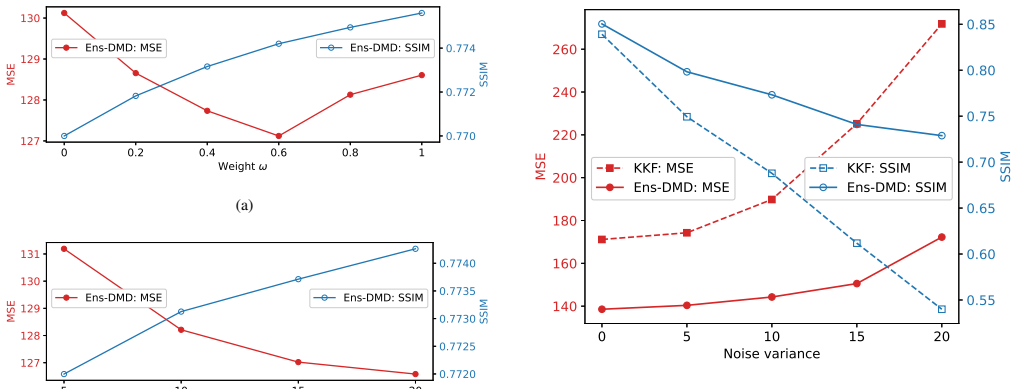
- [Section IV.B, Fig. 8(a), Eq. (25)] The fusion weight ω in Eq. (25) is tuned by sweeping over [0,1] and selecting the point that minimizes MSE/maximizes SSIM (Fig. 8(a)), but no train/validation/test split is described anywhere in Section IV. If the same data used to select ω are later used to produce the MSE/PSNR/SSIM values in Figs. 11, 13, and 14, those values are post-selection estimates, and the reported advantage over KKF, DMC, and LSTM is optimistic. Please evaluate with ω (and the eDMD rank, which is also swept in Fig. 8(b)) fixed on a validation set, and report test-set metrics.
- [Section IV.C, Figs. 11, 13, 14] Figs. 11 and 13 report a single value per metric with no error bars and no statement of the number of independent runs or trajectories, while Fig. 14 is the only figure stated to be averaged over 100 tests. Because several reported differences are small (e.g., MSE around 127 versus 130 in the clean-data reconstruction), the claim that Ens-DMD 'consistently outperforms' the baselines is not supported without a measure of variability. Please report mean ± standard deviation (or confidence intervals) over repeated Sionna realizations for all headline metrics.
- [Section III.A, Eq. (8), and Fig. 14] The linear Koopman assumption g(t+1) ≈ A_g g(t) is asserted without a concrete argument for its validity when a moving transmitter causes propagation paths to appear and disappear; Fig. 14 shows that Ens-DMD MSE degrades sharply after about 30 time steps. This is a correctness-risk concern rather than merely a scope limitation: please add a diagnostic of the model residual (e.g., ||g(t+1) − A_g g(t)|| over the prediction horizon, or a sliding-window DMD comparison) and state the horizon for which the 'self-evolving' claim is intended.
minor comments (6)
- [Section III.D] The complexity analysis uses N for the state dimension and M for the number of snapshots, but Section IV uses M=30×30 for the spatial grid and N=20 for the snapshot count; the notation is reversed and should be harmonized.
- [Section IV.C] Fig. 2(b) is referenced in Section IV as the location of the sampling grid, but the grid is shown in Fig. 3(b); correct the cross-reference.
- [Figures 1, 6, and 14] Several figure labels are corrupted by the production pipeline (e.g., 'snapsh ts' and 'C mputati n time' in Fig. 6, '/uni2016h ( f , t )/uni2016' in Fig. 1); please regenerate all figures with clean fonts.
- [Section IV.A, Eq. (29)] After Eq. (29), the text defines ¯Gtrue and ¯Gtwin but the formula uses gtrue = vec(Gtrue − mean(Gtrue)); please align the notation and state explicitly that the metric is cosine similarity.
- [Section II, Eq. (4)] Eq. (4) introduces λ0 in the Kriging estimator without defining it; for ordinary Kriging the constant term should be specified.
- [Section V] The phrase 'Section V concludes the conclusions' should read 'Section V concludes the paper.'
Circularity Check
No circularity: the Ens-DMD framework is fit on historical snapshots and tested on genuinely future maps, so the central comparison is not equivalent to its inputs.
full rationale
The derivation chain is self-contained. The DMD model in Eq. (8) is fitted to the training snapshot matrices G_1^{N-1} and G_2^N, and the prediction at t = 25δt is explicitly described as an unseen sample in Section IV.C, so the forecasting comparison is a legitimate out-of-sample test. The ensemble construction in Eq. (25) is a convex combination of cDMD and eDMD outputs modulated by a median-based mask; none of these ingredients is defined in terms of the reported MSE/SSIM values, and the predicted radio map is not forced to equal any fitted parameter by construction. The only methodological concern is that Section IV.B sweeps ω and the eDMD rank without describing a train/validation/test split, so the reported bar-chart metrics may be post-selection estimates; this is an evaluation-leakage and reproducibility issue, not a circular reduction, because the predicted map is not equal to the swept parameter or to any training label. Self-citations (e.g., [2]) are used only as background and are not load-bearing, and no uniqueness theorem or ansatz is imported from the authors' prior work. Hence no circular step can be exhibited.
Assumptions & free parameters
free parameters (4)
- eDMD rank =
5 for cDMD (rank r=5); eDMD rank tested over 5 to 20
- fusion weight omega =
0.6
- measurement time interval delta_t =
2 ms
- noise variance =
10
assumptions (3)
- domain assumption The Koopman operator assumption: there exists a linear operator A such that g(t+1) approximately equals A g(t), making the snapshot evolution linearizable.
- domain assumption Kriging yields a reliable spatial interpolation from the DMD-compressed measurements at grid points.
- domain assumption The Sionna ray-tracing simulator produces physically representative channel gain maps for real-world street scenarios.
Cite this review
Pith. "Pith review of Lightweight and Self-Evolving Channel Twinning: An Ensemble DMD-Assisted Approach." pith.science (2026). https://pith.science/paper/XER4APAN
@misc{pith2026250416376,
  author       = {Pith},
  title        = {Pith review of: Lightweight and Self-Evolving Channel Twinning: An Ensemble DMD-Assisted Approach},
  year         = {2026},
  howpublished = {\url{https://pith.science/paper/XER4APAN}},
  note         = {Machine review of arXiv:2504.16376}
}
read the original abstract
Traditional channel acquisition faces significant limitations due to ideal model assumptions and scalability challenges. A novel environment-aware paradigm, known as channel twinning, tackles these issues by constructing radio propagation environment semantics using a data-driven approach. In the spotlight of channel twinning technology, a radio map is recognized as an effective region-specific model for learning the spatial distribution of channel information. However, most studies focus on static channel map construction, with only a few collecting numerous channel samples and using deep learning for radio map prediction. In this paper, we develop a novel dynamic radio map twinning framework with a substantially small dataset. Specifically, we present an innovative approach that employs dynamic mode decomposition (DMD) to model the evolution of the dynamic channel gain map as a dynamical system. We first interpret dynamic channel gain maps as spatio-temporal video stream data. The coarse-grained and fine-grained evolving modes are extracted from the stream data using a new ensemble DMD (Ens-DMD) algorithm. To mitigate the impact of noisy data, we design a median-based threshold mask technique to filter the noise artifacts of the twin maps. With the proposed DMD-based radio map twinning framework, numerical results are provided to demonstrate the low-complexity reproduction and evolution of the channel gain maps. Furthermore, we consider four radio map twin performance metrics to confirm the superiority of our framework compared to the baselines.
Figures


Figures from the paper (12 more)




Reference graph
Works this paper leans on
-
[1]
Digital twin-empowered communications: A new frontier of wireless networks,
L. Bariah, H. Sari, and M. Debbah, “Digital twin-empowered communications: A new frontier of wireless networks,” IEEE Commun. Mag., vol. 61, no. 12, pp. 24–36, Dec. 2023
work page 2023
-
[2]
Advancing ubiquitous wireless connectivity through channel twinning,
Y . Cao, L. Dai, J. Tan, J. Wang, T. Zheng, W. Ni, E. Hossain, and D. Niyato, “Advancing ubiquitous wireless connectivity through channel twinning,” IEEE Commun. Mag. , 2024, early access, doi: 10.1109/MCOM.001.2400476
-
[3]
Digital twin channel for 6G: Concepts, architectures and potential applications,
H. Wang, J. Zhang, G. Nie, L. Yu, Z. Yuan, T. Li, J. Wang, and G. Liu, “Digital twin channel for 6G: Concepts, architectures and potential applications,” IEEE Commun. Mag. , vol. 63, no. 3, pp. 24–30, Mar. 2024
work page 2024
-
[4]
Boston Twin: the Boston digital twin for ray-tracing in 6G networks,
P. Testolina, M. Polese, P. Johari, and T. Melodia, “Boston Twin: the Boston digital twin for ray-tracing in 6G networks,” in Proc. ACM Multimedia Systems Conf. , New York, USA, Apr. 2024, p. 441–447
work page 2024
-
[5]
CAVIAR: Co-simulation of 6G Communications, 3D Scenarios and AI for Digital Twins
J. Borges, F. Bastos, I. Correa, P. Batista, and A. Klautau, “CA VIAR: Co-simulation of 6G communications, 3D scenarios and AI for digital twins,” arXiv preprint arXiv:2401.03310 , Jan. 2024
work page Pith review arXiv 2024
-
[6]
Toward environment-aware 6G communications via channel knowledge map,
Y . Zeng and X. Xu, “Toward environment-aware 6G communications via channel knowledge map,” IEEE Wireless Commun. , vol. 28, no. 3, pp. 84–91, Jun. 2021
2021
-
[7]
Radio map estimation in the real-world: Empirical validation and analysis,
R. Shrestha, T. N. Ha, P. Q. Viet, and D. Romero, “Radio map estimation in the real-world: Empirical validation and analysis,” in Proc. IEEE Conf. Antenna Meas. Appl. (CAMA) , Genoa, Italy, Nov. 2023, pp. 169– 174. 13
work page 2023
-
[8]
A tutorial on environment-aware communications via channel knowledge map for 6G,
Y . Zeng, J. Chen, J. Xu, D. Wu, X. Xu, S. Jin, X. Gao, D. Gesbert, S. Cui, and R. Zhang, “A tutorial on environment-aware communications via channel knowledge map for 6G,” IEEE Commun. Surv. Tutorials , vol. 26, no. 3, pp. 1478–1519, Thirdquarter 2024
work page 2024
Show all 52 references
-
[9]
Comparison of OTFS and OFDM in ray launched sub-6 GHz and mmwave line-of- sight mobility channels,
F. Wiffen, L. Sayer, M. Z. Bocus, A. Doufexi, and A. Nix, “Comparison of OTFS and OFDM in ray launched sub-6 GHz and mmwave line-of- sight mobility channels,” in Proc. IEEE Annu. Int. Symp. Pers. Indoor Mobile Radio Commun. (PIMRC), Bologna, Italy, Sep. 2018, pp. 73–79
2018
-
[10]
Sionna RT: Differentiable ray tracing for radio propagation modeling,
J. Hoydis, F. A. Aoudia, S. Cammerer, M. Nimier-David, N. Binder, G. Marcus, and A. Keller, “Sionna RT: Differentiable ray tracing for radio propagation modeling,” in Proc. IEEE Globecom Workshops (GC Wkshps), Dec. 2023, pp. 317–321
2023
-
[11]
Radio environment map-aided doppler shift estimation in LTE railway,
Z. Hou, Y . Zhou, L. Tian, J. Shi, Y . Li, and B. Vucetic, “Radio environment map-aided doppler shift estimation in LTE railway,” IEEE Trans. Veh. Technol., vol. 66, no. 5, pp. 4462–4467, May 2017
2017
-
[12]
A generalized channel dataset generator for 5G new radio systems based on ray- tracing,
Y . Zhang, J. Sun, G. Gui, H. Gacanin, and H. Sari, “A generalized channel dataset generator for 5G new radio systems based on ray- tracing,” IEEE Wireless Commun. Lett., vol. 10, no. 11, pp. 2402–2406, Nov. 2021
2021
-
[13]
Indoor propagation channel simulations for 6G wireless networks,
H. Obeidat and G. T. El Sanousi, “Indoor propagation channel simulations for 6G wireless networks,” IEEE Access , vol. 12, pp. 133 863–133 876, 2024
2024
-
[14]
Engineering radio maps for wireless resource management,
S. Bi, J. Lyu, Z. Ding, and R. Zhang, “Engineering radio maps for wireless resource management,” IEEE Wireless Commun., vol. 26, no. 2, pp. 133–141, Apr. 2019
2019
-
[15]
Dynamic radio map using statistical hypothesis testing,
K. Katagiri, K. Sato, K. Inage, and T. Fujii, “Dynamic radio map using statistical hypothesis testing,” IEEE Trans. Cognit. Commun. Networking, vol. 7, no. 3, pp. 752–766, Sep. 2021
2021
-
[16]
UA V-based dynamic object tracking with radio map,
Y . Dong, F. Li, C. Ma, C. He, and Z. J. Wang, “UA V-based dynamic object tracking with radio map,” in Proc. IEEE Int. Conf. Acoust., Speech, Signal Process. (ICASSP), BSeoul, Korea, Apr. 2024, pp. 9166– 9170
2024
-
[17]
Deep-learning-based radio map reconstruction for V2X communications,
S. Roger, M. Brambilla, B. C. Tedeschini, C. Botella-Mascarell, M. Cobos, and M. Nicoli, “Deep-learning-based radio map reconstruction for V2X communications,” IEEE Trans. Veh. Technol. , vol. 73, no. 3, pp. 3863–3871, Mar. 2024
2024
-
[18]
Temporal prediction for spectrum environment maps with moving radiation sources,
Y . Zhao, Q. Zhu, Z. Lin, L. Guo, Q. Wu, J. Wang, and W. Zhong, “Temporal prediction for spectrum environment maps with moving radiation sources,” IET Commun. , vol. 17, no. 5, pp. 538–548, Mar. 2023
2023
-
[19]
Cooperative spectrum sensing for cognitive radios using Kriged Kalman filtering,
S.-J. Kim, E. Dall’Anese, and G. B. Giannakis, “Cooperative spectrum sensing for cognitive radios using Kriged Kalman filtering,” IEEE J. Sel. Top. Signal Process., vol. 5, no. 1, pp. 24–36, Feb. 2011
2011
-
[20]
Channel gain map tracking via distributed Kriging,
E. Dall’Anese, S.-J. Kim, and G. B. Giannakis, “Channel gain map tracking via distributed Kriging,” IEEE Trans. Veh. Technol. , vol. 60, no. 3, pp. 1205–1211, Mar. 2011
2011
-
[21]
Radio map estimation: A data-driven approach to spectrum cartography,
D. Romero and S.-J. Kim, “Radio map estimation: A data-driven approach to spectrum cartography,” IEEE Signal Process Mag. , vol. 39, no. 6, pp. 53–72, Nov. 2022
2022
-
[22]
RadioUNet: Fast radio map estimation with convolutional neural networks,
R. Levie, Ç. Yapar, G. Kutyniok, and G. Caire, “RadioUNet: Fast radio map estimation with convolutional neural networks,” IEEE Trans. Wireless Commun., vol. 20, no. 6, pp. 4001–4015, Jun. 2021
2021
-
[23]
RadioDiff: An effective generative diffusion model for sampling-free dynamic radio map construction,
X. Wang, K. Tao, N. Cheng, Z. Yin, Z. Li, Y . Zhang, and X. Shen, “RadioDiff: An effective generative diffusion model for sampling-free dynamic radio map construction,” arXiv preprint arXiv:2408.08593 , Aug. 2024
2024 arXiv
-
[24]
Channel estimation and pilot overhead reduction in OFDM systems using compressed sensing dynamic mode decomposition,
F. Haddad, C. Bockelmann, and A. Dekorsy, “Channel estimation and pilot overhead reduction in OFDM systems using compressed sensing dynamic mode decomposition,” IEEE Commun. Lett., vol. 28, no. 5, pp. 1137–1140, May 2024
2024
-
[25]
A dynamical model for CSI feedback in mobile MIMO systems using dynamic mode decomposition,
F. Haddad et al., “A dynamical model for CSI feedback in mobile MIMO systems using dynamic mode decomposition,” in Proc. IEEE Int. Conf. Commun. (ICC), Rome, Italy, May 2023, pp. 5265–5271
2023
-
[26]
J. N. Kutz, S. L. Brunton, B. W. Brunton, and J. L. Proctor, Dynamic Mode Decomposition: Data-Driven Modeling of Complex Systems . Philadelphia, PA, USA: SIAM, 2016
2016
-
[27]
Extended dynamic mode decomposition with learned koopman eigenfunctions for prediction and control,
C. Folkestad, D. Pastor, I. Mezic, R. Mohr, M. Fonoberova, and J. Burdick, “Extended dynamic mode decomposition with learned koopman eigenfunctions for prediction and control,” in Proc. American Control Conf. (ACC), Denver, USA, Jul. 2020, pp. 3906–3913
2020
-
[28]
On-the-fly dynamic mode decomposition for rapid time-extrapolation and analysis of cavity resonances,
I. Nayak, F. L. Teixeira, and R. J. Burkholder, “On-the-fly dynamic mode decomposition for rapid time-extrapolation and analysis of cavity resonances,” IEEE Trans. Antennas Propag., vol. 72, no. 1, pp. 131–146, Jan. 2024
2024
-
[29]
Digital twin for natural gas infrastructure operation and management via streaming dynamic mode decomposition with control,
B. Koo, S. Chang, and H. Kwon, “Digital twin for natural gas infrastructure operation and management via streaming dynamic mode decomposition with control,” Energy, vol. 274, p. 127317, Jul. 2023
2023
-
[30]
Segmentation is tracking: Spatial-temporal map vehicle trajectory reconstruction and validation,
T. T. Zhang and P. J. Jin, “Segmentation is tracking: Spatial-temporal map vehicle trajectory reconstruction and validation,”IEEE Trans. Intell. Transp. Syst., vol. 24, no. 12, pp. 13 617–13 626, Dec. 2023
2023
-
[31]
How much data is needed for channel knowledge map construction?
X. Xu and Y . Zeng, “How much data is needed for channel knowledge map construction?” IEEE Trans. Wireless Commun., vol. 23, no. 10, pp. 13 011–13 021, Oct. 2024
2024
-
[32]
Kriging-based 3-D spectrum awareness for radio dynamic zones using aerial spectrum sensors,
S. J. Maeng, O. Ozdemir, I. Güvenç, and M. L. Sichitiu, “Kriging-based 3-D spectrum awareness for radio dynamic zones using aerial spectrum sensors,” IEEE Sens. J. , vol. 24, no. 6, pp. 9044–9058, Mar. 2024
2024
-
[33]
Ordinary Kriging interpolation for indoor 3D REM,
P. Maiti and D. Mitra, “Ordinary Kriging interpolation for indoor 3D REM,” J. Ambient Intell. Hum. Comput. , vol. 14, no. 10, pp. 13 285– 13 299, Oct. 2023
2023
-
[34]
Sionna: An open-source library for next-generation physical layer research,
J. Hoydis, S. Cammerer, F. Ait Aoudia, A. Vem, N. Binder, G. Marcus, and A. Keller, “Sionna: An open-source library for next-generation physical layer research,” arXiv preprint arXiv:2203.11854 , Mar. 2022
2022 arXiv
-
[35]
Multi- resolution dynamic mode decomposition for foreground/background separation and object tracking,
J. Nathan Kutz, X. Fu, S. L. Brunton, and N. Benjamin Erichson, “Multi- resolution dynamic mode decomposition for foreground/background separation and object tracking,” in Proc. IEEE Int. Conf. Comput. Vis. (ICCV) Workshops, Santiago, Chile, Dec. 2015
2015
-
[36]
Compressed dynamic mode decomposition for background modeling,
N. B. Erichson, S. L. Brunton, and J. N. Kutz, “Compressed dynamic mode decomposition for background modeling,” J. Real-Time Image Process., vol. 16, no. 5, pp. 1479–1492, Oct. 2019
2019
-
[37]
An operator theoretic approach for analyzing sequence neural networks,
I. Naiman and O. Azencot, “An operator theoretic approach for analyzing sequence neural networks,” in Proc. the AAAI Conf. Artificial Intelligence (AAAI) , vol. 37, no. 8, Washington, USA, Jun. 2023, pp. 9268–9276
2023
-
[38]
Operator is the model,
I. Mezi ´c, “Operator is the model,” arXiv preprint arXiv:2310.18516 , Dec. 2023
2023 arXiv
-
[39]
DLKoopman: A deep learning software package for Koopman theory,
S. Dey and E. W. Davis, “DLKoopman: A deep learning software package for Koopman theory,” in Proc. Learning for Dynamics and Control Conf. (L4DC) , vol. 211, Philadelphia, USA, Jun. 2023, pp. 1467–1479
2023
-
[40]
Explaining transformers through dynamical systems theory,
N. Okorokov, “Explaining transformers through dynamical systems theory,” Ph.D. dissertation, Technical University of Munich, May 2024
2024
-
[41]
Generative AI on SpectrumNet: An open benchmark of multiband 3-D radio maps,
S. Zhang, S. Jiang, W. Lin, Z. Fang, K. Liu, H. Zhang, and K. Chen, “Generative AI on SpectrumNet: An open benchmark of multiband 3-D radio maps,” IEEE Trans. Cognit. Commun. Networking , vol. 11, no. 2, pp. 886–901, Apr. 2025
2025
-
[42]
When generative AI meets semantic communication: Optimizing radio map construction and distribution in future mobile networks,
L. Zhou, X. Deng, Z. Ning, H. Zhao, J. Wei, and V . C. M. Leung, “When generative AI meets semantic communication: Optimizing radio map construction and distribution in future mobile networks,” IEEE Network, 2025, early access, doi: 0.1109/MNET.2025.3529513
2025
-
[43]
Physics-inspired machine learning for radiomap estimation: Integration of radio propagation models and artificial intelligence,
S. Zhang, B. Choi, F. Ouyang, and Z. Ding, “Physics-inspired machine learning for radiomap estimation: Integration of radio propagation models and artificial intelligence,” IEEE Commun. Mag., vol. 62, no. 8, pp. 155–161, Aug. 2024
2024
-
[44]
Dynamic matrix completion based state estimation in distribution grids,
B. Rout, S. Dahale, and B. Natarajan, “Dynamic matrix completion based state estimation in distribution grids,” IEEE Trans. Ind. Inf. , vol. 18, no. 11, pp. 7504–7511, Nov. 2022
2022
-
[45]
Fast Kalman-like filtering for large- dimensional linear and Gaussian state-space models,
B. Ait-El-Fquih and I. Hoteit, “Fast Kalman-like filtering for large- dimensional linear and Gaussian state-space models,” IEEE Trans. Signal Process., vol. 63, no. 21, pp. 5853–5867, Nov. 2015
2015
-
[46]
Propagation map reconstruction via interpolation assisted matrix completion,
H. Sun and J. Chen, “Propagation map reconstruction via interpolation assisted matrix completion,” IEEE Trans. Signal Process. , vol. 70, pp. 6154–6169, Dec. 2022
2022
-
[47]
Ns3 meets Sionna: Using realistic channels in network simulation,
A. Zubow, Y . Pilz, S. Rösler, and F. Dressler, “Ns3 meets Sionna: Using realistic channels in network simulation,” arXiv preprint arXiv:2412.20524, Dec. 2024
2024 arXiv
-
[48]
PyDMD: Python Dynamic Mode Decomposition,
N. Demo, M. Tezzele, and G. Rozza, “PyDMD: Python Dynamic Mode Decomposition,” The Journal of Open Source Software , vol. 3, no. 22, p. 530, 2018
2018
-
[49]
Toward 5G NR high-precision indoor positioning via channel frequency response: A new paradigm and dataset generation method,
K. Gao, H. Wang, H. Lv, and W. Liu, “Toward 5G NR high-precision indoor positioning via channel frequency response: A new paradigm and dataset generation method,” IEEE J. Sel. Areas Commun., vol. 40, no. 7, pp. 2233–2247, Jul. 2022
2022
-
[50]
Digital twin of the radio environment: A novel approach for anomaly detection in wireless networks,
A. Krause, M. D. Khursheed, P. Schulz, F. Burmeister, and G. Fettweis, “Digital twin of the radio environment: A novel approach for anomaly detection in wireless networks,” in Proc. IEEE Globecom Workshops (GC Wkshps), Kuala Lumpur, Malaysia, Dec. 2023, pp. 1307–1312
2023
-
[51]
Radio map-based spectrum sharing for joint communication and sensing,
X. Fang, W. Feng, Y . Chen, D. Yang, N. Ge, Z. Feng, and Y . Gao, “Radio map-based spectrum sharing for joint communication and sensing,” IEEE Open J. Commun. Soc. , vol. 5, pp. 4541–4558, 2024
2024
-
[52]
Network massive MIMO transmission over millimeter-wave and Terahertz bands: Mobility enhancement and blockage mitigation,
L. You, X. Chen, X. Song, F. Jiang, W. Wang, X. Gao, and G. Fettweis, “Network massive MIMO transmission over millimeter-wave and Terahertz bands: Mobility enhancement and blockage mitigation,” IEEE J. Sel. Areas Commun. , vol. 38, no. 12, pp. 2946–2960, Dec. 2020
2020
Reviewed August 16, 2026 · model on record in the stance chip above.
Discussion (0). Continue with ORCID to comment.