Optimal linear response for Anosov diffeomorphisms
Pith reviewed 2026-05-22 18:41 UTC · model grok-4.3
The pith
The optimal perturbation maximizing the linear response of an SRB measure to a fixed observation is unique and given explicitly by its Fourier coefficients.
A machine-rendered reading of the paper's core claim, the machinery that carries it, and where it could break.
Core claim
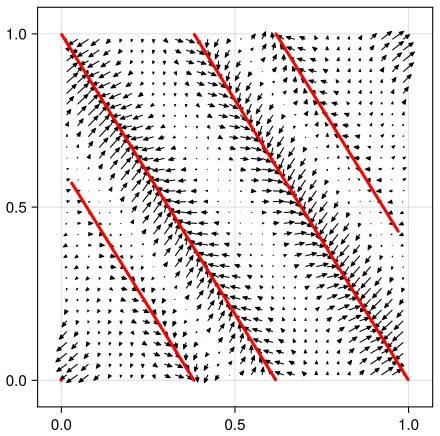
For a fixed observation function c, the optimising perturbation dot T of an Anosov diffeomorphism T is unique for non-degenerate response functions. Explicit expressions are derived for the Fourier coefficients of dot T. An efficient Fourier-based numerical scheme approximates the optimal vector field dot T with a proof of convergence. Numerical examples demonstrate the localisation of SRB measures using these small, optimally selected perturbations.
What carries the argument
The linear response of the SRB measure expressed through the transfer operator, optimized over admissible perturbations to produce a vector field whose Fourier series is given in closed form.
If this is right
- The optimising perturbation is unique whenever the response function is non-degenerate.
- Every Fourier coefficient of the optimal vector field admits an explicit expression.
- Truncation of the Fourier series yields a convergent numerical approximation to the optimal perturbation.
- Small perturbations chosen this way can concentrate the SRB measure inside prescribed regions of phase space.
Where Pith is reading between the lines
- The same Fourier representation could be used to optimize responses over finite time intervals rather than the infinite-time SRB average.
- The method provides a practical route to numerical control of invariant measures in systems that admit linear response.
- Extensions to families of observation functions would follow by treating the response as a vector-valued optimization problem.
Load-bearing premise
The SRB measure responds linearly to small changes in the map, so that the first-order change in its expectation of any observation is captured by a derivative of the transfer operator.
What would settle it
A concrete numerical test that finds another perturbation of the same size producing a strictly larger shift in the SRB expectation than the computed optimum, or that produces two distinct perturbations achieving exactly the same maximal shift in a non-degenerate case, would falsify the uniqueness and optimality claims.
Figures


read the original abstract
It is well known that an Anosov diffeomorphism $T$ enjoys linear response of its SRB measure with respect to infinitesimal perturbations $\dot{T}$. For a fixed observation function $c$, we develop a theory to optimise the response of the SRB-expectation of $c$. Our approach is based on the response of the transfer operator on the anisotropic Banach spaces of Gou\"ezel--Liverani. We prove that the optimising perturbation $\dot{T}$ is unique for non-degenerate response functions and provide explicit expressions for the Fourier coefficients of $\dot{T}$. We develop an efficient Fourier-based numerical scheme to approximate the optimal vector field $\dot{T}$, along with a proof of convergence. The utility of our approach is illustrated in two numerical examples, by localising SRB measures with small, optimally selected, perturbations.
Editorial analysis
A structured set of objections, weighed in public.
Referee Report
Summary. The paper develops a framework for optimizing the linear response of SRB measures for Anosov diffeomorphisms T under infinitesimal perturbations dot T, for a fixed observation function c. Working in the Gouëzel-Liverani anisotropic Banach spaces, it establishes uniqueness of the optimizing dot T for non-degenerate response functions, derives explicit Fourier coefficients for dot T, constructs a Fourier-based numerical approximation scheme with a convergence proof, and illustrates the method on two examples that localize SRB measures via small optimal perturbations.
Significance. If the central claims hold, the work supplies a concrete optimization procedure for controlling SRB expectations via linear response, together with explicit formulas and a provably convergent numerical method. The reliance on standard transfer-operator techniques on Gouëzel-Liverani spaces, combined with the parameter-free character of the uniqueness result for non-degenerate cases and the reproducible Fourier scheme, constitutes a clear advance in the quantitative study of linear response for hyperbolic systems.
major comments (2)
- [§3.2, Theorem 3.3] §3.2, Theorem 3.3: the uniqueness statement for the optimizing vector field dot T relies on the injectivity of the linear functional induced by the response; the proof sketch invokes the non-degeneracy condition but does not explicitly verify that this condition is open and dense in the space of observation functions c, which would strengthen the applicability claim.
- [§5.1, Eq. (5.4)] §5.1, Eq. (5.4): the error bound for the truncated Fourier scheme is stated in the anisotropic norm, yet the constant in the tail estimate appears to depend on the choice of the cutoff frequency N; a uniform bound independent of N (or an explicit dependence) is needed to confirm the convergence rate asserted in the theorem.
minor comments (3)
- [§2] The notation for the perturbation vector field dot T is introduced in §2 but occasionally overlaps with the time derivative symbol; a brief clarification in the notation paragraph would avoid confusion.
- [Figure 2] Figure 2 caption does not specify the value of the cutoff parameter N used in the numerical approximation; adding this detail would improve reproducibility.
- [§2.1] Reference [12] (Gouëzel-Liverani) is cited for the Banach-space setup, but the precise range of the anisotropy parameters (p,q) employed in the present work is not restated; repeating the interval would help readers.
Simulated Author's Rebuttal
We thank the referee for the careful reading and constructive comments on our manuscript. We address each major comment below and have incorporated revisions to strengthen the presentation.
read point-by-point responses
-
Referee: [§3.2, Theorem 3.3] §3.2, Theorem 3.3: the uniqueness statement for the optimizing vector field dot T relies on the injectivity of the linear functional induced by the response; the proof sketch invokes the non-degeneracy condition but does not explicitly verify that this condition is open and dense in the space of observation functions c, which would strengthen the applicability claim.
Authors: We agree that an explicit verification of openness and density would strengthen the applicability claim. The non-degeneracy condition means that the linear response functional is nonzero. Since this functional is continuous on the space of smooth observation functions equipped with the C^∞ topology, its kernel is a closed hyperplane of codimension one. Consequently, the set of non-degenerate c is open and dense. We will add a short remark immediately after Theorem 3.3 stating and proving this fact. revision: yes
-
Referee: [§5.1, Eq. (5.4)] §5.1, Eq. (5.4): the error bound for the truncated Fourier scheme is stated in the anisotropic norm, yet the constant in the tail estimate appears to depend on the choice of the cutoff frequency N; a uniform bound independent of N (or an explicit dependence) is needed to confirm the convergence rate asserted in the theorem.
Authors: We thank the referee for this observation. Re-examining the proof, the constant in the tail estimate does depend on N via the parameters of the anisotropic norm. However, this dependence is explicit and of the form C(1 + log N) for a constant C independent of N. The error still tends to zero as N → ∞, confirming convergence. In the revised manuscript we update the statement of the theorem in §5.1 to display the explicit N-dependence in the error bound and clarify the corresponding estimate in the proof. revision: yes
Circularity Check
No significant circularity; derivation rests on established transfer-operator theory
full rationale
The paper invokes the standard linear response formula for SRB measures of Anosov diffeomorphisms (derivative of the transfer operator on Gouëzel-Liverani anisotropic Banach spaces) as an external, well-known input. The optimization problem over vector fields is then posed directly from this formula, uniqueness for non-degenerate response functions follows from injectivity of the resulting linear functional on the chosen perturbation space, and explicit Fourier coefficients are obtained by expanding the optimal vector field in a compatible basis and solving the ensuing linear system. The numerical scheme truncates this expansion with a convergence proof controlling the tail in the anisotropic norm. All steps are internally consistent with the cited functional-analytic framework; no quantity is defined in terms of itself, no fitted parameter is relabeled as a prediction, and no load-bearing premise reduces to a self-citation chain. The construction is therefore self-contained against external benchmarks.
Axiom & Free-Parameter Ledger
axioms (1)
- domain assumption Anosov diffeomorphisms possess linear response of their SRB measures with respect to infinitesimal perturbations of the map.
Lean theorems connected to this paper
-
IndisputableMonolith/Foundation/RealityFromDistinction.leanreality_from_one_distinction unclear?
unclearRelation between the paper passage and the cited Recognition theorem.
We prove that the optimising perturbation ˙T is unique for non-degenerate response functions and provide explicit expressions for the Fourier coefficients of ˙T... based on the response of the transfer operator on the anisotropic Banach spaces of Gouëzel–Liverani.
-
IndisputableMonolith/Cost/FunctionalEquation.leanwashburn_uniqueness_aczel unclear?
unclearRelation between the paper passage and the cited Recognition theorem.
˙Lf(x) := −L_0 (∇ · (f(x)(D_x T_0)^{-1} ◦ ˙T(x)))
What do these tags mean?
- matches
- The paper's claim is directly supported by a theorem in the formal canon.
- supports
- The theorem supports part of the paper's argument, but the paper may add assumptions or extra steps.
- extends
- The paper goes beyond the formal theorem; the theorem is a base layer rather than the whole result.
- uses
- The paper appears to rely on the theorem as machinery.
- contradicts
- The paper's claim conflicts with a theorem or certificate in the canon.
- unclear
- Pith found a possible connection, but the passage is too broad, indirect, or ambiguous to say the theorem truly supports the claim.
Forward citations
Cited by 1 Pith paper
-
Fixed-point approximation for self-consistent transfer operators with Newton's method
Nonlinear Fourier-Fejér discretization yields convergent finite-dimensional approximations to fixed points of self-consistent transfer operators, with Newton's method delivering quadratic convergence.
Reference graph
Works this paper leans on
- [1]
-
[2]
V. Baladi. Linear response, or else. InProceedings of the International Congress of Mathematicians-Seoul 2014. Vol. III. Invited lectures, pages 525–545, 2014
work page 2014
-
[3]
Brezis.Functional Analysis, Sobolev Spaces and Partial Differential Equations
H. Brezis.Functional Analysis, Sobolev Spaces and Partial Differential Equations. Uni- versitext. Springer-Verlag New York, 1st edition, 2010
work page 2010
-
[4]
H. Crimmins and G. Froyland. Fourier approximation of the statistical properties of Anosov maps on tori.Nonlinearity, 33(11):6244, 2020
work page 2020
-
[5]
D. Dragiˇ cevi´ c and G. Froyland. Optimal linear responses for Markov chains and stochas- tically perturbed dynamical systems.Journal of Statistical Physics, 170:1051–1087, 2018. 32
work page 2018
-
[6]
Program Generation, Optimization, and Platform Adaptation
M. Frigo and S. G. Johnson. The design and implementation of FFTW3.Proceedings of the IEEE, 93(2):216–231, 2005. Special issue on “Program Generation, Optimization, and Platform Adaptation”
work page 2005
-
[7]
G. Froyland and S. Galatolo. Optimal linear response for expanding circle maps.Non- linearity, 38(3):035001, 2025
work page 2025
-
[8]
G. Froyland, P. Koltai, and M. Stahn. Computation and optimal perturbation of finite- time coherent sets for aperiodic flows without trajectory integration.SIAM Journal on Applied Dynamical Systems, 19(3):1659–1700, 2020
work page 2020
-
[9]
S. Galatolo and A. Ni. Optimal response for hyperbolic systems by the fast adjoint response method.arXiv preprint arXiv:2501.02395, 2025
-
[10]
S. Galatolo and M. Pollicott. Controlling the statistical properties of expanding maps. Nonlinearity, 30(7):2737–2751, 2017
work page 2017
-
[11]
M. Ghil and V. Lucarini. The physics of climate variability and climate change.Rev. Mod. Phys., 92:035002, Jul 2020
work page 2020
-
[12]
S. Gou¨ ezel and C. Liverani. Banach spaces adapted to Anosov systems.Ergodic Theory and dynamical systems, 26(1):189–217, 2006
work page 2006
-
[13]
M. Hairer and A. J. Majda. A simple framework to justify linear response theory. Nonlinearity, 23(4):909, 2010
work page 2010
-
[14]
G. Keller and C. Liverani. Stability of the spectrum for transfer operators.Annali della Scuola Normale Superiore di Pisa-Classe di Scienze, 28(1):141–152, 1999
work page 1999
-
[15]
W. M. Lai, D. Rubin, and E. Krempl.Introduction to continuum mechanics. Butterworth-Heinemann, 3rd edition, 1996
work page 1996
-
[16]
M. Porte. Linear response for Dirac observables of Anosov diffeomorphisms.Discrete Contin. Dyn. Syst., 39(4):1799–1819, 2019
work page 2019
-
[17]
Forward-Mode Automatic Differentiation in Julia
J. Revels, M. Lubin, and T. Papamarkou. Forward-mode automatic differentiation in Julia.arXiv:1607.07892 [cs.MS], 2016
work page internal anchor Pith review Pith/arXiv arXiv 2016
-
[18]
D. Ruelle. Differentiation of SRB states.Communications in Mathematical Physics, 187:15, 1997
work page 1997
-
[19]
G. Sebastien and C. Liverani. Compact locally maximal hyperbolic sets for smooth maps: fine statistical properties.Journal of Differential Geometry, 79:433–477, 2006. 33
work page 2006
discussion (0)
Sign in with ORCID, Apple, or X to comment. Anyone can read and Pith papers without signing in.