REVIEW 3 major objections 5 minor 63 references
MV-Crafter: An Intelligent System for Music-guided Video Generation
T0 review · 3 major / 5 minor · reviewed 2026-08-16 · deepseek-v4-flash
Pith's one-line read MV-Crafter produces a complete beat-synchronized music video from a single music file and a few theme words, with a monotone warp that prevents repeated frames.
desk verdict A credible end-to-end system with a genuinely novel synchronization module, but the headline quantitative claim is partly circular and the monotonicity guarantee is not proven. read the letter →
The pith
A machine-rendered reading of the paper's core claim, the machinery that carries it, and where it could break.
The reading
What carries the argument
The load-bearing object is the monotone warping function $G$, which reassigns each source video frame to a time in the synchronized clip. $G$ is anchored at key frames by a dynamic-programming matching of visual beats to music beats (one-to-one, forward-only), and the intermediate values are solved from the linear recurrence $G(t_k) = G(t_{k+1})\alpha_k + G(t_{k+2})\beta_k$, where $\alpha_k$ and $\beta_k$ are coefficients built from the visual impact envelope's values. The visual impact envelope itself, computed as the positive optical-flow deceleration summed over angles, is the quantity whose per-gap impulses the method equalizes so that the warped rhythm feels even. A frame-interpolation model then fills the gaps left by the warping.
What would settle it
Take a video clip whose visual impact envelope has a sharp isolated spike followed by a long flat segment, pair it with a music clip roughly twice as long, and print the solved $G(t_k)$ values: if any two adjacent target times are equal or decreasing, the synchronized video contains repeated or time-reversed frames, so the monotonicity claim is false.
Extended reading notes
Core claim
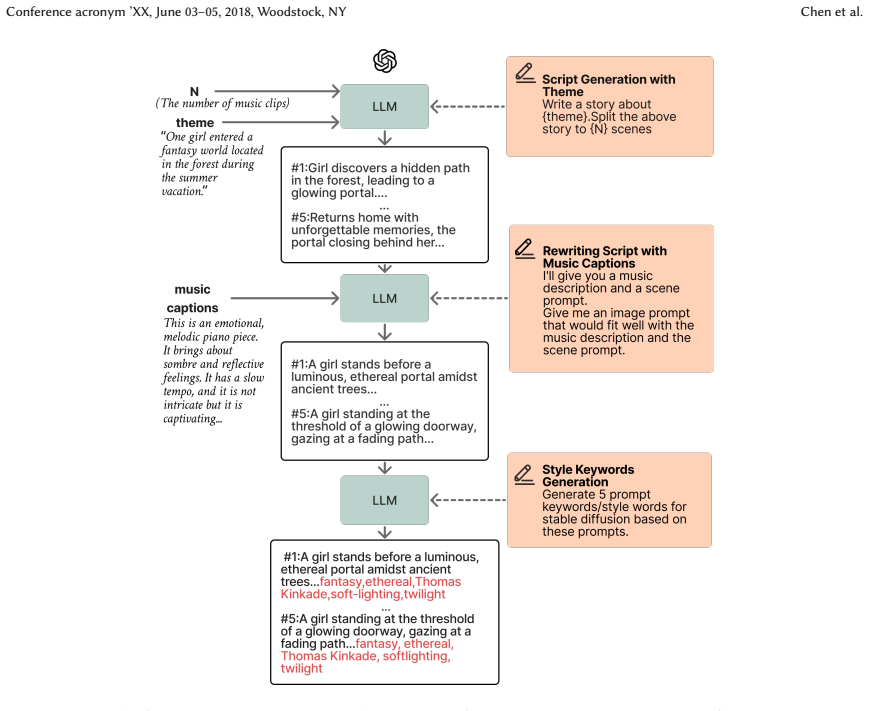
On its own terms, the paper claims that high-quality, rhythm-synchronized music videos can be generated from music plus a theme by a three-module pipeline, and that the key obstacle, short AI-generated clips against longer music, is solved by a two-stage synchronization. Stage one, dynamic beat matching, uses dynamic programming to pair each visual beat (a detected moment of strong optical-flow deceleration) with exactly one music beat, monotonically and in order. Stage two, visual envelope-induced warping, defines a warping function $G(t)$ that gives the target time for each source frame; between matched beats it sets $G$ by solving a linear system obtained by equalizing the impulse of the visual impact envelope between adjacent frames, then interpolates the remaining frames to 24 fps. The paper presents this as yielding accurate beat alignment with temporal monotonicity, and supports the claim with Beat Alignment Scores above two baselines and user ratings above AI baselines, though still below human-made videos.
Load-bearing premise
The core bet is that the timing map $G$, which stretches a short clip to a longer one, always moves strictly forward in time for arbitrary visual envelopes; the paper asserts this monotonicity but gives no proof, and a single reversed or repeated pair of frames would break the synchronization claim.
Editorial extensions
If this is right
- Non-professionals can go from a music file plus a theme to a finished, cut-to-the-beat music video without scriptwriting, shooting, or editing expertise.
- The synchronization module can stretch a short clip to fit a longer music segment without repeating frames or holding a static shot, which the paper's comparisons show the two baseline synchronization strategies do not.
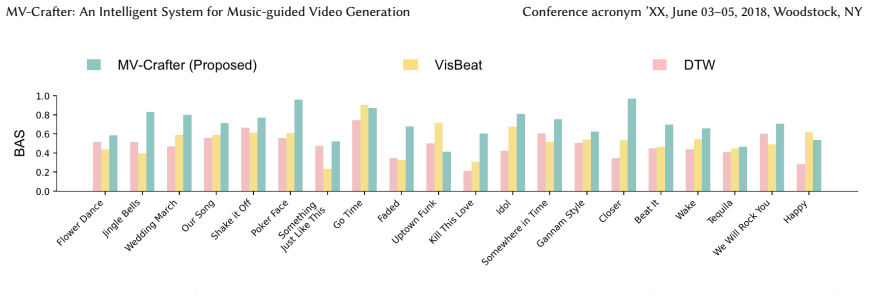
- In the paper's quantitative evaluation, the full pipeline's average Beat Alignment Score is higher than both compared generation baselines (0.777 versus 0.618 and 0.496).
- The three-step script generation, which injects music captions and style keywords, improves rated content coherence, style consistency, and music correspondence in the ablation study.
- Because the pipeline is modular, swapping in longer, higher-quality video generators, as the paper suggests, should directly improve output quality while leaving the synchronization method intact.
Reading between the lines
- The envelope-impulse linear system is a general technique, not a music-video-specific one: any task that must stretch a short visual sequence to a longer soundtrack while forbidding repeats, such as slide-to-podcast, archival footage rescoring, or dance tutorials, could use the same construction.
- The monotonicity of $G$ is asserted rather than demonstrated, so a direct stress test on adversarial envelopes (strong beat spikes next to flat regions) would separate the method's promise from its proof.
- The paper's own user study suggests that the ceiling for this pipeline is now narrative and character consistency, not rhythm: participants rated MV-Crafter below human-made videos mainly on coherence and style, implying that better character-consistency techniques would matter more than further beat-matching work.
- Because visual beats are extracted by a rule-based method, synchronization quality is bounded by that detector's reliability on smooth AI-generated clips; a learned eventfulness predictor could be swapped in and tested against the same Beat Alignment Score.
Signed reviews
Editorial analysis
A structured set of objections, weighed in public.
Referee Report
Summary. The paper presents MV-Crafter, a system that generates music videos from an input music file and a textual theme. The pipeline consists of three modules: an LLM-based script generation module that incorporates music captions and style keywords, a video generation module that combines Stable Diffusion XL with Stable Video Diffusion to create short clips, and a synchronization module that detects visual beats, matches them to music beats by dynamic programming, and warps remaining frames using a visual-envelope impulse objective. The authors report quantitative comparisons against Generative Disco and Music2Video baselines using BAS and CLIPSIM, a synchronization comparison against VisBeat and DTW, and four user studies. The central claims are that the system produces high-quality music videos and that the synchronization method achieves precise, monotonic alignment without repeated frames.
Significance. If the central synchronization claims hold, MV-Crafter would be a valuable integrated contribution for non-professional music-video creation. The paper has several genuine strengths: the three-step LLM prompting guided by music captions is well motivated, the adaptation of rule-based visual rhythm extraction to low-frame-rate AI-generated video is a sensible design choice, dynamic programming beat matching is clearly described, and the interface supports iterative editing. The ablation of script generation and the comparison with human-made animated videos are also useful evaluation components. However, the load-bearing proof of monotonic warping is incomplete, and the primary quantitative synchronization metric is partly circular. These issues must be resolved before the central contribution can be considered established.
major comments (3)
- [Section 4.4, Eqs. (14)–(18)] The central claim that the warping function G is monotone and that the synchronized video has no repeated frames is not established. Setting I_k = I_{k+1} leads to a recurrence whose coefficients divide by u_v(k)+u_v(k+1). For AI-generated 8 fps clips, static segments with u_v(k)=u_v(k+1)=0 are entirely plausible; in such segments I_k = 0 for every choice of G(t_k), so the objective does not constrain G, and the recurrence has no finite solution. The paper provides no proof that the solved G(t_k) is strictly increasing even in the non-degenerate case, and no floor, regularizer, or post-hoc monotonicity check for degenerate cases. Since temporal monotonicity is precisely the property that distinguishes this method from VisBeat and DTW in Section 5.4, this gap directly affects the abstract's synchronization claim.
- [Section 5.1, Eq. (19) and Section 4.4, Eq. (11)] The BAS metric is circular with respect to the synchronization module. BAS averages exp(-min distance from each visual beat to the nearest music beat), while the dynamic beat matching stage explicitly chooses music-beat targets for visual beats and Eq. (11) sets G(t_v') = t_m'. Thus the synchronized video's visual beats are placed at or near music beats by construction, and the reported BAS advantage is partly enforced rather than independently measured. The comparison against VisBeat and DTW in Section 5.4 is also reported only through BAS, and the user study in Section 6.1 does not directly compare MV-Crafter with VisBeat or DTW on synchronization. Please add an independent evaluation, such as a beat-alignment metric based on held-out visual events not used in the matching procedure, or a direct user rating of synchronized outputs from MV-Crafter, VisBeat, and DTW.
- [Section 6.1, Results] Four distinct metrics—theme correspondence, music correspondence, narrative, and overall quality—are reported with exactly the same mean and standard deviation (M = 3.82, SD = 0.97). Since these metrics are defined differently, this almost certainly reflects a reporting error, and as printed it makes the quantitative user-study support for those claims untrustworthy. Please re-check the data and report the actual values, or explain why the values are identical. The same subsection also reports that 14 of 30 participants (86.7%) watch music videos monthly or weekly, but 14/30 is 46.7%; this percentage should be corrected.
minor comments (5)
- [Section 5.2] The statement that 'our method accurately aligned visual beats with all music beats' is stronger than what the algorithm guarantees, because Section 4.4 explicitly allows unpaired music beats when there are fewer visual beats than music beats.
- [Section 5.4] The phrase 'monotonous temporal alignment' should be 'monotonic temporal alignment'; the same typo appears earlier in the description of the synchronization goal.
- [Section 5.1, Data] The list of ten genres contains 'classical' twice: pop, electronic, country, classical, dance, soul, hip-hop, classical, Christmas, and funk. The duplicate should be removed or replaced.
- [Section 4.4, Eq. (10)] The notation u_m(m_n) and u_v(v_n) is described as the average envelope of music beats and visual beats, but it is not specified over which beats the average is taken; please define these quantities precisely.
- [Section 5.1, Eq. (19)] The text describes BAS as the average distance between visual beats and music beats, but the formula is the average of exp(-squared-distance/(2 sigma^2)); the wording should match the formula.
Circularity Check
The headline BAS evaluation is the synchronization objective by construction: Eq. 11 places matched visual beats exactly on music beats, so the high BAS reported in Figs. 8 and 9 measures the algorithm's own construction rather than an independent prediction.
-
fitted input called prediction
[§4.4 Eq. (11) and §5.1 Eq. (19), used in §5.3 and §5.4]
"Upon solving the dynamic programming, we obtain the optimal matching beat pairs {(v′_i, m′_i)}, from which we deduce the warping of beat frames: G(t_v′_i) = t_m′_i [...] BAS is defined as the average distance between each visual beat and its nearest music beat: BAS = 1/|B_v| Σ_i exp(−min_{t_m_j ∈ B_m} ||t_v_i − t_m_j||²/2σ²)."
The synchronization module constructs the warping G so that every matched visual beat lands exactly on a music-beat time (Eq. 11), and the matching objective (Eq. 10) already minimizes a normalized version of that time difference. The evaluation metric BAS (Eq. 19) measures exactly this distance: each matched beat contributes exp(0)=1 by construction. Thus the reported BAS advantage (0.777 in Fig. 8; 0.699 in Fig. 9) is the algorithm's own objective renamed as a prediction, not an independent test. Baselines VisBeat and DTW, which do not enforce this equality, are compared against a metric that is the proposed method's objective.
full rationale
MV-Crafter's script and video generation claims are supported by independent user studies and by comparison with human-made videos, and I found no load-bearing self-citation chain: VisBeat is used as an independent low-level rhythm extractor, not as the source of the claimed synchronization novelty. The single genuine circular step is the BAS evaluation of the synchronization module. Eq. 11 explicitly fixes target times of matched visual beats to music-beat times, while Eq. 19 scores videos by the closeness of visual beats to the nearest music beat; the high BAS values are therefore enforced by the construction. The user studies are non-circular but do not rescue the synchronization-specific quantitative claim: in the quality study both MV-Crafter and Generative Disco+LLM significantly beat the no-sync SVD+LLM baseline on synchronization, and MV-Crafter is not shown to be significantly better than Generative Disco+LLM; the only evidence for that sync-module superiority is the constructed BAS metric. The missing monotonicity proof in Eqs. 16-18 is a correctness gap, not a circularity, so it is excluded from the score. Because one headline prediction reduces by construction while the overall system has independent content, the partial-circularity score is 6.
Assumptions & free parameters
free parameters (5)
- Visual beat detection threshold =
10% of global envelope maximum
- Visual beat local-max window =
0.125 seconds (1 frame at 8 fps)
- Beat Alignment Score sigma =
0.1
- Directogram angular bins =
12
- Bar duration target =
4 beats
assumptions (5)
- domain assumption Segmentation points should coincide with strong beats and scenes approximate one bar.
- domain assumption Visual beats extracted from 8 fps, 25-frame AI-generated clips are meaningful rhythm events.
- domain assumption Minimizing variance of envelope impulse between matched beats produces perceptually smooth synchronization.
- ad hoc to paper The equal-impulse linear system has a monotonic solution.
- domain assumption LP-MusicCaps captions accurately describe the music clips' genre, mood, and other semantics.
Cite this review
Pith. "Pith review of MV-Crafter: An Intelligent System for Music-guided Video Generation." pith.science (2026). https://pith.science/paper/E2UHPQKJ
@misc{pith2026250417267,
  author       = {Pith},
  title        = {Pith review of: MV-Crafter: An Intelligent System for Music-guided Video Generation},
  year         = {2026},
  howpublished = {\url{https://pith.science/paper/E2UHPQKJ}},
  note         = {Machine review of arXiv:2504.17267}
}
read the original abstract
Music videos, as a prevalent form of multimedia entertainment, deliver engaging audio-visual experiences to audiences and have gained immense popularity among singers and fans. Creators can express their interpretations of music naturally through visual elements. However, the creation process of music video demands proficiency in script design, video shooting, and music-video synchronization, posing significant challenges for non-professionals. Previous work has designed automated music video generation frameworks. However, they suffer from complexity in input and poor output quality. In response, we present MV-Crafter, a system capable of producing high-quality music videos with synchronized music-video rhythm and style. Our approach involves three technical modules that simulate the human creation process: the script generation module, video generation module, and music-video synchronization module. MV-Crafter leverages a large language model to generate scripts considering the musical semantics. To address the challenge of synchronizing short video clips with music of varying lengths, we propose a dynamic beat matching algorithm and visual envelope-induced warping method to ensure precise, monotonic music-video synchronization. Besides, we design a user-friendly interface to simplify the creation process with intuitive editing features. Extensive experiments have demonstrated that MV-Crafter provides an effective solution for improving the quality of generated music videos.
Figures


Figures from the paper (13 more)




Reference graph
Works this paper leans on
-
[1]
Rachele Bellini, Yanir Kleiman, and Daniel Cohen-Or. 2018. Dance to the beat: Synchronizing motion to audio. Computational Visual Media 4 (2018), 197–208
work page 2018
-
[2]
Donald J. Berndt and James Clifford. 1994. Using Dynamic Time Warping to Find Patterns in Time Series. In KDD Workshop. https://api. semanticscholar.org/CorpusID:929893
work page 1994
-
[3]
Andreas Blattmann, Tim Dockhorn, Sumith Kulal, Daniel Mendelevitch, Maciej Kilian, Dominik Lorenz, Yam Levi, Zion English, Vikram Vo- leti, Adam Letts, Varun Jampani, and Robin Rombach. 2023. Stable Video Diffusion: Scaling Latent Video Diffusion Models to Large Datasets. arXiv:2311.15127 [cs.CV]
arXiv 2023
-
[4]
Rui Cai, Lei Zhang, Feng Jing, Wei Lai, and Wei-Ying Ma. 2007. Automated Music Video Generation using WEB Image Resource.2007 IEEE International Conference on Acoustics, Speech and Signal Processing - ICASSP ’07 2 (2007), II–737–II–740. https://api.semanticscholar.org/CorpusID:12085909
work page 2007
-
[5]
Trista P Chen, Ching-Wei Chen, Phillip Popp, and Bob Coover. 2011. Visual rhythm detection and its applications in interactive multimedia. IEEE MultiMedia 18, 1 (2011), 88–95
work page 2011
-
[6]
Joon Son Chung and Andrew Zisserman. 2017. Out of time: automated lip sync in the wild. In Computer Vision–ACCV 2016 Workshops: ACCV 2016 International Workshops, Taipei, Taiwan, November 20-24, 2016, Revised Selected Papers, Part II 13 . Springer, 251–263
work page 2017
-
[7]
Abe Davis and Maneesh Agrawala. 2018. Visual rhythm and beat. ACM Transactions on Graphics (TOG) 37, 4 (2018), 1–11
work page 2018
-
[8]
SeungHeon Doh, Keunwoo Choi, Jongpil Lee, and Juhan Nam. 2023. LP-MusicCaps: LLM-Based Pseudo Music Captioning. (Jul 2023)
work page 2023
Show all 63 references
-
[9]
Patrick Esser, Robin Rombach, and Bjorn Ommer. 2021. Taming transformers for high-resolution image synthesis. In Proceedings of the IEEE/CVF conference on computer vision and pattern recognition . 12873–12883
2021
-
[10]
Jianyu Fan, William Li, Jim Bizzocchi, Justine Bizzocchi, and Philippe Pasquier. 2016. DJ-MVP: An Automatic Music Video Producer. Proceedings of the 13th International Conference on Advances in Computer Entertainment Technology (2016). https://api.semanticscholar.org/CorpusID:6869901
2016
-
[11]
Gunnar Farnebäck. 2003. Two-frame motion estimation based on polynomial expansion. In Image Analysis: 13th Scandinavian Conference, SCIA 2003 Halmstad, Sweden, June 29–July 2, 2003 Proceedings 13 . Springer, 363–370
2003
-
[12]
fffiloni. 2023. Music-To-Image. https://huggingface.co/spaces/fffiloni/Music-To-Image 23 Conference acronym ’XX, June 03–05, 2018, Woodstock, NY Chen et al
2023
-
[13]
Gen-2. 2023. https://research.runwayml.com/gen2
2023
-
[14]
Yuan Gong, Youxin Pang, Xiaodong Cun, Menghan Xia, Haoxin Chen, Longyue Wang, Yong Zhang, Xintao Wang, Ying Shan, and Yujiu Yang. 2023. TaleCrafter: Interactive Story Visualization with Multiple Characters. arXiv preprint arXiv:2305.18247 (2023)
2023 arXiv
-
[15]
Sarah Gross, Xingxing Wei, and Jun Zhu. 2019. Automatic Realistic Music Video Generation from Segments of Youtube Videos.ArXiv abs/1905.12245 (2019). https://api.semanticscholar.org/CorpusID:168170034
2019 arXiv
-
[16]
Tavi Halperin, Ariel Ephrat, and Shmuel Peleg. 2019. Dynamic temporal alignment of speech to lips. In ICASSP 2019-2019 IEEE International Conference on Acoustics, Speech and Signal Processing (ICASSP) . IEEE, 3980–3984
2019
-
[17]
Yingqing He, Menghan Xia, Haoxin Chen, Xiaodong Cun, Yuan Gong, Jinbo Xing, Yong Zhang, Xintao Wang, Chao Weng, Ying Shan, et al. 2023. Animate-a-story: Storytelling with retrieval-augmented video generation. arXiv preprint arXiv:2307.06940 (2023)
2023 arXiv
-
[18]
Xiansheng Hua, Lie Lu, and HongJiang Zhang. 2004. Automatic music video generation based on temporal pattern analysis. In MULTIMEDIA ’04. https://api.semanticscholar.org/CorpusID:7078739
2004
-
[19]
Zhewei Huang, Tianyuan Zhang, Wen Heng, Boxin Shi, and Shuchang Zhou. 2022. Real-time intermediate flow estimation for video frame interpolation. In European Conference on Computer Vision . Springer, 624–642
2022
-
[20]
Joel Jang, Sumin Shin, and Yoonjeon Kim. 2022. Music2Video: Automatic Generation of Music Video with fusion of audio and text. ArXiv abs/2201.03809 (2022). https://api.semanticscholar.org/CorpusID:245853828
2022 arXiv
-
[21]
Dasaem Jeong, Seungheon Doh, and Taegyun Kwon. 2021. TräumerAI: Dreaming Music with StyleGAN. ArXiv abs/2102.04680 (2021). https: //api.semanticscholar.org/CorpusID:231855393
2021 arXiv
-
[22]
Kaiber. 2023. https://kaiber.ai/
2023
-
[23]
Anna Keizer. 2023. How to Make a Music Video: A Music Video Director Go-To Guide. https://www.careersinfilm.com/how-to-make-a-music- video/#s_how_do_you_make_your_own_music_video
2023
-
[24]
Levon Khachatryan, Andranik Movsisyan, Vahram Tadevosyan, Roberto Henschel, Zhangyang Wang, Shant Navasardyan, and Humphrey Shi. 2023. Text2video-zero: Text-to-image diffusion models are zero-shot video generators. arXiv preprint arXiv:2303.13439 (2023)
2023 arXiv
-
[25]
Pika Labs. 2023. https://pika.art/home
2023
-
[26]
Ross, and Angjoo Kanazawa
Ruilong Li, Sha Yang, David A. Ross, and Angjoo Kanazawa. 2021. AI Choreographer: Music Conditioned 3D Dance Generation with AIST++. 2021 IEEE/CVF International Conference on Computer Vision (ICCV) (2021), 13381–13392. https://api.semanticscholar.org/CorpusID:236882798
2021
-
[27]
Zicheng Liao, Yizhou Yu, Bingchen Gong, and Lechao Cheng. 2015. Audeosynth: music-driven video montage. ACM Transactions on Graphics (TOG) 34, 4 (2015), 1–10
2015
-
[28]
Jen-Chun Lin, Wen-Li Wei, and H. Wang. 2016. Automatic Music Video Generation Based on Emotion-Oriented Pseudo Song Prediction and Matching. Proceedings of the 24th ACM international conference on Multimedia (2016). https://api.semanticscholar.org/CorpusID:16237080
2016
-
[29]
Jen-Chun Lin, Wen-Li Wei, and Hsin-Min Wang. 2015. EMV-matchmaker: Emotional Temporal Course Modeling and Matching for Automatic Music Video Generation. In Proceedings of the 23rd ACM International Conference on Multimedia (Brisbane, Australia) (MM ’15). Association for Comput...
2015
-
[30]
Jen-Chun Lin, Wen-Li Wei, James Yang, Hsin-Min Wang, and Hong-Yuan Mark Liao. 2017. Automatic Music Video Generation Based on Simultaneous Soundtrack Recommendation and Video Editing. In Proceedings of the 25th ACM International Conference on Multimedia (Mountain View, Califor...
2017
-
[31]
Vivian Liu, Tao Long, Nathan Raw, and Lydia B. Chilton. 2023. Generative Disco: Text-to-Video Generation for Music Visualization. ArXiv abs/2304.08551 (2023). https://api.semanticscholar.org/CorpusID:258187320
2023 arXiv
-
[32]
Wu-Qin Liu, Min-Xuan Lin, Hai-Bin Huang, Chong-Yang Ma, Yu Song, Wei-Ming Dong, and Chang-Sheng Xu. 2023. Emotion-Aware Music Driven Movie Montage. 38, 3 (may 2023), 540–553. https://doi.org/10.1007/s11390-023-3064-6
2023 doi
-
[33]
Fuchen Long, Zhaofan Qiu, Ting Yao, and Tao Mei. 2024. VideoDrafter: Content-Consistent Multi-Scene Video Generation with LLM. arXiv preprint arXiv:2401.01256 (2024)
2024 arXiv
-
[34]
Zhengxiong Luo, Dayou Chen, Yingya Zhang, Yan Huang, Liang Wang, Yujun Shen, Deli Zhao, Jingren Zhou, and Tieniu Tan. 2023. VideoFusion: Decomposed Diffusion Models for High-Quality Video Generation. In Proceedings of the IEEE/CVF Conference on Computer Vision and Pattern Reco...
2023
-
[35]
Brian McFee, Colin Raffel, Dawen Liang, Daniel P Ellis, Matt McVicar, Eric Battenberg, and Oriol Nieto. 2015. librosa: Audio and music signal analysis in python. In Proceedings of the 14th python in science conference , Vol. 8. 18–25
2015
-
[36]
OpenAI. 2023. GPT-4 Technical Report. arXiv:2303.08774 [cs.CL]
2023 arXiv
-
[37]
Robin Piree. 2022. How To Make A Music Video? A Step-By-Step Breakdown. https://robinpiree.com/blog/how-to-make-a-music-video
2022
-
[38]
Robin Piree. 2023. How To Plan A Music Video? https://robinpiree.com/blog/how-to-plan-a-music-video
2023
-
[39]
Plazmapunk. 2023. https://www.plazmapunk.com/
2023
-
[40]
language of music-video clips
Laure Prétet, Gaël Richard, and Geoffroy Peeters. 2021. Is there a "language of music-video clips" ? A qualitative and quantitative study. arXiv:2108.00970 [cs.MM]
2021 arXiv
-
[41]
Alec Radford, Jong Wook Kim, Chris Hallacy, Aditya Ramesh, Gabriel Goh, Sandhini Agarwal, Girish Sastry, Amanda Askell, Pamela Mishkin, Jack Clark, et al. 2021. Learning transferable visual models from natural language supervision. In International conference on machine learni...
2021
-
[42]
Nathan Raw. [n. d.]. Nateraw/stable-diffusion-videos: Create videos with stable diffusion by exploring the Latent Space and morphing between text prompts. https://github.com/nateraw/stable-diffusion-videos
-
[43]
Robin Rombach, Andreas Blattmann, Dominik Lorenz, Patrick Esser, and Björn Ommer. 2021. High-Resolution Image Synthesis with Latent Diffusion Models. CoRR abs/2112.10752 (2021). arXiv:2112.10752 https://arxiv.org/abs/2112.10752
2021 arXiv
-
[44]
Rémi Ronfard. 2021. Film directing for computer games and animation. In Computer Graphics Forum, Vol. 40. Wiley Online Library, 713–730
2021
-
[45]
Shamma, Bryan Pardo, and Kristian J
David A. Shamma, Bryan Pardo, and Kristian J. Hammond. 2005. MusicStory: a personalized music video creator. In Proceedings of the 13th Annual ACM International Conference on Multimedia (<conf-loc>, <city>Hilton</city>, <country>Singapore</country>, </conf-loc>) (MULTIMEDIA ’0...
2005
-
[46]
Ki Ho Shin, Hye-Rin Kim, and In-Kwon Lee. 2016. Automated music video generation using emotion synchronization. 2016 IEEE International Conference on Systems, Man, and Cybernetics (SMC) (2016), 002594–002597. https://api.semanticscholar.org/CorpusID:1172121
2016
-
[47]
Sora. 2024. https://openai.com/sora
2024
-
[48]
Jiatian Sun, Longxiulin Deng, Triantafyllos Afouras, Andrew Owens, and Abe Davis. 2023. Eventfulness for Interactive Video Alignment. ACM Transactions on Graphics (TOG) 42, 4 (2023), 1–10
2023
-
[49]
Dídac Surís, Carl Vondrick, Bryan Russell, and Justin Salamon. 2022. It’s time for artistic correspondence in music and video. In Proceedings of the IEEE/CVF Conference on Computer Vision and Pattern Recognition . 10564–10574
2022
-
[50]
Carol Vernallis. 2004. Experiencing music video: aesthetics and cultural context . Columbia University Press
2004
-
[51]
Jianren Wang, Zhaoyuan Fang, and Hang Zhao. 2020. AlignNet: A Unifying Approach to Audio-Visual Alignment. In Proceedings of the IEEE/CVF Winter Conference on Applications of Computer Vision (W ACV)
2020
-
[52]
Chenfei Wu, Lun Huang, Qianxi Zhang, Binyang Li, Lei Ji, Fan Yang, Guillermo Sapiro, and Nan Duan. 2021. GODIVA: Generating Open-DomaIn Videos from nAtural Descriptions. ArXiv abs/2104.14806 (2021). https://api.semanticscholar.org/CorpusID:233476314
2021 arXiv
-
[53]
Ho-Hsiang Wu, Prem Seetharaman, Kundan Kumar, and Juan Pablo Bello. 2022. Wav2clip: Learning robust audio representations from clip. In ICASSP 2022-2022 IEEE International Conference on Acoustics, Speech and Signal Processing (ICASSP) . IEEE, 4563–4567
2022
-
[54]
Jay Zhangjie Wu, Yixiao Ge, Xintao Wang, Stan Weixian Lei, Yuchao Gu, Yufei Shi, Wynne Hsu, Ying Shan, Xiaohu Qie, and Mike Zheng Shou. 2023. Tune-a-video: One-shot tuning of image diffusion models for text-to-video generation. In Proceedings of the IEEE/CVF International Conf...
2023
-
[55]
Xixuan Wu, Bing Xu, Yu Qiao, and Xiaoou Tang. 2012. Automatic music video generation: cross matching of music and image. In Proceedings of the 20th ACM International Conference on Multimedia (Nara, Japan) (MM ’12). Association for Computing Machinery, New York, NY, USA, 1381–1...
2012
-
[56]
Hu Ye, Jun Zhang, Sibo Liu, Xiao Han, and Wei Yang. 2023. Ip-adapter: Text compatible image prompt adapter for text-to-image diffusion models. arXiv preprint arXiv:2308.06721 (2023)
2023 arXiv
-
[57]
Jong-Chul Yoon, In-Kwon Lee, and Siwoo Byun. 2009. Automated music video generation using multi-level feature-based segmentation. Multimedia Tools and Applications 41 (2009), 197–214. https://api.semanticscholar.org/CorpusID:14386883
2009
-
[58]
Jiashuo Yu, Junfu Pu, Ying Cheng, Rui Feng, and Ying Shan. 2022. Self-supervised learning of music-dance representation through explicit-implicit rhythm synchronization. arXiv preprint arXiv:2207.03190 (2022)
2022 arXiv
-
[59]
David Junhao Zhang, Jay Zhangjie Wu, Jia-Wei Liu, Rui Zhao, Lingmin Ran, Yuchao Gu, Difei Gao, and Mike Zheng Shou. 2023. Show-1: Marrying pixel and latent diffusion models for text-to-video generation. arXiv preprint arXiv:2309.15818 (2023)
2023 arXiv
-
[60]
Lvmin Zhang, Anyi Rao, and Maneesh Agrawala. 2023. Adding conditional control to text-to-image diffusion models. In Proceedings of the IEEE/CVF International Conference on Computer Vision . 3836–3847
2023
-
[61]
Qiu Zhou, Manyi Li, Qiong Zeng, Andreas Aristidou, Xiaojing Zhang, Lin Chen, and Changhe Tu. 2023. Let’s all dance: Enhancing amateur dance motions. Computational Visual Media 9, 3 (2023), 531–550
2023
-
[62]
Junchen Zhu, Huan Yang, Huiguo He, Wenjing Wang, Zixi Tuo, Wen-Huang Cheng, Lianli Gao, Jingkuan Song, and Jianlong Fu. 2023. MovieFactory: Automatic Movie Creation from Text using Large Generative Models for Language and Images. arXiv preprint arXiv:2306.07257 (2023)
2023 arXiv
-
[63]
Shaobin Zhuang and Kunchang Li. 2024. Vlogger: Make Your Dream A Vlog. https://synthical.com/article/5de3d23e-4691-4dd8-8ea2-bc7de0c28fd3. arXiv:2401.09414 [cs.AI] 25 Conference acronym ’XX, June 03–05, 2018, Woodstock, NY Chen et al. A CASE STUDY OF SCRIPT GENERATION Fig. 16....
2024 arXiv
Reviewed August 16, 2026 · model on record in the stance chip above.
Discussion (0). Continue with ORCID to comment.