REVIEW 2 major objections 5 minor 50 references
The Riemannian Means Field Classifier for EEG-Based BCI Data
T0 review · 2 major / 5 minor · reviewed 2026-08-16 · deepseek-v4-flash
Pith's one-line read A means field of power means, fed as squared distances to LDA, beats the standard MDM across 20 EEG-BCI databases while staying deterministic.
desk verdict A genuinely new Riemannian classifier with a careful 20-database benchmark and honest reporting; the main flaw is an unverified 'hyperparameter-free' claim that should be fixed by sensitivity analysis. read the letter →
The pith
A machine-rendered reading of the paper's core claim, the machinery that carries it, and where it could break.
The reading
What carries the argument
The central object is the means field: a family of power means $\mathcal{P}_h$ of SPD covariance matrices for exponents $h \in [-1,1]$, interpolating between the harmonic mean ($h=-1$) and arithmetic mean ($h=1$), with the geometric mean as the $h\to 0$ limit. The MF classifier takes the squared Riemannian distance from each trial to every mean in the field and passes that distance vector to LDA, which learns a linear combination of distances; this is what distinguishes it from MDM and MDMF, which each use only one or the minimum distance. Two supporting mechanisms carry the result: RPME iteratively removes trials whose standardized geometric distance exceeds a threshold, making mean estimates robust, and ADCSP reduces high-dimensional motor-imagery covariance matrices in two stages with a CSP-like joint diagonalization.
What would settle it
Re-run the 20-database benchmark while varying the means field (e.g., 5, 11, or 21 power means, and shifted values of $h$) and the RPME threshold $z_{th}$ from 1.5 to 4, and check whether MF still outperforms MDM and MDMF by similar margins. If the advantage over MDM shrinks or reverses for some plausible settings, the central claim of a robust, tuning-free classifier is contradicted.
Extended reading notes
Core claim
On the paper's own terms, the central discovery is that the soft information contained in a whole field of distances carries more classification signal than the single nearest-mean distance. The MF classifier estimates eleven power means per class, for exponents $h \in \{\pm 1, \pm 0.75, \pm 0.5, \pm 0.25, \pm 0.1, 0\}$, builds a feature vector from the squared affine-invariant distances of each trial to all of those means, and classifies that vector with LDA. Across 20 public EEG-BCI databases the authors report that this pipeline, combined with an adaptive double common spatial pattern filter for motor imagery and robust power-mean estimation for both paradigms, outperforms MDM and MDMF significantly on both paradigms, with meta-analytic effect sizes SMD = 1.122 and 1.057 for motor imagery and 0.522 and 0.681 for P300, all with p < 0.001. It remains slightly but significantly behind tangent-space logistic regression, with meta-effect sizes of -0.28 and -0.498, but the gap is small. The paper presents the result as evidence that manifold-native, deterministic classifiers can rival tangent-space methods.
Load-bearing premise
The paper's claim that the new settings (the 11 power means and their positions, the ADCSP dimension thresholds, and the RPME outlier threshold) are not critical is asserted without sensitivity analysis, so the load-bearing premise is that these reasonable a priori choices do not drive the reported gains.
Editorial extensions
If this is right
- For motor imagery, MF with ADCSP outperforms MDM and MDMF on every database individually and overall, with meta-effect SMD = 1.122 and 1.057, both with p < 0.001.
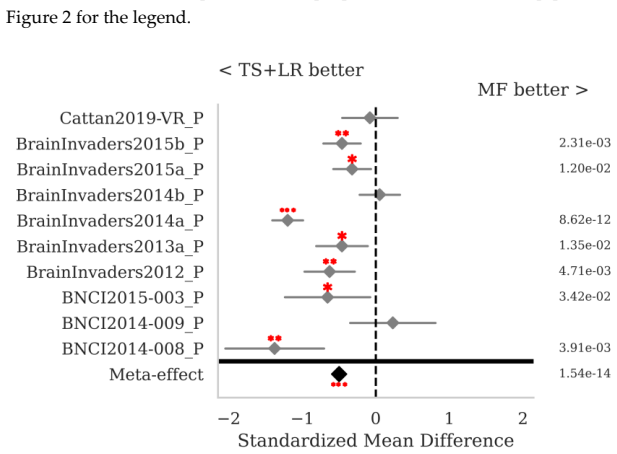
- For P300, MF outperforms MDM and MDMF overall, with meta-effect SMD = 0.522 and 0.681, both with p < 0.001, though TS+LR remains ahead in seven of ten databases.
- MF approaches but does not surpass tangent-space logistic regression: TS+LR wins six of ten motor-imagery databases and seven of ten P300 databases.
- RPME improves MF significantly on both paradigms, more so for P300, and ADCSP both improves accuracy and reduces runtime relative to standard CSP.
- A fully deterministic, essentially tuning-free classifier working directly on the manifold can compete with state-of-the-art tangent-space methods.
Reading between the lines
- Editorial inference: because LDA has a closed-form solution and the means are fixed once the exponents are chosen, the same means-field idea could replace the geometric mean in any MDM-based pipeline, including transfer-learning and calibration-free settings, at low computational cost.
- Editorial inference: the means field need not be restricted to power means; other SPD mean families such as log-Euclidean or alpha-divergence means could enrich the distance vector, and the clustering variant suggested in the discussion could improve granularity.
- Editorial inference: the larger RPME gains on P300 suggest that outlier handling matters most in less controlled recording conditions, so applying MF+RPME to out-of-the-lab data is a natural testable extension.
Signed reviews
Editorial analysis
A structured set of objections, weighed in public.
Referee Report
Summary. The paper proposes a Riemannian Means Field (MF) classifier that represents each trial by the squared affine-invariant distances to a field of power means of the class covariance matrices and feeds these features to LDA. The method is compared against the standard Riemannian MDM, the authors' earlier MDMF, and tangent-space logistic regression (TS+LR) on 20 public MOABB databases (10 motor imagery, 10 P300; 587 subjects total), using within-session 5-fold cross-validation with identical folds, per-database permutation/Wilcoxon tests, and a Liptak meta-analysis. The paper also introduces an adaptive double CSP (ADCSP) spatial filter for MI data and a robust power-mean estimation (RPME) procedure. The headline results are that MF outperforms MDM and MDMF with large meta-effect sizes (SMD = 1.122 and 1.057 for MI; 0.522 and 0.681 for P300), while being slightly but significantly worse than TS+LR on both paradigms. The authors characterize MF as deterministic and 'virtually hyperparameter-free'.
Significance. If the empirical results hold, the MF classifier is a practically valuable contribution: it is simple, deterministic, fast when combined with spatial filtering, and substantially closes the gap between manifold-based Riemannian classifiers and tangent-space state-of-the-art methods. The study has notable strengths: it uses 20 public databases, keeps folds identical across pipelines, applies exact permutation tests where possible, combines evidence with a weighted Liptak meta-analysis, and reports effect sizes. The code is made available. The main weakness is that the central 'virtually hyperparameter-free' claim is not supported by sensitivity analysis, and at least one of the introduced choices (RPME) demonstrably changes performance.
major comments (2)
- [Section 4 and Section 2.1] The claim that the newly introduced hyperparameters (the 11 power means and their positions, the ADCSP dimension thresholds 28 and 10, the RPME outlier threshold zth=2.5, I=4, tolerance, and iteration limits) are 'not critical' and that 'reasonable a priori choices give results that are statistically indistinguishable' is unsupported. No sensitivity analysis is provided. This is load-bearing because the paper's value proposition is a tuning-free deterministic classifier. Moreover, RPME itself is shown to change results significantly (Figure 10: SMD = -0.297, p < 0.001 for P300; Figure 6: SMD = -0.11, p < 0.01 for MI), so at least one introduced choice materially affects performance. The paper should either provide a sensitivity analysis over the means-field grid, the number of means, the ADCSP thresholds, and zth, or substantially soften the 'virtually hyperparameter-free' framing. The sentence 'Further research should establish a convenient choice of these hyperparameters to be used universally' also concedes that the choice is not yet settled.
- [Section 3.1, Table 4, Figures 2-3] The statement that MF 'significantly outperforms' MDM and MDMF 'for all databases taken individually' cannot be correct for databases with very few subjects. For example, Zhou2016 has only 4 subjects (Table 1), so the exact paired permutation test's minimum one-sided p-value is 1/16 = 0.0625, which exceeds 0.05. The authors should clarify what 'individually' means here: if they mean the effect direction is positive in every database, that wording should be used; if they mean per-database statistical significance, the claim is logically impossible for the small-n databases in this study.
minor comments (5)
- [Abstract and Section 5] The abstract says 'our code will be released as open source,' but Section 5 says 'Our code is published at ...' — please align these statements.
- [Figure 4 caption] The caption contains a typo: 'ACSTP' should be 'ADCSP'.
- [Table 2] The entry '1/8' for the number of sessions in Brain Invaders 2013a is unclear; please clarify whether this means one session for some subjects and eight for others, or something else.
- [Section 2.3] The statistical analysis would benefit from a statement about whether any correction for multiple comparisons was applied across the many pipeline pairs tested; as written, the reader cannot tell whether the reported p-values are corrected.
- [Section 4, Discussion of RPME] The sentence 'This suggests that the P300 data included in MOABB needs to be curated' is presented without evidence; consider rephrasing to avoid implying a data-quality judgment solely from improved outlier rejection.
Circularity Check
No circularity: the classifier's gains are established by empirical benchmarking on public MOABB datasets against external and prior baselines, with no fitted parameter renamed as a prediction.
full rationale
The paper's central claim is an empirical performance comparison, not a derivation. The MF classifier feeds squared Riemannian distances to a field of power means into a hyperparameter-free LDA, and the claimed advantages over MDM, MDMF, and TS+LR are obtained by cross-validated evaluation on 20 public MOABB databases with identical folds. No input quantity is defined in terms of the output metric: the power means are computed by published fixed-point algorithms, the LDA weights are learned on training folds, and the AUC-ROC scores are measured on held-out data. The MDMF baseline is the authors' prior method, but it is a real algorithmic alternative implemented in pyRiemann, and the comparison against it is data-driven rather than forced by construction. The citations to the authors' previous power-mean work [19] and MDMF [20] are citations to published mathematical algorithms and do not reduce the present result to those papers. The use of six Brain Invaders P300 databases from the authors' group is a data-independence concern, not a circularity concern, because the data are public and the benchmark also includes external databases. Section 4 asserts without sensitivity analysis that the newly introduced hyperparameters are 'not critical and reasonable a priori choices give results that are statistically indistinguishable.' This is an unsupported robustness claim, and the paper itself reports that RPME significantly changes results (e.g., SMD = -0.297, p < 0.001 for P300), which could weaken the 'virtually hyperparameter-free' framing. However, an unsupported assertion is not a circular derivation: the paper does not define the hyperparameters in terms of the outcome, nor does it fit them to the test databases and then call the outcome a prediction. No quoted step exhibits an equation or fitted parameter that is equivalent to the reported result by construction, so the honest finding is no significant circularity.
Assumptions & free parameters
free parameters (4)
- Power means field definition =
h in {-1,-0.75,-0.5,-0.25,-0.1,0,0.1,0.25,0.5,0.75,1}
- ADCSP dimension thresholds =
reduce to 28 if d>=28; reduce to 10 if d>=10
- RPME outlier parameters =
I=4 iterations, zth=2.5
- Number of spatial filters =
4 filters per class
assumptions (5)
- standard math Power means of SPD matrices are well-defined and computable by the fixed-point algorithm of [19] for h in [-1,1], with the geometric mean as the limit h->0.
- standard math The affine-invariant Fisher-Rao metric is the appropriate distance on the SPD manifold and the geometric mean minimizes the sum of squared distances.
- domain assumption MOABB v1.1.1 and pyRiemann v0.7 implement the preprocessing, cross-validation, and classifiers identically for all pipelines without systematic bias.
- ad hoc to paper The global outlier threshold zth=2.5 and the power-mean interval [-1,1] are valid uniformly across all 20 databases.
- domain assumption LDA on the squared-distance feature vectors is well-posed without shrinkage or regularization.
Cite this review
Pith. "Pith review of The Riemannian Means Field Classifier for EEG-Based BCI Data." pith.science (2026). https://pith.science/paper/QE2AR7RO
@misc{pith2026250417352,
  author       = {Pith},
  title        = {Pith review of: The Riemannian Means Field Classifier for EEG-Based BCI Data},
  year         = {2026},
  howpublished = {\url{https://pith.science/paper/QE2AR7RO}},
  note         = {Machine review of arXiv:2504.17352}
}
read the original abstract
A substantial amount of research has demonstrated the robustness and accuracy of the Riemannian minimum distance to mean (MDM) classifier for all kinds of EEG-based brain--computer interfaces (BCIs). This classifier is simple, fully deterministic, robust to noise, computationally efficient, and prone to transfer learning. Its training is very simple, requiring just the computation of a geometric mean of a symmetric positive-definite (SPD) matrix per class. We propose an improvement of the MDM involving a number of power means of SPD matrices instead of the sole geometric mean. By the analysis of 20 public databases, 10 for the motor-imagery BCI paradigm and 10 for the P300 BCI paradigm, comprising 587 individuals in total, we show that the proposed classifier clearly outperforms the MDM, approaching the state-of-the art in terms of performance while retaining the simplicity and the deterministic behavior. In order to promote reproducible research, our code will be released as open source.
Figures


Figures from the paper (7 more)



Reference graph
Works this paper leans on
-
[1]
The largest EEG- based BCI reproducibility study for open science: The MOABB benchmark
Chevallier, S.; Carrara, I.; Aristimunha, B.; Guetschel, P.; Sedlar, S.; Lopes, B.; Velut, S.; Khazem, S.; Moreau, T. The largest EEG- based BCI reproducibility study for open science: The MOABB benchmark. arXiv 2024, arXiv:2404.15319. https://doi.org/10.48550/arXiv.2404.15319
-
[2]
A review of classification algorithms for EEG-based brain–computer interfaces: A 10 year update
Lotte, F.; Bougrain, L.; Cichocki, A.; Clerc, M.; Congedo, M.; Rakotomamonjy, A.; Yger, F. A review of classification algorithms for EEG-based brain–computer interfaces: A 10 year update. J. Neural Eng. 2018, 15, 031005. https://doi.org/10.1088/1741- 2552/aab2f2
doi:10.1088/1741- 2018
-
[3]
Lezioni Di Calcolo Differenziale Assoluto; Nicola Zanichelli Editore: Bologna, Italy, 1925
Levi-Civita, T. Lezioni Di Calcolo Differenziale Assoluto; Nicola Zanichelli Editore: Bologna, Italy, 1925
work page 1925
-
[4]
Positive Definite Matrices; Princeton University Press: Princeton, NJ, USA, 2015
Bhatia, R. Positive Definite Matrices; Princeton University Press: Princeton, NJ, USA, 2015
work page 2015
-
[5]
Multiclass brain-computer interface classification by Riemannian geometry
Barachant, A.; Bonnet, S.; Congedo, M.; Jutten, C. Multiclass brain-computer interface classification by Riemannian geometry. IEEE Trans. Bio-Med. Eng. 2012, 59, 920–928. https://doi.org/10.1109/TBME.2011.2172210
-
[6]
Congedo, M. EEG Source Analysis. Habilitation Thesis, Université de Grenoble, Saint-Martin-d'Hères, France, 2013. Available online: https://tel.archives-ouvertes.fr/tel-00880483 (accessed on 1 February 2025)
work page 2013
-
[7]
Advanced Methods for BCI-EEG Processing for Improved Classification Performance and Reproducibility
Carrara, I. Advanced Methods for BCI-EEG Processing for Improved Classification Performance and Reproducibility. Phdthesis, Université Côte d’Azur, 2024. Available online: https://inria.hal.science/tel-04797267 (accessed on 12 February 2025)
work page 2024
-
[8]
Riemannian geometry for EEG-based brain-computer interfaces; a primer and a review
Congedo, M.; Barachant, A.; Bhatia, R. Riemannian geometry for EEG-based brain-computer interfaces; a primer and a review. Brain-Comput. Interfaces 2017, 4, 155–174. https://doi.org/10.1080/2326263X.2017.1297192
Show all 50 references
-
[9]
Riemannian Approaches in Brain-Computer Interfaces: A Review
Yger, F.; Berar, M.; Lotte, F. Riemannian Approaches in Brain-Computer Interfaces: A Review. IEEE Trans. Neural Syst. Rehabil. Eng. 2017, 25, 1753–1762. https://doi.org/10.1109/TNSRE.2016.2627016
2017
-
[10]
Single-trial classification of multi-user P300-based brain-computer interface using rie- mannian geometry
Korczowski, L.; Congedo, M.; Jutten, C. Single-trial classification of multi-user P300-based brain-computer interface using rie- mannian geometry. In Proceedings of the 2015 37th Annual International Conference of the IEEE Engineering in Medicine and Biology Society (EMBC), Mi...
2015
-
[11]
Mayaud, L.; Cabanilles, S.; Van Langhenhove, A.; Congedo, M.; Barachant, A.; Pouplin, S.; Filipe, S.; Pétégnief, L.; Rochecouste, O.; Azabou, E.; et al. Brain-computer interface for the communication of acute patients: A feasibility study and a randomized controlled trial comp...
2016
-
[12]
Brain Invaders Cali- bration-less P300-Based BCI Using Dry EEG Electrodes Dataset (bi2014a); GIPSA -lab, Research Report, juillet; 2019
Korczowski, L.; Ostaschenko, E.; Andreev, A.; Cattan, G.; Rodrigues, P.L.C.; Gautheret, V.; Congedo, M. Brain Invaders Cali- bration-less P300-Based BCI Using Dry EEG Electrodes Dataset (bi2014a); GIPSA -lab, Research Report, juillet; 2019. Available online: https://hal.scienc...
2019
-
[13]
Recreational Applications of OpenViBE: Brain Invaders and Use -the-Force; chap
Andreev, A.; Barachant, A.; Lotte, F.; Congedo, M. Recreational Applications of OpenViBE: Brain Invaders and Use -the-Force; chap. 14; John Wiley, Sons: Hoboken, NJ, USA, 2016. Available online: https://hal.archives-ouvertes.fr/hal-01366873/document (ac- cessed on 1 February 2025)
2016
-
[14]
A Differential Geometric Approach to the Geometric Mean of Symmetric Positive-Definite Matrices
Moakher, M. A Differential Geometric Approach to the Geometric Mean of Symmetric Positive-Definite Matrices. SIAM J. Ma- trix Anal. Appl. 2005, 26, 735–747. https://doi.org/10.1137/S0895479803436937
2005 doi
-
[15]
Matrix power means and the Karcher mean
Lim, Y.; Pálfia, M. Matrix power means and the Karcher mean. J. Funct. Anal. 2012, 262, 1498 –1514. https://doi.org/10.1016/j.jfa.2011.11.012
2012 doi
- [16]
-
[17]
Weighted means and Karcher equations of positive operators
Lawson, J.; Lim, Y. Weighted means and Karcher equations of positive operators. Proc. Natl. Acad. Sci. USA 2014, 110, 15626– 15632. https://doi.org/10.1073/pnas.1313640110
2014 doi
-
[18]
Karcher means and Karcher equations of positive definite operators
Lawson, J.; Lim, Y. Karcher means and Karcher equations of positive definite operators. Trans. Amer. Math. Soc. Ser. B 2014, 1, 1–22. https://doi.org/10.1090/S2330-0000-2014-00003-4
2014 doi
-
[19]
Fixed Point Algorithms for Estimating Power Means of Positive Definite Matrices
Congedo, M.; Barachant, A.; Bhatia, R. Fixed Point Algorithms for Estimating Power Means of Positive Definite Matrices. IEEE Trans. Signal Process. 2017, 65, 2211–2220. https://doi.org/10.1109/TSP.2017.2649483
2017
-
[20]
The Riemannian Minimum Distance to Means Field Classifier
Congedo, M.; Rodrigues, P.L.C.; Jutten, C. The Riemannian Minimum Distance to Means Field Classifier. In Proceedings of the BCI 2019 —8th International Brain -Computer Interface Conference, Graz, Austria, 16–20 September 2019. https://doi.org/10.3217/978-3-85125-682-6-02 16 of 17
2019 doi
-
[21]
Mother of All BCI Benchmarks, version v1.0.0; 23 October 2023; Zenodo: Genève, Switzerland
Bruno, A.; Igor, C.; Pierre, G.; Sara, S.; Pedro, R.; Jan, S.; Divyesh, N.; Erik, B.; Barthelemy, Q.; Tibor, S.R.; et al. Mother of All BCI Benchmarks, version v1.0.0; 23 October 2023; Zenodo: Genève, Switzerland. https://doi.org/10.5281/zenodo.10034224
2023 doi
-
[22]
MOABB: Trustworthy algorithm benchmarking for BCIs
Jayaram, V.; Barachant, A. MOABB: Trustworthy algorithm benchmarking for BCIs. J. Neural Eng. 2018, 15, 066011. https://doi.org/10.1088/1741-2552/aadea0
2018 doi
-
[23]
-R.; Gramfort, A.; Chevallier, S.; Rodrigues, P.L.C.; Olivetti, E.; Goncharenko, V.; Berg, G.W.v.; Reguig, G.; et al
Barachant, A.; Barthélemy, Q.; King, J. -R.; Gramfort, A.; Chevallier, S.; Rodrigues, P.L.C.; Olivetti, E.; Goncharenko, V.; Berg, G.W.v.; Reguig, G.; et al. pyRiemann, version v0.8; Zenodo: Genève, Switzerland, 2024. https://doi.org/10.5281/zenodo.593816
2024 doi
-
[24]
Optimizing Spatial filters for Robust EEG Single-Trial Analysis
Blankertz, B.; Tomioka, R.; Lemm, S.; Kawanabe, M.; Muller, K. Optimizing Spatial filters for Robust EEG Single-Trial Analysis. IEEE Signal Process. Mag. 2008, 25, 41–56. https://ieeexplore.ieee.org/document/4408441
2008
-
[25]
Xdawn algorithm to enhance evoked potentials: Application to brain-computer interface
Rivet, B.; Souloumiac, A.; Attina, V.; Gibert, G. Xdawn algorithm to enhance evoked potentials: Application to brain-computer interface. IEEE Trans. Biomed. Eng. 2009, 56, 2035–2043. https://ieeexplore.ieee.org/document/4760273
2009
-
[26]
Joint Approximate Diagonalization of Positive Definite Hermitian Matrices
Pham, T. Joint Approximate Diagonalization of Positive Definite Hermitian Matrices. SIAM J. Matrix Anal. Appl. 2001, 22, 1136–
2001
-
[27]
The Riemannian Potato Field: A Tool for Online Signal Quality Index of EEG
Barthélemy, Q.; Mayaud, L.; Ojeda, D.; Congedo, M. The Riemannian Potato Field: A Tool for Online Signal Quality Index of EEG. IEEE Trans. Neural Syst. Rehabil. Eng. 2019, 27, 244. https://doi.org/10.1109/TNSRE.2019.2893113
2019
-
[28]
Review of the BCI Competition IV
Tangermann, M.; Müller, K.R.; Aertsen, A.; Birbaumer, N.; Braun, C.; Brunner, C.; Leeb, R.; Mehring, C.; Miller, K.J.; Müller - Putz, G.R.; et al. Review of the BCI Competition IV. Front. Neurosci. 2012, 6, 55. https://doi.org/10.3389/fnins.2012.00055
2012 arXiv
-
[29]
Brain -computer communication: Motivation, aim, and impact of exploring a virtual apartment
Leeb, R.; Lee, F.; Keinrath, C.; Scherer, R.; Bischof, H.; Pfurtscheller, G. Brain -computer communication: Motivation, aim, and impact of exploring a virtual apartment. IEEE Trans. Neural. Syst. Rehabil. Eng . 2007, 15, 473 –482. https://doi.org/10.1109/TNSRE.2007.906956
2007
-
[30]
EEG datasets for motor imagery brain-computer interface
Cho, H.; Ahn, M.; Ahn, S.; Kwon, M.; Jun, S.C. EEG datasets for motor imagery brain-computer interface. Gigascience 2017, 6, gix034. https://doi.org/10.1093/gigascience/gix034
2017 doi
-
[31]
Beamforming in noninvasive brain-computer interfaces
Grosse-Wentrup, M.; Liefhold, C.; Gramann, K.; Buss, M. Beamforming in noninvasive brain-computer interfaces. IEEE Trans. Biomed. Eng. 2009, 56, 1209–1219. https://doi.org/10.1109/TBME.2008.2009768
2009
-
[32]
EEG dataset and OpenBMI toolbox for three BCI paradigms: An investigation into BCI illiteracy
Lee, M.H.; Kwon, O.Y.; Kim, Y.J.; Kim, H.K.; Lee, Y.E.; Williamson, J.; Fazli, S.; Lee, S.W. EEG dataset and OpenBMI toolbox for three BCI paradigms: An investigation into BCI illiteracy. Gigascience 2019, 8, giz002. https://doi.org/10.1093/gigascience/giz002
2019 doi
-
[33]
BCI2000: A general-purpose brain-computer interface (BCI) system
Schalk, G.; McFarland, D.J.; Hinterberger, T.; Birbaumer, N.; Wolpaw, J.R. BCI2000: A general-purpose brain-computer interface (BCI) system. IEEE Trans. Biomed. Eng. 2004, 51, 1034–1043. https://doi.org/10.1109/TBME.2004.827072
2004
-
[34]
Deep learning with convolutional neural networks for EEG decoding and visualization
Schirrmeister, R.T.; Springenberg, J.T.; Fiederer, L.D.J.; Glasstetter, M.; Eggensperger, K.; Tangermann, M.; Hutter, F.; Burgard, W.; Ball, T. Deep learning with convolutional neural networks for EEG decoding and visualization. Hum. Brain Mapp. 2017, 38, 5391–5420. https://do...
2017 doi
-
[35]
Open Access Dataset for EEG+NIRS Single-Trial Classification
Shin, J.; von Lühmann, A.; Blankertz, B.; Kim, D.W.; Jeong, J.; Hwang, H.J.; Müller, K.R. Open Access Dataset for EEG+NIRS Single-Trial Classification. IEEE Trans. Neural . Syst. Rehabil. Eng . 2017, 25, 1735 –1745. https://doi.org/10.1109/TNSRE.2016.2628057
2017
-
[36]
Evaluation of EEG oscillatory patterns and cognitive process during simple and compound limb motor imagery
Yi, W.; Qiu, S.; Wang, K.; Qi, H.; Zhang, L.; Zhou, P.; He, F.; Ming, D. Evaluation of EEG oscillatory patterns and cognitive process during simple and compound limb motor imagery. PLoS ONE 2014, 9, e114853. https://doi.org/10.1371/jour- nal.pone.0114853
2014 doi
-
[37]
A Fully Automated Trial Selection Method for Optimization of Motor Imagery Based Brain-Computer Interface
Zhou, B.; Wu, X.; Lv, Z.; Zhang, L.; Guo, X. A Fully Automated Trial Selection Method for Optimization of Motor Imagery Based Brain-Computer Interface. PLoS ONE 2016, 11, e0162657. https://doi.org/10.1371/journal.pone.0162657
2016 doi
-
[38]
Attention and P300- based BCI performance in people with amyotrophic lateral sclerosis
Riccio, A.; Simione, L.; Schettini, F.; Pizzimenti, A.; Inghilleri, M.; Belardinelli, M.O.; Mattia, D.; Cincotti, F. Attention and P300- based BCI performance in people with amyotrophic lateral sclerosis. Front. Hum. Neurosci. 2013, 7, 732. https://doi.org/10.3389/fnhum.2013.00732
2013
-
[39]
Influence of P300 latency jitter on event related potential- based brain-computer interface performance
Aricò, P.; Aloise, F.; Schettini, F.; Salinari, S.; Mattia, D.; Cincotti, F. Influence of P300 latency jitter on event related potential- based brain-computer interface performance. J. Neural Eng. 2014, 11, 035008. https://doi.org/10.1088/1741-2560/11/3/035008
2014 doi
-
[40]
How many people are able to control a P300-based brain-computer interface (BCI)? Neurosci
Guger, C.; Daban, S.; Sellers, E.; Holzner, C.; Krausz, G.; Carabalona, R.; Gramatica, F.; Edlinger, G. How many people are able to control a P300-based brain-computer interface (BCI)? Neurosci. Lett . 2009, 462, 94 –98. https://doi.org/10.1016/j.neulet.2009.06.045
2009 doi
-
[41]
Building Brain Invaders: EEG Data of An Experimental Validation
Van Veen, G.F.P.; Barachant, A.; Andreev, A.; Cattan, G.; Rodrigues, P.L.C.; Congedo, M. Building Brain Invaders: EEG Data of An Experimental Validation. GIPSA-Lab, Research Report 1, mai 2019. Available online: https://hal.archives-ouvertes.fr/hal- 02126068 (accessed on 1 Feb...
2019
-
[42]
Brain Invaders Adaptive Versus Non-Adap- tive P300 Brain-Computer Interface Dataset
Vaineau, E.; Barachant, A.; Andreev, A.; Rodrigues, P.C.; Cattan, G.; Congedo, M. Brain Invaders Adaptive Versus Non-Adap- tive P300 Brain-Computer Interface Dataset. GIPSA-LAB, Research Report 1, avril 2019. Available online: https://hal.archives- ouvertes.fr/hal-02103098 (ac...
2019
-
[43]
L.C.; Gautheret, V.; Congedo, M
Korczowski, L.; Ostaschenko, E.; Andreev, A.; Cattan, G.; Rodrigues, P. L.C.; Gautheret, V.; Congedo, M. Brain Invaders Solo Versus Collaboration: Multi-User P300-Based Brain-Computer Interface Dataset (bi2014b); GIPSA-lab, Research Report, juillet
-
[44]
Brain In- vaders Calibrationless P300-Based BCI with Modulation of Flash Duration Dataset (bi2015a); GIPSA-lab, Research Report, juillet; 2019
Korczowski, L.; Cederhout, M.; Andreev, A.; Cattan, G.; Rodrigues, P.L.C.; Gautheret, V.; Congedo, M. Brain In- vaders Calibrationless P300-Based BCI with Modulation of Flash Duration Dataset (bi2015a); GIPSA-lab, Research Report, juillet; 2019. Available online: https://hal.s...
2019
-
[45]
Brain Invaders Coopera- tive Versus Competitive: Multi-User P300-based Brain-Computer Interface Dataset (bi2015b); GIPSA-lab, Research Report, juil- let; 2019
Korczowski, L.; Cederhout, M.; Andreev, A.; Cattan, G.; Rodrigues, P.L.; Gautheret , V.; Congedo, M. Brain Invaders Coopera- tive Versus Competitive: Multi-User P300-based Brain-Computer Interface Dataset (bi2015b); GIPSA-lab, Research Report, juil- let; 2019. Available online...
2019
-
[46]
Randomization Tests, 3rd ed.; Marcel Dekker: New York, NY, USA, 1995
Edgington, E.S. Randomization Tests, 3rd ed.; Marcel Dekker: New York, NY, USA, 1995
1995
-
[47]
Multivariate Permutation Tests: With Applications in Biostatistics
Huson, L.W. Multivariate Permutation Tests: With Applications in Biostatistics. J. R. Stat. Soc. Ser. D Stat. 2003, 52, 247 . https://doi.org/10.1111/1467-9884.t01-6-00356
2003 doi
-
[48]
Approximate Joint Diagonalization and Geometric Mean of Symmetric Positive Definite Matrices
Congedo, M.; Afsari, B.; Barach ant, A.; Moakher, M. Approximate Joint Diagonalization and Geometric Mean of Symmetric Positive Definite Matrices. PLoS ONE 2015, 10, e0121423. https://doi.org/10.1371/journal.pone.0121423
2015 doi
-
[1152]
https://doi.org/10.1137/S089547980035689X
-
[2019]
Available online: https://hal.science/hal-02173958/ (accessed on 1 February 2025)
2025
Reviewed August 16, 2026 · model on record in the stance chip above.
Discussion (0). Continue with ORCID to comment.