REVIEW 2 major objections 5 minor 28 references
Efficient iterative techniques for solving tensor problems with the T-product
T0 review · 2 major / 5 minor · reviewed 2026-08-16 · deepseek-v4-flash
Pith's one-line read For $C\star X=D$ under the T-product, tensor-only iterative updates reach an exact solution in at most $n_1\ell n_3+1$ steps, and least-squares problems in at most $n_2\ell n_3$ steps.
desk verdict A competent but unsurprising translation of CG/CGNE/CGLS to the T-product tensor setting, with standard exact-arithmetic proofs, overshadowed by an overclaimed image-restoration experiment. read the letter →
The pith
A machine-rendered reading of the paper's core claim, the machinery that carries it, and where it could break.
The reading
What carries the argument
The load-bearing object is the T-product together with its Fourier-diagonalization identity: after applying fft along the third dimension, $C\star D$ is computed slicewise as $\widehat C^{(i)}\widehat D^{(i)}$, so iterations can be coded directly on tensors. The algorithmic core is the direction-update recurrence $X_k=X_{k-1}+\frac{\|R_{k-1}\|^2}{\|Q_{k-1}\|^2}Q_{k-1}$, with $R_k=D-C\star X_k$, $P_k=C^T\star R_k$, and $Q_k=P_k-\frac{\langle P_k,Q_{k-1}\rangle}{\|Q_{k-1}\|^2}Q_{k-1}$. The inner-product identity $\langle C,D\rangle=\operatorname{Tr}((D^T\star C)^{(1)})$ translates every orthogonality statement into a trace condition, allowing the proofs to run in tensor arithmetic; the same recurrence, applied to the normal equation, gives the least-squares variant.
What would settle it
Run Algorithm 3 in exact rational arithmetic on a small generic consistent equation, for example $n_1=n_2=n_3=2$, $\ell=1$, with $D$ constructed as $C\star X^*$ for a known $X^*$, and check whether the residual after $n_1\ell n_3+1=5$ steps is exactly zero for a nonzero starting tensor; any nonzero exact residual would disprove the finite-termination theorem. For the least-squares claim, run Algorithm 4 with $X_1=O$ in the same exact setting and verify by an independent calculation that the returned tensor minimizes $\|C\star X-D\|_F$ and is the unique minimal-norm minimizer.
Extended reading notes
Core claim
The central claim is that direction-update tensor recurrences terminate exactly: for a consistent equation $C\star X=D$ with $C\in\mathbb{R}^{n_1\times n_2\times n_3}$, Algorithm 3 returns an exact solution in at most $n_1\ell n_3+1$ steps from any initial tensor, and for the possibly inconsistent case Algorithm 4 returns a least-squares solution of $\min_X\|C\star X-D\|_F$ in at most $n_2\ell n_3$ steps. The mechanism is a dimension argument: the residual tensors $R_k$ are mutually orthogonal in the T-product inner product, and the search directions $Q_k$ are likewise orthogonal, so within a space of dimension $n_1\ell n_3$ one residual must vanish; in the least-squares case the same argument runs on the normal equation $C^T\star C\star X=C^T\star D$. Choosing $X_1=C^T\star H$, in particular $X_1=O$, forces the returned solution into the range of $C^T$, which the paper proves is exactly the minimal Frobenius norm solution, and a residual with $Q_k=O$ signals inconsistency.
Load-bearing premise
The iteration counts and minimal-norm conclusions assume exact arithmetic, because the proofs require the residual and search-direction tensors to be exactly orthogonal; with floating-point arithmetic those orthogonalities are lost to rounding, so the stated guarantees are only approximate and the paper gives no rounding-error analysis.
Editorial extensions
If this is right
- Consistent T-product systems inherit a hard iteration bound: from any starting tensor the residual is exactly zero after at most $n_1\ell n_3+1$ updates, so a solvable system cannot make the solver loop indefinitely.
- Because the algorithms never form the equivalent block-circulant or Kronecker matrices, per-iteration storage stays at the size of the tensors themselves, and the dominant cost is a handful of fft-based T-products per step.
- Starting from the zero tensor automatically returns the minimal Frobenius norm solution of a consistent equation and the minimal-norm least-squares solution of an inconsistent one, giving a deterministic route to a pseudoinverse-type tensor solution.
- Algorithm 4 also covers the consistent case, since any exact solution minimizes the residual; a single implementation therefore handles both solvable and unsolvable systems, with the condition $R_k\neq O$, $Q_k=O$ marking inconsistency.
Reading between the lines
- Beyond the paper, the termination bound is essentially a dimension count, so the same recurrence should transfer to other tensor products whenever a compatible transpose and trace inner product exist; the iteration limit would be the dimension of the corresponding solution space.
- Beyond the paper, the reported experiments use random Gaussian coefficient tensors, which are typically well-conditioned; the natural stress test not included is to run Algorithm 4 on severely ill-conditioned or structured coefficient tensors and measure how far the floating-point residual deviates from the exact-arithmetic bound.
- Beyond the paper, the minimal-norm guarantee suggests a direct method for the T-product pseudoinverse: apply Algorithm 4 with $X_1=O$ to $C\star X=I$ for multiple right-hand sides and assemble the returned slices; the same finite-termination bound would apply.
Signed reviews
Editorial analysis
A structured set of objections, weighed in public.
Referee Report
Summary. The paper develops three iterative algorithms for tensor equations under the T-product. Algorithm 2 is a conjugate-gradient-type method for C*X=D when C is T-symmetric positive definite; Algorithm 3 treats consistent equations C*X=D with rectangular C by a CGNR-type process using residuals R_k=D-C*X_k and search directions generated from C^T*R_k; Algorithm 4 applies the same construction to the normal equation C^T*C*X=C^T*D to obtain least-squares solutions. The main formal claims are that Algorithm 3 terminates in at most n1*l*n3+1 iterations with the exact solution, that Algorithm 4 terminates in at most n2*l*n3 iterations with a least-squares solution, and that with X1=0 the computed solutions have minimal Frobenius norm. Numerical experiments on random synthetic tensors and on image/video recovery illustrate the residual decay.
Significance. Read as exact-arithmetic statements, the convergence and minimal-norm results are coherent, and the tensor formulation is convenient because the algorithms avoid explicit construction of bcirc matrices and can be implemented with the FFT-based T-product. The extension of classical CG/CGNR to the T-product is natural, the proofs are self-contained, and the paper gives explicit finite-termination bounds that are useful for this problem class. A manual consistency check of the recurrences on a small system indicates that Algorithm 3 behaves as stated in exact arithmetic. The novelty is incremental, and no reproducibility artifact or comparison with existing T-product solvers is provided, but the paper's central exact-arithmetic claims are defensible. The main substantive weakness is that the practical claims of finite termination with negligible errors are stated without any treatment of floating-point effects, so the theorems should be read as exact-arithmetic results rather than as unconditional statements about the implemented algorithms.
major comments (2)
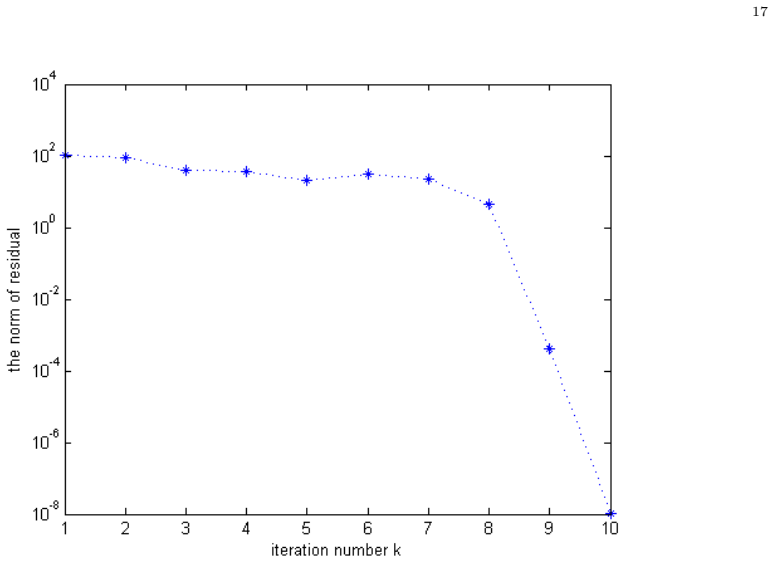
- [Theorems 4.4 and 5.4; Algorithms 3 and 4; Section 6] The termination and minimal-norm guarantees are exact-arithmetic statements. The recurrences in Algorithm 3, step 5, and Algorithm 4, step 5, are used to prove <R_i,R_j>=0 and <Q_i,Q_j>=0 in Lemma 4.3; in floating-point arithmetic these identities are destroyed by rounding in the T-product, the inner products, and the short recurrences, and no reorthogonalization or rounding-error analysis is supplied. Consequently the asserted iteration bounds (n1*l*n3+1 and n2*l*n3) and the minimal-norm conclusion that relies on exact termination at a zero residual are not guaranteed by the implemented algorithms. Because the abstract and Section 6 present the methods as practical solvers with 'negligible errors,' this gap is load-bearing; either add a stability or rounding-error discussion, or explicitly qualify the theorems as exact-arithmetic results and soften the practical claim.
- [Theorem 4.6, Eqs. (4.6)-(4.7)] The proof of minimal Frobenius norm relies on the equivalence C*X=D <=> C.X=D <=> (I_{l.n3} (x) C) vec(X) = vec(D). For the T-product, the correct linear representation is bcirc(C) unfold(X) = unfold(D) in the original domain, or bdiag(C_hat) X_hat = D_hat in the Fourier domain; it is not simply (I_{l.n3} (x) C) vec(X) as written, unless substantial additional notation is introduced. As written, the range argument for the adjoint is therefore not established. The result itself is true: starting from X1=0, all iterates lie in the range of Y -> C^T*Y, and the solution in that range has minimal Frobenius norm. Please replace the proof with a correct argument.
minor comments (5)
- [Abstract and throughout] The abstract contains the typo 'demonste' for 'demonstrate,' and the text has numerous other typos, including 'tensot,' 'researchears,' 'uder,' and 'edequate'; the manuscript should be carefully proofread.
- [Lemma 3.3] In the proof, the displayed expression for Tr[(f(Y)-f(X))^{(1)}] has an extra factor 1/2 in front of the first term; the following line drops the factor, so the conclusion is correct but the displayed equation should be fixed.
- [Theorem 3.4] In the proof, the expression 'Tr((P_{k+1} * A * P_k)(1)) = 0' uses an undefined tensor A; it should presumably be the C-orthogonality statement Tr((P_{k+1}^T * C * P_k)(1)) = 0.
- [Section 3] Algorithm 2 is not given an explicit finite-termination theorem, although the same dimension argument used in Theorem 4.4 applies; stating this theorem would make the abstract's 'finite number of iterations' claim complete for all three algorithms.
- [Theorem 5.4] The proof is only one sentence referring to Theorems 4.4 and 4.6; because the normal-equations operator C^T*C can be semidefinite in the rank-deficient case, the proof should include a short explanation of why the dimension count and the minimal-norm argument remain valid.
Circularity Check
No significant circularity: the algorithms' convergence and termination proofs are self-contained, and no fitted quantities are relabeled as predictions.
full rationale
The paper's derivation chain is self-contained. The T-product properties used as inputs (distributivity, associativity, transpose, inner-product identity, DFT block-diagonal equivalence) are cited standard results from the literature, not derived from the paper's own conclusions. Algorithms 2–4 are constructed by explicitly deriving residual recurrences and scalar step/orthogonalization coefficients from the definitions, and the finite-termination theorems (Theorem 3.4, Lemma 4.3, Theorem 4.4, Theorem 5.4) prove orthogonality of the generated residual and search-direction sequences by induction inside the paper, then invoke only the finite dimensionality of the tensor space to conclude termination. There is no fitted parameter that is later called a prediction, no quantity defined in terms of the claimed output, and no load-bearing self-citation: the authors' own prior work [20] is cited only as context for existing Krylov-type methods for T-product equations, and the central proofs do not depend on it. The main caveat, that the exact-arithmetic orthogonality arguments do not automatically survive floating-point roundoff without reorthogonalization or a rounding-error analysis, is a numerical robustness issue rather than a circularity issue; it does not make the derivation equivalent to its inputs. Numerical experiments in Section 6 provide external demonstrations of practical behavior, but they are not needed to make the mathematical derivation circular. Overall, no circular step satisfying the required evidence standard is present.
Assumptions & free parameters
assumptions (5)
- standard math The T-product of third-order tensors is equivalent to block-circulant matrix multiplication after unfolding, and via fft it is equivalent to slice-wise matrix multiplication of the block-diagonal Fourier representation (Definitions 2.2, 2.3, and Algorithm 1).
- standard math For real tensors, the Frobenius inner product satisfies <C,D> = (1/n3) <C,D> with the Fourier block-diagonal representations (Definition 2.9).
- standard math The trace identity Tr((C⋆D)(1)) = <C,D> (Remark 2.10) holds.
- domain assumption The sequences generated by the algorithms are assumed to be computed in exact arithmetic; floating-point rounding is not analyzed.
- domain assumption For Algorithm 3, the equation C⋆X = D is assumed consistent (Section 4); for Algorithm 4, the normal equation is consistent by construction.
Cite this review
Pith. "Pith review of Efficient iterative techniques for solving tensor problems with the T-product." pith.science (2026). https://pith.science/paper/YVTXOPA3
@misc{pith2026250417861,
  author       = {Pith},
  title        = {Pith review of: Efficient iterative techniques for solving tensor problems with the T-product},
  year         = {2026},
  howpublished = {\url{https://pith.science/paper/YVTXOPA3}},
  note         = {Machine review of arXiv:2504.17861}
}
read the original abstract
This paper presents iterative methods for solving tensor equations involving the T-product. The proposed approaches apply tensor computations without matrix construction. For each initial tensor, these algorithms solve related problems in a finite number of iterations, with negligible errors. The theoretical analysis is validated by numerical examples that demonstrate the practicality and effectiveness of these algorithms.
Figures


Figures from the paper (5 more)


Reference graph
Works this paper leans on
-
[20]
Computational and Applied Mathematics, 42(8), 358 (2023)
Nobakht-Kooshkghazi, M., Afshin, H., The new Krylov subspace methods for solving tensor equations via T- product. Computational and Applied Mathematics, 42(8), 358 (2023)
work page 2023
-
[1]
Com- munications on Applied Mathematics and Computation, 5(4), 1564-1583 (2023)
Ahmadi-Asl, S., An efficient randomized fixed-precision algorithm for tensor singular value decomposition. Com- munications on Applied Mathematics and Computation, 5(4), 1564-1583 (2023)
work page 2023
-
[2]
Ahmadi-Asl, M.G Asante-Mensah, A
S. Ahmadi-Asl, M.G Asante-Mensah, A. Cichocki, A-H. Phan, I. Oseledets, J. Wang, Fast cross tensor approxima- tion for image and video completion, Signal Processing, 213, 109121 (2023)
work page 2023
-
[3]
Bentbib, A. H., Hachimi, A. E., Jbilou, K., Ratnani, A. A., Tensor Regularized Nuclear Norm Method for Image and Video Completion, J. Optim. Theory Appl. 192(2) 401-425 (2022)
work page 2022
-
[4]
Beik, F. P., Najafi-Kalyani, M., A preconditioning technique in conjunction with Krylov subspace methods for solving multilinear systems. Appl. Math. Lett. 116 107051 (2021)
work page 2021
-
[5]
T product Tensors Part I: Inequalities
Chang, S. Y., Wei, Y., T product tensors part I: Inequalities. arXiv preprint arXiv:2107.06285 (2021)
work page Pith review arXiv 2021
-
[6]
Journal of Mathematical Modeling, 10(1), 21-37 (2022)
El Guide, M., El Ichi, A., Jbilou, K., Discrete cosine transform LSQR methods for multidimensional ill-posed problems. Journal of Mathematical Modeling, 10(1), 21-37 (2022). 21
work page 2022
-
[7]
Guide, M. E., Ichi, A. E., Beik, F. P., Jbilou, K., Tensor GMRES and Golub-Kahan Bidiagonalization methods via the Einstein product with applications to image and video processing. arXiv preprint arXiv:2005.07458 (2020)
work page Pith review arXiv 2020
Show all 28 references
-
[8]
El Guide, M. O. H. A. M. E. D., El Ichi, A. L. A. A., Jbilou, K., Sadaka, R., On tensor GMRES and Golub-Kahan methods via the T-product for color image processing, Electron. J. Linear Algebra. 37 524-543 (2021)
2021
-
[9]
Linear Algebra
Elden, L., Ahmadi-Asl, S., Solving bilinear tensor least squares problems and application to Hammerstein identifi- cation, Numer. Linear Algebra. Appl. 26 (2) (2019) e2226
2019
-
[10]
Fusiello, A., A matter of notation: Several uses of the Kronecker product in 3D computer vision, Pattern Recognit. Lett. 28(15), 2127-2132 (2007)
2007
-
[11]
Jin, H., Bai, M., Ben´ ıtez, J., Liu, X., The generalized inverses of tensors and an application to linear models. Comput. Math. Appl. 74(3), 385-397 (2017)
2017
-
[12]
E., Braman, K., Hao, N., Hoover, R
Kilmer, M. E., Braman, K., Hao, N., Hoover, R. C., Third-order tensors as operators on matrices: A theoretical and computational framework with applications in imaging. SIAM J. Matrix Anal. Appl. 34(1), 148-172 (2013)
2013
-
[13]
E., Martin, C
Kilmer, M. E., Martin, C. D., Factorization strategies for third-order tensors, Linear Algebra Appl. 435(3), 641-658 (2011)
2011
-
[14]
A., An efficient color/grayscale image encryption scheme based on hybrid chaotic maps
Khalil, N., Sarhan, A., Alshewimy, M. A., An efficient color/grayscale image encryption scheme based on hybrid chaotic maps. Opt. Laser Technol. 143, 107326 (2021)
2021
-
[15]
G., Bader, B
Kolda, T. G., Bader, B. W., Tensor decompositions and applications. SIAM Rev. 51(3) 455-500 (2009)
2009
-
[16]
Tensor-tensor product toolbox
Lu, C. Tensor-tensor product toolbox. arXiv preprint arXiv:1806.07247 (2018)
2018 arXiv
-
[17]
Pattern Anal
Lu, C., Feng, J., Chen, Y., Liu, W., Lin, Z., Yan, S., Tensor robust principal component analysis with a new tensor nuclear norm, IEEE Trans. Pattern Anal. Mach. Intell. 42(4) 925-938 (2019)
2019
-
[18]
D., Shafer, R., LaRue, B., An order-p tensor factorization with applications in imaging, SIAM J
Martin, C. D., Shafer, R., LaRue, B., An order-p tensor factorization with applications in imaging, SIAM J. Sci. Comput. 35(1) A474-A490 (2013)
2013
-
[19]
Asante-Mensah, S
MG. Asante-Mensah, S. Ahmadi-Asl, A. Cichocki, Matrix and tensor completion using tensor ring decomposition with sparse representation, Machine Learning: Science and Technology 2(3), 035008 (2021)
2021
-
[21]
Qi, L., Luo, Z., Tensor analysis: spectral theory and special tensors, Society for Industrial and Applied Mathematics (2017)
2017
-
[22]
E., Miller, E
Semerci, O., Hao, N., Kilmer, M. E., Miller, E. L., Tensor-based formulation and nuclear norm regularization for multienergy computed tomography, IEEE Trans. Image Process. 23(4) 1678-1693 (2014)
2014
-
[23]
Neural Inf
Settles, B., Craven, M., Ray, S., Multiple-instance active learning, Adv. Neural Inf. Process. Syst. 20 (2007)
2007
-
[24]
Moore–Penrose inverse of tensors via Einstein product
Sun, L., Zheng, B., Bu, C., Wei, Y. Moore–Penrose inverse of tensors via Einstein product. Linear Multilinear Algebra. 64(4) 686-698 (2016)
2016
-
[25]
W., Xu, X., Iterative algorithms for solving some tensor equations
Wang, Q. W., Xu, X., Iterative algorithms for solving some tensor equations. Linear Multilinear Algebra. 67(7), 1325-1349 (2019)
2019
-
[26]
arXiv preprint arXiv:1312.1254 (2013)
Xu, Y., Hao, R., Yin, W., Su, Z., Parallel matrix factorization for low-rank tensor completion. arXiv preprint arXiv:1312.1254 (2013)
2013 arXiv
-
[27]
Signal Process
Zhang, Z., Aeron, S., Exact tensor completion using t-SVD, IEEE Trans. Signal Process. 65(6) 1511-1526 (2016)
2016
-
[28]
IEEE Comput
Zhang, Z., Ely, G., Aeron, S., Hao, N., Kilmer, M., Novel methods for multilinear data completion and de-noising based on tensor-SVD, Proc. IEEE Comput. Soc. Conf. Comput. Vis. Pattern Recognit. 3842-3849 (2014)
2014
Reviewed August 16, 2026 · model on record in the stance chip above.
Discussion (0). Continue with ORCID to comment.