REVIEW 4 major objections 5 minor 76 references
Evidence of electronic states driving current-induced insulator-to-metal transition
T0 review · 4 major / 5 minor · reviewed 2026-08-16 · deepseek-v4-flash
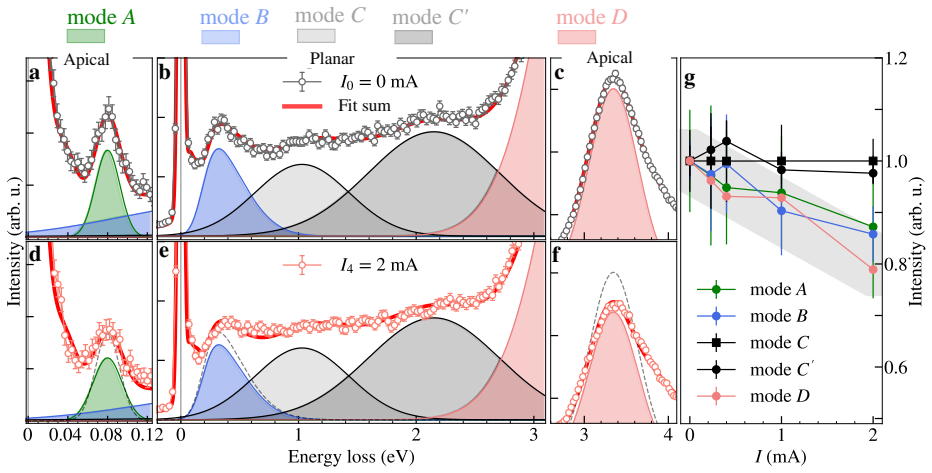
Pith's one-line read The paper claims that applying a d.c. current across Ca2RuO4 creates electronic defects at ruthenium sites—d3/d5 charge configurations—whose concentration rises with current and turns the material conductive while the Mott gap remains open.
desk verdict A well-executed in-operando RIXS study with a clean observation, but the d3-defect mechanism is a plausible hypothesis presented as a demonstrated conclusion. read the letter →
The pith
A machine-rendered reading of the paper's core claim, the machinery that carries it, and where it could break.
The reading
What carries the argument
The load-bearing object is the linear-mixing model for the RIXS cross section, $I_{\rm total}(x) = (1-x)I_{d^4} + x I_{d^3}$, where $x$ is the concentration of current-induced d3 defects and $I_{d^4}$, $I_{d^3}$ are the calculated spectra of defect-free and defect-containing Ru-O clusters. It converts a set of spectroscopic observations—energy-selective suppression of modes A, B, and D without peak shifts—into a quantitative statement about defect concentration, assuming $x$ scales with applied current. The supporting machinery is in-operando O K-edge RIXS on a ~10×12×1 µm flake, with spectra at both apical and planar oxygen resonances, alongside exact-diagonalization cross-section calculations that include spin-orbit coupling, Hund's coupling, crystal-field splittings, and Ru-O hybridization. The model's key output is the prediction that modes A, B, and D lose weight linearly with $x$, while modes C and C′ remain nearly unchanged.
What would settle it
Spatially resolved RIXS or nano-infrared imaging during current flow could show whether the spectral suppression is uniform or localized in conductive filaments; a Ru L-edge RIXS or XAS measurement could quantify the d5 population directly. If the energy-selective suppression tracks only filamentary regions, or if d5 states appear at concentrations comparable to d3, the claimed homogeneous electronic-defect mechanism would be contradicted.
Extended reading notes
Core claim
The central claim is that the current-driven insulator-to-metal transition in Ca2RuO4 is not the usual Mott-gap collapse. In a device held at 300 K, the RIXS spectra show no peak shifts and no low-energy particle-hole continuum; instead, the spectral weight of certain excitations—magnetic spin-orbital modes at about 80 meV, the spin-orbit exciton around 350 meV, and the high-energy dd excitations near 3.5 eV—falls linearly with current, while Hund's-exchange modes barely change. The paper attributes this energy-selective suppression to the formation of correlated electronic states, predominantly d3 (one hole per Ru site) alongside the d4 host, with d5 and d6 also possible but less populated. Calculations of the O K-edge RIXS cross section using exact diagonalization, combined as $I_{\rm total}(x) = (1-x) I_{d^4} + x I_{d^3}$, reproduce the observed linear suppression with defect concentration x, which the paper identifies with current. The conclusion is that a conductive non-equilibrium steady state coexists with a persistent Mott gap, with an electronic rather than structural origin.
Load-bearing premise
The argument assumes the RIXS changes come from a uniform population of d3 defects whose fraction grows linearly with current, with d3 the only important charge state; if conduction instead runs through filaments, comes from structural reconfiguration, or involves comparable d5 populations, the quantitative demonstration loses its footing.
Editorial extensions
If this is right
- The current-driven conducting state in Ca2RuO4 is electronically distinct from the high-temperature metallic phase, so Joule heating does not explain the transition.
- A persistent Mott gap can coexist with high conductivity when current-created correlated defects provide in-gap charge carriers.
- The defect concentration, tracked through the RIXS spectral weight, is a directly measurable order parameter for the non-equilibrium steady state.
- In-operando RIXS can be applied to other electrically driven phase transitions to distinguish electronic-defect mechanisms from gap closure or structural transitions.
- Switching devices based on such materials would rely on controlling the density of electronic defects rather than on heating or structural collapse.
Reading between the lines
- A natural extension the paper does not develop is that the same linear-mixing formula could be fit to RIXS data with both d3 and d5 fractions free, which would test whether d5 contributes measurably at higher currents.
- If the defect population is in fact homogeneous, transport across the device should obey a smooth scaling of resistance with spectral-weight suppression; spatially resolved measurements could check whether conduction instead runs through filaments.
- The energy-selective suppression pattern might serve as a spectroscopic fingerprint for identifying current-induced defect-mediated conduction in other correlated oxides, not just ruthenates.
- The paper's plaquette energy arguments imply that tuning octahedral distortions or intersite Coulomb interactions—for instance by strain—could change which defect charge states dominate, offering a design lever for such transitions.
Signed reviews
Editorial analysis
A structured set of objections, weighed in public.
Referee Report
Summary. The manuscript reports in-operando O K-edge resonant inelastic x-ray scattering (RIXS) on a micrometer-sized Ca2RuO4 device while a d.c. current drives an insulator-to-metal transition (IMT). The data show an energy-selective suppression of the spectral weight of modes A, B, and D that grows with current, while Hund's modes C and C' remain essentially unchanged; the low-energy weight does not develop the continuum seen in the thermally induced metallic state, and the spectrum fully recovers when the current is removed. The authors reproduce the suppression pattern with exact-diagonalization RIXS calculations based on a weighted average Itotal(x) = (1−x)Id4 + xId3, where x is a current-induced concentration of d3 defects, and conclude that the conductive non-equilibrium steady state is caused by correlated electronic defects that coexist with a persistent Mott gap.
Significance. The experimental dataset is of high quality and directly addresses a long-standing question: what microscopic electronic changes accompany a current-induced IMT in a Mott insulator. The energy-selective suppression, the thermal-vs-current comparison, and the full reversibility are clean observations that will be useful to the community regardless of the final interpretation. If the d3-defect mechanism were established, the paper would provide a new microscopic route to current-driven IMT distinct from Mott-gap collapse, with implications for resistive switching and orbitronic/spintronic devices. However, the mechanistic claim is currently supported only by a qualitative model whose free parameters and assumptions (x, linear x–I relation, d3-only population, homogeneous distribution) are not independently constrained. The value of the work is therefore primarily experimental and phenomenological; the theoretical demonstration of the defect mechanism still needs substantial strengthening.
major comments (4)
- [§3, Eq. Itotal(x) = (1−x)Id4 + xId3] The mapping between the calculated defect concentration x and the applied current is assumed, not derived. Because the theoretical curves in Fig. 4h are plotted against x and the experimental data in Fig. 3g are plotted against I, the comparison necessarily includes a free proportionality constant that converts x to I. The linear-in-x prediction does constrain the relative slopes of modes A, B, and D, and the observed suppression is consistent with that constraint; however, the Conclusions claim that the calculation 'validates the assumptions that the d3 concentration is predominant and linearly increases with the current' overstates what a two-axis comparison with one free scale can establish. An independent determination of x (for example, from XAS line-shape analysis or from transport modeling) is needed to make the d3 concentration a demonstrated outcome rather than a model input.
- [§3, d5/d6 neglect] The calculation uses Itotal(x) = (1−x)Id4 + xId3, and the text states that d6 does not contribute to O K-edge RIXS and that d5 is not included in the main calculation. Yet the multiplet diagram in Fig. 4c shows that d5, like d3, lacks the low-energy A-type magnetic mode and has a different B-mode set, so the observed suppression of A and B is equally compatible with a d5-dominated defect population or a d3/d5 mixture. The only quantitative argument for d3 dominance is the plaquette energy estimate in S3.2 (Eqs. 9–11), which depends on the unmeasured intersite Coulomb parameter v and is not compared with any experimental quantity. A calculation that compares d3-only, d5-only, and mixed populations against the same dataset is necessary before 'the d3 concentration is predominant' can be regarded as demonstrated.
- [Fig. 4h, C/C' discrepancy] The calculation predicts a small suppression of the C and C' spectral weights, while the experiment shows no resolvable change; the manuscript attributes this discrepancy to the T = 0 calculation and thermal broadening of C and C' at 300 K without performing or quoting a finite-temperature calculation. Since the claimed agreement in Fig. 4h is central to the mechanistic conclusion, this acknowledged mismatch should be backed by an explicit finite-T simulation or by a quantitative demonstration that room-temperature broadening is sufficient to wash out the predicted suppression.
- [§2 (spatial inhomogeneity) vs §3 (homogeneous model)] The main text (Section 2) notes that the current-driven transition is 'known to be spatially inhomogeneous' (Refs. 35, 39), but the model of Section 3 assumes defects 'homogeneously distributed across the sample' (Fig. 4 caption). A filamentary or phase-separated conductive state within the 10×3 µm² probed volume would produce the same averaged RIXS suppression as a homogeneous population of defects, because the RIXS signal is an average over the beamspot. The current data therefore cannot distinguish a growing filament volume fraction from an increasing homogeneous defect density, and the latter is required for the microscopic interpretation in terms of Itotal(x).
minor comments (5)
- [S2.2] S2.2 states that mode A at 2 mA required a ~20% larger FWHM, which appears to contradict the main-text statement that no line-shape change is identified; this should be clarified.
- [Fig. 3g] The 'linear suppression' shading in Fig. 3g is not accompanied by a fitted line or residuals; adding the linear fit with slopes and uncertainties would make the 'proportional to current' claim quantitative.
- [S3.4, S3.5] The headings in S3.4 and S3.5 contain 'Wannerization' rather than 'Wannierization'.
- [Fig. 2] The insets in Fig. 2 are too small to see the claimed differences in low-energy spectral weight; difference spectra or a zoomed panel would help the reader verify the comparison.
- [Data availability] A data-availability statement for the raw RIXS spectra and fitting parameters would improve reproducibility.
Circularity Check
The claimed validation of the d3-defect mechanism reduces partly to its own input: the linear x↔I mapping and d3-only composition are assumed, then read back as the conclusion that defect concentration increases linearly with current.
-
self definitional
[Main text, Section 3 ('Electronic states driving insulating-to-conductive transition'), around Eq. Itotal(x) = (1−x)Id4 + xId3 and Fig. 4h; conclusion sentence at the end of Section 3.]
"Here, we consider that the magnitude of the applied current scales linearly with the defect concentration x. In the calculation shown in Fig. 4d-g, we assume that the concentration x is exclusively due to d3 defects. This choice is based on the initial assumption of a predominant d3 concentration. Therefore, we express the RIXS cross-section as Itotal(x) = (1 −x)Id4 +xId3."
The comparison in Fig. 4h is between a calculated weight W_j(x) and a measured weight W_j(I). The only bridge between x and I is the assumption, stated in this quoted passage, that current scales linearly with x, and the only bridge to the d3 mechanism is the assumption, also stated here, that x is exclusively d3 because d3 was assumed predominant. Since the ED calculation yields an approximately linear decrease of W_j with x, positing x ∝ I makes the computed suppression linear in I by construction. Therefore the measured linear suppression in Fig. 3g cannot independently validate either the linear x↔I relation or d3 predominance.
full rationale
The experimental work is substantial and self-contained: the in-operando RIXS measurements show a genuine energy-selective suppression of spectral weight with current, and the thermal comparison independently rules out simple Joule heating. The multiplet and exact-diagonalization calculations are also genuine forward calculations with parameters from prior literature rather than fits to the current data. The circularity is confined to the load-bearing interpretive step that converts the observed current dependence into the claimed microscopic mechanism. The theoretical control parameter is the defect concentration x, while the experimental axis is current I; the paper explicitly assumes x ∝ I and x exclusively d3, based on the very assumption the comparison is said to validate. Because the computed weights are approximately linear in x, an assumed linear x(I) automatically yields a linear suppression in I, so the agreement in Fig. 4h with Fig. 3g mainly confirms the assumed mapping rather than the physics. The only feature not encoded by construction, the mode selectivity (A, B, D suppressed; C, C′ not), is only partly reproduced: the calculation predicts small C and C′ suppression that is absent experimentally, and this discrepancy is attributed qualitatively to temperature broadening without a supporting finite-T calculation. Thus the central conclusion—that current creates predominantly d3 correlated defects with concentration proportional to current—is partially self-confirming. The paper's own language ('validating the assumptions') makes this explicit. This is not a case of pure renaming or imported uniqueness; the calculation has independent structural content, so a score of 6 rather than 8 or 10 is appropriate. The prior ARPES results on the persistent Mott gap and the earlier RIXS mode assignments are external evidence and do not themselves constitute circularity.
Assumptions & free parameters
free parameters (2)
- d3 defect concentration x =
not fitted; scanned 0-20%
- intersite Coulomb interaction v =
approximately 0.5 eV
assumptions (5)
- standard math Kramers-Heisenberg relation with dipole and fast collision approximation describes O K-edge RIXS intensity.
- domain assumption Ca2RuO4 ground state is a d4 Mott insulator with the multiplet structure of Ru4+ in an octahedral crystal field.
- domain assumption The current-induced conductive state is homogeneous on the probed length scale, so Itotal = (1-x)Id4 + xId3 is a valid volume average.
- ad hoc to paper d3 defects are the predominant species, d6 does not contribute to O K-edge RIXS, and the d5 contribution is neglected in the main calculation.
- ad hoc to paper Defect concentration increases linearly with applied current.
invented entities (3)
-
Current-induced d3 correlated electronic states (Ru5+ sites)
-
d5 and d6 correlated states
-
Enhanced short-range intersite Coulomb interaction at octahedra interfaces
Cite this review
Pith. "Pith review of Evidence of electronic states driving current-induced insulator-to-metal transition." pith.science (2026). https://pith.science/paper/MNM5UEBV
@misc{pith2026250417871,
  author       = {Pith},
  title        = {Pith review of: Evidence of electronic states driving current-induced insulator-to-metal transition},
  year         = {2026},
  howpublished = {\url{https://pith.science/paper/MNM5UEBV}},
  note         = {Machine review of arXiv:2504.17871}
}
abstract
On demand current-driven insulator-to-metal transition (IMT) is pivotal for the next generation of energy-efficient and scalable microelectronics. IMT is a key phenomenon observed in various quantum materials, and it is enabled by the complex interplay of spin, lattice, charge, and orbital degrees of freedom (DOF). Despite significant prior work, the underlying mechanism of the current-driven IMT remains elusive, primarily due to the difficulty in simultaneously obtaining bulk fingerprints of all the electronic DOF. Here, we employ in-operando resonant inelastic x-ray scattering (RIXS) on Ca$_2$RuO$_4$, a prototypical strongly correlated material, to track the evolution of the electronic DOF encoded in the RIXS spectra during the current-driven IMT. Upon entering the conductive state, we observe an energy-selective suppression of the RIXS intensity, proportional to the current. Using complementary RIXS cross-section calculations, we demonstrate that the non-equilibrium conductive state emerges from the formation of correlated electronic states with a persistent Mott gap.
Figures


Figures from the paper (1 more)

Reference graph
Works this paper leans on
-
[1]
The IMT is typically explained by the closure of a gap in the energy spectrum [6, 7, 9]
MAIN The insulator-to-metal transition (IMT) is a fundamental physical phenomenon that refers to the change from a non-conductive to a conductive state [1, 2], and it is observed in a variety of quantum materials, such as strongly correlated oxides and transition-metal dichalcogenides [3–8]. The IMT is typically explained by the closure of a gap in the en...
-
[2]
SPECTROSCOPIC EVIDENCE OF CURRENT-INDUCED CONDUCTIVE STATE To perform in-operando RIXS experiment, we fabricated a device with a micrometer-sized flake (10 µm× 12 µm laterally, 1 µm thick) exfoliated from a Ca 2RuO4 single crystal. The flake was selected on a SiO 2/Si substrate, and Au/Ti contacts were deposited on its surface to realize a two-point confi...
-
[3]
ELECTRONIC STATES DRIVING INSULATING-TO-CONDUCTIVE TRAN- SITION In this context, to explain the above experimental observations, we propose a model based on three main assumptions: i) the creation of correlated electronic states at the Fermi level within the bulk band gap of the homogeneous insulating phase, see Fig. 4a; ii) such electronic states are of ...
-
[4]
CONCLUSIONS We performed in-operando RIXS investigations of Ca 2RuO4 across the current-driven IMT, and observed an energy selective suppression of the spectral weight as a function of d.c. current, without involving shifts in the energy spectrum or reorganization of the low-energy spectral weight. By combining our experimental results with RIXS cross-sec...
work page 2020
-
[5]
VKB, VB, RH, ADB, AV, and MC designed the study, with contributions from RF, CM, and JP
AUTHOR CONTRIBUTIONS VB, FF, MC, AV, ADB, CM conceived the research project. VKB, VB, RH, ADB, AV, and MC designed the study, with contributions from RF, CM, and JP. AV, RF, and ML grew the CRO single crystals. RH fabricated and characterized the CRO devices with help from ADB, VKB, FC, KK, DNB, AV, and VB. VKB, TK, SF, JP, RH, ADB, and VB carried out the...
-
[6]
COMPETING INTERESTS The authors declare no competing interests. 12
-
[7]
Correspondence and requests for materials should be addressed to V
ADDITIONAL INFORMATION Supplementary Information is available for this paper at ... Correspondence and requests for materials should be addressed to V. Bhartiya, F. Forte, or V. Bisogni
-
[8]
N. F. Mott, Metal-insulator transition, Rev. Mod. Phys. 40, 677 (1968)
1968
Show all 76 references
-
[9]
Imada, A
M. Imada, A. Fujimori, and Y. Tokura, Metal-insulator transitions, Rev. Mod. Phys. 70, 1039 (1998)
1998
-
[10]
C. S. Alexander, G. Cao, V. Dobrosavljevic, S. McCall, J. E. Crow, E. Lochner, and R. P. Guertin, Destruction of the Mott insulating ground state of Ca 2RuO4 by a structural transi- tion, Phys. Rev. B 60, R8422 (1999)
1999
-
[11]
Kalcheim, A
Y. Kalcheim, A. Camjayi, J. del Valle, P. Salev, M. Rozenberg, and I. K. Schuller, Non-thermal resistive switching in Mott insulator nanowires, Nature Communications 11, 2985 (2020)
2020
-
[12]
Radisavljevic and A
B. Radisavljevic and A. Kis, Mobility engineering and a metal–insulator transition in mono- layer MoS2, Nature Materials 12, 815 (2013)
2013
-
[13]
Yasui, K
Y. Yasui, K. Iwata, S. Okazaki, S. Miyasaka, Y. Sugimoto, T. Hanaguri, H. Takagi, and T. Sasagawa, Closing of the Mott gap near step edges in NiS 2, Phys. Rev. B 110, 045139 (2024)
2024
-
[14]
Z. Shao, X. Cao, H. Luo, and P. Jin, Recent progress in the phase-transition mechanism and modulation of vanadium dioxide materials, NPG Asia Materials 10, 581 (2018)
2018
-
[15]
D. D. Sarma, S. R. Krishnakumar, E. Weschke, C. Sch¨ ußler-Langeheine, C. Mazumdar, L. Kil- ian, G. Kaindl, K. Mamiya, S.-I. Fujimori, A. Fujimori, and T. Miyadai, Metal-insulator crossover behavior at the surface of NiS 2, Phys. Rev. B 67, 155112 (2003)
2003
-
[16]
Sutter, C
D. Sutter, C. G. Fatuzzo, S. Moser, M. Kim, R. Fittipaldi, A. Vecchione, V. Granata, Y. Sassa, F. Cossalter, G. Gatti, M. Grioni, H. M. Rønnow, N. C. Plumb, C. E. Matt, M. Shi, M. Hoesch, T. K. Kim, T.-R. Chang, H.-T. Jeng, C. Jozwiak, A. Bostwick, E. Rotenberg, A. Georges, T....
2017
-
[17]
Zylbersztejn and N
A. Zylbersztejn and N. F. Mott, Metal-insulator transition in vanadium dioxide, Phys. Rev. B 11, 4383 (1975)
1975
-
[18]
Y. Chen, S. Zhang, F. Ke, C. Ko, S. Lee, K. Liu, B. Chen, J. W. Ager, R. Jeanloz, V. Eyert, and J. Wu, Pressure–temperature phase diagram of vanadium dioxide, Nano Letters 17, 2512 (2017)
2017
-
[19]
Parija, J
A. Parija, J. V. Handy, J. L. Andrews, J. Wu, L. Wangoh, S. Singh, C. Jozwiak, A. Bostwick, E. Rotenberg, W. Yang, S. C. Fakra, M. Al-Hashimi, G. Sambandamurthy, L. F. Piper, R. S. Williams, D. Prendergast, and S. Banerjee, Metal-insulator transitions in β′-CuxV2O5 mediated by...
2020
-
[20]
D. Lee, B. Chung, Y. Shi, G.-Y. Kim, N. Campbell, F. Xue, K. Song, S.-Y. Choi, J. P. Podkaminer, T. H. Kim, P. J. Ryan, J.-W. Kim, T. R. Paudel, J.-H. Kang, J. W. Spinuzzi, D. A. Tenne, E. Y. Tsymbal, M. S. Rzchowski, L. Q. Chen, J. Lee, and C. B. Eom, Isostructural metal-insu...
2018
-
[22]
Sindhu, K
P. Sindhu, K. S. Ananthram, A. Jain, K. Tarafder, and N. Ballav, Insulator-to-metal-like transition in thin films of a biological metal-organic framework, Nature Communications 14, 2857 (2023)
2023
-
[23]
Nakatsuji and Y
S. Nakatsuji and Y. Maeno, Quasi-two-dimensional mott transition system Ca 2−xSrxRuO4, Phys. Rev. Lett. 84, 2666 (2000)
2000
-
[24]
Ricc´ o, M
S. Ricc´ o, M. Kim, A. Tamai, S. McKeown Walker, F. Y. Bruno, I. Cucchi, E. Cappelli, C. Besnard, T. K. Kim, P. Dudin, M. Hoesch, M. J. Gutmann, A. Georges, R. S. Perry, and F. Baumberger, In situ strain tuning of the metal-insulator-transition of Ca 2RuO4 in angle-resolved ph...
2018
-
[26]
Crunteanu, J
A. Crunteanu, J. Givernaud, J. Leroy, D. Mardivirin, C. Champeaux, J.-C. Orlianges, A. Catherinot, and P. Blondy, Voltage- and current-activated metal-insulator transition in 14 VO2-based electrical switches: a lifetime operation analysis, Sci. Technol. Adv. Mater. 11, 065002 (2010)
2010
-
[27]
Zhang, S
C. Zhang, S. KC, Y. Nie, C. Liang, W. G. Vandenberghe, R. C. Longo, Y. Zheng, F. Kong, S. Hong, R. M. Wallace, and K. Cho, Charge mediated reversible metal–insulator transition in monolayer MoTe2 and WxMo1−xTe2 alloy, ACS Nano 10, 7370 (2016)
2016
-
[28]
Cirillo, V
C. Cirillo, V. Granata, G. Avallone, R. Fittipaldi, C. Attanasio, A. Avella, and A. Vecchione, Emergence of a metallic metastable phase induced by electrical current in Ca 2RuO4, Phys. Rev. B 100, 235142 (2019)
2019
-
[29]
Verma, D
A. Verma, D. Goleˇ z, O. Y. Gorobtsov, K. Kaj, R. Russell, J. Z. Kaaret, E. Lamb, G. Khalsa, H. P. Nair, Y. Sun, R. Bouck, N. Schreiber, J. P. Ruf, V. Ramaprasad, Y. Kubota, T. Togashi, V. A. Stoica, H. Padmanabhan, J. W. Freeland, N. A. Benedek, O. G. Shpyrko, J. W. Harter, R...
2024
-
[30]
Curcio, C
D. Curcio, C. E. Sanders, A. Chikina, H. E. Lund, M. Bianchi, V. Granata, M. Cannavacci- uolo, G. Cuono, C. Autieri, F. Forte, G. Avallone, A. Romano, M. Cuoco, P. Dudin, J. Avila, C. Polley, T. Balasubramanian, R. Fittipaldi, A. Vecchione, and P. Hofmann, Current- driven insu...
2023
-
[31]
C. T. Suen, I. Markovi´ c, M. Zonno, N. Heinsdorf, S. Zhdanovich, N. H. Jo, M. Schmid, P. Hansmann, P. Puphal, K. F¨ ursich, S. Smit, C. Au-Yeung, V. Zimmermann, B. Zwartsen- berg, M. Krautloher, I. S. Elfimov, R. Koch, S. Gorovikov, C. Jozwiak, A. Bostwick, M. Franz, E. Roten...
2024
-
[32]
de la Torre, D
A. de la Torre, D. M. Kennes, M. Claassen, S. Gerber, J. W. McIver, and M. A. Sentef, Colloquium: Nonthermal pathways to ultrafast control in quantum materials, Rev. Mod. Phys. 93, 041002 (2021)
2021
-
[33]
del Valle, N
J. del Valle, N. M. Vargas, R. Rocco, P. Salev, Y. Kalcheim, P. N. Lapa, C. Adda, M.-H. Lee, P. Y. Wang, L. Fratino, M. J. Rozenberg, and I. K. Schuller, Spatiotemporal characterization of the field-induced insulator-to-metal transition, Science 373, 907 (2021). 15
2021
-
[34]
X. Li, I. Esin, Y. Han, Y. Liu, H. Zhao, H. Ning, C. Barrett, J.-Y. Shan, K. Seyler, G. Cao, G. Refael, and D. Hsieh, Time-hidden magnetic order in a multi-orbital mott insulator, Nature Physics 21, 451 (2025)
2025
-
[35]
Zhou and S
Y. Zhou and S. Ramanathan, Mott memory and neuromorphic devices, Proceedings of the IEEE 103, 1289 (2015)
2015
-
[36]
T. J. Park, S. Deng, S. Manna, A. N. M. N. Islam, H. Yu, Y. Yuan, D. D. Fong, A. A. Chubykin, A. Sengupta, S. K. R. S. Sankaranarayanan, and S. Ramanathan, Complex oxides for brain-inspired computing: A review, Advanced Materials 35, 2203352 (2023)
2023
-
[37]
L. Das, F. Forte, R. Fittipaldi, C. G. Fatuzzo, V. Granata, O. Ivashko, M. Horio, F. Schindler, M. Dantz, Y. Tseng, D. E. McNally, H. M. Rønnow, W. Wan, N. B. Christensen, J. Pelli- ciari, P. Olalde-Velasco, N. Kikugawa, T. Neupert, A. Vecchione, T. Schmitt, M. Cuoco, and J. C...
2018
-
[38]
Nakamura, H
F. Nakamura, H. Ogura, T. Sakami, and T. Suzuki, Unique itinerant ferromagnetism in 4 d electron system Ca 2RuO4, JPS Conf. Proc. 38, 011128 (2023)
2023
-
[39]
A. Jain, M. Krautloher, J. Porras, G. H. Ryu, D. P. Chen, D. L. Abernathy, J. T. Park, A. Ivanov, J. Chaloupka, G. Khaliullin, B. Keimer, and B. J. Kim, Higgs mode and its decay in a two-dimensional antiferromagnet, Nature Physics 13, 633 (2017)
2017
-
[41]
Terasaki, I
I. Terasaki, I. Sano, K. Toda, S. Kawasaki, A. Nakano, H. Taniguchi, H. J. Cho, H. Ohta, and F. Nakamura, Non-equilibrium steady state in the Mott insulator Ca 2RuO4, Journal of the Physical Society of Japan 89, 093707 (2020)
2020
-
[42]
Zhang, A
J. Zhang, A. S. McLeod, Q. Han, X. Chen, H. A. Bechtel, Z. Yao, S. N. Gilbert Corder, T. Cia- vatti, T. H. Tao, M. Aronson, G. L. Carr, M. C. Martin, C. Sow, S. Yonezawa, F. Nakamura, I. Terasaki, D. N. Basov, A. J. Millis, Y. Maeno, and M. Liu, Nano-resolved current-induced i...
2019
-
[43]
F¨ ursich, J
K. F¨ ursich, J. Bertinshaw, P. Butler, M. Krautloher, M. Minola, and B. Keimer, Raman scattering from current-stabilized nonequilibrium phases in Ca 2RuO4, Phys. Rev. B 100, 081101 (2019). 16
2019
-
[44]
C. G. Fatuzzo, M. Dantz, S. Fatale, P. Olalde-Velasco, N. E. Shaik, B. Dalla Piazza, S. Toth, J. Pelliciari, R. Fittipaldi, A. Vecchione, N. Kikugawa, J. S. Brooks, H. M. Rønnow, M. Grioni, C. R¨ uegg, T. Schmitt, and J. Chang, Spin-orbit-induced orbital excitations in Sr 2RuO...
2015
-
[45]
von Arx, P
K. von Arx, P. Rothenb¨ uhler, Q. Wang, J. Choi, M. Garcia-Fernandez, S. Agrestini, K.-J. Zhou, A. Vecchione, R. Fittipaldi, Y. Sassa, M. Cuoco, F. Forte, and J. Chang, Resolving the orbital character of low-energy excitations in Mott insulator with intermediate spin-orbit cou...
2023 arXiv
-
[46]
Gauquelin, F
N. Gauquelin, F. Forte, D. Jannis, R. Fittipaldi, C. Autieri, G. Cuono, V. Granata, M. Lettieri, C. Noce, F. Miletto-Granozio, A. Vecchione, J. Verbeeck, and M. Cuoco, Pattern formation by electric-field quench in a Mott crystal, Nano Letters 23, 7782 (2023)
2023
-
[47]
Bradicich, T
A. Bradicich, T. D. Brown, S. Ganguli, R. S. Williams, and P. J. Shamberger, Spontaneous symmetry-breaking of nonequilibrium steady–states caused by nonlinear electrical transport, Advanced Electronic Materials 9, 2300265 (2023)
2023
-
[48]
J. Kim, D. Casa, M. H. Upton, T. Gog, Y.-J. Kim, J. F. Mitchell, M. van Veenendaal, M. Daghofer, J. van den Brink, G. Khaliullin, and B. J. Kim, Magnetic excitation spectra of Sr2IrO4 probed by resonant inelastic x-ray scattering: Establishing links to cuprate supercon- ductor...
2012
-
[49]
von Arx, F
K. von Arx, F. Forte, M. Horio, V. Granata, Q. Wang, L. Das, Y. Sassa, R. Fittipaldi, C. G. Fatuzzo, O. Ivashko, Y. Tseng, E. Paris, A. Vecchione, T. Schmitt, M. Cuoco, and J. Chang, Resonant inelastic x-ray scattering study of Ca 3Ru2O7, Phys. Rev. B 102, 235104 (2020)
2020
-
[50]
Gretarsson, H
H. Gretarsson, H. Suzuki, H. Kim, K. Ueda, M. Krautloher, B. J. Kim, H. Yava¸ s, G. Khaliullin, and B. Keimer, Observation of spin-orbit excitations and Hund’s multiplets in Ca2RuO4, Phys. Rev. B 100, 045123 (2019)
2019
-
[51]
Braden, G
M. Braden, G. Andr´ e, S. Nakatsuji, and Y. Maeno, Crystal and magnetic structure of Ca2RuO4: Magnetoelastic coupling and the metal-insulator transition, Phys. Rev. B 58, 847 (1998)
1998
-
[53]
M. B. J. Meinders, J. van den Brink, J. Lorenzana, and G. A. Sawatzky, Atomic screening and intersite Coulomb repulsion in strongly correlated systems, Phys. Rev. B 52, 2484 (1995). 17
1995
-
[55]
Dvorak, I
J. Dvorak, I. Jarrige, V. Bisogni, S. Coburn, and W. Leonhardt, Towards 10 mev resolu- tion: The design of an ultrahigh resolution soft x-ray rixs spectrometer, Review of Scientific Instruments 87, 115109 (2016)
2016
-
[56]
D. G. Porter, V. Granata, F. Forte, S. Di Matteo, M. Cuoco, R. Fittipaldi, A. Vecchione, and A. Bombardi, Magnetic anisotropy and orbital ordering in Ca 2RuO4, Phys. Rev. B 98, 125142 (2018). 18
2018
-
[57]
Evidence of electronic states driving current-induced insulator-to-metal transition
METHODS 8.1. Sample Information For the devices, we used flakes of Ca2RuO4 obtained by exfoliating high-quality Ca2RuO4 single crystals with the scotch-tape technique. The Ca 2RuO4 single crystals were grown by the floating zone technique and their structural and electronic pr...
2025 arXiv
-
[58]
We employed a k-point grid of 11 × 11×
generalized gradient approximation (GGA). We employed a k-point grid of 11 × 11×
-
[59]
The experimental lattice constant values a = 5.3945 ˚A, b = 5.5999 ˚A, c = 11.7653 ˚A [17] in the S-Pbca phase were used
The total energy was minimized to less than 1 × 10⁻⁵ eV. The experimental lattice constant values a = 5.3945 ˚A, b = 5.5999 ˚A, c = 11.7653 ˚A [17] in the S-Pbca phase were used. Once the Bloch wave functions were obtained, the Wannier functions [18, 19] were constructed with ...
-
[60]
Nakamura, M
F. Nakamura, M. Sakaki, Y. Yamanaka, S. Tamaru, T. Suzuki, and Y. Maeno, Electric-field- induced metal maintained by current of the Mott insulator Ca 2RuO4, Scientific Reports 3, 2536 (2013)
2013
-
[61]
Bertinshaw, N
J. Bertinshaw, N. Gurung, P. Jorba, H. Liu, M. Schmid, D. T. Mantadakis, M. Daghofer, M. Krautloher, A. Jain, G. H. Ryu, O. Fabelo, P. Hansmann, G. Khaliullin, C. Pfleiderer, B. Keimer, and B. J. Kim, Unique crystal structure of Ca 2RuO4 in the current stabilized semimetallic ...
2019
-
[62]
A. M. Ole´ s, G. Khaliullin, P. Horsch, and L. F. Feiner, Fingerprints of spin-orbital physics in cubic Mott insulators: Magnetic exchange interactions and optical spectral weights, Phys. Rev. B 72, 214431 (2005)
2005
-
[63]
Cuoco, F
M. Cuoco, F. Forte, and C. Noce, Interplay of coulomb interactions and c-axis octahedra distortions in single-layer ruthenates, Phys. Rev. B 74, 195124 (2006)
2006
-
[64]
Cuoco, F
M. Cuoco, F. Forte, and C. Noce, Probing spin-orbital-lattice correlations in 4d 4 systems, Phys. Rev. B 73, 094428 (2006)
2006
-
[65]
J. C. Slater and G. F. Koster, Simplified LCAO Method for the Periodic Potential Problem, Physical Review 94, 1498 (1954)
1954
-
[66]
D. G. Porter, V. Granata, F. Forte, S. Di Matteo, M. Cuoco, R. Fittipaldi, A. Vecchione, and A. Bombardi, Magnetic anisotropy and orbital ordering in Ca 2RuO4, Phys. Rev. B 98, 125142 (2018)
2018
-
[67]
Gorelov, M
E. Gorelov, M. Karolak, T. O. Wehling, F. Lechermann, A. I. Lichtenstein, and E. Pavarini, Nature of the Mott transition in Ca 2RuO4, Phys. Rev. Lett. 104, 226401 (2010)
2010
-
[68]
Van Den Brink, M
J. Van Den Brink, M. Meinders, and G. Sawatzky, Influence of screening effects and inter-site Coulomb repulsion on the insulating correlation gap, Physica B: Condensed Matter 206, 682 (1995)
1995
-
[69]
M. B. J. Meinders, J. van den Brink, J. Lorenzana, and G. A. Sawatzky, Atomic screening and intersite Coulomb repulsion in strongly correlated systems, Phys. Rev. B 52, 2484 (1995)
1995
-
[70]
L. J. P. Ament, M. van Veenendaal, T. P. Devereaux, J. P. Hill, and J. van den Brink, Resonant inelastic x-ray scattering studies of elementary excitations, Rev. Mod. Phys. 83, 705 (2011)
2011
-
[71]
Kresse and J
G. Kresse and J. Hafner, Ab initio molecular dynamics for liquid metals, Phys. Rev. B 47, 18 558 (1993)
1993
-
[72]
Kresse and J
G. Kresse and J. Furthm¨ uller, Efficiency of ab-initio total energy calculations for metals and semiconductors using a plane-wave basis set, Computational Materials Science 6, 15 (1996)
1996
-
[73]
Kresse and J
G. Kresse and J. Furthm¨ uller, Efficient iterative schemes for ab initio total-energy calculations using a plane-wave basis set, Phys. Rev. B 54, 11169 (1996)
1996
-
[74]
Kresse and D
G. Kresse and D. Joubert, From ultrasoft pseudopotentials to the projector augmented-wave method, Phys. Rev. B 59, 1758 (1999)
1999
-
[75]
J. P. Perdew, A. Ruzsinszky, G. I. Csonka, O. A. Vydrov, G. E. Scuseria, L. A. Constantin, X. Zhou, and K. Burke, Restoring the density-gradient expansion for exchange in solids and surfaces, Phys. Rev. Lett. 100, 136406 (2008)
2008
-
[76]
Friedt, M
O. Friedt, M. Braden, G. Andr´ e, P. Adelmann, S. Nakatsuji, and Y. Maeno, Structural and magnetic aspects of the metal-insulator transition in Ca2−xSrxRuO4, Phys. Rev. B 63, 174432 (2001)
2001
-
[77]
Marzari and D
N. Marzari and D. Vanderbilt, Maximally localized generalized wannier functions for composite energy bands, Phys. Rev. B 56, 12847 (1997)
1997
-
[78]
Souza, N
I. Souza, N. Marzari, and D. Vanderbilt, Maximally localized wannier functions for entangled energy bands, Phys. Rev. B 65, 035109 (2001)
2001
-
[79]
A. A. Mostofi, J. R. Yates, Y.-S. Lee, I. Souza, D. Vanderbilt, and N. Marzari, wannier90: A tool for obtaining maximally-localised wannier functions, Computer Physics Communications 178, 685 (2008)
2008
-
[80]
Cuono and C
G. Cuono and C. Autieri, Mott insulator Ca 2RuO4 under external electric field, Materials 15 (2022)
2022
-
[81]
Cuono, R
G. Cuono, R. M. Sattigeri, J. Skolimowski, and C. Autieri, Orbital-selective altermagnetism and correlation-enhanced spin-splitting in strongly-correlated transition metal oxides, Journal of Magnetism and Magnetic Materials 586, 171163 (2023). 19
2023
Reviewed August 16, 2026 · model on record in the stance chip above.
Discussion (0). Continue with ORCID to comment.