REVIEW 4 major objections 5 minor 1 cited by
Delayed and Displaced: The Impact of Binary Interactions on Core-collapse SN Feedback
T0 review · 4 major / 5 minor · reviewed 2026-08-16 · deepseek-v4-flash
Pith's one-line read Most massive stars have binary partners, which this paper shows delays about 25% of core-collapse supernovae and moves 13% more than 100 parsecs from their birth clusters.
desk verdict A thorough, well-released simulation study showing binaries delay and displace core-collapse SNe, but the headline displacement fraction rests on an unconstrained cluster velocity dispersion; the qualitative result is robust, the specific 13% is not. read the letter →
The pith
A machine-rendered reading of the paper's core claim, the machinery that carries it, and where it could break.
The reading
What carries the argument
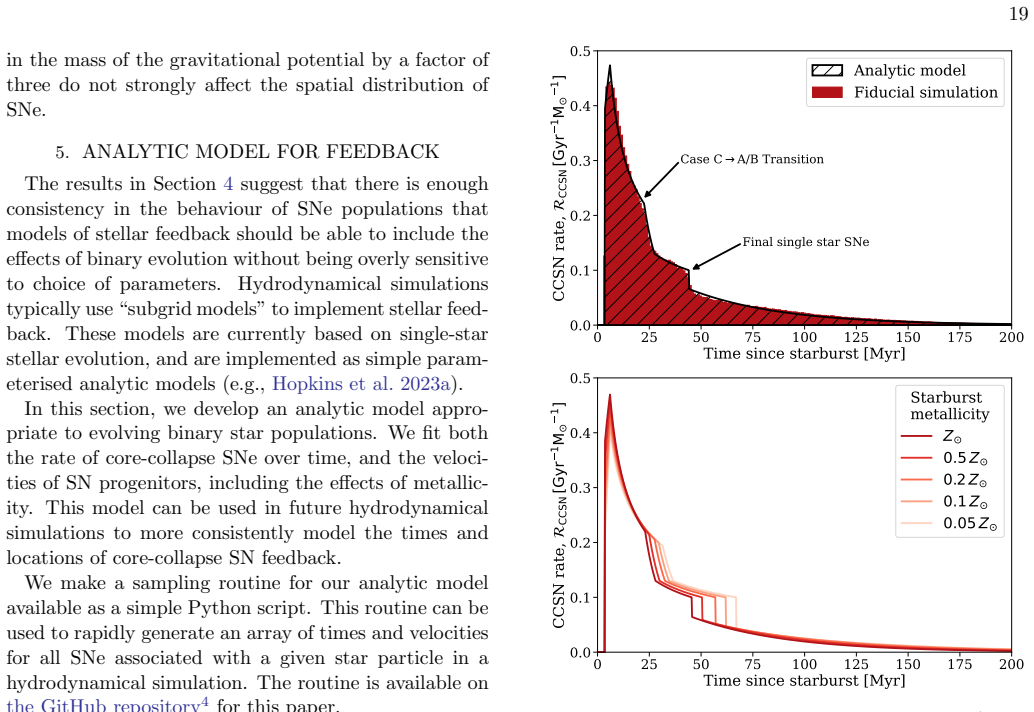
The central machine is cogsworth, the paper's population-synthesis-plus-galactic-dynamics framework, which replaces young star particles in a hydrodynamical dwarf-galaxy simulation with clusters of binary stars, evolves each binary with the COSMIC rapid population-synthesis code, and simultaneously integrates every star's galactic orbit through a potential fitted to the simulated galaxy, so that the time and position of each core-collapse supernova are recorded self-consistently. The argument runs on three binary mechanisms: mass transfer, which lengthens the donor's nuclear timescale and delays its explosion; stellar mergers, which combine two stars below the single-star core-collapse threshold into one star that explodes later, producing the long tail; and binary disruption at the first supernova, which launches the surviving secondary as a runaway at roughly its orbital velocity. The analytic deliverable is a metallicity-dependent piecewise power-law supernova rate with an exponential tail, paired with a four-component mixture model for progenitor ejection velocities that distinguishes unejected stars and ejections after no mass transfer, case A, case B/C, or common-envelope evolution.
What would settle it
Measure the internal velocity dispersions of young embedded clusters near $10^4\,M_\odot$: if reliable measurements cluster near 0.5 km/s rather than 1.7 km/s, the displacement fraction drops toward 5%, while values near 5 km/s would push it to 45%, settling whether the 13% headline holds. Independently, count core-collapse supernovae in regions of galaxies that lack young massive stars: the model predicts roughly a quarter of all core-collapse explosions occur more than 44 Myr after the birth burst, so an observed late fraction well below a quarter would rule out the timing tail's size.
Extended reading notes
Core claim
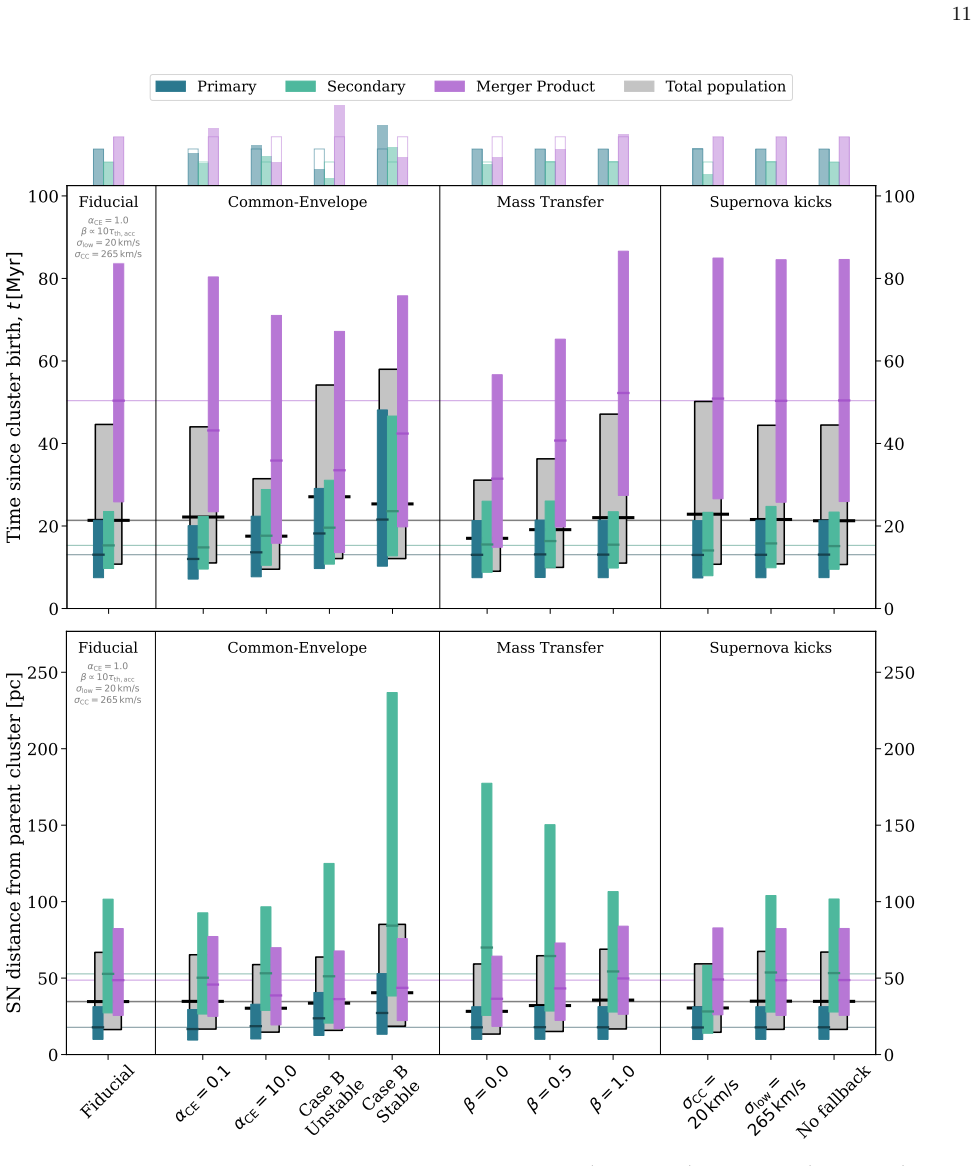
On its own terms, the central discovery is that binary interactions reshape the joint time-distance distribution of core-collapse supernovae in a way that single-star prescriptions cannot capture. In the fiducial simulation, the median supernova occurs 22 Myr after a star-formation event and 35 pc from its parent cluster, compared with 17 Myr and 23 pc for an equivalent single-star population, and binaries produce about 11% more supernovae overall because mergers and accretion let stars below the single-star core-collapse threshold still explode. The two headline features are a long late tail, with 25% of supernovae exploding after the 44 Myr at which the last single star explodes, almost all of them merger products, and a long-distance tail, with 13% of supernovae more than 100 pc from their cluster, dominated by secondary stars ejected at their orbital velocity when the primary exploded. The paper further claims these distributions are surprisingly stable across wide variations in binary physics, initial conditions, and host galaxy, with medians typically moving by less than 15%, while both tails strengthen at low metallicity, reaching about 34% late and 21% beyond 100 pc at one-tenth solar metallicity. It concludes that this stability justifies an analytic fit, and presents one along with a sampling routine for use in hydrodynamical simulations.
Load-bearing premise
The load-bearing premise is the assumed initial velocity dispersion of young stellar clusters, set to 1.7 km/s in the fiducial model with no strong observational constraint; the fraction of supernovae beyond 100 pc swings from about 5% at 0.5 km/s to about 45% at 5 km/s, so the paper's 13% displacement headline rides on this one unconstrained input.
Editorial extensions
If this is right
- Simulations that keep single-star supernova prescriptions omit roughly a quarter of core-collapse explosions and place about 13% of the feedback energy more than 100 pc away from where the simple model puts it, so adopting binary-aware feedback should change the predicted efficiency of star formation regulation and outflow driving.
- The paper's analytic fits reproduce the simulated timing distribution to within 0.5% and the ejection-velocity distribution to within a few percent, so they can be installed into existing hydrodynamical codes at negligible computational cost.
- Because both the late and the distant tails grow at low metallicity (roughly 34% late and 21% beyond 100 pc at $Z = 0.1\,Z_\odot$), the error in single-star prescriptions is largest in exactly the regime occupied by high-redshift galaxies.
- A longer, smoother energy-release history turns supernova feedback from an impulsive burst into a gradual push, which the paper argues could reduce the burstiness of star formation and change how the interstellar medium responds to successive explosions.
- In dwarf galaxies with effective radii below about a kiloparsec, the displaced supernovae traverse a substantial fraction of the galaxy, so binary-driven feedback automatically becomes a galaxy-wide process and a plausible contributor to dwarf outflows.
Reading between the lines
- A testable observational corollary: surveys of nearby core-collapse supernovae should find a population of 'orphan' explosions with no young massive stars nearby, and those orphans should be systematically old; the paper's joint time-distance distribution predicts exactly this correlation and could be read off existing supernova remnant catalogs.
- Because the displacement numbers follow from the cluster velocity dispersion, the portability of the analytic model hinges on matching its velocity-dispersion input to each simulation's own cluster dissolution treatment, and the paper's choice of fitting velocities rather than distances is what makes such matching possible.
- The same population-synthesis physics that generates the delayed merger-product tail also sets the merger rates of compact-object binaries, so the predicted roughly 25% late-supernova fraction is a consistency check for gravitational-wave progenitor models built on the same binary physics.
- The paper implies a redshift-dependent feedback geometry: in compact, low-metallicity high-redshift galaxies the energy is deposited later and farther from dense gas, so simulations adopting the low-metallicity fits should see systematically different gas retention and star-formation histories than those using solar-metallicity single-star prescriptions.
Signed reviews
Editorial analysis
A structured set of objections, weighed in public.
Referee Report
Summary. The paper uses the cogsworth population-synthesis and orbital-integration framework to replace the star particles formed in the past 150 Myr of the FIRE-2 m11h dwarf galaxy simulation with clusters of binary stars, evolving them with COSMIC and integrating their orbits in a gala potential fitted to the hydrodynamical simulation. It records the time and position of every core-collapse supernova relative to the parent cluster, for a fiducial binary model and for a broad set of variations of initial conditions, binary physics, metallicity, cluster dissolution assumptions, and galaxy potential. The central results are that binary interactions produce a long tail of delayed SNe (about 25% after the 44 Myr single-star cutoff, predominantly merger products) and displaced SNe (about 13% beyond 100 pc, predominantly ejected secondaries), and that these distributions are robust in their qualitative form across most variations. The paper also presents a metallicity-dependent analytic model for the SN rate and progenitor velocity distribution, intended as a subgrid replacement for single-star feedback prescriptions.
Significance. If the results hold, the paper provides the most complete joint time-distance distribution of core-collapse SN feedback from binaries in a realistic galactic potential to date, and a practical analytic prescription that can be incorporated into hydrodynamical simulations. The forward-modeling pipeline is clearly specified, and the code and simulation data are released on GitHub and Zenodo, which makes the experiment reproducible. The extensive parameter study, including extreme variations in common-envelope efficiency, mass-transfer stability, kicks, IMF, orbital period, mass ratio, metallicity, velocity dispersion, and galaxy code, is a genuine strength, as are the quantitative comparisons to De Donder & Vanbeveren (2003), Zapartas et al. (2017), Eldridge et al. (2011), and Renzo et al. (2019). The qualitative existence of delayed and displaced SNe is robust; less robust is the specific 13% displacement fraction, as discussed in the major comments.
major comments (4)
- [Section 4.6.1 / Table C1] The abstract and Section 3.2 quote about 13% of SNe beyond 100 pc as a headline result. Section 4.6.1 states that there are currently no strong observational constraints on the initial cluster velocity dispersion, and Table C1 shows that fD>100pc changes from 5.1% (vdisp = 0.5 km/s) to 45.3% (vdisp = 5 km/s). Since the unejected-component velocity distribution in Eq. (6) is set by vdisp, the quantitative displacement claim is a one-point draw from a largely unconstrained parameter rather than a robust prediction. I recommend presenting the displacement result as a conditional range and explicitly labeling the fiducial 13% as such throughout the abstract, Section 6, and the conclusions.
- [Section 6.2.2] The statement that "in all of our models, at least 12-15% of all SNe occur more than 0.1 kpc from the centre of the clustered star formation" is contradicted by the vdisp = 0.5 km/s variation in Table C1, for which fD>100pc = 5.1%. This overstatement appears in the discussion that motivates galaxy-evolution implications and should be corrected, along with the related framing in Section 6.1.2 that the low velocity dispersion is the only case below 10%.
- [Section 5.1 / Figures 9-10] The analytic model in Section 5 is calibrated with the fiducial simulation and the same metallicity variations used for the comparisons; the reported 0.5% and 1% agreements are therefore in-sample fit qualities, not validation against independent data. The adequacy of the model as a subgrid replacement for hydrodynamical simulations would be much better supported by a holdout test, for example fitting on m11h and predicting the ChaNGa r442 run, or leaving out one metallicity variation and predicting it. If the authors instead intend the numbers as fit residuals, that should be stated explicitly.
- [Section 6.1.2 / Figure 13] The claim that the distributions are "surprisingly insensitive" is based mainly on medians, but the tails that are most relevant for feedback vary substantially across Table C1: fD>100pc ranges from 5.1% to 45.3%, fD>500pc from 0.0% to 3.1%, and ft>44Myr from 12.3% to 34.6%. The robustness summary should explicitly separate median stability from tail sensitivity, and the abstract's phrase "surprisingly insensitive to most of these variations" should be qualified accordingly.
minor comments (5)
- [Abstract / Section 8] The >100 pc fraction is given as about 13% in the abstract and about 14% in conclusion item 2, while Table C1 lists 13.2% for the fiducial model; please standardize the quoted value.
- [Equation (18)] The second parameter of the beta distribution is labelled beta_B/C, but in the preceding line it is defined as beta_CE; the label should be made consistent.
- [Section 6.1.1 / Table C1] Section 6.1.1 states ft>44Myr = 0% for the single-star model, whereas the Singles row of Table C1 gives 1.3%; either round explicitly or quote the tabulated value.
- [Section 5.2] The values of feject in Eq. (5) and the mixture fractions in Eqs. (8)-(11) are presented without uncertainties or sample sizes; reporting these would help users of the analytic model gauge its precision.
- [Figure 13] The markers for ft>44Myr, fD>100pc and fD>500pc may be hard to distinguish in grayscale print; consider different marker shapes or a table callout for the key values.
Circularity Check
No significant circularity: the headline timing and displacement percentages are forward simulation outputs, and the analytic model is explicitly fitted rather than disguised as an independent prediction.
full rationale
The paper's central claims—that binary interactions delay core-collapse SNe (ft>44 Myr ≈ 25%) and displace them (fD>100 pc ≈ 13%)—are produced by cogsworth simulations that evolve binary populations and integrate their orbits in FIRE galaxy potentials. These are forward outputs of population synthesis plus orbital dynamics; they are not defined in terms of the claimed results. The single-star comparison is constructed consistently by widening binary orbits to be non-interacting, and the robustness suite varies binary physics, initial conditions, metallicity, and galaxy settings independently. The analytic model in Section 5 is transparently introduced as a fit: the text says 'We fit both the rate of core-collapse SNe over time, and the velocities of SN progenitors' and 'we outline our model for each of these distributions and assess their goodness-of-fit to our simulations.' Its quoted 0.5% and 4% agreements are therefore in-sample goodness-of-fit statistics, not independent predictions, and the paper does not use this agreement to justify the headline simulation results. The acknowledged uncertainty in the initial cluster velocity dispersion (Section 4.6.1 states 'There are currently no strong observational constraints on the appropriate value of the initial cluster velocity dispersion') is a parameter-sensitivity limitation, with Table C1 bracketing fD>100 pc between 5.1% and 45.3%; this affects robustness but is not circular because the dispersion is an input, not an output of the derivation. Self-citations to cogsworth (Wagg et al. 2025a,b) and 'Wagg et al. in prep.' support software and secondary mechanism explanations, but the load-bearing robustness claims are demonstrated by the paper's own variation runs. Overall, the derivation chain is self-contained and no circular step is present.
Assumptions & free parameters
free parameters (7)
- Cluster velocity dispersion vdisp =
1.7 km/s (fiducial)
- Cluster radius =
3 pc
- SN rate fit coefficients a_i =
[0.38+0.13[Fe/H], 0.47+0.05[Fe/H], 0.22+0.02[Fe/H], 0.13, 0.1, 0.175+0.05[Fe/H]]
- SN rate transition times t_i =
[3.5, 6, 23-6.5[Fe/H], 28-6.5[Fe/H], 45.5-16.5[Fe/H], 200] Myr
- Ejected progenitor fraction feject(t) =
0.24 for 5 <= tSN < t5; 0.1 for t5 <= tSN < 60; 0 otherwise
- Ejection velocity mixture fractions =
fnoMT = 0.14 - 0.12[Fe/H], fMT,A = 0.12 + 0.035[Fe/H], fMT,B = 0.67 + 0.12[Fe/H]
- Ejection velocity distribution shape parameters =
power-law slope -1.8+0.5*sqrt(|[Fe/H]|); Normal(22-8[Fe/H], 6-3[Fe/H]); beta shapes alpha=1.5-1.5[Fe/H]…
assumptions (5)
- domain assumption Kroupa IMF slope and Sana et al. period/eccentricity distributions for initial binaries
- domain assumption Binary fraction of 100% for massive stars
- domain assumption COSMIC/BSE rapid population synthesis prescriptions (mass transfer, common envelope, kicks)
- domain assumption All stars with non-zero ejecta mass produce a visible core-collapse SN
- ad hoc to paper Each star particle is treated as a 3 pc radius cluster with a Gaussian position spread and a velocity dispersion of 1.7 km/s
Cite this review
Pith. "Pith review of Delayed and Displaced: The Impact of Binary Interactions on Core-collapse SN Feedback." pith.science (2026). https://pith.science/paper/ISSY3KUP
@misc{pith2026250417903,
  author       = {Pith},
  title        = {Pith review of: Delayed and Displaced: The Impact of Binary Interactions on Core-collapse SN Feedback},
  year         = {2026},
  howpublished = {\url{https://pith.science/paper/ISSY3KUP}},
  note         = {Machine review of arXiv:2504.17903}
}
read the original abstract
Core-collapse supernova feedback models in hydrodynamical simulations typically assume that all stars evolve as single stars. However, the majority of massive stars are formed in binaries and multiple systems, where interactions with a companion can affect stars' subsequent evolution and kinematics. We assess the impact of binary interactions on the timing and spatial distribution of core-collapse supernovae, using `cogsworth` simulations to evolve binary star populations, and their subsequent galactic orbits, within state-of-the-art hydrodynamical zoom-in galaxy simulations. We show that binary interactions: (a) displace supernovae, with ~13% of all supernovae occurring more than 0.1 kpc from their parent cluster; and (b) produce delayed supernovae, such that ~25% of all supernovae occur after the final supernova from a single star population. Delays are largest for low-mass merger products, which can explode more than 200 Myr after a star formation event. We characterize our results as a function of: (1) initial binary population distributions, (2) binary physics parameters and evolutionary pathways, (3) birth cluster dissolution assumptions, and (4) galaxy models (which vary metallicity, star formation history, gravitational potential and simulation codes), and show that the overall timing and spatial distributions of supernovae are surprisingly insensitive to most of these variations. We provide metallicity-dependent analytic fits that can be substituted for single-star subgrid feedback prescriptions in hydrodynamical simulations, and discuss some of the possible implications for binary-driven feedback in galaxies, which may become particularly important at high redshift.
Figures


Figures from the paper (10 more)




Forward citations
Cited by 1 Pith paper
-
Stellar ejection velocities from the binary supernova scenario: A comparison across population synthesis codes
Across three population synthesis codes, secondary stars ejected by supernova disruption leave at approximately their pre-supernova orbital velocity, nearly independent of natal kick strength; a correction to the Kiel...
Reference graph
Works this paper leans on
-
[1]
Aghakhanloo, M., Murphy, J. W., Smith, N., & Hloˇ zek, R. 2017, MNRAS, 472, 591, doi: 10.1093/mnras/stx2050
-
[2]
A., Sana, H., Taylor, W., et al
Almeida, L. A., Sana, H., Taylor, W., et al. 2017, A&A, 598, A84, doi: 10.1051/0004-6361/201629844
-
[3]
Andersson, E. P., Agertz, O., & Renaud, F. 2020, MNRAS, 494, 3328, doi: 10.1093/mnras/staa889
-
[4]
P., Agertz, O., Renaud, F., & Teyssier, R
Andersson, E. P., Agertz, O., Renaud, F., & Teyssier, R. 2023, MNRAS, 521, 2196, doi: 10.1093/mnras/stad692
-
[5]
2022, MNRAS, 511, 176, doi: 10.1093/mnras/stab3776 —
Antoni, A., & Quataert, E. 2022, MNRAS, 511, 176, doi: 10.1093/mnras/stab3776 —. 2023, MNRAS, 525, 1229, doi: 10.1093/mnras/stad2328
-
[6]
Applebaum, E., Brooks, A. M., Christensen, C. R., et al. 2021, ApJ, 906, 96, doi: 10.3847/1538-4357/abcafa Astropy Collaboration, Robitaille, T. P., Tollerud, E. J., et al. 2013, A&A, 558, A33, doi: 10.1051/0004-6361/201322068 Astropy Collaboration, Price-Whelan, A. M., Sip˝ ocz, B. M., et al. 2018, AJ, 156, 123, doi: 10.3847/1538-3881/aabc4f Astropy Coll...
-
[7]
Baraffe, I., & El Eid, M. F. 1991, A&A, 245, 548
1991
-
[8]
2017, MNRAS, 465, 4795, doi: 10.1093/mnras/stw3042
Bastian, N., Cabrera-Ziri, I., Niederhofer, F., et al. 2017, MNRAS, 465, 4795, doi: 10.1093/mnras/stw3042
Show all 164 references
-
[9]
2011, Computing in Science Engineering, 13, 31, doi: 10.1109/MCSE.2010.118
Behnel, S., Bradshaw, R., Citro, C., et al. 2011, Computing in Science Engineering, 13, 31, doi: 10.1109/MCSE.2010.118
2011 doi
-
[10]
Bertoldi, F., & McKee, C. F. 1992, ApJ, 395, 140, doi: 10.1086/171638
1992 doi
-
[11]
Beyer, W. H. 1987, CRC Handbook of mathematical sciences
1987
-
[12]
1961, BAN, 15, 291
Boersma, J. 1961, BAN, 15, 291
1961
-
[13]
Boubert, D., & Evans, N. W. 2018, MNRAS, 477, 5261, doi: 10.1093/mnras/sty980
2018 doi
-
[14]
1995, A&A, 297, 483
Braun, H., & Langer, N. 1995, A&A, 297, 483
1995
-
[15]
2020, ApJ, 898, 71, doi: 10.3847/1538-4357/ab9d85
Breivik, K., Coughlin, S., Zevin, M., et al. 2020, ApJ, 898, 71, doi: 10.3847/1538-4357/ab9d85
2020 doi
- [16]
-
[17]
A., Renzo, M., Grichener, A., & Shah, N
Burt, C. A., Renzo, M., Grichener, A., & Shah, N. 2025, Research Notes of the AAS, 9, 75, doi: 10.3847/2515-5172/adc921
2025 doi
-
[18]
C., Langer, N., & Livio, M
Cantiello, M., Yoon, S. C., Langer, N., & Livio, M. 2007, A&A, 465, L29, doi: 10.1051/0004-6361:20077115
2007 doi
-
[19]
2009, ApJ, 695, 292, doi: 10.1088/0004-637X/695/1/292
Ceverino, D., & Klypin, A. 2009, ApJ, 695, 292, doi: 10.1088/0004-637X/695/1/292
2009 doi
-
[20]
S., et al
Ceverino, D., Klypin, A., Klimek, E. S., et al. 2014, MNRAS, 442, 1545, doi: 10.1093/mnras/stu956
2014 doi
-
[21]
K., Kereˇ s, D., Wetzel, A., et al
Chan, T. K., Kereˇ s, D., Wetzel, A., et al. 2018, MNRAS, 478, 906, doi: 10.1093/mnras/sty1153
2018 doi
-
[22]
Chevance, M., Kruijssen, J. M. D., Vazquez-Semadeni, E., et al. 2020, SSRv, 216, 50, doi: 10.1007/s11214-020-00674-x
2020 doi
- [23]
-
[24]
Verbunt, F. W. M. 2014, A&A, 563, A83, doi: 10.1051/0004-6361/201322714
2014 doi
-
[25]
2013, Python and HDF5 (O’Reilly)
Collette, A. 2013, Python and HDF5 (O’Reilly)
2013
-
[26]
A., et al
Collette, A., Kluyver, T., Caswell, T. A., et al. 2023, h5py/h5py: 3.8.0, 3.8.0, Zenodo, doi: 10.5281/zenodo.7560547
2023 doi
-
[27]
2025, COSMIC-PopSynth/COSMIC: v3.6.0, v3.6.0, Zenodo, doi: 10.5281/zenodo.15164778 da Costa-Luis, C., Larroque, S
Coughlin, S., Breivik, K., Zevin, M., et al. 2025, COSMIC-PopSynth/COSMIC: v3.6.0, v3.6.0, Zenodo, doi: 10.5281/zenodo.15164778 da Costa-Luis, C., Larroque, S. K., Altendorf, K., et al. 2023, tqdm: A fast, Extensible Progress Bar for Python and CLI, v4.66.1, Zenodo, doi: 10.52...
2025 doi
-
[28]
Schneider, F. R. N. 2014, ApJ, 782, 7, doi: 10.1088/0004-637X/782/1/7
2014 doi
-
[29]
1986, ApJ, 303, 39, doi: 10.1086/164050 32
Dekel, A., & Silk, J. 1986, ApJ, 303, 39, doi: 10.1086/164050 32
1986 doi
-
[30]
1980, Journal of Computational and Applied Mathematics, 6, 19, doi: https://doi.org/10.1016/0771-050X(80)90013-3
Dormand, J., & Prince, P. 1980, Journal of Computational and Applied Mathematics, 6, 19, doi: https://doi.org/10.1016/0771-050X(80)90013-3
1980 doi
-
[31]
Eggleton, P. P. 1971, MNRAS, 151, 351, doi: 10.1093/mnras/151.3.351 Ekstr¨ om, S., Georgy, C., Eggenberger, P., et al. 2012, A&A, 537, A146, doi: 10.1051/0004-6361/201117751
1971 doi
-
[32]
2018, MNRAS, 473, 1930, doi: 10.1093/mnras/stx2482
El-Badry, K., Quataert, E., Wetzel, A., et al. 2018, MNRAS, 473, 1930, doi: 10.1093/mnras/stx2482
2018 doi
-
[33]
J., Izzard, R
Eldridge, J. J., Izzard, R. G., & Tout, C. A. 2008, MNRAS, 384, 1109, doi: 10.1111/j.1365-2966.2007.12738.x
2008
-
[36]
2016, ApJ, 818, 124, doi: 10.3847/0004-637X/818/2/124
Ugliano, M. 2016, ApJ, 818, 124, doi: 10.3847/0004-637X/818/2/124
2016 doi
-
[37]
E., Sukhbold, T., & Janka, H
Ertl, T., Woosley, S. E., Sukhbold, T., & Janka, H. T. 2020, ApJ, 890, 51, doi: 10.3847/1538-4357/ab6458
2020 doi
-
[38]
L., Belczynski, K., Wiktorowicz, G., et al
Fryer, C. L., Belczynski, K., Wiktorowicz, G., et al. 2012, ApJ, 749, 91, doi: 10.1088/0004-637X/749/1/91
2012 doi
-
[39]
2016, MNRAS, 456, 3432, doi: 10.1093/mnras/stv2742
Girichidis, P., Walch, S., Naab, T., et al. 2016, MNRAS, 456, 3432, doi: 10.1093/mnras/stv2742
2016 doi
-
[40]
1994, A&A, 282, 801
Goldberg, D., & Mazeh, T. 1994, A&A, 282, 801
1994
-
[41]
2023, scipy/scipy: SciPy 1.11.2, v1.11.2, Zenodo, doi: 10.5281/zenodo.8259693 G¨ otberg, Y., de Mink, S
Gommers, R., Virtanen, P., Burovski, E., et al. 2023, scipy/scipy: SciPy 1.11.2, v1.11.2, Zenodo, doi: 10.5281/zenodo.8259693 G¨ otberg, Y., de Mink, S. E., Groh, J. H., Leitherer, C., &
2023 doi
-
[42]
2019, A&A, 629, A134, doi: 10.1051/0004-6361/201834525
Norman, C. 2019, A&A, 629, A134, doi: 10.1051/0004-6361/201834525
2019 doi
-
[43]
2021, MNRAS, 502, 4479, doi: 10.1093/mnras/stab287
Vynatheya, P. 2021, MNRAS, 502, 4479, doi: 10.1093/mnras/stab287
2021 doi
-
[44]
R., Millman, K
Harris, C. R., Millman, K. J., van der Walt, S. J., et al. 2020, Nature, 585, 357, doi: 10.1038/s41586-020-2649-2
2020 doi
-
[45]
1983, Ap&SS, 96, 37, doi: 10.1007/BF00661941
Hellings, P. 1983, Ap&SS, 96, 37, doi: 10.1007/BF00661941
1983 doi
-
[46]
Hennebelle, P., & Grudi´ c, M. Y. 2024, ARA&A, 62, 63, doi: 10.1146/annurev-astro-052622-031748
2024 doi
-
[47]
Hernquist, L., & Ostriker, J. P. 1992, ApJ, 386, 375, doi: 10.1086/171025
1992 doi
-
[48]
Hills, J. G. 1980, ApJ, 235, 986, doi: 10.1086/157703
1980 doi
-
[49]
S., & Webbink, R
Hjellming, M. S., & Webbink, R. F. 1987, ApJ, 318, 794, doi: 10.1086/165412
1987 doi
-
[50]
R., Lyne, A
Hobbs, G., Lorimer, D. R., Lyne, A. G., & Kramer, M. 2005, MNRAS, 360, 974, doi: 10.1111/j.1365-2966.2005.09087.x
2005
-
[51]
Hopkins, P. F. 2015, MNRAS, 450, 53, doi: 10.1093/mnras/stv195
2015 doi
-
[52]
F., Quataert, E., & Murray, N
Hopkins, P. F., Quataert, E., & Murray, N. 2012, MNRAS, 421, 3522, doi: 10.1111/j.1365-2966.2012.20593.x
2012
-
[53]
F., Wetzel, A., Kereˇ s, D., et al
Hopkins, P. F., Wetzel, A., Kereˇ s, D., et al. 2018a, MNRAS, 477, 1578, doi: 10.1093/mnras/sty674 —. 2018b, MNRAS, 480, 800, doi: 10.1093/mnras/sty1690 —. 2018c, MNRAS, 480, 800, doi: 10.1093/mnras/sty1690
-
[54]
F., Wetzel, A., Wheeler, C., et al
Hopkins, P. F., Wetzel, A., Wheeler, C., et al. 2023a, MNRAS, 519, 3154, doi: 10.1093/mnras/stac3489
-
[55]
F., Gurvich, A
Hopkins, P. F., Gurvich, A. B., Shen, X., et al. 2023b, MNRAS, 525, 2241, doi: 10.1093/mnras/stad1902
-
[56]
2019, MNRAS, 483, 3363, doi: 10.1093/mnras/sty3252
Hu, C.-Y. 2019, MNRAS, 483, 3363, doi: 10.1093/mnras/sty3252
2019 doi
-
[57]
Hu, C.-Y., Naab, T., Glover, S. C. O., Walch, S., & Clark, P. C. 2017, MNRAS, 471, 2151, doi: 10.1093/mnras/stx1773
2017 doi
-
[58]
Hu, C.-Y., Naab, T., Walch, S., Glover, S. C. O., & Clark, P. C. 2016, MNRAS, 458, 3528, doi: 10.1093/mnras/stw544
2016 doi
-
[59]
S., & Naab, T
Hu, C.-Y., Zhukovska, S., Somerville, R. S., & Naab, T. 2019, MNRAS, 487, 3252, doi: 10.1093/mnras/stz1481
2019 doi
-
[60]
C., Teyssier, R., et al
Hu, C.-Y., Smith, M. C., Teyssier, R., et al. 2023, ApJ, 950, 132, doi: 10.3847/1538-4357/accf9e
2023 doi
-
[61]
Hunter, J. D. 2007, Computing in Science & Engineering, 9, 90, doi: 10.1109/MCSE.2007.55
2007 doi
-
[62]
R., Pols, O
Hurley, J. R., Pols, O. R., & Tout, C. A. 2000, MNRAS, 315, 543, doi: 10.1046/j.1365-8711.2000.03426.x
2000
-
[63]
R., Tout, C
Hurley, J. R., Tout, C. A., & Pols, O. R. 2002, MNRAS, 329, 897, doi: 10.1046/j.1365-8711.2002.05038.x
2002
-
[64]
Igoshev, A. P. 2020, MNRAS, 494, 3663, doi: 10.1093/mnras/staa958
2020 doi
-
[65]
2020, Common Envelope Evolution, doi: 10.1088/2514-3433/abb6f0
Ivanova, N., Justham, S., & Ricker, P. 2020, Common Envelope Evolution, doi: 10.1088/2514-3433/abb6f0
2020 doi
-
[66]
2013, A&A Rv, 21, 59, doi: 10.1007/s00159-013-0059-2
Ivanova, N., Justham, S., Chen, X., et al. 2013, A&A Rv, 21, 59, doi: 10.1007/s00159-013-0059-2
2013 doi
-
[67]
Tout, C. A. 2006, A&A, 460, 565, doi: 10.1051/0004-6361:20066129
2006 doi
-
[68]
G., Glebbeek, E., Stancliffe, R
Izzard, R. G., Glebbeek, E., Stancliffe, R. J., & Pols, O. R. 2009, A&A, 508, 1359, doi: 10.1051/0004-6361/200912827
2009 doi
-
[69]
G., & Jermyn, A
Izzard, R. G., & Jermyn, A. S. 2023, MNRAS, 521, 35, doi: 10.1093/mnras/stac2899
2023 doi
-
[70]
G., Preece, H., Jofre, P., et al
Izzard, R. G., Preece, H., Jofre, P., et al. 2018, MNRAS, 473, 2984, doi: 10.1093/mnras/stx2355
2018 doi
-
[71]
G., Tout, C
Izzard, R. G., Tout, C. A., Karakas, A. I., & Pols, O. R. 2004, MNRAS, 350, 407, doi: 10.1111/j.1365-2966.2004.07446.x
2004
-
[72]
A., Hirschi, R., Arnett, W
Kaiser, E. A., Hirschi, R., Arnett, W. D., et al. 2020, MNRAS, 496, 1967, doi: 10.1093/mnras/staa1595
2020 doi
-
[73]
H., & Hernquist, L
Katz, N., Weinberg, D. H., & Hernquist, L. 1996, ApJS, 105, 19, doi: 10.1086/192305 33
1996 doi
- [74]
-
[75]
Kim, C.-G., & Ostriker, E. C. 2017, ApJ, 846, 133, doi: 10.3847/1538-4357/aa8599
2017 doi
-
[76]
C., Somerville, R
Kim, C.-G., Ostriker, E. C., Somerville, R. S., et al. 2020, ApJ, 900, 61, doi: 10.3847/1538-4357/aba962
2020 doi
-
[77]
2015, MNRAS, 451, 2900, doi: 10.1093/mnras/stv1211
Kimm, T., Cen, R., Devriendt, J., Dubois, Y., & Slyz, A. 2015, MNRAS, 451, 2900, doi: 10.1093/mnras/stv1211
2015 doi
-
[78]
1967, ZA, 65, 251
Kippenhahn, R., & Weigert, A. 1967, ZA, 65, 251
1967
-
[79]
2022, A&A, 662, A56, doi: 10.1051/0004-6361/202142701
Klencki, J., Istrate, A., Nelemans, G., & Pols, O. 2022, A&A, 662, A56, doi: 10.1051/0004-6361/202142701
2022 doi
-
[80]
2016, in Positioning and Power in Academic Publishing: Players, Agents and Agendas, ed
Kluyver, T., Ragan-Kelley, B., P´ erez, F., et al. 2016, in Positioning and Power in Academic Publishing: Players, Agents and Agendas, ed. F. Loizides & B. Schmidt, IOS Press, 87 – 90
2016
- [81]
-
[82]
2001, MNRAS, 322, 231, doi: 10.1046/j.1365-8711.2001.04022.x
Kroupa, P. 2001, MNRAS, 322, 231, doi: 10.1046/j.1365-8711.2001.04022.x
2001
-
[83]
2018, A&A, 612, A74, doi: 10.1051/0004-6361/201732151
Yan, Z. 2018, A&A, 612, A74, doi: 10.1051/0004-6361/201732151
2018 doi
-
[84]
R., McKee, C
Krumholz, M. R., McKee, C. F., & Bland-Hawthorn, J. 2019, ARA&A, 57, 227, doi: 10.1146/annurev-astro-091918-104430
2019 doi
-
[85]
A., Hillenbrand, L
Kuhn, M. A., Hillenbrand, L. A., Sills, A., Feigelson, E. D., & Getman, K. V. 2019, ApJ, 870, 32, doi: 10.3847/1538-4357/aaef8c
2019 doi
-
[86]
J., & Lada, E
Lada, C. J., & Lada, E. A. 2003, ARA&A, 41, 57, doi: 10.1146/annurev.astro.41.011802.094844
2003 arXiv
-
[87]
M., Renzo, M., Rau, S., & Vigna-G´ omez, A
Landri, C., Ricker, P. M., Renzo, M., Rau, S., & Vigna-G´ omez, A. 2025, ApJ, 979, 57, doi: 10.3847/1538-4357/ad9d3c
2025 doi
-
[88]
1998, A&A, 329, 551
Langer, N. 1998, A&A, 329, 551
1998
-
[89]
2021, A&A, 656, A58, doi: 10.1051/0004-6361/202140506
Laplace, E., Justham, S., Renzo, M., et al. 2021, A&A, 656, A58, doi: 10.1051/0004-6361/202140506
2021 doi
- [90]
- [91]
-
[92]
2014, ApJS, 212, 14, doi: 10.1088/0067-0049/212/1/14
Leitherer, C., Ekstr¨ om, S., Meynet, G., et al. 2014, ApJS, 212, 14, doi: 10.1088/0067-0049/212/1/14
2014 doi
-
[93]
1992, ApJ, 401, 596, doi: 10.1086/172089
Leitherer, C., Robert, C., & Drissen, L. 1992, ApJ, 401, 596, doi: 10.1086/172089
1992 doi
-
[94]
D., et al
Leitherer, C., Schaerer, D., Goldader, J. D., et al. 1999, ApJS, 123, 3, doi: 10.1086/313233
1999 doi
-
[95]
K., & Han, Z
Liu, Z.-W., R¨ opke, F. K., & Han, Z. 2023, Research in Astronomy and Astrophysics, 23, 082001, doi: 10.1088/1674-4527/acd89e
2023 doi
-
[96]
Lovegrove, E., & Woosley, S. E. 2013, ApJ, 769, 109, doi: 10.1088/0004-637X/769/2/109
2013 doi
-
[97]
2011, MNRAS, 416, 2697, doi: 10.1111/j.1365-2966.2011.19222.x
Lowing, B., Jenkins, A., Eke, V., & Frenk, C. 2011, MNRAS, 416, 2697, doi: 10.1111/j.1365-2966.2011.19222.x
2011
-
[98]
Helsel, J. W. 2009, AJ, 137, 3358, doi: 10.1088/0004-6256/137/2/3358
2009 doi
-
[99]
1975, Mem
Massevitch, A., & Yungelson, L. 1975, Mem. Soc. Astron. Italiana, 46, 217
1975
-
[100]
1992, ApJ, 401, 265, doi: 10.1086/172058
Mazeh, T., Goldberg, D., Duquennoy, A., & Mayor, M. 1992, ApJ, 401, 265, doi: 10.1086/172058
1992 doi
-
[101]
2015, Computational Astrophysics and Cosmology, 2, 1, doi: 10.1186/s40668-015-0007-9
Menon, H., Wesolowski, L., Zheng, G., et al. 2015, Computational Astrophysics and Cosmology, 2, 1, doi: 10.1186/s40668-015-0007-9
2015 doi
-
[102]
2017, ApJS, 230, 15, doi: 10.3847/1538-4365/aa6fb6
Moe, M., & Di Stefano, R. 2017, ApJS, 230, 15, doi: 10.3847/1538-4365/aa6fb6
2017 doi
-
[103]
Naab, T., & Ostriker, J. P. 2017, ARA&A, 55, 59, doi: 10.1146/annurev-astro-081913-040019
2017 doi
-
[104]
1977, PASJ, 29, 249 O’Connor, E., & Ott, C
Neo, S., Miyaji, S., Nomoto, K., & Sugimoto, D. 1977, PASJ, 29, 249 O’Connor, E., & Ott, C. D. 2011, ApJ, 730, 70, doi: 10.1088/0004-637X/730/2/70
1977 doi
- [105]
-
[106]
2016, A&A, 590, A107, doi: 10.1051/0004-6361/201628233 ¨Opik, E
Oh, S., & Kroupa, P. 2016, A&A, 590, A107, doi: 10.1051/0004-6361/201628233 ¨Opik, E. 1924, Publications of the Tartu Astrofizica Observatory, 25, 1
2016 doi
-
[107]
E., Fielding, D
Orr, M. E., Fielding, D. B., Hayward, C. C., & Burkhart, B. 2022, ApJ, 932, 88, doi: 10.3847/1538-4357/ac6c26
2022 doi
-
[108]
E., Hayward, C
Orr, M. E., Hayward, C. C., Hopkins, P. F., et al. 2018, MNRAS, 478, 3653, doi: 10.1093/mnras/sty1241
2018 doi
-
[109]
1991, ApJ, 370, 597, doi: 10.1086/169846 pandas development team, T
Paczynski, B. 1991, ApJ, 370, 597, doi: 10.1086/169846 pandas development team, T. 2023, pandas-dev/pandas: Pandas, v2.1.0, Zenodo, doi: 10.5281/zenodo.8301632
1991 doi
-
[110]
1996, ApJ, 462, 594, doi: 10.1086/177175
Parravano, A. 1996, ApJ, 462, 594, doi: 10.1086/177175
1996 doi
-
[111]
A., & Sukhbold, T
Patton, R. A., & Sukhbold, T. 2020, MNRAS, 499, 2803, doi: 10.1093/mnras/staa3029
2020 doi
-
[112]
Perez, F., & Granger, B. E. 2007, Computing in Science and Engineering, 9, 21, doi: 10.1109/MCSE.2007.53
2007 doi
-
[113]
Petrovic, J., Langer, N., & van der Hucht, K. A. 2005, A&A, 435, 1013, doi: 10.1051/0004-6361:20042368 34
2005 doi
-
[114]
Piro, A. L. 2013, ApJL, 768, L14, doi: 10.1088/2041-8205/768/1/L14
2013 doi
-
[115]
Pols, O. R. 1994, A&A, 290, 119
1994
-
[116]
Eggleton, P. P. 1998, MNRAS, 298, 525, doi: 10.1046/j.1365-8711.1998.01658.x
1998
-
[117]
R., Tout, C
Pols, O. R., Tout, C. A., Eggleton, P. P., & Han, Z. 1995, MNRAS, 274, 964, doi: 10.1093/mnras/274.3.964
1995 doi
-
[118]
S., et al
Pontzen, A., Roˇ skar, R., Stinson, G. S., et al. 2013, pynbody: Astrophysics Simulation Analysis for Python
2013
-
[119]
2023, pynbody/pynbody: Version 1.5.2, v1.5.2, Zenodo, doi: 10.5281/zenodo.10276404
Pontzen, A., Roˇ skar, R., Cadiou, C., et al. 2023, pynbody/pynbody: Version 1.5.2, v1.5.2, Zenodo, doi: 10.5281/zenodo.10276404
2023 doi
-
[120]
1991, ApJ, 370, 604, doi: 10.1086/169847 Portegies Zwart, S
Popham, R., & Narayan, R. 1991, ApJ, 370, 604, doi: 10.1086/169847 Portegies Zwart, S. F., McMillan, S. L. W., & Gieles, M. 2010, ARA&A, 48, 431, doi: 10.1146/annurev-astro-081309-130834
1991 doi
-
[121]
1967, Boletin de los Observatorios Tonantzintla y Tacubaya, 4, 86
Poveda, A., Ruiz, J., & Allen, C. 1967, Boletin de los Observatorios Tonantzintla y Tacubaya, 4, 86
1967
- [122]
-
[123]
2024, adrn/gala: v1.9.1, v1.9.1, Zenodo, doi: 10.5281/zenodo.13377376
Price-Whelan, A., Souchereau, H., Wagg, T., et al. 2024, adrn/gala: v1.9.1, v1.9.1, Zenodo, doi: 10.5281/zenodo.13377376
2024 doi
-
[124]
Price-Whelan, A. M. 2017, The Journal of Open Source Software, 2, doi: 10.21105/joss.00388
2017 doi
-
[125]
M., & Foreman-Mackey, D
Price-Whelan, A. M., & Foreman-Mackey, D. 2017, The Journal of Open Source Software, 2, doi: 10.21105/joss.00357
2017 doi
-
[126]
C., & Bland-Hawthorn, J
Quillen, A. C., & Bland-Hawthorn, J. 2008, MNRAS, 386, 2227, doi: 10.1111/j.1365-2966.2008.13193.x
2008
-
[127]
2021, ApJ, 923, 277, doi: 10.3847/1538-4357/ac29c5
Renzo, M., & G¨ otberg, Y. 2021, ApJ, 923, 277, doi: 10.3847/1538-4357/ac29c5
2021 doi
-
[128]
2023, ApJL, 942, L32, doi: 10.3847/2041-8213/aca4d3
Renzo, M., Zapartas, E., Justham, S., et al. 2023, ApJL, 942, L32, doi: 10.3847/2041-8213/aca4d3
2023 doi
-
[129]
E., et al
Renzo, M., Zapartas, E., de Mink, S. E., et al. 2019, A&A, 624, A66, doi: 10.1051/0004-6361/201833297 R¨ opke, F. K., & De Marco, O. 2023, Living Reviews in Computational Astrophysics, 9, 2, doi: 10.1007/s41115-023-00017-x
2019 doi
- [130]
-
[131]
J., & Seitenzahl, I
Ruiter, A. J., & Seitenzahl, I. R. 2025, A&A Rv, 33, 1, doi: 10.1007/s00159-024-00158-9
2025 doi
-
[132]
E., de Koter, A., et al
Sana, H., de Mink, S. E., de Koter, A., et al. 2012, Science, 337, 444, doi: 10.1126/science.1223344
2012 doi
-
[133]
B., Lacour, S., et al
Sana, H., Le Bouquin, J. B., Lacour, S., et al. 2014, ApJS, 215, 15, doi: 10.1088/0067-0049/215/1/15
2014 doi
-
[134]
E., Wetzel, A., Loebman, S., et al
Sanderson, R. E., Wetzel, A., Loebman, S., et al. 2020, ApJS, 246, 6, doi: 10.3847/1538-4365/ab5b9d
2020 doi
-
[135]
Schneider, F. R. N., Izzard, R. G., Langer, N., & de Mink, S. E. 2015, ApJ, 805, 20, doi: 10.1088/0004-637X/805/1/20
2015 doi
-
[136]
Schneider, F. R. N., Podsiadlowski, P., Langer, N., Castro, N., & Fossati, L. 2016, MNRAS, 457, 2355, doi: 10.1093/mnras/stw148
2016 doi
-
[137]
Schneider, F. R. N., Sana, H., Evans, C. J., et al. 2018a, Science, 359, 69, doi: 10.1126/science.aan0106
-
[138]
Schneider, F. R. N., Ram´ ırez-Agudelo, O. H., Tramper, F., et al. 2018b, A&A, 618, A73, doi: 10.1051/0004-6361/201833433
-
[139]
M., Agarwal, A., Barnes, J., et al
Siegel, D. M., Agarwal, A., Barnes, J., et al. 2022, ApJ, 941, 100, doi: 10.3847/1538-4357/ac8d04
2022 doi
-
[140]
C., Bryan, G
Smith, M. C., Bryan, G. L., Somerville, R. S., et al. 2021, MNRAS, 506, 3882, doi: 10.1093/mnras/stab1896
2021 doi
-
[141]
S., & Dav´ e, R
Somerville, R. S., & Dav´ e, R. 2015, ARA&A, 53, 51, doi: 10.1146/annurev-astro-082812-140951
2015 doi
-
[142]
Staritsin, E. I. 2019, Ap&SS, 364, 110, doi: 10.1007/s10509-019-3600-6
2019 doi
-
[143]
2024, The Journal of Open Source Software, 9, 7102, doi: 10.21105/joss.07102
Stegmann, J., & Antonini, F. 2024, The Journal of Open Source Software, 9, 7102, doi: 10.21105/joss.07102
2024 doi
-
[144]
C., & Burkhart, B
Hayward, C. C., & Burkhart, B. 2023, MNRAS, 526, 1408, doi: 10.1093/mnras/stad2744
2023 doi
-
[145]
Struck-Marcell, C., & Scalo, J. M. 1987, ApJS, 64, 39, doi: 10.1086/191191
1987 doi
-
[146]
Janka, H. T. 2016, ApJ, 821, 38, doi: 10.3847/0004-637X/821/1/38
2016 doi
-
[147]
Sukhbold, T., & Woosley, S. E. 2014, ApJ, 783, 10, doi: 10.1088/0004-637X/783/1/10
2014 doi
-
[148]
2016, Computational Astrophysics and Cosmology, 3, 6, doi: 10.1186/s40668-016-0019-0
Toonen, S., Hamers, A., & Portegies Zwart, S. 2016, Computational Astrophysics and Cosmology, 3, 6, doi: 10.1186/s40668-016-0019-0
2016 doi
-
[149]
A., Aarseth, S
Tout, C. A., Aarseth, S. J., Pols, O. R., & Eggleton, P. P. 1997, MNRAS, 291, 732, doi: 10.1093/mnras/291.4.732
1997 doi
-
[150]
2012, ApJ, 757, 69, doi: 10.1088/0004-637X/757/1/69
Ugliano, M., Janka, H.-T., Marek, A., & Arcones, A. 2012, ApJ, 757, 69, doi: 10.1088/0004-637X/757/1/69
2012 doi
-
[151]
2025, arXiv e-prints, arXiv:2501.18689, doi: 10.48550/arXiv.2501.18689 van den Heuvel, E
Ugolini, C., Limongi, M., Schneider, R., et al. 2025, arXiv e-prints, arXiv:2501.18689, doi: 10.48550/arXiv.2501.18689 van den Heuvel, E. P. J. 1969, AJ, 74, 1095, doi: 10.1086/110909 Van Rossum, G., & Drake, F. L. 2009, Python 3 Reference Manual (Scotts Valley, CA: CreateSpace) 35
-
[152]
1998, NewA, 3, 443, doi: 10.1016/S1384-1076(98)00020-7
Rensbergen, W., & De Loore, C. 1998, NewA, 3, 443, doi: 10.1016/S1384-1076(98)00020-7
1998 doi
-
[153]
E., et al
Virtanen, P., Gommers, R., Oliphant, T. E., et al. 2020, Nature Methods, 17, 261, doi: 10.1038/s41592-019-0686-2
2020 doi
-
[154]
2025a, The Journal of Open Source Software, 10, 7400, doi: 10.21105/joss.07400
Wagg, T., Breivik, K., Renzo, M., & Price-Whelan, A. 2025a, The Journal of Open Source Software, 10, 7400, doi: 10.21105/joss.07400
-
[155]
Wagg, T., Breivik, K., Renzo, M., & Price-Whelan, A. M. 2025b, ApJS, 276, 16, doi: 10.3847/1538-4365/ad8b1f
-
[156]
2024, TomWagg/software-citation-station: v1.2, v1.2, Zenodo, doi: 10.5281/zenodo.13225824
Wagg, T., Broekgaarden, F., & G¨ ultekin, K. 2024, TomWagg/software-citation-station: v1.2, v1.2, Zenodo, doi: 10.5281/zenodo.13225824
2024 doi
-
[157]
Wagg, T., & Broekgaarden, F. S. 2024, arXiv e-prints, arXiv:2406.04405. https://arxiv.org/abs/2406.04405
2024
-
[158]
P., et al
Wagg, T., Johnston, C., Bellinger, E. P., et al. 2024, A&A, 687, A222, doi: 10.1051/0004-6361/202449912
2024 doi
-
[159]
2015, MNRAS, 454, 238, doi: 10.1093/mnras/stv1975
Walch, S., Girichidis, P., Naab, T., et al. 2015, MNRAS, 454, 238, doi: 10.1093/mnras/stv1975
2015 doi
-
[160]
Waskom, M. L. 2021, Journal of Open Source Software, 6, 3021, doi: 10.21105/joss.03021
2021 doi
-
[161]
Webbink, R. F. 1984, ApJ, 277, 355, doi: 10.1086/161701 Wes McKinney. 2010, in Proceedings of the 9th Python in Science Conference, ed. St´ efan van der Walt & Jarrod Millman, 56 – 61, doi: 10.25080/Majora-92bf1922-00a
1984 doi
-
[162]
C., Sanderson, R
Wetzel, A., Hayward, C. C., Sanderson, R. E., et al. 2023, ApJS, 265, 44, doi: 10.3847/1538-4365/acb99a
2023 doi
-
[163]
Xiao, L., & Eldridge, J. J. 2015, MNRAS, 452, 2597, doi: 10.1093/mnras/stv1425
2015 doi
-
[164]
Xin, C., Renzo, M., & Metzger, B. D. 2022, MNRAS, 516, 5816, doi: 10.1093/mnras/stac2551
2022 doi
-
[165]
E., Izzard, R
Zapartas, E., de Mink, S. E., Izzard, R. G., et al. 2017, A&A, 601, A29, doi: 10.1051/0004-6361/201629685
2017 doi
-
[166]
2015, MNRAS, 450, 2327, doi: 10.1093/mnras/stv740 36 APPENDIX A
Zolotov, A., Dekel, A., Mandelker, N., et al. 2015, MNRAS, 450, 2327, doi: 10.1093/mnras/stv740 36 APPENDIX A. DEPENDENCE OF LATE SN FRACTION ON METALLICITY In Section 7, we highlighted that our results for the trend of the late SN fraction as a function of metallicity seem to...
2017 doi
Reviewed August 16, 2026 · model on record in the stance chip above.
Discussion (0). Continue with ORCID to comment.