REVIEW 3 major objections 6 minor 42 references
EAQGA: A Quantum-Enhanced Genetic Algorithm with Novel Entanglement-Aware Crossovers
T0 review · 3 major / 6 minor · reviewed 2026-08-16 · deepseek-v4-flash
Pith's one-line read This paper reports a quantum genetic crossover that, on 100-qubit portfolio instances, improves average fitness by 33.6% over classical GA and 37.2% over quantum-inspired GA.
desk verdict A novel and plausible crossover heuristic with clean simulator numbers, but the printed Algorithm 1 does not implement the described method and the hardware claim lacks statistics. read the letter →
The pith
A machine-rendered reading of the paper's core claim, the machinery that carries it, and where it could break.
The reading
What carries the argument
The load-bearing mechanism is the entanglement-aware crossover: a rule that converts the two fittest binary parents into circuits for the next population. For every bit pair that appears correlated across the parents (matching values or opposite values), the circuit applies a rotation and a CNOT to create an entangled state $\alpha|00\rangle+\beta|11\rangle$ or $\alpha|01\rangle+\beta|10\rangle$, with the angle set so the bit values from the best solution are measured with probability $p_a=0.95$. A selection probability $p_s \cdot df(t) \cdot |\Sigma_{i,j}^n|$ decides which detected pairs actually become entangled, using the normalized covariance matrix to favor pairs consistent with the objective; a decay factor $df(t) = 0.5 + t/(2T_{\max})$ relaxes this consistency penalty over the run. Shared qubits are chained so the number of CNOTs stays below the qubit count, which is why the circuits remain shallow enough for current hardware.
What would settle it
Re-run the 100-asset comparison on at least ten independently drawn stock subsets with thirty or more repetitions per subset, and report the mean difference and its standard error; if the average advantage of EAQGA over GA and AQGA is not positive across subsets, the paper's central quantitative claim is refuted.
Extended reading notes
Core claim
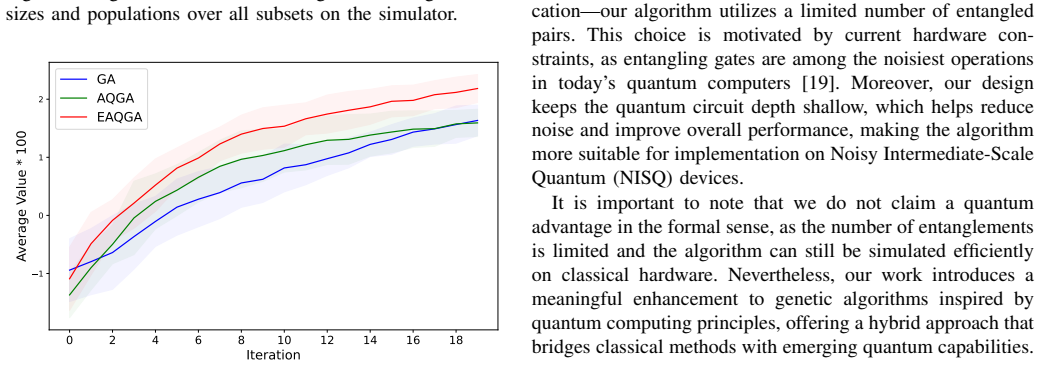
The central claim is that a genetic algorithm's crossover can be made entanglement-aware: each generation, the two best solutions identify bit pairs whose values match or oppose across both parents, and a probabilistic selection step, guided by the normalized coupling matrix of the objective, chooses which of those pairs to entangle. Each chosen pair is realized in the next circuit by one rotation gate and one CNOT (plus an X gate for opposing pairs), producing a two-qubit state biased toward the elite values, while unpaired qubits receive rotations that nudge them toward the best solution's bits. The authors report that on ten 30-asset and ten 40-asset portfolio subsets, EAQGA achieves the highest average fitness and lowest standard deviation for both population sizes 10 and 20, and that on a 100-asset instance executed on a real 127-qubit device, EAQGA's average fitness after 20 iterations is 33.6% higher than classical GA's and 37.2% higher than AQGA's. They explicitly disclaim a formal quantum advantage because the entanglement count is limited and the circuits remain efficiently simulable classically.
Load-bearing premise
The 33.6% and 37.2% hardware margins assume that ten repetitions on a single randomly selected 100-stock subset are enough to estimate each algorithm's average fitness reliably; without standard deviations or statistical tests, those margins could come from that particular subset and device noise.
Editorial extensions
If this is right
- Iteration for iteration, EAQGA reaches higher fitness than GA and AQGA at equal population size, which reduces the number of fitness evaluations needed to reach a given solution quality.
- Because the crossover is defined for any binary objective through its coupling matrix, the same circuit construction applies to other combinatorial problems such as knapsack, MaxCut, or quadratic assignment.
- The shallow depth and limited two-qubit gate count make the algorithm executable on current noisy devices, where alternative full-entanglement QGAs require fault-tolerant hardware.
- The consistently lower standard deviations imply the algorithm's outputs are more reproducible across runs, a property that matters for practical deployment.
Reading between the lines
- The crossover learns only pairwise correlations, so its advantage over classical crossover should shrink on problems whose optimal solutions are governed by higher-order interactions; this could be tested directly on QUBOs with 3-body penalty terms.
- The decay factor in the pair-selection probability is effectively an annealing schedule that trades objective-guided against empirically-guided pair selection; trying other schedules (cosine, step, or adaptive) is a natural experiment the paper leaves open.
- The hardware result rests on a single 100-asset subset repeated ten times; averaging the same comparison over several independently drawn 100-asset subsets would show whether the 33.6% and 37.2% margins are a property of the algorithm or of that one covariance matrix.
Signed reviews
Editorial analysis
A structured set of objections, weighed in public.
Referee Report
Summary. The paper proposes EAQGA, a quantum-enhanced genetic algorithm for combinatorial optimization, and evaluates it on a portfolio-optimization QUBO formulation. The method maintains an elitism pool of the two best binary solutions, detects positively or negatively correlated bit pairs across the parents, encodes selected pairs as entangled states (\psi_p or \psi_n) using RY and CNOT gates, and biases non-entangled qubits toward the best solution's bit values. Experiments are reported on simulators for 10 subsets of size 30 and 10 subsets of size 40 with population sizes 10 and 20 and 100 runs each, and on the ibm_quebec 127-qubit processor for a single 100-stock subset with population 10 and 10 runs. The authors report average fitness improvements of 33.6% over GA and 37.2% over AQGA on the hardware experiment, while explicitly disclaiming a formal quantum advantage.
Significance. If the algorithm had been correctly and completely specified, the paper would offer a useful NISQ-oriented quantum crossover that keeps circuit depth low by limiting entanglements. The simulator study is extensive in its own terms: 20 subsets, two population sizes, and 100 runs per configuration, with tabulated averages and standard deviations, and the authors are appropriately cautious in not claiming formal quantum speedup. However, the contribution is defined by the crossover mechanism, and the manuscript's own pseudocode does not implement the described mechanism. Because the central algorithmic description is internally inconsistent, the empirical results cannot currently be attributed to the claimed method, and the hardware comparison rests on a single subset without uncertainty quantification. The strengths of the empirical study do not compensate for the load-bearing algorithmic mismatch.
major comments (3)
- [Section III-B and Algorithm 1] Algorithm 1 (lines 20-30) does not implement the entanglement-aware crossover described in Section III-B. The prose defines P/N correlations from the joint pattern of both parent bitstrings, but the pseudocode branches only on xb1[n1]: if xb1[n1] == 0 it builds the |\psi_p> circuit, otherwise the |\psi_n> circuit. For the example in Fig. 2, pair (1,2) is negatively correlated across both parents, yet with xb1[1] = 0 Algorithm 1 would apply the positive-correlation circuit. The else branch also contains an incorrect rotation formula: line 37 sets θ = 1 - 2*arccos(sqrt(Pa)) when the desired bit value is 1, whereas Section III-B correctly gives θ = 2*arccos(sqrt(1 - Pa)). These are not typographical details; the printed algorithm cannot generate the circuits that the text and figures describe, so the reported simulator and hardware results cannot be verified as coming from the proposed crossover.
- [Algorithm 1 and Section III-B] The probabilistic pair-selection and chain-formation steps are not specified in the pseudocode. Algorithm 1's line 18 says only "Select the entangled qubits using Pool elitism, Ps, and Q", but the manuscript does not define how ps and the decay factor df(t) are used to sample from the candidate sets P and N, how pairs sharing a qubit are merged into chains, or how the control/target assignment within a chain is determined. Without an unambiguous description of these steps, the method is not reproducible even if the P/N branching bug in the previous comment were corrected.
- [Section IV-D2 and Fig. 6] The hardware experiment uses one randomly selected subset of 100 stocks and only 10 repetitions, and Fig. 6 reports average fitness without standard deviations, confidence intervals, or any statistical test. The abstract's headline improvements of 33.6% over GA and 37.2% over AQGA are therefore not supported as stable statements about the algorithms; they may reflect the particular subset, the particular 10 runs, or hardware noise. Additional subsets or at least per-iteration variability and a statistical comparison are needed before these margins can be taken as evidence of a consistent advantage.
minor comments (6)
- [Algorithm 1] Line 31 contains a typo, "for for n = 1 to S", and the variable name is inconsistent: line 16 initializes a circuit with n qubits while line 31 uses S; the relationship between n and S should be clarified.
- [Throughout] The amplitude probability hyperparameter is written inconsistently as pa in the text and Pa in Algorithm 1; this should be unified.
- [Reference [38]] The reference to Yahoo Finance misspells "Finance" as "Fianance", and the URL is incomplete for a formal reference.
- [Section IV-A] The Bayesian optimization used for hyperparameter tuning is described only as performed on a randomly selected subset; the search space, evaluation budget, and resulting hyperparameter values for GA, AQGA, and EAQGA are not reported, which makes it hard to assess whether the comparisons are demonstrably fair.
- [Section IV-D2] Figure 6 would benefit from error bars or shaded confidence bands; without them, the eye cannot distinguish systematic advantage from run-to-run variation.
- [General] The manuscript does not state whether code or data are available; given that the paper's contribution is an algorithmic procedure, providing either the implementation or a precise, corrected pseudocode is essential for reproducibility.
Circularity Check
No significant circularity: EAQGA's reported fitness values are genuine measurements, and the heuristic use of the covariance matrix does not make the derivation self-referential.
full rationale
The paper's derivation chain is not circular. The EAQGA crossover uses covariance-based selection probabilities to choose which measured parent bit-pair correlations to encode, and the objective function (Eq. 3) is used only to evaluate measured bitstrings; no parameter is fitted to the target optimum and then renamed a prediction. The reported simulator and ibm_quebec fitness values are actual measurement outcomes, not restatements of the QUBO inputs. The only self-citation is reference [33], used to note an analogy between Hadamard initialization and the initial Hamiltonian in quantum annealing; that citation is incidental and not load-bearing. No uniqueness theorem, no ansatz smuggled via self-citation, and no known result merely renamed are present. The substantive concern raised by a close reading is that Algorithm 1 does not appear to implement the entanglement-aware crossover described in Section III-B (e.g., the branch depends only on xb1[n1] rather than on the joint P/N pattern, and the angle formula for a desired bit value of 1 is inconsistent with the text). That is a correctness and reproducibility risk, not circularity, because even if the pseudocode were wrong, the experimental claims could in principle be independently verified against the actual implementation. Accordingly, the circularity score is 0.
Assumptions & free parameters
free parameters (2)
- pa (amplitude probability) =
0.95
- ps (pair selection probability) =
0.6
assumptions (5)
- standard math Standard gate identities: an RY rotation followed by a CNOT produces the two-qubit states |ψp> and |ψn> shown in Fig. 3.
- domain assumption Equation (3) with historical mean returns and covariance is an adequate objective for portfolio selection.
- domain assumption The MPS simulator and ibm_quebec hardware produce measurement distributions close enough to the ideal circuits to support the fitness comparisons.
- ad hoc to paper The heuristic of weighting pair selection by the normalized covariance sign improves search.
- domain assumption The randomly chosen S&P 500 subsets are representative of the optimization problem.
Cite this review
Pith. "Pith review of EAQGA: A Quantum-Enhanced Genetic Algorithm with Novel Entanglement-Aware Crossovers." pith.science (2026). https://pith.science/paper/YFP3BIBU
@misc{pith2026250417923,
  author       = {Pith},
  title        = {Pith review of: EAQGA: A Quantum-Enhanced Genetic Algorithm with Novel Entanglement-Aware Crossovers},
  year         = {2026},
  howpublished = {\url{https://pith.science/paper/YFP3BIBU}},
  note         = {Machine review of arXiv:2504.17923}
}
read the original abstract
Genetic algorithms are highly effective optimization techniques for many computationally challenging problems, including combinatorial optimization tasks like portfolio optimization. Quantum computing has also shown potential in addressing these complex challenges. Combining these approaches, quantum genetic algorithms leverage the principles of superposition and entanglement to enhance the performance of classical genetic algorithms. In this work, we propose a novel quantum genetic algorithm introducing an innovative crossover strategy to generate quantum circuits from a binary solution. We incorporate a heuristic method to encode entanglement patterns from parent solutions into circuits for the next generation. Our algorithm advances quantum genetic algorithms by utilizing a limited number of entanglements, enabling efficient exploration of optimal solutions without significantly increasing circuit depth, making it suitable for near-term applications. We test this approach on a portfolio optimization problem using an IBM 127 qubits Eagle processor (ibm_quebec) and simulators. Compared to state-of-the-art algorithms, our results show that the proposed method improves fitness values by 33.6% over classical genetic algorithm and 37.2% over quantum-inspired genetic algorithm, using the same iteration counts and population sizes with real quantum hardware employing 100 qubits. These findings highlight the potential of current quantum computers to address real-world utility-scale combinatorial optimization problems.
Figures


Figures from the paper (2 more)

Reference graph
Works this paper leans on
-
[1]
L. A. Wolsey and G. L. Nemhauser, Integer and combinatorial opti- mization. John Wiley & Sons, 2014
work page 2014
-
[2]
J. Hromkovi ˇc, Algorithmics for hard problems: introduction to com- binatorial optimization, randomization, approximation, and heuristics . Springer Science & Business Media, 2013
work page 2013
-
[3]
Comparison among five evolutionary-based optimization algorithms,
E. Elbeltagi, T. Hegazy, and D. Grierson, “Comparison among five evolutionary-based optimization algorithms,” Advanced engineering in- formatics, vol. 19, no. 1, pp. 43–53, 2005
work page 2005
-
[4]
Bub, Quantum computation: Where does the speed-up come from? , p
J. Bub, Quantum computation: Where does the speed-up come from? , p. 231–246. Cambridge University Press, 2010
work page 2010
-
[5]
A quantum approximate optimization algorithm,
E. Farhi, J. Goldstone, and S. Gutmann, “A quantum approximate optimization algorithm,” arXiv preprint arXiv:1411.4028 , 2014
arXiv 2014
-
[6]
A. E. Eiben and J. E. Smith, Introduction to evolutionary computing . Springer, 2015
2015
-
[7]
Evolu- tionary machine learning: A survey,
A. Telikani, A. Tahmassebi, W. Banzhaf, and A. H. Gandomi, “Evolu- tionary machine learning: A survey,” ACM Computing Surveys (CSUR) , vol. 54, no. 8, pp. 1–35, 2021
work page 2021
-
[8]
M. A. Nielsen and I. L. Chuang, Quantum computation and quantum information. Cambridge university press, 2010
2010
Show all 42 references
-
[9]
Quantum genetic algorithms for computer scientists,
R. Lahoz-Beltra, “Quantum genetic algorithms for computer scientists,” Computers, vol. 5, no. 4, p. 24, 2016
2016
-
[10]
The improvement of quantum genetic algorithm and its application on function optimization,
H. Wang, J. Liu, J. Zhi, and C. Fu, “The improvement of quantum genetic algorithm and its application on function optimization,” Mathe- matical problems in engineering , vol. 2013, no. 1, p. 730749, 2013
2013
-
[11]
Hybrid quantum genetic algorithm with adaptive rotation angle for the 0-1 knapsack problem in the ibm qiskit simulator,
E. Ballinas and O. Montiel, “Hybrid quantum genetic algorithm with adaptive rotation angle for the 0-1 knapsack problem in the ibm qiskit simulator,” Soft Computing, vol. 27, no. 18, pp. 13321–13346, 2023
2023
-
[12]
Quantum rotation gate in quantum-inspired evolutionary algorithm: A review, analysis and comparison study,
H. Xiong, Z. Wu, H. Fan, G. Li, and G. Jiang, “Quantum rotation gate in quantum-inspired evolutionary algorithm: A review, analysis and comparison study,” Swarm and Evolutionary Computation , vol. 42, pp. 43–57, 2018
2018
-
[13]
Quantum-inspired evolutionary algorithms on ibm quantum experience.,
Y . Rubio, C. Olvera, and O. Montiel, “Quantum-inspired evolutionary algorithms on ibm quantum experience.,” Engineering Letters, vol. 29, no. 4, 2021
2021
-
[14]
Implementing quantum ge- netic algorithms: a solution based on grover’s algorithm,
M. Udrescu, L. Prodan, and M. Vl ˘adut ¸iu, “Implementing quantum ge- netic algorithms: a solution based on grover’s algorithm,” inProceedings of the 3rd Conference on Computing Frontiers , pp. 71–82, 2006
2006
-
[15]
Using quantum ampli- tude amplification in genetic algorithms,
G. Acampora, R. Schiattarella, and A. Vitiello, “Using quantum ampli- tude amplification in genetic algorithms,” Expert Systems with Applica- tions, vol. 209, p. 118203, 2022
2022
-
[16]
Quantum computing in the nisq era and beyond,
J. Preskill, “Quantum computing in the nisq era and beyond,” Quantum, vol. 2, p. 79, 2018
2018
-
[17]
Dynamic adaptive quantum approximate optimization algorithm for shallow, noise-resilient circuits,
N. Yanakiev, N. Mertig, C. K. Long, and D. R. Arvidsson-Shukur, “Dynamic adaptive quantum approximate optimization algorithm for shallow, noise-resilient circuits,” Physical Review A , vol. 109, no. 3, p. 032420, 2024
2024
-
[18]
Noise-resilient and reduced depth approximate adders for nisq quantum computing,
B. Gaur, T. Humble, and H. Thapliyal, “Noise-resilient and reduced depth approximate adders for nisq quantum computing,” in Proceedings of the Great Lakes Symposium on VLSI 2023 , pp. 427–431, 2023
2023
-
[19]
Quantum circuit engineering for correcting coherent noise,
M. Ahsan, S. A. Z. Naqvi, and H. Anwer, “Quantum circuit engineering for correcting coherent noise,” Physical Review A , vol. 105, no. 2, p. 022428, 2022
2022
-
[20]
Efficient classical simulation of slightly entangled quantum computations,
G. Vidal, “Efficient classical simulation of slightly entangled quantum computations,” Physical review letters, vol. 91, no. 14, p. 147902, 2003
2003
-
[21]
Genetic algorithms,
J. H. Holland, “Genetic algorithms,” Scientific american, vol. 267, no. 1, pp. 66–73, 1992
1992
-
[22]
Genetic algorithm performance with different selection strategies in solving tsp,
N. M. Razali, J. Geraghty, et al., “Genetic algorithm performance with different selection strategies in solving tsp,” in Proceedings of the world congress on engineering , vol. 2, pp. 1–6, International Association of Engineers Hong Kong, China, 2011
2011
-
[23]
Genetic quantum algorithm and its applica- tion to combinatorial optimization problem,
K.-H. Han and J.-H. Kim, “Genetic quantum algorithm and its applica- tion to combinatorial optimization problem,” in Proceedings of the 2000 congress on evolutionary computation. CEC00 (Cat. No. 00TH8512) , vol. 2, pp. 1354–1360, IEEE, 2000
2000
-
[24]
Quantum-inspired acromyrmex evolutionary algorithm,
O. Montiel, Y . Rubio, C. Olvera, and A. Rivera, “Quantum-inspired acromyrmex evolutionary algorithm,” Scientific reports , vol. 9, no. 1, p. 12181, 2019
2019
-
[25]
Implementation of efficient quantum search algorithms on nisq computers,
K. Zhang, P. Rao, K. Yu, H. Lim, and V . Korepin, “Implementation of efficient quantum search algorithms on nisq computers,” Quantum Information Processing, vol. 20, pp. 1–27, 2021
2021
-
[26]
Best practices for portfolio optimization by quantum computing, ex- perimented on real quantum devices,
G. Buonaiuto, F. Gargiulo, G. De Pietro, M. Esposito, and M. Pota, “Best practices for portfolio optimization by quantum computing, ex- perimented on real quantum devices,” Scientific Reports, vol. 13, no. 1, p. 19434, 2023
2023
-
[27]
H. M. Markowitz and G. P. Todd, Mean-variance analysis in portfolio choice and capital markets , vol. 66. John Wiley & Sons, 2000
2000
-
[28]
A brief review of portfolio optimiza- tion techniques,
A. Gunjan and S. Bhattacharyya, “A brief review of portfolio optimiza- tion techniques,” Artificial Intelligence Review, vol. 56, no. 5, pp. 3847– 3886, 2023
2023
-
[29]
Modern portfolio theory,
H. Markowitz, “Modern portfolio theory,” Journal of Finance , vol. 7, no. 11, pp. 77–91, 1952
1952
-
[30]
Linear vs. quadratic port- folio selection models with hard real-world constraints,
F. Cesarone, A. Scozzari, and F. Tardella, “Linear vs. quadratic port- folio selection models with hard real-world constraints,” Computational Management Science, vol. 12, pp. 345–370, 2015
2015
-
[31]
Meta-heuristics for portfolio optimiza- tion,
K. Erwin and A. Engelbrecht, “Meta-heuristics for portfolio optimiza- tion,” Soft Computing, vol. 27, no. 24, pp. 19045–19073, 2023
2023
-
[32]
Quantum-inspired meta-heuristic ap- proaches for a constrained portfolio optimization problem,
A. Gunjan and S. Bhattacharyya, “Quantum-inspired meta-heuristic ap- proaches for a constrained portfolio optimization problem,” Evolutionary Intelligence, pp. 1–40, 2024
2024
-
[33]
An enhanced hybrid approach using d-wave’s cqm to solve the phase unwrapping problem,
M. K. Haghighi and N. Dimopoulos, “An enhanced hybrid approach using d-wave’s cqm to solve the phase unwrapping problem,” in 2024 IEEE International Conference on Quantum Computing and Engineer- ing (QCE), vol. 01, pp. 443–449, 2024
2024
-
[34]
Qiskit primitives api documentation
I. Quantum, “Qiskit primitives api documentation.” https://docs. quantum.ibm.com/api/qiskit/primitives, 2024. Accessed: 2024-10-30
2024
-
[35]
Practical bayesian opti- mization of machine learning algorithms,
J. Snoek, H. Larochelle, and R. P. Adams, “Practical bayesian opti- mization of machine learning algorithms,” in Proceedings of the 26th International Conference on Neural Information Processing Systems - Volume 2 , NIPS’12, (Red Hook, NY , USA), p. 2951–2959, Curran Associate...
2012
-
[36]
S&P 500 Index
S&P Dow Jones Indices, “S&P 500 Index.” https://www.spglobal.com/ spdji/en/indices/equity/sp-500/#overview, 2024. Accessed: 2025-01-13
2024
-
[37]
Loading and Processing Stock-Market Time-Series Data
IBM, “Loading and Processing Stock-Market Time-Series Data.” https://qiskit-community.github.io/qiskit-finance/tutorials/11 time series.html#Loading-and-Processing-Stock-Market-Time-Series-Data,
-
[38]
Yahoo Fianance
Yahoo, “Yahoo Fianance.” https://www.yahoo.com/author/ yahoo--finance/
-
[39]
Matrix Product State Simulation Method
IBM, “Matrix Product State Simulation Method.” https://qiskit.github. io/qiskit-aer/tutorials/7 matrix product state method.html, 2024. Ac- cessed: 2024-10-30
2024
-
[40]
The density-matrix renormalization group in the age of matrix product states,
U. Schollw ¨ock, “The density-matrix renormalization group in the age of matrix product states,” Annals of physics , vol. 326, no. 1, pp. 96–192, 2011
2011
-
[41]
IBM and PINQ² unveil utility-scale quantum computer in Qu ´ebec
IBM, “IBM and PINQ² unveil utility-scale quantum computer in Qu ´ebec.” https://research.ibm.com/blog/ ibm-pinq2-quantum-computer-install
-
[2024]
Accessed: 2024-10-30
2024
Reviewed August 16, 2026 · model on record in the stance chip above.
Discussion (0). Continue with ORCID to comment.